1 Introduction
‘Ternary rhythm’ refers to patterns in which stress falls rhythmically on every third syllable or mora. A paradigm case is Cayuvava (Key Reference Key1961), where stress occurs on every third syllable counting backwards from the end of the word. According to Levin (Reference Levin1988: 105), the rightmost stress is primary, as in (1a), where n indicates the number of syllables. Another classical example is Chugach Alutiiq Yupik (Leer Reference Leer1985a, b, c) in (1b). Stress falls on every second syllable and every third syllable thereafter. In 3n+1 forms (i.e. 4- and 7-syllable words) the final syllable is also stressed. Leer (Reference Leer1985a) describes all stresses as equally strong. A third example is Tripura Bangla (Das Reference Das2001) in (1c), where stress falls on every third syllable, except that final syllables are always unstressed. The leftmost stress is primary.
-
(1)

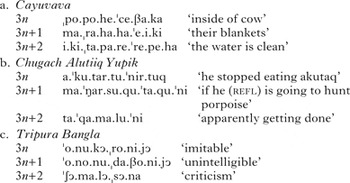
Ternary stress has been reported for a handful of other languages: Estonian (Hint Reference Hint1973), Sentani (Cowan Reference Cowan1965), Hocąk (Miner Reference Miner1979) and possibly Finnish (Carlson Reference Carlson1978). The pitch-accent patterns of a few other systems, for example Gilbertese (Blevins & Harrison Reference Blevins and Harrison1999) and Irabu Ryukyuan (Shimoji Reference Shimoji2009), have also been claimed to display similar ternary groupings.Footnote 1
The dominant analysis of ternary rhythm in metrical theory has traditionally involved binary feet and the non-parsing of a light syllable (‘weak local parsing’; Hayes Reference Hayes1995). Weak local parsing as a parsing mechanism in rule-based metrical theories was well constrained and typologically successful. However, it has been shown that more recent weak local parsing analyses couched in Optimality Theory (OT) suffer from both undergeneration (i.e. they are not able to predict all the attested ternary systems) and pathological overgeneration (Eisner Reference Eisner1997, Kager Reference Kager2001, McCarthy Reference McCarthy2003). In an attempt to develop an alternative OT account of ternary rhythm, the main goal of this article is to present an analysis of binary and ternary quantity-insensitive stress patterns that overcomes the empirical limitations of previous constraint-based analyses.
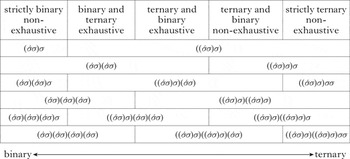
On the representational side, we will argue for the rehabilitation of internally layered ternary (ILT) feet in metrical representations (Prince Reference Prince1980, Selkirk Reference Selkirk1980). An ILT foot consists of a binary foot with a right- or left-adjoined syllable, i.e. ((σσ)Ftσ)Ft or (σ(σσ)Ft)Ft. Contrary to the originally dominant belief that the unique raison d’être of ternary feet is their ability to model ternary rhythm, a number of recent works in metrical phonology have provided cross-linguistic segmental and tonal evidence in support of the incorporation of ILT feet in prosodic representations (Davis Reference Davis1999, Reference Davis, Downing, Hall and Raffelsiefen2005, Jensen Reference Jensen2000, Davis & Cho Reference Davis and Cho2003, Yu Reference Yu2004, Bennett Reference Bennett2012, Reference Bennett2013, Martínez-Paricio Reference Martínez-Paricio2012, Reference Martínez-Paricio2013, Buckley Reference Buckley, Kingston, Moore-Cantwell, Pater and Staubs2014). Importantly, some of these studies have shown that ILT feet can also be active in languages with binary rhythm, hence an ILT foot should no longer be regarded as a ternary-specific ad hoc device exclusively required to account for ternary stress distributions. On this point, we will argue that the strict typological subdivision between binary and ternary rhythmic systems should be relaxed in favour of the introduction of the notion of a rhythmic continuum. More specifically, we will propose that there is no absolute boundary between binary and ternary systems; rather, a typological rhythmic continuum emerges, in which systems differ in the number and type of binary and ternary feet they allow, as shown in Table I.
The binary-to-ternary rhythmic continuum.

At one end of this continuum, we find systems with strictly binary feet (Pintupi, Warao), and at the other end systems with only ternary feet (Cayuvava, Gilbertese). In between, we find mixed systems, in which binary and ternary feet coexist in three different ways. In binary and ternary exhaustive systems (Garawa, Wargamay), feet are preferably binary, but a single ternary foot emerges to avoid underparsing. In ternary and binary exhaustive systems (Chugach, Estonian), feet are preferably ternary, while (one or two) binary feet emerge whenever needed to avoid underparsing. In ternary and binary non-exhaustive systems (Tripura Bangla, Hocąk), feet are preferably ternary, but one binary foot is allowed to avoid double underparsing. Note that in order to improve comparisons between systems, Table I exemplifies only ((σ́σ)σ) ‘dactylic’ systems with directionality oriented toward the left edge; however, systems with different types of ILT feet and different directionalities will also be shown to fall into the continuum.
Our OT analysis of quantity-insensitive binary and ternary stress will use only a small set of categorical alignment constraints of the ‘non-intervention’ format (McCarthy Reference McCarthy2003). We will demonstrate that our constraint set generates the full typology of binary and ternary quantity-insensitive stress systems, while avoiding undergeneration and pathological overgeneration. We will do so by means of a computer-generated factorial typology calculated using OTSoft (Hayes et al. Reference Hayes, Tesar and Zuraw2003). Interestingly, the resulting typology will include all systems occurring on the rhythmic continuum; our constraint set thus predicts the existence of the rhythmic continuum.
The article is organised as follows. First, we present the main ingredients of our theoretical proposal (§2). Second, we analyse the factorial typology of our constraint set, exploring the binary-to-ternary continuum (§3). Next, we discuss a number of residual theoretical issues in §4, and conclude in §5.
2 Theoretical proposal: representations and constraints
This section introduces the principal components of the analysis of binary and ternary rhythm, which will be typologically motivated in §3. We first present our working hypothesis and assumptions about metrical representations (§2.1), and then discuss the format of the non-intervention alignment constraints necessary to model the rhythmic patterns of stress (§2.2).
2.1 Representations: internally layered ternary feet
In line with standard metrical theories, we assume that stress is the manifestation of a foot head (Liberman & Prince Reference Liberman and Prince1977, Selkirk Reference Selkirk1980, Halle & Vergnaud Reference Halle and Vergnaud1987, Hayes Reference Hayes1995).Footnote 2 However, rather than adopting the standard assumptions that metrical feet are maximally binary and universally dominated by the prosodic word (2a), we utilise ILT feet in metrical representations. As previously mentioned, ILT feet result from adjoining a weak syllable to a binary foot. More specifically, our working hypothesis will be that foot structure can be recursive (2b), but only minimally so: a single foot layer can be stacked on top of a ‘minimal’ foot by adjunction.
-
(2)
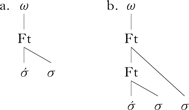
Foot recursion involves a departure from the traditional assumption that feet must be exclusively dominated by the prosodic word (ω). However, the idea that a metrical foot might undergo minimal recursion, giving rise to a layered trisyllabic foot (2b), is not new in phonological theory. It was originally proposed by Selkirk (Reference Selkirk1980) and Prince (Reference Prince1980) in their early work on English and Estonian foot structure. Additionally, ILT feet, or fairly similar structures, have been posited in other studies (e.g. Dresher & Lahiri Reference Dresher and Lahiri1991, Rice Reference Rice1992, Kager Reference Kager1994). Such proposals have not met with the same amount of approval as standard metrical theories, but ILT feet have recently experienced a modest revival: they have been invoked for a variety of languages, many of which do not display ternary rhythm (see the references in §1, as well as Caballero Reference Caballero2008 and Kager Reference Kager2012). These studies have shown that minimally recursive feet are supported on empirical grounds that go well beyond the explanation of ternary stress. On the one hand, it has been demonstrated that some phonological processes need to differentiate between two types of foot heads: those that are dominated by one foot projection (cf. (2a)) and those that are dominated by two foot projections (cf. (2b)). This has been argued to be the case in Wargamay and Yidiɲ, two Australian languages with binary stress where only syllables with a double-head status undergo a vowel-lengthening process (see Martínez-Paricio Reference Martínez-Paricio2012, Reference Martínez-Paricio2013 for details). Similarly, it has been proposed that the layered foot provides an optimal framework for capturing reported differences among weak syllables. Note that the two unstressed syllables in an ILT foot have different structures: each weak syllable is immediately dominated by a different foot projection, and hence the phonology may exploit this structural difference in phonological processes. This has been reported to be the case in Chugach, where Low tonal accents only dock onto weak syllables that occupy the adjunct position of an ILT foot. Furthermore, in some ILT configurations, one of the two weak syllables is located at the left edge of the foot, whereas the other is placed in foot-final position, e.g. ((σσ́)Ftσ)Ft, (σ(σ́σ)Ft)Ft. Since the initial position of a foot is prominent (just like the initial position of other prosodic domains), this syllable, even if weak, may be the target of strengthening effects, and behave as phonologically stronger than the other weak syllable in an ILT foot (Bennett Reference Bennett2012, Reference Bennett2013). Such foot-initial strengthening in systems has been documented in English (Davis & Cho Reference Davis and Cho2003, Davis Reference Davis, Downing, Hall and Raffelsiefen2005), Dutch (Kager & Martínez-Paricio Reference Kager and Martínez-Paricio2014), Chugach (Leer Reference Leer1985c, Rice Reference Rice1992) and Huariapano (Bennett Reference Bennett2013), among other languages. In all these systems, only weak syllables that occur in a foot-initial position are targeted by a range of fortition phenomena, e.g. aspiration (English), glottal insertion (Huariapano), fortition of consonants (Chugach) and greater resistance to vowel reduction (Dutch).Footnote 3 Furthermore, beyond these subtle strength distinctions, the ILT foot has been argued to constitute a useful analytical device for restricting the typology of stress-window systems (Kager Reference Kager2012, based on Caballero Reference Caballero2008, Reference Caballero2011).
2.1.1 Minimal and maximal foot projections
We propose that, in languages whose metrical structure involves ILT feet, the phonology is able to distinguish between its different foot projections, but in a restrictive way. Borrowing the definitions of minimal and maximal prosodic categories of Ito & Mester's recursion-based subcategories model (Reference Ito and Mester2007, Reference Ito, Mester, Grijzenhout and Kabak2009, Reference Ito and Mester2013), we claim that prosodic systems may exploit the structural contrast between minimal and maximal feet, as well as their negative counterparts, non-minimal and non-maximal feet, as in (3).
-
(3)
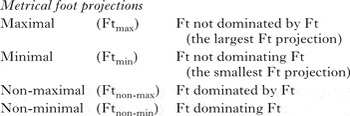
These are illustrated in (4) (see Elfner Reference Elfner2012 for evidence for other non-minimal prosodic subcategories).
-
(4)
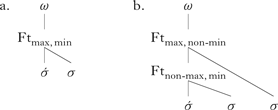
As shown in (4), every foot layer can be characterised with a positive or negative value for the parameters ‘minimal’ and ‘maximal’. A traditional (binary or unary) foot will be both ‘minimal’ and ‘maximal’ (4a): its single projection is ‘maximal’ by not being dominated by another foot, and ‘minimal’ by not dominating a foot. The top node in the recursive foot in (4b) is defined as ‘maximal’ in the same way as (4a), but since it directly dominates a foot, it is ‘non-minimal’ as well. The bottom node of the recursive foot in (4b), its innermost foot, is both ‘minimal’ by not dominating a foot and ‘non-maximal’ by being directly dominated by a foot. As pointed out by Itô & Mester, these terms (minimal/maximal and non-minimal/non-maximal) are not mere notational variants referring to new language-particular categories in the prosodic hierarchy. On the contrary, they are structural terms that can be fully and locally inferred from domination relations. When applied to the category foot, they capture information about its specific daughter (i.e. whether it immediately dominates another foot) and/or its mother node (i.e. whether it is immediately dominated by another foot). In this sense, these terms are local: the specific characterisation of a given foot layer is directly inferred from local relations. In §2.1 we saw that different metrically conditioned phenomena need to distinguish between different foot projections. This distinction will also turn out to be crucial for stress assignment, and the formulation of our metrical constraints will therefore involve reference to the different projections of a foot (§2.2).
2.1.2 Restrictions on Gen
Before discussing the main properties of the violable constraints used in our OT analysis of rhythmic stress, we outline in this section a few inviolable restrictions which we will tentatively assume to be enforced by Gen. These restrictions should not be taken as axioms, but merely as initial working hypotheses that will facilitate our typological investigation of the ILT foot in §3.
-
(5)
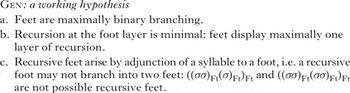
(5a) excludes flat ternary branching feet from Gen, in accordance with standard metrical theories of stress (Rice Reference Rice, van Oostendorp, Ewen, Hume and Rice2011 and references therein). As pointed out by Hayes (Reference Hayes1995: 315), flat ternary feet are unable to capture typological predictions relating to the binary foot inventory. In particular, a theory with flat ternary feet cannot account for the similarities between ternary and binary feet within a language. Consider for instance a language with iambic lengthening and ternary rhythm, like Chugach, where lengthening occurs in both ternary feet, e.g. (σσ́ːσ), and binary feet, e.g. (σσ́ː) (Leer Reference Leer1985a). A theory with flat ternary feet would fail to unify the structural context of lengthening, since lengthening occurs in different types of feet: amphibrachs and iambs. In contrast, in a theory where ternary feet arise by adjoining a syllable to a binary foot (in the case of Chugach, an iambic foot) it is evident why binary feet (σσ́ː) and ternary feet ((σσ́ː)σ) both display lengthening: both structures contain an iamb. Another reason to exclude flat ternary feet from Gen is their inability to capture the reported difference in phonological behaviour between the head of a binary foot and the head of a flat ternary foot, as well as the different behaviour of weak syllables within a ternary foot (see §2.1.1 for references and details). Note that the heads of binary and ternary flat feet have similar structures and, therefore, it is in principle predictable that they should display similar phonological behaviour. Likewise, a theory with flat ternary feet can only account for the dual behaviour of unstressed syllables by stipulating the position of the weak syllable within the foot (at an edge or not) that targets a particular process, and/or by referring to its adjacency (or lack of adjacency) to the foot head. This is not sufficient in the analyses of various fortition phenomena, which need to appeal to the structural difference between weak syllables in an ILT foot.
The other two restrictions in (5) limit prosodic recursion at the level of the foot in two respects. First, (5b) bans quaternary feet, (((σ́σ)σ)σ), and larger recursive feet from Gen. Second, (5c) disallows feet from domina-ting two feet, i.e. it prohibits balanced feet, and only allows unbalanced recursive feet in which a foot dominates another foot and a weak syllable. Note that these restrictions are specific to the foot: both balanced recursive prosodic structures in which a category X dominates two categories X and prosodic structures with more than one layer of recursion have been proposed for higher layers of the prosodic hierarchy (Ladd Reference Ladd1986, Ito & Mester Reference Ito and Mester2007). In §4 we will clarify the specific arguments that lead us to posit these restrictions as absolute conditions within Gen rather than violable constraints in Con. For the moment, we observe that these arguments stem partially from the rhythmic nature of the foot and its relational inherent definition.
Assuming the three working hypotheses in (5), there are seven types of maximal feet that can be generated by Gen in our framework: four ILT feet (6a), two binary feet (6b) and one unary foot (6c).
-
(6)
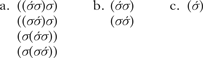
To facilitate our typological research, we have also excluded from Gen candidates with internally layered feet in which a syllable is adjoined to a unary foot (e.g. ((σ́)σ)). The goal of the present paper is to account for quantity-insensitive binary and ternary stress patterns. Whether a particular binary or ternary system is better analysed with this type of unary recursive foot or with a simple binary foot (σ́σ) is an open question. However, as the former merely introduces recursiveness without optimising parsing in any respect, and given the lack of compelling evidence for such type of foot (cf. Buckley Reference Buckley, Kingston, Moore-Cantwell, Pater and Staubs2014), we have omitted them from Gen. As pointed out by an anonymous reviewer, if future research proves that Gen must include such feet, the task of ruling them out in certain evaluations would be shifted to Con, presumably by markedness constraints specifically penalising unary feet and/or superfluous complex structure (e.g. *Structure; Gouskova Reference Gouskova2003).
We now turn to the constraints that are responsible for the location of feet within the prosodic word, and for the size and type of feet.
2.2 Non-intervention alignment constraints
All constraints used in our analysis conform to McCarthy's (Reference McCarthy2003) alignment format: (i) they are categorical (i.e. they maximally assign one violation mark per locus of violation), and (ii) they qualify as local, in the sense that they do not ‘mention more than two distinct constituents and a relation between them, such as adjacency or shared membership in a superordinate constituent’ (McCarthy Reference McCarthy2003: 80). According to McCarthy's definition, constraints involving three categories can still be local, as long as one of them is a superordinate category that contains the other two. We will see this is relevant for the definition of our constraints. In addition, to avoid complex computational problems that arise when the locus of violation refers to more than one constituent (see §4 for discussion), we follow McCarthy's restriction on the locus of violation: every locus will be a single phonological constituent (Reference McCarthy2003: 77). Finally, to make the assignment of violation marks more explicit and as a means of achieving local foci, we also follow McCarthy's proposal of formulating categorical alignment constraints according to the non-intervention format presented in Ellison (Reference Ellison1994) and Zoll (Reference Zoll1998). This non-intervention schema, which will be implemented in our constraint set, is illustrated in (7), which is adapted from McCarthy (Reference McCarthy2003: 78).
-
(7)

Note that Cat1 corresponds to the locus of alignment (or violation), i.e. the designated category that is required to be aligned with the (left or right) edge of a particular domain or superordinate category, Cat3. This locus of violation can be separated from the left/right edge of the superordinate category by a separator category, Cat2. In such a case, the constraint will assign only a single violation mark per locus of violation, no matter how many separators intervene between the locus of alignment and the relevant edge of the domain. To better illustrate the non-intervention format, consider the constraint in (8), which is a concrete example from our set.
-
(8)

This non-intervention constraint penalises maximal foot projections (Cat1=locus of violation) that are separated from the left edge of the ω (Cat3=domain, superordinate category) by some foot (Cat2=separator), independently of its minimal/maximal status. As shown in (9), it assigns fewer violations to candidate (b), with two ternary feet, than to (a), with three binary feet. However, the true function of this constraint is to promote candidates with a single foot, like (c).
-
(9)
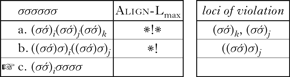
Candidate (c) will be selected when constraints ensuring exhaustive parsing of syllables are low-ranked. We have indicated on the right of the tableau the exact loci that incur a violation. Note that the maximum number of violations which a constraint of this sort can assign is bounded: it equals the number of loci of violation present in a given domain. This boundedness property of our constraints will be argued to be warranted on computational grounds in §4. In the example above, where the locus of alignment is a maximal foot, the number of violation marks a particular candidate incurs will never exceed the number of maximal feet present in a prosodic word.
Note that the non-intervention relation between Cat1 and Cat3 in McCarthy's constraint format cannot always be characterised as ‘local’. Since Cat1 (e.g. an unparsed σ) and Cat3 (e.g. the designated edge of ω) can be at an unbounded distance from one another, the non-intervention constraint must be able to ‘look’ an unbounded distance from the locus of violation (Cat1) to test for the absence of an intervening Cat2 (e.g. a Ft). Locality is considered to be a fundamental principle of grammar (Chomsky Reference Chomsky1965), in the sense that it constrains the expressive formats of rules and constraints in syntax as much as in phonology. Nevertheless, we propose that the relation between Cat1 and Cat3 can be characterised as ‘local’ in a particular way. We assume (following Eisner Reference Eisner1997 and McCarthy Reference McCarthy2003) that edges of Cat3 are accessible to Cat1 and Cat2 by virtue of ‘vertical’ locality. In order to contribute to a more restrictive theory of Con and limit the size of the constraint set, we impose two vertical locality conditions on our non-intervention constraints. These conditions, stated in (10), restrict the types of prosodic elements that can occupy each of the three categories in the non-intervention format. In §3 we will demonstrate that these locality restrictions are typologically motivated.Footnote 4
-
(10)
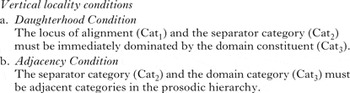
Taken together, the conditions in (10) fully determine the values of the separator and the domain category for a given locus. First, the Daughterhood Condition establishes that the locus and separator must be immediate daughters of the superordinate category, thereby establishing the superordinate category and restricting the separator category. For instance, within the ω-domain, where the locus of alignment is the Ft, the separator category can only be a Ftmax or a σ, since only maximal feet and unfooted syllables are directly dominated by ω. Second, the Adjacency Condition requires the separator to be vertically adjacent in the prosodic hierarchy to the superordinate domain category. Hence, in cases where the domain category is ω, the separator will be Ft. In cases where the domain is Ft, the separator will be σ. These conditions greatly restrict the number of possible constraints in our model. For instance, a constraint such as Align-L/R(Ftmax, [σ]Ft, ω), in which the locus of alignment is a Ftmax, the separator category is a footed syllable and the domain or superordinate category is ω, is not possible in our framework, because it does not satisfy the locality conditions in (10). On the one hand, the Daughterhood Condition is violated because the maximal projection of the foot, Ftmax, is an immediate daughter of ω, but the footed syllable is not: it is immediately dominated by Ft, and hence is not a sister of Ftmax. On the other hand, this constraint is also defective according to the Adjacency Condition, because ω and σ are not vertically adjacent categories in the prosodic hierarchy: Ft intervenes between them.
We will assume that the locus category can be instantiated by different projections of a recursive foot, by feet with specific prominence and branchingness properties (head feet, non-branching feet) and by unfooted syllables or syllables with foot-head status. On the basis of this, we derive the sets of constraints in (11) and (18) below, all of which satisfy the two vertical locality conditions. The constraints are arranged in two classes, determined by the superordinate category, ω or Ft. In (11) we present the class that determines the location and number of feet, as well as the location of unfooted syllables within a prosodic word. Later, in (18), we present the class of constraints which regulates the location of foot heads and foot dependents. We use square brackets with a subindex to represent immediate domination in our constraint set. Since in (11) the superordinate category is the prosodic word, all loci are indicated with […]ω. In (11a) the indication that the maximal foot is immediately dominated by the prosodic word ([Ftmax]ω) is redundant, but in other cases, like (11b), where the locus category is [Ftmin]ω, the […]ω notation becomes crucial: it indicates that the constraint will only affect minimal feet that are immediately dominated by ω (i.e. non-recursive feet). This notation is equally crucial in (11f), where the locus is stated as [σ]ω, which means that the constraint only targets syllables that are immediately dominated by ω, i.e. unfooted syllables.
-
(11)
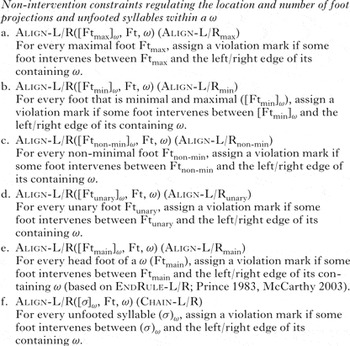
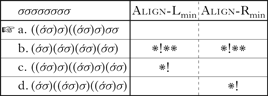
A complete factorial typology of these constraints will be presented in §3. Here we concentrate on illustrating the main functions of some of these constraints and their roles in predicting ternary and binary patterns. Since the first pair of constraints, Align-L/Rtmax, was exemplified in (8) and (9), we turn to the effects of Align-L/Rmin in (11b). The locus of violation in this pair of constraints is a minimal foot that is simultaneously maximal, i.e. a non-recursive foot. The constraints have two functions. First, they draw non-recursive feet toward the left/right edge of their containing ω. Second, they share the economising function of the other alignment constraint: whereas Align-L/Rmax minimises the number of maximal feet in general, Align-L/Rmin minimises the number of maximal feet that are minimal, maximising the emergence of recursive feet. As such, they promote ternarity. The two functions are illustrated in the tableau in (12). Given a candidate with eight syllables, Align-L/Rmin favours the candidate with two ILT feet (a), rather than alternative parsings with four minimal binary feet (b) or two ILT feet and a binary foot (c), (d). (We abstract away from headedness parameters for the moment, so that the head of all candidates in (12) is in foot-initial position.)
-
(12)
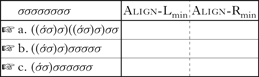
These constraints alone cannot be responsible for selecting the ternary pattern in (13a). Note that candidates with a single recursive foot (b) or a single non-recursive foot (c) satisfy the two constraints equally well, as with Align-L/Rmax in (8).
-
(13)
To derive the ternary stress pattern in (12a) and (13a), Align-L/Rmin must crucially dominate the constraint that minimises the number of unparsed syllables and chains feet towards the left edge of the prosodic word. This is Chain-L, the left version of the constraint in (11f), which promotes exhaustivity while chaining any unfooted syllables to the left edge of ω and feet to the opposite edge. Hence, for a pattern like (12a), Align-L/Rmin and Chain-R must be undominated, so that all unfooted syllables are chained to the right edge of ω. When these three constraints dominate Chain-L, a system like Cayuvava, with extreme ternarity, emerges, as in (14).
-
(14)
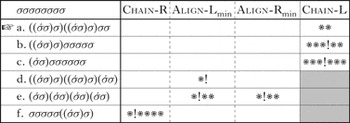
Candidate (f), with unfooted syllables chained at the right edge of the prosodic word, is eliminated because it violates Chain-R. Candidates (d) and (e) are also ruled out because they incur various violations of the Align-L/Rmin constraints. Finally, candidates (a)–(c) all respect high-ranked Chain-R and Align-L/Rmin, but violate Chain-L. Since (a) has only two unfooted syllables at the right edge of ω, it incurs fewer violations of Chain-L than (b) and (c), and is thus optimal. The ranking in (14) thus promotes ternarity, while allowing a small amount of underparsing, i.e. of two syllables. Observe that Chain-L and Chain-R together eliminate the need for Parse-σ, by minimising the number of unparsed syllables. When Chain-L and Chain-R are both undominated, candidates with exhaustive parsing of syllables will surface as optimal, even if exhaustivity is achieved by means of a binary foot. This pattern is illustrated in (15a), and corresponds to languages like Estonian. These systems promote ternarity, but prefer building a binary foot to leaving two syllables unparsed.
-
(15)
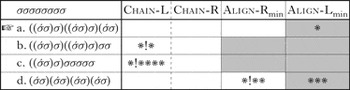
To account for languages that also display exhaustive parsings of syllables, but invoke binary footing instead of achieving exhaustivity by means of building ternary feet, we need to introduce the constraint in (11c), which regulates the position of non-minimal feet, Align-L/Rnon-min. As can be seen in the tableaux in (16), the role of this constraint is to minimise ternary feet. When either the left or right edge version of this constraint is undominated, and ranked together with Chain-L/R above the Align-L/Rtmin constraints, a system with binary feet in even-parity forms arises, as in (16a.i). However, in odd-parity forms, exhaustivity is ensured by the presence of one ternary foot, as in (16b.ii).
-
(16)
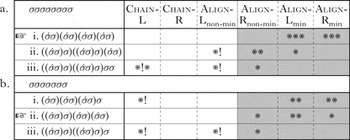
Tableaux (14)–(16) show that our constraint set predicts that there is no absolute boundary between binary and ternary systems, but that there is indeed a typological rhythmic continuum, as anticipated in §1. In §3, we will present evidence for the predicted continuum from language examples in the context of a full factorial typology. First, however, we discuss the two remaining pairs of constraints needed to account for the typology of rhythmic stress, Align-L/Runary (11d) and Align-L/Rmain (11e), which are necessary to minimise the number of unary feet in languages and select the primary stress in a word. Both constraints pull unary feet and main stress towards the edges of words.
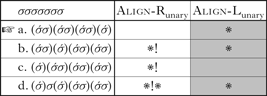
The function of Align-L/Rmain corresponds to the old EndRule-L/R, and for this reason, there is no need for illustration. Tableau (17) shows the principal effects of Align-L/Runary: they minimise the number of unary feet in ω and, when present, they chain the unary feet to a particular ω-edge.
-
(17)
The second class of constraints, given in (18), has the foot as the superordinate category.
-
(18)
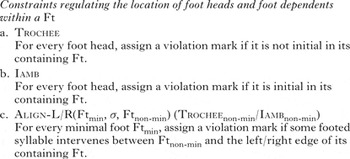
The first two constraints correspond to the traditional foot-type constraints: Trochee favours feet beginning with a strong syllable, and Iamb feet beginning with a weak syllable. The formulation of these constraints does not follow the non-intervention format in (7): they do not specify a separator category. Instead, these alignment constraints favour the presence of a head at the left edge of a foot (in the case of Trochee) or its absence (in the case of Iamb). This is for typological reasons, to avoid unary-only languages. Note that a unary foot (σ́) starts and ends with a strong syllable, while not containing any separators. Hence, if Trochee and Iamb were formulated as mirror-image non-intervention constraints, such that Trochee banned feet whose head was separated from the left edge of the foot by an intervening syllable, and Iamb banned feet whose head was separated from the right edge of the foot by an intervening syllable, a unary foot would simultaneously respect both constraints. This problem with mirror versions of the foot-form constraints is not specific to our framework, and has been noted by previous authors, who have solved it in a similar asymmetrical way, assuming all unary feet to incur a violation of Iamb (e.g. Tesar & Smolensky Reference Tesar and Smolensky2000). Finally, we propose the foot-form constraints in (18c) to determine the location of the adjunct in an ILT foot: the left version (Trocheenon-min) favours ILT feet with a right adjunct ((σσ)σ), whereas the right version (Iambnon-min) prefers feet with a left adjunct (σ(σσ)).
The interaction of these constraints will be crucial in selecting the particular shape of any ILT foot. To illustrate the effects of the constraints in (18), in (19) we provide a list of the possible feet in our model and their respective violations of these constraints.
-
(19)
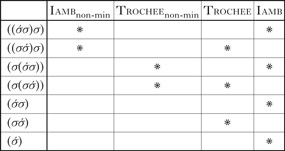
3 Factorial typology
3.1 Method
The factorial typology of the constraint set was calculated using OTSoft (Hayes et al. Reference Hayes, Tesar and Zuraw2003). Candidates and their violations were generated using a computer script. The constraint set consisted of the twelve ω-domain constraints in (11) and the four Ft-domain constraints in (18). With 16 constraints, the number of logically possible rankings equals 16! (2·1×1013).
Candidates to be evaluated were all the logically possible metrifications of input strings ranging in length from two to eight syllables. Gen was limited to metrifications containing all logically possible combinations of the seven feet in (6) (ternary, binary and unary) plus unparsed syllables. We also excluded two types of candidates. First, candidates whose primary stress foot was in a non-leftmost or non-rightmost position were excluded. These candidates are harmonically bounded under the current constraint set. Second, all candidates satisfied culminativity: each contained one and only one primary stress foot. The total number of candidates equalled 10,612 (distributed over different word lengths).
3.2 Results
There were 316 different output patterns, all with distinct bracketings. This represents a huge reduction in the number of logically possible rankings, by a factor 1·5×10−11. For conciseness, we collapsed the 316 patterns by abstracting over the following properties: (a) primary/secondary stress; (b) left/right mirror image; (c) foot headedness. The collapsed forms for the three foot types are given in Table II.
Collapsed patterns.

We will refer to the collapsed patterns as BTU-patterns. Abstracting in this way allows for a more condensed and insightful discussion of the factorial typology than presenting all the individual patterns, since headedness at the level of Ftmin and Ftnon-min and differences between primary and secondary stresses never interact with foot distribution. For the BTU-patterns presented below as illustrations, we chose to have binary feet (σ́σ) and (σσ́) always agree in headedness with the heads of ILT feet that co-occur in the same pattern.Footnote 5
The factorial typology contained a total of 22 BTU-patterns, classified into nine categories on a rhythmic continuum. None of the potentially optimal candidates in the tableaux submitted to OTSoft had tied violation profiles. This was checked by running the same input file in OTWorkplace (Prince et al. Reference Prince, Tesar and Merchant2015). It was established that the total number of predicted languages was the same as the number generated in OTSoft. The factorial typology of 316 languages was also independently replicated from a newly generated input file. This replication was run in OTWorkplace on an automatically generated enlarged set of 27,526 candidates, rather than 10,612, which included all candidates with primary stress on a medial (non-peripheral) foot, all of which turned out to be harmonically bounded.
We will now discuss the 22 BTU-patterns, subdivided into nine categories. For each BTU-pattern, we will present the ranking that is responsible for generating it, and an example showing data from a language that instantiates it, with the foot boundaries hypothesised. References for metrical systems will be taken mainly from Gordon (Reference Gordon2002), and occasionally from other typological studies (Elenbaas & Kager Reference Elenbaas and Kager1999, Kager Reference Kager2005, Reference Kager2012).
3.3 The factorial typology
3.3.1 Rhythmic category A: single-foot systems
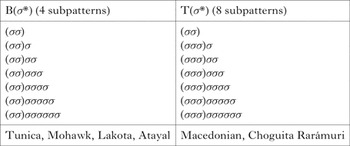
Category A contains two BTU-patterns: a single binary foot and a single ternary foot. Table III shows parsings for forms of two to eight syllables, with examples of attested languages.
BTU-patterns for rhythmic category A: single-foot systems.

The notation B(σ*) is used to represent a single binary foot followed by an optional sequence of unparsed syllables, and T(σ*) a single ternary foot followed by an optional sequence of unparsed syllables. The number of subpatterns for each BTU-pattern (4, 8 or 16) is determined by three factors: (a) the number of ILT feet (4 possibilities), (b) the position of the primary stress (2), which is irrelevant in single-foot parsings, and (c) the directionality of parsing (2). Since BTU-patterns abstract over left–right mirror images, the foot occurs either at the left edge (with stress falling on the initial syllable (Tunica), the second syllable (Lakota) or the third syllable (Choguita Rarámuri)) or at the right edge (with stress falling on the final syllable (Atayal), the penultimate (Mohawk) or the antepenultimate (Macedonian)). Note that the two subpatterns converge if the ILT foot in T(σ*) is left-branching at the left word edge or right-branching at the right word edge.
The first pattern, B(σ*), is exemplified in (20a) by initial stress in Tunica (Haas Reference Haas and Hoijer1946); the other pattern, T(σ*), in (20b) by antepenultimate stress in Macedonian (Lunt Reference Lunt1952).
-
(20)

These patterns are generated by the rankings in (21). Here and below, we suppress any constraints regulating primary/secondary stress. For foot-form constraints, we will assume trochee as a default at the Ftmin level, and left-headed ILT feet at the Ftnon-min level.Footnote 6 In some cases, foot-form constraints play a crucial role in imposing size restrictions on feet, and hence are included in the rankings.
-
(21)
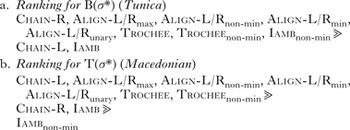
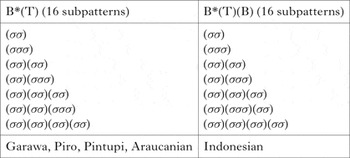
3.3.2 Rhythmic category B: strictly binary rhythmic systems
Binary feet are combined with an unparsed syllable in odd-parity forms. There are two BTU-patterns: one attested and basic, another with trisyllabic forms parsed into a single ternary foot, predicting an unattested pattern in case the head of the ternary foot in trisyllabic forms is not in the same position as in forms with binary feet, as in Table IV.
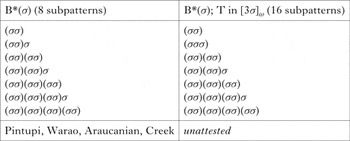
BTU-patterns for rhythmic category B: strictly binary systems.

The first pattern, B*(σ), has iterative binary feet with an unparsed syllable at one edge. In the case of left-to-right trochees, primary stress can be leftmost or rightmost (Pintupi vs. Cairene), and similarly for right-to-left trochees (Wargamay vs. Warao). Left-to-right iambs occur in Araucanian (primary leftmost) and Creek (primary rightmost). The Pintupi subpattern (Hansen & Hansen Reference Hansen and Hansen1969) is exemplified in (22).
-
(22)

The second pattern, B*(σ); T in [3σ]ω, is equivalent to B*(σ), except that an ILT foot occurs in trisyllabic forms. This pattern is equivalent to B*(σ) if left-to-right languages have a left-branching foot in trisyllabic forms and right-to-left languages have a right-branching foot, but not if branchingness and directionality are not correlated in this way. For example, an inconsistency would be difficult to notice if the ternary foot were left-headed ((σσ)σ), since the difference between the adjunct of a Ftnon-min (trisyllabic forms) and an unparsed syllable (longer odd-numbered forms) would not be audible. Still, inconsistency may arise with a ternary foot with a left adjunct. One example pattern, given in §2 of the online supplementary materials, has initial stress in all #(σ́σ) … forms, except for the unattested trisyllabic (σ(σ́σ)), which has second-syllable stress.
The two patterns are generated by the rankings in (23).
-
(23)
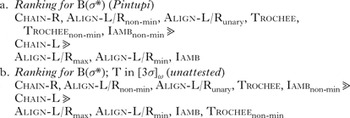
3.3.3 Rhythmic category C: mixed binary/unary systems
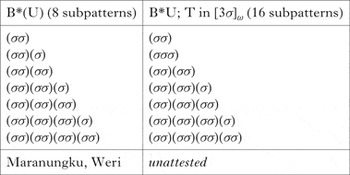
Here, binary feet combine with a single unary foot. Again, there are two BTU-patterns: the first is common, while the second (with the unary foot suppressed in trisyllabic forms) is unattested, as shown in Table V.
BTU-patterns for rhythmic category C: mixed binary/unary systems.

The first pattern, B*(U), has iterative binary feet and a unary foot at the left or right edge in odd-parity forms. This results in a perfect grid, with left-to-right trochees (Maranungku) or right-to-left iambs (Weri). A stress clash occurs in the remaining cases (leftward trochees (Passamaquoddy); rightward iambs (Ojibwa)). Examples from Maranungku (Tryon Reference Tryon1970) are given in (24).
-
(24)

The second BTU-pattern, B*(U); T in [3σ]ω, which is unattested, is a minimal variation on the Maranungku pattern, such that trisyllabic words have no final secondary stress. The rankings for the two patterns are given in (25).
-
(25)
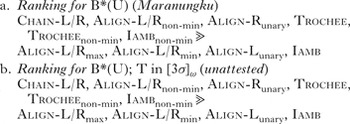
3.3.4 Rhythmic category D: mixed binary/ternary systems. In this category binary feet combine with a ternary foot in odd-parity forms, as in Table VI.
BTU-patterns for rhythmic category D: mixed binary/ternary systems.

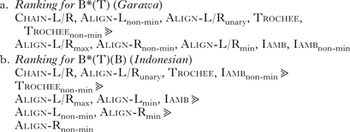
The first BTU-pattern, B*(T), corresponds to bidirectional systems such as Garawa (initial primary stress, secondaries from right-to-left) and Piro (its mirror image), which are predicted to be exhaustively footed. This pattern also predicts an (alternative) exhaustive parsing of unidirectional systems (in addition to category B). Importantly, although the stress pattern is ambiguous between two metrical bracketings (categories B and D) in such cases, non-stress evidence may be available to resolve this ambiguity. Whether the pattern is bidirectional or unidirectional depends on the location of the adjunct in the ILT foot. If it is left-branching in a left-to-right pattern (or right-branching in a right-to-left pattern), it is unidirectional; however when directionality and branchingness have the opposite relationship (a right-branching ILT foot in a left-to-right pattern or a left-branching ILT foot in a right-to-left pattern), it is bidirectional. The bidirectional pattern with right-to-left trochees and initial dactyl is exemplified in (26a) by Garawa (Furby Reference Furby1974).
-
(26)
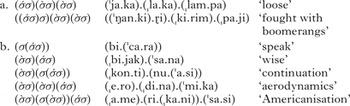
The second BTU-pattern, B*(T)(B), has T in medial position. This is attested in a rather subtle way in Indonesian (Cohn Reference Cohn1989), as shown in (26b). Primary stress is penultimate, and an initial secondary stress occurs in forms of minimally four syllables, while in longer odd-parity words, secondary stresses go from right to left. Penultimate stress in trisyllabic forms indicates a right-headed Ftnon-min ((σ(σ́σ))), while consistent initial secondary stress in longer forms shows that Ftnon-min avoids initial position. This pattern is referred to as ‘complex bidirectional’ by Elenbaas & Kager (Reference Elenbaas and Kager1999), as the secondary stress foot is at the opposite edge to the primary stress, while the other secondaries depart from the primary stress.Footnote 7 However, the terms ‘bidirectional’ and ‘complex bidirectional’ do not readily translate into our typology as B*(T) vs. B*(T)(B), which abstracts away from the primary–secondary distinction.
The rankings for Garawa and Indonesian are given in (27).
-
(27)
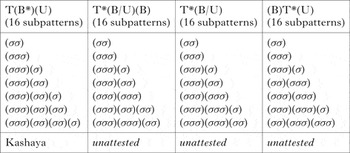
3.3.5 Rhythmic category E: mixed ternary/binary/unary systems
This category combines ternary with binary and unary feet, as in Table VII.
BTU-patterns for rhythmic category E: mixed ternary/binary/unary systems.

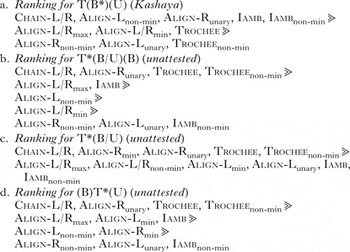
The first pattern, T(B*)(U), has a single ternary foot at one edge, with binary feet moving away from the ternary foot, and a unary foot at the opposite edge. The pattern seems to be attested in Kashaya (Buckley Reference Buckley, Kingston, Moore-Cantwell, Pater and Staubs2014) with third-syllable accent (an ILT anapest) and rightward iambic rhythm, as in (28).Footnote 8
-
(28)

The next two patterns, T*(B/U)(B) and T*(B/U), have iterative ternarity, resolving non-ternary sequences with various combinations of binary and unary feet. These patterns appear to be unattested. Note that both correspond to Chugach when the ILT foot is a left-branching amphibrach with an iambic head. However, the bracketings do not correspond to Chugach; (σσ́σ)(σ́), for example, differs from (σσ́)(σσ́), as evidenced by consonant fortition and other foot-based processes (Rice Reference Rice1992).
The fourth pattern, (B)T*(U), is ‘non-directional’, since it is inconsistent in the edge (left/right) towards which the pattern is oriented (Elenbaas & Kager Reference Elenbaas and Kager1999: 322). Ternary feet are assigned from left to right in forms of length 3n+1, but from right to left in forms of length 3n+2. Non-directionality may disrupt the consistency of stress placement at the left or right edge, depending on foot headedness. For example, if ILT feet are left-branching in the (B)T*(U) pattern, stress placement will be consistent at the left edge, but inconsistent at the right edge, and vice versa. Notice too that non-directionality may cause inconsistent placement of primary or secondary stress, depending on the edge at which the primary stress is situated.
The ranking for the four patterns is given in (29).
-
(29)
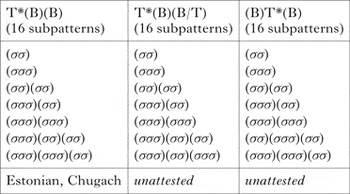
3.3.6 Rhythmic category F: ternary and binary exhaustive systems
This rhythmic category combines basic ternarity with occasional binarity to achieve exhaustivity, as in Table VIII.
BTU-patterns for rhythmic category F: ternary and binary exhaustive systems.

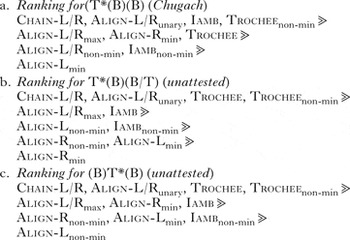
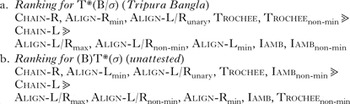
The first pattern, T*(B)(B), is unidirectional, as all ternary feet are built starting from a single edge; binary feet occur in pairs or singles at the right edge, resolving non-ternary intervals of four and two syllables respectively. This pattern is attested in Estonian (dactyls) and Chugach (left-branching amphibrachs).
The other patterns, T*(B)(B/T) and (B)T*(B), are respectively bidirectional and non-directional variants of the first one. The patterns are generated by the rankings in (30).
-
(30)
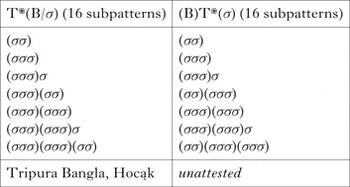
3.3.7 Rhythmic category G: ternary and binary non-exhaustive systems
This category involves ternary systems that only opt for a binary foot in 3n+2 forms, but have an unparsed syllable in 3n+1 forms, as in Table IX.
BTU-patterns for rhythmic category G: ternary and binary non-exhaustive systems.

The first pattern, T*(B/σ), is unidirectional, as all ternary feet are built starting from a single edge; ternary feet are preferred, but a binary foot occurs to avoid a pair of unparsed syllables and a single syllable remains unparsed. This pattern is attested in light-syllable words in Tripura Bangla (dactyls), and in Hocąk (anapests).
The second pattern, (B)T*(σ), is a non-directional variant of the first, combining binary feet and unparsed syllables at different edges. As shown in §7 of the online supplementary materials, breaking down this pattern into left-branching vs. right-branching feet brings out two degrees of non-directionality: one pattern (with left-branching feet) is inconsistent at the right edge only, while the second pattern (with right-branching feet) is inconsistent at both edges. The rankings are given in (31).
-
(31)
3.3.8 Rhythmic category H: strictly ternary systems
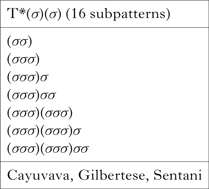
This category displays a single strictly ternary pattern, attested in Cayuvava (dactyls), Gilbertese (left-branching amphibrachs) and Sentani (right-branching amphibrachs), as in Table X.
BTU-patterns for rhythmic category H: strictly ternary systems.

Cayuvava data were presented in (1a). The ranking for Cayuvava is given in (32).
-
(32)

3.3.9 Rhythmic category I: mixed ternary/binary triple stray systems
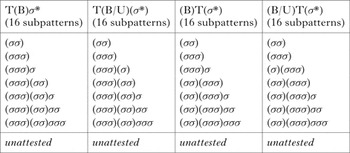
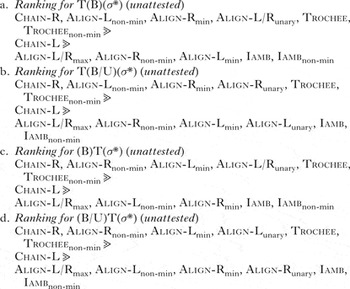
This category contains four BTU-patterns with ‘chained dual-foot parsings’, as in Table XI: each has a single ternary foot, which is chained with a single binary foot. Patterns differ in their parsing of four-syllable forms (which either have an unparsed syllable or a unary foot), as well as in whether the ternary or binary foot occurs in peripheral position. None of the patterns seem to be attested (but see below).
BTU-patterns for rhythmic category I: mixed ternary/binary triple stray systems.

The four patterns are generated by the rankings in (33).
-
(33)
(34) gives a tableau for an eight-syllable form, which illustrates how ‘chained dual-foot parsings’ may arise.
-
(34)
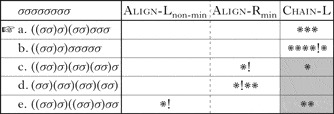
Maximally one ternary foot (Ftnon-min) occurs in leftmost position, and maximally one binary foot (Ftmin) occurs in rightmost position. So when two feet occur, these are necessarily of different sizes, with two opposite-edge non-intervention constraints targeting different feet. The pattern perhaps looks strange, but it may nevertheless be attested. For example, Ioway-Oto (Whitman Reference Whitman1947: 238) is reported to have free primary stress falling on the initial or second syllable (a disyllabic stress window), while secondary stress predictably falls on the third syllable after the one bearing the primary stress. No examples are given in the source, and for this reason we are hesitant to classify any of the patterns in category I as ‘attested’.
3.4 Discussion
The factorial typology contains 316 patterns, grouped into nine rhythmic categories, giving a total of 22 BTU-patterns. All nine rhythmic categories, except possibly one (category I), contain at least one attested stress pattern. Our discussion will focus on two criteria: undergeneration and overgeneration. We will then turn to the binary-to-ternary rhythmic continuum.
3.4.1 Undergeneration
We will compare our typology with Gordon's (Reference Gordon2002) factorial typology of quantity-insensitive stress systems. As compared to Gordon's typology, two cases of undergeneration occur; for each case, we will discuss the possible need for additional constraints.
Our constraint set fails to generate ‘dual stress systems’ such as Sibutu Sama (Allison Reference Allison1979), in which one foot is fixed at one edge and another at the opposite edge.Footnote 9 Such systems fall outside the current study, together with quantity-sensitive and lexical stress systems.
Another pattern that our typology fails to generate is a specific subtype of what Gordon (Reference Gordon2002: 531) refers to as ‘binary-plus-clash’ systems. Our typology includes four of the five binary-plus-clash systems reported by Gordon: Central Alaskan Yup'ik, Southern Paiute, Gosiute Shoshone and Biangai, all generated in the class of mixed binary/unary systems (C). The only system the typology fails to generate has stresses on both the first and final syllables, with binary rhythmic stresses in between, as has been reported for Tauya (MacDonald Reference MacDonald1990). In order to generate Tauya, the current constraint set needs to be enlarged by a categorical alignment constraint that anchors a unary foot at the right ω-edge. The consequences for the factorial typology are an extension of the current one from 316 to 616 patterns. However, since the evidence for initial secondary stress in Tauya is rather doubtful (Hyde Reference Hyde and van der Hulst2014: 320), we are reluctant to adopt this constraint.
3.4.2 Overgeneration
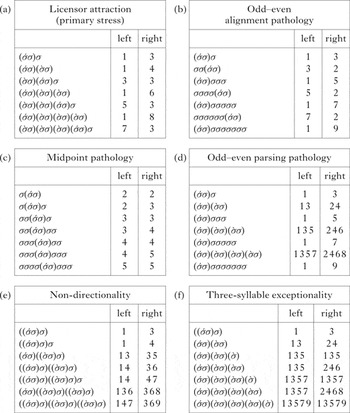
Since twelve of the 22 BTU-patterns are unattested, we must ask whether any of these unattested patterns are in any sense ‘pathological’. The term has been employed in different ways in the literature; here we use the following definition: ‘any pattern in which the location of stresses in forms of different lengths is inconsistent, with respect to strings of syllables counted from both edges of the ω’. Possible types of inconsistencies are defined below.
This definition covers pathologies such as those in Table XII: (a) inconsistency in the position in which the primary stress occurs (i.e. the primary stress is sometimes aligned with one ω-edge and sometimes with the opposite edge; ‘licensor attraction’); (b) inconsistent alignment of feet at the left or right edge, depending on syllable count (‘odd-even alignment pathology’); (c) inconsistent distance of the primary stress when counted from both ω-edges (‘midpoint pathology’); (d) inconsistent parsings – iterative vs. non-iterative – that depend on syllable count (‘odd-even parsing pathology’); (e) inconsistent directionality of iterative footing (‘non-directionality’); (f) inconsistent parsings of strings that cannot be parsed by a canonical foot (‘three-syllable exceptionality’).
Six pathologies covered by the revised definition; each is exemplified by strings of three to nine syllables; for (a), the position of primary stress is counted from the left and right edges; for (b)-(f), the positions of all stressed syllables are counted from the left and right edges.

Our factorial typology turns out to have only a modest amount of stress pathology. Importantly, it excludes BTU-patterns exhibiting licensor attraction, odd-even alignment pathology, midpoint pathology and odd-even parsing pathology. However, it does include trisyllabic exceptionality and non-directionality.
Trisyllabic exceptionality occurs in several BTU-patterns in categories B and C, where deviations from binarity are resolved by underparsing or unary feet, except in trisyllabic forms, where ILT feet occur. We hypothesise that its non-attestation arises from perceptual factors. Hayes (Reference Hayes1995: 100ff) argues that a stressed vs. unstressed contrast may be difficult to perceive in word-final syllables, due to their propensity to undergo final lengthening (see also Lunden Reference Lunden2014 for an account along the same lines, with experimental support). Final lengthening is known to depend on the length of a word; shorter words may show greater degrees of final lengthening, adding to the perceptual confusability of stressed vs. stressless, in particular in the final syllable of a trisyllabic word. This has implications both for the reliability of transcriptions of secondary stress in trisyllables and for the learnability of trisyllabic exceptionality.
Non-directionality occurs in three BTU-patterns (E, F and G), which always occur as a specific variant of some directional pattern. Elenbaas & Kager (Reference Elenbaas and Kager1999) judge non-directionality to be sufficient grounds for rejecting a metrical constraint model, but in retrospect this assessment appears to be too harsh. First, instability in the position of primary stress as a function of word length is known to be a major factor in negatively impacting the learnability of a stress system (Staubs Reference Staubs2014). Typological underrepresentation may well be strongly related to reduced learnability. Second, the non-directional character of unattested BTU-patterns is usually only apparent in forms of considerable length, which again reduces the learnability of the non-directional pattern, given reasonable assumptions about the limited amount of relevant input to the learner in the form of long words (Stanton Reference Stanton2014). Consider, for example, the third BTU-pattern in category F, which is identical to the first and second ones for forms with fewer than six syllables.
We conclude that the factorial typology of ILT feet powered by non-intervention constraints contains little ‘pathological’ overgeneration. However, since so much is still uncertain regarding the impact of learnability on phonological typology, imposing an absolute boundary between ‘pathological’ and ‘well-behaved’ patterns may be premature.
3.4.3 The binary-to-ternary rhythmic continuum
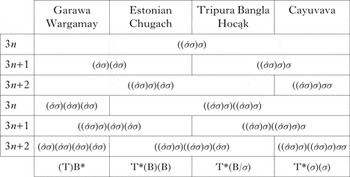
As anticipated in §1 and §2, an interesting consequence of our factorial typology is that the rhythmic categories B–H form a binary-to-ternary rhythmic continuum. At one end of the continuum, binarity is a strict requirement, while at the other end ternarity is enforced. In between, binary and ternary feet occur in combination. Estonian and Chugach display mixed ternary/binary patterns, with the ternary foot being the preferred foot. However, mixed binary/ternary patterns, with the binary foot as the preferred foot, are also attested in languages such as Wargamay, Yidiɲ and Garawa (Kager Reference Kager1994, Martínez-Paricio Reference Martínez-Paricio2012, Reference Martínez-Paricio2013). Distributional evidence for ternarity in such languages was offered in previous studies (see §1 and §2.1 for references). Among the predominantly ternary systems, increasing strictness is seen when going from Estonian and Chugach (category F) through Tripura Bangla and Hocąk (category G) to Cayuvava (category H). The relevant part of the rhythmic continuum (categories D, F, G and H) is given in Table XIII (cf. Table I above).
At the left end of the continuum (Garawa, Wargamay), ternary feet are used only as last-resort devices in odd-parity forms to ensure exhaustive parsing (Bennett Reference Bennett2012, Martínez-Paricio Reference Martínez-Paricio2012). At the right end of the continuum (the Cayuvava mirror-image pattern), ternary feet occur rigorously, at the expense of exhaustivity (Kager Reference Kager1994, Martínez-Paricio Reference Martínez-Paricio2013). In the two rhythmic types lying between these extremes, ternary feet are preferred to binary feet; exhaustivity is either maintained (allowing multiple binary feet per form; Estonian, Chugach) or relaxed (allowing only one binary foot per form; Tripura Bangla, Hocąk).
Patterns D, F, G and H on the binary-to-ternary continuum.

The binary-to-ternary rhythmic continuum in Table XIII emerges from the relative ranking of three constraint pairs: Chain-L/R (which promote exhaustivity), Align-L/Rmin (which promote ternarity) and Align-L/Rnon-min (which promote binarity).
-
(35)
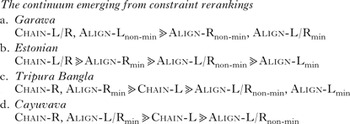
As mentioned in §2.2, the core roles of Chain-L/R are to chain feet at an edge and to promote exhaustivity: an unparsed syllable incurs a violation of either the left-edge or right-edge version of the constraint. If both Chain-L and Chain-R are top-ranked, exhaustivity emerges (Garawa, Estonian). The role of Align-L/Rmin is to promote ternarity: if both are undominated, strict ternarity emerges (Cayuvava). Finally, Align-L/Rnon-min functions to promote binarity; if both its members are top-ranked, ternary feet are excluded (e.g. category B, not shown in (35)). A preference for binarity over ternarity (Garawa, as compared to Estonian) emerges when either Align-Lnon-min or Align-Rnon-min dominates Align-L/Rmin. Finally, note that Align-L/Rmax, targeting feet in general, plays no crucial role in defining binary–ternary differences, as it is neutral with respect to foot size, and can only affect (minimise) the number of feet, not the distribution of differently sized feet.
The tableaux below highlight the three major boundaries on the rhythmic continuum in Table XIII, illustrating how pairs of languages differ minimally from each other with respect to rankings. We start with Garawa and Estonian, languages which both maintain strict exhaustivity. They have identical parsings for odd-parity words, as shown in (36).
-
(36)
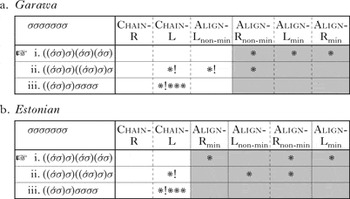
However, they differ in even-parity forms of six or more syllables, as in (37).
-
(37)
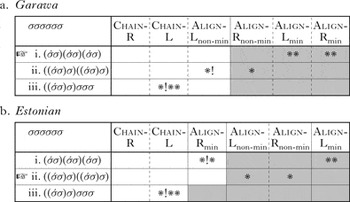
Both languages enforce exhaustive parsing. Garawa prefers binarity to ternarity; Estonian ternarity to binarity. The relative ranking of Align-Lnon-min and Align-Rmin determines the rhythmic preference: with the former higher-ranked, the rhythm is binary (37a); the reverse ranking produces ternarity (37b). Garawa and Estonian also differ in even-parity words of eight or more syllables, as in (38).
-
(38)

Again, the relative ranking of Align-Lnon-min and Align-Rmin determines rhythmic preference.
The difference between Estonian and Tripura Bangla can be seen only in odd-parity forms, as in (39).
-
(39)
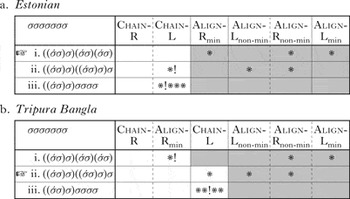
Estonian values exhaustivity higher than ternarity, allowing multiple binary feet whenever needed; in the same-sized strings, Tripura Bangla attaches more importance to ternarity, leaving one syllable unparsed. This difference is due to the relative ranking of Chain-L and Align-Rmin.
Finally, the difference between Tripura Bangla and Cayuvava can be observed in the even-parity forms in (40).
-
(40)
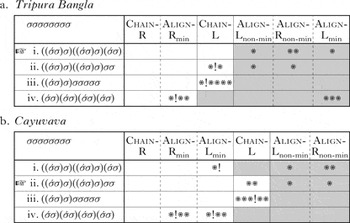
Tripura Bangla prefers binarity to non-exhaustive parsing; Cayuvava the reverse. The crucial constraints are Chain-L and Align-Lmin.
4 General discussion
4.1 Minimal recursion
After the presentation of the empirical force and typological coverage of our theory of ILT feet, there is a major conceptual issue that still needs to be addressed: why are recursive feet different from other recursive prosodic structures? In other words, why is recursion at the foot level minimal, if prosodic recursion at other layers of the prosodic hierarchy can in principle be unbounded (Wagner Reference Wagner2005, van der Hulst Reference Hulst and van der Hulst2010)?
We believe that the answer to this question lies precisely in the different nature of supra-foot prosodic categories (e.g. the prosodic word, the phonological phrase, etc.) and lower prosodic categories such as the foot. As traditionally acknowledged in prosodic hierarchy theory (e.g. Selkirk Reference Selkirk1980, Reference Selkirk and Fretheim1981, Nespor & Vogel Reference Nespor, Vogel, van der Hulst and Smith1982, Reference Nespor and Vogel1986), prosodic constituents above the foot are generally defined in relation to their corresponding morphosyntactic categories. That is, the prosodic word is defined in relation to the morphosyntactic word, the phonological phrase in relation to the syntactic phrase, etc. (Ito & Mester Reference Ito and Mester2013: 21 and references therein). Since syntactic structure in principle displays unlimited layers of recursion, it is not unexpected that prosodic categories above the foot display unlimited layers of recursion too (e.g. Ladd Reference Ladd2008, Wagner Reference Wagner2010, Ito & Mester Reference Ito and Mester2013). The foot is different in that it is not defined by its relation with morphosyntax, but according to phonological properties such as rhythm, sonority and relative prominence. A foot expresses a rhythmic relation between strong and weak nodes in the prosodic word. Consequently, foot recursion is in principle unmotivated, and has therefore often been completely banned from Gen (Ito & Mester Reference Ito and Mester2007).
Given that there is recent non-stress evidence for ILT feet (see again §1 and §2 and references therein), as well as stress evidence (there are languages with ternary rhythm and mixed binary–ternary rhythm, but not with quaternary rhythm), this paper has investigated the possibility of minimally relaxing the ban on recursion at the foot level, exploring the typological consequences of a framework with minimally recursive feet. More specifically, in our model only Ftmin can participate in the adjunction operation in Gen, giving rise to ILT feet.
A thorough investigation of the representational and typological predictions made by a theory allowing feet with more than one layer of recursion would require another full-length study. Although we have not found compelling linguistic evidence for multiple layers of recursion at the foot level (not even in languages with one stress per ω), and even though there is no apparent syntactic motivation for recursion at this level of the prosodic hierarchy, it still needs to be explored (i) whether it is desirable to allow multiple layers of foot recursion, and (ii) whether there is in fact any compelling distributional evidence for positing such structures. If there is evidence that Gen can produce such types of multiply recursive feet, our constraint set would need to be reconsidered, since our current non-intervention constraints would favour multiply recursive feet, e.g. [((((Ft)σ)σ)σ)σ)]ω, over flatter multiply footed structures, e.g. [(Ft)(Ft)(Ft)]ω, and over structures with a single foot plus a sequence of unparsed syllables, e.g. [(Ft)σσσσ]ω, under certain circumstances. This is because our non-intervention constraints specifically target multiply footed structures and sequences of unparsed syllables, but not multiply recursive feet.
In an earlier stage of our research, we explored a version of Gen which also allowed Ftnon-min to participate in the adjunction operation, i.e. we assumed that feet could display more than one layer of recursion. However, the factorial typologies in this approach (comparing our current constraint set with others containing no restrictions on the levels of recursion allowed by Gen) were unable to predict half of the attested systems. For these reasons, and given that it is uncertain which metrical systems could possibly benefit from being analysed with multiply recursive feet, we have followed the lead of authors like van der Hulst (Reference Hulst and van der Hulst2010) and Ito & Mester (Reference Ito and Mester2007, Reference Ito and Mester2013), who suggest that the absolute upper limit on recursion in the foot reflects its intrinsic relation with rhythmic well-formedness, whereas supra-foot prosodic categories, which display a closer relation with syntax, may involve various layers of recursion.Footnote 10
4.2 Unbalanced recursion
Prosodic recursion can take one of two forms: (i) balanced, where a higher node dominates two (full) categories of the same type (41a), and (ii) unbalanced, where a category of a lower level is adjoined to a higher-level category (41b) (van der Hulst Reference Hulst and van der Hulst2010: 322, Vigário Reference Vigário2010: 491). This latter type of structure has been proposed for clitic adjunction in various languages, and matches the type of structure currently proposed for ILT feet, where a syllable is adjoined to a foot to form a superordinate foot, e.g. ((Ft)σ)Ft.
-
(41)
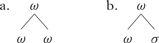
Given that balanced prosodic structures have been proposed for other prosodic categories (e.g. a prosodic word dominating two prosodic words (Ito & Mester Reference Ito, Mester, Grijzenhout and Kabak2009: 96a), or an intonational phrase dominating two intonational phrases (Myrberg Reference Myrberg2013)), one might wonder whether it is appropriate to ban balanced feet (e.g. ((σσ)Ft(σσ)Ft)Ft) from Gen. Some authors have posited balanced feet (referred to as ‘cola’) to account for the existence of tertiary stress in languages like Hungarian (Hammond Reference Hammond1987, Green Reference Green1997) and Passamaquoddy (Stowell Reference Stowell1979). However, later research has questioned the empirical status of tertiary stress in these languages, weakening the arguments for cola (e.g. LeSourd Reference LeSourd1993, Siptár & Törkenczy Reference Siptár and Törkenczy2000).
In our study, we have also banned balanced feet from Gen. That is, we have assumed that Gen does not generate any non-minimal feet such as those in (42) below. Once again, we believe that this difference between recursive feet and recursive supra-foot prosodic categories, which may be balanced, emerges from the close relation between foot-level prominence and rhythm. At higher levels of the prosodic hierarchy, where syntactic structure is mapped onto prosodic structure, prosodic categories are not defined by their phonetic properties, but by their particular relation with (morpho-)syntax. In syntax, a category can be self-embedded in a category of the same type, and hence a head can contain more than one head. In contrast, the rhythmic nature of the metrical foot strictly links up the notion of ‘head/stress’ and ‘foot’ in a one-to-one fashion: a foot can have at most one head. In the same way that binary feet with two heads (e.g. (σhσh)) have generally been excluded from Gen (cf. Bye Reference Bye1996, Kager Reference Kager, Nespor and Smith1996), we assume that recursive feet that dominate two feet are also excluded. Note that a balanced foot implies that a non-minimal foot contains more than one foot head at the syllable level. One of the predictions of a language with balanced feet of this sort is that multiple levels of stress can arise, as illustrated in (42), where tertiary stress is represented as σ̆.
-
(42)
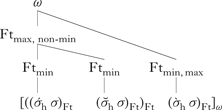
The primary-stressed syllable is at the same time the head of a minimal foot, the head of a balanced foot and the head of ω. The secondary-stressed syllable is the head of a minimal foot, which is also maximal. Finally, the tertiary-stressed syllable is the head of a minimal foot, which is located in the dependent position of the balanced foot (or colon). It surfaces with stress, but this stress is weaker than the others, due to its dependent status. Self-embedding more than one foot in a recursive foot has various implications with respect to prominence, multiplying the levels of stress, but also the types of weak syllables. Since we do not know of any system or phonological phenomena that could benefit from these structures, and we believe that at lower levels of the prosodic hierarchy, headedness is a definitional property (i.e. the presence of one syllable head or one foot head entails the presence of exactly one syllable/foot), we have not incorporated balanced feet into our analysis.
4.3 Categorical vs. gradient alignment
Our theory of non-intervention categorical alignment constraints offers a new way of accounting for rhythmic stress distributions, which have previously been analysed by means of gradient alignment. Here we focus on some formal properties of categorical and gradient alignment, and on some differences in typological predictions.
In a formal sense, categorical and gradient constraints differ in the maximal number of violation marks they assign to a locus of violation (McCarthy Reference McCarthy2003: 79). Gradient alignment constraints are known to cause a non-linear ‘quadratic’ relationship between the number of elements in a domain evaluated by a constraint and the number of violation marks it assigns (Bíró Reference Bíró2003; similar arguments are put forward by Riggle Reference Riggle2004 and Heinz et al. Reference Heinz, Kobele and Riggle2005). In contrast, the maximum number of violation marks assigned by a non-intervention categorical alignment constraint is a linear function of the number of loci of violation per form.Footnote 11
A potential concern about non-linearity is related to computational tractability. Several proposals have been made to implement OT grammars as finite state transducers (FSTs) (e.g. Ellison Reference Ellison1994, Frank & Satta Reference Frank and Satta1998, Karttunen Reference Karttunen, Karttunen and Oflazer1998, Gerdemann & van Noord Reference Gerdemann, van Noord, Eisner, Karttunen and Thériault2000). Yet it is known that quadratic constraints cannot be implemented as FSTs (e.g. Eisner Reference Eisner1997, Frank & Satta Reference Frank and Satta1998, Bíró Reference Bíró2003). However, as pointed out by an anonymous reviewer, ‘interpretability by a finite state grammar is neither necessary nor always sufficient for computational tractability under all forms’. In sum, quadratic constraints have more computational power than linear ones, yet this only leads to formal concerns if we adopt assumptions on the implementation of OT grammars that are not universally accepted.
A second set of arguments raised against gradient alignment constraints concerns incorrect typological predictions, such as ‘midpoint pathology’ (Table XIIc; see Eisner Reference Eisner1997, Hyde Reference Hyde2012) and unattested distinctions in directionality among metrical systems (e.g. Kager Reference Kager2001, McCarthy Reference McCarthy2003). Yet, as we argued in §3, criteria for pathology and insights into effects on learnability are currently insufficiently developed to base a decisive argument on.
Empirically, it might be asked whether gradient alignment is crucially needed to model metrical patterns. Among the critical cases which have been examined (McCarthy Reference McCarthy2003: 116ff, Hyde Reference Hyde2012: 809ff), one stands out. In languages such as Maithili, Hindi, Paumari and Banawá, the primary stress foot cannot be in word-final position, so that the primary stress is retracted to the penultimate foot. This n−1 pattern, described using foot extrametricality in rule-based theory (Hayes Reference Hayes1995: 77), can be analysed in gradient alignment theory by ranking Non-finality(Ftmain) above Rightmost(Ftmain), pulling the primary stress onto the penultimate foot. It may seem that categorical alignment has no account, yet this is not the case. The pattern is analysable by ranking Non-finality(Ftmain) above a non-intervention constraint Align-L([Ftmax]ω, [Ftmain]ω, ω): ‘For every maximal foot [Ftmax]ω assign a violation mark if some main foot stress [Ftmain]ω intervenes between Ftmax and the left edge of its containing ω’, as in (43).
-
(43)
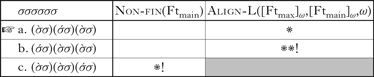
Note that the current set only includes constraints whose separator category is an unspecified category, e.g. Ft. Separator-specific non-intervention constraints are not included, since we have not considered non-finality effects (see §4.4). Interestingly, (43) shows that a categorical non-intervention constraint may produce gradient effects while still being linear (not quadratic), as its locus of violation is Ft. In sum, there seems to be no compelling evidence that gradient alignment is crucially needed.
Our approach to circumventing gradient alignment is not the first on record. Previous attempts have been based on the ‘rhythmic licensing’ framework of Kager (Reference Kager2001, Reference Kager2005). This framework sets up constraints to license rhythmic configurations such as (extended) lapses and clashes near specific landmarks, such as word edges and stress peaks. Typological and computational studies exploring this approach include McCarthy (Reference McCarthy2003), Heinz et al. (2005) and Houghton (Reference Houghton2006, Reference Houghton2008). A full review of this framework is beyond the scope of this paper, but we note here some criticisms that have been raised against it, such as the problem of stressing sequences of light syllables occurring between heavy syllables (Alber Reference Alber2005), pathological patterns such as ‘lapse-licensing’ (Heinz et al. Reference Heinz, Kobele and Riggle2005), the complex locus of violation of lapse-licensing constraints (Buckley Reference Buckley2009) and the inability to deal with distance-counting patterns (Hyde Reference Hyde2012). None of these problems carry over to the present framework, however.
Since no decisive formal or typological arguments can be made against gradient alignment that might favour categorical alignment, we conclude that the two theories seem to be equally able to account for gradient metrical distributions. As pointed out by Alan Prince (personal communication), having two full-fledged theories of alignment instead of only one allows us to better evaluate their insights and shortcomings.
4.4 Non-finality
This study has not considered effects of constraints that enforce non-finality in the factorial typology. In order to motivate this, we must separate out the three main types of non-finality effects. It will become clear that in two out of three cases our account is nearly identical to standard accounts, while in a third case, which we consider first, we have offered a reanalysis.
The first non-finality effect is syllable unparsability at edges, the device which leads to locating a foot one syllable away from the edge (Hayes Reference Hayes1982, Prince & Smolensky Reference Prince and Smolensky1993). At the right edge this leads to parsings such as …(σ́σ)σ]ω, needed for antepenultimate stress in Macedonian, Latin, etc., and at the left edge to parsings such as ω[σ(σσ́)…, required for third-syllable stress in Kashaya, Azkoita Basque, etc. ILT feet generally alleviate the need for non-finality in such cases, reanalysing them as …((σ́σ)σ)]ω and ω[(σ(σσ́))… respectively (see §4). (See Kager Reference Kager2012 for discussion of the ILT foot typology in trisyllabic window systems at the left and right word edges.) In summary, in an ILT framework, syllable unparsability at edges is not needed, and is clearly undesirable, because ILT feet in combination with unparsability incorrectly predict stress on the fourth syllable from the edge. Residual cases of unparsability fall out from the interaction of syllable unstressability at edges with foot-form constraints.
The second type is foot extrametricality (Hayes Reference Hayes1995, McCarthy Reference McCarthy2003, Hyde Reference Hyde2012), which leads to the desired effect of removing the primary stress of the final foot, and relocating it on the rightmost non-final foot. Such cases were discussed in §4.3, where it was shown that our theory accounts in principle for such effects by the interaction of Non-finality(Ftmain) – the constraint also used in standard accounts – with the separator-specific non-intervention constraint Align-L([Ftmax]ω, [Ftmain]ω, ω).
The third non-finality effect is syllable unstressability at edges, associated mainly with patterns with iterative binary iambs with a foot-prominence reversal (to a binary trochee) on the final foot, e.g. (σσ́)(σσ́)(σσ́)(σ́σ). The constraint responsible bans stress (but not foot structure) from final syllables (see Gordon Reference Gordon2002, for example). Such patterns occur in languages such as Hopi and Ashininca, and in ‘restricted trisyllabic window’ systems in which primary stress can be antepenultimate or penultimate, but not final. Our analysis is identical to the standard analysis (see Kager Reference Kager2012 for discussion of window systems).
5 Conclusions
This paper has offered a novel OT analysis of binary and ternary rhythm, using a restrictive format of categorical alignment constraints of the non-intervention type (McCarthy Reference McCarthy2003). A factorial typology of the constraint set does not undergenerate rhythmic stress systems, and mostly avoids pathological overgeneration. Our alignment constraints are computationally restricted in the sense of lacking quadratic power. Overall, the approach is based on principles that aspire toward locality.
On the representational side, we have argued for the rehabilitation of ILT ternary feet in metrical theory. Contrary to the traditional view that the unique raison d’être of ternary feet is their ability to model ternary stress, we have proposed that several foot-conditioned processes in languages with binary stress, as well as in languages with mixed stress patterns, also necessitate ILT feet. This is corroborated by the resulting typology, which suggests that the boundary between binary and ternary systems is not absolute; rather, a continuum emerges, such that binary and ternary feet may coexist in rhythmic stress systems.
At a conceptual level, our non-intervention constraints and the minimally recursive foot constitute an attempt to adhere to locality principles both from the point of view of the formulation of constraints and the possible representations allowed by particular grammars. Our model has thus extended locality from the ‘horizontal’ dimension (adjacency of heads and dependents; non-intervention format) to the ‘vertical’ dimension (minimal recursion; vertical locality conditions).
Since the main focus of the paper is quantity-insensitive stress, the factorial typology in §3 was exclusively based on forms with strings of light syllables. Our typology evidently needs extension to quantity-sensitive (rhythmic) stress systems. Another area of future study concerns the typological properties of non-intervention constraints from the viewpoint of parallel vs. serial OT, which may answer the question whether the ‘residual non-directionality’ is an artefact of parallel evaluation or is fundamentally rooted in the constraint set.