In 2010, Prime Minister Hatoyama Yukio resigned his premiership after only eight months in office. He yielded to public anger after breaking a campaign promise to renegotiate a 2006 base agreement with the United States and close a Marine Corps Air Station in Okinawa. Without a replacement for the Futenma facility, the United States refused to draw down the 28,000 U.S. troops stationed on the island chain. Hatoyama could seemingly do nothing in the face of Washington's insistence that its military would go on occupying nearly one-fifth of Okinawa until Tokyo yielded (Kan Reference Kan2013, 4; Ministry of Defense 2013, 156).
Two years later, the United States and Japan agreed that some 9,000 Marines would be redeployed from Okinawa to other Pacific bases, including Guam and Hawaii.Footnote 1 Rather than an answer to Japanese demands, the move was widely perceived to be part of a larger effort to “rebalance” U.S. forces to face the rise of China and North Korea's nuclear arsenals. It was later announced that no move would take place until the first half of the 2020s, a decade later than specified in the 2006 agreement, and that Tokyo would still have to help pay for it (Kan Reference Kan2013, 4–7). U.S. military forces will remain deployed throughout Japan, notwithstanding the continuing and obvious sensitivity of the American presence. Even when there is a major shift, as in this case, it appears to be on an American timetable and serves American strategic interests.
How is it that American military bases in Japan have endured under different political regimes and despite a series of embarrassing and sometimes violent incidents before, during, and after the Cold War, all the while provoking popular protests, sometimes on a massive scale? Hatoyama was actually the second prime minister to lose office at least in part because of them, if one recalls the 1959–60 protests that brought down Kishi Nobusuke over the Treaty of Mutual Security and Cooperation (Anpo jōyaku; hereinafter Anpo). American bases have clearly had a major impact on Japanese political culture, to the point that whether Japan is fully sovereign on its own territory remains an open question.
Scholars have not neglected such questions. U.S. bases in Japan stand at the junction of two large interdisciplinary literatures. Researchers who seek “policy relevance” analyze the bases in the context of security studies, usually in a global context, to provide answers and recommendations for the military, diplomats, and elected officials. Other scholars instead view the bases in the context of the history of U.S. imperialism and militarism, often using gender and sexuality as frames of analysis. They see themselves as activists working in solidarity with those who oppose the U.S. presence. The two approaches rarely meet, to the point that these distinct literatures disagree even about basic facts. Whereas one side begins with the proposition that the U.S. military presence has been largely without incident, the other argues that the bases have caused grievous harm.
This article seeks to explain the enduring U.S. military presence in postwar Japan by putting these different approaches in dialogue and highlighting the complexity and diversity of Japanese views. First, it argues for a synthesis that integrates diplomatic and social history and analyzes the strategies of both U.S. policymakers and anti-base activists.Footnote 2 As we shall see, diverse elements in Japanese society have shaped attitudes toward U.S. bases. These attitudes cannot be reduced either to the complaisant acquiescence suggested by U.S.-centric political scientists or to the pacifist opposition celebrated by activist scholars. Some oppose the bases simply because they do not want to live near them. Others accept the American presence only because they are economically dependent on them. Moral reformers and union interests with larger agendas have also been active in this struggle, which has served the interests of both socialist and conservative politicians.
While there have been enormous changes in the number and size of the bases, this account shows why certain issues have long served to rally opponents, especially sex work and sexual violence, territorial disputes, and nuclear weapons. This is best illustrated by starting in 1945 and distinguishing distinct periods in the two decades that followed the formal end of the Occupation: the increasing reliance on Okinawa and nuclear weapons beginning in the mid-1950s, the 1959–60 protests over the renewal of the U.S.-Japan Security Treaty, and the negotiations that secured Tokyo's tacit acceptance of U.S. nuclear weapons even after the “reversion” of Okinawa in 1972. In Japan there are few diplomatic documents available on these sensitive subjects, and even a deliberate strategy of sometimes not recording agreements. U.S. diplomatic archives are therefore essential.
Taken as a whole, one can summarize much of this history using the metaphor of soundproofing. The bases have endured because Washington and Tokyo have insulated Japanese society from this foreign military presence, thus reducing the cultural consequences for Japanese society. Fully one-fourth of the budget of the Defense Facilities Administration Agency (Bōei Shisetsuchō)—11 percent of Japan's Defense Agency spending—pays for noise reduction in homes, schools, and other facilities near air bases (Calder Reference Calder2007, 132–33). It began during the Allied Occupation, when a series of laws and anti-fraternization policies aimed to keep sex workers who catered to servicemen off the streets and away from children. U.S. and Japanese authorities gradually reduced the territorial footprint of military bases and shifted troops to Okinawa. Tokyo also had to pretend not to hear when the United States moved nuclear weapons in and out of the country. Understanding how the soundproofing policy came about—and why it has never completely succeeded in muffling popular protests—requires removing some of the sound insulation that has prevented policy scholars and activist scholars from coming into dialogue.
American political scientists have long been intrigued by the case of Japan, a supposedly anti-militarist society with a history of resisting outside rule, which has nonetheless hosted foreign military bases for decades (Calder Reference Calder2007, 132). In seeking to exploit this apparent contradiction, they tend to agree that the immediate postwar years were a formative period, and that it is unlikely that Japan will adopt an aggressive military stance in the future (Berger Reference Berger1998; Katzenstein Reference Katzenstein1993).Footnote 3 Andrew Yeo (Reference Yeo2011, 7) argues that elite views of the United States determine anti-base movement effectiveness and host governments' response to anti-base movements. Alexander Cooley (Reference Cooley2009, 15) has a distinct but complementary argument, finding that base frameworks are most stable under consolidated democracies. Kent Calder's “contact hypothesis” proposes that when conflict occurs it is “a function of how frequently and intensely base inhabitants and the general community interact.” He also emphasizes “compensation politics.” Calder, like Cooley, considers this vital—and ubiquitous—in Japan (Calder Reference Calder2007, 75–76, 132; Cooley Reference Cooley2009, 193–95).
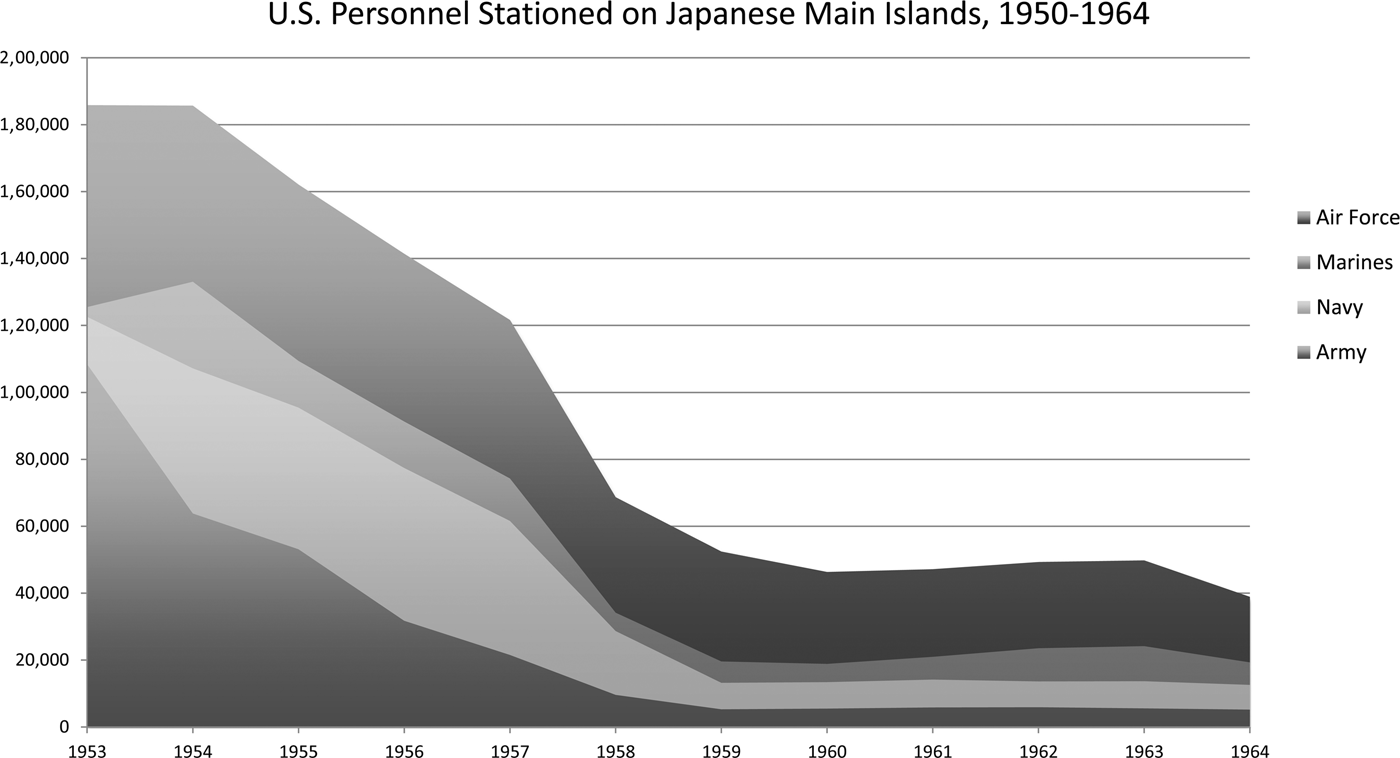
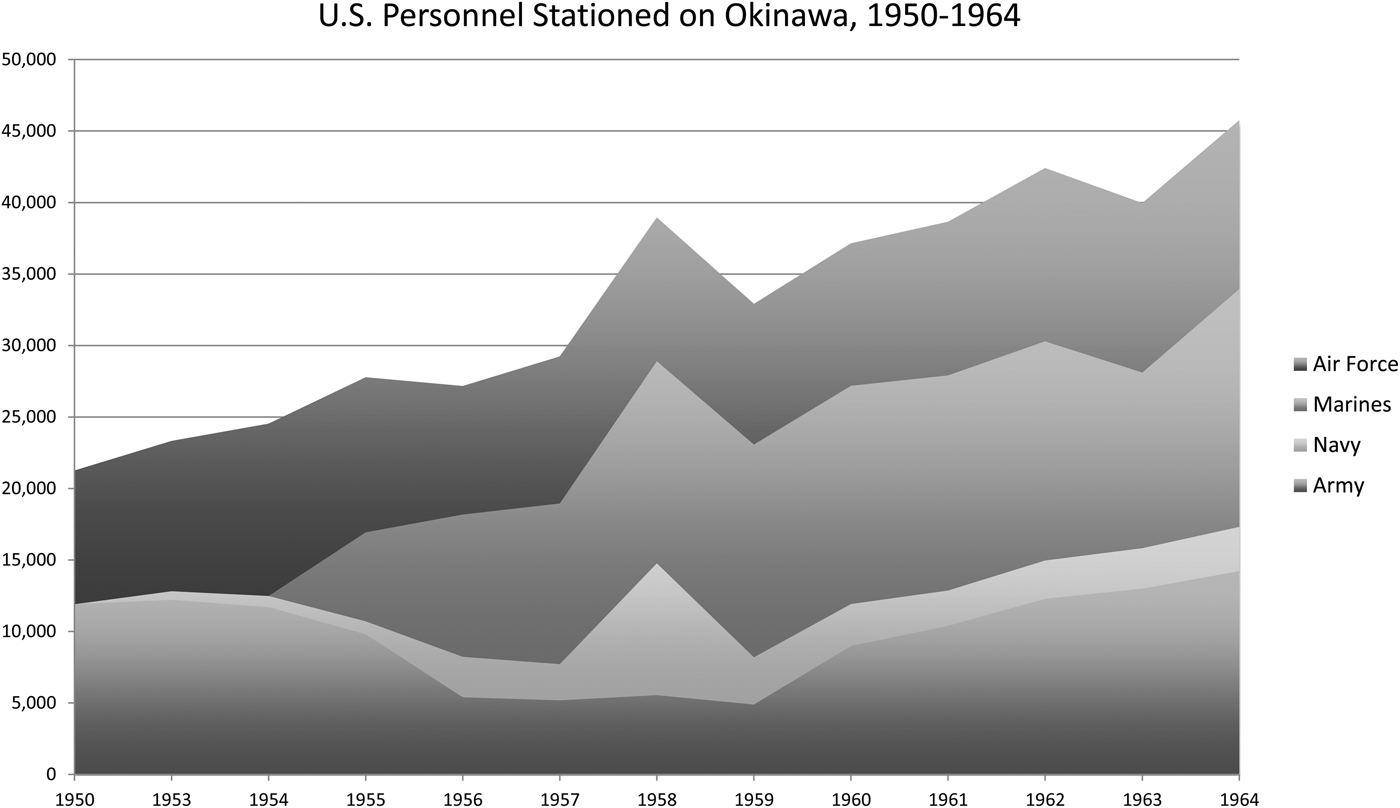
Policy scholars would point out that anti-base agitation in Japan pales by comparison with the bombings and kidnappings that once targeted U.S. servicemen in Germany, Spain, and Italy, to say nothing of the mass-casualty attacks in Saudi Arabia, Iraq, and Afghanistan. But they tend to overlook variation over time. Calder, for instance, suggests that “there have been virtually no incidents against these foreign, largely American troops,” failing to note the often violent nature of encounters between U.S. troops and Japanese civilians during the Occupation, or the massive nature of the Anpo protests (Calder Reference Calder2007, 132). He also treats factors like the concentration of U.S. troops as a binary: bases are, or are not, widely distributed. Yet in Japan there have been dramatic shifts in the number and distribution of U.S. forces (see figures 1 and 2). It would be surprising if the same generalizations held across the entire postwar period, when the nature of both the Japanese “elite” and Japanese democracy—the two factors emphasized by Yeo (Reference Yeo2011) and Cooley (Reference Cooley2009)—were often in question.
U.S. personnel stationed on Japanese main islands. Based on data in Umebayashi (Reference Umebayashi2002, 126–27).

U.S. personnel stationed on Okinawa. Based on data in Umebayashi (Reference Umebayashi2002, 126–27).
When their hypotheses do not hold up, the policy scholars sometimes shift from a national to a subnational level of analysis, using the contact hypothesis to attribute protests in particular towns to the ratio of U.S. servicemen to Japanese citizens (Calder Reference Calder2007, 122). But protesters have often traveled long distances to mass forces at particular bases, greatly complicating the question of why demonstrations occur in one place rather than another. Since policy scholars start with the premise that the bases arouse little opposition, they tend not to investigate the reasons for the protests that do occur.
The contact hypothesis, however reductionist, nonetheless represents one of the few examples of tacit agreement between policy scholars and activist scholars. In effect, Calder (Reference Calder2007) takes it as a given that the more contact there is between U.S. servicemen and foreign civilians, the more conflict will ensue. Whereas for Calder this is a problem to be managed, for activist scholars—typically pacifists—U.S. bases are always and everywhere a problem that should be ended. As Catherine Lutz (Reference Lutz2009, 29) has written, “support for foreign military bases hinges first on the idea that war is often necessary and ultimately inevitable.” For Lutz, this is a dangerous illusion.
Lutz is one of a number of feminist scholars, beginning with Cynthia Enloe, who have explored the gendered nature of U.S. force projection and the complex ways in which it depends on women—as wives, maids, and sex workers—while provoking other women to spearhead protest movements (Enloe Reference Enloe1990, 67). Many view all U.S. military bases as part of the history of militarism, including the unresolved debate over Japan's wartime responsibility and atrocities such as the sexual slavery of the military comfort women. Not coincidentally, scholars like Yuki Tanaka (Reference Tanaka2002) tend to emphasize the importance of issues like prostitution and sexual violence around American bases. During the U.S. intervention in Iraq, feminist scholars such as Hirai Kazuko (Reference Hirai2004) explicitly compared the sexual violence perpetrated against women during the U.S. occupation of Iraq with the Allied Occupation of Japan. The sociologist Hayashi Hirofumi (Reference Hayashi2012) also places the American global base network within the larger history of U.S. expansionism. Umebayashi Hiromichi (Reference Umebayashi2002, 188) argues that bases on Japanese soil are there to serve U.S. military strategy, not Japan. In an effort to expose Japan's reliance on U.S. military power, he meticulously records the presence of U.S. bases in Japan. The book assumes that the Japanese public is unaware of the extent to which the American military presence is imbricated in Japanese foreign and domestic policy. The online Asia-Pacific Journal: Japan Focus has become a key node in this transnational network of scholars who oppose U.S. bases.
The fact that most Japan scholars who write about U.S. bases share an anti-war orientation can leave critical questions unanswered, beginning with whether, for instance, Tokyo might have more influence than commonly assumed in decisions like the redeployment of U.S. forces to face China and North Korea. Does it still make sense to call Okinawans an “abandoned people” when they annually host millions of Japanese tourists and have a higher per capita GDP than Italy or Canada (Inoue Reference Inoue2007, 66–67; Norimatsu Reference Norimatsu2011)? If the U.S.-Japan alliance ended, might Tokyo not expand its own military capabilities—perhaps even in Okinawa—or face new threats to its sovereignty? Over the last two decades, the Japanese national press has occasionally been galvanized by the issue of U.S. bases, but not because of fatal accidents or environmental pollution—grievances that figure large in Japan Focus. Why is it incidents of sexual violence—and not environmental damage or accidental deaths—that have developed into diplomatic crises?
Any convincing account of the resilience of U.S. bases must begin by acknowledging the tremendous changes they underwent over the last seventy years, in no small part because of persistent resistance to them. After Tokyo's devastating loss in World War II, troops from several nations occupied bases in Japan, including Australia, New Zealand, and India in addition to the United States. Their number peaked in late 1945 and early 1946 at 430,000. It gradually declined until 1950, when most of the British Commonwealth Occupation Forces had departed and just 115,000 Americans remained. During the Korean War, the U.S. contingent more than doubled again to 260,000. Many more thousands of servicemen streamed through Japan on their way to and from the war (Kovner Reference Kovner2012, 19).
This was the period in which the American military had maximum cultural impact. “Demilitarization and democratization,” the slogan of the Occupation, was the subject of many a bestseller. Education reforms meant new textbooks for students and, until they arrived, students crossing out undemocratic words and lines. The U.S.-written Constitution of 1947 gave Japanese women more status, through the power both to vote and to stand in parliament. The dismantling of the household system was another epochal change. Films started to portray men and women choosing their own partners, and many Japanese followed suit. Other trends proved more ephemeral, such as the kasutori (dregs) culture, in which decadence and escapism became the only way to live (McDonald Reference McDonald1992; McLelland Reference McLelland2012). After years of military songs, American jazz soared in popularity, as the Armed Forces radio station and entertainment facilities on bases formed an improbable avant-garde. This meant Japanese jazz musicians would also thrive after years of hardship (Atkins Reference Atkins2001, 159, 174). In Tokyo, “Little America,” site of MacArthur's General Headquarters, stood in place of Tokyo's financial district. English signs were everywhere, and the ability to communicate with the occupiers could mean at the least food and sometimes much more.
For some Japanese, the Occupation period, especially at the beginning, was a time of violence and humiliation. Many troops arrived directly from combat zones, and there were dozens of reports of how they raped and robbed defenseless civilians. The number fell quickly, although some argue it was only because victims realized they had little recourse. Even before the Occupation began, Japanese authorities set about preparing brothels, or “Recreational Amusement Associations.” Yet the Supreme Command for the Allied Power (SCAP) shut the Recreational Amusement Associations down in 1946, creating a deregulated market in sexual services (Kovner Reference Kovner2012, 49–73).
The streetwalking panpan, who appeared willingly to sell sex to servicemen, became the most conspicuous symbol of Japan's loss of empire and compromised sovereignty. Yet sex workers, and the entertainment of servicemen more generally, were critical in Japan's economic recovery, earning scarce dollars and supporting many ancillary occupations—from seamstresses to barkeepers to letter-writers.Footnote 4 Base towns boomed, especially during the Korean War, and some began to resemble the Las Vegas strip.Footnote 5
No less important in terms of cultural impact was the reaction against the U.S. presence. Not everyone was happy about Americans rewriting the Constitution, or the “reverse course” that soon followed with the beginning of the Cold War. Open criticism was censored, and demonstrations could be banned. The fashion for American music, theater, and books faded once the United States no longer seemed to stand for “demilitarization and democratization” (Dower Reference Dower1999, 525–27). SCAP cooperated closely with Japanese elites, suppressing dissent as they retained the emperor and created a new imperial state (Marotti Reference Marotti2013, 37–73, esp. 49).
As a matter of international law, the end of the Occupation was declared with a peace treaty signed in San Francisco on September 8, 1951. Yet it seemed to begin again five hours later with the U.S.-Japan Security Treaty. Both treaties came into effect in April 1952, as the Korean War still raged, when they were ratified by the Diet. The Security Treaty's first article permitted the United States to base land, air, and sea forces in Japan without explicitly committing them to its defense. The treaty also permitted the United States to “put down large-scale internal riots and disturbances in Japan” (Department of State 1957).
There were also administrative agreements between the two governments that did not even come before the Diet. They gave U.S. troops the use of “not more than” 1,400 installations and some 245,000 acres gratis. Japan would also have to contribute $155 million in yen annually (Packard Reference Packard1966, 7–8). As George Packard has argued, happiness at finally being readmitted into the family of nations overcame “shadow doubts” about the Security Treaty (Miller Reference Miller2012; Packard Reference Packard1966, 31). The treaty's term was indefinite—another reason why, for many, it did not end the Occupation but marked a new beginning.
The nature of the foreign military presence, and not just the nationality and number of servicemen stationed in Japan, changed over time. U.S. military rule persisted in Japan until 1972, when Okinawa reverted to Japanese control. Although the Allied Occupation ended in 1952, and in 1960 renegotiation reduced American authority to intervene in Japanese affairs, U.S. military bases remained. This base presence resulted in an atmosphere of semi-occupation for many Japanese men and women. Some of the same issues that had been important in the Allied Occupation remained salient. The bodies of sex workers, for instance, had become a site at which men and women could begin to reassert national sovereignty during the Allied Occupation. The focus on sex workers also served to occlude other issues around military bases, such as the way many more Japanese profited from the U.S. presence.
Nonetheless, many Japanese targeted sex workers as the worst exemplars of “postwar” culture. Worries about their biracial offspring helped win passage of the 1948 Eugenic Protection law, making Japan one of the first countries to have legal abortion. Commanders were also critical, mainly because they perceived these women—rather than servicemen—as a source of venereal disease. They viewed marriages with Japanese women as detrimental to morale, and worried about condemnation both in Australia and the United States. Allied commanders periodically ordered crackdowns, such as raids and compulsory V.D. exams that swept up—and humiliated—many Japanese women. But even the most hardline commanders of the British Commonwealth Occupying Force found it impossible to stop sex work altogether (Kovner Reference Kovner2012).
During the Korean War, activists succeeded in passing many local laws against sex work but repeatedly failed to pass national legislation. Brothel and bar owners were an important constituency for conservative politicians. As one Sasebo bank executive argued in 1953, sex work was an essential part of the economy, generating dollars equivalent to 100 million yen, and contributing to a better standard of living for the city. Not only should citizens not disdain sex workers, he concluded, they should thank them (Inomata et al. Reference Inomata1953). In effect, all of Japanese society, including its government, was complicit in profiting from the economic recovery sparked by the Korean War, in which GIs on “R and R” were only one conspicuous symbol.
Anti-prostitution activists did not begin to gain traction on the national level until they took up a new line of attack. In August 1955, professor Shimuzu Ikutarō wrote in the women's monthly Fujin kōron how military bases threatened families: “along with the bases come their accessories; the prostitutes, cabarets, bars and a generally bad environment for children.” He argued that “this environment leaves its influence on the children no matter how conscientious parents and teachers are.” Shimizu used prostitution and the threat to children to argue for abolishing the Japanese-American administrative treaty, since it allowed for permanent U.S. bases (Shimizu Reference Shimizu1955).
Crime was a major concern for activists—particularly women. Once censorship ended, the Japanese press regularly reported on rapes, murders, and robberies committed by American servicemen. After the Japanese jurisdiction clause went into effect in October 1953, American servicemen were charged with hundreds of serious offenses. The Asahi Weekly reported many soldiers' crimes, but focused on crimes against children, in particular the case of Yumiko, a six-year-old kidnapped girl, whose dead body showed evidence of rape. According to the Asahi Weekly, an American sergeant was responsible (Asahi Weekly 1956). But Japanese authorities waived jurisdiction in the vast majority of cases, instead turning the culprits over to their commanders. Victims could not sue anyone during the Occupation, and when the peace treaty was signed, Japan abandoned the right to ask for compensation.
What finally provoked a national law against sex work was the realization that there was no way even to stop men who engaged in child prostitution. On May 10, 1955, the Asashi shinbun reported that in Kagoshima the Saryō Matsumoto teahouse employed high school students, among others, to entertain powerful local men. Because of Japan's inadequate national prostitution laws, the Public Prosecutor's Office was unable to punish anyone. The case, and others that directly involved American servicemen, had a catalytic effect on female legislators (Kovner Reference Kovner2012, 114–15, 132). After the Diet passed the Prostitution Prevention Law, the National Police Criminal Board composed a blacklist of 852 foreign civilians plus several high-ranking American and other diplomats and U.S. military officers to be prosecuted and expelled (Los Angeles Times 1957; Washington Post and Times Herald 1957).
The Prostitution Prevention Law, which ended a 300-year tradition of tolerating sex work, should therefore be considered, at least in part, as reflecting the impact of the U.S. military and the Japanese reaction to it. Of course, complaints about American servicemen soliciting women would continue. But sex workers now tended to work in bars and cabarets rather than walking in the street (Sasebo Municipal Archives 1964a, 1964b). By keeping the streets quiet and clear of sex workers, the law effectively soundproofed most of Japanese society from the most humiliating aspect of the American presence, making it less noticeable and more tolerable.
Efforts to limit the territorial footprint of particular military bases provided another way to contest and ultimately contain the U.S. presence. In 1955, after the Japanese government agreed to fund the expansion of runways at Air Force bases to accommodate new jet aircraft, the Asahi shinbun predicted it would be one of the biggest political questions of the year, going so far as to argue that it was turning vague anti-American feeling into a united struggle. On “Hiroshima Day,” an editorial argued, “We feel deeply that it is time to re-consider the whole problem of U.S. bases more closely” (Asahi shinbun 1955a).
When in 1956 the Japanese government surveyed private land in Sunagawa Town to plan the expansion of the runways at the Tachikawa Air Base, residents reacted peacefully at first, with farmers occupying their own land. Sunagawa was ideally situated to bus protesters in, since it was just eighty minutes by car from Tokyo (Packard Reference Packard1966, 131). Additionally, teachers and mothers—organized by Nikkyōso (Japan Teachers' Union)—marched daily to the site. They framed the struggle as about Japan's future: the children. Students and unionists repeatedly clashed with police in attempts to block the survey and disrupt base operations. They argued that Sunagawa was a local example of a national and international issue: land was being taken from farmers to accommodate the jets that would drop nuclear bombs on cities in China and the U.S.S.R. (Gerteis Reference Gerteis2009, 99; Packard Reference Packard1966, 131–33).
After protesters broke through a barbed-wire fence and stormed the runway, seven of the leaders were put on trial. On March 30, 1959, Tokyo District Court Judge Date Akio acquitted them and denied the constitutionality of the Security Treaty. Although the Supreme Court unanimously rescinded the verdict, the press widely reported the case, which gave welcome publicity to the anti-treaty forces. Artists such as director Kamei Fumio memorialized it in film and song (Miller Reference Miller2012, 16). The U.S. government finally gave up on plans to expand the runway.
Opponents elsewhere generally failed to stop the expansion of U.S. air bases. It is important not to exaggerate the scale of anti-base agitation, considering all of the other popular protests through the 1950s (Sugimoto Reference Sugimoto1978, 280, 285). Many if not most of the base protests actually consisted of trade unionists demanding better conditions for workers. U.S. bases, after all, were one of the largest employers in the country, with a workforce of 230,000 at the height of the Korean War (Morris-Suzuki Reference Morris-Suzuki2010, 132). In August 1956, an estimated 100,000–130,000 base workers participated in a country-wide, twenty-four-hour strike against punitive new rules, whereby a delay in assigned work or sleeping on the job were cause for dismissal, even if it was the first such offense. The Asahi shinbun portrayed the workers' struggle as emblematic of Japan's need to win respect from Washington. “United States property” was literally stamped on the back of uniforms worn by base workers. “Even if the work clothes are Americans' the people who wear them are independent Japanese. Please don't look down on us as occupiers” (Asahi shinbun 1956c, 1956b; Washington Post and Times Herald 1956).
Retrospective accounts identify this labor activism as part of the peace movement and in opposition to American power projection (Gerteis Reference Gerteis2009; Sasaki-Uemura Reference Sasaki-Uemura2001). Still, withdrawing U.S. forces altogether would have threatened the livelihoods of unionized employees. In 1957, after the United States announced that 30,000 Army men would be withdrawn, 23,000 employees engaged in another daylong protest at nineteen U.S. bases, demanding government relief measures. As the African American weekly New Journal and Guide reported, “Many Japanese who shouted ‘Yankee Go Home’ are wearing long faces now that the Yanks are really going” (New Journal and Guide 1957).
Other protests in the period that actually protested against the very existence of the bases tended to take two forms. Either they were highly localized, reflecting local resistance to expansion, or they were a more elite phenomenon, whether for social reformers who viewed base prostitution as an affront to Japanese women and children, for journalists concerned about national sovereignty, or for communist and socialist intellectuals, who opposed the U.S. alliance more generally. Even local opposition was not necessarily at the “grassroots” level. At one such protest, a mayor from Niigata—one of the other sites scheduled for a runway expansion—pointed out that the land the government wanted for bases was right behind the port and important for future industry. “The government should take into consideration the fact that this land is necessary for our city's growth and development” (Asahi shinbun 1956a). Farmers, a key constituency for the Liberal Democratic Party, were especially unhappy with the Japanese government's attempts to take their land, even if they would receive compensation. Others were more outraged that the United States sought to use public land in Yoyogi, in the middle of Tokyo, to build bachelor quarters for 2,500 officers. Local authorities had sought to build primary and junior high schools (Asahi shinbun 1955b).
While there were many reasons to protest U.S. bases, it is striking how often these protests were articulated as a defense of children and the future. Even opposition to nuclear weapons testing—an increasingly important theme after the Lucky Dragon No. 5 incident—was justified in these terms. Nobel-winning scientist Yukawa Hideki wrote in Chisei that nuclear weapons presented possible ill effects to children: “If this is repeated for generations the percentage of those who have undesirable hereditary characteristics increases, and may endanger all of mankind. Such fear cannot be called groundless” (Yukawa Reference Yukawa1956).
In 1956, Japan and the United States undertook a series of proactive measures that served to further insulate Japanese society from American servicemen and military bases. Some of these measures—such as the reduction in the number of ground troops and the increasing reliance on airpower and nuclear weapons—were part of a global shift in U.S. strategy during the Eisenhower administration, as shown by the way they were discussed in the National Security Council. Yet the way they were implemented—such as dissolving the Far East command in Tokyo—was intended to “scotch the idea so prevalent in Japan that that country was still occupied,” as Eisenhower's Secretary of Defense, Charles Wilson, put it. “If we could not succeed in destroying this idea, we stood to lose our entire position in the Japanese islands” (Foreign Relations of the United States 1991, 188–89; Jones Reference Jones2010, 324). The rest of the National Security Council was clearly worried about Socialist gains in the Diet, a resurgence of nationalism, and impending Japanese-Soviet negotiations to conclude a formal peace treaty. The only discussion was about whether the Defense Department could move more quickly.
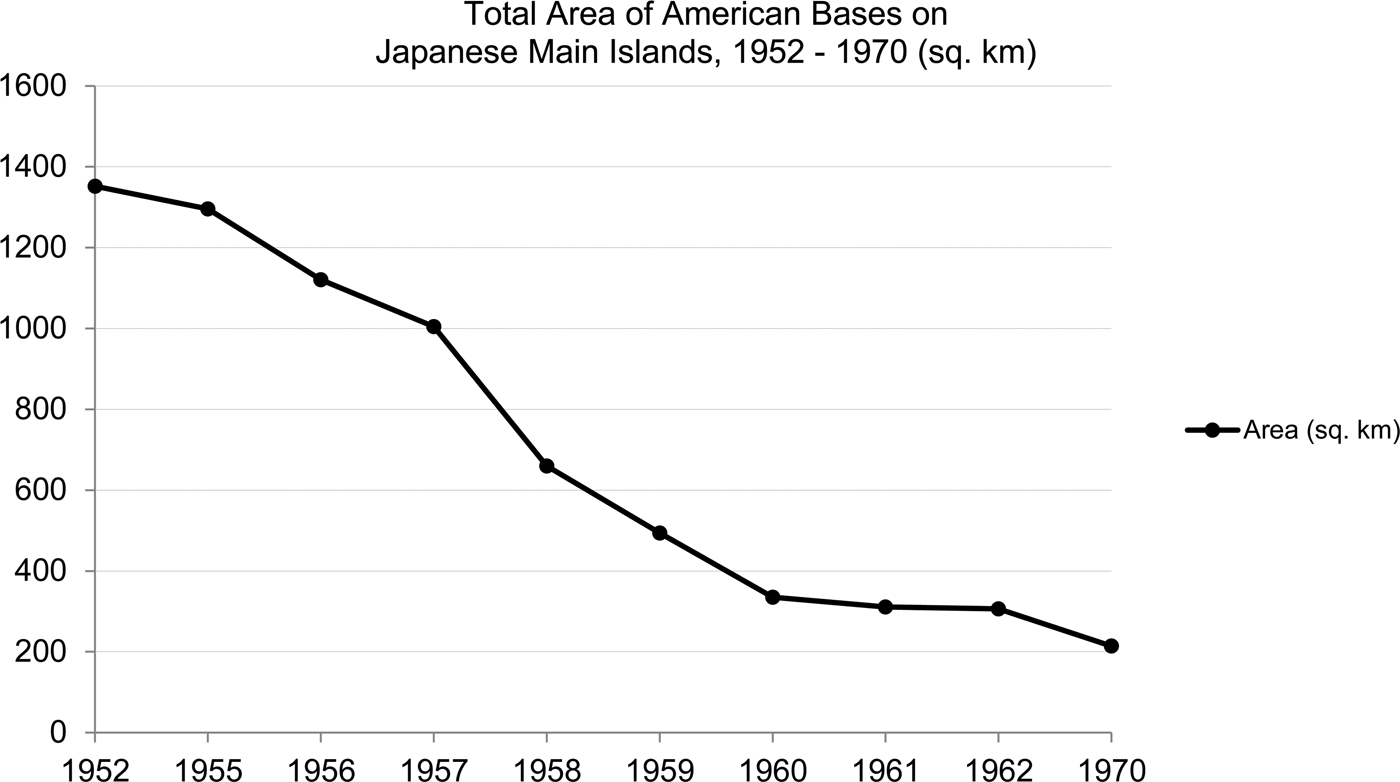
One tactic was to reduce the territorial footprint and the total number of U.S. personnel (see figure 3). By 1955, the United States had already closed many small facilities on the main islands, reducing the total from 2,824 in 1952 to 658 in 1955. From that point it also began closing many of the larger bases. Yet Japan would still host the bulk of U.S. tactical aircraft in East Asia, and it would remain “the most valuable U.S. base complex in the whole Pacific area,” as the 1957 Nash report on overseas bases concluded. There was no prospect of establishing a comparable logistics base anywhere west of Hawaii, what with Japan's skilled labor, tool shops, and seaports (Nash Reference Nash1957).
Total area of American bases on Japanese main islands in square miles, 1952–70. Based on data in Umebayashi (Reference Umebayashi2002, 108).
The key then was to consolidate the remaining U.S. base facilities and military forces in a way that would minimize their visibility and impact. Okinawa, some 400 miles from Kyushu, was ideal for this purpose, and also well-situated for U.S. war plans. From there, even medium-range bombers like the B-47 could reach targets in Southeast Asia, China, and the eastern half of the U.S.S.R. (Sarantakes Reference Sarantakes2000, 66). It would remain under U.S. military occupation and serve as home to a Marine division and—at Kadena—two of the longest airstrips in East Asia. Complete nuclear weapons were deployed there beginning in December 1954. In fact, after 1956, many more U.S. servicemen moved to Okinawa, dramatically shifting their relative distribution away from the main islands. The Nash Report concluded that it was “essential to U.S. security that Japan become militarily secure and remain politically aligned with the United States” (Jones Reference Jones2010, 324). Just in case, the United States also retained control of the Bonin Islands, which were seen as a fallback position if the United States needed an alternate nuclear base (Nash Reference Nash1957).
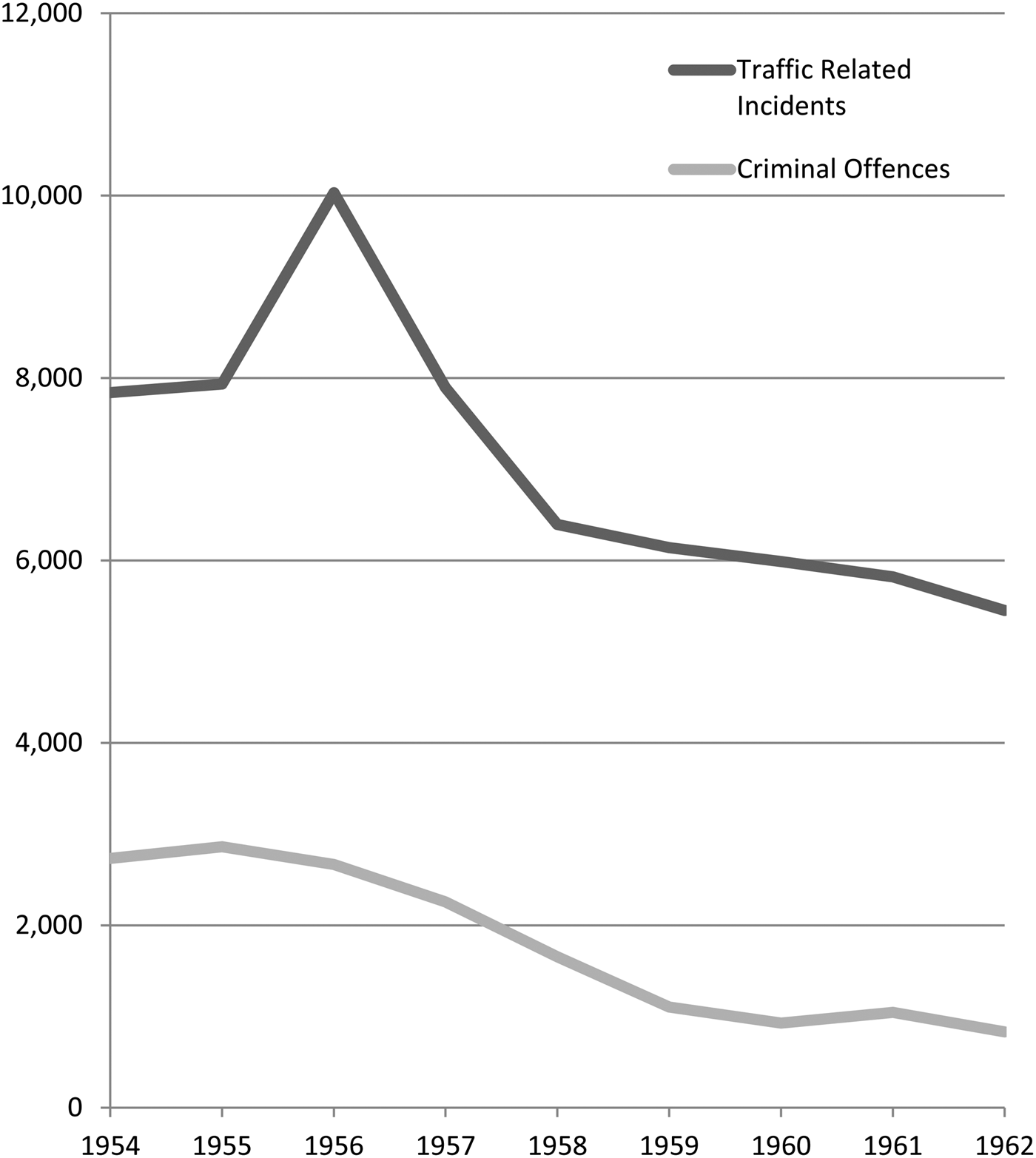
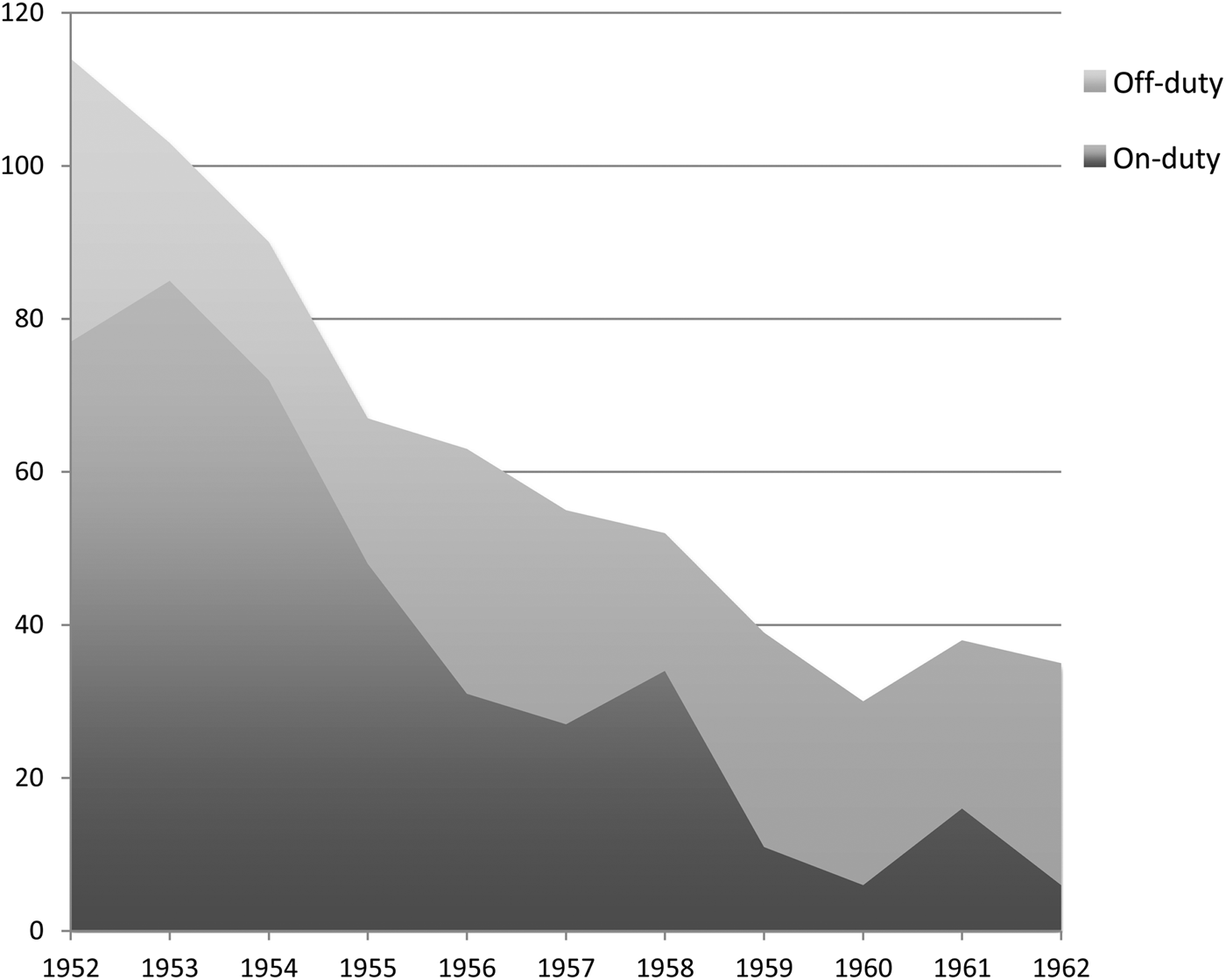
Reducing the number of troops and bases helped commanders reduce rates of crime and, after a spike during the peak period of redeployment, traffic accidents as well (see figures 4 and 5). There was also a drop in the most serious incidents. The 1957 Girard case, in which a soldier killed an elderly woman collecting shells from a firing range, sparked national outrage. Yet such incidents were becoming increasingly rare. When servicemen caused fatalities, whether by accident or criminal intent, it was usually while they were off duty. Officers therefore sought to keep men on bases and reduce opportunities for “fraternization” to a minimum. This could reduce friction—Japanese men preferred not bumping into Americans when patronizing brothels—but it could also breed resentment. Americans living in privileged enclaves, complete with movie theaters and golf courses, still employed Japanese “boy-san” (Morris-Suzuki Reference Morris-Suzuki2010, 127–31; Packard Reference Packard1966, 35–37). Even as the rest of Japanese society was increasingly insulated from the U.S. military, they could sometimes overhear their insulting remarks.
Traffic accidents and criminal offenses attributed to U.S. servicemen in Japan. Based on data in Bōei Shisetsuchō shi hensan iinkai (1973, 55–56).
Fatalities caused by U.S. servicemen in Japan. Based on data in Bōei Shisetsuchō shi hensan iinkai (1973, 55–56).
In 1959, at least twenty million Japanese men and women, including artists, trade unionists, students, and women's groups, joined demonstrations, a unique period in the whole postwar history of U.S. bases in Japan (Kapur Reference Kapur2011, 13; Marotti Reference Marotti2013). The protests were ostensibly about the revision of the 1951 Security Treaty. People feared Prime Minister Kishi Nobusuke's sudden move to revise the Police Duties Performance Law—an expansion of police power to interrogate, search, and arrest. Since it was introduced at the same time as high-level diplomatic talks over the Security Treaty, some feared it would be used to push through the treaty (Sasaki-Uemura Reference Sasaki-Uemura2001, 172–73). It catalyzed the Japan Socialist Party, Sōhyō, and Zengakuren, among others, to fight against the revised treaty.
Ironically U.S. and Japanese negotiators had removed the most offensive provisions, which precluded base agreements with third countries and allowed American troops to put down “internal disturbances.” The revised treaty, which was signed in Washington in January 1960, also established an American obligation to defend Japan against foreign attack, required prior consultation before major movements of troops, and called for economic cooperation. But the need to pass it in the Diet, and also the addition of a ten-year renewable term, gave long-time critics of the alliance the opportunity they needed.
The Socialists followed a strategy of delay, giving the anti-treaty movement more time to gather support, and launched a sit-in at the Diet to prevent a vote. Kishi countered by extending the session and calling in 500 policemen to remove the Socialists from the building. Kishi's parliamentary maneuver ensured that the treaty would automatically be ratified at midnight on June 19, when President Eisenhower was scheduled to visit Tokyo.Footnote 6 Massive protests broke out, and Kishi had to tell Eisenhower that he could not guarantee his safety. An estimated 330,000 people marched on the Diet, the U.S. Embassy, and the prime minister's official residence (Kapur Reference Kapur2011, 13–14). Although Eisenhower's visit was cancelled, the treaty was renewed, and no protest on that scale would occur in Tokyo again.
Anpo is often remembered as unusually violent, and incidents included the death of a Tokyo University female student as well as physical attacks by rightists on other female participants (Marotti Reference Marotti2009; Sasaki-Uemura Reference Sasaki-Uemura2001). This violence itself undoubtedly played a dynamic role in the protests, encouraging artists, among others, to become even more involved (Marotti Reference Marotti2013). Yet large numbers of injuries and even shootings occurred at protests throughout the 1950s (Gerteis Reference Gerteis2009; Marotti Reference Marotti2009; Takemae Reference Takemae2002). Historians do agree that Anpo was nonetheless a watershed moment. For the political left, it was both the zenith of its power and the moment of its greatest defeat, resulting in its fragmentation. Social activists would increasingly focus on consumer issues and the environment (Avenell Reference Avenell2010; Sasaki-Uemura Reference Sasaki-Uemura2001, 2). Many prominent intellectuals, such as Maruayama Masao, Yoshimoto Takaaki, and Shimizu Ikutarō, would “turn their backs” on “progressive politics and activists” (Kapur Reference Kapur2011, 198). For historians who identify with progressive causes, this is another tragic consequence of the U.S.-Japan alliance.
New scholarship has differed on whether these protests can be understood in terms of just one cause. The memories of the war and the imperial state loomed large, and some protestors, aware of U.S. nuclear weapons positioned on warships and bases in Japan, feared a nuclear holocaust (Yamamoto Reference Yamamoto2004, 11). For Simon Avenell (Reference Avenell2010, 3), Anpo was, at a basic level, a case of activists mobilizing men and women into protests through the idea of the citizen (shimin). For Wesley Sasaki-Uemura (Reference Sasaki-Uemura2001, 3), it was a struggle over the form that Japan's democracy would take rather than a critique of its foreign policy. William Marotti (Reference Marotti2013, 134) has argued that the protesters played a performative role, trying to convince rather than compel.
The new scholarship on Anpo suggesting that it cannot be reduced to a protest against the U.S.-Japan security relationship is consistent with the work of some of the first scholars to study these events. Writing in the Journal of Asian Studies some thirty-five years ago, the sociologist Yoshio Sugimoto quantified newspaper accounts of protests outside Tokyo and Hokkaido from 1952 to 1960. He found that they were becoming more frequent in 1957, 1958, and 1959. But the bases and the alliance more generally were relatively minor issues, present in just one in twenty demonstrations (Sugimoto Reference Sugimoto1978, 285). People were far more likely to go to the streets over issues like unsafe working conditions or education. In his classic study of Anpo, Packard found that farmers and fishermen resented the efforts of trade unionists and students to tell them what to protest, and how to protest (Packard Reference Packard1966, 39). Sōhyō, the labor federation, turned out five to six million protestors in 1959, but not to oppose U.S. bases. Instead, members worried that the treaty would lead Japan to switch from extracting coal to importing oil, endangering jobs (Gerteis Reference Gerteis2009, 169–71).
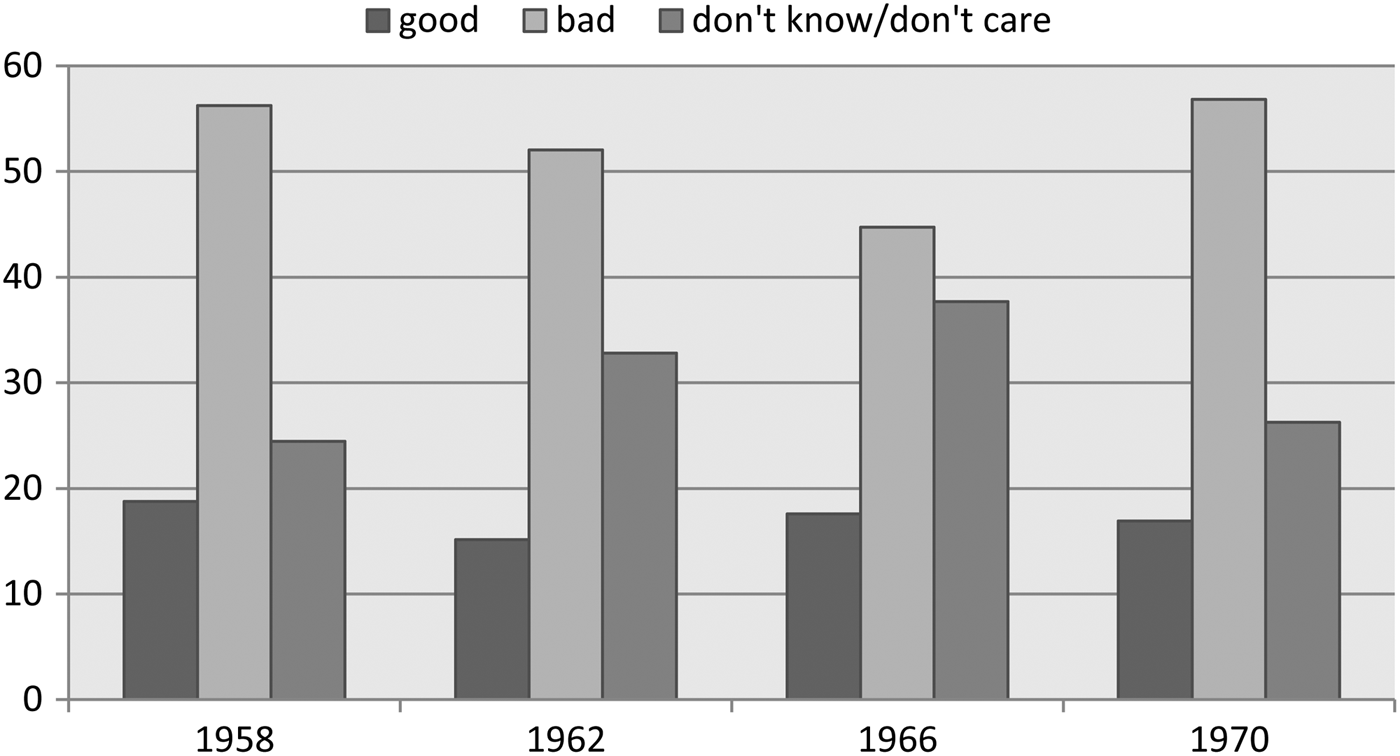
While U.S. bases were never popular, opinion polls before and after Anpo show a clear trend toward increasing indifference through 1966 (see figure 6). It was not until 1970, with the Vietnam War and the renegotiation of the U.S. Security Treaty, that one finds a majority believing that the U.S. presence was bad for Japan. For all its drama, Anpo did not fundamentally alter the U.S.-Japan security relationship. Instead, the more noxious aspects of the U.S. alliance, and U.S. bases, were more and more confined to Okinawa. By keeping bases in Okinawa, considered by many as somewhere “other” than Japan, Tokyo's soundproofing strategy effectively disarmed the opposition.
Opinion polling on U.S. bases (Social Science Japan Data Archive 1958–70). Sources include Social Science Japan Data Archive, Survey M091, “Public Opinion Survey on International Problems (FE4),” 1958; Survey M097, “Public Opinion Survey on International Problems (no. 2),” 1962; Survey M094, “Public Opinion Survey on International Problems (no. 3),” 1966; Survey M095, “Public Opinion Survey on International Problems (no. 4),” 1970. Note: In 1958, the question posed was “What do you think of American bases in Japan? Do you believe that they will benefit Japan?” In 1962 and 1966, the question was “What do you think of the continued presence of the American Army, Air Force in Japan?” In 1970, the question was “Do you think the presence of American bases is good for Japan?”
American and Japanese leaders preferred to focus on “modernization.” As Sebastian Conrad (Reference Conrad2012, 183) has argued, for the United States, modernization theory was a Cold War project, but one that was embraced in Japan because of the way that it elided recent history, above all the recent loss (and subsequent disregard) of empire. As for Okinawa, even oppositional writing favored themes that unwittingly served the convenient myth of Japan as war victim, with Okinawa standing in for the nation—starting with the devastating U.S. invasion, continuing during a prolonged occupation, and suffering even afterward from a massive military presence. All Okinawans wanted, it was often said, was to rejoin the nation.
At the same time, as a more favored part of a new, but informal, American dominion, Japan was able to spend less than one percent of its gross national product on defense—far less than any of its neighbors—while enjoying privileged access to U.S. markets. In Tokyo, Ikeda pushed what came to be known as the Income Doubling Plan. With a strengthening economy—one increasingly focused on consumption—the conservative government found it easier to defuse protest movements, buy off opponents, and maintain almost continuous power. Japan, for its part, became a beacon for a U.S.-centered economic system, one that—more than any other ally—subsidized American power projection. Much of this subsidy was directed towards Okinawa, which—with more than half of U.S. troops by 1964—more and more resembled an unsinkable aircraft carrier. All the while, modernization was depicted as value-free social science and development as value-free growth—indeed, growth for the sake of growth.
This narrative of victimhood and counter-narrative of modernization could be an explosive combination, as shown by the politics of nuclear weapons and nuclear power. This was the third issue around which opposition to bases had been most vocal, demanding measures to shield Japanese society from the reality of U.S. military power. It began well before Anpo, though not as early as Hiroshima (Katzenstein Reference Katzenstein1993, 199–201). Instead, nuclear activism in Japan did not fully emerge until 1954, with the Lucky Dragon No. 5 incident, when a Japanese fishing boat was exposed to nuclear fallout from American tests of a thermonuclear bomb on Bikini Atoll (Zwigenberg Reference Zwigenberg2012). James Orr (Reference Orr2001, 3–7) argues that seizing on the incident, and the danger of nuclear war more generally, helped Japanese to move beyond issues of their responsibility in the war that just ended. Hiroshima became a synecdoche of Japan's war victim experience.
During the Eisenhower administration, the United States tried to promote the idea of “atoms for peace,” so the Lucky Dragon No. 5 incident was a public relations disaster. In a bold move, the U.S. Information Agency staged an exhibit in Hiroshima presenting a nuclear-powered, high-modernist vision of a consumerist future. Hiroshima almost became the site of the first Japanese nuclear power plant (Zwigenberg Reference Zwigenberg2012). Though this initiative failed, Japan went on to build many such plants in cooperation with the United States, presenting nuclear energy as a peaceful technology to fuel national recovery, at the same time that the United States quietly built up a stockpile of nuclear weapons in Okinawa.
Japanese leaders have long denied agreeing to the deployment of nuclear weapons, and the United States has stuck to a policy of neither confirming nor denying. Political alignment with the United States appeared to depend on rule by conservatives, and this meant keeping quiet when the Japanese government misrepresented the nature of their relationship. In 1955, for instance, Shigemitsu went before the Diet and explained that he had reached an agreement with the U.S. Ambassador, John Allison, that U.S. forces in Japan did not then have atomic weapons and would not introduce them without the Japanese government's approval. He also maintained that the Security Treaty and the accompanying administrative agreement did not give the United States the authority to base nuclear weapons in Japan. This went further than anything Washington had said, but the State Department privately concluded that the United States had enough legal cover to deploy nuclear weapons if it needed to. The State Department said as much in a letter to Shigemitsu, and he did not disagree (Jones Reference Jones2010, 283–85).
Part of soundproofing meant pretending in public not to have heard what the United States was saying and doing in secret. But in the late 1990s, the United States began declassifying documents that demonstrated the existence of a secret codicil to the 1960 treaty. Washington clearly believed it had secured acceptance that it would only have to consult Japan if it stationed nuclear weapons on Japanese territory, such as by installing intermediate-range missiles, but not if they were being carried by aircraft or naval vessels stopping over in Japan (Wampler Reference Wampler2009).Footnote 7
Establishing that Japan did, indeed, agree that the United States could move nuclear weapons in and out of its territory has important political implications, and not just because it would prove what activist scholars have always argued: the Japanese government has not been honest with the public about its dealings with the United States. Ever since Prime Minister Satō Eisaku announced Japan's “Three Nonnuclear Principles” in 1967, Tokyo has linked a ban on the introduction of nuclear weapons to its refusal to contemplate manufacturing nuclear weapons or possessing weapons produced by others. Satō later won the Nobel Peace Prize for his anti-nuclear advocacy, and the “three nos” have become enshrined as national principles. If Japan did not actually refuse the introduction of U.S. nuclear weapons, might there also be reason to doubt the other “nos,” that is, to wonder whether Japan might consider having its own nuclear arsenal?
In fact, Satō and his foreign minister Shiina Etsusabarō were initially thought to be “hot for proliferation,” according to a 1964 U.S. intelligence analysis. The prime minister himself told Johnson in 1965 that “nuclear weapons in Japan just make sense.” He felt that “if the Chicoms [Chinese communists] had nuclear weapons, the Japanese should have them” too (Gavin Reference Gavin2012, 88).
American policymakers often speculated about the conditions under which Japan might proceed with a nuclear weapons program. One worry was that an American military defeat in Vietnam, and more general weakening of the U.S. position in Asia, might lead Japanese leaders to conclude that they needed to take greater responsibility for their own defense. Favoring a nuclear weapons program was a minority view in Japan—garnering just 20 percent support in one 1966 survey, with 55 percent opposed (Social Science Japan Data Archive 1958–70, 1966). While the American bases were no more popular than the nuclear option, Japan's leadership was able to maintain the bases for decades. One U.S. official perceived that, “though public opposition may be strong, the governmental-military elite in some countries (e.g. India, Japan) is far ahead of the public. A nuclear decision may be made and advanced under the guise of a peaceful program while public opinion is shifting” (Gavin Reference Gavin2012, 79).
In 1967, a weekly intelligence digest from the Pacific Command noted that, despite official Japanese policy, government leaders were careful to keep their options open by emphasizing that there “are no constitutional constraints on any category of ‘defensive weapons' and by continuing to build up space and peaceful atomic-use capabilities.” The report also noted that in March 1967 Satō reportedly requested studies on how long it would take Japan to produce a bomb once a decision was made to do so (Lyndon Baines Johnson Presidential Library 1967, 11–12). According to an American assessment, the Japanese would be able to test nuclear weapons by 1975. But if Tokyo felt itself secure under the U.S. nuclear umbrella, it would “obviate the need for Japan to create a nuclear force on its own” (Gavin Reference Gavin2012, 91).
The issue came to a head because of Satō's determination to negotiate the reversion of Okinawa back to Japan. In 1968, Okinawans elected a chief executive, Yara Chōbyō, who demanded an immediate end to the Occupation. The State Department Bureau of Intelligence concluded that “there is good reason to believe that Satō is using the problem to generate changes in public attitudes toward Japanese security needs and reduce the Japanese ‘nuclear allergy’” (Foreign Relations of the United States 2006). In 1969, a Ministry of Foreign Affairs internal memo reportedly established the following policy: Japan would not possess nuclear weapons but would keep the potential to produce nuclear weapons.Footnote 8
Through prolonged negotiations spanning the Johnson and Nixon administrations, the United States finally agreed that both the Bonin Islands and Okinawa would revert to Japan. The uniformed services waged a rear-guard fight to delay it, but finally gave in. Satō's acceptance that American bases would remain—and the revelation that they housed chemical and biological weapons, some of them leaky—was already enough to provoke violent protests. Yet while these weapons and the nuclear stockpile were removed from Okinawa, Nixon did obtain a quid pro quo. In a signed note that would also bind future governments, Nixon and Satō agreed that the United States could reintroduce nuclear weapons in the event of an emergency (Wakaizumi Reference Wakaizumi2002).
From such evidence, Gavan McCormack concludes that “reversion was built on deception and trumpery, bribery, and lies. The Japanese state used smoke and mirrors to try to create a theater capable of deceiving and persuading the Okinawan people on a mass scale” (McCormack and Norimatsu Reference McCormack and Norimatsu2012, 8). In this telling, political history becomes a kind of cultural history, and both add up to the same thing: the Occupation has never ended. Yet this reading is too simple. Facts were hidden from the Japanese public, and continue to be—the Japanese archives are still largely closed on these still-sensitive matters—but this does not mean that all Japanese citizens were simply duped or their true wishes suppressed. Japanese citizens themselves had diverse interests and opinions on the issue. For their part, American observers did not think their counterparts were naïve. As Ambassador Reischauer wrote in November 1964, while port visits by nuclear-powered submarines like the Seadragon were a major public issue, there “is indication that increasingly mature and sophisticated Japanese public [is] no longer willing [to] respond willy nilly to leftist and extremist alarmism and demands for show of mass force and even violence in demonstrating opposition…” (Reischauer Reference Reischauer1964).
Protests died down after the Seadragon's visit but broke out again when plans were announced that the aircraft carrier Enterprise would visit in 1968 en route to the Tonkin Gulf. Satō's perceived support for the Vietnam War had enraged student activists. Foreign Minister Miki Takeo denied that the Enterprise was even equipped with nuclear weapons. Nevertheless, some 46,000 demonstrators converged at Sasebo. And for the first time, the mainstream press criticized the violent tactics the police used to stamp out such protests (Marotti Reference Marotti2009, 113, 119–26, 135).
But the Enterprise protest was the high-water mark for anti-base activism in this period. Over time, the tolerance for nuclear-powered vessels grew to include tacit acceptance of the nuclear weapons that they carried, or so the Americans thought. “I believe that responsible and thinking Japanese, both within and outside of the government, accept the probability that at least some of our ships may carry nuclear weapons, but that it is not in their best interest to belabor the issue with the one ally that is underwriting their security,” U.S. Defense Secretary Melvin Laird concluded (Laird Reference Laird1972).
As William Marotti (Reference Marotti2009, 127) argues, while appearing to credit Japanese with maturity and thoughtfulness, remarks like Reischauer's and Laird's also dismissed as immature those who did not comply with U.S. desires. Nevertheless, beginning in 1973, Japan hosted the U.S.S. Midway, the first time an American carrier had a homeport anywhere outside U.S. territory (Smith Reference Smith1997). Ironically, what appeared to Japanese pacifists to be a militarist policy of prosecuting the Vietnam War and deploying nuclear weapons was, at least in part, motivated by fear that otherwise Tokyo might feel compelled to do more for its own defense, up to and including acquiring its own nuclear arsenal. And one reason why the Defense Department resisted relinquishing the Bonin Islands so long and so stubbornly was that U.S. officials worried that anti-nuclear sentiment would make it impossible to deploy these weapons anywhere else.
None of this was said openly, and American officials would allow their Japanese counterparts to deny in public what was agreed in private, keeping American bases out of sight and out of mind. Local stresses could be kept local, and the government in Tokyo could silence oppositional voices, further soundproofing the nation. The early adoption of policies to limit contact between Americans and Japanese, and the shift of more and more troops to Okinawa, reduced the visibility of the U.S. presence for most Japanese. So too did the tremendous growth of the Japanese economy, boosted first by the Korean War and then by policies that afforded privileged access to the American market. All along, U.S. officials strove to accommodate the need of conservative politicians to mitigate anti-base sentiment. Today, U.S. commanders continue to use “off-limits designations” to manage community relations.Footnote 9 In that way, they helped ensure the continuity of conservative governments that, in turn, could pursue a long-term strategy of compensating at least some of those negatively affected by American bases. But the economic resurgence of Japan, the persistence of its military relationship with the United States even after the Cold War, and the conservatives' historical revisionism depicting Japan as a victim in World War II would eventually become impossible for its neighbors to ignore.
Diplomatic and military history can therefore show how Washington and Tokyo created an environment that made it easier for Japanese men and women to tolerate the bases, and easier for U.S. servicemen to live within them. After the formal end of the Occupation, they had little influence on Japanese popular culture, but they continue to have a major impact on Japan's relations with its Asian neighbors. To explain why they endure—and continue to elicit particular kinds of protest—we also need to understand the social and cultural history of both these surrounding communities and the protest movements that would seek to organize them. There are many forms of “contact,” after all. In base towns, there was always a constituency that accepted and even welcomed American servicemen, if only for the dollars they would spend. But the more they went into communities seeking amenities and entertainment, the more likely they were to provoke a reaction, for good or ill. Trying to make bases into self-sufficient enclaves, with golf courses and shopping malls, could reduce the stakes for all concerned, except when—as in Okinawa, or near airfields—these enclaves began to expand. Even then, compensation could buy off opposition, but it was more difficult when either close proximity to the capital or media visibility beyond amplified a local protest into a national cause.
Elsewhere in Japan, reducing the number of troops and their scope of operations doubtless helped win the acquiescence of many who did not directly profit from their presence. So too did the reduction in crime and accidents, both in terms of the absolute number and the rate of criminal activity among the troops that remained. But a single case that provoked traumatic memories and a sense of national vulnerability, such as the 1995 rape of a twelve-year-old girl in Okinawa, was still enough to rock the U.S.-Japan alliance.
New policies towards Okinawa make it difficult to determine whether these patterns will continue, especially if troops are redeployed to other parts of Japan. Progress for some may seem like regression for others, even if the number involved is relatively small. As we have seen, ever since the Occupation, Japanese resistance to American power has focused on children and the future, evoking narratives of victimization and provoking counter-narratives of modernization. Neither story, by itself, is the whole story, and both can serve to elide the past rather than explain it. To comprehend the persistence of the U.S. military presence in Japan, it is no less important to understand what is not said, what is not heard, and what is rarely seen. Exploring the presence of an absence is always difficult. But it is a worthy project for scholars who are prepared to probe military bases in all their dimensions.
Acknowledgments
I thank Seungsook Moon for her invitation to contribute to this forum and for her constructive reading of my article. I am also grateful to Bill Marotti, Scott Sagan, Ryan Santicola, and Ran Zwigenberg for their valuable comments. International Security Studies at Yale University generously funded my work while I was researching this article.