Introduction
Cranes (family Gruidae) are among the most threatened large terrestrial birds in Africa (Meine and Archibald Reference Meine and Archibald1996, Beilfuss et al. Reference Beilfuss, Dodman and Urban2007). Their dependence on wetlands and grasslands makes them susceptible to habitat loss and fragmentation (Harris and Mirande Reference Harris and Mirande2013). South Africa harbours three species: The Grey Crowned Crane Balearica regulorum, the Blue Crane Anthropoides paradiseus and the Wattled Crane Bugeranus carunculatus, all of which appear on the regional Red List (Taylor et al. Reference Taylor, Peacock and Wanless2015), and globally are all listed as threatened on the IUCN Red List (BirdLife International 2016, 2018a,b). The KwaZulu-Natal (hereafter KZN) province of South Africa includes some of the most important areas for all three species (McCann Reference McCann2003) and concerted efforts are being made in the monitoring and conservation of their local populations.
Regular monitoring of populations is vital for determining the effectiveness of conservation actions (McCann Reference McCann2003). When monitoring large conspicuous bird species such as cranes, aerial surveys are often more efficient than land-based surveys, as they allow observers to cover larger distances over the same time period, reducing error from duplicate counts of highly mobile birds (Caughley Reference Caughley1977).
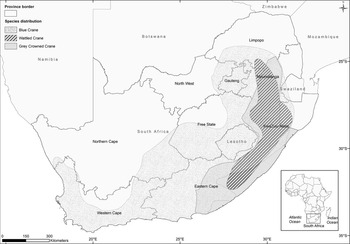
The conservation status of all three crane species has changed throughout the various red-listing assessment cycles within the region (South Africa, Lesotho, and Swaziland), the result of each assessment being the catalyst for conservation action. The Grey Crowned Crane, originally classified as ‘Vulnerable’ in the regional assessment undertaken by Barnes (Reference Barnes2000), was uplisted to ‘Endangered’ by Morrison and Smith (Reference Morrison, Smith, Taylor, Peacock and Wanless2015). This uplisting mirrored the global status for the species (BirdLife International 2016). Grey Crowned Cranes rely on a wetland-grassland mosaic, preferring the wetland edge for breeding (during summer), and the adjacent grasslands and agricultural lands for foraging (Morrison and Smith Reference Morrison, Smith, Taylor, Peacock and Wanless2015). In South Africa, they occur in the higher altitudes of the northern Eastern Cape, southern, and central parts of KZN, north-eastern Free State and Mpumalanga provinces (Figure 1; Morrison and Smith Reference Morrison, Smith, Taylor, Peacock and Wanless2015). The degradation and loss of breeding habitats and the expansion of agricultural lands have resulted in the utilisation of more open habitats (Harris and Mirande Reference Harris and Mirande2013), and the species has demonstrated a greater degree of adaptation to increasing agriculture in the grassland biome. The tendency to access agricultural lands for foraging and resultant crop damage increases the conflict potential with landowners, and this places the species at risk from accidental and deliberate poisoning (Harris and Mirande Reference Harris and Mirande2013).

The conservation status of the Blue Crane has varied through the assessment periods, ranging from ‘Not Evaluated’ (Brooke Reference Brooke1984) to ‘Critically Endangered’ (Meine and Archibald, Reference Meine and Archibald1996), and then to ‘Vulnerable’ (Barnes Reference Barnes2000), through to the most recent assessment of ‘Near Threatened’ (Shaw Reference Shaw, Taylor, Peacock and Wanless2015). However, this recent regional assessment has been challenged (BirdLife International Red List Team 2020) and the global assessment remains at ‘Vulnerable’ (BirdLife International 2018a). The Blue Crane is the most range-restricted of all crane species, being a near-endemic to South Africa, with isolated populations occurring in northern Namibia (Barnes Reference Barnes2000, Shaw Reference Shaw, Taylor, Peacock and Wanless2015). In South Africa it ranges from Mpumalanga in the north-east, across KZN and into the Western Cape in the south-west (Figure 1; Shaw Reference Shaw, Taylor, Peacock and Wanless2015). The Blue Crane inhabits grassland areas in the east, where it nests in summer and utilises the open landscape to watch for predators (Meine and Archibald Reference Meine and Archibald1996, Barnes Reference Barnes2000, McCann et al. Reference McCann, Theron and Morrison2007). Blue Cranes are affected by the loss of these grasslands, due to agriculture and afforestation (Harris and Mirande Reference Harris and Mirande2013), which were once their stronghold, but now hold only an estimated 20% of the global population (Shaw Reference Shaw, Taylor, Peacock and Wanless2015). Most of the population now occurs outside of grasslands in the semidesert Karoo and on agricultural lands of the Western Cape (Shaw Reference Shaw, Taylor, Peacock and Wanless2015), with the wheat fields simulating artificial grasslands. They have also suffered poisoning by farmers due to the damage they cause to crops (Harris and Mirande Reference Harris and Mirande2013), although they do also provide the benefit of removing plant and insect pests.
The conservation status of the Wattled Crane has always been precarious, with the most recent regional assessment classifying it as ‘Critically Endangered’ (Smith Reference Smith, Taylor, Peacock and Wanless2015). The reduction in suitable habitat has confined the species to the eastern parts of South Africa, where there is higher rainfall, with most of the population residing in the central and southern parts of KZN (Figure 1; Smith Reference Smith, Taylor, Peacock and Wanless2015). Wattled Cranes are highly dependent on wetlands for both foraging and breeding (Allan Reference Allan, Hockey, Dean and Ryan2005c, Jordan Reference Jordan2018), and they are sensitive to disturbance, which leads to nest abandonment (Jordan Reference Jordan2018). Wattled Cranes spend up to the first seven years of their lives in a non-breeding ‘floater’ flock, where they will eventually find a mate and leave the flock for the breeding territories (Jordan Reference Jordan2018). It is believed that they breed in winter to avoid damage to nests and eggs from hailstorms and flooding (Johnson and Barnes Reference Johnson and Barnes1986). Dry conditions during winter increase the risk of fire damage to nests and the loss of young, unfledged chicks (Jordan Reference Jordan2018).
Conservation interventions for the three crane species in KZN have targeted reductions in adult mortality due to electrocutions and collisions on overhead power lines, as well as improvements in breeding success by improved protection and management of crane breeding sites and feeding grounds. All three species are susceptible to interactions with electrical infrastructure. Power line collisions leading to mortality are a common threat especially for young birds, whilst adult Grey Crowned Cranes roost on transformer boxes, which can lead to electrocutions (Barnes Reference Barnes2000, Harris and Mirande Reference Harris and Mirande2013, Morrison and Smith Reference Morrison, Smith, Taylor, Peacock and Wanless2015). Collisions with overhead power lines are mostly mitigated by installing markers - either recommended because of a mortality incident or prior to construction - to conductors or shield wires, thus improving the visibility of the cables to approaching birds. Other mitigation measures (e.g. burying power lines) are too costly and impracticable to implement once a line has been strung (Bernardino et al. Reference Bernardino, Bevanger, Barrientos, Dwyer, Marques, Martins, Shaw, Silva and Moreira2018). In addition, the appropriate placement and design of electrical infrastructure can be incorporated into planning processes to limit collisions and electrocutions.
Other conservation initiatives have been undertaken to protect crane habitats in South Africa, including, but not limited to, the declaration of at least 12 protected areas primarily to conserve the species and their associated habitats (Paterson Reference Paterson2009, Department of Environmental Affairs 2016). The size and quality of habitat for cranes has also improved through the promotion of sustainable land management practices that facilitate the maintenance of crane habitats by private landowners, some of whom have had their farms declared as protected areas through the biodiversity stewardship mechanism (Little and Theron Reference Little and Theron2014, Mitchell et al. Reference Mitchell, Stolton, Bezaury-Creel, Bingham, Cumming, Dudley, Fitzsimons, Malleret-King, Redford and Solano2018, Cockburn et al. Reference Cockburn, Cundill, Shackleton and Rouget2019). Landowners participating in biodiversity stewardship are guided by conservation authorities and NGOs through the implementation of management plans developed for the benefit of cranes (Paterson Reference Paterson2009).
A less formal intervention is (crane) custodianship, whereby conservation-conscious landowners are recognized for their efforts to adapt farming practices for the conservation of cranes on their land (Little and Theron Reference Little and Theron2014). Crane custodians are encouraged to manage the timing of burning to avoid sensitive nesting periods, report power line collisions and/or electrocutions, and to reduce general nest disturbance (Little and Theron Reference Little and Theron2014).
In this paper we present the results of 15 years of aerial crane surveys conducted from 2003 to 2018. We analysed trends in the populations of all three species over this time period and summarise the scope and extent of conservation interventions instituted in KZN prior to, and during this period, and how they may have contributed to the crane population trends. We have included the costs of these interventions from two of the implementing organisations, the Endangered Wildlife Trust (EWT), in partnership with the International Crane Foundation, and the KZN Crane Foundation, to demonstrate a return on investment in crane conservation.
Methods
Aerial survey
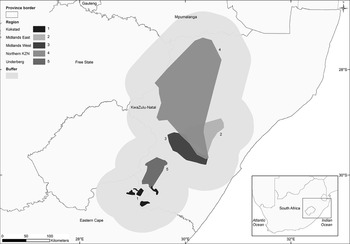
The annual aerial surveys were conducted from 1989 to the present day, but this paper presents results from 2003 to 2018 due to the standardised methodology of the same flight paths being surveyed from 2003 onwards (explained further below). The surveys occurred during winter (June/July) as this is the peak breeding season for Wattled Cranes and the flocking (thus non-breeding) season of Blue Cranes and Grey Crowned Cranes (Barnes Reference Barnes2000, Allan Reference Allan, Hockey, Dean and Ryan2005a,Reference Allan, Hockey, Dean and Ryanb,Reference Allan, Hockey, Dean and Ryanc). The surveys were conducted over at least five days every year to cover five survey regions, namely, KZN Midlands East, KZN Midlands West, Northern KZN, Underberg, and Kokstad (Figure 2). These survey regions account for approximately 90% of the Wattled Crane and 70% of Grey Crowned Crane populations within South Africa (Coverdale Reference Coverdale2006, Rennie et al. Reference Rennie, Becker, Smith and Craigie2018). A Cessna 182 (high wing) plane was used for all surveys. Four people were present to observe and count the species, including the pilot, a navigator and two dedicated observers one on each side of the plane. Ideally the same observers were used year to year, but this was not always possible especially considering the long-time frame over which the aerial surveys have been conducted. Over the years the following people have been involved as observers: Andre Rossouw, Brent Coverdale, Claire Relton, Cobus Theron, Debbie Jewitt, Greg Nanni, Ian Little, Jiba Magwaza, John Craigie, Kevin McCann, Matthew Becker, Myuri Basdew, Paige Potter, Richard Schutte, Sue Viljoen, Tanya Smith, and Thabo Madlala.
Map of the crane aerial survey regions between 2003 and 2018 within KwaZulu-Natal province, South Africa and surrounding 55 km buffer zone, from which conservation interventions were compiled.

A loose grid system with a 500-m spacing between flight path transects within the five survey regions was followed to allow for maximum coverage of the area during the survey, which amounted to an average of five hours of flying time per day. The species, number, activity (breeding, nesting, foraging etc.), type of habitat, and GPS coordinates were recorded for each sighting. This information was captured in real time on a laptop, which allowed for background maps to be used, and set routes to be followed, and it also helped prevent duplicate counting. The detailed route followed during each of the surveys was determined and plotted using the Garmin GPS track log function. This allowed for the standardisation of survey routes in each demarcated area throughout the province. For large flocks, photographs were taken, and a more accurate count was done after the survey was concluded.
Statistical analysis
A non-linear trend analysis was conducted on the total abundance of the three crane species for the period 2003 to 2018 with the effect of survey region taken into consideration. This analysis was run using the ‘poptrend’ package in R studio version 1.2.1335 (Knape Reference Knape2016, R Core Team, 2019). The function makes use of Generalized Additive Mixed Models to create a smooth long-term population trend, which consists of short-term fluctuations (Knape Reference Knape2016). The change function was also run to quantify the percentage change between 2003 and 2018.
Conservation interventions
Efforts to conserve cranes started within the region in 1989 when drastic declines of all three species were witnessed and recorded by conservationists and biologists. For this paper, the known conservation intervention methods were collated since 1995 when most of the below- mentioned interventions began. Only those interventions that had been implemented by the end of 2018 as well as occurring within a 55 km buffer zone from each of the five block regions (Figure 2) where the surveys took place are presented here. The interventions were implemented by the EWT/Eskom Strategic Partnership and the African Crane Conservation Programme (ACCP), a partnership between the EWT and the International Crane Foundation, as well as Ezemvelo KwaZulu-Natal Wildlife (EKZNW) and the KZN Crane Foundation. The investments that have been made directly towards crane conservation were collated to show the consistency and the value of long-term investments to implement the necessary conservation interventions. Numerous donors and funding sources have contributed throughout the period under review including monetary and in-kind support. The information presented herein only represents the donations and contributions through the EWT, International Crane Foundation, and KZN Crane Foundation and is thus the minimum amount that has been invested in crane conservation in this province. These investments, along with other key players, were directed towards implementing some of the following interventions:
-
1) Power line collision mitigation
The power line mitigation information was collated to indicate the various types of mitigation that have been implemented reactively by Eskom in response to collision (with the use of bird flight diverters) and electrocution (with the use of insulation and perch guards) incidents that were reported to the EWT. These incidents were stored in a central database called the EWT/Eskom Central Incident Register (CIR). Data were extracted from the CIR for electrical infrastructure incidents where at least one crane was involved, but all mitigation for the focal area was collated as any reactive mitigation implemented could aid in preventing further collision and electrocution incidents of the three crane species. Not all incident mitigation measures were confirmed in the field. We could thus only assume that unconfirmed installations were completed; annual audits of a proportion of incidents indicated general implementation of recommendations. Eskom has absorbed the cost of mitigation. A minimum cost evaluated by Schorn (Reference Schorn2019) to mitigate for collision and electrocution incidents was used to estimate the minimum cost of mitigation for the study region. This calculation is based on the number of personnel required, distances to travel, the costs of vehicles (including the use of a cherry picker/bucket truck), and number of hours required to install the devices. These calculations only take bird flight diverters, insulation, and bird guard installation into account. Other mitigation could require the use of a specialised team that can work with the power line remaining live (live line teams) as well as the need for helicopters for large transmission lines.
-
2) Protected area expansion
Stewardship and protected areas were extracted from the South Africa Protected Areas Database (SAPAD_OR_2019_Q2) shapefile (Department of Environmental Affairs 2019). The study area contained provincial and private reserves as well as properties declared as protected areas under the Biodiversity Stewardship Programme. The total area in hectares declared per year was calculated to show the growth in protected area size.
-
3) Crane custodians
Crane custodians are farm owners or managers that are recognised for their effort towards protecting the land and species. The owner is nominated, verified and then recognised either by certificate and/or by a custodian signboard (Little and Theron Reference Little and Theron2014). Any individual who commits to the conservation of cranes and demonstrates this commitment through management actions that support crane survival and/or breeding could be nominated and recognised as a crane custodian. Individual crane custodian farms were mapped, where the farm names provided in a crane custodian database correlated with the farm names in the Parent Farm layer (Department of Rural Development and Land Reform 2018). All crane custodians could be associated with a district municipality, and thus a density map of the number of custodians per district municipality within KZN was also created to show the focus areas of custodians.
Results
Aerial survey
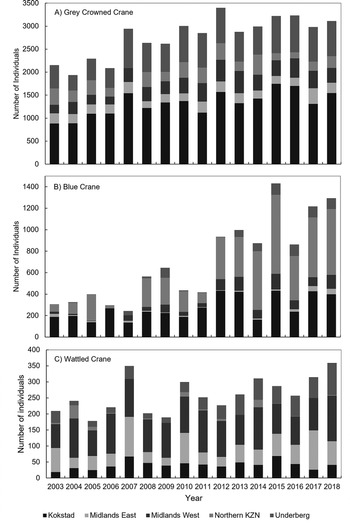
A total of 3,910 sightings were recorded between 2003 and 2018. Grey Crowned Cranes accounted for 74% of the sightings, and their population count grew from 2,128 in 2003 to 3,132 birds in 2018 (Figure 3A). Blue Cranes accounted for 19% of all the sightings and their population count grew from 311 in 2003 to 1,295 birds in 2018 (Figure 3B). Seven percent of the sightings were Wattled Cranes, and their population count changed from 208 birds in 2003 to 380 in 2018 (Figure 3C). Kokstad was the most populated of the five survey regions (Figure 3).
Number of individuals per species A) Grey Crowned Crane, B) Blue Crane, C) Wattled Crane, per year, per region.

Statistical analysis
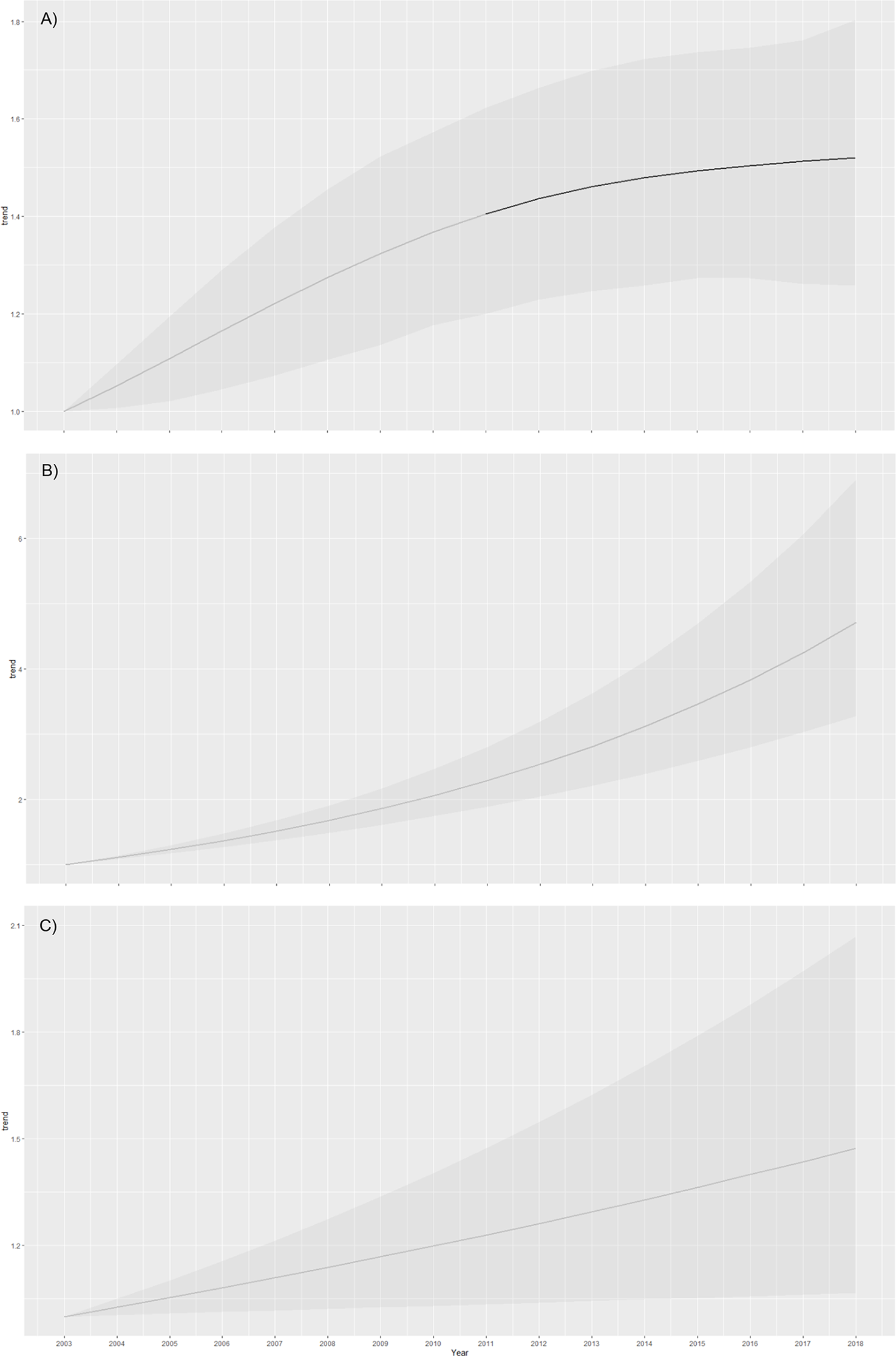
There was a significant increase, at the 5% level, in the number of Grey Crowned Cranes observed in aerial surveys between 2003 and 2011, and a non-significant increase from 2011 to 2018 (Figure 4A) with a change of 52% between 2003 and 2018. There was a significant increase (at the 5% level) in the number of Blue Cranes observed in aerial surveys between 2003 and 2018 (Figure 4B), with an increase of 366%. Wattled Cranes also experienced a significant increase of 49% between 2003 and 2018 (Figure 4C).
A) Grey Crowned Crane, B) Blue Crane, C) Wattled Crane poptrend graph. The grey line indicates the period of significant increase whereas the black line indicates no significant change. The shaded area is the confidence interval from 2.5 to 97.5%.

Conservation interventions
Electrical infrastructure mitigation
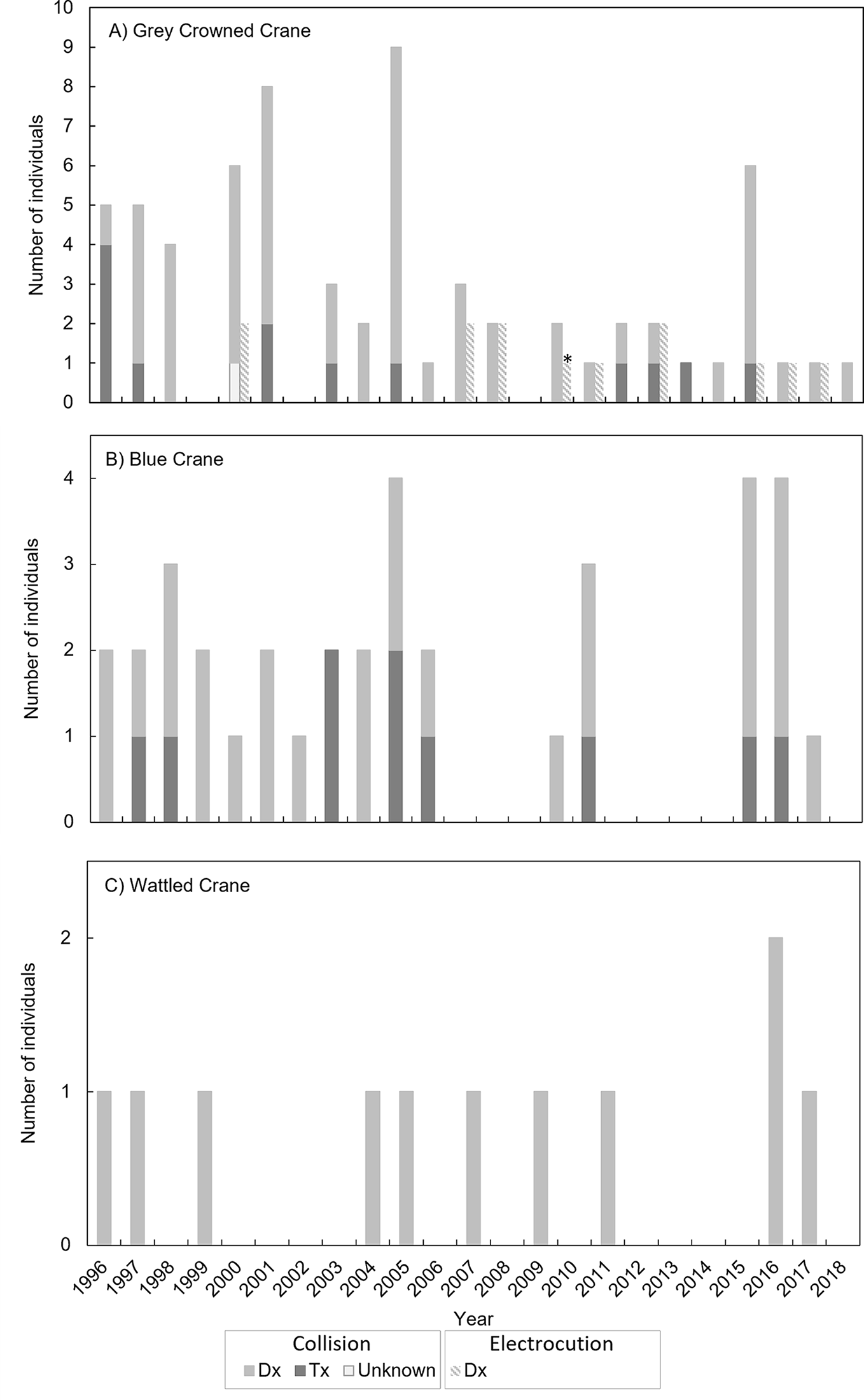
The number of crane mortalities that were recorded in the CIR in our study area, up to the end of 2018, were 13 electrocutions on power lines and 113 collisions with power lines (Figure 5), and one whose cause of mortality is unknown. The Grey Crowned Crane had the largest number of recorded mortalities (79), followed by Blue Crane (37) and Wattled Crane (11) with one unidentified crane.
Number of individuals affected by collisions and electrocutions on distribution (Dx) transmission (Tx) and unknown power lines, per species A) Grey Crowned Crane, B) Blue Crane, C) Wattled Crane, and Unknown Crane (*), per year, within the buffer area.

Since the EWT and Eskom started recording incidents, the following crane incidents have been recorded: 96 incidents have occurred on distribution lines (11 to 132 kV) and 22 on transmission lines (132 to 765 kV) within the study area (Table S1 in the online supplementary material). Approximately 55% of the distribution incidents had reactive mitigation implemented based on recommendations generated after investigation of an incident was completed (Figure S1A and B). The remainder of the incidents received no recommendation for mitigation, most likely because incidents were a once off occurrence and thus did not provide enough risk to other birds for mitigation to be implemented. Most of the transmission incidents (approximately 54.5%) also received no recommendation for mitigation, for the same reason as distribution as well as the high costs involved in mitigating transmission lines (which often requires a helicopter – see investment in species conservation for more information on cost of mitigation). Approximately 40% of the transmission incidents were reactively mitigated (Figure S1A and B).
Reactive mitigation against collision was implemented on 53 km of distribution lines (0.13% of the lines in the buffer area), and against electrocution on 128 distribution poles for all incidents within the study area on distribution lines. Approximately 85% of the 53 km, and 21% of the 128 poles were for incidents involving a crane. The reactive mitigation on transmission lines only occurred for collision incidents, and this amounted to a minimum of 29 km (0.72% of the lines in the buffer area), 52% of which were crane incidents. In addition, over 100 km of distribution lines were proactively mitigated to minimise collision risk of Wattled Cranes near their nest sites.
Protected area expansion, including stewardship sites
During the study period, additional land has become formally recognised as protected within the study area (Figure S2). Table S2 shows the total area in hectares of protected areas declared per year. The overall positive change in protected area coverage from 1996 to 2018 is 45.42%.
Custodian sites
A total of 52 landowners or farm managers have been acknowledged as crane custodians for their practical on-the-ground efforts to protect and conserve cranes since the 1990s. Being awarded crane custodianship recognition acknowledges the practical behaviour that promotes crane well-being and conservation. These custodians occur in 10 municipalities in KZN (Figure S3). The highest densities of crane custodians occur in the Mpofana and uMngeni municipalities, which overlap with Midlands West survey block.
Investment in species conservation
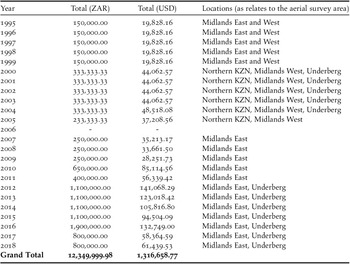
Since the mid-1990s there has been regular and ongoing investment made towards conserving crane species in KZN (Table 1). This funding includes estimations of the cost of manpower, for at least 10 staff members working in the different time periods, required to implement conservation interventions. The table represents values in South African Rands (ZAR) and United States Dollars (USD). An annual average exchange rate was used to calculate the USD value (South African Revenue Service 2020) and should be viewed as an estimate value due to fluctuations in exchange rates. Exchange rates before 2003 were difficult to access, therefore the reported rate from 2003 was used to estimate values before 2003. A minimum of R4 million (approximately $300,000, converted using the 2018 USD exchange rate – R3.6 million for collision mitigation on transmission and distribution lines and R400,000 for electrocution mitigation on Distribution lines) has been spent by Eskom towards reactive mitigation of power lines, while a minimum of R12 million (or $1.3 million) has been spent by the EWT, in partnership with the International Crane Foundation and the KZN Crane Foundation.
Estimates of the funding received per year by the Endangered Wildlife Trust and KZN Crane Foundation since 1995, and the regions where field staff were present.

Discussion
Crane population trends
The results of our aerial surveys show an increasing trend for populations of all three crane species in the five regions that have been studied for the last three decades. The conservation interventions in this region have allowed for the return and repopulation of cranes during the survey period, likely through a reduction in adult mortalities as a result of power line collisions, improved breeding productivity through the protection of grasslands and reduction of disturbance during breeding (a key activity of crane custodians). Other environmental aspects such as climate change and changes in land use elsewhere may have influenced the return and repopulation to this area, but these aspects were not tracked during the course of the study period.
Grey Crowned Cranes were the most abundant species throughout the study region, with a positive 52% change over the 15-year period. Although the increase in the last seven years was non-significant, overall, there has been an increase in the population size. This appears to be the only confirmed increasing population of Grey Crowned Cranes across their range in Africa (AEWA 2019).
Blue Cranes experienced the greatest growth in population during the 15-year period in this study region with the ‘poptrend’ analysis showing a 366% change. We suspect that this 366% change is too large to attribute only to improvements in breeding success and a reduction in adult mortality, but that the Blue Crane population has been supplemented by repopulation from other regions, such as Mpumalanga and the Karoo, and possibly the Western Cape, which hold larger populations. As mentioned previously, for both Blue Cranes and Grey Crowned Cranes, the timing of the aerial survey coincides with the flocking (non-breeding) season and missing any flocks during the survey will have a noticeable impact on overall counts for the species. This would explain some of the annual variation in the survey results.
The timing and location of the annual aerial surveys were designed to capture the number of Wattled Crane breeding pairs and non-breeding individuals within floater flocks. Approximately half of the Wattled Crane population in South Africa forms part of non-breeding floater flocks (Jordan Reference Jordan2018), and sometimes not all of the floater flocks are found and counted during the aerial surveys. In recent years, a greater number of these floater flocks have formed and been recorded but they have become less predictable in their location and sizes (Jordan Reference Jordan2018). This has resulted in variability in the count of Wattled Cranes year on year, which is becoming more pronounced in recent years (see Jordan Reference Jordan2018 for further details). This greater variation in the Wattled Crane counts is reflected in the confidence intervals around the trend analyses. Therefore, to track more accurate population counts of the Wattled Crane, it is recommended that early evening roost site ground counts are required to supplement the aerial survey counts. Although spread across the landscape in multiple flocks during the day, Wattled Cranes come together to roost at only a handful of sites in the KZN midlands and Southern Drakensberg. These sites have been identified through the fitting of satellite trackers to five wild Wattled Cranes between 2016 and 2018 (Jordan et al. in press).
Conservation interventions
For the last three decades, numerous conservation interventions have been implemented, resulting in considerable effort to conserve these three threatened crane species and to prevent further losses to the population. In this paper, it must be noted that we cannot attribute the growth in population of the three crane species to any one intervention, without further detailed analysis, but rather the result of combined interventions by multiple stakeholders to address all the key drivers of the declines of all three crane species. These interventions were put in place to combat what are considered the key threats to cranes in this region and have been the core focus of crane conservation efforts in KZN. We elaborate our discussion on the three interventions implemented to address the key drivers of declines: Power line related mortalities, loss of habitat for breeding and foraging, and finally human disturbance resulting in unnatural mortality and/or poor breeding productivity.
Electrical infrastructure mitigation
Within the study period, Eskom mitigated all mortality incidents that were reported to the EWT, for which a recommendation was produced. These mitigation measures include the use of bird flight diverters (flappers) and other line markers that have been shown to be effective in increasing the visibility of power lines and thereby reducing collisions. Certain mitigation measures have proven successful in dissimilar landscapes, e.g. a 92% reduction in Blue Crane collision mortalities with the use of EDM (Eberhardt Martin marking device) markers in the Karoo (Shaw et al. Reference Shaw, Reid, Gibbons, Pretorius, Jenkins, Visagie, Michael and Ryan2021). We would recommend that an appropriate study, similar to that of Shaw et al. (Reference Shaw, Reid, Gibbons, Pretorius, Jenkins, Visagie, Michael and Ryan2021) is initiated within KZN, to show the impact of the effectiveness of mitigation on crane population trends. This is critical for directing future conservation efforts on these species to understand which conservation interventions are most effective in the recovery of these populations. The strategic partnership between the EWT and Eskom has allowed for the quantity and focus of mitigation counteracting the collision and electrocution risk, to increase over the years. Eskom is obliged to adhere to the recommendations made, and the EWT creates these recommendations based on the occurrence and potential for reoccurrence of incidents in certain locations, the species involved, and the number of mortalities. The three crane species’ threatened status means all incidents involving cranes will be investigated, and if the risk of reoccurrence is deemed high then a recommendation for mitigation will be provided and implemented. Threatened or endemic species take priority for investigation and mitigation over non-threatened species that were involved in a power line collision or electrocution.
Protected area expansion and crane custodians
The 45% expansion in formally protected areas within KZN from 1996 to 2018 is likely to have contributed to an increase in breeding success due to improved protection of crane breeding sites and reduced disturbance around nest sites (Little and Theron Reference Little and Theron2014) as well as greater availability of suitable nesting sites. As part of the Biodiversity Stewardship Programme, farmers are equipped with a detailed management plan that outlines the priority management objectives for a site over a 5–10 year period. From these, annual plans of operations are developed with farmers to guide the implementation and monitoring of management activities, such as alien plant control, fire, grazing, erosion control and security (or anti-poaching). The relationships formed between conservationists and the farm owners within the Biodiversity Stewardship Programme and crane custodian sites, has aided the correct management of the habitat the cranes rely on for breeding, foraging, and roosting. Improved fire management in terms of timing of burns and coverage across the landscape, decrease in disturbance at nest sites due to improved farm security/anti-poaching and engaging with staff on site, increased reporting of power line collisions due to higher state of awareness and the overall improved communication between the landowners and crane conservationists have allowed sound conservation efforts to be implemented. An average of 12% of crane sightings received per year are within protected areas.
Financial investment in species conservation
The above-mentioned interventions would not have been possible without significant funding, for, at the very least, salaries and running costs for the various field staff to implement these interventions. We estimate that the minimum investment from the EWT’s ACCP alone in this area is US $1,316,658 over 23 years. McCarthy et al. (Reference McCarthy, Donald, Scharlemann, Buchanan, Balmford, Green, Bennun, Burgess, Fishpool, Garnett, Leonard, Maloney, Morling, Schaefer, Symes, Wiedenfeld and Butchart2012) estimated that the annual cost to achieve down-listing of species within 10 years was around $848,000. Positive population trends for all three species in the region have been achieved, which indicates these interventions are proving to be effective. The cost of saving a species cannot easily be estimated and is highly dependent on the types of interventions needed. However, the constant investment in this region and on these crane species since the mid-1990s, when all three populations were in decline (Barnes Reference Barnes2000), has seen an increase in the population of all three crane species.
In conclusion, the results of our aerial survey analysis show that all three crane species have had an increasing population trend in the study area since 2003, when aerial survey methodologies were standardised. Our investment in these species started in 1995, with interventions targeting adult and sub-adult mortality on power lines, and improvements in breeding success by protection and better management of crane habitat. It is difficult for us to attribute the increasing populations to the success of one intervention, but all are likely to have contributed significantly to the improvements in the species’ population sizes. The long-term monitoring of cranes in KwaZulu-Natal through aerial surveys has demonstrated that we can successfully determine population trends for species that are not confined to protected areas and are dependent on private and communal landowners for their survival. However, due to their high mobility in the landscape and differences in crane biology between the three species, we recommend the following adjustments be made to the methodology:
-
1. Validate the aerial survey counts for Wattled Cranes, with coordinated ground surveys of known Wattled Crane roost sites (as identified by tracking of individuals). This will ensure any flocks of Wattled Cranes missed on the aerial survey during the day are recorded from ground roost surveys in the early evening.
-
2. Conduct a winter and summer survey every alternate year. This will ensure Blue and Grey Crowned Cranes are monitored through their breeding season (summer). This will give a more complete assessment of the population health and structure of the three species.
Supplementary Materials
To view supplementary material for this article, please visit http://doi.org/10.1017/S0959270921000496.
Acknowledgements
With thanks, in no specific order, to the following people for their contribution towards this paper: Dominic Henry, Matthew Becker, Claire Relton, Lara Jordan, Janine Rennie, Andre Rossouw and Greg Nanni, who was the pilot for the aerial surveys. Other NGOs and stakeholders in addition to the EWT were also present within the region working towards the conservation of the cranes. In recognition they are, and not limited to: The International Crane Foundation, Ezemvelo KZN Wildlife (EKZNW), KZN Crane Foundation, WWF-SA, Conservation Outcomes, Eskom, Critical Ecosystem Partnership Fund, World Wildlife Fund (WWF)- Nedbank Green Trust, Rand Merchant Bank, N3 Toll Concession, the Darwin Initiative, and The Bateleurs.