1. Introduction
Significant chemical and isotopic compositional changes can occur in thermal gradients while conducting laboratory experiments with silicate melts, known as the Soret effect (Walker & Delong, Reference Walker and Delong1982; Lesher & Walker, Reference Lesher and Walker1986). Specifically, when the concerned species only focuses on isotopes associated with the Soret effect, it is called a Richter effect (Dauphas et al. Reference Dauphas, Teng and Arndt2010). Both the Soret effect and the Richter effect have been widely investigated in high-temperate experiments using a thermal gradient where both ends of the experimental silicate melt were set at a higher temperature than the liquidus temperature of silicate samples (Lesher & Walker, Reference Lesher and Walker1986; Richter et al. Reference Richter, Davis, DePaolo and Watson2003, Reference Richter, Watson, Mendybaev, Dauphas, Georg, Watkins and Valley2009). Although thermal gradients must exist in the cooling and solidification processes of magma bodies, the role of thermal gradients in magmatic differentiation has been regarded as unimportant since heat dissipation occurs faster than mass diffusion (Bowen, Reference Bowen1915). However, recent geochronological observations and numerical results have revealed that the cooling time for plutonic rocks may be 10–100 Ma; Soret and Richter effects may therefore be expected (Coleman et al. Reference Coleman, Gray and Glazner2004; Huang et al. Reference Huang, Lundstrom, Glessner, Ianno, Boudreau, Li, Ferre, Marshak and DeFrates2009, Reference Huang, Chakraborty, Lundstrom, Holmden, Glessner, Kieffer and Lesher2010; Xu et al. Reference Xu, Huang, Zhu and Luo2014). For example, Bouquain et al. (Reference Bouquain, Arndt, Hellebrand and Faure2009) explained the reversal of the crystallizing sequence of pigeonite and augite along the investigated rock profile by referring to the Soret diffusion in Alexo komatiites in Canada. However, the large isotopic variations (Richter effect) that were expected for magnesium and iron were not observed (Dauphas et al. Reference Dauphas, Teng and Arndt2010). Moreover, no isotopic fractionation that has been caused by the Richter effect has been found in the natural samples that have been studied to date (Teng, Reference Teng2017). The reason for this discrepancy is not clear and needs further investigation.
Thermal migration is another process that is different from the Soret and Richter effects, and it occurs when the temperatures at both ends of a thermal gradient are lower than the liquidus temperature (Lesher & Walker, Reference Lesher and Walker1988; Huang et al. Reference Huang, Lundstrom, Glessner, Ianno, Boudreau, Li, Ferre, Marshak and DeFrates2009). The mechanism for thermal migration is that crystal solubilities vary with changes in temperature, which establishes a chemical gradient in an interstitial melt and also induces mass transportation. As a result, minerals keep crystallizing at the cold end and dissolving at the hot end because of the local equilibrium between minerals and interstitial melts, the composition of which changes. Overall, two potentials drive the species to diffuse within interstitial melts in partially molten silicates: one is the Soret effect, which tends to concentrate in cooler or warmer regions depending on its component properties; and the other is thermal migration, which is derived from the chemical gradient (Lesher & Walker, Reference Lesher and Walker1988). Both the Soret effect and thermal migration are achieved through mass diffusion during which kinetic isotope fractionation occurs because light isotopes diffuse at a faster rate than heavy isotopes. The kinetic isotope effects mentioned here could theoretically weaken or eliminate the Richter effect. However, the degree to which the Richter effect is weakened has not been evaluated before.
Here, we first emphasized the experimental differences between wholly molten and partially molten basaltic silicates, and theoretically elaborated on the mechanisms of isotopic fractionation in partially molten silicates. We then conducted quantitative Mg kinetic isotope fractionations to assess the influence of isotopic fractionation on the Richter effect. We aim to provide a new explanation for the absence of the Richter effect in Alexo komatiites in Canada, and to further our understanding of isotopic behaviour during the cooling and solidification processes of natural magmatic systems.
2. Theoretical analysis
2.a. Richter effect (δ 1)
Thermal isotope fractionation was initially found in oxygen isotopes during thermal gradient experiments (Kyser et al. Reference Kyser, Lesher and Walker1998). Further studies have been undertaken using wholly molten silicate experiments, measured using the application of a multicollector inductively coupled plasma mass spectrometer (MC-ICP-MS) to non-traditional stable isotopic measurements (Richter et al. Reference Richter, Davis, DePaolo and Watson2003, Reference Richter, Watson, Mendybaev, Teng and Janney2008, Reference Richter, Watson, Mendybaev, Dauphas, Georg, Watkins and Valley2009, Reference Richter, Watson, Chaussidon, Mendybaev, Christensen and Qiu2014; Lacks et al. Reference Lacks, Goel, Bopp, Van Orman, Lesher and Lundstrom2012). Isotope fractionation under thermal gradient in silicate liquids is termed the ‘Richter effect’ to highlight Frank M. Richter’s contribution (Dauphas et al. Reference Dauphas, Teng and Arndt2010). The Richter effect is denoted δ 1 in this paper.
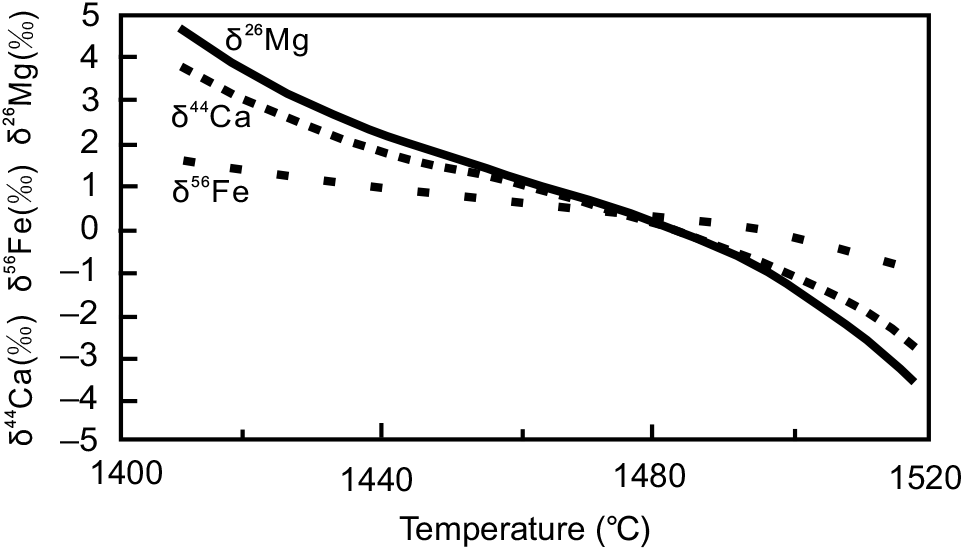
Within the Richter effect, light isotopes tend to enrich the hot end of a thermal gradient, while heavy isotopes tend to enrich the cold end (Fig. 1). The typical Richter effect is a steady state that is between equilibrium and kinetic isotope fractionation (Yun, Reference Yun2015). Although the elemental and isotopic compositions of the thermal ends differ, they do not vary with time and no net chemical flux occurs across the section. Although the governing mechanism of the Richter effect has not been fully elucidated (Dominguez et al. Reference Dominguez, Wilkins and Thiemens2011; Lacks et al. Reference Lacks, Goel, Bopp, Van Orman, Lesher and Lundstrom2012; Li & Liu, Reference Li and Liu2015), the value of the Richter effect can be calculated from experiments and the following recommended equation (Lacks et al. Reference Lacks, Goel, Bopp, Van Orman, Lesher and Lundstrom2012):
 $${\delta _1} = - \Omega \times ({m_{\rm{h}}} - {m_{\rm{l}}})({T_{\rm{h}}} - {T_{\rm{c}}}),$$
Richter effect for Mg, Ca and Fe isotopes (Richter et al. Reference Richter, Watson, Mendybaev, Dauphas, Georg, Watkins and Valley2009).

where Ω is an experimental parameter, defined as the fractionation in per mil per 100°C per atomic mass unit (amu), m h and m l are the atomic mass of the heavy and light isotopes, respectively, and T h and T c are the temperatures of the hot end and cold end, respectively.
2.b. Kinetic isotope fractionation caused by thermal migration (δ 2)
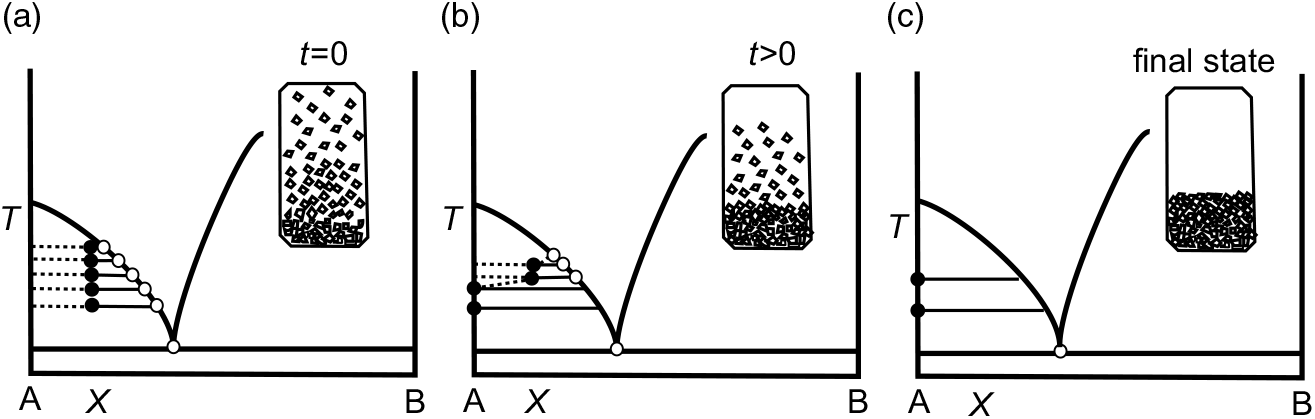
Thermal gradients occur in partially molten silicates. Figure 2 demonstrates thermal migration in a binary system comprising phases A and B (Lesher & Walker, Reference Lesher and Walker1988). The system is open to heat but is isolated from mass transfers. The bulk composition X is placed under a thermal gradient, as shown in Figure 2a. The system quickly establishes a local chemical and isotopic equilibrium along the temperature gradient, and the cold end of the gradient becomes enriched in heavy isotopes (the Richter effect in partially molten silicates, δ 1). Solid-phase A is on liquidus throughout, and the amount increases with decreasing temperature as per the level rule (William & Javad, Reference William and Javad2005). As a result, the interstitial melt becomes poorer in component A as the temperature decreases. Although this initial configuration corresponds to an equilibrium state within a closed system, it is not actually stable since mass communication is permitted through the melts. Figure 2b shows that component A begins to diffuse from a high-temperature to a low-temperature region, and the diffusing process enriches the number of light isotopes of A in the cold end as light isotopes diffuse at a faster rate than heavy isotopes. This kinetic isotope fractionation (denoted δ 2) occurs in the opposite direction to that of the Richter effect. The mass transfer throughout the melts disrupts the previous local equilibrium between solid and liquid states. Furthermore, an increasing amount of component A in the cold melts is consumed by the crystallization of phase A, and a reduced amount of component A in the hot melts are replenished by the dissolution of phase A. The isotopic composition of the newly crystallized phase A consists of a combination of δ 1 and δ 2. Figure 2c is the final state, when the solid and liquid fronts meet. The Richter effect remains only within the molten region.
Schematic illustration of thermal migration in binary system A–B (Lesher & Walker, Reference Lesher and Walker1988).

Zhu et al. (Reference Zhu, Bao and Liu2015) provided the following equation to calculate kinetic isotopic fractionation associated with the diffusing process:
 $${{\rm{\delta }}_2} = 1000 \times \left( {1 - {{\left( {{{{{\rm{m}}_2}} \over {{{\rm{m}}_1}}}} \right)}^{\rm{\beta }}}} \right)\left( {{{{{\rm{C}}_0}} \over {{{\rm{C}}_\infty }}} - 1} \right),$$
where m 1 and m 2 are masses of heavy and light isotopes, respectively; β is an empirical parameter obtained from experiments (Richter et al. Reference Richter, Davis, DePaolo and Watson2003) and theoretical computation (Watson & Muller, Reference Watson and Muller2009); and C 0 and C ∞ are the elemental concentrations of an interface of crystals and melts and of far-field melts, respectively. C 0 and C ∞ provide a chemical potential for diffusion occurrence. In this paper, these C 0 and C ∞ may be viewed as elemental concentrations of the hot and cold ends, respectively.
2.c. Kinetic isotope fractionation caused by Soret diffusion (δ 3)
In addition to δ 2 in partially molten silicates, another kinetic isotope fractionation influences the final result. This effect is caused by a non-equilibrium Soret diffusion (denoted δ 3). The elemental and isotopic equilibrium states can be reached if Soret diffusion takes place within wholly molten silicates; this is conditional upon whether they are given enough time and whether their variations are associated with temperature differences. However, in partially molten silicates, an elemental Soret equilibrium cannot be achieved because the distribution in the melts is not only influenced by the Soret effect, but also constrained by the local equilibrium between liquids and solids; on other words, more components are consumed upon crystallization, as shown in Figure 2b. Consequently, the Soret equilibrium has the potential to keep acting and driving the diffusion of species, during which kinetic isotope fractionation occurs. Using Mg as an example in partially molten basaltic silicates, heavy Mg isotopes initially concentrate in melts at the cold end (δ 1). Thermal migration then drives Mg to migrate from the hot end to the cold end, because the concentration of Mg is higher at the hot end. This process enriches light Mg isotopes in the cold end (δ 2); meanwhile, Mg spontaneously diffuses to the cold end, even if there is no chemical migration; this is because the Soret effect requires the enrichment of Mg at the cold end, and this also enriches the light Mg isotopes at the cold end (δ 3). Therefore, δ 2 and δ 3 play roles opposite to that of δ 1.
The chemical distribution for Soret equilibrium is described (Walker & Delong, Reference Walker and Delong1982):
 $$\sigma = {{{X_{{\rm{cold}}}} - {X_{{\rm{hot}}}}} \over {\bar X(1 - \bar X) \times \Delta T}}$$
where σ is the Soret coefficient; X cold, X hot and  $$\bar X$$
are the concentrations at the cold end, hot end and the bulk value, respectively; and ΔT is the temperature difference. X cold and X hot can be calculated if
 $$\bar X$$
, ΔT and σ are known. X cold and X hot provide the diffusion potential, and δ 3 can be obtained from:
 $${{\rm{\delta }}_3} = 1000 \times \left( {1 - {{\left( {{{{{\rm{m}}_2}} \over {{{\rm{m}}_1}}}} \right)}^{\rm{\beta }}}} \right)\left( {{{{{\rm{X}}_{{\rm{cold}}}}} \over {{{\rm{X}}_{{\rm{hot}}}}}} - 1} \right)$$
3. Calculations and results
δ 1, δ 2 and δ 3 for Mg are obtained from Equations (1), (2) and (4). The results may vary if different parameters are used for the calculations (temperature gradient, β Mg, σ Mg, etc.). In this paper, the temperature gradient is quoted from a portion of the crystallizing komatiitic lava in Alexo, Canada, which is suggested to be 1200–1270°C across a 22 cm profile (Bouquain et al. Reference Bouquain, Arndt, Hellebrand and Faure2009). β Mg, the ratio of the effective diffusing coefficient of 24Mg to that of 26Mg, is 0.05, which is obtained from Richter et al. (Reference Richter, Watson, Mendybaev, Teng and Janney2008). The Soret coefficient σ Mg acts as a proxy for the Mg Soret effect, and can span four orders of magnitude ranging from 10−2 (Walker & Delong, Reference Walker and Delong1982) to 10−5 (Latypov, Reference Latypov2003). The reason for this wide range is partially due to the differing water content between the experimental samples. In addition, the experiment itself has a high level of uncertainty. We arrive at the calculated results by using σ Mg over several orders of magnitude. The MgO content under liquidus temperature is also needed for these calculations. Multiple equations have been provided in previously published literature (e.g. Niu et al. Reference Niu, Gilmore, Mackie, Greig, Bach, Natland, Miller, Dick and Von Herzen2002; Chen & Zhang, Reference Chen and Zhang2008) to calculate the relationship between MgO and the lava liquidus temperature; the results are similar, and we used the equation provided by Niu et al. (Reference Niu, Gilmore, Mackie, Greig, Bach, Natland, Miller, Dick and Von Herzen2002):
 $${T_{{\rm{liquidus}}}} = 1026{\mkern 1mu} {e^{0.01894{\rm{MgO}}}},$$
where T is in °C and MgO is in wt%.
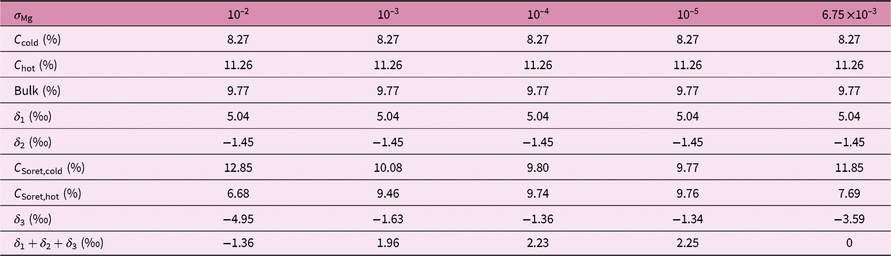
Results for δ 1, δ 2 and δ 3 with different σ Mg are listed in Table 1.
Calculations of Mg isotope fractionation with a thermal gradient (T cold–T hot) of 1200–1270°C and β Mg of 0.05 for different values of σ Mg.

Notes: T cold and T hot are temperatures of the cold and hot ends, respectively; β is an empirical parameter obtained from experiments (Richter et al. Reference Richter, Watson, Mendybaev, Teng and Janney2008); σ Mg is the Soret coefficient of Mg; C cold and C hot are Mg concentrations at the cold and hot ends, respectively (Equation (5)); Bulk is the theoretical mean Mg concentration, estimated as (C cold + C hot)/2; δ 1 is the Richter effect; δ 2 and δ 3 are the values of kinetic isotope fractionation caused by thermal migration and Soret diffusion, respectively; C Soret,cold and C Soret,hot are the theoretical Soret steady values of Mg; and δ 1 + δ 2 + δ 3 is the final value of Mg isotope fractionation.
4. Discussion
4.a. Influence of Mg kinetic isotope effects on the Richter effect
As the Richter effect is approximately one order of magnitude larger than the equilibrium fractionation in magmatic rocks for Mg isotopes, and since a temperature difference of 70°C can fractionate Mg isotopes by 5.04‰ (Table 1), the conventional view states that the Richter effect should be observed if it manifests in natural samples. However, the calculated results indicate that the Mg kinetic isotope effects are the same order of magnitude as δ 1 but of the opposite sign; they therefore have the potential to theoretically counterbalance the Richter effect. The value of δ 2 was determined by the saturation gradient of MgO between the hot and cold ends, which was fixed according to the given local temperature. For 1200–1270°C, δ 2 is −1.45‰ and δ 3 is set by the MgO chemical gradient under the assumed ideal Soret steady state. If the Soret effect could demonstrate the fractionation of Mg isotopes of a large value, the diffusing potential would correspondingly increase, leading to a large δ 3 value. The results show that δ 3 can vary from −4.95‰ to −1.34‰ with the variation of σ Mg. The total δ 26Mg (e.g. δ 1 + δ 2 + δ 3) varies from −1.36‰ to +2.25‰. If σ Mg is arbitrarily adopted as 6.75 × 10⁻³, then the total δ 26Mg is calculated as 0 and the Mg isotope fractionation that is caused by the thermal gradient would not be observed in natural samples. We acknowledge that the calculations are currently not precise enough due to uncertainty regarding σ Mg, which leads to a wide range of values for δ 3. However, the calculations provide a theoretical possibility that the Richter effect could be counterbalanced by the kinetic isotope effects and could further be understood as the reason for the absence of the Richter effect in natural samples.
4.b. Time of thermal gradient existence
It is important to consider whether the thermal gradient can be maintained long enough for mass diffusion to occur. We estimated the existence interval of a thermal gradient and the time required to achieve a Richter ‘steady state’. A thermal gradient may be maintained for a longer period in erupted lava than in intrusions. This is because the quenched surface of the lava flow is held to be near the value of 0, while the thermal gradient may disappear after boundary rocks are heated by intrusions. It has been suggested that the cooling rate is near 0.1°C/hour for komatiite flows in the case of liquids under a 4 m thick solid crust (Turner et al. Reference Turner, Huppert and Sparks1986). In 1200–1270°C across 22 cm, the thermal gradient might exist for at least 29 days.
The time taken for the silicate melts to reach the Richter steady state can be estimated from the equation θ = L 2/Dπ 2 (Richter et al. Reference Richter, Watson, Mendybaev, Teng and Janney2008), where θ is the time needed, L is the diffusing distance and D an effective binary diffusing coefficient, reported as 5.10−5 cm2 s−1 from Bouquain et al. (Reference Bouquain, Arndt, Hellebrand and Faure2009). Here, L = 22 cm, and θ is approximately 11 days. This result indicates that the thermal gradient interval is sufficient for the Richter effect to occur.
4.c. Mg isotopes in Alexo komatiites
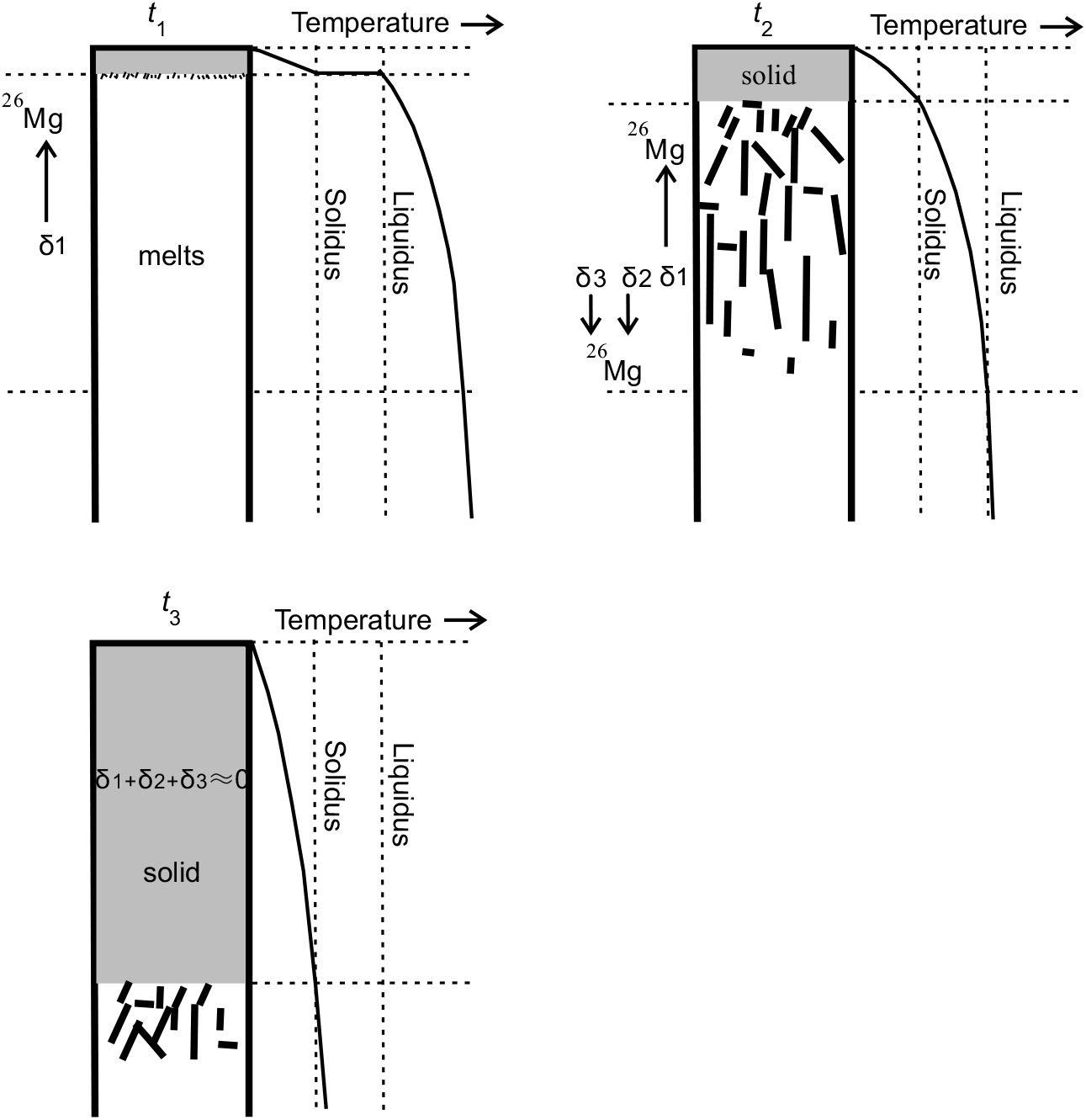
In the Alexo komatiites of Canada, a temperature gradient has been reported to explain the reverse order of pigeonite and augite crystallization that occurred during the processes of cooling and solidifying (Bouquain et al. Reference Bouquain, Arndt, Hellebrand and Faure2009). Furthermore, no obvious Mg isotope fractionation was observed along the profile (Dauphas et al. Reference Dauphas, Teng and Arndt2010). The Mg isotope fractionation which considered only the occurrence of the Richter effect during magma cooling in previous calculations was too large. However, we have interpreted the observation as a combination of the Richter effect and kinetic isotope fractionations. We divided the magma-evolving process after an eruption into three stages (Figure 3). Over t 1, conducted crust forms quickly because the surface temperature remains near 0°C and a nearly wholly molten interior is under the crust (where the adiabatic thermal gradient exists). The Soret effect for elements and isotopes are active, enriching the upper layer (cooler end) with high Mg concentration and heavier isotopes. During t 2, a partial crystallizing zone forms with a degree of solidification that ranges from 100% at the top to 0% at the bottom. Mg accumulated in melts during stage t 1 is consumed by the crystallization of mafic minerals with a high Mg content. An Mg chemical gradient forms within the interstitial melts, with the Mg content in each section maintained at the local temperature. Thermal gradients and Soret diffusion continue driving Mg to migrate upwards and provides a buffer against the heavy Mg that accumulated during t 1. The crystallized Mg minerals reflect the mixed isotopic contributions of the Richter effect and kinetic effects. During t 3, crystallizing fronts move downwards, and no Mg isotope variation can be found on the rock profile.
Mg isotope fractionation after magma eruption. During t 1, a quenched lid forms at the surface to be near 0°C and the bottom becomes the solidus of silicate lava. A thin layer exists under the lid, within which temperature jumps from solidus to liquidus. Under this thin layer, the temperature distribution is adiabatic and super-liquidus; this zone can therefore be assumed to comprise wholly molten silicates. The Richter effect drives heavy Mg isotopes to the cold surface and light Mg isotopes to the hot interior. During t 2, with lava cooling progressively, a partial crystallizing zone forms, where the presence of crystals decrease from the surface to the interior, leading to Mg chemical gradients in interstitial melts. Mg migrates to the cold surface, responding to thermal migration and Soret diffusion, and this diffusing process enriches light Mg isotopes in the cold surface. During t 3, with the lava becoming cooler, the crystallized zone moves downwards. The solidified rocks record the sum of the Richter effect and kinetic effects.

5. Conclusions
The conclusions of this study are that the Richter effect obtained from wholly molten silicate experiments cannot be directly applied to Mg isotope fractionation under a thermal gradient in natural systems. Furthermore, kinetic isotope fractionation during thermal migration and a non-steady-state Soret diffusion should be considered for future investigations. The calculations indicate that thermal migration and non-steady-state Soret diffusion are qualitatively sufficient to offset the Richter effect, which may be taken as a reason for the absence of Mg isotope fractionation in natural samples.
Acknowledgements
We thank Hao Yan, Dongyong Li, Xinyang Chen, Chuanwei Zhu and Yongsheng He for their valuable comments. Constructive and detailed comments from two anonymous reviewers, and efficient editorial handling by Dr Chad Deering, are gratefully acknowledged. This study is funded by Chinese NSF projects (grant nos 41773064, 41573040 and 41931077), the Key Research Program of the Chinese Academy of Sciences (grant no. XDPB11-1) and the CAS Interdisciplinary Innovation Team.