Introduction
Research on the relationship between herbivores and their host plants generally focuses on the factors determining host species choice, and to a lesser extent, on herbivores’ preferences and performance within a species. Differences between and within host species can affect trophic levels (Price et al., Reference Price, Bouton, Gross, McPheron, Thompson and Weis1980), such as herbivorous insects, by contributing to differences in the quality of food and to the quality of the conditions that affect the development and reproduction of the herbivores (Alonso & Herrera, Reference Alonso and Herrera1996; Giertych et al., Reference Giertych, Karolewski, Grzebyta and Oleksyn2007; Anderson et al., Reference Anderson, Sadek, Larsson, Hansson and Thöming2013). There are many plant features, such as morphology and anatomy (Calixto et al., Reference Calixto, Lange and Del-Claro2015; Łukowski et al., Reference Łukowski, Giertych, Zadworny, Mucha and Karolewski2015), as well as chemical composition (Barber & Marquis, Reference Barber and Marquis2011; Karolewski et al., Reference Karolewski, Giertych, Żmuda, Jagodziński and Oleksyn2013), that can affect plant-herbivore interactions. Plants are also strongly influenced by environmental factors (light conditions, humidity, etc.) that affect their physiology and development (Abrams et al., Reference Abrams, Kloeppel and Kubiske1992; Barber & Marquis, Reference Barber and Marquis2011; Bielinis & Robakowski, Reference Bielinis and Robakowski2015).
Forests are complex ecosystems and are typically composed of a number of different niches and specialized microhabitats (Winter & Möller, Reference Winter and Möller2008). Conditions such as canopy density and gaps, forest edges, presence of road, etc., create a specific light conditions in both tropical and temperate forests (Leather & Mackenzie, Reference Leather and Mackenzie1994; Mooney & Niesenbaum, Reference Mooney and Niesenbaum2012). Shrubs of Prunus L., and other understory species, have evolved the ability to grow in a variety of light conditions and possess a range of physiological responses that enable them to adapt to different levels of light (Abrams et al., Reference Abrams, Kloeppel and Kubiske1992). Understory plants are an important source of food for herbivores, including folivorous insects (Menken et al., Reference Menken, Herrebout and Wiebes1992). However, their utility as a food source for folivores may vary with the physiological status of the plant, which can in turn be impacted by the level of abiotic stress (DeLucia et al., Reference DeLucia, Nabity, Zavala and Berenbaum2012). Plants that are exposed to different levels of biotic stress, such as insect feeding and fungal pathogens, try to minimize leaf damage through an induction of various chemical and structural defense mechanisms (Giertych et al., Reference Giertych, Karolewski, Żytkowiak and Oleksyn2006; Eyles et al., Reference Eyles, Bonello, Ganley and Mohammed2010). Several hypotheses have been proposed to explain the mechanisms by which changes in a complex of environmental factors can alter the production of defense compounds in leaves (Gong & Zhang, Reference Gong and Zhang2014). For example, the carbon/nutrient balance hypothesis postulates that the carbon/nitrogen ratio in plants determines which secondary metabolites will be synthesized (Koricheva et al., Reference Koricheva, Larsson, Haukioja and Keinänen1998b ). When the plants grow in high light conditions (HL), resulting in high levels of carbon assimilation, the high levels of carbohydrates are used to produce carbon-based defenses metabolites to repel herbivores. It is plausible that the correlation between light conditions and the production of defense compounds is one of the underlying reasons that understory trees and shrubs, which grow in low light conditions (LL), are frequently more heavily attacked by insect herbivores than tree and shrub species growing in HL conditions. Shade leaves, relative to sun leaves, are characterized by a less resistant structure (Abrams et al., Reference Abrams, Kloeppel and Kubiske1992) and lower levels of carbon-based defense compounds (Henriksson et al., Reference Henriksson, Haukioja, Ossipov, Osipova, Sillsnpää, Kapari and Pihlaja2003; Karolewski et al., Reference Karolewski, Giertych, Żmuda, Jagodziński and Oleksyn2013).
In European forests, the native bird cherry Prunus padus L. and the non-native black cherry P. serotina Ehrh. are widespread understory plants (Leather, Reference Leather1996; Godefroid et al., Reference Godefroid, Phartyal, Weyembergh and Koedam2005). The native host range of P. padus extends from the southern to the northern parts of Europe (Leather, Reference Leather1996), whereas P. serotina is native to northeastern and central areas of the USA and Mexico (Pairon et al., Reference Pairon, Petitpierre, Campbell, Guisan, Broennimann, Baret, Anne-Jacquemart and Besnard2010). Prunus serotina is a non-native kenophyte in Europe and is a highly invasive species (Chabrerie et al., Reference Chabrerie, Loinard, Perrin, Saguez and Decocq2009; Halarewicz, Reference Halarewicz2011). Leaves of both Prunus species are strongly attacked by a variety of polyphagous insect pests, especially by leaf beetle Gonioctena species (Coleoptera: Chrysomelidae) (Leather, Reference Leather1994; Mąderek et al., Reference Mąderek, Łukowski, Giertych and Karolewski2015) and aphids – Rhopalosiphum padi (Heteroptera: Aphididae) (Archetti & Leather, Reference Archetti and Leather2005; Halarewicz & Gabryś, Reference Halarewicz and Gabryś2012). Whereas monophagous ermine moth Yponomeuta evonymellus L. (Lepidoptera: Yponomeutidae) attacks almost entirely P. padus (Leather, Reference Leather1986; Menken et al., Reference Menken, Herrebout and Wiebes1992), and only in recent years also finding on the P. serotina (Karolewski et al., Reference Karolewski, Jagodziński, Giertych, Łukowski, Baraniak and Oleksyn2014).
The genus Yponomeuta has received great attention from scientific studies as reflected by the abundance of literature that exists pertaining to the ecology of these mono- and oligophagous moths (e.g., Hora & Roessingh, Reference Hora and Roessingh1999; Javoiš et al., Reference Javoiš, Tammaru and Käär2005; Bakker et al., Reference Bakker, Roessingh and Menken2008; Ulenberg, Reference Ulenberg2009; Parker et al., Reference Parker, Roessingh and Menken2012). Leather (Reference Leather1986), as well as Turner et al. (Reference Turner, Lieshout, Van Ginkel and Menken2010), consider Y. evonymellus to be an obligatory monophagous species that feeds only on P. padus. In recent years, however, an increase in the number of cases of larval feeding on P. serotina (see photos in Karolewski et al., Reference Karolewski, Jagodziński, Giertych, Łukowski, Baraniak and Oleksyn2014) has been observed. In most cases, larvae will feed on leaves of P. serotina shrubs when they touch branches of P. padus. The movement of larvae from P. padus (where they hatch) on to P. serotina is often the result of almost complete defoliation of P. padus shrubs, and by this a lack of food. One of the main findings of a previous field experiment was the discovery that Y. evonymellus moths can survive on P. serotina, a new host plant, although it is difficult due to the differences between the phenology of P. serotina and P. padus (Karolewski et al., Reference Karolewski, Jagodziński, Giertych, Łukowski, Baraniak and Oleksyn2014). We consider that light conditions can also play an important role in the development and growth of Y. evonymellus on P. serotina.
The same folivorous species occur on both P. serotina and P. padus, but the latter host experiences a much greater loss of leaf mass (Karolewski et al., Reference Karolewski, Giertych, Żmuda, Jagodziński and Oleksyn2013). The amount of damage, however, also depends on light conditions. Damage is extensive in both species when plants are growing in the shade, however under HL conditions, damage is high in P. padus and low in P. serotina (Karolewski et al., Reference Karolewski, Giertych, Żmuda, Jagodziński and Oleksyn2013). The strength of chemical defense in both species is not so different (Karolewski et al., Reference Karolewski, Jagodziński, Giertych, Łukowski, Baraniak and Oleksyn2014; Mąderek et al., Reference Mąderek, Łukowski, Giertych and Karolewski2015). In this case, decisive are not so much differences in the chemistry of leaves, but their structure. Structure of shade leaves is similar in both Prunus species. In contrast, sun leaves of P. serotina are particularly thick and tough while this is observed to a much lesser extent in P. padus. Thus these observations are the result of many interactions between the host plant and light condition on their growth and structure of leaves, and thus on the possibility of insect grazing.
Previous studies (Alonso, Reference Alonso1997; Łukowski et al., Reference Łukowski, Mąderek and Karolewski2014) reported that some species in the family Yponomeutidae are more likely to feed in well-lighted places within an individual shrub, such as the south side of the crown, than in the shade or the north side of the crown. These observations are probably due to the fact that larvae feeding on shrubs growing under HL conditions (in higher temperature) have a greater mass and/or faster pupation process which reduces the time of exposure to predators and parasitoids (Sarfraz et al., Reference Sarfraz, Kharouba and Myers2013; Łukowski et al., Reference Łukowski, Giertych, Zadworny, Mucha and Karolewski2015). At present, the impact of light conditions on Y. evonymellus feeding on P. serotina shrubs is not yet known.
The objective of the present study was to determine the effect of the two host species, P. serotina and P. padus, and the light conditions of their growth habitats, on the performance (parameters of growth and development and potential fecundity) of Y. evonymellus moths. Although the influence of the host plant species on the insect feeding has been studied, the results of the previous studies did not take into consideration the interaction of the plant species and light conditions. In particular, no convincing and unequivocal results exist pertaining to the influence of light conditions on the host quality and thus the growth and development of folivorous insects (Roberts & Paul, Reference Roberts and Paul2006). We know that leaves of the alien P. serotina are not as ideal a food source for Y. evonymellus as leaves of the native P. padus, however, they can be a substitute (Karolewski et al., Reference Karolewski, Jagodziński, Giertych, Łukowski, Baraniak and Oleksyn2014). We hypothesized that in HL conditions the larvae grow better on the native host than on the alien host, while there is no such difference in LL conditions. We also hypothesized that no differences in the performance of Y. evonymellus would be observed when larvae fed in LL conditions on shrubs of the two species. Larvae of Y. evonymellus at an early stage of development were moved from original P. padus shrubs to new environments in either LL and HL conditions of P. serotina or P. padus shrubs. This translocation to new environments enabled us to precisely determine the effect of changes in host plant in each of the lighting conditions, and thus the quality of food, on adult eclosion, pupation dynamic, body mass, fecundity and wing parameters.
Materials and methods
Insect and plant material
The study was conducted on the bird cherry ermine moth, Y. evonymellus (Lepidoptera: Yponomeutidae). Several parameters were used: the insects performance, pupation, adult eclosion, body mass, potential fecundity, and wing size to determine the effect of shrub species and light conditions on the growth and development. Two species of understory shrubs, black cherry (Prunus serotina non-native species) and bird cherry (P. padus; native species), were used as plant material for this study. In the past P. serotina used to be intensively planted in the understory, mainly in Scots pine monocultures on sandy soils, by European foresters. Prunus serotina has been able to invade Europe due to its lower requirement for water and nutrients as compared with P. padus (Ellenberg et al., Reference Ellenberg, Weber, Düll, Wirth, Werner and Paulißen1992; Halarewicz, Reference Halarewicz2011). In addition to its ability to rapidly establish itself within a habitat poor in nutrients and water, it is also relatively resistant to insect damage (Abrams et al., Reference Abrams, Kloeppel and Kubiske1992; Karolewski et al., Reference Karolewski, Zadworny, Mucha, Napierała-Filipiak and Oleksyn2010).
The field experiment was carried out on a research site located in the Kobylepole Forest in Poland (Babki Forest District; 52°36′N, 17°06′E). Earlier observations and research in the area of the Kobylepole Forest indicated that both Prunus species exhibit an equal occurrence at the selected site. The Prunus shrubs were growing under a canopy of Pinus sylvestris L., with an admixture of Quercus robur L., Fagus sylvatica L., Carpinus betulus L., and Ulmus laevis Pall. Shrubs (3–5 m high) were selected from HL conditions along wide forest roads or in forest gaps, and within LL conditions under a dense forest canopy (approximately 15–30% of full light as measured using an LAI-2200 Plant Canopy Analyzer) (LI-COR Company, USA). Ten similarly sized shrubs per plant species (P. padus and P. serotina), growing within the specific light conditions (LL and HL), were selected at the site; comprising a total of 40 shrubs for the study.
Experimental design and measurements
We conducted a continuous daily observation of the larval development in nature. On 18 May 2015, a sample of Y. evonymellus larvae, which had reached L2 instar on the same day, were transferred from P. padus shoots to selected shrubs for the study, which had no ermine moths and other herbivores on them at that time. Eighty sections of shoots with L2 larvae were selected, forty from HL and forty from LL conditions (in total 80 shoots). We selected shoots with similar number of larvae (ca. 50 specimens).The larvae were then transferred to new shrubs of P. padus and P. serotina (20 sections of shoots with larvae per shrub species and light conditions), ensuring that similar light conditions were maintained within the new host shrubs. More specifically, L2 larvae obtained from shoots (LL) were placed on new hosts that were also in LL conditions. Similarly, larvae obtained from shrubs growing under HL conditions were placed on new hosts, growing HL conditions. In order to maintain natural conditions for the experiment, larvae were free to move and were not shielded from biotic and abiotic factors. The sampled sections of shoots with larvae were tied by nylon thread to locations on the new shrubs where larvae typically infest. Larvae of Y. evonymellus live gregariously and feed together in one or few groups, and finally join together formed a single bunch of cocoons. In this experiment larvae of this species were unprotected from predators and parasites (without artificial mesh). After 25 days, almost all the larvae had pupated and were moved to the laboratory and the time and percentage of adult eclosion were recorded (pupation time appeared not to differ among treatments). Shoots with pupae were placed in 1-liter plastic containers at ambient temperature with ventilation. Ten randomly selected bunch of cocoons from each species and light variant were used to breed females and to determine potential fecundity. The remaining ten shoots were used to obtain other measurements (mass and wing parameters).
In order to determine the potential fecundity, ovaries were isolated from females that were frozen 1 day after eclosion. During the isolation of the ovary, the female was placed on its back and secured to Sylgard elastomer with microentomological pins in a Petri dish filled with Ringer's solution. Each pinned insect was cut along the ventral side of the abdomen using microsurgery scissors. Fat bodies and Malpighian tubules were removed from the abdomen using micro tweezers. The ovipositor was also removed in order to expose and isolate the ovary. Ovaries were stained with a 0.5% solution of Evans blue in physiological saline. The potential fecundity was assessed as the total number of previtellogenic and vitellogenic oocytes in ovaries.
Newly hatched moths were counted every day and were separated and anesthetized in the vapours of ethyl acetate approximately 3 h after hatching for determination of sex and weight. Body mass was measured with a Sartorius CP225D analytical balance (up to 0.01 mg). The experiment concluded when no new moths had eclosed for a period of 1 week. The number of cocoons was also counted, and each cocoon was dissected to determine percentage of adult eclosion (the sole reason for not eclosing appeared to be parasitization). In addition, wings were cut and removed from moths and the length, width, and area of each forewing and hindwing was measured using a high resolution scanner (800 dpi) and WinFolia 2004 software (Regent Instruments Inc., USA). Wing length and width were defined as the longest and widest point on each wing.
Statistical analyses
Analysis of variance (ANOVA) was used to assess the statistical significance of differences between species of Prunus, light conditions, sex, and the interaction between these factors, in moth mass, total wing area, forewing and hindwing area, length and width, and female potential fecundity. Because the analyzed variation over time of the same objects (bunch of cocoons), a repeated-measures ANOVA was used to assess the impact of light conditions and Prunus species on the percentage of moths that eclosed. The percentage of adults that eclosed from pupae were transformed using the Bliss arc sin formula prior to conducting statistical analyses (Snedecor & Cochran, Reference Snedecor and Cochran1976). A Tukey's HSD test was employed to assess the significance of differences between all four variants. All calculations were performed using JMP software (SAS Institute Inc., Cary, NC, USA).
Results
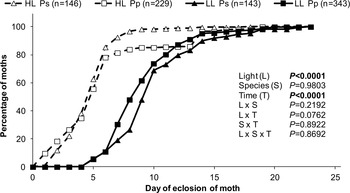
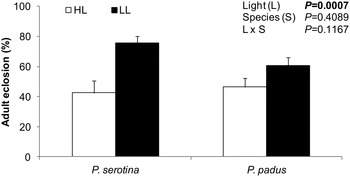
The moths eclosed from all the cocoon bunch, in the case of shoots of P. padus from HL conditions and on all shoots of P. padus and P. serotina from LL conditions (n = 10 per variant). In the case of P. serotina from HL conditions, moths hatched from only 9/10 shoots. The fig. 1 shows the total number of eclosed moths for each variant (a species of Prunus and light conditions). The period of time over which adults continued to eclose from pupae (starting from the first moth until the last moth) was longer and less dynamic on shrubs from LL conditions than on shrubs from HL conditions (fig. 1), and was not significantly affected by the host plant. The average percentage of adult eclosion on both Prunus species was significantly higher (53.3%) for larvae that grazed on leaves of shrubs from LL than those that grazed on leaves of shrubs from HL conditions (44.3 vs. 68.2%; fig. 2). The host plant species had no significant effect on this parameter and there was no significant interaction also species of Prunus × light conditions.
Cumulative daily percentage of moths that eclosed from pupae derived from larvae that fed on P. padus (Pp) or P. serotina (Ps) growing in high light (HL) or low light (LL) conditions. These data were expressed in relation to the total number of moths (n) that eclosed from pupae, which was set at 100%. A repeated measures ANOVA was used to assess the effect of light conditions (L), plant species (S), time (T) and their interactions on the percentage of moths that eclosed. P values <0.05 are in bold.

Percentage of adults that eclosed from pupae derived from larvae that fed on P. padus or P. serotina growing in high light (HL) or low light (LL) conditions. These data were expressed in relation to the total number of moths that emerged from pupae, which was set at 100%. A two-way ANOVA was used to determine the significance of the observed differences in the percentages of adults that eclosed from pupae in the different conditions. Vertical bars represent SE. P values <0.05 are in bold.

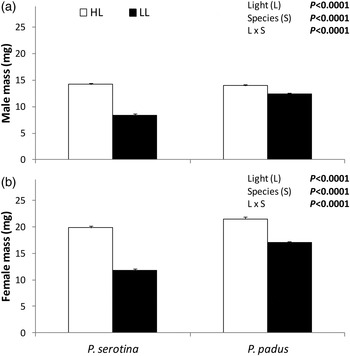
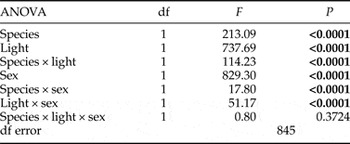
A significant effect of Prunus species and light conditions was observed on the adult body mass of Y. evonymellus (fig. 3; table 1). The body mass of moths, average of both light conditions variants and both sexes, was 17.0% higher for larvae that grazed on P. padus as compared with those that grazed on P. serotina. Whereas, in the case of the effect of light, the mass of adult moths, average of both Prunus species and both sexes, that emerged from larvae feeding on shrubs growing in HL was 27.4% greater than those that emerged from larvae on leaves of shrubs in LL conditions. Females were 40.3% heavier than males based on the average for all variants, species and light conditions. Additionally, the mass of females was more strongly affected by the Prunus species and light conditions than the mass of males. The interaction between Prunus species and light conditions was also significant (table 1). Moth mass was the highest on P. padus growing in HL (a), followed by P. serotina growing in HL (b), then P. padus growing in LL (c), and the lowest on LL shrubs of P. serotina (d; Tukey's HSD test; P < 0.05).
Mass of male (A) and female (B) moths hatched from larvae that fed on P. padus or P. serotina shrubs growing in high light (HL) or low light (LL) conditions. A two-way ANOVA was used to determine the significance of the observed differences in the mass of both sexes from the different conditions. Vertical bars represent SE. P values <0.05 are in bold.

Summary of ANOVA results (F and P values) for body mass of moths derived from larvae of Yponomeuta evonymellus that fed on leaves of Prunus padus or P. serotina growing in high light (HL) or low light (LL) conditions. P values <0.05 are in bold.

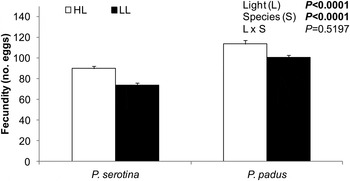
The average potential fecundity was 16.3% higher for females that grazed on shrubs in HL than those that grazed on the leaves of shrubs growing in LL conditions, based on the average of both species (fig. 4). A significant effect of Prunus species on the fecundity of Y. evonymellus was also observed. An average of 31.5% more eggs were produced by females whose larvae had fed on P. padus shrubs as compared with those feeding on P. serotina.
Fecundity of females, as measured by the number of eggs that were derived from larvae that fed on P. padus or P. serotina shrubs growing in high light (HL) or low light (LL) conditions. A two-way ANOVA was used to determine the significance of the observed differences in fecundity from the different conditions. Vertical bars represent SE. P values <0.05 are in bold.

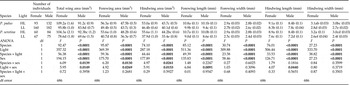
Light conditions and Prunus species also had a significant effect on all of the measured wing parameters (table 2). Significantly higher values were observed for nearly all of the measured wing parameters in adults whose larvae fed on P. padus vs. P. serotina and in HL vs. LL conditions. Different results were obtained only for certain parameters for the male moths that larvae fed on leaves of shrubs in HL conditions. Moreover, the interaction between Prunus species and light conditions was also significant for all of the wing parameters. According to Tukey's HSD test, wing parameters did not differ significantly between the host species in moths grown under HL conditions. However, in LL conditions moth had a significantly larger wings when larvae were feeding on the leaves of P. padus than on P. serotina. These relationships corresponded well with adult body mass (fig. 3). Moths, which have a higher mass have a greater wings. Female wings were always larger than male wings (table 2).
Total wing area, forewing and hindwing area, forewing and hindwing length, and forewing and hindwing width of moths derived from larvae of Yponomeuta evonymellus that fed on leaves of Prunus padus or P. serotina growing in high light (HL) or low light (LL) conditions; and a summary of the ANOVA results (F and P values). Significantly higher values were observed for nearly all of the measured wing parameters in adults whose larvae fed on P. padus vs. P. serotina and in HL vs. LL conditions. Data represent the mean and SE (in parentheses). Means with the same letter are not significantly different (Tukey's HSD test; P < 0.05). P values <0.05 are in bold.

Discussion
A significant effect of Prunus species and light conditions was observed on the growth and development of Y. evonymellus. Larvae of Y. evonymellus, a species which is widely thought to be monophagous feeding only on native P. padus, can successfully survive and develop in both HL and LL conditions on the non-native shrub P. serotina. Among the examined variants, light conditions (HL vs. LL) had a greater effect than host species (P. padus vs. P. serotina) on the obtained results of the growth and development of Y. evonymellus.
The results of the present field research indicate that the light conditions under which the Prunus species grow significantly affect moth mass, fecundity, and all of the measured wings parameters. A higher insect mass found by us is also the most frequently used indicator of improved living and feeding conditions (Morrison & Lindell, Reference Morrison and Lindell2012). Better host quality leads to a higher efficiency of conversion of ingested food in larvae, and thus results in increased mass in adults (Giertych et al., Reference Giertych, Bąkowski, Karolewski, Zytkowiak and Grzebyta2005; Niesenbaum & Kluger, Reference Niesenbaum and Kluger2006; Tremmel & Muller, Reference Tremmel and Muller2013). Although some researchers indicate that leaves of shrubs growing in HL are a worse food source (higher concentration of repellents) for herbivorous insects than leaves of shrubs growing in LL conditions (Koricheva et al., Reference Koricheva, Larsson and Haukioja1998a ; Hemming & Lindroth, Reference Hemming and Lindroth1999; Galway et al., Reference Galway, Duncan, Syrett, Emberson and Sheppard2004), there are also contrary evidence that are supported by our results. For example, Leather & Mackenzie (Reference Leather and Mackenzie1994) found that Y. evonymellus that developed from larvae feeding on P. padus shrubs located at the edge of a forest (HL conditions) were heavier than larvae from shrubs growing deeper in the forest (LL conditions). In some cases, LL conditions can impede the growth and development of insects (Oishi et al., Reference Oishi, Yokota, Teramoto and Sato2006; Muth et al., Reference Muth, Kluger, Levy, Edwards and Niesenbaum2008; Stoepler & Lill, Reference Stoepler and Lill2013).
Larvae of Y. evonymellus live gregariously until pupation (Leather, Reference Leather1986). Gregariousness provides some advantages to the eggs and larvae of insects (Grégoire, Reference Grégoire, Jolivet, Petitpierre and Hsiao1988). Larvae jointly spin a specific silk tent in order to hide from natural enemies and raise ambient temperatures by creating a closed environment (Joos et al., Reference Joos, Casey, Fitzgerald and Buttemer1988). Even a small increase in temperature can have a positive effect on the rate of development, final body mass or the duration of the time period in which adult insects hatch (Knapp & Casey, Reference Knapp and Casey1986; Łukowski et al., Reference Łukowski, Mąderek and Karolewski2014). Considering the above, it is suggested that the performance of Y. evonymellus could be enhanced by the warmer temperatures associated with high sun exposure of shrubs growing in HL conditions.
It is known fact that leaves of plants growing in HL have a higher nutritional value (content of carbohydrates and nitrogen) for folivores (Fortin & Mauffette, Reference Fortin and Mauffette2002; Oishi et al., Reference Oishi, Yokota, Teramoto and Sato2006; Osier & Jennings, Reference Osier and Jennings2007). Higher leaf nutritive values usually result in the shortened developmental duration (Tremmel & Muller, Reference Tremmel and Muller2013), a higher body mass (Giertych et al., Reference Giertych, Bąkowski, Karolewski, Zytkowiak and Grzebyta2005), and higher egg production (Awmack & Leather, Reference Awmack and Leather2002). Also in the presented research, the period over which adults continued to eclose from pupae was significantly shorter and more dynamic in larvae residing in HL shrubs than shrubs growing in LL conditions (fig. 1). In addition, body mass (fig. 3) and fecundity (fig. 4), as well as the sizes of wings (table 2), were also higher in HL shrubs as compared with shrubs growing in LL conditions. Yponomeuta evonymellus has been reported to exhibit a strong correlation between the size of adult females and fecundity (Kooi et al., Reference Kooi, Herrebout and Van de Water1989; Leather & Mackenzie, Reference Leather and Mackenzie1994). Our results are in accordance to these observations.
The results presented study and our previous research (Mąderek et al., Reference Mąderek, Łukowski, Giertych and Karolewski2015) indicate that the leaves of shrubs growing in HL conditions represented a higher leaf quality as food source for insects (‘luxury consumption’; Muth et al., Reference Muth, Kluger, Levy, Edwards and Niesenbaum2008). As a result, the insects did not need to consume as much of this food source; consequently resulting in lower defoliation (Muth et al., Reference Muth, Kluger, Levy, Edwards and Niesenbaum2008; Karolewski et al., Reference Karolewski, Giertych, Żmuda, Jagodziński and Oleksyn2013). The preference of insects for leaves of shrubs growing in HL is usually due to the presence of specific feeding stimulants such as sugars (Harborne, Reference Harborne1993; Levesque et al., Reference Levesque, Fortin and Mauffette2002). However, in the larval feeding period (April to June), the content of total nonstructural carbohydrates available to feeding larvae should be similar in both sunlit and shaded leaves (Karolewski et al., Reference Karolewski, Giertych, Żmuda, Jagodziński and Oleksyn2013). As concluded in our previous paper (Karolewski et al., Reference Karolewski, Jagodziński, Giertych, Łukowski, Baraniak and Oleksyn2014), P. padus and P. serotina leaves that were grown under the same, moderate light conditions are both comparatively high-quality foods for Y. evonymellus considering their chemical composition. However, under HL conditions levels of defensive compounds, such as phenolics and condensed tannins, was higher than in shrubs growing in the LL conditions, in the leaves of both the invasive P. serotina and native P. padus. Collectively, the results of the present and previous studies are consistent with the idea that monophagous insects tolerate higher levels of defense compounds in leaves than polyphagous insects (Mathur et al., Reference Mathur, Ganta, Raaijmakers, Reddy, Vet and van Dam2011; Ali & Agrawal, Reference Ali and Agrawal2012; Łukowski et al., Reference Łukowski, Giertych, Zadworny, Mucha and Karolewski2015).
HL conditions also lead to differences in leaf structure, including greater toughness and trichome density (Molina-Montenegro et al., Reference Molina-Montenegro, Ávila, Hurtado, Valdivia and Gianoli2006; Łukowski et al., Reference Łukowski, Mąderek and Karolewski2014; Mąderek et al., Reference Mąderek, Łukowski, Giertych and Karolewski2015). In relative comparison with LL conditions, leaves of P. serotina in HL are characterized by greater thickness and toughness, and thus are often considered highly resistant to insect damage (Abrams et al., Reference Abrams, Kloeppel and Kubiske1992). Laboratory experiments conducted by Kooi (Reference Kooi1989) demonstrated that Y. evonymellus could feed on Prunus laurocerasus L., a species with extremely hard and leathery leaves. Therefore, it is reasonable to consider that the increased toughness of leaves in P. serotina in HL conditions does not exert a negative impact on leaf consumption by Y. evonymellus.
Wing parameters are correlated with body mass and both strongly depend on leaf quality as food for insects (Thomas et al., Reference Thomas, Borland and Greenbank1980). Similar to research of Kooi (Reference Kooi1989), our study indicated that new host plant species has a negative effect on body mass (fig. 3) and wing size (table 2), while full light has positive effect on these parameters. Morphological plasticity of wings as it is affected by host quality and environment parameters, may be important for the movement and survival of an insect population (Taylor & Merriam, Reference Taylor and Merriam1995). This relationship, however, most likely depends on the insect species. In the case of Y. evonymellus, leaves of the native shrub P. padus growing in HL conditions appear to be a more optimum food source.
A benefit derived from feeding on HL leaves is that it shortens the time period over which adults continue to eclose from pupae. This in turn, further reduces the time that an insect is exposed to natural enemies during a vulnerable stage (fig. 1) which may be important to the reproductive success of Y. evonymellus. The quality of the host plant used by males and females during larval instars may significantly affect the reproductive success of both sexes (Delisle & Hardy, Reference Delisle and Hardy1997).
Light conditions affected the percentage of pupation, which was higher for larvae that grazed on leaves of LL shrubs rather than leaves of shrubs growing in HL (fig. 2). These results may be due to the variable occurrence and activity of natural enemies. Predatory and parasitic organisms have been widely investigated and evaluated as biological control agents (Unruh et al., Reference Unruh, Short, Herard, Chen, Hopper and Pemberton2003; Barber & Marquis, Reference Barber and Marquis2011). Natural enemies, such as other insects (Stoepler & Lill, Reference Stoepler and Lill2013) and arthropod predators (Skoczylas et al., Reference Skoczylas, Muth and Niesenbaum2007; Barber & Marquis, Reference Barber and Marquis2011) are often more abundant on fully sunlight (HL) than on shaded (LL) plants.
The Y. evonymellus moth reaches sexual maturity a few days after leaving the pupa but further dissemination of adults is a small distance (Menken et al., Reference Menken, Herrebout and Wiebes1992; Javoiš et al., Reference Javoiš, Tammaru and Käär2005). In this scope, the size of the wings may therefore be important. Furthermore, the simultaneous eclosion of many individuals that are capable of reproduction creates a potential opportunity to achieve a high level of reproductive success (Bakker et al., Reference Bakker, Campos Louçã, Roessingh and Menken2011). Moreover, higher fecundity is also a crucial factor that increases the transmission of the gene pool. Summarizing, better performance of insects mentioned above seem to confirm the higher quality of Prunus shrubs growing in HL than LL conditions for Y. evonymellus that was also previously postulated (Leather & Mackenzie, Reference Leather and Mackenzie1994; Łukowski et al., Reference Łukowski, Mąderek and Karolewski2014).
The present study provides a more comprehensive understanding of the phenomenon of the adaptation of Y. evonymellus to a new host plant and different light conditions within the host plant. This is especially relevant in the context of changing climate – global warming and drought; namely the displacement of P. padus by the invasive P. serotina. From an ecosystem perspective, it is interesting that the effect of light conditions (HL vs. LL) on the performance of this folivorous insect varied between the two host species. Such differential effects on host plant – insect interactions could potentially alter the successional dynamics of moth communities. The long-term displacement of P. padus by the invasive P. serotina could result in a gradual adaptation by Y. evonymellus to use the leaves of shrubs growing in HL conditions. Better growth and development of moths that larvae feeding on P. serotina shrubs growing in HL conditions implies that this insect may be observed to be more willing to use shrubs located in open, sunlit forest areas in the future. Since insects a play major role in the transfer of energy from plants to higher trophic levels, it is important to determine the effect of alien plants on size of the insect population and their biomass (Tallamy, Reference Tallamy2004). The effect of neophytes on insect body mass may have far-reaching consequences on ecosystem structure and the complexity of ecological interactions (Heleno et al., Reference Heleno, Ceia, Ramos and Memmott2009). It is too early to predict, however, the extent to which Y. evonymellus will adapt to using P. serotina leaves and whether this broadening the base of hosts plant will impact the spread of this invasive shrub in European forests. Further studies pertaining to the adaptation of Y. evonymellus to a new host plant are required to determine the factors determining oviposition and population parasitism in Y. evonymellus.
Acknowledgements
The research was financially supported by the statutory activities of the Institute of Dendrology Polish Academy of Sciences in Kórnik. The authors would like to thank A. Grzybek for his technical assistance with the experiments. We are also grateful to the Babki Forest District for allowing us to conduct the field research at their location.