Introduction
Since Tepper’s (Reference Tepper2000) seminal work on abusive supervision, there has been a surge in research on the topic (refer to reviews by Tepper, Reference Tepper2007; Martinko, Harvey, Brees, & Mackey, Reference Martinko, Harvey, Brees and Mackey2013; Tepper, Simon, & Park, Reference Tepper, Simon and Park2017). Abusive supervision is defined as ‘subordinates’ perceptions of the extent to which supervisors engage in the sustained display of hostile verbal and nonverbal behaviours, excluding physical contact’ (Tepper, Reference Tepper2000: 178). It includes behaviours such as ridiculing, lying, putting subordinates down in front of others, failing to give due credit to subordinates and according them the ‘silent treatment’. Research on abusive supervision has largely focussed on examining the consequences of abusive supervision for subordinates’ well-being (e.g., Tepper, Moss, Lockhart, & Carr, Reference Tepper, Moss, Lockhart and Carr2007), attitudes (e.g., Tepper, Reference Tepper2000; Aryee, Chen, Sun, & Debrah, Reference Aryee, Chen, Sun and Debrah2007) and behaviour (e.g., Zellars, Tepper, & Duffy, Reference Zellars, Tepper and Duffy2002; Liu, Liao, & Loi, Reference Liu, Liao and Loi2012; Xu, Huang, Lam, & Miao, Reference Xu, Huang, Lam and Miao2012; Liu & Wang, Reference Liu and Wang2013; Atwater et al., Reference Atwater, Kim, Witt, Latheef, Callison, Elkins and Zheng2016). It is only in the last 5 years that there has been a burgeoning growth in examinations of the antecedents of abusive supervision (Zhang & Bednall, Reference Zhang and Bednall2016; Tepper, Simon, & Park, Reference Tepper, Simon and Park2017).
While much is now known about antecedents of abusive supervision, special attention is still required to derive insights for workplace practitioners to mitigate such deleterious behaviours; especially with respect to how the work context shapes supervisors’ hostile interactions with subordinates. Given the high financial and social costs associated with abusive supervision, questions such as ‘why does abusive supervision persist in organisations given its deleterious consequences?’ and ‘why do supervisors continue to adopt such unethical behaviours in their work-related interactions with subordinates?’ need to be addressed. Abusive supervision is associated with approximately US$23.8 billion per annum of related health costs and lost productivity to organisations (Tepper, Duffy, Henle, & Lambert, Reference Tepper, Duffy, Henle and Lambert2006) and has negative personal and social costs for individuals, ranging from psychological distress to the spill over across domains from work to family. From the organisational perspective, there is a need to develop actionable knowledge to manage the ethical phenomenon of abusive supervision in the workplace.
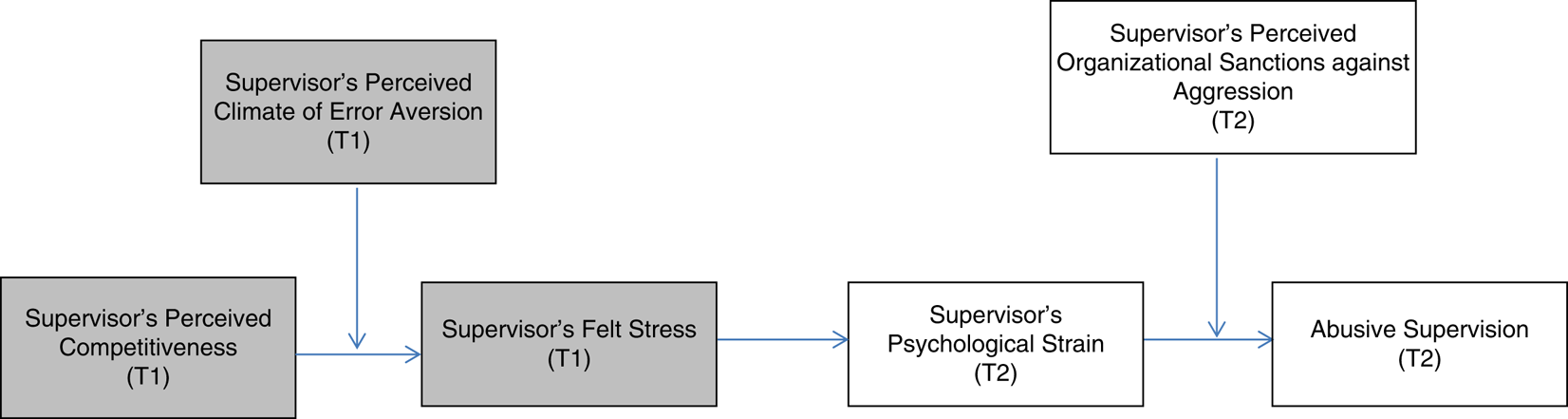
The purpose of this study is to improve understanding of antecedents to abusive supervision and develop actionable knowledge in the workplace to prevent perpetuation of such phenomena. First, we suggest that there is much to gain by taking the stress perspective from supervisors’ lens to examine the antecedents of abusive supervision. Adopting a stress perspective, this study examines the antecedents to abusive supervision and when such hostile behaviours are perpetuated in the workplace. Figure 1, which depicts our proposed theoretical model, identifies supervisors’ perceived competitiveness as the workplace stressor and the precursor to abusive supervision. We posit that supervisors’ felt stress and psychological strain serve as mediating mechanisms linking supervisors’ perceived competitiveness to abusive supervision. By drawing from the transactional theory of stress (Lazarus & Folkman Reference Lazarus and Folkman1984), our study extends the literature on abusive supervision and highlights supervisors as circumstantial ‘victims’ of workplace stressors who precipitate aggression downwards on their subordinates when their resources are depleted. Our empirical results linking perceived competition with supervisors’ displays of hostilities towards their subordinates provides the needed balanced view that supervisors can also be ‘victims’ of stresses in the workplace.
Theoretical model

Second, in their meta-analytic review of literature on antecedents to abusive supervision, Zhang and Bednall (Reference Zhang and Bednall2016) highlighted that research on antecedents of abuse is still in the early stages. With only two factors (organisational sanctions and aggressive norms) having been investigated, they called for more organisation-related studies. We examine two workplace practices (‘climate of error aversion’ and ‘organisational sanctions against aggression’) that may accentuate or attenuate supervisors’ hostilities, to offer actionable knowledge that organisations should adopt, to manage the abusive supervision phenomenon.
We suggest that both climate of error aversion and organisational sanctions against aggression could moderate the effects of workplace stressors on abusive supervision, such that perceived climate of error aversion would moderate the relationship between supervisors’ perceived competitiveness and felt stress, while perceived organisational sanctions against aggression would moderate the relationship between supervisors’ psychological strain and abusive supervision. We draw from the basic tenet of the conservation of resources (COR) theory (a theory of motivation in the stress literature) that supervisors are motivated to obtain, retain, foster and protect those things they centrally value; and suggest that both climate of error aversion and organisational sanctions against aggression may hinder or encourage perpetuation of supervisors’ hostilities in the workplace.
Last, by integrating the transactional theory of stress (Lazarus & Folkman, Reference Lazarus and Folkman1984), the job demands-resources (JD-R model) (Demerouti, Bakker, Nachreiner, & Schaufeli, Reference Demerouti, Bakker, Nachreiner and Schaufeli2001) and the COR theory (Hobfoll, Reference Hobfoll1988, Reference Hobfoll1989, Reference Hobfoll2001, Reference Hobfoll2002) in our study, we provide both the theoretical understanding and empirical support to address existing gaps in the abusive supervision literature: What and how abusive supervision occurs; and what are the organisation-related variables that perpetuate abusive supervision in the workplace.
Theoretical background and framework
In developing our hypotheses for this study, we draw from the literature on the transactional theory of stress (Lazarus & Folkman Reference Lazarus and Folkman1984), the COR theory (Hobfoll Reference Hobfoll1988, Reference Hobfoll1989, Reference Hobfoll2001, Reference Hobfoll2002) and the JD-R model (Demerouti et al., Reference Demerouti, Bakker, Nachreiner and Schaufeli2001) to understand what, how and when exhausted supervisors abuse their subordinates. First, we draw from Lazarus and Folkman’s (Reference Lazarus and Folkman1984) transactional theory of stress, which proposes a stressor–appraisal–emotion–outcome process to explain the underlying psychological mechanisms from workplace stressor to abusive supervision relationship. Specifically, we draw from the JD-R model as a starting point and primarily focus on supervisors’ perceived competitiveness as a form of job demand in the workplace (i.e., those physical, social or organisational aspects of the job that require sustained physical and/or psychological effort) that would trigger a health impairment process. Supervisors’ perceived competitiveness triggers supervisors’ felt stress and psychological strain, which in turn results in abusive supervision as part of supervisors’ coping mechanisms to vent or let off steam.
The COR theory serves to explain how individuals (and groups) strive to obtain, retain, foster and protect resources they centrally value. Resources are loosely defined as objects, states, conditions and other things that people value (Hobfoll, Reference Hobfoll1988). We draw from two key tenets of the COR theory – the primacy of loss principle and resource investment principle (Hobfoll, Halbesleben, Neveu, & Westman, Reference Hobfoll, Halbesleben, Neveu and Westman2018) to explicate how two workplace practices (i.e., climate of error aversion [‘blame’ climate] and organisational sanctions against aggression) further constrain supervisors’ ability to respond and adapt to stress in the workplace. Specifically, we postulate that a climate of error aversion further depletes supervisors’ resources when supervisors perceive heightened competition in the workplace, resulting in increased stress. Further, when organisations impose sanctions against workplace aggression (a workplace intervention practice), exhausted supervisors are more likely to invest in resources to protect against resource loss (i.e., negative consequences of being sanctioned).
Workplace stressors and abusive supervision
The literature on aggression suggests that negative workplace stressors are related to aggressive behaviours. For example, a meta-analysis by Hershcovis et al. (Reference Hershcovis, Turner, Barling, Arnold, Dupré, Inness, LeBlanc and Sivanathan2007) revealed that frustrating events and situational constraints were strong predictors of workplace aggression, while Chen and Spector (Reference Chen and Spector1992) reported that job stressors were positively related to interpersonal aggression at work. Burton, Hoobler, and Scheuer (Reference Burton, Hoobler and Scheuer2012) demonstrated a link between increased levels of stress experienced by supervisors and increased experience of employee-rated abusive supervision. We extend the current understanding in the abusive supervision literature by expanding and explicating the mechanisms by which job demand (i.e., supervisors’ perceived competitiveness) is linked to aggression (abusive supervision).
Theoretical and empirical work (e.g., Lazarus & Folkman, Reference Lazarus and Folkman1984; Burton, Hoobler, & Scheuer, Reference Burton, Hoobler and Scheuer2012; Mawritz, Folger, & Latham, Reference Mawritz, Folger and Latham2014; Scheuer, Burton, Barber, Finkelstein, & Parker, Reference Scheuer, Burton, Barber, Finkelstein and Parker2016) has identified and supported the underlying appraisal processes triggered by stressors; the associated emotional reactions; and the associated coping mechanisms that eventually influence behaviours. By drawing from the stressor–appraisal–emotion–outcome sequence of Lazarus and Folkman’s (Reference Lazarus and Folkman1984) transactional theory of stress, as well as the JD-R model (Demerouti et al., Reference Demerouti, Bakker, Nachreiner and Schaufeli2001), we explicate how supervisors’ perceived competitiveness influences felt stress (referred to as a sense of time pressure, anxiety and worry that is associated with job demand) and subsequently the psychological strain that eventually precipitates abusive supervision – a form of aggressive reaction or response to workplace stressors. We consider supervisors’ perceived competitiveness as a form of job demand in the workplace as well as a workplace stressor (i.e., ‘stimuli that evoke the stress process’; LePine, Podsakoff, & LePine, Reference LePine, Podsakoff and LePine2005: 764) to which supervisors are exposed in an organisation. Supervisors’ perceived competitiveness refers to the degree to which supervisors perceive that organisational rewards are contingent on their performance compared with that of their peers (Brown, Cron, & Slocum, Reference Brown, Cron and Slocum1998). Examples of workplace factors that could contribute to perceived competitiveness include perceptions of differential reward distribution, having performance compared with other individuals within a work unit, perceiving competition from others and frequent status comparisons.
Competition is endemic within organisations especially for supervisors as they compete for resources, rewards and status to stay ahead or survive within the organisation. Such competition in the workplace can be unhealthy as it leads to uncertainty. The job demands for supervisors to remain constantly competitive create tension and frustrate the supervisors’ ability to attain valued resources, status and success within the organisation. Supervisors who perceive strong competition within the workplace are likely to believe that there is no relationship between effort expended and the likelihood of attaining valued resources. As an illustration, when a supervisor performs at an objectively measured high level or meets his or her own performance goals, he or she may not be a better or the best performer when compared with others. While competition may enhance performance in the short term, it could lead to stress over time as one remains in the rat race to stay ahead of the others. As such, increased perceptions of competition heighten tension for supervisors trying to secure resources and rewards while remaining competitive vis-à-vis their peers in the workplace. A study by Fletcher, Major, and Davis (Reference Fletcher, Major and Davis2008) demonstrated that increased perceptions of competition leads to increased stress regardless of one’s level of trait competitiveness. Based on the above arguments and consistent with past empirical findings (Fletcher, Major, & Davis, Reference Fletcher, Major and Davis2008), we hypothesise the following:
Hypothesis 1: Supervisors’ perceived competitiveness will lead to supervisors’ felt stress.
Empirical studies have made the distinction between challenging stress and hindrance stress and have associated these with positive outcomes such as job satisfaction and job performance (e.g., LePine, Podsakoff, & LePine, Reference LePine, Podsakoff and LePine2005) as well as negative outcomes such as turnover and exhaustion (Cavanaugh, Boswell, Roehling, & Boudreau, Reference Cavanaugh, Boswell, Roehling and Boudreau2000; Podsakoff, LePine, & LePine, Reference Podsakoff, LePine and LePine2007). Following an initial appraisal of the workplace stressor (i.e., supervisors’ felt stress), we expect supervisors to respond with psychological strain when workplace stimuli are experienced as stressful. This is line with the finding by Boswell, Olson-Buchanan, and LePine (Reference Boswell, Olson-Buchanan and LePine2004) that psychological strain is associated with stress regardless of whether the stressful experience has the potential for gain. Psychological strain is a mental state characterised by negative thoughts and feelings related to anxiety and depression (Warr, Reference Warr1990). Both anxiety and depression are forms of psychological distress that reflect an individual’s emotional reaction to stressful experiences (Jex & Beehr, Reference Jex and Beehr1991). When workplace stimuli are deemed as job stressors that are constraining, supervisors are likely to experience negative feelings following exposure to stressful and emotionally traumatic experiences (Fox & Spector, Reference Fox and Spector1999). Considerable research suggests that job stressors are likely to induce negative emotions (Lazarus & Folkman, Reference Lazarus and Folkman1984; Fox, Spector, & Miles, Reference Fox, Spector and Miles2001) and the stressor–strain literature (LePine, Podsakoff, & LePine, Reference LePine, Podsakoff and LePine2005) further supports our arguments that workplace constraints induce the stress process and that psychological strain (referred to as feelings of anxiety and depression) is an outcome of the stress process:
Hypothesis 2: Supervisors’ felt stress will lead to supervisors’ psychological strain.
Consistent with the coping process as a final stage in the transactional theory of stress, we posit that psychologically strained supervisors are likely to adopt aggression as an emotion-focussed coping behaviour to alleviate their negative thoughts and feelings. Indeed, ancillary research has shown that individuals generally view aggression, such as venting anger and demonstrating hostility, as an outlet for venting their distress or ‘blowing off steam’ (e.g., Lazarus, Reference Lazarus1991; Berkowitz, Reference Berkowitz1993). Supervisors are more likely to displace their aggression towards subordinates, who represent easy and ready targets for supervisors to ‘let off steam’ and do not readily retaliate against supervisors. This is due to the power imbalance in the supervisor–subordinate relationship, which may deter subordinates from retaliating against their abusive supervisors. Consistent with a recent study by Lam, Walter, and Huang (Reference Lam, Walter and Huang2017) demonstrating a relationship between supervisors’ emotional exhaustion and abusive supervision, we hypothesise the following:
Hypothesis 3: Supervisors’ psychological strain will lead to abusive supervision.
Taking into consideration the above arguments, we posit that supervisors who face increasing competition in the workplace will appraise these workplace stimuli as stressful and thus experience psychological strain. To cope with these negative experiences, they use aggression towards their subordinates as an emotion-focussed coping strategy to deal with their stressful experiences. Hence, we propose the following:
Hypothesis 4: Supervisors’ felt stress and psychological strain will serially mediate the relationship between supervisors’ perceived competitiveness and abusive supervision.
The moderating influence of supervisors’ perceptions of climate of error aversion
The COR theory has been used in the abusive supervision literature to examine how leaders’ abusive behaviours deplete subordinate resources and, in turn, negatively affect work outcomes (Palanski, Avey, & Jiraporn, Reference Palanski, Avey and Jiraporn2014; Avey, Wu, & Holley, Reference Avey, Wu and Holley2015; Pan & Lin, Reference Pan and Lin2016). Although the literature explicates the link between abusive supervision and its effect on subordinate’s outcomes using the COR theory, we extend the COR theory in our study to suggest that two workplace constraints (perceived climate of error aversion and organisational sanctions against aggression) moderate the workplace stressor–abusive supervision relationships.
The COR theory states that individuals strive to obtain, retain, foster and protect those things they centrally value. One of the key tenets of the COR theory is the primacy of loss principle where resource loss is more salient and harmful than resource gain (Hobfoll, Reference Hobfoll2002). When resources are unavailable, threatened or invested with insufficient gain, the primacy of loss principle sets in. Workplace stressors consume or threaten resources (e.g., consume time and threaten monetary rewards) and when there are situational constraints that create a further drain on one’s resources, ‘loss spirals’ occur, resulting in heightened levels of stress. Environmental circumstances are often the cause of resource depletion. In particular, we propose that when supervisors perceive a climate of error aversion, this diminishes their resources and accentuates the relationship between supervisors’ perceived competitiveness and supervisors’ felt stress.
In the literature, there are two archetypes of error management climate: an open one where individuals are supported upon reporting errors; and a climate of error aversion (‘blame’ climate) where one is sanctioned for committing mistakes and errors (Van Dyck, Frese, Baer, & Sonnentag, Reference Van Dyck, Frese, Baer and Sonnentag2005). Given our focus on illuminating how environmental factors reinforce the persistence of abusive supervision in the workplace, we examine supervisors’ perceptions of climate of error aversion as a boundary condition in the stressor–stress relationship. In a ‘blame’ climate, people generally believe that a reported error of any size has the possibility to result in sanctions (e.g., Rybowiak, Garst, Frese, & Batinic, Reference Rybowiak, Garst, Frese and Batinic1999; Van Dyck et al., Reference Van Dyck, Frese, Baer and Sonnentag2005; Van Dyck, Reference Van Dyck2009). Hence, in a climate of ‘getting it right the first time’, supervisors who are confronting competition within the organisation for valued resources, rewards and status may experience further resource depletion because the ‘blame’ climate does not allow for omission or commission of errors. Generally, individuals are averse to errors for several reasons. First, errors have negative and fundamental attribution bias (Brown, Williams, & Lees-Haley, Reference Brown, Williams and Lees-Haley1994; Gilbert & Malone, Reference Gilbert and Malone1995) as people attribute them to undesirable personality traits, lack of knowledge and skills, or low intelligence. Second, individuals fear being sanctioned and punished for errors. As such, they will expend and deplete their resources (e.g., time or sleep) in an attempt to achieve zero error and avoid any negative attributions. To stay ahead or survive within the organisation, supervisors confronted with intense competition will experience loss spirals with further resources being depleted, resulting in higher levels of stress in a ‘blame’ climate, to avoid being deemed as incompetent by their peers or receiving sanctions or punishments. As such, we propose that:
Hypothesis 5: Supervisors’ perceived climate of error aversion moderates the relationship between supervisors’ perceived competitiveness and supervisors’ felt stress such that it will have an exacerbating effect on the perceived competitiveness–felt stress relationship.
The moderating effects of supervisors’ perceived organisational sanctions against aggression
In our model, we identify organisational sanctions against aggression as an intervention strategy to mitigate the psychological strain–abusive supervision relationship. Research has demonstrated that individuals tend to refrain from behaviour associated with negative personal consequences, especially when an organisation has established processes that invoke sanctions against aggression (Dekker & Barling, Reference Dekker and Barling1998; Dupré & Barling, Reference Dupré and Barling2006). As such, organisational sanctions against aggression plays a crucial role in the way supervisors respond to and cope with psychological strain. According to the resource investment principle – a key tenet of the COR theory (Hobfoll, Reference Hobfoll2002) – individuals invest resources to protect against resource loss, to recover from losses and to gain resources (Hobfoll, Reference Hobfoll2001). As psychological strain represents a significant depletion of resources (e.g., health), the COR model suggests that resource-drained supervisors will carefully select the manner in which they use their remaining resources (Halbesleben & Bowler, Reference Halbesleben and Bowler2007). As abusive supervision constitutes a form of aggression towards subordinates that is being monitored and sanctioned by the organisation, it is likely that supervisors will take steps to protect further resource losses (e.g., sanctions and punishments) and refrain from engaging in aggression, given the negative consequences of such actions. As such, organisational sanctions against aggression have mitigating effects on the relationship between supervisors’ psychological strain and abusive supervision.
Specifically, we argue that the perception of weak organisational sanctions against aggression is likely to create ambiguity for supervisors concerning what are the consequences if one engages in acts of violence or aggression. In contrast, the perception of strong organisational sanctions against aggression is likely to send a strong signal to supervisors that violence and aggression are not tolerated within the organisation, and have detrimental implications for perpetrators such as written warnings and the possibility of termination. Earlier, we postulated that supervisors under strain will vent their frustrations by taking them out on their subordinates. When organisational sanctions against aggression are high and the likelihood of sanctions or punishments are more salient, supervisors are likely to take steps and show restraint in adopting aggression, as there are personal consequences. We expect exhausted supervisors to distance themselves from engaging in aggression and invest their remaining resources (e.g., exercising self-restraint) in an attempt to prevent further resource losses. In contrast, when organisations lack clear guidelines regarding aggressive behaviour, supervisors are more likely to vent and let off steam by engaging in abusive behaviour (without effortful resource investment) as they appraise their workplace situation and recognise that they may not be sanctioned if they engage in aggression. Thus, we offer the following hypothesis:
Hypothesis 6: Perceived organisational sanctions against aggression will moderate the effects of supervisors’ psychological strain on abusive supervision such that the relationship will be stronger when organisational sanctions against aggression are low as opposed to high.
Methods
Sample and procedure
Following the common practice of survey studies in organisational behaviour (see Qin, Huang, Johnson, Hu, & Ju, Reference Qin, Huang, Johnson, Hu and Ju2018; Hu, Erdogan, Jiang, Bauer, & Liu, Reference Hu, Erdogan, Jiang, Bauer and Liu2018; Lam, Lee, Taylor, & Zhao, Reference Lam, Lee, Taylor and Zhao2018), we used a convenience sample to test our hypotheses. The sample came from Guangdong province, South China, which is one of the more prosperous and developed provinces in China. Many studies on organisational behaviour have been carried out in this region (e.g., Aryee et al., Reference Aryee, Chen, Sun and Debrah2007; Pan & Lin, Reference Pan and Lin2016). Our sample consisted of 450 subordinates and 115 immediate supervisors. The supervisors were part-time Master of Business Administration students at a leading university in Guangdong province, who had full-time jobs in business organisations ranging from manufacturing to services industries (e.g., electric appliances, telecommunications, airlines, banks, automotive) and worked in various departments including production, marketing, financial and accounting, and quality management. These supervisors were asked to randomly select up to four of their subordinates (or, if they had fewer than four, to include at least two subordinates) to participate in the survey. Each survey package contained a questionnaire as well as a cover letter explaining the objectives of the study, the voluntary nature of participation and an assurance on the confidentiality of responses. We used a coding scheme to ensure matched supervisor–subordinate data.
To minimise possible common method bias, we adopted a time-lagged design (Times 1 and 2) with a 2-week interval (Podsakoff, MacKenzie, Lee, & Podsakoff, Reference Podsakoff, MacKenzie, Lee and Podsakoff2003). At Time 1, supervisors were asked to assess their perceived competitiveness, supervisor felt stress and the error aversion climate and to provide personal background information. At Time 2, supervisors were asked to respond to measures on psychological strain and organisational sanctions regarding aggression, while subordinates were asked to rate their supervisors’ abusive behaviour to subordinates and to provide personal background information. In total, we received 362 matched responses (representing a response rate of 80%) for further analysis. After eliminating questionnaires with omissions and errors, we had a total of 358 matched responses from 95 groups with an average group size of 3.8.
Of the 95 supervisors, 63% were male, their average age was 35.55 (SD = 5.34) years, their average number of years of education was 16.46 (SD = 1.31) and 96% possessed college or university degrees. Of the 358 subordinates, 51% were male, their average age was 29.60 (SD = 3.96) years, their average number of years of education was 15.88 (SD = 1.13) and 90% possessed college or university degrees.
Measures
All scales in the questionnaires were administered in Chinese following Brislin’s (Reference Brislin1980) recommended standard translation and back-translation procedures to ensure the equivalence of measures. The translation and back translations were conducted by two Chinese bilingual academics and a bilingual human resource practitioner (who is not from the same company). Unless otherwise indicated, response options ranged from 1 = ‘strongly disagree’, to 7 = ‘strongly agree’.
Supervisors’ perceived competitiveness
We assessed supervisors’ perceived competitiveness with three of four item measures taken from Brown, Cron, and Slocum (Reference Brown, Cron and Slocum1998). A sample item is ‘My boss frequently compares my results with those of other peers’. Cronbach’s α for this scale is 0.76.
Supervisors’ felt stress
This was measured with six items taken from scales reported by Hunter and Thatcher (Reference Hunter and Thatcher2007). An example item is ‘Too many people at my level get burned out by job demands’. The reliability α for this scale is 0.88.
Supervisors’ psychological strain
Supervisors’ psychological strain was measured with a scale reported by Sprigg, Stride, Wall, Holman, and Smith (Reference Sprigg, Stride, Wall, Holman and Smith2007) as adapted from a scale used by Warr (Reference Warr1990). Supervisors were asked to consider over recent weeks and indicate the frequency with which their job made them feel in a certain way (e.g., ‘nervous, worried’) on a scale from 1 = ‘never’, to 7 = ‘always’. The reliability α for this scale is 0.89.
Perceived climate of error aversion
We measured this factor with five items adapted from scales reported by Van Dyck et al. (Reference Van Dyck, Frese, Baer and Sonnentag2005). We only used items that were related to ‘experiencing strain from errors’, such as getting upset and irritated when mistakes occur. An example item is ‘People in this organisation are often afraid of making errors’. The reliability α for this scale is 0.91.
Perceived organisational sanctions against aggression
We measured this factor with four items taken from scales reported by Inness, LeBlanc, and Barling (Reference Inness, LeBlanc and Barling2008). An example item is ‘In this organisation an individual would be sanctioned or reprimanded for behaving aggressively towards others’. The reliability α for this scale is 0.84.
Control variables
We controlled for supervisors’ gender, age, education and negative affectivity as these variables have been shown to relate to workplace aggression (Barling, Dupré, & Kelloway, Reference Barling, Dupré and Kelloway2009) and victimisation (Aquino & Thau, Reference Aquino and Thau2009). Negative affectivity was measured with the 10-item negative affect scale (Watson, Clark, & Tellegen, Reference Watson, Clark and Tellegen1988). Response options ranged from 1 = ‘not at all’, to 7 = ‘extremely’. The α reliability for this scale is 0.92.
Abusive supervision
We measured this factor using the 15-item scale developed and validated by Tepper (Reference Tepper2000). We used the referent shift approach to reword the scale items to refer specifically to the treatment that the subordinates of the focal supervisor received. The reference was to team members (i.e., subordinates) rather than individuals (i.e., me). Sample items for this measure include ‘My supervisor ridicules subordinates’ and ‘My supervisor puts subordinates down in front of others’. Subordinates were asked to indicate the frequency with which their supervisor engaged in each behaviour, ranging from 1 = ‘never’, to 7 = ‘very often’. The score for each of the subordinates in the group was then aggregated to the group level. The group-level α reliability for this scale of 0.99 was obtained by averaging the item response per group and then calculating the scale reliabilities at the aggregate level of analysis (Chen, Mathieu, & Bliese, Reference Chen, Mathieu and Bliese2005).
Justification for aggregation
Abusive supervision was aggregated to the group level and tested for both between-group variability and within-group agreement (Klein, Dansereau, & Hall, Reference Klein, Dansereau and Hall1994; Hofmann, Reference Hofmann1997). The between-group variance for group-level abusive supervision was significantly different from 0 (F(94, 337) = 6.74, p <.001). The mean r wg for group-level abusive supervision was 0.97 (range -.75–1.00), the intraclass correlation coefficient (1) was 0.60 and intraclass correlation coefficient (2) was 0.85. These intraclass correlation coefficient values are comparable to the prescribed values for group-level constructs in the literature (Bliese, Reference Bliese2000; Morgeson, Reference Morgeson2005) and the mean r wg is above the threshold value of 0.70 that suggests a high group-level agreement (James, Demaree, & Wolf, Reference James, Demaree and Wolf1984). Taken together, these results suggest that it is statistically appropriate to aggregate abusive supervision to the group level.
Data analysis
We first conducted a confirmatory factor analysis to ascertain the dimensionality and discriminant validity of our multiitem measures. We tested our model using path analyses (at supervisor level) with Mplus version 6.11 (Muthén & Muthén, Reference Muthén and Muthén1998–2010). The bootstrap method was used to estimate confidence intervals for the hypothesised mediated relationships to determine their significance (Preacher & Hayes, Reference Preacher and Hayes2008). To ensure the robustness of our data analyses, we used multiple regressions with SPSS 18.0 to retest the hypotheses and calculate the statistical power for each hypothesis test with G*power version 3.1.9.2 (Faul, Erdfelder, Buchner, & Lang, Reference Faul, Erdfelder, Buchner and Lang2014)
Results
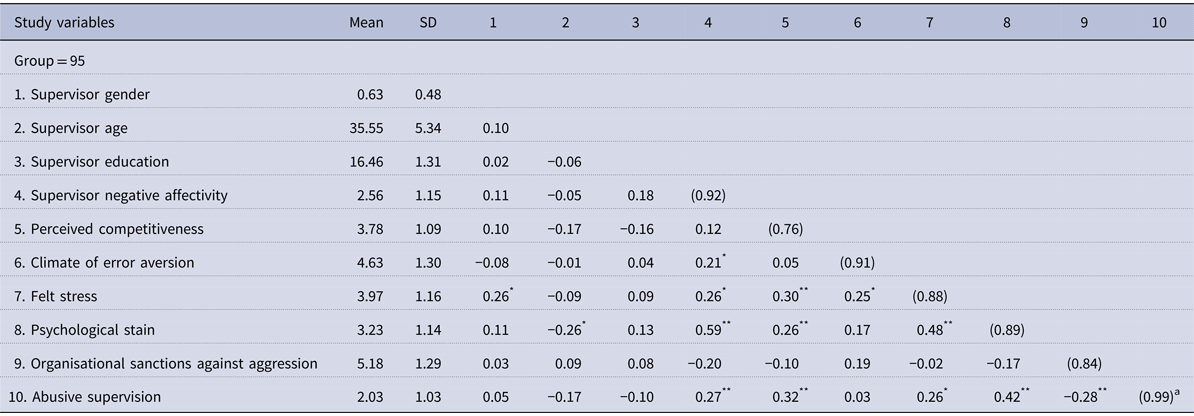
Descriptive statistics and intercorrelations among the variables are shown in Table 1. Zero-order correlations were in the expected direction.
Means, standard deviations and correlations between study variables

Note. Reliability coefficients are shown on the diagonal in parentheses.
a Computed by calculating the mean for each item within the team.
* p <.05
** p <.01.
Measurement model
We conducted a two-level confirmatory factor analysis to ascertain the distinctiveness of the multilevel variables (abusive supervision at individual level as it was rated by two to four subordinates of each supervisor; all supervisor-rated variables at group level) in the study using Mplus version 6.11 (Muthén & Muthén, Reference Muthén and Muthén1998–2010). All the factor loadings were significant at the 0.01 level and all items were loading correctly on the expected constructs, indicating validity of indicators (Bollen, Reference Bollen1989).
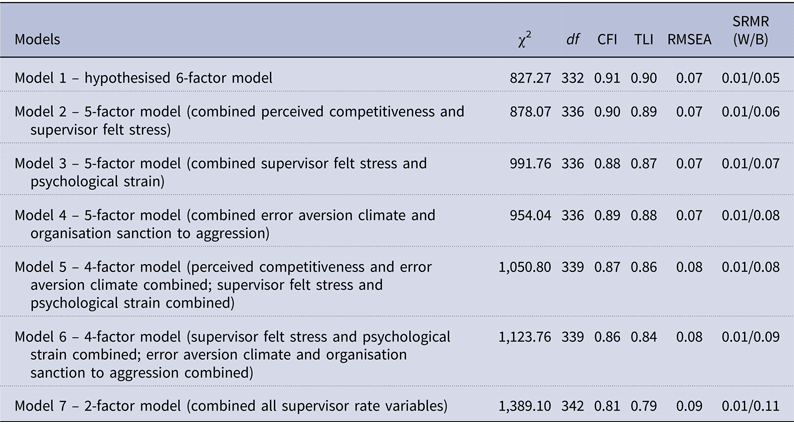
Next, we compared the fit of a hypothesised 6-factor model with a series of alternative models: three 5-factor models (Models 2–4: combining supervisors’ perceived competitiveness and felt stress in Model 2; combining supervisors’ felt stress and psychological strain in Model 3; combining perceived climate of error aversion and perceived organisational sanctions against aggression in Model 4), two 4-factor models (Models 5 and 6: combining supervisors’ perceived competitiveness and perceived climate of error aversion; combining supervisors’ felt stress and psychological strain in Model 5; combining supervisors’ felt stress and psychological strain; combining perceived climate of error aversion and perceived organisation sanction to aggression in Model 6) and one 2-factor model (combining all supervisor-rated variables in Model 7). The hypothesised 6-factor model fit the data reasonably well (Hair, Anderson, Tatham, & Black, Reference Hair, Anderson, Tatham and Black1998) (χ2 = 827.27, df = 332, comparative fit index (CFI) = 0.91, Tucker–Lewis index (TLI) = 0.90, root mean square effort of approximation (RMSEA) = 0.07, standardised root mean square residual (within/between) (SRMR [W/B]) = 0.01/0.05); alternative models exhibited worse fit than the baseline model. Table 2 shows the overall results (including the model comparisons) and provides evidence for the distinctiveness of the six studied constructs.
Results of the two-level confirmatory factor analyses for variables studied

Note. CFI = comparative fit index; RMSEA = root mean square effort of approximation; SRMR(W/B) = standardised root mean square residual (within/between); TLI = Tucker–Lewis index.
Number of groups = 95; number of individuals = 358.
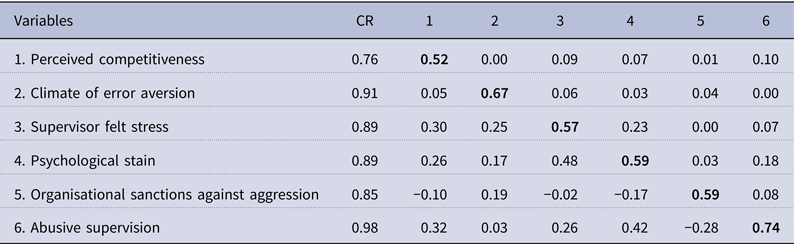
We used the method described by Fornell and Larcker (Reference Fornell and Larcker1981) to assess the discriminant validity and construct reliability of the studied constructs. We computed the average variance extracted of each construct and the shared variance between constructs. Table 3 shows the results for discriminant validity and construct reliability. The average variance extracted for each construct was over 0.50 and greater than its shared variance with any other construct (Fornell & Larcker, Reference Fornell and Larcker1981), providing support for discriminant validity. Composite reliability values for each construct were all above 0.70, indicating reasonable construct reliability (Fornell & Larcker, Reference Fornell and Larcker1981).
Composite reliability (CR), average variance extracted (AVE) and share variance of constructs

Note. AVEs are shown on the diagonal in bold; shared variances are shown on the upper right triangle; correlations are shown on the lower left triangle.
We conducted a Harman’s single-factor test to detect common method variance. We ran a factor analysis without rotation with five variables collected from the supervisors. We obtained five components, the first of which contained 26% of the variance, which is much lower than 50%, indicating common method variance is not an issue in our study. Further, we followed the method described by Williams and McGonagle (Reference Williams and McGonagle2016) to test for both common method variance and discriminant validity. In the comparison of two-level confirmatory factor analysis models, we constrained all of the composite indicators of all five supervisor-rated variables to load onto one factor, a ‘common method factor’. The sequential χ2 differential test comparing the models indicated that the constrained model (Model 7 in Table 2), estimating one common method factor, did not fit well according to the fit indices (χ2 = 1389.10, df = 342, CFI = 0.81, TLI = 0.79, RMSEA = 0.09, SRMR [W/B] = 0.01/0.01), signifying that the indicators were not related solely because of a common method.
Hypothesis testing
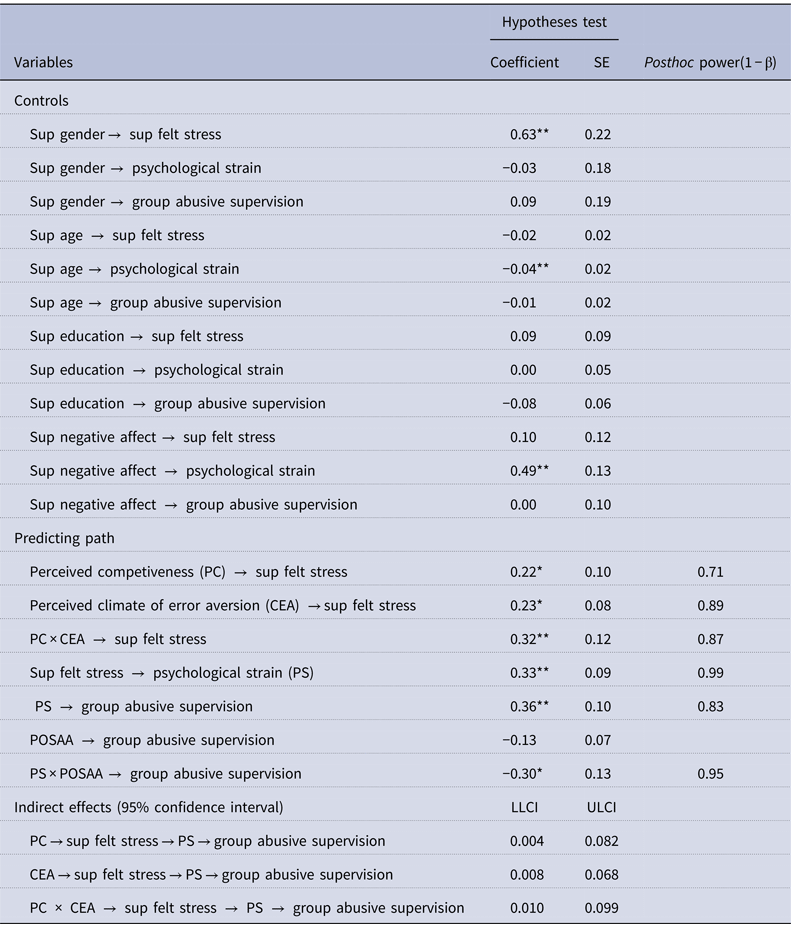
We tested our hypothesised model using path analyses with Mplus version 6.11 (Muthén & Muthén, Reference Muthén and Muthén1998–2010). Table 4 shows the results of the test. After controlling for supervisors’ negative affectivity and demographics (age, gender and education), supervisors’ perceived competitiveness had a significant positive relationship with supervisors’ felt stress (b = 0.22, SE = 0.10, p <.05). Hence, Hypothesis 1 is supported. Supervisors’ felt stress was also positively related to supervisors’ psychological strain (b = 0.33, SE = 0.09, p <.01), thus lending support to Hypothesis 2. Hypothesis 3 is also supported as supervisors’ psychological strain was positively related to abusive supervision (b = 0.36, SE = 0.10, p <.01).
Results of the path analysis for hypotheses test

Note. LLCI = lower level of the 95% confidence interval; POSAA = perceived organisational sanctions against aggression; Sup = supervisor; UCLI = upper level of the 95% confidence interval.
Confidence intervals are calculated with 5,000 bootstrap.
* p <.05
** p <.01.
Hypothesis 4 predicted that supervisors’ felt stress and psychological strain would serially mediate the relationship between supervisors’ perceived competitiveness and abusive supervision. We used a bias-corrected bootstrap procedure of 5,000 draws (Preacher & Hayes Reference Preacher and Hayes2008; Barnes, Lucianetti, Bhave, & Christian, Reference Barnes, Lucianetti, Bhave and Christian2015) to estimate the hypothesised serial mediation effect. The estimate of the indirect effect for the serial mediation was significant at the 5% level (i.e., p <.05), and the lower and upper bounds of the 95% bias-corrected bootstrap confidence interval were 0.004 and 0.082, respectively; they did not include zero. The results supported Hypothesis 4.
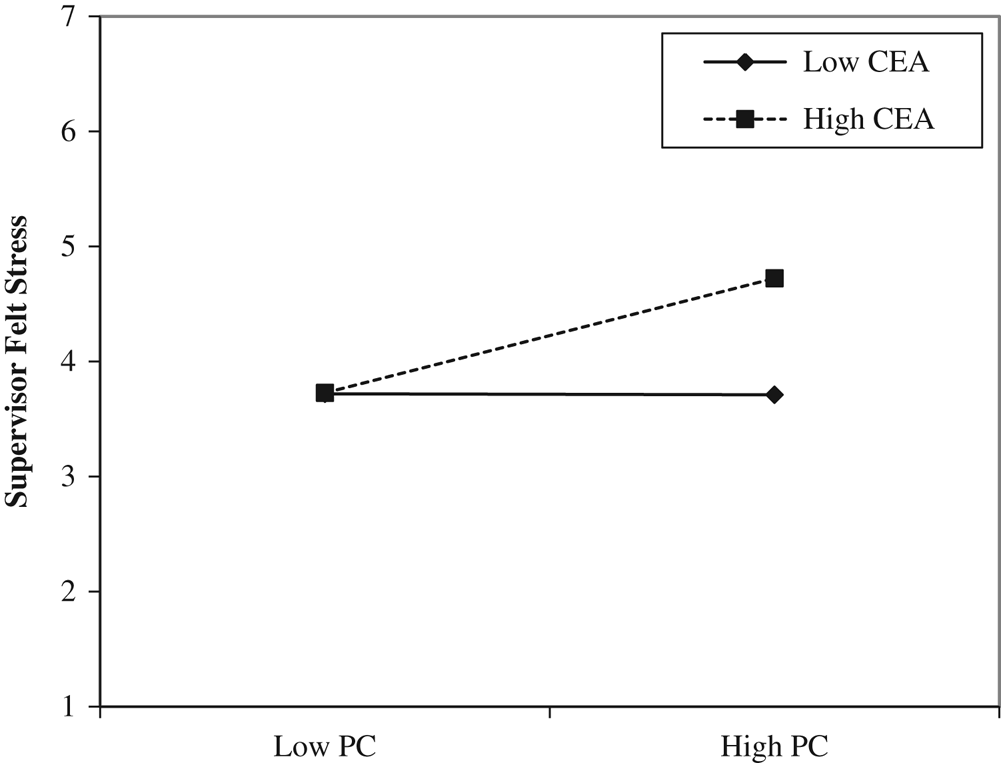
Table 4 shows support for Hypothesis 5 as the interaction term for supervisors’ perceived competitiveness and climate of error aversion was positively related to supervisors’ felt stress (b = 0.32, SE = 0.12, p <.01). To interpret the demonstrated moderating effects, regression equations were solved for high and low error aversion climates without controlling for demographics. Following Cohen and Cohen (Reference Cohen and Cohen1983), high and low levels of the moderator were defined as plus and minus one standard deviation from the mean, respectively. Figure 2 indicates that the patterns of interactions were as predicted in that the positive relationship between supervisors’ perceived competitiveness and supervisors’ felt stress was stronger for a high than for a low climate of error aversion. Tests of the simple slopes indicated that the relationship between supervisors’ perceived competitiveness and supervisors’ felt stress was significant only for a high error aversion climate (b = 0.50, t = 3.88, p <.001) and not significant for a low climate of error aversion (b = –0.003, t = –0.02, p >.10); suggesting support for Hypothesis 5.
Moderating effect of supervisor’s perceived climate of error aversion on relationship between supervisor’s perceived competitiveness and felt stress. CEA = climate of error aversion; PC = supervisor perceived competitiveness

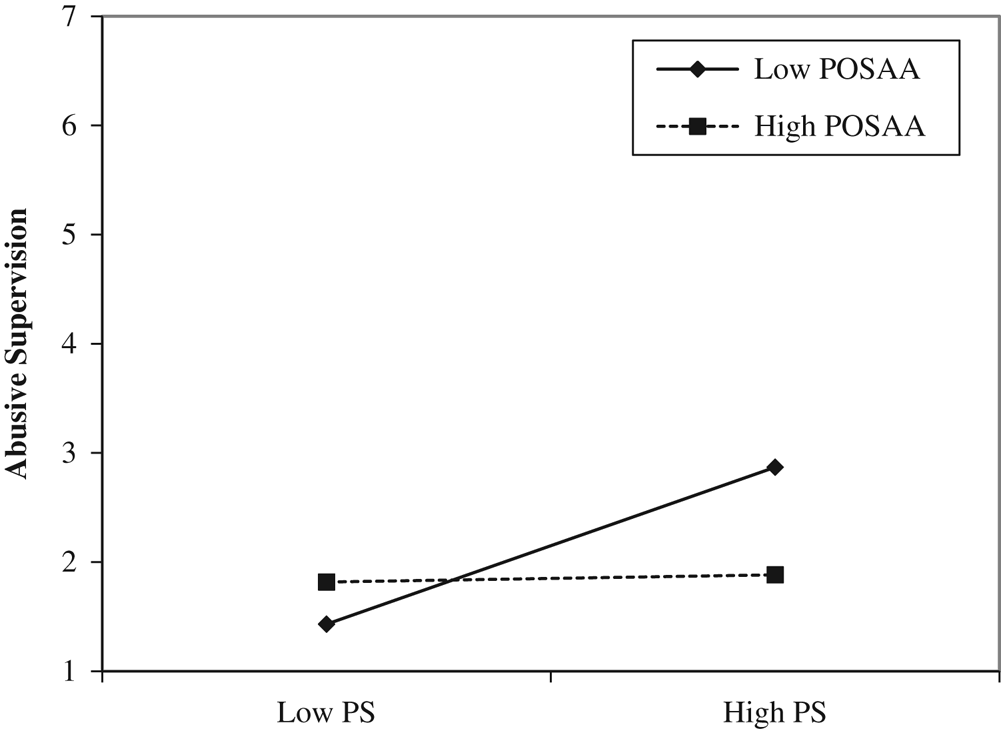
Hypothesis 6 predicted that perceived organisational sanctions against aggression would moderate the relationship between supervisors’ psychological strain and abusive supervision. The results revealed that the interaction term for supervisors’ psychological strain and perceived organisational sanctions against aggression was negatively related to abusive supervision (b = –0.30, SE = 0.13, p <.05). We used Cohen and Cohen’s (Reference Cohen and Cohen1983) procedures to test the pattern of interactions. As predicted, the positive relationship between supervisors’ psychological strain and abusive supervision was stronger for low than for high perceived organisational sanctions against aggression (see Figure 3). Tests of the simple slopes indicated that the relationship between supervisors’ psychological strain and abusive supervision was significant only for low perceived organisational sanctions against aggression (b = 0.70, t = 6.88, p <.001) and not significant for high perceived organisational sanctions against aggression (b = 0.11, t = 0.83, p >.10). Hypothesis 6 is supported, showing the mitigating effects of organisational sanctions on aggression. When organisational sanctions were low, the positive relationship between supervisors’ psychological strain and abusive supervision was accentuated. When organisational sanctions were high, the positive relationship between supervisors’ psychological strain and abusive supervision became insignificant.
Moderating effect of perceived organisation sanction against aggression on the relationship between psychological strain and abusive supervision. POSAA = perceived organisation sanction against aggression; PS = psychological strain

Posthoc analysis
Table 4 also shows that the climate of error aversion was positively and significantly related to supervisors’ felt stress (b = 0.23, SE = 0.08, p <.01). Further, the climate of error aversion served as a distal antecedent to abusive supervision and was serially mediated via supervisors’ felt stress and psychological strain. The lower and upper bounds of the 95% bias-corrected bootstrap confidence interval were 0.008 and 0.068, respectively and excluded zero, suggesting the indirect effect was significant at the 5% level (p <.05).
To compute the statistical power of our hypothesis tests, we reran the data with multiple regressions using SPSS. We used G*power with t- test, linear multiple regression: fixed model, single regression coefficient to compute the powers of each hypothesis test (Faul, Erdfelder, Buchner, & Lang, Reference Faul, Erdfelder, Buchner and Lang2009). Table 4 presents the statistical powers of the hypothesised path. As shown in column 4, the statistical powers of hypothesis tests ranged from 0.71 to 0.99. With the exception of Hypothesis 1 (0.71), these values were greater than the conventional value of 0.80. Further, we calculated the power for the whole path model with RMSEA using the generic χ2 procedure in G*power and the achieved power was over 0.99, indicating high statistical power in our model.
Discussion
The purpose of our study was to provide both the theoretical understanding and empirical support to address existing gaps in the abusive supervision literature on what are the antecedents of abusive supervision and organisation-related factors that perpetuate abusive supervision in the workplace. We tested and provided empirical evidence for the underlying causal mechanisms of abusive supervision antecedents. We examined supervisors’ perceived competitiveness as a distal antecedent to abusive supervision, with supervisors’ felt stress and psychological strain serially mediating the relationship between perceived competitiveness and abusive supervision. Our posthoc analyses and results further revealed that the perceived climate of error aversion served not only as a boundary condition but was also an antecedent of abusive supervision that was serially mediated by supervisors’ felt stress and psychological strain.
We depart from an earlier established model of abusive supervision that relies on characteristics of supervisors and subordinates to examine contextual factors that reinforce the abusive supervision phenomenon in the workplace. Our study examined two relevant contextual factors (perceived climate of error aversion and organisational sanctions against aggression) that perpetuate and/or mitigate the intensity of abusive supervision in the workplace and provided empirical support for the moderating effects of perceived climate of error aversion on supervisors’ perceived competitiveness–felt stress relationship. When supervisors have to deal with intense competition for valued resources to stay ahead of competition, but perceive that the consequential costs of making errors are high, this inevitably raises their stress level. We predicted that perceived organisational sanctions against aggression would weaken the effects of supervisors’ psychological strain on abusive supervision. We found support for the mitigating effects of organisational sanctions against aggression. In particular, when the salient source of sanctions against aggression is high, resource-drained supervisors will hold back on engaging in abusive supervision. When organisational sanctions against aggression are low, supervisors are less inhibited to hold back their responses and lash out onto their subordinates.
Theoretical implications
Our study underscores the need to examine stress from supervisors’ perspectives to identify the antecedents of abusive supervision. It adds to the growing scholarship on examining antecedents to abusive supervision (see review by Tepper, Simon, & Park, Reference Tepper, Simon and Park2017) to explain why such hostile behaviours continue to persist in the workplace. The literature on abusive supervision focuses extensively on the emotionally exhausted subordinate and associated outcomes but fails to provide insights that supervisors may have similar experiences. Our study highlights that supervisors are often the ‘sandwiched’ managers that are hard pressed to deliver organisational outcomes within a constrained environment. When confronted with stressful workplace demands, supervisors are likely to opt for aggression and coercion to deliver results. From a business ethics standpoint, we stress it is not our intention to absolve the supervisor of their responsibilities in how they treat their subordinates but contend that their behaviours are shaped by environmental factors and workplace interactions (Chan & McAllister, Reference Chan and McAllister2014).
Our study extends the literature on stress (Lazarus & Folkman, Reference Lazarus and Folkman1984) and the JD-R model (Demerouti et al., Reference Demerouti, Bakker, Nachreiner and Schaufeli2001) to explicate the underlying causal mechanisms linking workplace demands (competitive workplace and ‘blame’ climate) to the emergence of supervisors’ abusive behaviours. It corroborates findings from past empirical studies (Courtright, Gardner, Smith, McCormick, & Colbert, Reference Courtright, Gardner, Smith, McCormick and Colbert2016; Zhang & Bednall, Reference Zhang and Bednall2016) that abusive supervision is an outcome of resource-drained supervisors that is driven by impulsive and destructive responses to external environment. Courtright et al. (Reference Courtright, Gardner, Smith, McCormick and Colbert2016) examined family–work conflict as an antecedent to resource-drained supervisors, our study focuses on workplace demands (i.e., workplace competitiveness and climate of error aversion) that drive such maladaptive responses in the workplace.
We relied on the COR theory (Hobfoll, Reference Hobfoll1989, Reference Hobfoll2001, Reference Hobfoll2002) to shed light on resource impairment perspectives and explicate the boundary conditions of two workplace constraints (climate of error aversion climate and organisational sanctions against aggression) that perpetuate the intensity of supervisors’ hostility. We aim to create new knowledge regarding workplace practices (i.e., climate of error aversion and organisational sanctions against aggression) that would perpetuate or mitigate antecedents of abusive supervision. Our findings show that the perceived climate of error aversion serves not only as a boundary condition but also as an antecedent of abusive supervision. First, a perceived climate of error aversion creates both cognitive and physical demands (e.g., greater attention, and additional time and effort) that can strain supervisors’ resources and cause stress. When coupled with a perceived competitive workplace that further drains valued resources, this means that supervisors have fewer resources to offset the resource loss. With each iteration of spirals from both stressors (workplace competitiveness and climate of error aversion), loss spirals gain in momentum and magnitude, resulting in greater experiences of stress.
Our findings provide support regarding the restraining effects of supervisors’ aggression towards subordinates in the presence of workplace organisational sanctions against aggression. In particular, we highlight the perils of resource-drained supervisors engaging in abusive supervision in workplaces where organisational sanctions are weak.
Practical implications
Pfeffer (Reference Pfeffer2018) argued that modern managers are harming employees and called for changes to workplace practices to manage the detrimental consequences, particularly stress in workplaces. Our study provides empirical evidence to guide the development of actionable knowledge that organisations can use to manage the abusive supervision phenomenon. First, we highlight the influence of an intense and competitive workplace on supervisors’ stress levels. Increasing competitive levels within a performance-driven culture may have the unintended consequence of negative workplace behaviour such as abusive supervision. Rather, fostering a collaborative workplace and framing a value- and performance-based culture through partnerships would provide much-needed support for supervisors to achieve organisational outcomes collectively rather than competitively. For example, instead of assessing performance of employees based on individual outcomes, organisations should incorporate assessment related to team outcomes. In addition, by focusing on collective goals rather than individual goals, organisations can achieve the same outcomes without the unintended consequence of abusive supervision.
Our study also highlights the risks of an error aversion climate as this may unnecessarily overburden and exhaust supervisors and ultimately lead to abusive supervision. As a start, organisations should take pro-active steps to adopt an open climate (known as an error management climate) that encourages sharing and learning of errors among employees. As recommended by Van Dyck et al. (Reference Van Dyck, Frese, Baer and Sonnentag2005), an error management climate that communicates about errors, shares error knowledge and helps in error situations, as well as effective error recovery efforts, are all directly aimed at avoiding and reducing negative error consequences and improving measures for handling errors in the future.
Our findings provide support for the restraining influence of organisational sanctions against aggression on abusive supervision. We know that an absence of clear policies on sanctions against aggression will aggravate resource-drained supervisors’ aggression towards subordinates. Thus, it is important that organisations also put in place policies and procedures or processes that sanction workplace aggression and mitigate the prevalence of aggression in the workplace. Greater clarity on what constitutes an act of hostility, proper management responses to incidents, clear communication on the consequences of aggression as well as training for all supervisors on the policies and processes for handling aggression would help provide a safe working environment for all employees.
Limitations and directions for future research
As in all studies, there are limitations to this study that need to be highlighted. First, although data on our variables were collected at multiple points, our study was essentially cross-sectional. Future research that adopts a longitudinal design would be better suited to demonstrate the causal status of the relationships we have examined. Given the nature of the study to examine the influence of stress from the supervisor perspective, it is inevitable that the self-reported nature of the data could inflate the magnitude of the relationships between the variables (predictors, mediators and moderators). Nonetheless, we endeavoured to minimise common method variance by using a time-lagged study to measure some of the variables 2 weeks apart and different sources (i.e., subordinates) to rate and aggregate the abusive behaviours of their supervisor (dependable variable).
Use of the supervisor as a proxy to measure the climate of error aversion and organisational sanctions against aggression is another limitation. We used a key informant assessment approach, relying exclusively on supervisors’ ratings (e.g., Van Dyck et al., Reference Van Dyck, Frese, Baer and Sonnentag2005; Mawritz, Folger, & Latham, Reference Mawritz, Folger and Latham2014). Although it makes sense to do so, a legitimate concern is whether supervisors’ perceptions are reflective of the shared perceptions of other members. Future research should examine these organisational factors by collecting from both the supervisor and their subordinates to assess these shared perceptions. Alternatively, we recommend the use of objective measures such as existing policies or procedures for error aversion or sanctions against aggression.
We did not control for industry effects or supervisors’ years of experience in leading teams as these may potentially influence the level of stress experienced by supervisors. However, we did control for the age of supervisors, which should be highly correlated with number of years as a supervisor. To some extent, a supervisor’s age should serve as a proxy for their experience.
Given that our study used a sample from China, there is a limitation in the transferability of our findings to other cultures. In addition, we acknowledge the presence of a social desirability bias among Chinese samples to underreport activities that are deemed to be socially or culturally undesirable. Hence, research that replicates the present study in different cultures may provide further confidence in its generalisability.
Our study highlights the possibility of an intricate and complex resource conservation process when implementing workplace practices that restrain aggression. In line with scholarship on the toxic triangle of destructive leadership (Padilla, Hogan, & Kaiser, Reference Padilla, Hogan and Kaiser2007), future research should examine and explicate how other factors (supervisor and subordinate characteristics) may interact with organisational sanctions, thus offering greater insight into supervisor aggression in the workplace.
Conclusion
Our study addresses two key issues in the abusive supervision literature: Why and how abusive supervision occurs and what are the contextual variables that perpetuate abusive supervision in the workplace. In the pursuit of organisational resources and rewards in a competitive landscape, supervisors are likely to experience stress and psychological strain and subsequently displace their aggression downwards onto their subordinates. Our study sheds light on the plight of resource-drained supervisors who are ‘victims’ of organisational demands and how aggression is displaced onto subordinates when supervisors are exhausted.
We further address the influence of workplace constraints in perpetuating abusive supervision. Workplace constraints such as those in a ‘blame’ climate increase supervisors’ stress and ultimately perpetuate the enactment of supervisors’ abuse. Moreover, a lack of organisational practices that sanction against aggression aggravates the intensity of abusive supervision.
Compliance with ethical standards
All procedures performed in this study involving human participants were in accordance with the ethical standards of the institutional and/or national research committee and with the 1964 Helsinki declaration and its later amendments or comparable ethical standards.
Acknowledgements
The authors wish to thank Dr. Bevan Catley, Associate Editor, Journal of Management & Organization, the two anonymous reviewers, and Professor Samuel Aryee for their supportive and very constructive comments on earlier drafts of this article. This research is supported by a grant from the National Natural Science Foundation of China (71372143).
Conflicts of interest
All authors declare that they have no conflicts of interest.
About the authors
Boon Ching Serene Ng is Director at Nanyang Technological University. She received her PhD from Australian National University. As a practitioner in HR working with MNCs and public institution, she works closely with senior leaders on change management, leadership, and talent development and employee motivation including rewards and remuneration.
Xiujuan Zhang is Associate Professor at the School of Business, Sun Yat-sen University of China. She received her PhD in business administration from Sun Yat-sen University. Her research interests focus on leadership, organisational justice, employee emotion, and voice. Her work has been published in Journal of Organizational Behavior, Management and Organization Review, and others.
Zhen Xiong George Chen is Professor of Management at the Research School of Management, The Australian National University. He received his PhD from Hong Kong University of Science and Technology. His research centers on organisational behavior in cross-cultural contexts. His work has been published in Academy of Management Journal, Journal of Applied Psychology, Journal of Organizational Behavior, and others.