Introduction
The use of CO2 laser in the treatment of glottic tumours has met with ever-growing consensus over the last few years.Reference Eckel and Thumfart1–Reference Strong and Jako8 This equipment allows radical surgery to be carried out with reduced trauma, a low incidence of peri-operative complications, and a very short hospital stay, compared with traditional techniques, and therefore reduced inconvenience for the patient.Reference Motta, Esposito, Motta, Tartaro and Testa3
Vocal results after endoscopic cordectomy have not yet been well defined; previous reports on this subjectReference Pia, Gonella, Boggero, Ponzo and Giordano5–Reference Strong and Jako8 have concerned the functional outcomes obtained after early stage glottal cancer removal.
The aim of our study was to assess the vocal function of patients who had undergone CO2 laser endoscopic cordectomies of varying extents.
Materials and methods
From 1981 to 2002, 912 patients with T1–T3 N0 M0 glottal cancer underwent endoscopic surgery with CO2 laser at the otolaryngology unit of the ‘Federico II’ University of Naples. Of these, 140 subjects (135 men and five women) with ages ranging from 36 to 83 years (mean 60 years) were retrospectively selected, as they were documented to have undergone a complete post-operative functional vocal study, as described below. The five female patients were excluded from the study, to give greater homogeneity to the series. A total of 135 men, with ages ranging from 36 to 83 years (mean 60 years) made up the case load for this study.
The present study was performed in accordance with the local institutional review board guidelines, as well as with the 1983 revision of the Helsinki Declaration of 1975.
The patients had undergone different types of cordectomy (Table I), according to the site and extent of their glottic carcinoma, as follows. Five T1a cases, with superficial tumour, had undergone ipsilateral, transmuscular cordectomy. Forty-four T1a cases, with deep extension of the tumour, had undergone ipsilateral, subperichondral cordectomy. Thirty-four T1b cases had undergone bilateral, subperichondral cordectomy. Twenty-nine ipsilateral T2 cases had undergone ipsilateral, subperichondral cordectomy extending to Morgagni's ventricle and the false vocal fold. Finally, 23 bilateral T2 cases had undergone bilateral cordectomy extending to Morgagni's ventricles and the false vocal folds.
Tumour extent, number, cordectomy type and compensation type in study group

T=tumour
We preferred not to make primary reference to the European classification of endoscopic cordectomy, proposed by the working committee of the European Laryngological Society.Reference Remacle, Eckel, Antonelli, Brasnu, Chevalier and Friedrich9 This classification system is as follows: type I, subepithelial cordectomy; type II, subligamental cordectomy; type III, transmuscular cordectomy; type IV, total cordectomy; type Va, extended cordectomy encompassing the contralateral vocal fold and the anterior commissure; type Vb, extended cordectomy including the arytenoid; type Vc, extended cordectomy encompassing the subglottis; type Vd, extended cordectomy including the ventricle. We decided not to use this system because it was not coincident with the surgical staging scheme that we have adopted and described in detail previously.Reference Motta, Esposito, Motta, Tartaro and Testa3 Moreover, we employed type I and II cordectomy exclusively for resection of laryngeal dysplasia and enlarged bilateral cordectomy for more extended tumours (T2b), and this approach was not mentioned in the above classification.
Five months after surgery, the study patients were classified according to their videolaryngostroboscopic findings (using a 90° fibre-optic device connected to an Atmos stroboscope (Atmos, Lenzkirch, Germany)). These findings indicated the main site of the phonatory neo-glottis (Table I).
The following sites were identified: glottal (group one, 44 subjects), limited to the healthy vocal fold and the opposite neo-fold; inferior mixed (group two, five subjects), limited to the true vocal fold on one side and the false fold on the opposite side; vestibular (group three, nine subjects), limited to the two false vocal folds; superior mixed (group four, 42 subjects), limited to the false vocal fold on one side and the mucosa of the aryepiglottic fold on the opposite side; and aditus laryngis (group five, 35 subjects), limited to the two aryepiglottic folds.
The functional results were assessed according to the findings of electroacoustic voice analysis, using a CSL 4400 analyser (Kay-Elemetrics, Lincoln Park, New Jersey), carried out five months after surgery. For this purpose, a sampling frequency of 20 kHz was applied, with a narrow band filter of <50 Hz, during the recording of the vowel ‘/a/’ sustained for the maximum phonation time, from which the middle two seconds were taken.
The CSL 4400 analyser was connected to a personal computer and adjusted as follows: 6/9 input level, less than 30 dB of background noise, and microphone 20 cm away from the patient's lips at a 45° angle. Before commencing, a sound pressure level (SPL) calibration with a (Bruel and Kjaer (Nærum, Denmark)) microphone was obtained. The following findings were analysed: the maximum phonation time (i.e. the maximum duration of the vowel at an average conversation intensity, after a deep inspiration, expressed in seconds); the harmonic/noise ratio (i.e. the ratio between the harmonics and the noise component, expressed in dB); and the average intensity (i.e. the average voice intensity recorded during the middle two seconds of an utterance of ‘/a/’, expressed in dB). Since other acoustic parameters, such as jitter, shimmer, soft phonation index (SPI) and F0-tremor intensity index (FTRI), are not yet unanimously accepted as normative data,Reference Dejonekere, Bradley and Clemente10 these were not taken into consideration in the present study.
A sample of 40 age-matched, euphonic male subjects with no history of voice disorders was selected as a control group and underwent spectrographic testing.
Statistical analysis was performed using the Mann–Whitney test to compare the functional values for each study group, and the rank Spearman test to determine any possible correlation between the type of compensation adopted and the functional values, assuming p<0.05 as the minimum significance value.
Results
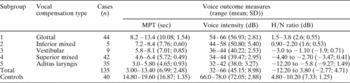
Table II shows a complete list of the functional results in the study patients. Statistical analysis demonstrated significant differences (p<0.001) for all parameters assessed, comparing study patients and control subjects, with higher values for the controls. On comparing the study patients, grouped according to the vocal compensation identified, there was a statistically significant difference in: maximum phonation time between group one vs group two, group three vs group four, and group four vs group five (p<0.001 for all); voice intensity between group one vs group two (p<0.013) and group two vs group three (p<0.05); and harmonic/noise ratio for all group comparisons (p<0.005).
Functional results in study group

SD=standard deviation; MPT=maximum phonation time; H/N ratio=harmonic to noise ratio; sec=seconds
A direct positive relation was found between maximum phonation time, voice intensity and harmonic/noise ratio (p<0.001). A direct negative relation was found between the type of compensation adopted (groups one to five) and all the parameters studied (p<0.001).
Discussion
The aim of our study was to assess the functional vocal results after CO2 laser cordectomy in a group of 135 patients affected by laryngeal cancer. The study patients were therefore subdivided according to the main type of vocal compensation identifiable a few months after surgery. Based on the laryngostroboscopic findings, we identified five types of vocal compensation in the study patients: glottis; laryngeal vestibule; aditus laryngis; or, in the case of mixed compensation, between the glottis and vestibule (inferior mixed type) or the vestibule and the aditus (superior mixed type).
We chose this subdivision since the parameters under study could have been influenced by the type of functional vocal compensation adopted, rather than by the type of surgery performed, thus giving rise to misleading instrumental findings and incorrect correlations. In our opinion, the outcome measures employed for vocal assessment of the study patients gave a sufficiently detailed, simple and unambiguously interpretable voice function profile. In particular, the maximum phonation time and the voice intensity express the general functional status of the pneumo-phonatory system, especially regarding the patient's social communication; the harmonic/noise ratio reflects the degree of change in voice timbre, with particular reference to glottic insufficiency as a surgical outcome and the type of functional vocal compensation adopted by each patient.
The results of our investigation show that no type of functional vocal compensation enabled the study patients to achieve a voice quality comparable to that of control subjects. The mean values of the studied parameters deviated from normal values in a steadily increasing way, starting with glottal compensation (group one) and progressing to aditus laryngis compensation (group five). In this regard, a direct negative correlation was found between the type of vocal compensation adopted and the functional parameters studied, and a direct positive correlation was found between maximum phonation time, voice intensity and harmonic/noise ratio. These findings suggest there may be a directly proportional relation between the extent of functional deficit of the pseudo-glottis, the reduced maximum phonation time and the voice intensity … and the increase in the noise component in the voice spectrum (harmonic to noise ratio), the latter being due to air turbulence created at the level of the new laryngeal vibratory source.
• The aim of this study was to assess the vocal function of patients who had undergone CO2 laser cordectomy
• Outcomes measures were maximum phonation time, vocal intensity and harmonic/noise ratio
• Functional outcomes varied in relation to the main site of the pseudo-glottis
• No type of functional compensation enabled the study patients to achieve a voice quality comparable to that of the control subjects
Different authors have reported favourable functional results in patients who have undergone CO2 laser cordectomy.Reference Steiner7, Reference Strong and Jako8, Reference McGuirt, Blalock, Koufman and Feehs11–Reference Almadori, Ottaviani, D'Alatri, Carriero, Modica and Paludetti13 Few reports have thoroughly examined the subjectReference Pia, Gonella, Boggero, Ponzo and Giordano5, Reference Sittel, Heckel and Heschenburg12 by comparing the results of endoscopic surgery with those of open techniques. These studies agree that endoscopic techniques are more successful from the voice perspective. However; it should be pointed out that the cases included in these studies involved limited tumours and therefore relatively limited surgery.
More recently, Peretti et al. Reference Peretti, Piazza, Balzanelli, Mensi, Rossigni and Antonelli14 studied the vocal functional results of various types of cordectomy in 101 patients with carcinoma in situ (15 cases) and infiltrating carcinoma (T1a, 66 cases; T1b, 20 cases). These authors found spectro-acoustic values within normal limits in patients who had undergone sub-epithelial and subligamentous cordectomy for very early glottic carcinoma (carcinoma in situ, T1a). Statistically worse values were seen in patients who had undergone more extensive cordectomy (i.e. trans-muscular cordectomy, total cordectomy or extended cordectomy) for limited (T1a) or relatively more extensive (T1b) carcinoma.
In our opinion, on the basis of the functional outcomes of our study subjects, assessment of vocal function after endoscopic cordectomy should take into account a number of factors, with particular importance being given to the type of functional vocal compensation adopted post-surgery.