Introduction
Sustaining falls is a major cause of morbidity and mortality in the older population, with one of the most serious complications being hip fractures (Cumming, Reference Cumming1998).
The identified risk factors for falls in older people include previous falls (Kiely et al., Reference Kiely, Kiel, Burrows and Lipsitz1998; Bueno-Cavanillas et al., Reference Bueno-Cavanillas, Padilla-Ruiz, Jimenez-Moleon, Peinado-Alonso and Galvez-Vargas2000; Vassallo et al., Reference Vassallo, Sharma and Allen2002; Kallin et al., Reference Kallin, Gustafson, Sandman and Karlsson2004), advanced age (Kiely et al., Reference Kiely, Kiel, Burrows and Lipsitz1998; Bueno-Cavanillas et al., Reference Bueno-Cavanillas, Padilla-Ruiz, Jimenez-Moleon, Peinado-Alonso and Galvez-Vargas2000), male sex (Kiely et al., Reference Kiely, Kiel, Burrows and Lipsitz1998; van Dijk et al., Reference van Dijk, Meulenberg, van de Sande and Habbema1993; Eriksson et al., Reference Eriksson, Gustafson and Lundin-Olsson2007b), female sex (de Carle and Kohn, Reference de Carle and Kohn2001), depression (Kallin et al., Reference Kallin, Gustafson, Sandman and Karlsson2005), impaired mobility (Kallin et al., Reference Kallin, Gustafson, Sandman and Karlsson2004), wandering behavior (Kiely et al., Reference Kiely, Kiel, Burrows and Lipsitz1998; French et al., Reference French2007) and use of assistive devices (Kiely et al., Reference Kiely, Kiel, Burrows and Lipsitz1998; French et al., Reference French2007). Impaired cognition and dependence in activities of daily living (ADL) have also been reported as risk factors (Kallin et al., Reference Kallin, Gustafson, Sandman and Karlsson2005).
Various drugs have been considered as risk factors, such as antidepressants (Liu et al., Reference Liu, Topper, Reeves, Gryfe and Maki1995; Cumming, Reference Cumming1998; Leipzig et al., Reference Leipzig, Cumming and Tinetti1999; Bueno-Cavanillas et al., Reference Bueno-Cavanillas, Padilla-Ruiz, Jimenez-Moleon, Peinado-Alonso and Galvez-Vargas2000; Kelly et al., Reference Kelly2003; Kallin et al., Reference Kallin, Gustafson, Sandman and Karlsson2004) especially SSRIs (Kallin et al., Reference Kallin, Gustafson, Sandman and Karlsson2004), neuroleptics (Leipzig et al., Reference Leipzig, Cumming and Tinetti1999; Bueno-Cavanillas et al., Reference Bueno-Cavanillas, Padilla-Ruiz, Jimenez-Moleon, Peinado-Alonso and Galvez-Vargas2000; Kallin et al., Reference Kallin, Gustafson, Sandman and Karlsson2004), benzodiazepines (Leipzig et al., Reference Leipzig, Cumming and Tinetti1999), opioids (Kelly et al., Reference Kelly2003), digoxin (Leipzig et al., Reference Leipzig, Cumming and Tinetti1999), sedatives (Leipzig et al., Reference Leipzig, Cumming and Tinetti1999) and anti-epileptics (Kelly et al., Reference Kelly2003), and polypharmacy (> four drugs) (Leipzig et al., Reference Leipzig, Cumming and Tinetti1999). Studies concerning fall circumstances in older people have shown that slipping (van Dijk et al., Reference van Dijk, Meulenberg, van de Sande and Habbema1993) and not wearing shoes (Jensen et al., Reference Jensen, Lundin-Olsson, Nyberg and Gustafson2002; Koepsell et al., Reference Koepsell2004) are often associated with falls and that a large proportion of them are not witnessed (van Dijk et al., Reference van Dijk, Meulenberg, van de Sande and Habbema1993). A study performed over a period of one week addressed hyperactive, paranoid and hallucinatory symptoms and restless behavior as possible risk factors for falls in old people with dementia (Kallin et al., Reference Kallin, Gustafson, Sandman and Karlsson2005).
Staff assessments of patient fall risk have been shown to be fairly accurate in predicting falls in residential care facilities (Lundin-Olsson et al., Reference Lundin-Olsson, Jensen, Nyberg and Gustafson2003).
One common method used to prevent falls and injuries is physical restraint, although its preventive effect has not been proven and its use might even increase the incidence of falls and serious injuries (Hamers and Huizing, Reference Hamers and Huizing2005).
Older people with dementia or cognitive impairment have been shown to have a higher fall rate (Tinetti et al., Reference Tinetti, Speechley and Ginter1988; van Doorn et al., Reference van Doorn2003) and sustain more fractures (Shaw et al., Reference Shaw2003) than those without. Fall prevention studies have failed to prevent falls in people with impaired cognition (Jensen et al., Reference Jensen, Nyberg, Gustafson and Lundin-Olsson2003), indicating that other risk factors may operate in this particular group (Eriksson et al., Reference Eriksson, Gustafson and Lundin-Olsson2007b). The purpose of this study is therefore to identify risk factors for falls in people with dementia.
Methods
Materials
This study uses data collected in a randomized controlled trial (RCT) study aimed at evaluating the effects of staff education on dementia care. This study was performed in nine municipalities in northern Sweden. Before it was initiated an inventory was made of 99 group dwellings for people suffering from dementia. From these, 40 units were selected on the basis that at least 20% of the residents were physically restrained. A physical restraint was defined as a technical device that inhibited free physical movement, e.g. belts or chairs with fixed tray tables but not bedrails (Karlsson et al., Reference Karlsson, Bucht, Eriksson and Sandman1996). Twenty units were allocated to the intervention group and 20 units to the control group, and it is the latter which constituted the population of the current study. These 20 group dwelling units each had 6–12 residents, giving a total of 162 persons. Two residents were excluded owing to insufficient data, resulting in a final study population of 160 participants. Of these participants, 126 (78.8%) were women and the mean age ± SD (and range) was 83.6 ± 6.6 (62–102) years. Other characteristics of the residents are presented in Table 1. One hundred and thirty residents were present for the whole study period. The staff to patient ratio was 0.83 ± SD 0.12 and of those who answered a staff questionnaire 7.5% were registered nurses, 49.7% licensed practical nurses and 42.8% were nurse aides.
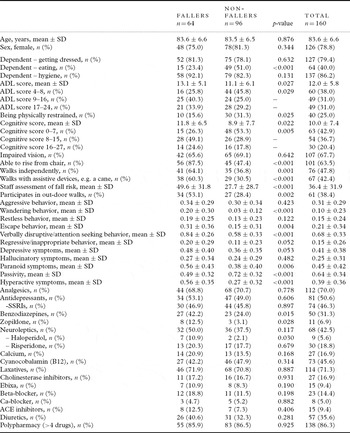
Characteristics of fallers and non-fallers

Procedures
All participants were assessed by means of the Multi-Dimensional Dementia Assessment Scale (MDDAS; Sandman et al., Reference Sandman, Adolfsson, Norberg, Nystrom and Winblad1988), which measures motor function, visual and auditory status, ADLs (activities of daily living) and behavioral and psychiatric symptoms. The MDDAS has been shown to have good inter- and intra-rater reliability (Sandman et al., Reference Sandman, Adolfsson, Norberg, Nystrom and Winblad1988). The assessment, based on observations made over the preceding seven days, was made by the staff member who knew the resident best.
An ADL score ranging from 4 to 24 was calculated based on the resident's ability to cope with washing, dressing, eating, and bladder and bowel control. A higher ADL score indicates that the resident is more ADL-independent. Behavioral and psychiatric symptoms were measured using 25 and 14 items respectively, which were reduced to six constructs (e.g. aggressive behavior) and five constructs (e.g. depressive symptoms) respectively based on a previous study (Lövheim et al., Reference Lövheim, Sandman, Kallin, Karlsson and Gustafson2006). In the analysis the relative frequency for all constructs is used, ranging between 0 and 1 (0 = displaying none of the symptoms; 1 = displaying all of the symptoms within the construct). A scale developed by Gottfries-Gottfries (Sandman et al., Reference Sandman, Adolfsson, Norberg, Nystrom and Winblad1988) was used to measure the participants' cognitive impairment. This scale consists of 27 items measuring the resident's ability to orient her/himself, with a higher score indicating better orientation ability. A cut-off (24/27) on the Gottfries-Gottfries scale has been validated against the cut-off point of 24/30 traditionally used in the Mini-mental State Examination (MMSE) with a sensitivity of 90% and a specificity of 91% (Adolfsson et al., Reference Adolfsson, Gottfries, Nystrom and Winblad1981). In this study the raw scores and a variable dividing the residents' cognitive level into three groups were used, the latter variable having been used in a previous study (Kallin et al., Reference Kallin, Gustafson, Sandman and Karlsson2005). Staff judgments of the residents' fall risk were assessed by means of a visual analogue scale (VAS) from 0 to 100, with a higher number indicating a higher fall risk. Data on the use of physical restraint were collected over three weeks by using a daily registration form. The data were dichotomized into being subjected to physical restraints (one or more days) or not at all.
Data on the use of medication were derived from the medication lists and all on-demand drugs were omitted.
All residents in the units were followed up with regard to falls over a period of six months, from September 2005 to February 2006 (181 follow-up days). The staff were instructed to register every fall and the circumstances involved, including behavioral and psychological symptoms preceding the fall, on an incidence form immediately after the fall. The researchers supplemented the data on falls by going through the unit's compulsory incidence reports. A fall was defined as any event leading to the person unintentionally ending up on the ground or floor, irrespective of the reason and regardless of whether any injury was sustained.
Statistics
The fallers and non-fallers were compared using the χ2 test, Fisher's exact test and Student's t-test. Variables associated with falls (p < 0.15) were entered into a logistic regression analysis (with backward selection algorithm based on likelihood ratio) in order to identify factors independently related to falls and to estimate odds ratios for these factors. Factors with p < 0.15 were tested for multicollinearity before being entered into the logistic regression model, if a factor was strongly correlated (r > 0.5) to another, the factor with the strongest association with falls was included. All tests were 2-tailed and p values < 0.05 were considered to indicate statistical significance. All calculations were made using the SPSS software package, version 11.0 for Macintosh.
Ethical approval
The study was approved by the Ethics Committee of the Medical Faculty of Umeå University (§92/02, dnr02–105).
Results
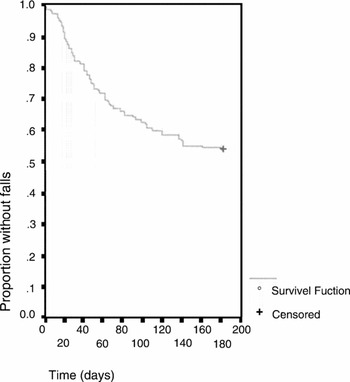
Sixty-four of the 160 residents (40.0%) fell at least once during the six-month period and they suffered a total of 191 falls; the fall incidence among residents remaining in the study after six months was 2.6 per person year (PY) (169 falls/130 residents). Thirty-eight (23.8%), residents were multiple fallers, and the highest number of falls for any one person was 12. Fifty percent of first falls occurred before day 47 of follow-up, (q1–q3 = 22.5–82 days) (see Figure 1). Fifty-four (28.4%) of the falls resulted in an injury. Four injuries resulted in five fractures: three of the hip, one of the shoulder and one unknown.
Kaplan-Meier survival plot for falls in a 6-month period (181 days). Including 139 residents of whom 64 (46.0%) sustained a fall. Note that drop-outs without a fall are excluded from the graph

Factors that were found in the univariate analyses to be significantly associated with falls are presented in Table 1 and include being independent when eating, being able to rise from a chair, walking independently, walking with assistive devices, participating in outdoor walks, various behavioral/psychiatric symptoms such as, being hyperactive, wandering, and escape behavior. Cognitive level and ADL function were shown to be associated with falls but not in a linear fashion as those with intermediate scores were the most likely to fall.
The fall risk assessed on a Visual Analogue Scale (VAS) by the staff was significantly higher among the fallers than the non-fallers (mean ± SD 49.6 ± 31.8 and 27.7 ± 28.7 respectively p < 0.001). Use of benzodiazepines, zopiklon and haloperidol were the only drugs to be significantly associated with falls in the univariate analyses.
There was no significant difference between fallers and non-fallers regarding staff-to-patient ratio (fallers = 0.82 ± 0.17 and non-fallers = 0.80 ± 0.17, p = 0.423).
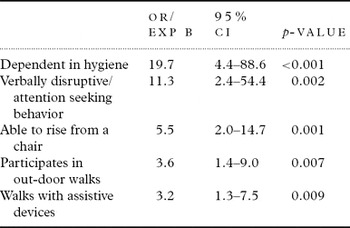
Analyses of the data in logistic regression models showed that dependency in performing hygiene (OR = 19.7), displaying verbally disruptive/attention-seeking behavior (OR = 11.3), being able to rise from a chair (OR = 5.5), participating in out-door walks (OR = 3.6) and using assistive devices when walking (OR = 3.2), were all significantly associated with a higher risk of sustaining a fall (Table 2).
Logistic regression analysis of factors associated with falls
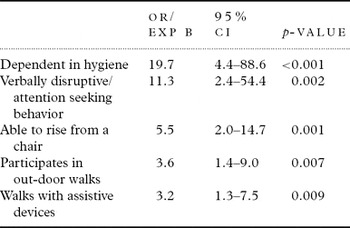
*Multiple logistic regression with backward selection algorithm based on the likelihood ratio. Model χ2; 68.1 (df=5, p value = 0.000), model Cox & Snell; 36.1%, concordant; 79.6%.
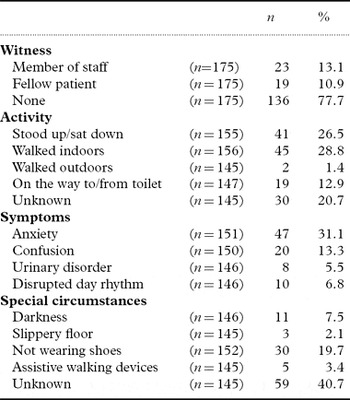
Regarding the circumstances surrounding the falls (Table 3), 61.7%, of the falls occurred in the resident's own room, 25.6% in another resident's room and 12.2% in public spaces. The majority of the falls, 77.7% were not witnessed, 26.5% occurred as the participant was standing up or sitting down and 12.9% when the resident was on his/her way to/from the toilet. Symptoms preceding the falls were anxiety (31.1%) and confusion (13.3%). Other circumstances reported in connection with the falls were not wearing shoes (19.7%) and walking with assistive devices (3.4%). Thirty-five percent of the falls occurred between 9 pm and 6 am with a peak between 5 pm and 6 pm.
Circumstances surrounding the falls (n = 191)

Discussion
This study supports earlier studies which report that older people with dementia have a high tendency to fall. According to a prospective study from Finland, the fall-incidence rate among older people living in institutional care was approximately 1.7 per PY (Luukinen et al., Reference Luukinen, Koski, Hiltunen and Kivela1994) whereas our study revealed a fall incidence of 2.6 per PY, a value more than 50% higher. Previous studies among patients with dementia have, on the other hand, reported fall incidences of between 4.1 and 6.2 falls per PY (van Doorn et al., Reference van Doorn2003; Eriksson et al., Reference Eriksson, Gustafson and Lundin-Olsson2007a; Reference Eriksson, Gustafson and Lundin-Olsson2007b). The prevalence of injury matched the results of previous research (Jensen et al., Reference Jensen, Lundin-Olsson, Nyberg and Gustafson2002), while only 2.1% of the falls resulted in fractures, which is lower than the 5.6–6.0% reported in previous studies (Eriksson et al., Reference Eriksson, Gustafson and Lundin-Olsson2007a; Reference Eriksson, Gustafson and Lundin-Olsson2007b). The difference, however, could merely indicate that some fractures remained undiagnosed and were reported only as “having pain.” On the other hand, the low proportion of falls resulting in injuries might indicate greater compliance in the reporting of falls.
In this study 36.1% of the variance in falls could be explained by being dependent in hygiene, displaying verbally disruptive/attention-seeking, being able to rise from a chair, walking with assistive devices, and participating in outdoor walks. These were found in the logistic regression analysis to be the independent risk factors most strongly associated with falling in this particular group. Previous studies among people with dementia have explained slightly lower percentages, e.g. 25.5–26.8% of the variance in falls (Eriksson et al., Reference Eriksson, Gustafson and Lundin-Olsson2007a; Reference Eriksson, Gustafson and Lundin-Olsson2007b).
Being dependent in hygiene was shown to be the strongest risk factor and may be viewed as a marker for impaired ADL functions. In the univariate analyses, being a faller was associated with being in the intermediate group with regard to cognitive function (score 10–15) and ADL functions (score 12–19), a phenomenon also seen in a previous study (Kallin et al., Reference Kallin, Gustafson, Sandman and Karlsson2005). It has also been shown that those with intermediate standing balance have an increased risk of falling (Lord et al., Reference Lord2003). Tinetti (Reference Tinetti1987) found that low extremity weakness and needing less help were risk factors for injury after a fall (Tinetti, Reference Tinetti1987), while one study reported that ambulatory residents had a much higher incidence of injury following a fall (Thapa et al., Reference Thapa, Brockman, Gideon, Fought and Ray1996). The residents thereby need to have a certain motoric ability in order to be exposed to the risk of falling; however, residents with a high motoric ability fall less.
Being able to rise from a chair was a factor independently associated with the risk of falling, which is logical since if one cannot get up one cannot fall. For this reason, it is open to discussion whether being able to rise from a chair should be labeled as a risk factor for falling or as a prerequisite for falling. An association between this factor and falls was also found in a previous study (Kallin et al., Reference Kallin, Gustafson, Sandman and Karlsson2005). The factor “participates in outdoor walks” might indicate that people who fall have a certain ability to walk.
Assistive devices, such as canes or walkers, are often prescribed to aid mobility. However, the use of such devices is often a marker of abnormal gait and thus is associated with an increased fall risk. Moreover, studies have shown that these devices may actually increase the risk of falling by affecting compensatory mechanisms (Bateni et al., Reference Bateni, Heung, Zettel, McLlroy and Maki2004). An alternative explanation could be that the residents tend to misplace and forget their assistive devices and thus fall because they are not using them. The latter explanation might be more plausible, as investigation of the circumstances surrounding falls revealed that only 3.4% of the falls were considered to be due to assistive devices. Future studies should consider the use of assistive devices as a possible field for fall prevention.
Displaying verbally disruptive or attention-seeking behavior (three items: constantly seeking attention; talking spontaneously with patients and staff; and interrupted night sleep) was shown to be a risk factor. This result was in accord with those of previous studies which have shown that behavioral and psychological symptoms of dementia (hyperactive symptoms and wandering behavior) are associated with falls (Kiely et al., Reference Kiely, Kiel, Burrows and Lipsitz1998; Kallin et al., Reference Kallin, Gustafson, Sandman and Karlsson2005; French et al., Reference French2007). The univariate analysis showed that fallers displayed more wandering and escape behavior and also more paranoid and hyperactive symptoms. They also had fewer passivity symptoms, which might be an effect of increased time at risk when not being passive. Impaired judgment, usual in demented patients, in combination with an increased prevalence of behavioral and psychological symptoms seems to increase the risk of falling (Price et al., Reference Price, Hermans and Grimley Evans2000).
This study found a strong univariate association between falls and staff judgment of participant fall risk, which has also been reported in previous studies (Lundin-Olsson et al., Reference Lundin-Olsson, Jensen, Nyberg and Gustafson2003). This measure may be an asset in future fall-prevention programs.
Those participants who had not been physically restrained had a significantly higher fall incidence. It is unclear whether this is due to the protection obtained from physical restraint being used at the right time or to the fact that people subjected to physical restraint often lose their strength and balance and are thus less able to manage to get up and walk.
There was no significant association between gender and being a faller, and earlier studies are contradictory on this matter (van Dijk et al., Reference van Dijk, Meulenberg, van de Sande and Habbema1993; Kiely et al., Reference Kiely, Kiel, Burrows and Lipsitz1998; de Carle and Kohn, Reference de Carle and Kohn2001; Eriksson et al., Reference Eriksson, Gustafson and Lundin-Olsson2007a).
Somewhat surprisingly there was no association with age. This may be due to the younger participants being more mobile, thus evening out the reduced postural stability of the older participants, or age may be of no importance for falls among people with dementia.
Haloperidol was shown to constitute a risk factor for falls in the univariate analysis. A recent case-control study of elderly patients living in nursing homes reported that haloperidol increases the risk of hospitalization for femur fractures (Liperoti et al., Reference Liperoti2007). However, this drug is often prescribed to people who are agitated, which may in itself be a fall-risk factor. The use of benzodiazepines/zopiklone also constituted a risk factor for falling – either due to the drowsiness it induces or because the indications for using benzodiazepines include anxiety and sleeping problems, which might be the reason for the fall. Somewhat surprisingly, no other risk-factor medications, such as antidepressants, were associated with falls, and nor was polypharmacy (> 4 drugs).
Although impaired vision was not shown to be a risk factor, there was an interesting tendency associated with it. Much like the participants with intermediate impaired cognitive function who have the highest risk of sustaining a fall, having moderately impaired vision also seemed to be a risk factor. This requires further investigation in future studies.
Symptoms that preceded the falls were anxiousness and confusion; similar conditions have previously been reported as risk factors (Kallin et al., Reference Kallin, Gustafson, Sandman and Karlsson2005). It is very important to investigate the etiology of these symptoms if fall prevention is to be successful. One successful intervention among patients with dementia focused on prevention, detection and treatment of confusion (delirium) (Stenvall et al., Reference Stenvall2007). Not wearing shoes was also associated with falling, confirming the findings of earlier studies (Jensen et al., Reference Jensen, Lundin-Olsson, Nyberg and Gustafson2002; Koepsell et al., Reference Koepsell2004). Future fall-prevention studies should consider these risk factors, perhaps by ensuring that the care staff pay more attention to states of anxiety and confusion and offer shoes to residents who are not wearing any.
The fact that most falls (nearly 80%) went unwitnessed could be an indication of understaffing or that supervision of the residents is not prioritized. The majority of the falls also occurred in the resident's or other resident's rooms, while only one in four falls occurred in public areas. As most of these units provide private rooms for the residents, effective supervision might be difficult to provide.
The peak in the occurrence of falls between 5 pm and 6 pm could be a consequence of the “sundown syndrome,” the phenomenon where mainly people with dementia become more restless and agitated as evening approaches (Little et al., Reference Little, Satlin, Sunderland and Volicer1995). Another interesting finding is the relatively high incidence of falls at night – approximately 35%, compared to the results of another study on older people both with and without dementia which reported 27% falls at night (Jensen et al., Reference Jensen, Lundin-Olsson, Nyberg and Gustafson2002). This suggests perhaps that people with dementia have a different diurnal rhythm from those without dementia.
One weakness of our study is that the risk factors were measured only at baseline, so the characteristics of the residents might have changed due to fluctuations in the disease or to changes in their medication, for example. On the other hand, 75% of the first falls among the residents occurred within two months of follow-up. Generalization of the present study results might be affected by the selection of units where at least 20% of the residents were subjected to physical restraint. There may be other fall-risk factors relevant to residents subject to restraint use. This needs to be investigated further.
Conclusions
Older people with dementia run a high risk of falling. Risk factors for falls include being dependent in hygiene, displaying verbally disruptive/attention-seeking behavior, being able to rise from a chair, walking with assistive devices, and participating in outdoor walks. These factors may be of importance when identifying residents with a high risk of falling and should therefore be considered when designing interventions. The staff's judgment concerning fall risk among residents is an asset in fall prevention. It is important to observe fluctuating symptoms such as anxiety and confusion and to assess the underlying causes in order to prevent falls in people with dementia. Many falls occur at night and in the residents' own rooms without being witnessed, which must also be considered in future fall-prevention interventions.
Conflict of interest
None.
Description of authors' roles
T. Pellfolk, T. Gustavsson, Y. Gustafson and S. Karlsson analyzed the data and wrote the paper. T. Pellfolk and S. Karlsson designed the study, recruited the subjects, collected the data and interpreted the data.
Acknowledgments
This study was supported by grants from Lions Research Foundation for Age-Related Diseases, King Gustaf V's and Queen Victoria's Freemason Foundation, the Field Research Center for the Elderly in Västerbotten and the Swedish Research Council, Grant K2005-27-VX-15357-01A.