The threats posed by antimicrobial resistance have led to strong recommendations and regulatory actions. The number of trained infectious disease physicians and pharmacists is insufficient to meet the urgent need for comprehensive antimicrobial stewardship programs across healthcare settings, 1 – Reference Stenehjem, Hyun and Septimus 5 including the Veterans Health Administration, the largest integrated healthcare system in the United States. A 2012 survey found that of 130 Veterans Affairs medical centers (VAMCs) providing inpatient care, 52 (40%) did not have a full-time infectious disease physician on staff.Reference Chou, Graber and Jones 6 Thus, the implementation of antimicrobial stewardship programs often depends on professionals, including physicians, pharmacists, and nurses, who lack training in infectious diseases or antimicrobial stewardship.
One proposed solution for supporting antimicrobial stewardship programs in small and rural hospitals is telehealth.Reference Stenehjem, Hyun and Septimus 5 , Reference Siddiqui, Herchline and Kahlon 7 , 8 The VA has successfully used telemedicine to increase veterans’ access to specialty care providers. Titled the Specialty Care Access Network Extension for Community Healthcare Outcomes (SCAN‑ECHO), this program is an effective healthcare delivery model that integrates patient care with provider education, improving access to specialty care from a distance.Reference Watts, Roush, Julius and Sood 9 – Reference Glass, Waljee, McCurdy, Su and Sales 11
To improve antimicrobial stewardship at VA facilities with limited access to infectious diseases specialists, we developed a pilot project using telehealth. Specifically, we used SCAN-ECHO to connect pharmacists, infection preventionists, staff nurses, and other clinicians at a rural VAMCs with an infectious disease physician at a geographically distant VA to form a videoconference antimicrobial stewardship team (VAST). Staff from acute-care and long-term care settings participated. Here, we describe program implementation at 2 VAs, and we report related qualitative results based on interviews with participating clinical staff.
Methods
Intervention
We conducted a 1-year prospective quasi‑experimental study in parallel at 2 intervention sites, starting in August 2016 for site A and in October 2016 for site B. The intervention sites were rural Veterans Affairs medical centers (VAMCs) without a trained infectious disease professional on staff. Site A has 27 acute-care beds and 162 long-term care beds; site B has 10 acute-care beds and 180 long-term care beds. Medical providers, pharmacists, infection preventionists, and staff nurses from each intervention site who were interested in participating were paired with an off-site infectious disease physician from another VAMC for weekly telehealth sessions. Together, these individuals formed the videoconference antimicrobial stewardship team (VAST), and they discussed concerns related to infections and antimicrobial use among patients at the intervention site.
Each week, staff at the intervention sites selected cases for discussion; patients could come from any setting, including acute care, long-term care, urgent care, and outpatient clinics. During the 1-hour meetings, a VAST member from the intervention site presented cases for discussion, recorded the team’s recommendations, and entered them into the electronic medical record (EMR) at the intervention site. The VAST member also placed an interfacility consult to the VAMC of the infectious disease physicians, who used a templated note to complete the consult and capture workload. The clinical providers for the patient being discussed did not need to be present for the VAST meeting to formulate recommendations. The infectious disease physicians were also available outside of the VAST session for brief or urgent questions, some of which were answered using e-consults.
Before initiating the VAST sessions, the research team agreed on a general approach and process for workload capture in the EMR. The 2-month difference in the start dates permitted the personnel working with site B to anticipate problems and adapt solutions implemented by the research team working with site A.
Quantitative results
We recorded the number of patients discussed, their infectious syndromes, their location (acute, long-term, or urgent care), the recommendations made by the VAST, and whether they provide followed through on those recommendations within 7 days. We also noted the number and roles of participants at each VAST session.
Qualitative results
Six months after the intervention began, we conducted semi-structured interviews to assess participants’ perceptions of the VAST (detailed in Appendix 1). Individuals who participated in at least 1 VAST session were approached for an interview, primarily through e-mail. Telephone interviews (20–60 minutes) were digitally recorded, transcribed, and analyzed using NVivo software (QSR International, Melbourne, Australia). Inductive and deductive content analysis identified salient themes, with deductive codes based on domains from the Systems Engineering Initiative for Patient Safety (SEIPS 2.0), a human factors model geared toward improving patient safety, which proposes that the following 5 components of a work system continuously interact and influence one another: (1) tools and technologies, (2) organizational conditions, (3) participant(s), (4) tasks, and (5) the physical environment.Reference Holden, Carayon and Gurses 12 Qualitative data were analyzed as an aggregate, and site-level comparisons were not made.
Results
Differences in implementation at sites A and B
While following the same general approach, distinct features emerged at each site. Infection preventionists championed the VAST at site A, selecting cases to discuss, presenting the cases at the sessions, and incorporating most of recommendations into the EMR. At site B, a pharmacist served as the champion, selecting cases to review and entering relevant documentation into the EMR. The infectious diseases physicians working with site A reviewed cases prior to each session, whereas for site B, the infectious disease physician learned about the cases during the VAST session, reviewing the medical record after the meeting and adding the note placed by the pharmacist.
Additional differences pertained to engagement and education. Site A benefited from leadership support; the chief of staff, the chief of medicine, the associate director for patient care, and the chief of nursing demonstrated their support of the VAST by attending several sessions. Furthermore, approximately once each month, the infectious disease physicians working with site A prepared and gave brief didactic sessions (10–15 minutes) relevant to the cases discussed. At site B, there was limited support to provide frontline providers with administrative time to attend VAST sessions. While their VAST also had a strong educational component, the content was incorporated into notes for subsequent review by clinical providers.
Quantitative results
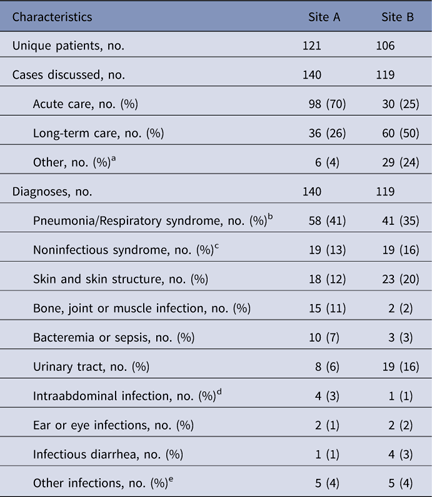
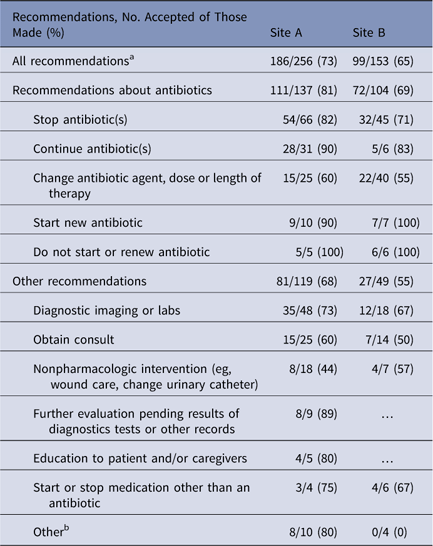
Over a 1-year period, the VAST at site A discussed 140 cases over 40 sessions for an average of 3.5 cases per session. Similarly, site B discussed 119 cases over 38 sessions, for an average of 3.1 cases per session. Most cases for site A came from the acute-care wards (70%); most cases at site B came from the long-term care ward (50%). Pneumonia and respiratory syndromes, including acute exacerbations of chronic obstructive pulmonary disease, accounted for ~40% of the cases from both intervention sites (Table 1). The acceptance rate for actionable recommendations made by the VASTs was >65% at both intervention sites (Table 2). The most common recommendation at both sites was to stop antibiotics, which had an 82% acceptance rate (54 of 66 recommendations) at site A and a 71% acceptance rate (32 of 45 recommendations) at site B.
Location and Diagnoses of Cases Discussed at VAST Sessions

Note. VAST, videoconference antimicrobial stewardship team.
a Site A includes patients from outpatient clinics (n=4) and 1 case each from urgent care and home-based primary care. Site B includes urgent care (n=17) and outpatient clinics (n=12).
b Includes respiratory viral infections and acute exacerbations of chronic obstructive pulmonary disease.
c Site A includes bacteriuria (n=3), 2 cases each of drug-fever, dysuria, heart-failure, hematuria, ruling out Lyme disease, and 1 case each of cirrhosis, irritable bowel syndrome, lymphedema, myelodysplastic syndrome, positive blood culture (contaminant) and venous insufficiency. Site B includes bacteriuria (n=7), cough or dyspnea (n=4), fatigue (n=2), and 1 case each of abdominal tenderness, asplenia, encephalopathy, gross hematuria, nocturia, and rheumatoid arthritis.
d Site A includes abscesses (n=2) and 1 case each of acute cholecystitis and diverticulitis. Site B includes 1 case of diverticulitis.
e Site A includes unspecified fever (n=3), candidal esophagitis and orchitis. Site B includes urethritis (n=2), fever, lung abscess, and prostatitis.
Recommendations Made by the VAST and Accepted by Primary Team
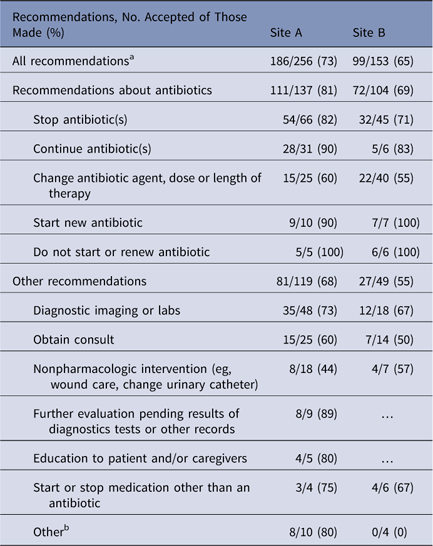
Note. VAST, videoconference antimicrobial stewardship team.
a Some patients received ≥1 recommendation.
b Site A included change remove or do not place device (3 of 4, 75%) recommendations accepted), nursing intervention (2 of 3, 67%), transfer to a tertiary care facility (2 of 2, 100%), and establish with primary care (1 of 1; 100%). Site B included antibiotic allergy rechallenge (0 of 3, 0%) and do obtain a diagnostic test (0 of 1, 0%).
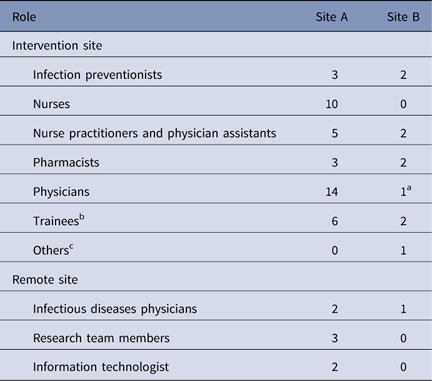
Site A had a greater number and variety of attendees than site B, with ~15 and 3 attendees per session, respectively (Table 3). This difference may reflect both the individual cultures at each intervention sites and differences in access to infectious disease expertise. Specifically, at site A, the VAST was the primary means to access infectious disease expertise, whereas site B had recently engaged a part-time infectious disease physician who was available to address more complex infectious disease problems commonly encountered in the inpatient setting.
Roles of VAST Participants Who Attended at Least 1 Session During the 1-Year Study Period
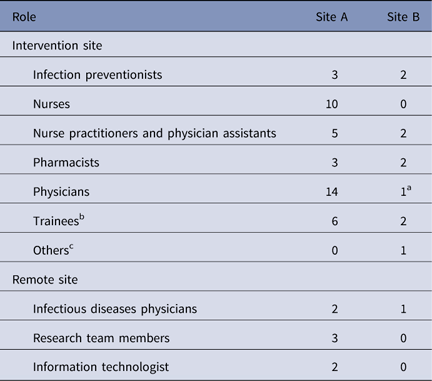
Note. VAST, videoconference antimicrobial stewardship team.
a During the latter part of the 1-year assessment period, the infectious diseases physician making rounds at site B adjusted his schedule to attend the VAST in person.
b Medical resident (n=1), pharmacy residents (n=2), nurse practitioner students (n=2) and pharmacy students (n=3).
c Dentist.
Qualitative results
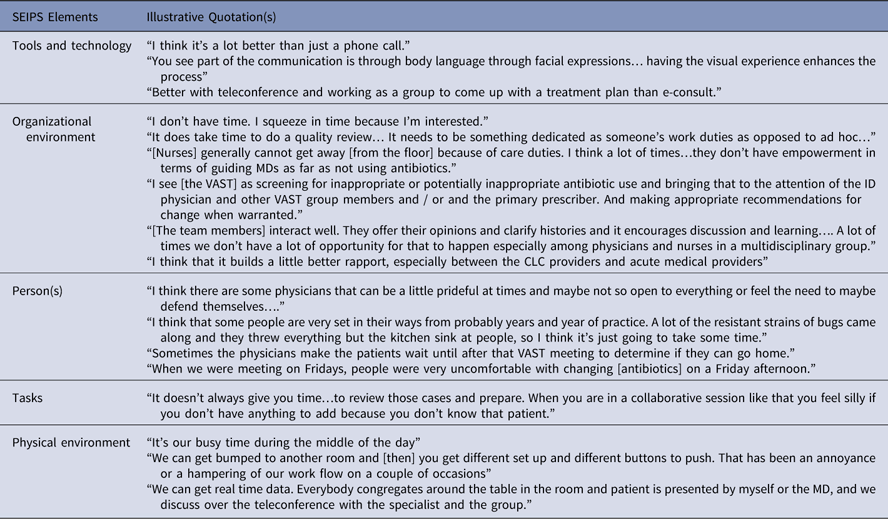
From sites A and B, 19 of 41 (46%) and 5 of 5 (100%) VAST members, respectively, agreed to be interviewed. Most of the qualitative findings aligned with the 5 domains of the SIEPS 2.0 human factors model (Table 4). Practice change emerged as an inductive theme outside of the SEIPS domains.
Illustrative Quotations Identified From the Semi-Structured Interviews, Presented in the Context of the SEIPS Framework

Note. SEIPS, Systems Engineering Initiative for Patient Safety; CLC, community living center, nursing home and long-term care units at Veterans Affairs medical centers; VAST, videoconference antimicrobial stewardship team; CPRS, computerized patient record system (the VA’s electronic medical record); MD, medical doctor.
Practice change
Participants reported that the VAST sessions increased their awareness of antibiotic stewardship principles, helping them to adapt their practice patterns and engage in antimicrobial stewardship efforts. They specifically mentioned feeling greater confidence in their ability to make more targeted antibiotic choices, to reduce the time patients were on antibiotics, and to utilize more effective methods whenever possible (ie, intravenous to oral conversions). They also highlighted the educational component, including the brief didactic sessions, and being able to apply what they learned from case presentations to other patients. Providers were eager to see whether the data on antibiotics use and hospitalizations would reflect their perception of the changes. In the context of barriers, participants reported that some providers were not open to recommendations to change to their treatment plans. They attributed this resistance to ego or to the idea that some providers are set in their ways and preferred to use their established practice patterns.
Both sites reported efforts to improve antimicrobial stewardship independent of the VAST, including auditing cases to identify areas for improvement in antibiotic stewardship. At site B, decision aid tools were developed to help providers identify appropriate testing for certain illnesses and symptoms to ensure best choices for antibiotic use were made when appropriate.
Tools and technology
The video component, which allowed face-to-face communication, facilitated the VAST. Participants reported that it enhanced their positive experience by supporting learning and communication, which in turn led to a better understanding of the recommendations. Video conferencing also facilitated discussion among participants, compared to traditional consults in which asynchronous communication between providers and specialists may be limited to reviewing content within the EMR. Furthermore, the team at the intervention site and the infectious disease physician accessed the same EMR, which participants felt also advanced learning, development of recommendations, and treatment steps. Barriers reported by some participants included having to learn to operate the technology associated with running the videoconference system and, occasionally, technical difficulties such as audio interference.
Organizational environment
Engagement differed by site and by the participants’ roles. At site A, participants were highly engaged and attended VAST sessions whether or not they had a case to present. At site B, however, while the pharmacist and infection preventionists remained strongly engaged, providers rarely attended sessions.
At site A, nurses mentioned barriers to participation, although several regularly participated in the VAST. The nurses interviewed indicate that they learned a lot about antimicrobial stewardship by attending the VAST sessions. They also shared that they could not readily apply that knowledge clinically due to the culture of their work setting and the relationship between nursing staff and the providers making treatment decisions for patients.
At site A, the organizational culture and approach to patient care sometimes differed between acute-care and long-term care settings. Providers reported gaining more confidence in communicating their plans of care for patients transferring from one setting to another leading to more closely aligned patient care. One provider reported less antibiotic use in patients transferred from acute-care to long-term care.
Participant responses
At site A, the interviews highlighted efforts by the local champions to encourage participation in VAST. Respondents also reported that the infectious disease physician made them feel welcome, prompted questions, and encouraged them to give their opinions. Participants emphasized that they were never made to feel that they did something wrong or made a bad choice, which made them feel more comfortable about presenting cases and discussing how to improve antimicrobial stewardship. Site B respondents also reported being encouraged to participate by the specialist when they were asked questions and to contribute to case discussion even if they were unsure.
Participants reported valuing the multidisciplinary input they received from VAST participants and indicated more willingness to ask for assistance from the infectious disease physician or from their local colleagues. Specifically, they identified their local infection preventionists as a resource. Furthermore, they noted that the VAST sessions built the rapport with the off-site infectious disease physician. Site A participants discussed an increase in communication among medical providers (ie, peer-to-peer) and between providers and professionals from other disciplines (ie, pharmacists, infection preventionists and infectious diseases physicians). Notably, site A providers reported learning that their facility’s pharmacists are a knowledgeable resource for antibiotic selection and use.
Tasks
The infection preventionists at both sites helped identify appropriate cases for discussion at the VAST sessions, notifying providers of the intent to discuss one of their patients. At site A, the infection preventionists entered consults, reviewed and presented cases during the VAST session, and recorded recommendations into the patient’s EMR. At site A, some providers identified and either presented their own cases or supplemented the presentations made by the infection preventionists. While providers from site A reported no increase in workload burden from VAST participation, the infection preventionists commented that they typically dedicated 8 hours each week to VAST activities.
At both sites, participants reported enjoying the VAST sessions and attended when it did not interfere with patient care. Despite limited time and availability site A participants reported prioritizing VAST sessions because they were interested and felt the program helped them provide better patient care. Many participants mentioned enjoyed meeting each week because it provided routine feedback on antimicrobial stewardship, allowed for follow-up on challenging cases, enhanced learning, and improved treatment.
Scheduling issues, such as rotating work weeks and conflicting times with grand rounds or other duties, were barriers to participation. VAST sessions were held in the middle of the day, typically at noon. Providers reported feeling pressure to discharge patients who needed to move to a different level of care and to address other pressing patient care issues. Some participants mitigated these barriers by arranging cross coverage or by communicating information from the session to individuals who were not able to attend. At site A, the initial VAST sessions were on Friday afternoons, a time that made attendance difficult for several interviewees. After several weeks, the VAST for site A moved to Wednesdays, which was better but also overlapped with grand rounds once a month.
Physical environment
The physical space available for VAST sessions was a concern for participants. Initially, the setting for site A was small, hot, and noisy. The meeting was moved to a larger room with a more comfortable temperature and less ambient noise. Participants at both sites reported occasional issues with not having rooms available for the VAST session. The distance from providers’ work area and the meeting room was a barrier for some due to the large campus size. Site B overcame this barrier by allowing providers to call in from their location.
Discussion
This pilot study has demonstrated successful implementation of a telehealth antimicrobial stewardship program at 2 rural VAMCs. The initial protocol called for a 6-month trial of the VAST. At the requests of participants from both sites, the VAST sessions continued well beyond the planned intervention period, permitting us to report outcomes from the first year of implementation. To our knowledge, this is the first description of a telehealth program focused on antimicrobial stewardship in the VA. Additionally, the VAST discussed cases from both acute-care and long-term care units, providing team members from these different settings an opportunity to interact and address antimicrobial stewardship at transitions of care.
Previous telehealth antimicrobial stewardship programs have used both synchronous and asynchronous approaches, with the latter relying upon a linked EMR or dedicated web application for communication.Reference Morquin, Ologeanu-Taddei, Koumar, Bourret and Reynes 13 , Reference dos Santos, Deutschendorf, Carvalho, Timm and Sparenberg 14 Synchronous programs used technology to permit a multidisciplinary team of professionals to discuss cases in real time and also allowed for consultation to occur outside of scheduled sessions.Reference Yam, Fales, Jemison, Gillum and Bernstein 15 – Reference Zhou, Lynch and Pottinger 18 In addition to infectious disease physicians and pharmacists, team members included epidemiologists, microbiologists, administrators, information technology specialists, infection control staff members, as well as other physicians. To help broaden the inclusion of antimicrobial stewardship principles across clinical disciplines, the VAST specifically involved staff nurses.Reference Olans, Olans and DeMaria 19 Similar to the program described by Zhou et al,Reference Zhou, Lynch and Pottinger 18 the VAST began with a site visit, and subsequent meetings included brief didactic sessions on topics relevant to the cases addressed.
The VAST approach represents a successful implementation of the SCAN-ECHO model, demonstrated by continuation of the program and acceptance of most VAST recommendations at both sites. Contributing factors aligned with those previously described by Stevenson et al,Reference Stevenson, Ball, Haverhals, Aron and Lowery 20 including a design built around VA infrastructure, compatibility with existing workflow processes for documentation and workload capture, as well as increased knowledge and competency reported by participants. These factors may also account for some of the differences in implementation between the 2 intervention sites. At site A, leaders from both medicine and nursing attended several sessions, demonstrating leadership engagement. Site A also engaged in reflection and evaluation of the VAST with tangible changes such as adjusting the day and location to better suit attendees’ needs. Additionally, the infection preventionist at site A regularly included a “kudos” case for which the VAST recognized and celebrated a provider’s good antimicrobial stewardship practices. Finally, the VAST filled a gap at site A, which did not have access to a local infectious disease expert, compared to site B, where an infectious diseases physician had recently started making rounds weekly.
Champions are important facilitators when implementing successful programs, including those related to antimicrobial stewardship.Reference Barlam, Cosgrove and Abbo 21 They promote and support intervention and can also overcome indifference or resistance. 22 The champions at both intervention sites were instrumental to the VASTs’ success. In addition to aligning VAST-related activities with their work responsibilities, they also served as primary points of contact for the off-site infectious disease physicians as well as for individuals at their sites.
This study has several limitations. First, both intervention sites had pre-existing relationships with the off-site infectious disease physicians; this likely facilitated successful implementation. Future renditions of the VAST will need to cultivate trust and relationships among team members. Second, not all VAST participants engaged in interviews, which may have influenced the tone of the qualitative results. Third, an unintended consequence of the VAST reported from site A was that providers would sometimes wait for a weekly VAST session to inform some aspects of patient care, leading to potential delays in treatment decisions. As the providers grew more comfortable with the VAST, phone calls to infectious disease physicians and e-consults may have mitigated some of these delays.
Our pilot project has demonstrated that telehealth is a viable method to expand access to specialty care and promote antimicrobial stewardship within the VA. In addition to evaluating the influence of the VAST on antibiotic use at the intervention sites, future activities will expand implementation to other VAMCs with limited access to infectious disease expertise.
Supplementary materials
To view supplementary material for this article, please visit https://doi.org/10.1017/ice.2018.197
Acknowledgments
The authors are grateful to the VAST participants at both intervention sites, and particularly thank Yvonne Jones, Jason Cherry, Brett Anderson, Stacey Hirth, and David C. Aron. The findings and conclusions in this document are those of the authors, who are responsible for its content, and do not necessarily represent the views of the VA or of the United States Government.
Financial support
This work was supported by the Veterans Affairs Merit Review Program (grant no. PPO 16-118-1 to R.J.) and, in part, by funds and facilities provided by the Cleveland Geriatric Research Education and Clinical Center (GRECC) and the Specialty Care Center of Innovation at the Louis Stokes Cleveland Department of Veterans Affairs Medical Center.
Conflicts of interest
R.J. is the principal investigator on research grants from Steris and Pfizer; she has also participated in advisory boards for Pfizer and Merck. None of the other authors have relevant conflicts of interest to disclose.