


Introduction
Non-alcoholic fatty liver disease (NAFLD) includes a spectrum of liver disorders, ranging from simple liver steatosis to non-alcoholic steatohepatitis (NASH) and cirrhosis, which can lead to the development of liver cancer(Reference Friedman, Neuschwander-Tetri and Rinella1). The mechanisms underlying the development of this metabolic disease are complex, resulting from the interaction of genetic and environmental factors. Maternal diet during gestation and lactation is an important environmental condition that has direct effects on liver development(Reference Campisano, La Colla and Echarte2). In addition, early malnutrition can affect mitochondrial function and epigenetics(Reference Picard and Turnbull3,Reference Calcaterra, Cena and Verduci4) . In this sense, a growing body of evidence indicates that inadequate nutrition during preconception, pregnancy and early infancy can affect the metabolic phenotype of the progeny, thus contributing to the development of NAFLD in later life, according to the concept of ‘developmental programming’(Reference Brumbaugh and Friedman5).
The regulation of metabolism is strongly related to mitochondrial function. Mitochondria are subcellular organelles that play a significant role in energy homoeostasis by metabolising nutrients as well as in ATP synthesis. Additionally, these organelles are involved in a variety of processes, including regulation of apoptosis, calcium homoeostasis and generation of reactive oxygen species (ROS)(Reference Kim, Wei and Sowers6). In the past years, evidence has supported the notion that mitochondrial dysfunction has a central role in the pathophysiology of NAFLD. Alteration of mitochondrial function was related to fat liver deposition, lipid peroxidation, hepatic oxidative stress and accumulation of mitochondrial DNA (mtDNA) damage(Reference Picard and Turnbull3,Reference Xu, Nagata and Ota7) . Moreover, it has been reported that mitochondrial dysfunction is linked to liver insulin resistance(Reference Wiederkehr and Wollheim8).
Epigenetic mechanisms involve changes in gene expression and phenotype not associated with modifications in primary DNA sequence. These alterations are heritable and induced by the exposure to different environmental factors(Reference Campisano, La Colla and Echarte2,Reference Del Campo, Gallego-Durán and Gallego9) . Epigenetics has been related to alterations in genes involved in lipid metabolism, fibrogenesis, inflammation and tumorigenesis(Reference Xu and Guo10). Studies have demonstrated that nutritional perturbances during early development can lead to epigenetic dysregulation, which may be later associated with NAFLD development(Reference Campisano, La Colla and Echarte2).
The aim of the present review is to discuss the interplay between mitochondrial dysfunction and epigenetics and their relation to the development of NAFLD associated with early-life nutrition. We first outline the concept of developmental programming and its relation to early-life nutrition. Next, we present an overview of mitochondrial biology, including bioenergetics, biogenesis and biodynamics. Then, we discuss the involvement of mitochondrial dysfunction and epigenetics in the pathogenesis of NAFLD, related to disturbances in early-life nutrition. Finally, we conclude by establishing a link between NAFLD, nutrition, epigenetics and mitochondrial dysfunction, and describe future scopes of research in this field.
Developmental programming of NAFLD: Impact of early-life nutrition
The nutritional environment during preconception, pregnancy and early life plays a critical role in the development of the progeny and is related to the incidence of acute and chronic diseases later in life(Reference Black, Victora and Walker11). Early nutritional environment, including undernutrition, macronutrient excess or micronutrient deficiency, has been related to long-term metabolic disorders(Reference Li, Reynolds and Segovia12). Certainly, human epidemiological evidence and animal studies have reported an association between maternal undernutrition and the appearance of metabolic diseases in adulthood, such as diabetes and NAFLD(Reference Ross and Beall13). Maternal obesity has also been demonstrated to be an important risk factor for NAFLD(Reference Thompson14). These events are in accordance with the ‘developmental origins of disease hypothesis’, which posits that exposure to an adverse environment during sensitive periods of cellular plasticity confers an augmented risk of developing diseases later in life(Reference Barker15). This process, known as ‘developmental programming’, is directly related to the ‘thrifty phenotype’ hypothesis. This argues that, when a foetus is exposed to undernutrition, it adapts to nutrient availability limitation, thus conferring the capacity of short-term survival under these adverse conditions. However, these metabolic adaptations increase susceptibility to long-term metabolic diseases when exposed to an adequate nutrient environment(Reference Gluckman and Hanson16). Similarly, maternal obesity and micronutrient deficiency lead to the programming of the foetus as in maternal undernutrition, since these nutritional environments represent a form of foetal malnutrition(Reference Li, Reynolds and Segovia12).
Several animal studies have reported an association between a maternal obesogenic environment and the development of NAFLD in the progeny. In this regard, it has been shown that exposure to a high-fat diet (HFD) during preconception, pregnancy and lactation leads to a NAFLD phenotype in rodents and non-human primates(Reference McCurdy, Bishop and Williams17,Reference Bruce, Cagampang and Argenton18) . Moreover, the administration of a HFD after weaning exacerbated this phenotype, with the offspring developing NASH in early adulthood, while the ones exposed to a normal diet exhibited only simple steatosis(Reference Gregorio, Souza-Mello and Carvalho19,Reference Souza-Mello, Mandarim-de-Lacerda and Aguila20) . Regarding the influence of high-calorie processed foods during early life, Sánchez Blanco et al. reported that 21-day-old pups from dams administered cafeteria diet during preconception, gestation and lactation present increased plasma triacylglycerol levels(Reference Sanchez-Blanco, Amusquivar and Bispo21). In another study the long-term influence of cafeteria diet during pregnancy and lactation was evaluated in 14-month-old male rats, showing an increase in triacylglycerol and fatty acid content in liver(Reference Sánchez-Blanco, Amusquivar and Bispo22). Furthermore, the effects of maternal junk food rich in energy, fat, sugar and salt were studied, demonstrating that offspring exposed to this diet during foetal life developed several exacerbated signs of NAFLD, such as liver steatosis, oxidative stress and hepatocyte ballooning at the end of adolescence, when compared with animals that had only received this diet from weaning(Reference Bayol, Simbi and Fowkes23). Interestingly, liver steatosis and oxidative stress were also present in offspring from junk-food-fed mothers that had received a regular diet after weaning(Reference Bayol, Simbi and Fowkes23). Maternal Western-style diet administration during prenatal and post-weaning periods also programmes susceptibility to liver disease into male offspring, as a result of alterations in inflammation and lipid metabolism(Reference Pruis, Lendvai and Bloks24). Additionally, a considerable body of evidence from animal models has shown a link between in utero undernutrition and the development of NAFLD in the offspring. In this respect, it has been demonstrated that the administration of low-protein diets during pregnancy and lactation is conducive to liver steatosis in rats during adulthood(Reference Campisano, Echarte and Podaza25,Reference Erhuma, Salter and Sculley26) . With regard to early micronutrient deficiency, it has been shown that vitamin B12 restriction in maternal diets is conducive to increased body fat mass, diabetes mellitus type 2, augmented plasma cholesterol levels and dysregulation of fatty acid metabolism pathways(Reference Deshmukh, Katre and Yajnik27–Reference Ahmad, Kumar and Basak29). Another study reported that vitamin B12 and folate deficiency during gestation and lactation induces rat liver steatosis at weaning and is related to impaired mitochondrial fatty acid oxidation and a significant reduction in birth weight in the offspring(Reference Pooya, Blaise and Moreno Garcia30). Sharma et al. demonstrated that maternal calcium and vitamin D deficiency is conducive to abnormal lipid metabolism and liver gene expression in female offspring rats, resulting in liver steatosis, even though control diet was administered after weaning(Reference Sharma, Jangale and Harsulkar31). Given that NAFLD has become one of the most prevalent liver metabolic diseases worldwide, much interest has been given to developmental programming, its association with the nutritional environment and the potential underlying mechanisms.
Mitochondria: Bioenergetics, biogenesis and biodynamics
Mitochondria are double-membrane organelles that contain their own DNA. The outer mitochondrial membrane (OMM) and the inner mitochondrial membrane (IMM) enclose distinct proteins and have different functions. The OMM is more permeable and characterised by the establishment of membrane contact sites with endoplasmic reticulum, lysosomes, peroxisomes, plasma membrane, endosomes and lipid droplets. The IMM includes the mitochondrial invaginations known as cristae, which contain electron transport chain (ETC) complexes and ATP synthase. A small intermembrane space is found between the outer and inner mitochondrial membranes. IMM delimits the mitochondrial matrix, which includes enzymes involved in glycolysis, tricarboxylic acid (TCA) cycle and fatty acid β-oxidation (FAO). In addition, the matrix encloses a circular mtDNA which is packaged in nucleoids. mtDNA encodes two ribosomal RNAs, twenty-two transfer RNAs, thirteen polypeptide subunits of ETC and some noncoding RNAs, while the rest of proteins are encoded by the nuclear genome.
Mitochondria are known as the ‘powerhouses of the cell’(Reference Spinelli and Haigis32). They generate energy in the form of ATP through oxidative metabolism of nutrients(Reference Walsh, Tu and Tang33). Glucose, amino acids and fatty acids from nutrients are metabolised, and then enter the TCA cycle. As a result, electrons are released and stored in the carriers NADH and FADH2. These reducing agents transfer electrons to the ETC in the IMM(Reference Zhao, Jiang and Zhang34). Mitochondrial ETC includes five enzyme complexes. Complex I (NADH ubiquinone reductase) collects electrons from NADH, while complex II (succinate dehydrogenase) obtains them from FADH2. Then, electrons from these complexes are transferred to coenzyme Q, which donates them to complex III (ubiquinol–cytochrome c reductase). Complex IV (cytochrome c oxidase) oxidises cytochrome c and transfers electrons to oxygen, forming water. This flow of electrons along the ETC is employed to pump protons into the intermembrane space(Reference Sazanov35), which establishes the electrochemical gradient necessary for the generation of ATP through complex V (ATP synthase) in the process of oxidative phosphorylation(Reference Watt, Montgomery and Runswick36).
As described above, the transfer of electrons along the ETC through oxygen is coupled to the generation of ATP. However, a fraction of electrons commonly leak from the ETC, reacting directly with oxygen and generating superoxide radicals(Reference Murphy37). These ROS may be converted to hydrogen peroxide (H2O2), and then to hydroxyl radicals through the Fenton reaction(Reference Spinelli and Haigis32). Even though there exist eight sites involved in the production of these ROS, mitochondrial complexes I, II and III are the main contributors to ROS generation(Reference Brand38). Fortunately, mitochondria have antioxidant mechanisms to scavenge these extremely reactive ROS, thus protecting molecules from oxidative damage. These antioxidant defences comprise enzymatic and non-enzymatic mechanisms. The mitochondrial enzyme superoxide dismutase converts superoxide anion into H2O2, which is less reactive(Reference Schieber and Chandel39). H2O2 can then be converted to water by different enzymes, including catalase, peroxiredoxins (PRX) and glutathione peroxidases (GPX)(Reference Sena and Chandel40). While PRXs are abundant in mitochondria, only isoform 4 of GPx is located in this compartment and catalase is found in peroxisomes(Reference Sena and Chandel40). Mitochondrial enzymes PRX3 and PRX5 are oxidised by H2O2, and then reduced by thioredoxin 2 and thioredoxin reductase 2(Reference Cox, Winterbourn and Hampton41). In turn, GPX4 is oxidised by H2O2 and then reduced by the non-enzymatic antioxidant glutathione(Reference Sena and Chandel40). It has been proposed that PRXs are the principal mitochondrial antioxidant enzymes involved in the elimination of minimal levels of H2O2, as a result of their high abundance and their high rate constant. On the contrary, due to their lower abundance, GPXs are critical for scavenging higher levels of H2O2, when they can compete with PRXs for substrate(Reference Winterbourn and Hampton42). Under physiological conditions, ROS have intracellular messenger actions and their production is controlled by mitochondrial antioxidant defences, to prevent cellular oxidative injury(Reference Ray, Huang and Tsuji43). However, when these protective mechanisms are insufficient, the overproduction of ROS results in oxidative damage to lipids, mtDNA and proteins in mitochondria(Reference Betteridge44). In addition, mitochondria have an important role in the defence against ROS from other subcellular compartments such as peroxisomes(Reference Wang, Van Veldhoven and Brees45). Other reactive species can be found in mitochondria. Although the presence of nitric oxide synthase in mitochondria has been controversial, either nitric oxide derived from ETC or that produced in a different compartment, after diffusing through the mitochondrial membranes, can react with superoxide, forming peroxynitrite inside the mitochondria (Reference Radi, Cassina and Hodara46). Even though peroxynitrites can affect different proteins, they are efficiently detoxified by PRXs and GPXs(Reference Trujillo, Ferrer-Sueta and Radi47). Since mitochondria have a critical role in the production and maintenance of physiological levels of ROS, alterations in these organelles can lead to oxidative stress, which is considered to be an important factor in the generation of hepatocyte injury in the context of NAFLD(Reference Simões, Fontes and Pinton48). In animal models of NAFLD, enhanced ROS formation has been reported as a result of impairment of mitochondrial ETC activity(Reference Petrosillo, Portincasa and Grattagliano49). Similar observations were made in patients with NAFLD(Reference Pérez-Carreras, Del Hoyo and Martín50). In addition, a diminished expression and activity of antioxidant enzymes has been described in in vitro and in vivo models of NAFLD(Reference Besse-Patin, Leveille and Oropeza51). Thus, excessive ROS production and decreased antioxidant capacity can contribute to NAFLD pathogenesis.
Mitochondrial biogenesis is defined as the process by which cells augment their mitochondrial mass via increasing their size and number(Reference Onyango, Lu and Rodova52). The majority of mitochondrial constituents are synthesised in the nucleus(Reference Scarpulla, Vega and Kelly53). These nuclear proteins have to be imported into mitochondria. Therefore, mitochondrial biogenesis requires the coordinated expression of nuclear and mitochondrial genes(Reference Wallace54). Different factors are involved in the regulation of this process. Peroxisome proliferator-activated receptor γ co-activator-1 α (PGC-1α) is a co-activator that promotes mitochondrial biogenesis through the activation of different nuclear receptors and nuclear transcription factors, including nuclear respiratory factors (NRF) 1 and 2(Reference Irrcher, Adhihetty and Sheehan55). NRF-1 and NRF-2 induce the transcription of almost every component of the ETC, and promote the expression of mitochondrial transcription factor A (Tfam), which leads to mtDNA synthesis(Reference Virbasius and Scarpulla56). Additionally, PGC-1α co-activates other factors such as thyroid hormone, glucocorticoid, oestrogen, peroxisome proliferator-activated receptors (PPAR) and oestrogen-related receptors (ERR) α and γ(Reference Jornayvaz and Shulman57). By acting as a co-activator of PPAR α and δ, PGC-1α induces the expression of mitochondrial FAO genes(Reference Vega, Huss and Kelly58). PGC-1α also affects mitochondrial biogenesis by interacting with ERRs, which are involved in fatty acid metabolism and oxidative phosphorylation(Reference Giguère59). In turn, PGC-1α is regulated by AMP-activated protein kinase (AMPK) and sirtuin 1 (SIRT1). AMPK phosphorylates PGC-1α in response to acute energy deprivation(Reference Winder, Holmes and Rubink60). The protein deacetylase SIRT1 activates PGC-1α in liver in response to fasting(Reference Rodgers, Lerin and Haas61). In contrast, the mitochondrial SIRT3 is a downstream target of PGC-1α. SIRT3 up-regulates several proteins such as FAO enzymes and ETC complexes I and II, thus affecting mitochondrial biogenesis(Reference Kong, Wang and Xue62). PGC-1β is another co-activator that regulates this process through NRF-1(Reference Lin, Handschin and Spiegelman63). Different studies have shown that alterations in mitochondrial biogenesis are related to obesity and type II diabetes(Reference Ritov, Menshikova and He64,Reference Lowell and Shulman65) , establishing an important link with NAFLD development.
Mitochondrial dynamics involves the balance between fusion and fission mechanisms to maintain normal mitochondrial function. Mitochondrial fusion refers to the union of two mitochondria resulting in one mitochondrion. This event is mediated by mitofusin 1 (MFN1) and mitofusin 2 (MFN2), which enable the fusion of OMMs, and optic atrophy 1 (OPA1), which allows the fusion of IMMs(Reference Delettre, Lenaers and Griffoin66,Reference Cipolat, Martins de Brito and Dal Zilio67) . Mitochondrial fission involves the division of a mitochondrion into two mitochondria. It is mediated by different proteins such as dynamin-related protein 1 (DRP1), mitochondrial fission factor (MFF), mitochondrial dynamics proteins of 49 kDa (MID49) and 51 kDa (MID51), and mitochondrial fission 1 protein (FIS1)(Reference Smirnova, Griparic and Shurland68–Reference Palmer, Osellame and Laine71). In this process, DRP-1 translocates from the cytosol to mitochondria, and then binds to MFF, MID49, MID51 and FIS1 in the OMM. This allows for DRP1 oligomerisation and posterior mitochondrial division(Reference Losón, Song and Chen72). The balance between fusion and fission events depends on the metabolic state and the nutrient availability of cells(Reference Nasrallah and Horvath73). In response to an enriched nutrient environment, mitochondria undergo fragmentation, while starvation induces mitochondria elongation(Reference Molina, Wikstrom and Stiles74–Reference Jheng, Tsai and Guo76). Thus, mitochondrial fragmentation leads to reduced ATP production and nutrient storage, in an attempt to prevent energy waste. On the contrary, mitochondrial elongation leads to maintenance of ATP generation, through an increase in mitochondrial bioenergetic efficiency(Reference Schrepfer and Scorrano77). Additionally, a shift toward fission is related to degradation of injured mitochondria through the process of mitophagy(Reference Mansouri, Gattolliat and Asselah78).
Mitochondrial dysfunction, NAFLD and early-life nutrition
Different mechanisms are involved in the development and progression of NAFLD. The ‘two-hit hypothesis’ was initially postulated to explain the occurrence of this metabolic disorder(Reference Peverill, Powell and Skoien79). According to this theory, the ‘first hit’ is represented by liver accumulation of lipids as a consequence of sedentary lifestyle, hyperenergetic diets, insulin resistance and obesity. Afterwards, this fatty liver becomes more vulnerable to a ‘second hit’, which induces inflammation and fibrosis. However, accumulating research has shown that this theory is insufficient to explain the complex alterations observed in human NAFLD patients. Nowadays, the most accepted model is the ‘multiple-hit hypothesis’. This theory posits that multiple factors act in conjunction in genetically susceptible individuals to lead to the development of NAFLD. These ‘hits’ include dietary factors, insulin resistance, adipose tissue dysfunction and changes in gut microbiome(Reference Buzzetti, Pinzani and Tsochatzis80). The high levels of NEFAs, free cholesterol and other lipid metabolites that are derived from the above-described insults induce lipotoxicity(Reference Cusi81). This environment in the liver leads to an impaired mitochondrial function that favours an excessive production of ROS and inflammation(Reference Satapati, Kucejova and Duarte82). The ‘multiple-hit hypothesis’ considers mitochondrial dysfunction a critical player in the development of NAFLD(Reference Mansouri, Gattolliat and Asselah78). In fact, evidence shows that hepatic mitochondrial dysfunction occurs before NAFLD development in rodents(Reference Rector, Thyfault and Uptergrove83). Accordingly, livers from NASH patients showed structural and functional mitochondrial alterations. Structural damage includes morphological changes, such as para-crystalline inclusions in megamitochondria and mtDNA depletion, which may be related to the liver injury developed in NAFLD patients(Reference Sanyal, Campbell-Sargent and Mirshahi84,Reference Koliaki, Szendroedi and Kaul85) . Functional modifications include impaired mitochondrial protein synthesis which is related to uncoupling and decrease of ETC complex activities, alterations in mitochondrial biogenesis and biodynamics, and reduced concentrations of antioxidant enzymes(Reference Koliaki, Szendroedi and Kaul85). Similar alterations have been observed in ob/ob mice, which showed modifications in ROS production and glutathione levels, lipid peroxidation and changes in mitophagy and mitochondrial biogenesis(Reference Mansouri, Gattolliat and Asselah78).
Mitochondrial structure and function are directly related to the cellular metabolic state. An enriched nutrient environment induces fragmentation of mitochondria, increase of mitochondrial ROS production and mtDNA damage, whereas undersupply of nutrients restricts mtDNA damage and induces fusion and elongation of mitochondria. A continuous metabolic imbalance induces alterations in mitochondrial morphology that could affect mitochondrial function and mtDNA quality that, in turn, can alter the susceptibility to long-term metabolic diseases(Reference Picard and Turnbull3,Reference Liesa and Shirihai86,Reference Westermann87) . Importantly, studies have demonstrated that even mitochondria in the fertilised oocyte are prone to damage by nutritional stressors. Oocytes exposed to a high-fat high-sucrose diet showed a diminishment in mitochondrial membrane potential and in the metabolites involved in ATP production, and absence of mitophagy, thus resulting in the transmission of dysfunctional mitochondria(Reference Boudoures, Saben and Drury88). Moreover, the maintenance of this altered mitochondrial phenotype has been demonstrated across generations, and has been proven to favour the development of insulin resistance in the offspring(Reference Saben, Boudoures and Asghar89). In this regard, it is important to note that the transfer of these mitochondrial disturbances through three generations was observed between obese mothers and female offspring, supported by the fact that these organelles are maternally inherited(Reference Saben, Boudoures and Asghar89).
Several studies have demonstrated a strong relationship between early-life malnutrition, NAFLD and mitochondrial disturbances (Table 1). In this regard, different alterations in mtDNA, mitochondrial bioenergetics, biogenesis and biodynamics have been related to metabolic disorders, including obesity, diabetes and NAFLD(Reference Simões, Fontes and Pinton48,Reference Cheng and Almeida90,Reference Lee, Kim and Friso91) . Alfaradhi et al. reported that young offspring (8 weeks of age) exposed to a high-fat, high-sugar diet during pregnancy and lactation, which reflects a Western obesogenic environment, presented augmented mitochondrial complex I and II activities and diminished mitochondrial cytochrome c and glutamate dehydrogenase levels, showing hepatic dysfunctional mitochondria(Reference Alfaradhi, Fernandez-Twinn and Martin-Gronert92). These detrimental changes were associated with an increase in hepatic lipid content, oxidative damage, PPARγ expression and insulin levels, and a decrease in triacylglycerol lipase(Reference Alfaradhi, Fernandez-Twinn and Martin-Gronert92). Another study showed that adult offspring exposed to a semisynthetic not obesogenic Western-style diet (rich in energy, moderate in fat and cholesterol) from prenatal to post-weaning developed microvesicular fat accumulation and diminished plasma β-hydroxybutyrate and mRNA levels of PPARα, showing an imbalance between mitochondrial FAO and augmented production of fatty acids, which is consistent with mitochondrial dysfunction(Reference Pruis, Lendvai and Bloks24). Impairment of mitochondrial ETC complex activities (I, II, III and IV) and reduced serum concentrations of β-hydroxybutyrate were also demonstrated by others in offspring fed a HFD (42 % kcal from fat) that had been born to obese mothers, during gestation and post-weaning(Reference Bruce, Cagampang and Argenton18,Reference Keleher, Zaidi and Shah93) . Burgueño et al. reported that exposure to a HFD (40 % fat added to standard diet) 2 weeks before breeding and during gestation and lactation resulted in adult offspring (18 weeks of age) with reduced hepatic mtDNA content and male-specific diminishment in hepatic transcriptional activity of PGC1α, which was further related to insulin resistance and abnormal liver fat accumulation(Reference Burgueño, Cabrerizo and Gonzales Mansilla94). Other studies have shown that post-weaning HFD-fed adult offspring (45 % kcal from fat) born to pre-pregnancy obese dams presented reduced levels of regulators of mitochondrial dynamics (PGC1α, PGC1β and ERRα) and mitofusins in liver(Reference Borengasser, Lau and Kang95). In another set of experiments, de Velasco et al. demonstrated the effecs of maternal consumption of isoenergetic and normolipidic diets rich in trans-fatty acids, that is, hydrogenated fat, or its industrial substitute lipid source, interesterified fatty acids, during pregnancy and lactation(Reference De Velasco, Chicaybam and Ramos-Filho96). These early-life insults predispose to hepatic mitochondrial dysfunction in adult offspring (postnatal day 110), related to changes in mitochondrial bioenergetics, which includes respiration impairment, augmentation of H2O2 production in the liver and compromised mitochondrial membrane permeability(Reference De Velasco, Chicaybam and Ramos-Filho96). The current research provides convincing evidence for the critical role of these mitochondrial alterations in offspring programming related to malnutrition and NAFLD development.
Studies associated with the interplay between early-life nutrition, NAFLD and mitochondrial disturbances

FAO, fatty acid β-oxidation; ETC, electron transport chain; mtDNA, mitochondrial DNA; PGC1, peroxisome proliferator-activated receptor-γ co-activator α; ERR, oestrogen-related receptor; MFN, mitofusin; PPAR, peroxisome proliferator-activated receptor.
Epigenetics, NAFLD and early-life nutrition
Although the exact mechanisms underlying NAFLD development have not been completely described, epigenetics arises as an important player contributing to NAFLD pathophysiology(Reference Lee, Kim and Friso91). Furthermore, studies have established a link between environmental factors, epigenetics and developmental programming(Reference Wankhade, Zhong and Kang97). In this regard, it is important to mention that inadequate nutrition during preconception, pregnancy and early infancy has been related to epigenetic modifications in genes involved in lipid metabolism and inflammation, which may favour the development of metabolic alterations later in life(Reference Wankhade, Zhong and Kang97,Reference Zheng, Xiao and Zhang98) . The epigenetic mechanisms that regulate nuclear gene expression include non-coding RNAs, DNA methylation and post-translational modifications of histones. DNA methylation refers to methylation of cytosine nucleotides at CpG-rich promoters(Reference Xu and Guo10). While hypermethylation blocks gene transcription, hypomethylation induces gene activation, which depends on the activity of DNA methyltransferases (DNMT)(Reference Campisano, La Colla and Echarte2). Post-translational modifications of histones include acetylation, methylation, ubiquitylation, phosphorylation and SUMOylation(Reference Campisano, La Colla and Echarte2). Histone acetylation is the most reported mechanism. While acetylation is related to promotion of gene transcription, deacetylation is associated with gene inactivation(Reference Campisano, La Colla and Echarte2). Among non-coding RNAs, microRNAs (miRNA) are the most studied. MiRNAs are non-coding single-stranded RNAs with nineteen to twenty-three nucleotides that modulate mRNA degradation or inhibition of translation(Reference Campisano, La Colla and Echarte2).
In the past years, several studies have shown the interplay between adverse maternal nutrition, epigenetic modifications and developmental programming of this liver disease(Reference Wankhade, Zhong and Kang97) (Table 2). Researchers found that a high-fat lard diet rich in unsaturated fatty acids (35 %) during preconception and pregnancy until gestation days 18–20 modulated the epigenome of foetal livers, evidenced by the promotion of DNA methylation and histone acetylation, leading to liver lipid accumulation(Reference Ramaiyan and Talahalli99). Keleher et al. reported that a maternal HFD induced thousands of DNA methylation alterations in livers of post-weaning HFD-fed offspring mice (42 % kcal from fat), which were also evident in adulthood(Reference Keleher, Zaidi and Shah93). In addition, in HFD-fed daughters, these epigenetic alterations were associated with obesity and diabetes-related phenotypic changes(Reference Keleher, Zaidi and Shah93). Similarly, Seki et al. showed that exposure to a maternal high-fat lard diet during preconception, gestation and lactation results in global hepatic DNA hypermethylation in male offspring(Reference Seki, Suzuki and Guo100). Persistent methylation of three genes involved in growth and metabolism (Arhgef19, Zbtb17/Miz-1 and Mmp9) was observed in these offspring throughout life(Reference Seki, Suzuki and Guo100). Exposure to a Western diet (rich in energy and moderate in fat and cholesterol) during preconception, pregnancy, lactation and post-weaning results in phenotypic alterations compatible with NAFLD in the offspring, which were further associated with significant methylation differences in PPARα, an important gene involved in lipid metabolism(Reference Pruis, Lendvai and Bloks24). In accordance, Whankhade et al. showed that maternal overnutrition via in utero exposure to a HFD (45 % fat) induced alterations in DNA methylation of PGC1α and Fgf21 in livers of post-weaning HFD offspring, which may be involved in NAFLD development(Reference Wankhade, Zhong and Kang97). A maternal HFD (22·6 % fat) during pregnancy and lactation has also been demonstrated to affect miRNA expression in adult offspring livers(Reference Zhang, Zhang and Didelot101). Furthermore, it was evidenced that an adverse intra-uterine environment induced by a high-sucrose (72 %), low-copper diet induces significant modifications in DNA methylation of 327 regions corresponding to 183 genes in offspring rat livers. The affected pathways were associated with metabolic disease, insulin resistance and carbohydrate metabolism(Reference Petropoulos, Guillemin and Ergaz102). A high-fat high-cholesterol Western-type diet before and during gestation and lactation given to apolipoprotein (Apo) E-deficient dams resulted in augmented hepatic methylation of CpG nucleotides on the promoter region of ApoB genes of male adult offspring(Reference Chen, Chen and Wang103). The progeny also developed hyperinsulinemia, insulin resistance, glucose intolerance and hepatic steatosis(Reference Chen, Chen and Wang103). Another study showed that perinatal exposure to an obesity-inducing diet rich in saturated fat, fructose and cholesterol, used to reproduce the Western fast-food diet, induced alterations compatible with NAFLD in the offspring (10 weeks of age), which were further related to differential expression and methylation of genes associated with fibrosis and cell death pathways(Reference Gutierrez Sanchez, Tomita and Guo104). Interestingly, these authors also demonstrated that this phenotype could be reversed if a healthy diet is administered after weaning to the offspring; otherwise, the progeny would develop a NASH phenotype following re-exposure to this Western fast-food diet in adulthood(Reference Gutierrez Sanchez, Tomita and Guo104). Du et al. reported that the male offspring born to mothers exposed to 50 % food restriction during gestation presented a dysregulated hepatic metabolism through alterations in taurine levels and hepatocyte nuclear factor 4 A (HNF4A) methylation that is associated with alterations in hepatic lipogenesis and gluconeogenesis(Reference Du, You and Kwon105). In another study, which fed pregnant rats a low-protein (8 %) diet, maternal protein restriction during gestation led to histone acetylation of liver X receptor α (Lxrα) in male rat offspring(Reference Vo, Revesz and Sohi106). This finding suggests that its promoter was epigenetically silenced, thus leading to glucose intolerance in adulthood(Reference Vo, Revesz and Sohi106). Intra-uterine growth restriction as a result of maternal low-protein diet (8 %) during pregnancy and lactation induced repressive histone modifications at hepatic cholesterol 7α-hydroxylase promoter in adult rat offspring, leading to an increase in cholesterol levels(Reference Sohi, Marchand and Revesz107). In non-human primates, in utero exposure to a HFD (32 % calories from fat), but not maternal obesity per se, altered the foetal metabolome through augmented acetylation of histone H3 (H3K14ac) and decreased SIRT1 expression in foetal livers(Reference Suter, Chen and Burdine108). These modifications were related to altered expression of PPARα, PPARγ, SREBF1, Cyp7A1, Fasn and SCD, which are modulated by SIRT1 and known to be dysregulated in NAFLD(Reference Suter, Chen and Burdine108). Maternal obesity induced by a high-fat high-fructose diet during preconception and pregnancy until gestation day 165 showed dysregulated TCA cycle, proteasome, glycolysis, oxidative phosphorylation and Wnt/β-catenin pathways along with excessive lipid accumulation in foetal baboon livers(Reference Puppala, Li and Glenn109). This was correlated with the identification of several miRNAs that were inversely expressed with key genes in these pathways that have been shown to be regulated by these miRNAs, suggesting that these foetal hepatic miRNA–gene interactions may affect these pathways, thus leading to regulation of cell proliferation, liver steatosis, hepatic fibrosis and lipid metabolism(Reference Puppala, Li and Glenn109). In conjunction, the available evidence strongly supports the notion that modulation of the nuclear epigenome mediated by early-life nutrition plays an important role in NAFLD pathophysiology. Thus, current epigenetic studies not only may explain the mechanisms underlying the development of NAFLD, but also provide evidence concerning the role of epigenetic modifications in the developmental programming of this liver disease.
Studies related to the link between early-life nutrition, NAFLD and epigenetics

PPAR, peroxisome proliferator-activated receptor; Insig2, insulin-induced gene 2; Fasn, fatty acid synthase; DNMT1, DNA methyltransferase 1; HAT, histone acetyltransferase; SFA, saturated fatty acid; MUFA, monounsaturated fatty acid; PUFA, polyunsaturated fatty acid; PGC1ß, peroxisome proliferator-activated receptor γ co-activator 1-ß; Fgf21, fibroblast growth factor 21; Arhgef19, rho guanine nucleotide exchange factor 19; Zbtb17/Miz-1, Myc-interacting zinc finger protein 1; Mmp9, matrix metallopeptidase 9 ; Cpt-1a, carnitine palmitoyltransferase 1a; IGF2, insulin-like growth factor 2; ApoB, apolipoprotein B; HNF4A, hepatocyte nuclear factor 4 α; Lxrα, liver X receptor α; SREBF1, sterol regulatory element binding transcription factor 1; Cyp7a1, cholesterol 7α-hydroxylase; SCD, stearoyl-CoA desaturase; DMR, differentially methylated region.
Due to evident ethical restrictions, there exists limited evidence concerning a link between adverse maternal nutrition, metabolic disease and epigenetic alterations in human offspring. The famine suffered by pregnant human females during the Dutch Hunger Winter in 1944–1945 provides evidence about the consequences of long-term exposure to maternal undernutrition in humans(Reference Burger, Drummond and Sandstead110,Reference Roseboom, de Rooij and Painter111) . In this regard, it was reported that human offspring who were exposed to famine during the first and second trimester in utero had lower birth weights than those not exposed(Reference Lumey112). Moreover, prevalence of obesity in young men was augmented in those individuals who had been exposed to famine undernutrition during the first half of pregnancy(Reference Ravelli, Stein and Susser113). In addition, epidemiological studies from the Chinese Great Famine (1959–1961) have demonstrated a significant association between early-life undernutrition and augmented risk of later NAFLD development, where steatosis degree was determined by abdominal ultrasonography(Reference Wang, Chen and Ning114,Reference Qi, Hu and Wang115) . Early famine exposure has also been linked to obesity, type 2 diabetes and metabolic syndrome, which are closely related to NAFLD(Reference Wang, Cheng and Wan116–Reference Li, Jaddoe and Qi118). It is important to mention that, even though findings that link early famine exposure to NAFLD development have been reported, we cannot conclude that higher risks for NAFLD in early famine-exposed individuals are exclusively related to early-life malnutrition.
Even though human studies usually employ reduced birth weight to demonstrate the effects of an inadequate maternal nutrition, researchers showed that a lower birth weight was insufficient to probe epigenetics involvement(Reference Heijmans, Tobi and Stein119). Interestingly, while human offspring born alive (50–58 years ago) with a normal birth weight who were exposed to famine during the Dutch Hunger Winter at early gestation showed epigenetic alterations, those offspring with low birth weight exposed to this famine during late gestation did not present epigenetic modifications(Reference Heijmans, Tobi and Stein119) (Table 2). In fact, other researchers reported lower DNA methylation of the insulin-like growth factor II gene in human offspring born alive exposed to this famine (winter of 1944–1945) during periconception, in comparison with their unexposed siblings of the same sex, six decades later(Reference Roseboom, de Rooij and Painter111). These data support the notion that, in humans, adverse maternal nutrition leads to epigenetic alterations during the first stages of development that are maintained over time, which may be related to metabolic liver disease during adulthood.
Interestingly, while epigenetic regulation of nuclear DNA has been extensively reported, that of mtDNA has recently been demonstrated(Reference Saini, Mangalhara and Prakasam120,Reference Mposhi, Van der Wijst and Faber121) . Moreover, in the past years, studies have reported the complex interaction between mitochondrial metabolism, epigenetics and environmental changes(Reference Sharma, Pasala and Prakash122). Mitochondria are highly sensitive to environmental factors and could acquire epigenetic alterations that may disrupt mitochondrial function(Reference Jang, Shin and Lee123). Maternal nutrition is described as a relevant factor that may affect these epigenetic modifications(Reference Oestreich and Moley124). In addition, since mitochondria depend on nuclear-encoded proteins to function, it is crucial to explain the link between nuclear and mitochondrial DNA and the subsequent epigenetic alterations to nuclear DNA that may affect mitochondrial metabolism. Mitochondrial epigenetic mechanisms include mtDNA methylation, post-translational modifications of nucleoid-associated proteins and non-coding RNAs (ncRNA)(Reference Sharma, Pasala and Prakash122).
Over the last years, the epigenetic mechanism of mtDNA methylation has been extensively studied. However, it is far from being clearly understood. Studies have centred on mtDNA methylation at CpG sites, though adenine and non-CpG methylations have also been discovered(Reference Bellizzi, D’Aquila and Scafone125,Reference Koh, Goh and Toh126) . Moreover, it has been hypothesised that mtDNA methylation on adenine is the principal alteration among them(Reference Sharma, Pasala and Prakash122). Given that environmental factors could affect mtDNA methylation, maternal diet arises as an important contributor to mtDNA regulation. In this regard, it has been reported that a maternal low-protein diet during pregnancy alters DNA methylation and hydroxymethylation of mtDNA-encoded oxidative phosphorylation gene promoters in a sex-specific manner, in livers of newborn piglets(Reference Jia, Li and Cong127). These modifications may be associated with long-term consequences in energy homoeostasis(Reference Sharma, Pasala and Prakash122) that, in turn, could be involved in the development of liver metabolic disease.
Unlike nuclear DNA, mtDNA is not surrounded by histones. However, mtDNA is organised in nucleoids. Thus, this epigenetic mechanism is referred to as post-translational modification of nucleoid-associated proteins. The principal protein present in mitochondrial nucleoids is Tfam, which is a nuclear-encoded binding factor also required for mtDNA transcription(Reference Nicholls and Gustafsson128). Different post-translational modifications of Tfam have been reported, including acetylation, glycosylation, phosphorylation and ubiquitination(Reference Sharma, Pasala and Prakash122,Reference King, Hashemi Shabestari and Taris129–Reference Dong, Pu and Cui131) . For instance, phosphorylation and acetylation of Tfam reduce the binding affinity of Tfam to DNA, thus resulting in a decreased mtDNA compaction that ultimately leads to alterations in mtDNA transcription(Reference Sharma, Pasala and Prakash122). Although it can be hypothesised that all of those alterations may affect Tfam function, which, in turn, could lead to mitochondrial dysfunction that may later be involved in NAFLD development, until now there is no evidence supporting the notion that epigenetic modifications of Tfam are associated with NAFLD pathophysiology.
Recently, it was reported that the presence of ncRNAs inside mitochondria was associated with epigenetic regulation of mitochondrial gene expression(Reference Sharma, Pasala and Prakash122,Reference Mercer, Neph and Dinger132) . These ncRNAs include nuclear-encoded and mitochondria-encoded ncRNAs (nuclear ncRNAs and mt-ncRNAs, respectively). While the former are involved in anterograde communication, the latter are associated with retrograde communication(Reference Zhao, Sun and Wang133). With regard to mt-ncRNAs, long non-coding RNAs (mt-lncRNA) and small non-coding RNAs (mt-sncRNA) are included. The discovery of these ncRNAs in mitochondria increases the level of complexity in mitochondrial gene expression. However, few studies have related mt-ncRNAs to the development of diseases, such as cancer and cardiovascular diseases(Reference Wang, Gan and Li134,Reference Villota, Campos and Vidaurre135) . Therefore, until now, data are insufficient to establish a link between mitochondrial epigenetics and NAFLD development. However, it can be envisioned that the association between mt-ncRNAs and human diseases in general, and NAFLD in particular, may be potent as they are relevant in mitochondrial homoeostasis and communication. In this sense, mt-ncRNAs may be employed as biomarkers of different diseases.
Conclusion and perspectives
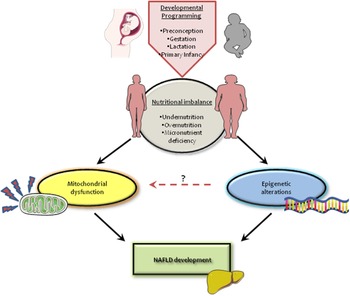
In summary, the reviewed data support the relevance of mitochondrial dysfunction and epigenetic modifications as contributors to the dysregulated mechanisms underlying the developmental programming of NAFLD. Rodent and non-human primate studies have shown that early-life exposure, including preconception, pregnancy, lactation and early infancy, to an adverse nutritional environment is linked to long-term alterations in mitochondrial function and epigenetics in the offspring (Fig. 1). Due to evident ethical limitations, human studies concerning this association are scarce. Given that dysfunctional mitochondria are strongly related to NAFLD development, mitochondrial epigenetics could also be involved in the regulation of NAFLD pathogenesis, in the context of early-life malnutrition. However, the association of mitochondrial epigenetics and NAFLD in this adverse context has yet to be elucidated.
Interplay between mitochondrial dysfunction, epigenetics and nutrition during early life, which is relevant to developmental programming of NAFLD. Different types of early nutritional imbalances, including undernutrition, overnutrition and micronutrient deficiency, have been related to long-term metabolic disorders. Accumulating evidence has demonstrated that disturbances in nutrition during the period of preconception, pregnancy and primary infancy can affect mitochondrial function and epigenetic mechanisms. In addition, in the past years, special attention has been given to mitochondrial dysfunction and epigenetic alterations as probable mechanisms underlying non-alcoholic fatty liver disease (NAFLD). Dysfunctional mitochondria contribute to oxidative stress, insulin resistance and inflammation. Epigenetic mechanisms have been related to alterations in genes involved in lipid metabolism, fibrogenesis, inflammation and tumorigenesis. Mitochondria are highly sensitive to environmental factors and could acquire epigenetic alterations that may disrupt mitochondrial function. Thus, mitochondrial dysfunction and epigenetics linked to early-life nutrition can be important contributing factors in the pathogenesis of NAFLD.

The increasing prevalence of NAFLD in the past years positions it as an emerging health concern. Therefore, clarification of the modulation of the epigenome and mitochondrial function related to nutritional disturbances during early life may contribute to the progress in this emerging field of research. Advances in the understanding of these dysregulated mechanisms in NAFLD are essential to design early interventions applied during the critical periods of human development intended to prevent this liver disease. More research in this field would aid the development of adequate treatment strategies, focused on mitochondrial function improvement and epigenome modulation, to prevent and/or treat NAFLD. Furthermore, this knowledge would be beneficial for the design of new diagnostic biomarkers..
Financial support
The present review received no specific grant from any funding agency, commercial or not-for-profit sector.
Conflict of interest
The authors have no conflicts of interest to declare.
Authorship
A.L. contributed to literature search, design, the writing of the manuscript, data interpretation and critical revision. C.A.C. contributed to literature search and revised the manuscript critically. S.C. contributed to literature search and the writing of the manuscript. A.N.C. contributed to the writing of the article and revised it critically. All authors approved the final version to be published.