1. Introduction
Old English versification is organized in its foundations by the principle of four metrical positions to the verse: A well-formed verse must be composed of four such smallest metrical units (Suzuki Reference Suzuki2014b). Given the minimal alignment of a metrical position with a single syllable, the verse must be quadrisyllabic at the least in its realization. There are, however, a small number of verses in the extant manuscripts of Old English poetry that count as too short to meet this minimum standard. In Beowulf (Fulk et al. Reference Fulk, Bjork and Niles2008), for example, one finds some 30 such instances, as listed in Suzuki Reference Suzuki1996a:45–46 (compare Bliss Reference Bliss1967:§§84–85). Among these apparently aberrant verses, I am specifically interested in those of the form Px…P, as provided in 1 below in the following section.Footnote 1 Although this configuration has long been dismissed as unmetrical in previous scholarship, Weiskott (Reference Weiskott2013) most recently made a far-fetched claim that it is a genuine verse, thereupon provoking Pascual's (Reference Pascual2013–Reference Pascual2014) decisive rebuttal formulated convincingly on philological and general methodological grounds, as reviewed in section 2.
At the same time, the verse Px…px ending in what might be analyzed as the resolved second lift can readily be scanned as a peripheral member of subtype A1s—realized prototypically as PSpx—that lacks a lexical stress on the second position (compare Sievers Reference Sievers1893:§§85.1, 85.8). Of central importance is the minimal form Pxpx with a single verse-internal unstressed syllable x: Unlike PxP, it can be legitimized as a four-position verse as it is (subtype A1s, largely corresponding to Sievers's type A2k; Suzuki Reference Suzuki1996a:81–91). The longer variants Px…px, by contrast, can be ambiguous, scannable either as subtype A1s with the short second lift or as type E with the resolved second lift. In any event, the configuration Px…px easily lends itself to scansion in accordance with the four-position principle without invoking postulation of the short verse / × /. Therefore, I concentrate for the time being on the form Px…P as the most straightforward candidate for a three-position verse (section 2). After having settled the scansion of the configuration Px…P, I offer a principled account of the less transparent case with greater insight and confidence (section 3).
In contrast to the extreme marginality in Beowulf, the configuration Px…P—along with less common varieties such as x…PP and PPx—occurs in conspicuously large numbers and is accordingly authenticated as a catalectic variant of Px…Px in Old Norse cognate meters fornyrðislag and ljóðaháttr (Suzuki Reference Suzuki2014a:185–201, 595–598); in fact, the form Px…P is the most representative of catalexis in Old Norse. The alleged attestation of analogous verses in Beowulf is accordingly of particular interest from a comparative Germanic perspective: One may reasonably ask if catalexis was emergent already in the earliest West Germanic meter, long before its firm establishment in North Germanic.Footnote 2 With a view to answering this question, then, this paper explores the structural basis of the verse Px…P and the mechanism of its derivation in the metrical system of Beowulf. In doing so, I offer a complementary argument against the postulation of the three-position verse in this Old English poem. The argument is structured in terms intrinsic to the overall metrical organization of Beowulf by carefully weighing competing scansions available to the meter (section 2).
Of further interest in this regard is Genesis A (Doane Reference Doane2013), which is notable for a relatively high incidence of three-position verses in general. With a corpus size largest next to Beowulf in Old English poetry, Genesis A provides a supplementary dataset for contextualizing use of catalexis in Old English meter. In an intuitive sense, Genesis A may broadly be situated between the above two opposites that are represented by Beowulf with a minimal frequency of catalexis on the one hand, and by the Norse meters with a high productivity on the other. Going beyond the particular configuration Px…P (as treated in section 2), I address the whole variety of short verses and rigorously compare the different ways in which catalexis is organized in the three metrical systems. This allows me to offer a principled account of the mechanism of composing three-position verses on precise terms specific to each meter and on a commensurate basis from a perspective of Old Germanic metrical typology (section 4; compare Suzuki Reference Suzuki2014b).
2. The Configuration Px…P
The following list provides all probable examples of the verse form Px…P (/ × /) in Beowulf:
-
(1)


Sievers Reference Sievers1893:134, note 10 (type E∗ / × \ × /); Pope Reference Pope1966:371 (type E∗ / × \ × /); Bliss Reference Bliss1967:77 (remainder); Russom Reference Russom1987:107–108 (type E); Kendall Reference Kendall1991:98–99 (type E); Hutcheson Reference Hutcheson1995:254 (type E); Suzuki Reference Suzuki1996a:165 (type E); Fulk et al. Reference Fulk, Bjork and Niles2008:129; Pascual Reference Pascual2013–Reference Pascual2014:52–56 (type E)
Sievers Reference Sievers1893:134, note 10 (type E∗ / × \ × /); Bliss Reference Bliss1967:77 (remainder); Pope Reference Pope1966:371 (type E∗ / × \ × /); Kendall Reference Kendall1991:98–99 (type E); Hutcheson Reference Hutcheson1995:254 (type E); Suzuki Reference Suzuki1996a:165 (type E); Pascual Reference Pascual2013–Reference Pascual2014:52–56 (type E)
type B1 by emendation; Pope Reference Pope1966:287; Russom Reference Russom1987:129; Hutcheson Reference Hutcheson1995:204; Suzuki Reference Suzuki1996a:443, note 10
Bliss Reference Bliss1967:76 (remainder/type E); Cable Reference Cable1974:61 (type E); Hutcheson Reference Hutcheson1995:156 (type E); Suzuki Reference Suzuki1996a:120 (type E); Hē hi(m) rǣhte ongēan ‘He reached out toward him’ (x#x#Px#xP; Fulk et al. Reference Fulk, Bjork and Niles2008; type B1 by emendation corresponding to the erased or damaged five letters between the preceding verse and rǣhte); him swā rǣhte ongēan ‘thus reached out toward him’ (x#x#Px#xP; Pope Reference Pope1966:372; type B1 by emendation); Russom Reference Russom1987:117; Fulk Reference Fulk1992:§209; Hutcheson Reference Hutcheson1995:156, note 3; Pascual Reference Pascual2013–Reference Pascual2014:62–63
[swā] gegnum fōr ‘[as]’ ([x]Px#P; Klaeber Reference Klaeber1950); type B1 by emendation; Pope Reference Pope1966:334; Russom Reference Russom1987:129; Hutcheson Reference Hutcheson1995:204; Suzuki Reference Suzuki1996a:46
Pope Reference Pope1966:320–321 (deficient); Bliss Reference Bliss1967:76 (remainder/type E); Cable Reference Cable1974:61 (type E); Fulk Reference Fulk1992:§209; Suzuki Reference Suzuki1996a:120 (type E); Fulk et al. Reference Fulk, Bjork and Niles2008:234 (defective); Weiskott Reference Weiskott2013:484–485 (prime case for a three-position verse; see below); Pascual Reference Pascual2013–Reference Pascual2014:64–65 (defective); liss ā gelong ‘joy always dependent on’ (P#P#xP) Russom Reference Russom1987:117–118 (type E)
These isolated occurrences of Px…P in Beowulf attracted due attention in previous scholarship (see the references in the above list, for example, Sievers Reference Sievers1893:§85.8, Bliss Reference Bliss1967:§84, Hutcheson Reference Hutcheson1995:156–158, Suzuki Reference Suzuki1996a:46–47, 120, Fulk et al. Reference Fulk, Bjork and Niles2008:332). Overall, there seems to be a general agreement reached in the literature that these verses are related to type E, however much they may arguably be deviated from its prototype. Most recently, however, Weiskott (Reference Weiskott2013) challenges the traditional view by claiming that the configuration Px…P constitutes an independent verse form, irreducible as it is to any extant verse type composed in accordance with the four-position canon. Oddly enough, he adduces no substantive argument against the commonly practiced scansion. All he manages to do for justification is to draw an alleged parallel between a five-position form, which is independently motivated, and a three-position verse form, which is controversial. Both of those forms, Weiskott (Reference Weiskott2013) claims, may be characterized as marginal alternatives to the four-position canon prescribed by the fundamental principle of versification mentioned at the outset of this paper (compare Pascual Reference Pascual2013–Reference Pascual2014:67–69). I return to this point below.
Before proceeding to an assessment of Weiskott's claim, it is necessary to comment briefly on additional possible examples of Px…P.
-
(2)
While Weiskott (Reference Weiskott2013:483, note 4) scans this verse as Px…P, a more plausible scansion, as commonly held by, for example, Pope Reference Pope1966:259, Bliss Reference Bliss1967:144, Suzuki Reference Suzuki1996a:65, Pascual Reference Pascual2013–Reference Pascual2014:60–61, would be type A2b (/ × / \), despite his contention to the contrary (see the following paragraph): The second lift is realized by þā, rather than niht as Weiskott assumes. A function word occasionally takes precedence over the following lexical word in metrical alignment with a lift, as testified by 197a, 790a, and 806a on þǣm dæge ‘on that day’.
Fully aware of such phenomena, Weiskott nevertheless contends that this occasional promotion involves only the first lift (as stated earlier by Hutcheson Reference Hutcheson1995:159, note 13), as implemented in the last three examples; accordingly, the promotion that is invoked for the scansion of 736a as type A2b looks unprecedented. While Weiskott's observation is credible, the apparent restriction of metrical promotion to the first lift may be regarded as a contingent consequence of the rarity of the configuration X…YZ. In this configuration, the concatenation of a function word Y (a candidate for the second lift by metrical promotion), and a lexical word Z (another candidate for the second lift on lexical grounds) is preceded by a lexical stress X, the carrier of the first lift.
Moreover, one must take issue with Weiskott's appeal to the avoidance of two successive monosyllabic words—in favor of a disyllabic word—at the end of type A. The last two positions of type A1 (/ × / ×) are filled by a disyllabic word (compare Suzuki Reference Pope2014a:32), to be sure, but type A2b, which verse 736a is an instance of, can be treated differently: The last position—the heavy drop—may occasionally be realized by an independent word (2509a hond ond heard sweord ‘hand and hard sword’, 2638a helmas ond heard sweord ‘helmets and hard swords’, 3105a bēagas ond brād gold ‘rings and broad gold’), in which case two monosyllabic words are concatenated one after the other, aligned with the second lift and the second drop, respectively.
All in all, the closest parallel to 736a—except for disyllabicity of the verse-final word—seems to be 2047a Meaht ðū, mīn wine ‘Can you, my friend’, a type A2b verse in which the final position is aligned with a disyllabic independent word through resolution. Of paramount interest is that the second lift is realized by a function word (mīn) in defiance of the following lexical one (wine), while the first lift is instantiated by a verb. Noteworthy is the phonological identity of wine, a short disyllable ending in pre-OE /i/, that is, the minimal disyllable that is most likely to be resolved according to Kaluza's Law (further on this, see Suzuki Reference Suzuki1996a:233–235). In this light, the verse in question should most plausibly be scanned as type A2b (compare Fulk Reference Fulk1992:§177), rather than type D∗2a (/ × / \ ×, as in 2018a bǣdde byre geonge ‘urged young men’).
Verses 673a and 1697a īrena cyst ‘choice of iron-swords’ (Pxx#P) constitute another group of verses that could be characterized as Px…P. In fact, they are amenable to two competing scansions with hardly distinguishable plausibility. On the one hand, they are scanned as Pxx#P, in strict conformity to the actual spelling of a single <n> that may be interpreted as a consequence of (incipient) degemination of the original /nn/; īrenn and īren would then be phonological variants of the same lexeme. On the other hand, they can no less plausibly be read as PXx#P, on the strength of 802b īrenna cyst, arguably with a geminate /nn/, which is opaquely represented by a graphically simplified form <n> (Pope Reference Pope1966:235, Bliss Reference Bliss1967:§66, Fulk et al. Reference Fulk, Bjork and Niles2008:157); īrenn and īren would accordingly be graphic variants of the same phonological form /īrenn/. The selection of one scansion over the other should entail notable consequences for the evaluation of the legitimation of the three-position verse / × /, particularly because of the small data available.Footnote 3 Accordingly, one needs to take into account implications of these two competing scansions in what follows.
The following instances, apparently comprising only three positions (Px#P, P#xP, PxS), can readily be restored to the four-position verses (type A1) by supplying an extra syllable in final position, the emendation that is fully motivated on semantic and grammatical grounds:
-
(3)
Having removed possible candidates for the scansion as / × /, let us return to the original list of the six verses in 1 and examine their authenticity. Of these six, verses 652a and 1404b are of enormous interest: The unstressed monosyllabicity involved in contrast to the polysyllabicity in the remaining examples defies any attempt to scan the two verses according to the four-position scheme. Without justification for emendation, then, these two minimal verses could be adduced as prima facie evidence for the postulation of / × / as a metrically legitimate configuration.
Of these two critical verses, however, 652a readily invites emendation by adding a prefix ge- in initial position: The emendation is supported by the exact parallel in 2516a. Also to be noted is the partial similarity between the paired b-verses involved, namely, 652b and 2516b, both beginning with the same lexeme guma. This insertion, then, makes the verse type B1. Given the bleached or very general meaning attached to ge-, one could still argue, with Weiskott (Reference Weiskott2013:483, note 4), that the verse as it stands in the manuscript makes perfect sense, both lexically and syntactically; therefore, the proposed expansion by ge- would be unnecessary. On the same ground, however, one may easily be led to suspect that this lack of semantic distinctiveness—perhaps along with the double occurrence of the same syllable-onset segment /g/ (Pascual Reference Pascual2013–Reference Pascual2014:64)—would have caused the scribe's inadvertent slippage of this verse-initial minimal material. In any event, the authenticity of the manuscript reading proves to be not as conclusive as Weiskott makes his readers believe.
In contrast, 1404b would appear to be more recalcitrant to a straightforward emendation. While the manuscript reading as it is makes perfect sense, the addition of a verse-initial word to rescan it as type B1 leaves a range of candidate words unsettled (compare Fulk et al. Reference Fulk, Bjork and Niles2008:49), for example, [þǣr] gegnum fōr ‘[where]’ (Fulk et al. Reference Fulk, Bjork and Niles2008), [swā] gegnum fōr ‘[as]’ (Klaeber Reference Klaeber1950).
The remaining four verses on the list, all having multiple unstressed syllables in medial position (183b, 186b, 747b, 2150a), can be scanned as type E, as is often practiced (see 1 above). The first two instances (P#x#x#x#P), virtually identical to each other, are comparable to 658a Hafa nū ond geheald ‘Have now and hold’, a marginal variant of type E verse with the heavy drop realized by a class 2 word (adverbs and finite verbs; see Russom Reference Russom1987:109). Inasmuch as the heavy drop is occupied by a word less pronounced than a class 1 word (substantives), these verses are provided with a smaller amount of prominence than normal type E examples.Footnote 4
Still more anomalous are 747b and 2150a (Px#xP), in which the heavy drop is exceptionally aligned with a word-final unstressed syllable -x#. While Bliss (Reference Bliss1967:§84) regards the last two verses (along with Px…px; see section 3 below) as “the simplest and most fundamental variety of type E,” one should better characterize them as the minimally prominent, atypical realization of the same type, as detailed below.
The exceptionality of the six verses under consideration is by no means disputable. Rather at issue are the differing ways in which they are conceptualized according to the particular metrical analyses. Specifically, Weiskott identifies them as substandard three-position compositions, whereas I characterize four of them as deviant realizations of a regular four-position type—type E variants with reduced prominence—and restore the remaining two as type B1 by emendation. The conceptual difference involved in turn entails significant consequences that lend themselves to empirical evaluation, which allows one to make an informed choice of one analysis over the other in holistic terms.
The most immediate consequence of the two competing scansions concerns the treatment of the minimal configuration PxP, which is presumably instantiated solely by verse 1404b, as argued above. This verse counts as perfectly metrical as it stands, according to Weiskott. By contrast, one needs to supply at least a single syllable (a monosyllabic word) at the beginning; otherwise, the verse would have to be left unaccounted for. As long as no emendation is required, Weiskott's scansion would appear simpler and less costly. In this respect, then, Weiskott's postulation of a three-position verse apparently commands higher credibility.
However, the postulation of the autonomous verse type with three positions should not be sanctioned on the basis of a single example alone, which may well be discarded as a pure contingency and rectified through a simple act of emendation. No less importantly, the metrical identity of the alleged substandard type must be explored specifically in relation to the canonical four-position ones. Labeling it as an “asystemic pattern” or a “historical residue” (Weiskott Reference Weiskott2013:483, referring to Yakovlev Reference Yakovlev2008) cannot replace a principled account. Only where such an explanatory account becomes available for empirical evaluation, can one engage in a substantive assessment of the proposal as compared with the competing scansions as type B1 or type E.
In the absence of a structurally sophisticated account, however, it may be worth exploring what would seem to be one viable line of theorizing on the alleged three-position verse. Given that the corresponding configuration Px…P is identified as a catalectic variant of type A1 in fornyrðislag, the Old Norse cognate closest to the meter of Beowulf, it would seem most appropriate to pursue a comparable conceptualization for the Old English meter at hand. In the Old Norse meter, catalexis is defined as a zero realization of the verse-final drop (Suzuki Reference Suzuki2014a:185–201). More technically, the drop at issue—which is no less real in underlying representation than the verse-final drop of type A1 (and some others) actualized in overt form—is aligned with null linguistic material on the surface.
Moreover, this Norse innovation of the zero realization is fully motivated on linguistic grounds: North Germanic was subject to extensive vowel weakening, particularly in word-final position, to the extent that was unmatched in West Germanic. This large-scale vowel loss, accordingly, would have suppressed the realization of the verse-final drop in a large number of verses, giving rise to the formation of catalectic variants. Since West Germanic was not affected by the change on a comparable scale, it would unlikely have introduced catalexis as an innovative metrical feature in the absence of other independent factors conceivably conducive to the novel convention. In parallel fashion, the nonfinal drops were also subject to reduction in size in the Old Norse meter, so that they were aligned with a smaller number of syllables than in the West Germanic cognates.
In this light, the zero realization of the verse-final drop may be characterized as a maximal reduction in size of a drop: While the verse-final drop—the least prominent one of all drops—is invariably occupied by a single syllable in Old English, it may occasionally be reduced to zero in Old Norse.Footnote 5 Catalexis is thus fully integrated into the overarching organization of metrical-linguistic alignment in the Old Norse meter.
The above inference is evidently confirmed in quantitative terms: While one counts 2,092 type A1 verses (without anacrusis) and 268 catalectic counterparts in fornyrðislag, the corresponding figures in Beowulf are 2,111 (without anacrusis) and at most 8 (including the two ambivalent verses, 673a and 1697a īrena cyst). As it turns out, the two meters differ significantly in their likelihood of exhibiting the configuration Px…P (p<0.001; by Fisher's exact test): It occurs in Beowulf with a significantly lower incidence than in the Norse meter.Footnote 6 It deserves emphasizing that only one of these eight examples—verse 1404b—is an unequivocal case of catalexis due to its irreducibility to a four-position verse (apart from emendation). In any event, the extreme scarcity in attestation forcefully argues against positing the configuration / × / as an independent verse type.
In this connection, it seems appropriate to substantiate statistically the singularity of the configuration Px…P in terms internal to Beowulf meter, notably with reference to some marginal but presumably metrical verses. Weiskott (Reference Weiskott2013:485) contends that Px…P (/ × /) occurs more frequently than type A∗, more precisely, the configurations PSxPx (/ \ × / ×) and PSxPS (/ \ × / \). According to my scansion, there are six instances of the expanded type in question: 308a geatolic ond goldfāh ‘splended and gold-ornamented’, 438a geolorand tō gūþe ‘yellow-shield to battle’, 608a gamolfeax ond gūðrōf ‘grey-haired and battle-brave’, 780a betlic ond bānfāg ‘excellent and bone-decorated’, 1649a egeslic for eorlum ‘terrible before noblemen’, 1698a wreoþenhilt ond wyrmfāh ‘with twisted hilt and with serpentine decoration’.Footnote 7
By contrast, there are 171 examples of the regular variant of type A2a (PSPx) and type A2b with the heavy first drop (PSPS). Assuming that there are at most eight instances of the configuration Px…P (/ × /) versus the 2,111 occurrences of Px…Px (/ × / ×; type A1) referred to above, one is confronted with a significant difference between the two distribution patterns (p<0.001), whereby the expanded type (/ \ × / × or / \ × / \) is more likely to occur. In other words, the exceptionality of Px…P significantly supersedes that of PSxPx/PSxPS, in contradiction to Weiskott's reasoning. Accordingly, the alleged authenticity of the expanded type cannot be adduced in support of the legitimacy of the three-position verse, which is vanishingly rare. Much the same argument would extend to the comparison with the strictest interpretation of Px…P, namely, PxP, in opposition to PxPx. As discussed above, while PxP is attested once as Px#P (1404b; see 1 above), there are 877 examples of Px#Px in the corpus. The ratio of 1 to 877 significantly differs from that of 6 to 171 (p<0.001): The likelihood of the occurrence of a three-position verse is significantly lower than that of PSxPx/PSxPS. The two pairs involved are thus anything but comparable. At any rate, resorting to the demonstrable five-position verse to justify the three-position counterpart proves to be unwarranted and inconclusive. The identification of the form / × / as a catalectic variety of type A1 is thus implausible in general conceptual terms.
Furthermore, this proposal can be dismissed on empirical grounds, as it makes false predictions. Under this view, the verse type / × / is distributed evenly in the a-verse (4 examples including 673a and 1697a) and the b-verse (4 examples). Lacking the verse-final drop regardless of its exact status in underlying metrical representation (present as in the Old Norse meter or totally eliminated), this configuration must indisputably be characterized as less prominent than the four-position canon. In this respect, this short verse may be regarded as analogous to type A3 (× × / ×, for example, 316a Mǣl is mē tō fēran ‘Time is for me to go’), in which the otherwise expected verse-initial lift is suppressed and substituted by a drop (on the derivation of this type, see Suzuki Reference Suzuki1996a:47–59). Equipped with only a single lift, type A3 should command a lesser amount of prominence than its full version, namely, type A1 (/ × / ×).
Of vital importance is the fact that this weakened type is limited to the a-verse in distribution: There is not a single instance of type A3 attested in the b-verse. In light of this categorical constraint, one would duly predict the alleged catalectic variant—another reduced derivative—of exactly the same basic type, type A1, to be treated in a comparable manner: It should, in all likelihood, be totally absent in the b-verse; that is, one would have 8 a-verses compared to 0 b-verses. As it turns out, the actually observed even distribution deviates from the expected pattern with a p-value of 0.077.Footnote 8 In other words, the attested pattern significantly differs from the predicted pattern with a confidence level of 90%. One may therefore conclude that the scansion as the catalectic variant of type A1 makes a claim that is substantially different from and statistically at variance with the actual state of affairs: Demonstrably wrong in empirical entailment, the resort to catalexis as an explanation has accordingly been disconfirmed.
On the assumption that catalexis is involved, the above assessment demonstrates that the form in question is unlikely to be situated in the metrical system as its integral constituent. The so-called catalectic verse—if such a metrical category were valid for Beowulf at all—would be far from integrated with the system: In contrast to the Old Norse meter, its occurrence is vanishingly rare; hence, it remains isolated, not encoded with any structural value in the meter, such as covariations with verse distribution and alliterative pattern.
In the absence of an alternative conceptualization of the form / × / as a legitimate verse type in the current literature, one might be led to treat the isolated group of verses simply as exceptions or outliers, rather than to authenticate the three-position verse as metrical.Footnote 9 Acknowledged as gross exceptions to the overarching metrical organization predicated on the four-position principle, then, the eight verses at issue might as well be allowed to stand as they are without further concerns about their distribution and other properties, which ought to be matters of contingency beyond explanation.
However, treating the group of verses in question as exceptional—hardly anyone would object to this characterization—should by no means keep one from addressing the mechanism of their derivation and their attendant peculiarities in more rigorous terms, when such an illuminating perspective is available, as shown in the following discussion. Specifically, confronted with the exceptional status of the short verses under consideration, one should better explore an alternative account, which sticks with the four-position canon without postulating a distinct verse type with three positions. In fact, one can readily elaborate and build on the traditional insight for this line of theorizing.
As mentioned earlier in this section, the six verses in list 1 are all scanned as conforming to the four-position principle. Verses 652a and 1404b (the latter with an admittedly lesser certitude) are type B1. The other four are regarded as type E with reduced prominence due to an exceptional alignment of the heavy drop with a syllable weaker than normally involved, specifically, either with a class 2 word (183b and 186b) or with an unstressed word-final syllable (747b and 2150a). Possibly to be added to the list are verses 673a and 1697a, also touched on above.
This widely accepted identification as type E would be supported by the distribution pattern: It is found fully compatible with the observed distribution, 1 a-verse (or 3 a-verses when 673a and 1697a are counted together) versus 3 b-verses. In Beowulf, type E—excluding the critical four examples—occurs 134 times in the a-verse and 277 times in the b-verse, with a marked preference for the b-verse. As it turns out, the two distribution patterns do not differ significantly, with a p-value of 1 (673a and 1697a excluded) or 0.396 (673a and 1697a included). Either way, the scansion of the four (or six) verses as type E leads to no significant difference from the distribution pattern of this type in general. Moreover, even a finer comparison brings about a similar result. At issue is the relatively less prominent, marginal variant PXx#P (for example, 1581b slǣpende frǣt ‘devoured sleeping (men)’, in which the heavy drop is occupied by a medial long syllable lacking a lexical stress -X-). One finds 39 such examples in the corpus.Footnote 10 As with type E in general, the distributions involved do not differ significantly, p=1 (673a and 1697a excluded) and p=0.507 (673a and 1697a included). In this way, the proposed identification as type E commands greater plausibility than the competing one as three-position verses, which is incapable of providing a principled account of their actual distribution.Footnote 11
Overall, the apparently three-position verses of the form Px…P should be scanned as exceptional realizations of type E through a marked, downgraded alignment of the heavy drop with a syllable lacking a lexical stress, -x# or #x#. In the latter case, the position at issue is filled by a word without a lexical stress characteristic of a class 1 word (#x# rather than #P#), analogous to the substitution of -S-/-s-/-S# by -x-/-x# elaborated below. Rather than treating them in isolation, one may characterize these reductions in linguistic realization of the heavy drop as part of the more general, scalar organization of the position in terms of metrical-linguistic alignment: The prototype of the heavy drop -S- (medial, secondary-stressed, long syllable, for example, 564b sǣgrunde nēah ‘on the sea-ground’; 237 occurrences) may be weakened at least to -S# (word-final, secondary-stressed syllable, for example, 1494b brimwylm onfēng ‘sea-welling received’; 44 occurrences) or -s- (medial, secondary-stressed, short syllable, for example, 623b bēaghroden cwēn ‘ring-adorned queen’; 6 occurrences); it can be further weakened to -X- (medial, lexically unstressed, long syllable, for example, 3028b secggende wæs ‘was saying’; 67 occurrences), still more radically to -x- (medial, lexically unstressed, short syllable; 673a and 1697a; see above; 2 occurrences) or -X# (word-final, unstressed, long syllable, including the second constituent of a proper name, for example, 874b wēlhwylc gecwæð ‘said everything’; 1024b Bēowulf geþāh ‘Beowulf received’; 7 occurrences), and ultimately to -x# (word-final, unstressed, short syllable; 747b and 2150a; see 1 above; 2 occurrences).
The scalar value of syllable prominence is determined by the clustering of the following parameters: word-finality, lexical stress, and syllable length. Specifically, word-final syllables, lexically unstressed syllables, and short syllables count as less prominent than non-word-final ones, lexically stressed ones, and long ones, respectively. Since the word-final, lexically unstressed short syllable (-x#) is computed as the least prominent based on these parameters, it is identified as the farthest removed from the prototype -S-, the non-word-final, lexically stressed, long syllable. Because of the maximal distance from the prototype, the alignment of the heavy drop with this weakest entity is least likely to be implemented. Accordingly, one finds only two such instantiations in the corpus (747b and 2150a).
Note further that in both verses the normal drop—the third position—is occupied by a prefix (on-, ge-), rather than an independent word like þe. Put another way, the configuration Px#x#P is totally unattested. This should hardly be surprising, however, when one recalls that prefixes constitute prototypical realizations of anacrusis in Beowulf. Given that anacrusis does not count as an autonomous metrical position in this poem (Suzuki Reference Suzuki1996a:315–340), its prototypical embodiments—prefixes—may be characterized as being of minimal substance. Since the exceptionally reduced realization of type E has the heavy drop aligned with the weakest material available for this purpose (-x#), the metrically less salient, following position—the normal drop—must be kept to a minimum in linguistic realization. Therefore, there should be no choice but to have it occupied by a prefix.
Taken on its own, the absence of the configuration Px#x#P may appear to be a pure contingency in view of the small number of Px#xP in the corpus. There is, however, a cogent reason to infer from the data that the absence of Px#x#P is systematically motivated. At stake is the complete absence of the configuration PS#x#P compared to 44 occurrences of PS#xP (for example, 633a sǣbāt gesæt ‘sat down in the sea-boat’). In parallel fashion, where the heavy drop is realized by a word-final long syllable without a lexical stress (-X#, including the second element of compound proper names), the following drop is aligned with a prefix (compare Cable Reference Cable1974:61), with a single exception out of the total seven (1127b Hengest ðā gy¯t ‘Hengest then still’; PX#x#P; compare Pope Reference Pope1966:368, Cable Reference Cable1974:61, Fulk Reference Fulk1992:§210, Hutcheson Reference Hutcheson1995:157).Footnote 12 Since no statistically significant difference is ascertained between the ratio of 44 PS#xP to 0 PS#x#P and that of 6 PX#xP and 1 PX#x#P (p=0.137), one may generalize that the third position is restricted to a prefix for linguistic alignment. In light of this almost categorical constraint against #x#, the occurrence of Px#xP as opposed to the absence of Px#x#P may analogously be explained as a necessary consequence of the metrical constraint at issue, rather than an accident due to the small data size. It is worth pointing out that the remaining two logically possible distribution patterns—1 Px#xP and 1 Px#x#P on the one hand, and 0 Px#xP and 2 Px#x#P on the other—would differ significantly from the cases in which the heavy drop is filled by -S# or -X#: p=0.075 for the former pair and p=0.002 for the latter. Accordingly, the absence of Px#x#P compared to the existing two instances of Px#xP may be ascribed to the general prohibition against mapping the third position of type E to an independent word #x#. It should be noted further that the functional motivation for this avoidance would have been stronger where the preceding heavy drop is exceptionally aligned with the least prominent material -x#. Thus, one may infer that the configuration Px#x#P would more likely have been dispreferred than PX#x#P.
3. The Configuration Px…px
The scansion of the configuration Px…P established above puts the identification of the related sequence Px…px in perspective and leads one to a credible account. Five verses of the form Px…px are found in the corpus, as follows:Footnote 13
-
(4)
Pope Reference Pope1966:272 (subtype A1s); Bliss Reference Bliss1967:76 (type E); Fulk Reference Fulk1992:§§209–210; Hutcheson Reference Hutcheson1995:82, note 52 (type E); Suzuki Reference Suzuki1996a:120 (type E); Russom Reference Russom1998:107 (subtype A1s); Pascual Reference Pascual2013–Reference Pascual2014:56–58 (subtype A1s)
Pope Reference Pope1966:272 (subtype A1s); Bliss Reference Bliss1967:76 (type E); Russom Reference Russom1987:116–117, Reference Russom1998:107 (subtype A1s); Fulk Reference Fulk1992:§210; Hutcheson Reference Hutcheson1995:69, note 5, 84, note 59; Suzuki Reference Suzuki1996a:407, note 31 (ēam his nefan P#x#px; subtype A1s); Pascual Reference Pascual2013–Reference Pascual2014:59 (type E)
Pope Reference Pope1966:272 (subtype A1s); Bliss Reference Bliss1967:76 (type E); Russom Reference Russom1987:117, Reference Russom1998:107 (subtype A1s); Fulk Reference Fulk1992:§§209–210; Hutcheson Reference Hutcheson1995:157, 158, note 8 (type E); Suzuki Reference Suzuki1996a:120 (type E); Pascual Reference Pascual2013–Reference Pascual2014:56–58 (subtype A1s)
Pope Reference Pope1966:333; Hutcheson Reference Hutcheson1995:69, note 5; Suzuki Reference Suzuki1996a:83; Russom Reference Russom1998:107
Pope Reference Pope1966:333; Russom Reference Russom1987:46, 51–52, Reference Russom1998:107; Hutcheson Reference Hutcheson1995:69, note 5; Suzuki Reference Suzuki1996a:408, note 38; Pascual Reference Pascual2013–Reference Pascual2014:56–58
The above verses are divided into two groups, depending on the number of unstressed syllables standing between the stressed ones, Pxpx on the one hand (881a, 1828b, 2430b) and Px…px on the other (845a, 954a). While verse 881a is usually scanned as PS#x#px by restoring the apparently monosyllabic form ēam ‘uncle’ in the manuscript to an earlier uncontracted disyllabic one êeam or ēa[h]am (<PGmc. + awa-haim; Holthausen Reference Holthausen1974:84), such a textual alteration would be dispensable: As it is, the verse is identified as a variant of subtype A1s, a marginal one to be sure. More importantly, the configuration resulting from the decontraction, namely, PS#x#px/PX#x#px (or PS#x#P/PX#x#P repre-sented in a more general form, with the third position aligned with an independent word #x#, as opposed to a prefix #x-), is virtually absent in the corpus, in contrast to PS#xpx numerously attested, as pointed out in the preceding section. Therefore, verse 881a may well be assigned to the first group (Pxpx).
Given the virtual absence of the configuration PxP as demonstrated in the preceding section, the sequence Pxpx categorically defies scansion as / × /; rather, it is identified as subtype A1s, the only verse type independently available.Footnote 14 Upon this scansion, one might object that subtype A1s is defined by the presence of a lexical stress on the second position (the first drop), which is lacking in the instances at issue: hwīlum (1828b) and Hrēðel (2430b) are Px, rather than PS; and his (881a) is a function word #x#, rather than #P#, prototypically a substantive. In the absence of a lexical stress, the three verses are obviously derived through a marked mode of metrical-linguistic alignment. In this connection, one may refer to the minor group of subtype A1s verses in which the second position is occupied by a long syllable demonstrably lacking a lexical stress, such as 2457b rīdend swefað ‘riders sleep’ (PX#px).Footnote 15 On the one hand, with the still lower prominence on short syllables, verses 1828b and 2430b are characterized as further removed from the prototype PS#px than is the configuration PX#px. On the other hand, verse 881a constitutes another variation in the alignment of the first drop, that is, the one with a function word (#x#) rather than a word constituent (-X#).
The two verses of the second group (Px…px) are apparently ambivalent in categorization: They may be scanned as subtype A1s (for example, Pope Reference Pope1966; Russom Reference Russom1987, Reference Russom1998; Pascual Reference Pascual2013–Reference Pascual2014; see 4 above) or type E (Bliss Reference Bliss1967, Hutcheson Reference Hutcheson1995, Suzuki Reference Suzuki1996a; see 4 above).Footnote 16 The choice between the two possibilities rests on whether these two verses are considered more similar to Pxpx (subtype A1s; 881a, 1828b, 2430b) or to Px…P (type E; notably, 747b and 2150a; see 1 above). Specifically at issue is the relative plausibility, or structural cost, of the two competing operations that may be invoked to derive the target configuration Px…px from the respective sources: the expansion of x (subtype A1s) or the resolution of P (type E).
On closer consideration, the two metrical operations involved—the expansion of x and the resolution of P—turn out to be far from identical in terms of metrical organization, despite their derivational equivalence on the surface. On the one hand, the resolvability of the second lift in type E is independently motivated as witnessed in 142a healðegnes hete ‘hall-thane's hatred’ (PSx#px), for example. On the other hand, the expandability of the first drop in subtype A1s is by no means self-evident. Indeed, the corresponding position in type A1 may freely be realized by a string of unstressed syllables (Px…Px; for example, 1627b þēodnes gefēgon ‘they rejoiced at the prince’). However, the same does not hold for the marked variant in question—that is, A1s—in strict structural terms. The prototype of subtype A1s is demonstrably PS#px (for example, 838b gūðrinc monig ‘many a warrior’; Suzuki Reference Suzuki1996a:81–89), whereas the prototype of type A1 is Px#Px (Suzuki Reference Suzuki1996a:149–158), as most obviously testified by their overwhelming prevalence in occurrence over other variants. Accordingly, the structural relation between Px#Px and Px…Px proves to be anything but isomorphic to what would obtain between PS#px and Px…px: The latter is not predicated on the expansion of the basic -x# that underlies the former. Thus, driven by a different kind of analogical expansion, the availability of the configuration Px…px is not independently supported by the derivation of Px…Px from Px#Px. Thus, the configuration Px…px can be viewed as a straightforward consequence of the resolution of the final lift of Px…P (type E). However, this same configuration cannot be derived in a comparably straightforward way from the prototype of subtype A1s (PSpx).Footnote 17
To conclude, there are structural grounds for claiming that the configuration Px…px should be identified as type E with the resolved second lift, rather than subtype A1s with the polysyllabic first drop. This apparent ambivalence thus lends itself to a categorical scansion in a principled way.
4. Three-Position Verses in Genesis A, Beowulf, and Fornyrðislag
In section 2 above, I demonstrated that the catalectic verse / × / does not count as a significant type in the metrical system of Beowulf. The single instance of the configuration PxP, which would defy scansion otherwise (unless emended), should be characterized as a pure contingency; and the longer sequences Px…P should be scanned as peripheral variants of type E, whereby the first drop is marginally but systematically aligned with a syllable lacking a lexical stress.
Genesis A is notable for its rich array of metrical idiosyncrasies (for example, Schröder Reference Schröder1899:380, Fulk Reference Fulk1992:88–89). Among these exceptional features is the relatively large number of short verses that consist of only three metrical positions. The purpose of this section, then, is to examine such three-position verses in Genesis A in comparison with Beowulf and to explore their status in the metrical organization of this poem. In doing so, I address the whole body of minimal configurations with a single unstressed syllable, rather than focus on the single concatenation / × / with the drop occupied by a varying number of syllables as investigated in section 2. This exclusion of unstressed sequences, disyllabic or longer, may be justified by their immediate susceptibility to alternative scansions as two drops, as discussed above. By treating multiple configurations with a monosyllabic drop (PxP, PPx, PSP, etc.) rather than a single configuration Px…P with a varying number of x, and by taking into account not only Genesis A and Beowulf but also fornyrðislag, I am able to bring to light the specifics of catalexis as a whole in the individual meters in broad comparative terms.
There are 20 short verses in Genesis A that should most plausibly be read as they are found in the manuscript (compare Doane Reference Doane2013:477–479)—they are all alliterative and readily interpretable without emendation—and must accordingly be scanned as comprising only three metrical positions. In fact, I have no well-motivated means at my disposal—decontraction, vocalization, or otherwise—of accommodating these 20 verses to the four-position canon, in contrast to those apparently short verses that are readily restored to fully metrical, four-position ones by such means.Footnote 18 A list of three-position verses according to the manuscript reading is provided in 5.
-
(5)
A vast majority of the above short verses are adopted in Doane's (Reference Doane2013) second edition in accordance with the manuscript reading, with the exception of verses 907a, 1308b, 2058b, and 2629a. Of these four verses, the last three were left to stand in Doane's (Reference Doane1978) earlier edition as in the manuscript. While improving semantically to some extent, the addition of extra words in these three verses in the new edition does not seem to be indispensable. By the same token, verse 907a, which consistently receives emendation in both editions (Doane Reference Doane1978, Reference Doane2013), reads perfectly as it is: Bearm may reasonably be interpreted as an appositive not to brēostum ‘breast’ in the preceding verse (resulting in bearm[e]; Doane Reference Doane2013:308), but to eorðan ‘earth.acc.sg’ in the succeeding verse.Footnote 20
In regard to the configuration x…PP, Fulk (Reference Fulk1992:181, note 21) suggests reading seofon niht ‘seven nights’ in 1349a (and also 1449a) as a compound seofonniht; the two verses would accordingly be scanned as type A3 (xxxpxS). This interpretation, however, would have to categorize 2322a as type A3 with the monosyllabic drop (xpxS), a three-position verse, as Fulk himself notes (see also Doane Reference Doane2013:331). Yet such a minimal variant of type A3 would be found independently instantiated by 2235a (and possibly by 2142b, too; see 5 above). In any event, one cannot escape the postulation of a three-position verse, whether seofon niht is read as a noun phrase (which would result in x…PP) or as a compound (which would result in xPS). One is then left with 2600a, which may compel one to accept the configuration x…PP unless dydon is read as dēdon or dǣdon, as Fulk (Reference Fulk1992:185, note 29) speculates. Inasmuch as one adheres to the manuscript reading with a minimal textual intervention, however, one may well adopt the scansion x…PP for the four verses in question, as given in the above list in 5.
In comparison, one finds at most seven instances in Beowulf which, alliterating and made intelligible one way or another as they are recorded in the manuscript, could arguably be scanned as comprising three metrical positions. A list of three-position verses in Beowulf according to the manuscript reading is given in 6.
-
(6)
While all of the above verses receive emendation one way or another in the extant editions and are thus made to fit the four-position canon, they may be treated as genuine three-position verses just for the sake of discussion in the present context: The inclusion here of not only probable but also remotely possible cases of three-position verses in Beowulf is intended to ensure that this poem is not being treated too stringently for identification of three-position verses, compared with Genesis A. Even when allowing in such a liberal way for the maximally possible range of three-position verses in Beowulf in disregard of presumable textual corruptions involved, one must acknowledge that the poem stands far behind Genesis A in licensing short verses. Specifically, Genesis A contains 20 short verses and 4,150 others (excluding hypermetric verses, defective ones, and those containing biblical names), whereas Beowulf contains seven corresponding verses and 6,312 others (excluding hypermetric verses and defective examples). Comparing these ratios, one obtains a p-value of 0.001. Hence, it may be concluded that three-position verses are more likely to occur in Genesis A than in Beowulf with a statistical significance.
Genesis A's greater tolerance of three-position verses is indicated not only by the significantly larger quantity of attested examples, but by their broader variety as well. While Beowulf attests types A1-, D1-, and D2a-, as in 6, Genesis A realizes types A2a- and C- as well, with a further latitude of allowing for type A3 with the monosyllabic first drop, as in 5 (2235a).
Coupled with the larger presence of catalectic verses in Genesis A than in Beowulf is what would seem to be a higher degree of integrity with the system of metrical organization. Specifically, the number of type A1- occurring in the a-verse and the b-verse does not differ from that of type A3 in Genesis A. Since both configurations constitute reduced variants of type A1 in comparable fashion, their convergent distribution in Genesis A (in contrast to their divergence in Beowulf; section 2) might be regarded as a confirmation of the greater integrity and systematicity of catalexis in this poem. However, given that the occurrence of type A3 in the b-verse in Genesis A is in all likelihood due to the diminished force of the traditional constraint on verse distribution, it would seem implausible that the alleged distributional parallelism results from a deliberate reorganization; on the contrary, it should be viewed as a mechanical consequence of the relaxation of the distributional constraint in question.
Of greater concern still is the different extent to which these various types of verses tolerate catalexis. To determine this, I focus on the three major sources for catalexis in Genesis A: types A1 (with the monosyllabic first drop), C (with the primary-stressed second lift), and D1 (with both drops lacking a lexical stress). The relative likelihood of catalexis can be established by examining the ratio of basic to catalectic configurations for the three pairs as follows: 1,051 PxPx to 3 PxP; 353 x…PPx to 4 x…PP; 130 PPxx to 8 PPx. Performing Fisher's exact test results in the following p-values: p=0.073 between types A1/A1- and C/C-; p<0.001 between types A1/A1- and D1/D1-; p=0.005 between types C/C- and D1/D1-. Accordingly, one may be warranted to posit the following scale in order of decreasing likelihood for composition of catalectic verses: D1 > C > A1, although the relative ranking between types C and A1 is less than definite.
Of related interest in this connection is that Beowulf evinces a similar pattern: Catalexis is more likely to occur in type D1 (4 catalectic and 234 full) than in type A1 (1 catalectic and 1,192 full; p=0.003) or in type C (0 catalectic and 527 full; p=0.009). By contrast, types A1 and C are indistinguishable (p=1). In light of such a recurrent predominance of type D1, one may reasonably explore why this type, despite its low overall occurrence, is treated as most amenable to catalexis.
As shown in lists 5 and 6, only the verse-final drop is removed, except for the single instance of type A3 with the monosyllabic initial upbeat. Given this, its minimal prominence—compared with the drops appearing elsewhere—can be treated as fundamentally responsible for catalexis. According to the linearity-based scale of metrical positions (Suzuki Reference Suzuki1996a:167, Reference Suzuki2004:10, Reference Suzuki2014a:11), the drop occurring at the end of a verse counts as the weakest in prominence on syntagmatic grounds: the closer to the end, the smaller in size and hence the less prominent. This metrical minimality should be most conducive to ultimate reduction, that is, complete loss. Added to this general fundamental condition inherent in the traditional metrical organization are the differing configurations that precede the affected position, which may determine differentially the likelihood of catalexis.
Crucially, the succession of lifts or the lift clashing may induce weakening of prominence of the following drops, as substantiated below. This syntagmatically motivated prominence reduction, which may be characterized as metrical downstep (see Cable Reference Cable1991:150, Suzuki Reference Suzuki2014b:28), is manifested most conspicuously in the second of the consecutive lifts. The second lift in question is overshadowed by the first (see Sievers Reference Sievers1893:195–196; Tolkien Reference Tolkien, Clark Hall and Wrenn1950:xxx, note 2; Cable Reference Cable1974:71–73; Suzuki Reference Suzuki1996a:187–189, Reference Suzuki2014b:28), as evidenced by its frequent alignment with a short syllable following the long first lift in type C (x…Ppx rather than x…PPx).
In analogous fashion, the drops that follow the successive lifts may in turn undergo reduction. This is most clearly seen through comparison of size of the penultimate drop in the two minimally distinct configurations, × / × / (type B1) and / / × \ (type D2b). The two sequences are distinguished on the basis of the occurrence versus nonoccurrence of two consecutive lifts in the preceding location, with the verse-final position occupied by a stressed syllable—the second lift (type B1) or the heavy drop (type D2b). While the second drop of type B1 is often realized by more than one syllable (for example, Beowulf 272b þū wāst, gif hit is ‘you know, if it is’), the first drop of type D2b never receives such a polysyllabic alignment. Specifically, one finds the monosyllabic and polysyllabic realizations of the two types in question, as follows: for type B1, 598 monosyllabic and 108 polysyllabic in Genesis A, and 772 monosyllabic and 183 polysyllabic in Beowulf; for type D2b, 11 monosyllabic and 0 polysyllabic in Genesis A, and 33 monosyllabic and 0 polysyllabic in Beowulf (excluding the variants x…PxS and PPxS, in which the penultimate position is invariably monosyllabic due to word structure). While the distributions of the monosyllabic and polysyllabic realizations of the two types do not differ significantly in Genesis A, owing probably to the extreme scarcity of type D2b (p=0.386), their distributions differ significantly in Beowulf (p=0.002). One may, therefore, be justified in claiming that the drop located in penultimate position is reduced in realization when it is immediately preceded by the two clashing lifts.
With respect to the verse-final drop, at stake are the following two minimally distinct configurations, / × / × (type A1) and × / / × (type C). That is, the two configurations differ in the successive occurrence versus nonoccurrence of two lifts immediately before the final drop. Since the linguistic realization of the verse-final drop is limited to a single syllable, it is impossible to determine the relative size of the position in terms of differing numbers of syllables. Yet the comparison between the two positions is feasible by examining varying prominence of the monosyllables that can occupy them. The verse-final drop that is preceded by the sequence / × / may be aligned with a lexically stressed syllable, typically the second constituent of a compound, as in Genesis A 226a gold and gymcynn ‘gold and gems’. This means that the verse-final weak position in question is involved in a two-way distinction—the normal and the heavy drop—which provides a structural basis for the opposition between types A1 (/ × / ×) and A2b (/ × / \).
By contrast, the corresponding position in type C is strictly limited to the syllable without a lexical stress, with the sole exception of Beowulf 2309b Wæs se fruma egeslic ‘The beginning was terrible’ (Suzuki Reference Suzuki1996a:95).Footnote 21 In other words, the heavy configuration comparable to type A2b, namely, × / / \, is not legitimized as an acceptable verse form, not only as an autonomous type on its own, but also as a heavy variant of type C. This prohibition against the heavy form, then, may be adduced as evidence for the generalization that the verse-final drop preceded by the clashing lifts is of minimal prominence, which excludes alignment with relatively salient linguistic material, that is, a lexically stressed syllable; compounds PS are disallowed as the occupants of the last two positions immediately after P.
The foregoing examination thus substantiates the claim that the consecutive lifts bring about a prominence reduction to the following drop to such an extent that it is realized in significantly weaker form than elsewhere. With this generalization in mind, let us turn to the final drop of type D1 in comparison with that of type C. The difference between the two configurations is the intervention of another drop between the consecutive lifts and the final drop. Given the generalization at issue, this intervening drop is subject to reduction due to the preceding clashing lifts. Inasmuch as the second drop (the verse-final one) is determined as less prominent than the first one (according to the syntagmatic scale of prominence referred to above), it must undergo still further reduction so that it is properly perceivable as less salient than the immediately preceding, reduced one. The whole process may well be characterized as cumulative effects of successive metrical downstep. Overall, then, the final drop of type D1 is reduced to a greater degree than the corresponding one of type C.
This greatest degree of reduction in prominence of the final drop may accordingly provide a credible account of why type D1 is most vulnerable to catalexis: This is exactly the type of configuration whose final drop is subject to maximal reduction on syntagmatic grounds. This may ultimately lead to its complete removal at times, even in defiance of the four-position principle, when the poet falls short of full control of composition. In view of the demonstrable correlation thus uncovered between maximal reduction and maximal incidence of catalexis, the likelihood of catalexis may be generalized in gradient terms based on the syntagmatically motivated reduction of prominence of the verse-final drop: The lower its prominence, the likelier the composition of catalectic verses. Depending on the relative stringency of the four-position principle and/or the poet's adherence to the principle, and by no means organized on its own structural terms in the system, catalexis is nothing but a mechanical consequence of the maximal reduction in prominence the verse-final drop is susceptible to.
Beowulf's lesser tolerance of three-position verses immediately derives from its stricter adherence to the four-position principle. As amply substantiated, Beowulf evinces a demonstrably stronger resistance to deviations from the principle: Anacrusis is largely restricted to the least salient material, that is, prefixes (Suzuki Reference Suzuki1996a:315–322); the composition of five-position verses, types D∗1 (/ × / × ×), D∗2a (/ × / \ ×), and D∗2b (/ × / × \), is tightly controlled (Suzuki Reference Suzuki1996a:24–35); and type A3 never starts with a monosyllabic upbeat (Suzuki Reference Suzuki2014a:61–63), in contrast to Genesis A, as shown above. In this light, it should be no wonder that short verses, too, are more strongly deterred in Beowulf.
Nonetheless, the two Old English poems both fail to organize catalexis as a structural device: Since catalexis is not being used systematically, it remains extraneous to the metrical organization. In this respect, catalexis in Beowulf and Genesis A fundamentally differs from that in fornyrðislag, in which this marked mode of composition is organized as an integral part of the system of existing verse types, types A1, C, and D in particular. Specifically, not only the three major catalectic verses under consideration here, but also other minor ones such as the configurations PSP and PPS are incorporated as catalectic variants of the normal four-position counterparts. As a result, the verse-final drop is only apparently missing due to its alignment with zero linguistic material (Suzuki Reference Suzuki2014a:185–201): Every verse type ending in a drop may thus be realized in shortened form through suppression of the final position on the surface. The diminished prominence due to zero realization is organized on the basis of the marked association with the a-verse and single alliteration, that is, the independently motivated clustering of metrical properties. Furthermore, the reduced prominence in question is largely compensated for by a strengthening of the remaining positions (the first drop or lift), so that the resultant short verses may not become intolerably reduced at variance with the four-position principle. In this way, catalexis is tightly organized in fornyrðislag through a network of interdependent structural relations.
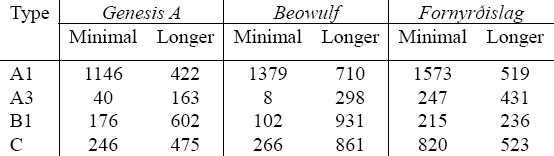
One is accordingly confronted with the fundamental difference between the two classes of meters—Genesis A (and Beowulf) on the one hand and fornyrðislag on the other—in the systematicity of catalexis: While catalectic verses are contingent outliers in Genesis A, they are fully organized as legitimate variants in the system of verse types in fornyrðislag. What determines this crucial difference lies ultimately in the interaction of the underlying linguistic motivation and the metrical underpinnings. Induced by the extensive loss of unstressed syllables in Old Norse and the concomitant large-scale reduction of the drop's linguistic realization (as argued in section 2 above), catalexis in fornyrðislag constitutes zero realization of the verse-final drop that is strictly regulated by the four-position principle (Suzuki Reference Suzuki2014a:185–201). By contrast, Genesis A does not share the linguistic motivation and the rigorous canonicity of the metrical principle, while the drop is reduced in its realization to a moderate extent: indeed, the size of the first drop of type A1 does not differ between Genesis A and fornyrðislag (p=0.157), both of which are in turn distinguished from Beowulf by the reduced size (p<0.001); in regard to the corresponding positions of types A3, B1, and C, however, Genesis A is significantly larger than fornyrðislag (p<0.001), although it is still kept shorter than Beowulf in these types as well (p<0.001). The size of each drop is determined in relative and statistical terms by performing Fisher's test on the distribution of its minimal—i.e., monosyllabic for types B1 and C, and disyllabic for type A3—versus longer realizations in the respective three meters, as represented in the following table (compare Suzuki Reference Suzuki2014a):
Occurrences of minimal and longer realizations of the first drop.

The rarity of catalexis in Genesis A may thus be ascribed to the lack of overall linguistic motivation for it and the metrical regularization mechanism: Catalexis may accidentally arise as a consequence of the failure to control, in conformity with the four-position principle, the syntagmatically induced reduction of prominence that the verse-final drop undergoes when preceded by the two consecutive lifts. The very general linguistic cause and the metrical condition that consistently holds (that is, the four-position principle) may thus be held responsible for the high productivity and rule-governed nature of catalectic verse formation in fornyrðislag. By contrast, the absence of general causation and overarching regularization may account for the contingency and sporadic nature of the three-position verses in Genesis A. Moreover, the lesser stringency of the four-position principle accounts for their significantly higher incidence in Genesis A than in Beowulf.
5. Conclusion
Three-position verses are not accepted as authentic expressions in the meters of Beowulf and Genesis A; occurring in isolation and unorganized on the structural level, the exceptional instances might be regarded simply as haphazard deviations from the canonical principle of four metrical positions per verse. These outliers, however, are far from random accidents; on the contrary, they are partially motivated, and their occurrences are conditioned on a gradient basis by their configurational properties. Two major factors are interactively involved. First, only the verse-final drop is susceptible to loss. This is a consequence of its inherent minimal prominence determined on syntagmatic grounds: The closer it is to the end of a verse, the less prominent it is.
Second, the successive occurrence of lifts or the clashing of lifts in the preceding location induces downgrading effects on whatever positions follow the initial lift: They are subject to reduction in prominence in terms of linguistic realization. Acting in conjunction, these factors converge to single out the verse-final drop of type D1 as most vulnerable to removal. The two Old English meters (or poets), however, react differently to this disruptive mechanism: Beowulf avoids it more consistently and successfully than Genesis A. This varied treatment of catalexis stems from the two meters’ differing conformity to the four-position principle: Beowulf adheres to it most strictly, whereas Genesis A is more liberal in departure from it, as independently testified by their distinct metrical operations in regard to the composition principle in question.
Overall, however, the difference between the two Old English meters is simply a matter of degree, determined as it is by the varying extent of faithfulness to which they comply with the principle of four metrical positions. In this respect, the Old English meters are fundamentally distinguished from their Old Norse cognate, fornyrðislag. In it, catalexis is organized as an integral operation in the metrical system: Three-position verses are fully subsumed under the regular four-position verse types as their reduced variants with the final drop aligned with null linguistic material. Accordingly, catalectic verses are regulated no less strictly by the body of generalizations that control their full counterparts, with respect to their distribution in the stanza and the line, alliterative pattern, and realizations of co-occurring metrical positions. In conclusion, then, contingent on the syntagmatically motivated susceptibility, three-position verses in Beowulf and Genesis A are produced inadvertently in violation of the principle of four metrical positions; by contrast, in fornyrðislag they are composed legitimately in accordance with the same principle.