1. Introduction
This paper examines the relationship between headedness (as expressed in word order differences) and language processing. It is well-known that languages vary in their word order, and although linguists have different opinions over what criteria should be used to establish the ‘basic word order’ of a specific language, languages do differ in basic word order no matter how it is defined (cf. Haspelmath et al. Reference Haspelmath, Dryer, Gil and Comrie2008). Given this variation, one may wonder what kind of interaction there is between word order and language processing. In particular, do languages of different basic word orders show different processing strategies in terms of comprehension and production, and if so, how?
There have been several suggestions that word order does influence processing. For instance, Yngve (Reference Yngve1960) used the notion of the interaction between phrase structure weight and processing load to account for the strong preference in English to place long and complex elements later in the sentence, as in heavy NP shift. For instance, sentences like He gave to the girl [a box of candy he got in New York while visiting his parents for ten days around Christmas and New Year's] would be preferred to sentences like He gave [the box of candy he got in New York while visiting his parents for ten days around Christmas and New Year's] to the girl. Yngve argued for a production model in which a phrase structure is generated from top to bottom and left to right, and the processing load at each node is proportional to the number of yet-to-be-expanded nodes (referred to as ‘depth’) that must be kept in working memory. Heavy NPs in English shift to the right within a sentence, and thus appear at the right edge, because long and potentially deep expressions have to start at the minimum depth, the right-most position, in order to minimize the memory load (see also Wasow Reference Wasow1997).
Hawkins (Reference Hawkins1994, Reference Hawkins1999, Reference Hawkins2002, Reference Hawkins2004) expanded the notion of phrase structure weight and processing load to account for typological word order preferences, such as pre/postpositions and pre/postnominal relative clauses. He argued that the language processor prefers to have a mother node and all its immediate constituents (e.g. V and NP for VP) recognized as quickly as possible either phrase-initially or phrase-finally, and that those word orders that are optimal for such comprehension constraints are grammaticalized into the most unmarked and frequent constructions in a given language.
More recently, Yamashita & Chang (Reference Yamashita and Chang2001), taking an experimental approach, showed that in Japanese, in contrast to English, long phrases tend to shift in front of shorter phrases in production. Yamashita & Chang argued that since Japanese is a verb-final free word order language, it allows speakers to use word order to mark the conceptual saliency of long and complex phrases by fronting them, whereas English has a strict word order and puts a higher value on the syntactic constraint of fronting shorter and more readily accessible phrases.
This paper extends this line of research by examining what types of strategies are used to ease the processing load associated with languages of different word orders. While earlier studies have focused primarily on gradient phenomena, sensitive to weight or information structure, our main interest here is in the deployment of structural phenomena available to a given language, in particular pro-drop and valency alternations. With this in mind, we conducted two comparative corpus studies of VO and OV languages to investigate such strategies. Study 1 compares English and Japanese and Study 2 examines Spanish and Turkish in addition to English and Japanese.
1.1 Proposed strategies: Pro-drop bias and Intransitive bias
We propose two strategies that may be used to facilitate language processing, namely, the Pro-drop bias and the Intransitive bias, as defined in (1).
(1) Strategies that aid processing
(a) Pro-drop bias
Minimize the size of the utterance by using fewer overt expressions: use more pro-drop with two-place predicates in both SVO and SOV languages.
(b) Intransitive bias
Minimize structural constraints: reduce the argument-assigning domain by having fewer valencies. SOV languages use a higher proportion of one-place predicates than SVO languages to reduce the number of preverbal arguments.
These two strategies can be motivated theoretically in terms of both language comprehension and production. As regards comprehension, we assume that structures that are optimal for comprehenders become grammaticalized (cf. Hawkins Reference Hawkins1994, Reference Hawkins2002). Those configurations that are optimal for producers may also be grammaticalized. Not only is there some evidence that speakers produce structures that are easier for their addressees (e.g. Haywood, Pickering & Branigan Reference Haywood, Pickering and Branigan2005), but there is also research suggesting that speakers produce whatever is simplest for themselves (e.g. Ferreira & Dell Reference Ferreira and Dell2000). Therefore, language producers may do two things: (i) they may follow the strategies for ease of comprehension that have become the internalized properties of the language, and (ii) they may adopt strategies that are easier for themselves (which may also have been grammaticalized). We discuss below how the biases we propose can be motivated based on their potential for easing comprehension and production, in connection to some relevant previous studies.
The Pro-drop bias (1a) is a general processing economy principle that applies to a language of any word order, in that it should be easier to comprehend and produce fewer overt arguments. We make two assumptions in postulating this strategy. First, we assume that recovering null pronouns is not costly to the listener. This assumption is based on studies showing that null pronouns in fact are highly recoverable in discourse, in that their referents tend to have been previously-mentioned and to be highly-ranked in the current and previous utterances – that is, they exhibit syntactic and pragmatic features such as being the topic or subject, or they are highly salient, and are thus at the center of the speaker's attention (Kameyama Reference Kameyama1985, Reference Kameyama and Poser1988; Walker, Iida & Cote Reference Walker, Iida and Cote1994; Turan Reference Turan, Walker, Joshi and Prince1998; Prince Reference Prince, Bosch and van der Sandt1999). Second, we assume that dropping a pronoun is easier for a speaker than producing an overt pronoun, since it seems natural that overtly articulating something would take more cognitive resources than not doing so. Syntactic priming evidence suggesting that producers build syntactic structures only with overt arguments (Yamashita, Chang & Hirose Reference Yamashita, Chang and Hirose2005) supports this assumption.
Possibly related to the Pro-drop bias, P. Bloom (Reference Bloom1990) reports that VP length in English-speaking children's utterances increases as a function of subject type – schematically, VP with a full NP subject<VP with a pronominal subject<VP with a null subject – and attributes this to a performance limitation of children, in that young children are not capable of producing long utterances. If we translate ‘shorter utterances’ into ‘fewer overt arguments’, Bloom's data become relevant to the ease of production strategy discussed here. Although adults do not have the same performance limitations as children, they may still prefer shorter utterances over longer utterances.
As we will discuss in section 4.1, the presence of Pro-drop bias has in fact already been observed in various published data, including a corpus of spoken Spanish (SVO with rich verb agreement) by Bentivoglio (Reference Bentivoglio, Hirschbühler and Koerner1992), a corpus of spoken Mandarin (SVO with no verb agreement) by Tao (Reference Tao1996), and a corpus of spoken Sacapultec Maya (an ergative VOS language with rich verb agreement) by Du Bois (Reference Du Bois1987). In addition, there appears to be a Pro-drop bias in child English (L. Bloom Reference Bloom1970, Braine Reference Braine1976, Mazuka et al. Reference Mazuka, Lust, Wakayama and Snyder1986, P. Bloom Reference Bloom1990), in that children tend to omit more subjects in two-place predicates than in one-place predicates. This study aims to test if the Pro-drop bias also holds for SOV languages in addition to SVO languages.
The Intransitive bias (1b) is based on the idea that since V comes later in the string for SOV than for SVO languages, the processing of SOV languages should be more difficult compared to that of SVO languages with regard to the distance needed to reach the argument-assigning verbal head. In the sentence comprehension literature, the verb is often argued to play a crucial role in parsing decisions. For instance, it is at the verb position that the parser determines how other elements of the sentence, such as a dislocated wh-filler, are interpreted (Pickering & Barry Reference Pickering and Barry1991, Gibson & Hickok Reference Gibson and Hickok1993, Gorrell Reference Gorrell1993, Pickering Reference Pickering1993). The parser also utilizes information about how likely a given verb is to take an NP or sentential complement (Trueswell, Tanenhaus & Kello Reference Trueswell, Tanenhaus and Kello1993, Garnsey, Pearlmutter, Myers & Lotocky Reference Garnsey, Pearlmutter, Myers and Lotocky1997). This centrality of the verb is captured by Pritchett's (Reference Pritchett1992) head-driven parser model, which argues that syntactic attachment happens at a verbal head. Since in an SOV language the parser has to hold both S and O in memory until it has reached V, as opposed to holding only S in memory in SVO languages, SOV constructions plausibly should carry an extra processing cost in comparison to SVO constructions. As a result, SOV languages could be expected to use more instances of SV (intransitive, one-place) structures than SVO languages in order to minimize the effects of this structural constraint.
It must be noted, however, that the head-driven parser model has recently been called into question on the basis of evidence that sentence comprehension is more incremental in nature than Pritchett's model supposes (e.g. Kamide & Mitchell Reference Kamide and Mitchell1999, Kamide, Altmann & Haywood Reference Kamide, Altmann and Haywood2003, Aoshima, Phillips & Weinberg Reference Aoshima, Phillips and Weinberg2004). Still, we cannot completely dismiss the importance of verbal heads in parsing operations, and having a verb appear later rather than sooner could well present a significant enough processing challenge to warrant compensatory strategies. For instance, incremental processing models argue that a range of cues are utilized to incrementally build a sentence. One of those cues is case-marking, which allows for the early determination of the thematic role and grammatical function of each nominal argument before the parser reaches the clause-final verb position. We therefore argue that overt case-marking is a strategy that compensates for the late appearance of V in SOV languages. This is consistent with Greenberg's (Reference Greenberg1966) classic claim that if in a language SOV is the dominant order, the language almost always has a case system (Universal 41). And indeed, of the many SOV languages, only a small number do not have overt case-marking, Abkhaz being the usual notable example (Hewitt Reference Hewitt1979). On the other hand, SVO languages often have little or no overt case-marking; the percentage of SVO languages without overt case-marking is much higher than that of SOV languages (Siewerska Reference Siewerska1996, Comrie Reference Comrie and Haspelmath2008). In addition to case-marking, we argue that the reduction of preverbal arguments (through creating intransitive structures) is another example of a compensatory strategy – a claim we test empirically and describe in the following sections.
As for production-based motivations for the Intransitive bias, recall Yngve's (Reference Yngve1960) ‘depth’ account, whereby expanding a node on the left side of the sentence (=deeper node), with more nodes yet to be expanded, is more costly than expanding a node on the right side of the sentence; this is why it is preferable to shift a long direct object from the left side to the right side of the sentence in heavy NP shift in English. Following Yngve's arguments, having an object NP on the left side of the verb involves a higher production cost in an SOV language than having an object NP on the right of the verb does in an SVO language. But if a one-place SV predicate were to be used instead of an SOV predicate, then there would be no such extra production cost. In addition to this phrase-structural account, it may well be that it is generally easier to produce fewer overt NPs before the verb. Lindsley (Reference Lindsley1975) reports that when English-speaking participants were instructed to describe a picture they were presented with (showing the subject referent in action or the subject referent only), they took the same amount of time to initiate a transitive sentence as they did to initiate an intransitive sentence, but a shorter time to say the word denoting the subject only. He concludes that speakers start their utterances before they have syntactically encoded the object of a transitive action but not before they have chosen the verb. If the verb in a predicate carries the most amount of information (in terms of grammatical functions and thematic roles, also for production as in for comprehension), then producers might benefit by getting to the heaviest information (i.e. the verb) as soon as possible and getting it out of the utterance by minimizing the preverbal materials.Footnote 2 It would thus be less costly to produce SV than SOV.
1.2 Predictions
In summary, based on the Pro-drop bias hypothesis, we predict that both SVO and SOV languages reduce processing load by reducing the number of overt arguments through the use of pro-drop, and more so with two-place predicates than with one-place predicates. In addition, based on the Intransitive bias hypothesis, we predict that SOV languages reduce processing load by reducing the number of preverbal arguments, and should therefore utilize more one-place predicates than SVO languages do.
2. Study 1
In order to test our hypotheses, Study 1 compared sentences from English (an SVO language) and Japanese (an SOV language) from various genres.
2.1 Methods
2.1.1 Materials
A total of 2,400 sentences from four genres in both English and Japanese (300 sentences/genre×4 genres×2 languages) were analyzed for predicate type. The four genres were home decoration magazines, mystery novels, books about Japanese politics, and children's utterances from CHILDES (mean age around 3;8) (see the data source references at the end of the paper for full citations).
2.1.2 Procedures
Sentences were manually coded for predicate type by a Japanese graduate student in syntax at University of California, San Diego,Footnote 3 who was unaware of the purpose of the study, and then checked by the first author. Only the matrix clause of the sentences was coded; in order to avoid possible differences between matrix and subordinate structures, adjoined/conjoined and embedded clauses were not considered. Relative clauses modifying an argument in the matrix clause were considered part of the relevant NP, but their internal structure was not considered (cf. (2c) and (3a)). Complement clauses in argument position were treated as being on a par with non-clausal arguments (cf. (3b)).
Matrix clauses were classified as ‘one-place predicates’, ‘two-place predicates’, or ‘sentence fragments’. The category labeled ‘one-place predicates’ included intransitives, non-verbal predicates (adjectival and nominal), and passives (with or without the by-phrase). ‘Two-place predicates’, or more accurately ‘2+-place predicates’, encompassed transitives and ditransitives. For the purposes of this study, the main contrast of interest was between one-place and 2+-place predicates, which is why we made a decision to collapse ‘transitives’ and ‘ditransitives’ into a single category. ‘Sentence fragments’ include bare NPs and interjections.
Examples of one-place predicates in English and Japanese are shown in (2).
(2) One-place predicates
(a)

(b)
(c)

(3) shows examples of two-place and higher predicates in English and in Japanese. In assembling corpus statistics, we did not make a distinction between NP and sentential complements; they were all counted as ‘objects’.
(3) Two-place predicates
(a)
(b)
(c)
When coding Japanese sentences, all nominative-marked NPs were coded as subjects, but constructions that arguably contained nominative-marked objects were also tallied.Footnote 4 We distinguish three main types of such constructions (see also Takezawa Reference Takezawa1987):
(i) ‘existential-possessive constructions’, with the possessor in the dative case and the possessee in the nominative, as in (4a)
(ii) ‘potential constructions’, with the subject in the dative case and the theme in the nominative (Dubinsky Reference Dubinsky and Clancy1993), as in (4b)
(iii) ‘need constructions’, with the agent in the dative case and the theme in the nominative, as in (4c).
(4) Constructions with nominative-marked objects
(a)
(b)
(c)
Occurrences of both subject and object pro-drop were also recorded in child English and in all the genres of Japanese (a pro-drop language), as seen in (5). Although adult English is not considered to be a pro-drop language, we included the child English data because child English shows a much broader use of pro-drop (L. Bloom Reference Bloom1970, Braine Reference Braine1976, Mazuka et al. Reference Mazuka, Lust, Wakayama and Snyder1986, P. Bloom Reference Bloom1990) compared to adult English, which exhibits pro-drop only in a few restricted cases (imperatives, ‘diary-drop’: cf. Haegeman Reference Haegeman1990, Rizzi Reference Rizzi, Hoekstra and Schwartz1994).Footnote 5 Imperatives were not included here as cases of pro-drop.
(5) Pro-drop examples
(a)
(b)
(c)
For each language, the number of sentence tokens of each classification category in each genre, such as ‘two-place predicates in the Japanese mystery genre’, was tallied. A separate count of the number of sentence tokens with null arguments was also tallied for each predicate type,Footnote 6 genre, and language.
In order to test the Pro-drop bias, we used a Pearson chi-square test to analyze the sentence tokens with and without pro-drop for either one-place or two-place predicates for each genre and each language to determine whether their distributions were significantly different. The point at issue was to test whether either language would show a higher rate of pro-drop with two-place than one-place predicates. In addition, details of pro-drop types (e.g. S-drop only, O-drop only) and types of null subject arguments (1st, 2nd, 3rd person) were recorded.
In order to test the Intransitive bias, the occurrences of one-place and two-place predicates for the two languages were placed into a two-by-two table (English vs. Japanese, one-place vs. two-place) for each genre and examined by a Pearson chi-square test to determine whether there was a significantly different distribution of one-place and two-place predicates between the two languages. Here the point was whether Japanese would have a higher percentage of one-place predicates than English. In addition, the constructions with arguably nominative-marked objects (see (4) above) were counted separately, and separate chi-square tests were run treating those constructions as two-place instead of one-place predicates, in order to see if coding these predicates differently would make any statistical difference in the one-place vs. two-place distribution between English and Japanese tested above. Further, different types of one-place predicates, such as ‘passives’ and ‘intransitives’, were counted separately to see whether there was any difference in the proportions of these predicate types between English and Japanese. An alpha level of.05 was used for all statistical tests.
2.2 Results
2.2.1 Pro-drop bias
Figure 1 shows the distribution of pro-drop for one-place vs. two-place predicates in child English, which shows a significantly higher percentage of pro-drop with two-place predicates than with one-place predicates [one-place vs. two-place: 3% vs. 19%, χ2(1)=13.20, p<.001].
Pro-drop for one-place vs. two-place predicates in child English.

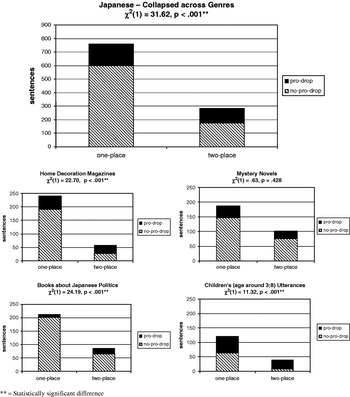
Figure 2 shows the distribution of pro-drop with one-place vs. two-place predicates in Japanese. When collapsed across genres, Japanese also shows a significantly higher percentage of pro-drop with two-place predicates than with one-place predicates [one-place vs. two-place: 21% vs. 38%, χ2(1)=31.62, p<.001]. This is also true for all but one of the genres separately [one-place vs. two-place, home decoration: 21% vs. 52%, χ2(1)=22.70, p<.001; politics: 6% vs. 26%, χ2(1)=24.19, p<.001; children: 49% vs. 79%, χ2(1)=11.32, p<.001]; the exception is mystery novels, which follow the trend numerically, but the difference is not statistically significant [one-place vs. two-place: 21% vs. 25%, χ2(1)=.63, p=.428]. In summary, as shown in figures 1 and 2, two-place predicates tend to involve more instances of pro-drop than one-place predicates for both child English and Japanese, consistent with the Pro-drop bias.
Pro-drop for one-place vs. two-place predicates in Japanese.

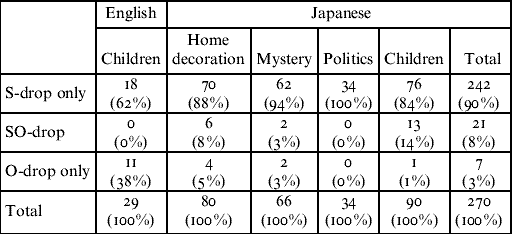
Table 1 shows the details of pro-drop types. For both languages, the majority of instances of pro-drop are S(ubject)-drop (child English 62%, Japanese total 90%). Other cases include O(bject)-drop only for child English (38%) and SO-drop (8%) and O-drop only (3%) for Japanese.Footnote 7
Details of pro-drop types in English and Japanese.
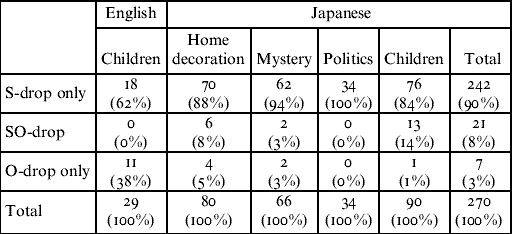
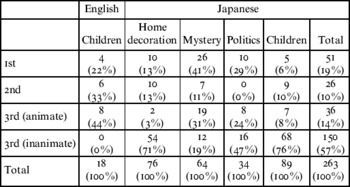
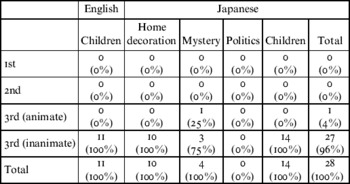
Table 2 shows the types of null subject arguments. Null subjects for first and second person referents are dominant in child English (1st+2nd: 56%), while null subjects for third person referents were dominant in Japanese (1st+2nd total: 29%). All of the third person referents are animate in child English, while most of the third person referents are inanimate in Japanese. All of the referents appear to be entities that had been previously mentioned in the discourse, and they refer to the speaker or the addressee at the rate given above for each language; thus, it seems more natural that they would be pronouns/demonstratives if overtly expressed, rather than lexical NPs, due to their discourse salience.
Types of null subject arguments in English and Japanese.

Table 3 shows the types of null object arguments. Here, unlike null subjects, all of the referents of the null objects for all the genres in both languages were inanimate third person – the only exception being one animate third person object in the mystery genre in Japanese. All of the referents again appear to be previously-mentioned information in the discourse, which would seem more likely to be overtly expressed as pronouns/demonstratives rather than as lexical NPs.
Types of null object arguments in English and Japanese.

2.2.2 Intransitive bias: one-place vs. two-place predicates
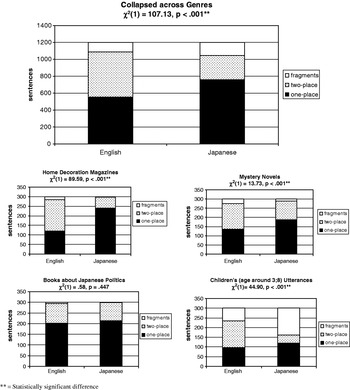
Figure 3 shows the distribution of sentence tokens for one-place vs. two-place predicates in English and Japanese. When collapsed across genres (see the upper part of figure 3), Japanese exhibits a significantly higher percentage of one-place predicates than English does [E(nglish) vs. J(apanese): 51% vs. 73%, χ2(1)=107.13, p<.001]. When each genre is examined separately, this is also the case for all the genres except for books about Japanese politics [home decoration: E 42% vs. J 81%, χ2(1)=89.59, p<.001; mystery: E 49% vs. J 65%, χ2(1)=13.73, p<.001; children: E 41% vs. J 76%, χ2(1)=44.90, p<.001; politics: E 68% vs. J 71%, χ2(1)=.58, p=.447]. Notice that the English discussion of Japanese politics shows a much higher percentage of one-place predicates (68%) than other genres (home decoration: 42%, mystery: 49%, children: 41%). By contrast, Japanese has a smaller inter-genre difference (range of one-place predicates in Japanese: 65%–81%).
One-place vs. two-place predicates for English and Japanese.

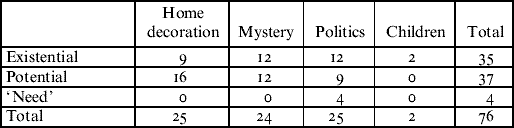
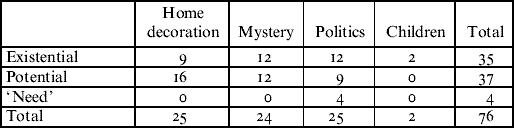
Table 4 shows the number of constructions that include what are arguably nominative-marked objects in Japanese (see footnote 4). We can see that such sentence tokens are fairly infrequent: only 76 tokens or 6% of the total number of the Japanese sentences examined contain arguably nominative-marked objects.
Number of constructions including arguably nominative-marked objects in Japanese.
Even when these constructions are counted as two-place predicates instead of one-place predicates, Japanese still exhibits a significantly higher percentage of one-place predicates than English does when collapsed across genres [E 51% vs. J 65%, χ2(1)=46.22, p<.001]. When each genre is examined separately, this holds true for home decoration magazines [E 42% vs. J 72%, χ2(1)=52.60, p<.001] and children's utterances [E 41% vs. J 74%, χ2(1)=41.58, p<.001], with mystery novels showing a marginal trend [E 49% vs. J 56%, χ2(1)=2.88, p=.090]. The politics genre again shows no significant difference between the two languages [E 68% vs. J 63%, χ2(1)=1.98, p=.159].
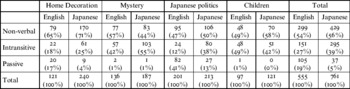
Table 5 shows the breakdown of one-place predicate types. Collapsed across genres, the higher ratio of one-place predicates over two-place predicates in Japanese appears to be due to there being more instances of non-verbal predicates (English 299 vs. Japanese 429) and intransitives (English 151 vs. Japanese 295) in Japanese than in English. When individual genres are examined, Japanese exhibits a higher percentage of non-verbal predicates than English in the home decoration, politics, and children's utterances genres, and intransitives show the same pattern in home decoration, mystery, and politics. Interestingly, more passive sentences are used in English (105 in total) than in Japanese (37 in total) in all the genres. The politics genre includes many more passive tokens (82) in English than in Japanese (27), and this seems to have made the total number of one-place predicates in both languages roughly equivalent within that genre, as discussed above with respect to figure 3.
Breakdown of one-place predicate types.

2.3 Study 1: preliminary discussion
The overall pattern of results in Study 1 was consistent with both of our hypotheses, namely, that pro-drop is more likely to occur with two-place predicates than with one-place predicates for both an SVO language and an SOV language, and that an SOV language tends to use more intransitive structures than an SVO language. In addition to typical pro-drop SVO languages (Spanish, Chinese) discussed in the Introduction, our results suggest that children's utterances in English also exhibit a Pro-drop bias, consistent with previous reports (L. Bloom Reference Bloom1970, Braine Reference Braine1976, Mazuka et al. Reference Mazuka, Lust, Wakayama and Snyder1986, P. Bloom Reference Bloom1990). Japanese also supports the Pro-drop bias hypothesis and shows more instances of pro-drop with two-place predicates than with one-place predicates, as demonstrated in figure 2. Recall that in the Introduction we assumed that processing a covert pronoun would not be hard because of the high recoverability of the referent. Our data in Study 1 suggest that in both child English and Japanese, the omitted arguments typically map onto previously mentioned information that is easily identifiable from the discourse (see section 2.2.1 above). Thus we continue to assume that recovering null pronouns is not costly, and that the reduction of overt argument NPs by pro-drop facilitates the processing of both SVO and SOV sentences.
As predicted by the Intransitive bias hypothesis, one-place predicates were more frequent in Japanese than in English. The only exception to this pattern was observed in the sub-corpus of texts about Japanese politics, which had approximately equal instances of one-place predicates in both languages. This seems to be due in large part to the high number of passive constructions in the English data, which is probably because in English the use of passive is more common in academic writing than in other genres (cf. Svartvik Reference Svartvik1966).
Therefore, our preliminary conclusion is that English and Japanese indeed seem to utilize strategies to facilitate processing by minimizing the number of overt arguments by pro-drop (for both child English and all genres of Japanese) and also by preferring intransitive structures which minimize structural constraints (for Japanese).
However, some questions still remain. The first is whether the pattern of results found in Study 1 will hold for other SVO and SOV languages. Since Japanese is (thus far) the only SOV language for which we have data concerning the Pro-drop bias, it is necessary to test another SOV language. Similarly, since we only have data points for English and Japanese for the Intransitive bias, we need to test more SVO and SOV languages. Second, the sentences in Study 1 were matched for genre, which means that they had similar, though not identical, content; additionally, the sentences in a given genre in a given language were produced either by one speaker or by a few (at most three) speakers. Therefore, the results may have been skewed by content and by individual speaker variation. We address these questions in Study 2.
3. Study 2
Study 2 investigated narratives produced by adult native speakers of English, Spanish, Japanese, and Turkish, elicited with the aid of a picture storybook. The study was conducted to test whether the pattern of results found in Study 1 holds for other SVO and SOV languages besides English and Japanese. Spanish was chosen because it is an SVO pro-drop language, and Turkish because it is an SOV pro-drop language. Frog, where are you? (Mayer Reference Mayer1969) is a picture book that has a transparent story line (a boy looking for his frog), but no words. The book has been used to collect narratives in a number of languages from speakers belonging to various age groups, with a fair amount of the data available online (cf. Berman & Slobin Reference Berman and Slobin1994). Since the data were gathered from narratives based on the same set of pictures, the content was expected to be controlled across speakers and languages. In addition, as the data included narratives produced by multiple speakers for each language, it was expected that we would find a reliably consistent pattern within a given language that would not be sensitive to individual speaker variation.
3.1 Methods
3.1.1 Materials
A total of 1,211 sentences were analyzed. These sentences were narratives of the ‘frog story’ elicited from adult native speakers of English, Spanish, Japanese, and Turkish. The English data consisted of 10 speakers' frog stories (473 sentences in total), and the Japanese data consisted of 10 speakers' frog stories (275 sentences in total), both elicited by Seig (Reference Seig1999). The Spanish data consisted of five speakers' frog stories (198 sentences in total), and the Turkish data consisted of five speakers' frog stories (265 sentences in total), both taken from CHILDES.
3.1.2 Procedures
The English and Japanese data were coded by the same Japanese graduate student in syntax who did the coding in Study 1. The Spanish data were coded by a Spanish graduate student in syntax at the University of Illinois, and the Turkish data were coded by the first author using a native speaker of Turkish as a language informant. Sentences were coded in the same way as in Study 1 (see section 2.1.2 above).
The number of sentence tokens of each predicate type (‘two-place predicate’, ‘one-place predicate’, ‘sentence fragment’, etc.) for each language was counted. In addition, the number of sentence tokens with null arguments for each predicate type was tallied for Spanish, Japanese, and Turkish. To test the Pro-drop bias, one-tailed paired t-tests were conducted on the percentage of pro-drop in one-place predicates vs. two-place predicates for the three pro-drop languages, in order to see whether any language would show a higher rate of pro-drop with two-place than with one-place predicates across speakers. To test the Intransitive bias, an analysis of variance was run to compare the proportion of one-place predicates between SVO and SOV languages, with ‘VO~OV’ as the main factor and ‘Language’ as a nested factor (with English and Spanish nested within VO, and Japanese and Turkish nested within OV), so as to see whether SOV languages would have a higher percentage of one-place predicates than SVO languages. Furthermore, one-tailed grouped t-tests were conducted for pairwise VO~OV comparisons between the languages of interest, namely, English vs. Japanese, English vs. Turkish, Spanish vs. Japanese, and Spanish vs. Turkish. As in Study 1, an alpha level of.05 was used for all statistical tests.
3.2 Results
3.2.1 Pro-drop bias
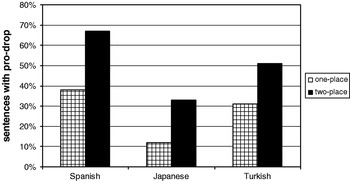
Figure 4 shows the mean proportion of pro-drop with one-place vs. two-place predicates for the three pro-drop languages, namely, Spanish, Japanese, and Turkish. As can be seen from the figure, every language shows a higher percentage of pro-drop with two-place predicates than with one-place predicates. This is statistically supported for all the languages [one-place vs. two-place, Spanish: 38% (standard deviation (SD) 11%) vs. 67% (SD 21%), t(4)=−4.64, p<.01; Japanese: 12% (SD 8%) vs. 33% (SD 20%), t(9)=−3.31, p<.01; Turkish: 31% (SD 11%) vs. 51% (SD 5%), t(4)=−3.31, p<.05].
Mean proportion of pro-drop for one-place vs. two-place predicates in Spanish, Japanese, and Turkish (averaged across speakers).

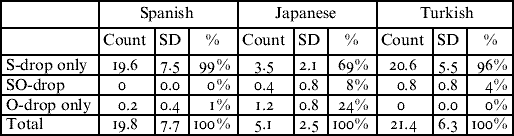
Table 6 shows the mean number of sentences showing pro-drop for each category, speaker, and language. For all the languages, the majority of pro-drop is S-drop (Spanish 99%, Japanese 69%, Turkish 96%). Other cases include O-drop only for Spanish (1%) and Japanese (24%) and SO-drop for Japanese (8%) and Turkish (4%).Footnote 8
Breakdown of pro-drop types: mean number of pro-drop occurrences for each category and each language (averaged across speakers).
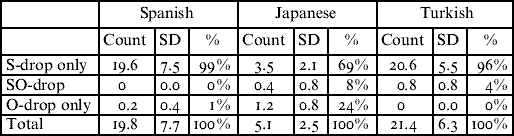
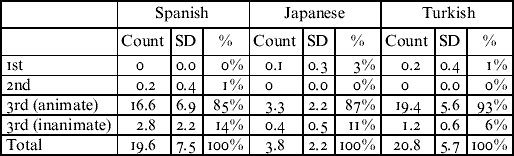
Table 7 shows the types of null subject arguments. For all the languages, animate third person references were dominant (Spanish 85%, Japanese 87%, Turkish 93%) and referred to the characters in the frog story, such as the boy, his dog, and his frog. Most of the inanimate referents were situational ‘it’.
Breakdown of person/animacy of null subject arguments for each language (averaged across speakers).
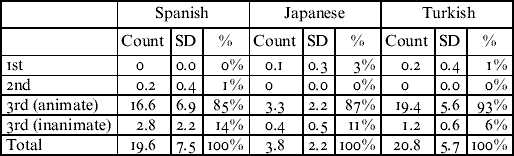
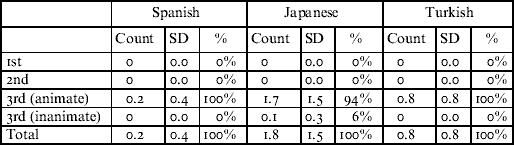
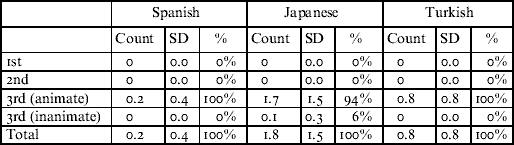
Table 8 shows the types of null object arguments. Almost all of the referents were animate third person – again, the characters of the frog story. Thus all of the referents appear to be previously-mentioned in the story, and accordingly it seems more natural that they would have been pronouns/demonstratives rather than lexical NPs, had they been overtly expressed.
Types of null object arguments for each language (averaged across speakers).
3.2.2 Intransitive bias
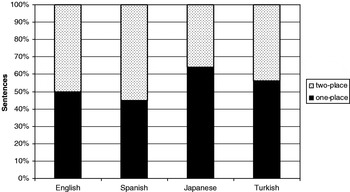
Figure 5 shows the mean proportion of one-place vs. two-place predicates for the four languages. As shown in the figure, the SOV languages (Japanese 64% (SD 11%), Turkish 56% (SD 5%)) exhibit a higher percentage of one-place predicates than the SVO languages (English 50% (SD 9%), Spanish 45% (SD 5%)). This observation is statistically supported by an overall analysis of variance comparing the proportion of one-place predicates between SVO (with English and Spanish nested) and SOV (with Japanese and Turkish nested) [F(1,26)=11.01, p=.003]. When each pair of SVO vs. SOV languages is compared individually, the Intransitive bias is also statistically supported for all the pairs [English vs. Japanese: t(18)=−2.95, p<.01; Spanish vs. Japanese: t(13)=−3.29, p<.01; Spanish vs. Turkish t(8)=−2.81, p<.05], except for the pair of English and Turkish, which follows the trend numerically but does not show a statistically significant difference [t(13)=−1.21, p=.124].
Mean proportion of one-place vs. two-place predicates for the ‘frog story’ in English, Spanish, Japanese, and Turkish (averaged across speakers).

3.3 Study 2: preliminary discussion
Overall, the pattern of results found in Study 1 was generally replicated in Study 2 and was consistent with the Pro-drop and Intransitive bias hypotheses we have proposed. Every pro-drop language (Spanish, Japanese, and Turkish) showed significantly more instances of pro-drop with two-place predicates than with one-place predicates. Recall that the characteristics of null subjects were different between child English and Japanese in Study 1, in that first and second person referents were dominant in child English, while third person referents were dominant in Japanese. The characteristics of null objects, in contrast, were the same in both languages: the referents of almost all null objects were inanimate third person. In Study 2 a large majority of both null subjects and null objects had animate third person referents in all languages. This is probably due to the nature of the frog story in that it involves several animate characters, who would likely be referred to in the third person by the storyteller.
As expected from our Intransitive bias hypothesis, one-place predicates were generally predominant in the SOV languages (Japanese, Turkish), but not in the SVO languages (English, Spanish). When each of the SOV and SVO languages were compared pairwise, there were significantly more instances of one-place predicates in the relevant SOV language than in the SVO language, except for the English and Turkish pair, where this difference was not statistically significant. This may be because Turkish is less rigidly head-final than Japanese: in general, there seems to be a sharp divide in grammatical properties between rigid SOV languages (Japanese, Korean) and SOV languages that are more accommodating of post-verbal constituents, such as Turkish (see Kural Reference Kural1997 on postverbal material in Turkish, and Dryer Reference Dryer and Shopen2007 for a more general typological discussion of rigid and flexible SOV languages).
Study 2 showed definite individual variation across speakers as shown by the standard deviations for both the Pro-drop and Intransitive biases. However, when the data from individual speakers were averaged and submitted to statistical tests, they were consistent with our two hypotheses. Therefore, our conclusion for Study 2 is that both of our hypotheses continue to hold even when other languages besides English and Japanese, including SVO pro-drop (Spanish) and SOV pro-drop (Turkish) languages, are used.
4. General discussion
In summary, Study 1 has shown that English and Japanese speakers seem to utilize strategies to facilitate processing by minimizing the number of overt arguments with pro-drop (for both child English and all genres of Japanese) and also by minimizing structural constraints by using one-place predicates (for Japanese). Study 2 shows the same thing for pro-drop languages to facilitate processing by using pro-drop (Spanish, Japanese, Turkish) and one-place predicates (Japanese and to some extent Turkish). In what follows, we will discuss each of these findings in relation to our proposed biases/hypotheses.
4.1 Pro-drop bias
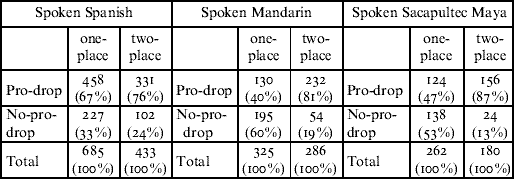
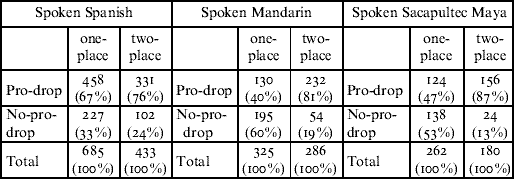
As predicted by the Pro-drop bias hypothesis, our data show that pro-drop is more prevalent with two-place predicates than with one-place predicates in pro-drop languages (Spanish, Japanese, and Turkish), as well as in child English. As mentioned in the Introduction, this hypothesis holds true for other languages and genres as well. If we apply the same statistical analyses to other published data, we find the same pattern of results (see table 9). A corpus of spoken Spanish (SVO with rich verb agreement) by Bentivoglio (Reference Bentivoglio, Hirschbühler and Koerner1992) shows a significantly higher percentage of pro-drop with two-place predicates than with one-place predicates [one-place vs. two-place: 458 (67%) vs. 331 (76%), χ2(1)=11.73, p<.001],Footnote 9 just as our Study 2 does. Similarly, a corpus of spoken Mandarin (SVO with no verb agreement) by Tao (Reference Tao1996) also shows a significantly higher percentage of pro-drop with two-place predicates than with one-place predicatesFootnote 10 [one-place vs. two-place: 130 (40%) vs. 232 (81%), χ2(1)=106.53, p<.001]. In addition, Sacapultec Maya, an ergative verb–object–subject (VOS) language with rich verb agreement, also shows a Pro-drop bias; according to a spoken corpus by Du Bois (Reference Du Bois1987), there is a significantly higher percentage of pro-drop with two-place predicates than with one-place predicates [one-place vs. two-place: 124 (47%) vs. 156 (87%), χ2(1)=71.11, p<.001].Footnote 11 Our own data showed that SOV languages, such as Japanese (no agreement) and Turkish (rich agreement), in addition to child English (SVO with some agreement), also have the same bias. There thus seems to be a general trend across languages of various basic word orders and agreement systems towards shortening two-place predicate utterances by means of pro-drop.
Pro-drop for one-place vs. two-place predicates in spoken Spanish (adopted from Bentivoglio Reference Bentivoglio, Hirschbühler and Koerner1992: 16), Mandarin (adopted from Tao Reference Tao1996: 116–117), and Sacapultec Maya (adopted from Du Bois Reference Du Bois1987: 822).
There may, therefore, be a general principle of economy in processing that applies to languages of all word order types, in that it is easier both to comprehend and to produce fewer arguments. In terms of comprehension, pro-drop with a two-place predicate reduces the number of overt NPs that must be processed, whether before or after the verb. Assuming again that recovering null pronouns is not costly, it would be more economical to comprehend shorter constructions with pro-drop than longer constructions with overt NPs. In terms of production, shorter utterances would also be easier to produce. As mentioned earlier, P. Bloom (Reference Bloom1990) reports that VP length in English-speaking children's utterances increases as a function of the subject type. If we recast ‘shorter utterances’ as ‘fewer overt arguments’, our data are consistent with Bloom's claim for all the genres in Japanese, for children's utterances in English in Study 1, for the adult narratives in all the pro-drop languages (Spanish, Japanese, and Turkish) in Study 2, as well as for the adults' spoken corpora in Spanish (Bentivoglio Reference Bentivoglio, Hirschbühler and Koerner1992), Mandarin (Tao Reference Tao1996), and Sacapultec Maya (Du Bois Reference Du Bois1987) discussed above. Therefore, as hypothesized in the Introduction, although adults are not subject to performance restrictions to the same extent that children are, they still seem to prefer to shorten their utterances. This is consistent with the view that pro-drop serves to satisfy performance constraints, at least to a certain degree, as opposed to the view that pro-drop is fundamentally a competence-based phenomenon (e.g. Hyams & Wexler Reference Hyams and Wexler1993).
It should be noted, however, that easing of processing load may not be the only motivation for shortening utterances – there may be an interaction with discourse factors. Recall from table 1 in Study 1 and table 6 in Study 2 that subject NPs are much more likely to be dropped than object NPs in all of the languages we examined.Footnote 12 This is consistent with data reported in earlier work concerning children's utterances in English and Japanese (Mazuka et al. Reference Mazuka, Lust, Wakayama and Snyder1986 for Japanese, P. Bloom Reference Bloom1990 and Hyams & Wexler Reference Hyams and Wexler1993 for English).Footnote 13 This dominance of S-drop could certainly be explained in terms of processing load. If we follow Yngve (Reference Yngve1960) as discussed in the Introduction, the most costly argument is the leftmost argument, which is an S. Thus S-drop would reduce the production cost more than O-drop would, for both SVO and SOV languages. However, it is also possible to offer a discourse account for the S-drop preferences. P. Bloom (Reference Bloom1990, Reference Bloom1993) argues that the tendency to drop subject NPs more than object NPs may be due to pragmatic factors surrounding subjects, which tend to be more ‘given’ than objects, and thus more prone to being omitted at a processing bottleneck. If subjects typically convey ‘given’ information (that is, previously mentioned and already activated, e.g. Chafe Reference Chafe and Li1976), while objects convey ‘new’ (newly introduced) information, it is not surprising that subjects tend to be omitted more than objects. Similarly, Du Bois (Reference Du Bois1987) discusses how discourse factors explain why O-drop occurs less frequently and why two-place predicates tend to have more pro-drop than one-place predicates. Du Bois argues that there tends to be only one lexical argument (which contributes new information) in a clause in Sacapultec Maya, probably because introducing a new lexical argument referent makes sufficient demands on one's attention that simultaneous introduction of a second new referent within the same clause would be too costly. The lexical argument appears preferentially in the S (intransitive subject) or O (transitive object) roles, but rarely in the A (transitive subject) role. This is because human agents (which occupy the A role) tend to be the topic and ‘given’ information in the sentence, while objects tend to be ‘new’ information, and intransitive clauses tend to be used when new human referents are introduced. As a result, the A role tends to be reduced to an overt or silent pronoun.
At any rate, although we cannot be completely sure how much of the Pro-drop bias is due to performance constraints on comprehending and producing sentences and how much is due to discourse factors, we can certainly say that performance and discourse interact with each other. Whether it is written or spoken, language in general seems to be under some pressure to make room for information having a greater need of being expressed (e.g. new information) by reducing information with a lesser need of being expressed (e.g. given, easily recoverable information). And this ‘pressure’ may well inhere in a processing constraint whose effect is to make utterances shorter for ease of comprehension and production. Furthermore, although it may seem that dropping both subject and object (SO-drop in tables 1 and 6) would shorten an utterance even further and thus make it still easier to process, there would be a tension between being short and being clear. Omitting both subject and object would tend to make the content of a given sentence unclear, and that is probably why there are very few instances of SO-drop. Therefore, it would be better to keep a less salient argument overt and only omit a more salient argument (which tends to be the subject).
4.2 Intransitive bias
As predicted by our Intransitive bias hypothesis, our results show that the SOV languages we have investigated (Japanese, Turkish) generally exhibit a higher proportion of one-place predicates to two-place predicates than the SVO languages we have looked at (English, Spanish). In terms of comprehension, the greater preference for one-place predicates shown by verb-final languages can be understood quite naturally as a processing strategy designed to reduce the number of arguments that need to be held in working memory until the verb is encountered, as discussed in the Introduction. Therefore, despite the skepticism regarding Pritchett's head-driven parser model (recall section 1.1, and cf. Kamide & Mitchell Reference Kamide and Mitchell1999, Kamide et al. Reference Kamide, Altmann and Haywood2003, Aoshima et al. Reference Aoshima, Phillips and Weinberg2004), having a verb appear later rather than sooner may still call forth a compensatory strategy. In terms of production, reducing the number of arguments before the verb can minimize the ‘depth’ in the phrase structure (Yngve Reference Yngve1960) and the time to get to the verb (Lindsley Reference Lindsley1975). It is possible that SOV is potentially harder to process,Footnote 14 both in terms of comprehension and production, which would motivate the preferential use of one-place predicates to reduce the number of preverbal arguments. Furthermore, this compensatory strategy seems to allow for an equally easy processing of languages with different basic word orders.
In addition to our frequency data, there is additional evidence from language acquisition that suggests that Japanese has a preference for one-place over two-place predicates, and thus an Intransitive bias. Rispoli (Reference Rispoli1987), Nomura & Shirai (Reference Nomura, Shirai and Clark1997), Fukuda (2005), Fukuda & Choi (Reference Fukuda, Choi, Iwasaki, Hoji, Clancy and Sohn2009), and Tsujimura (Reference Tsujimura, Gagarina and Gülzow2006) show that Japanese children under 3;0 use intransitive verbs significantly more often than transitive verbs – in contrast to their Portuguese or English-speaking peers. Fukuda (Reference Fukuda, Choi, Iwasaki, Hoji, Clancy and Sohn2005), Fukuda & Choi (2009) also report a developmental advantage for intransitives in Japanese: Japanese-speaking children start using the intransitive versions of verbs that have transitive counterparts (e.g. aku ‘open(int.)’ vs. ak-e-ru ‘open(tr.)’) two to three months earlier than the transitive versions. By contrast, an English-speaking child starts producing transitive versions approximately six months earlier than their intransitive counterparts. We presume that the Intransitive bias mirrors the pattern of acquisition in child language (see Kidd et al. Reference Kidd, Brandt, Lieven and Tomasello2007 for the close relationship between the comprehension and production systems of children and adults). Furthermore, the Intransitive bias hypothesis is also consistent with the observation in Nichols, Peterson & Barnes (Reference Nichols, Peterson and Barnes2004) that there may be cross-linguistic variation in the preference for one-place vs. two-place predicates. To describe this difference in adicity, Nichols et al. propose the notion of lexical valence orientation. This notion captures the descriptive generalization that some languages are predominantly intransitive and morphologically derive transitive verbs from intransitive forms, while other languages are predominantly transitive, deriving one-place predicates via detransitivization.Footnote 15 In examining correlations between various language properties and lexical valence orientation, Nichols et al. (Reference Nichols, Peterson and Barnes2004: 170) note that languages of the SOV type (which they refer to as OV languages) favor the intransitive orientation; they suggest that this correlation is grammatically driven (as opposed to being an areal feature) but do not provide an explanation for it. If the results obtained for Japanese (and Turkish) are reliably replicated in other head-final languages, the correlation noted by Nichols and colleagues receives a processing explanation: the predominance of one-place verbs in OV languages is consistent with the hypothesis that the number of arguments before the verb needs to be kept small.
4.3 Conclusion
We started out with the general question of whether or not differences in basic word order correlate with principled differences in processing. This question was inspired by earlier work on the differences between SOV and SVO languages in terms of constituent placement, such as the long-before-short principle demonstrated for an SOV language by Yamashita & Chang (Reference Yamashita and Chang2001).
Our own results point toward a heretofore unknown way in which SOV and SVO languages differ. The main difference uncovered here has to do with the proportion of one-place to two-place predicates. We found that SOV languages show an Intransitive bias: they use a higher proportion of one-place verbs. This bias is further supported by acquisition data (at least for Japanese), which indicate that child learners start out with a higher number of one-place predicates and develop them earlier.
The generalization that SOV languages show an Intransitive bias is quite robust. It is consistent with data from Japanese and Turkish, and, more indirectly, with the data on head-final languages in Nichols et al. (Reference Nichols, Peterson and Barnes2004). The explanation for this generalization (which of course needs to be tested in more head-final languages) is more tentative, but we would like to venture that it is related to processing. The main idea is that an SOV structure with all the constituents expressed is potentially harder to process, possibly in terms of both comprehension and production. In this context, the dominance of one-place predicates works as a compensatory strategy to reduce the number of preverbal arguments.
However, the number of preverbal arguments can be reduced by several means; for example, arguments that are recoverable from the context or from agreement could simply be omitted. This is of course the well-known pattern of pro-drop, which could potentially ease the processing bottleneck before the final predicate. Thus, one might suppose that pro-drop would be more prevalent in two-argument structures and that such a bias (the Pro-drop bias, in our terminology) would be more pronounced in SOV languages. This expectation is not met. Our corpus study showed that the occurrence of pro-drop was uniformly higher in two-argument structures, regardless of the OV/VO distinction. This finding has two implications. First, the Pro-drop bias seems to emerge as a universal economy principle for making utterances shorter, possibly interacting with discourse factors. As such, this principle does not show sensitivity to headedness, but is clearly sensitive to the number of arguments. Second, the observation that the Pro-drop bias is not sufficient to ameliorate the processing difficulty in SOV sentences suggests that processing is simultaneously subject to surface factors (weight, number of overt constituents) and to structural factors, such as valency. This in turn offers support for the general idea that there is an intimate interaction between grammar and parser, which has been advanced by a number of researchers (Phillips Reference Phillips1996, Reference Phillips2003, Reference Phillips2006; O'Grady Reference O'Grady1997, Reference O'Grady2005).
The tendencies we have presented here are quite robust and are supported by various statistics. It remains to be seen if further studies of other SOV/SVO languages will be consistent with our conclusions. If our generalizations are on the right track, they may provide a new tool that will be useful in determining the basic word order for languages where the surface facts are far from clear: presumably, head-final languages will tend to show the Intransitive bias we have uncovered here, while all types of languages will show the Pro-drop bias. Thus, our data suggest that human languages utilize both word-order-specific and universal strategies to facilitate processing. The Intransitive bias is specific to head-final languages, whereas the Pro-drop bias emerges as a more general strategy.
DATA SOURCE REFERENCES
Study 1
1. Home decoration magazines
House Beautiful, May 1998, 80–81.
Home Remodeling & Decoration, Winter 1997–98, 25–34.
Nachuraru-na Interia (Natural Interior), May 1998, 30–37.
2. Mystery novels
Stephen King. 1999. The girl who loved Tom Gordon, 3–30. New York: Pocket Books.
Mariko Koike. 1997. Kikenna shokutaku [The dangerous dinner table], 10–26. Tokyo: Shueisha.
3. Books about Japanese politics
Bradley M. Richardson & Scott C. Flanagan. 1984. Politics in Japan, 117–139. Boston, MA: Little, Brown and Company.
Juichi Aiba, Tadashi Iyasu & Shoji Takashima. 1998. Nihon seiji-o yomu [Reading Japanese politics], 1–42. Tokyo: Kodansha.
4. Children's utterances: CHILDES
Study 2
1. English
Mary Theresa DiGennaro Seig. 1999. A crosslinguistic comparison: Episodic boundaries in Japanese and English narratives. Ph.D. dissertation, Oklahoma State University.
2. Spanish: CHILDES
3. Japanese
Mary Theresa DiGennaro Seig. 1999. A crosslinguistic comparison: Episodic boundaries in Japanese and English narratives. Ph.D. dissertation, Oklahoma State University.
4. Turkish: CHILDES