Introduction
Cardamom, [Elettaria cardamomum (L.) Maton], is popularly called as ‘Queen of Spices’, and the economic part of which is the dried capsule fruit of the perennial rhizomatous herb belonging to the family Zingiberaceae. It is one of the costliest and most ancient and valuable spice crops since ancient times. Although the crop is indigenous to south India and Sri Lanka (Purseglove, Reference Purseglove, Brown, Green and Robbins1981), Guatemala is the largest producer and exporter. The natural habitat of the crop used to be in the erstwhile evergreen rainforests of the Western Ghats of south India at altitudes between 600 and 1500 m above MSL (Mean Sea Level). The cardamom-growing areas in India are concentrated mainly in those regions that were the natural habitat of the spices lie between 8°30′ and 14°30′N latitude and 75–70′E longitude. The area is an elongated tract from north to south from Sirsi of Karnataka state to Tirunelveli of Tamil Nadu state. From east to west, it is a narrow belt of high uplands distributed over the Western Ghats (Madhusoodanan et al., Reference Madhusoodanan, Kuruvilla, Priyadarshan, Chadha and Rethinam1994). Sufficient variability for economic traits must exist in the cardamom germplasm for profitable utilization in crop breeding programmes.
Cardamom is generally a cross-pollinated crop and propagated by seedlings and suckers; occasionally, selfing also occurs. Considerable variation is encountered in seedling progenies of cardamom (Padmini et al., Reference Padmini, Sasikumar and Venugopal2000a, Reference Padmini, Venugopal, Korikanthimath, Anke Gowda, Muralidharan and Rajkumar2000b). Based on the nature of panicles, three varieties of cardamom are recognized (Sastri, Reference Sastri1952). The var. Malabar (online Supplementary Fig. S9) is characterized by prostrate panicle, and the var. Mysore (online Supplementary Fig. S11) possesses erect panicle. The third type var. Vazhukka (online Supplementary Fig. S10) is considered as a natural hybrid between the two, and its panicle is semi-erect or flexuous.
An assembly of diverse genetic stocks of any crop is the raw material from which a new variety can be developed to suit the requirements of farmers and end users. Therefore, collection, conservation, evaluation and exploitation of germplasm deserve utmost importance in breeding strategies. Conservation of cardamom genetic resources under in situ situation does not exist, though natural population occurs in protected forest areas. Ex situ conservation in cardamom is being maintained as field gene banks, and they are used for preliminary evaluation, maintenance as well as for characterization.
Genetic diversity is the basis for the development of elite varieties with desirable characteristics. Genetic diversity analysis can be performed using morphological, biochemical and molecular markers (Govindaraj et al., Reference Govindaraj, Vetriventhan and Srinivasan2015). Detailed documentation of cardamom genetic resources was reported by Mayne (Reference Mayne1951), Abraham and Tulasidas (Reference Abraham and Tulasidas1958) and Sudharshan et al. (Reference Sudharshan, Kuruvilla and Madhusoodanan1991). Characterization of genetic divergence for the selection of suitable and diverse genotypes should be based on sound statistical procedures, such as D′-statistics and non-hierarchical Euclidean cluster analysis (Mahalanobis, Reference Mahalanobis1936; Spark, Reference Spark1973). These procedures characterize genetic divergence using the criterion of similarity or dissimilarity based on the aggregate effect of a number of economically important characters. In light of these, cardamom genotypes were evaluated in this study to determine the magnitude of variability existing in the population for yield and yield components as well as grouping pattern of genotypes in different clusters. The germplasm accessions are being grouped into different clusters based on the characters studied. So, this can be utilized for identifying genetically different germplasm accessions. Hybridization between unrelated strains generally leads to an increased vigour and fertility. Most of the improved varieties in cross-pollinated and asexually reproducing species are either hybrids or synthetics/composites and utilize the phenomenon of hybrid vigour. Identification of genetically different germplasm accessions with superior characters would be incorporated in heterosis breeding for the development of hybrids.
Materials and methods
The germplasm materials consisting of 67 accessions (online Supplementary Table S1) were collected and conserved from several cardamom-growing areas in south India since 1972. These accessions maintained at the research farm were evaluated for biometric and yield-attributing characters. The Cardamom Research Station, Kerala Agricultural University, Pampadumpara, where the experiment was done is located at an elevation of 1100 m above MSL. The research station comes under a medium rainfall zone receiving rainfall ranging from 1500 to 2500 mm annually. The experimental field was laid out with a spacing of 2 × 2 m comprising 10 experimental plants per accession. Crop-growing practices and inputs were given uniformly to all accessions as per KAU (Kerala Agricultural University) POP (Package of Practices) recommendations. Data on 14 characters were recorded from 10 plants based on the IPGRI (International Plant Genetic Resources Institute) descriptor of Indian cardamom from 2016 to 2018, and the data were subjected to statistical analysis. The mean and coefficient of variation were worked out as per the standard statistical procedures (IPGRI, 1994).
Results
Morphologically peculiar germplasm accessions identified by the study
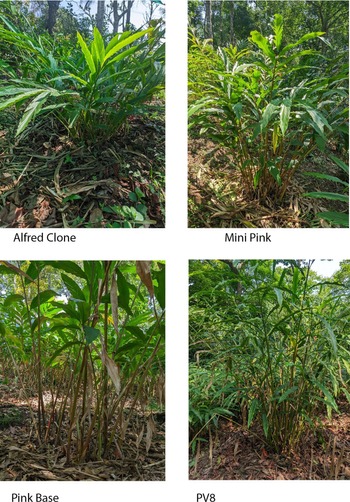
Among germplasm accessions studied, morphologically peculiar types identified were Pink Base, Mini Pink, MBP, Alfred clone, Compound Panicle and PV 8 (Fig. 1). Accessions like Pink Base and Mini Pink were characterized by pink-coloured pigmentation in the pseudostem. This pink-coloured pigmentation uniformly spread all over the pseudostem of Mini Pink. There was a slight change in the pattern of pink pigmentation on the pink base accession. The basal region of the pseudostem of the Pink Base type showed pink-coloured pigmentation. PV 8 could be distinguished by its narrow leaf lamina and thinner girth of pseudostem. MBP, Compound Panicle and PS 4 have multi-branched panicles. Alfred clone has produced both basal and occasionally terminal panicles.
Peculiar types of cardamom accessions maintained in field gene bank of the CRS Pampadumpara.

Yield and biotic stress characters
All germplasm accessions were evaluated for characteristics like wet and dry weight of capsules, 100 capsule weight, percentage incidence of thrips and borers and Azhukal disease. All of the germplasm accessions showed differences for each character studied (online Supplementary Tables S2, S2.1, S2.2 and S2.3). The coefficient of variation was high for the wet weight of capsules (69.19) followed by the dry weight of capsules (50.20). The least coefficient of variation was recorded for the percentage incidence of Azhukal disease (24.1).
Among accessions, highest wet weight of capsules per plant was noted for PPK 2 (3051 g) followed by PS 28 (3018 g), PS 10 (2635 g), PS 16 (2580 g), Sinchona Sel (2516 g) and PS 27 (2478 g). But, these accessions were statistically on par. Pink Base showed the lowest wet capsule yield (160.5 g). The wet capsule yield of the Pink Base was statistically on par with PV6 (161.5 g), Hema (210.0 g), Pro 107 (259.5 g) and Mini Pink (289.5 g). Dry weight of capsules was reported from 67 accessions. All accessions exhibited differences in dry capsule yield. PS 28 yielded the highest weight for dry capsule (560 g) followed by PS 10 (558 g), PPK 2 (509 g), PS 27 (459 g), BEP 1 (456 g), PS 12 (454.5 g), BEP 2 (445 g) and Sinchona Selection (440.5 g), and all were statistically on par. The lowest dry capsule yield was reported from the Pink Base (34.625 g). PV 6 (35.0 g), PV 7 (42.16 g), Hema (46.5 g), Type 6 (49.5 g), PRO 107 (59.0 g), Mini Pink (63.0 g), Clone 37 (87.5 g), PS 30 (89.5 g), PV 34 (90.0 g), Clone 57 (90.5 g) and PV 5 (92.5 g) showed no statistical difference to the Pink Base for dry capsule yield.
Mean value of 100 capsule weight ranged from 73 to 116 g. Clone 57 gave the highest value for 100 capsule weight (116 g) closely followed by PS 22 (115.5 g), PPK 1 (115.0 g), Type 6 (112.0 g), PS 21 (111.0 g), PS 10 (107 g), Sinchona Selection (106.5 g), Type 1 (106.0 g), Bep 1 (104.0 g), Compound panicle (104.0 g), PS 12 (104.0 g) and PS 25 (104.0 g). PS 7 registered the lowest 100 capsule weight (73 g), which was statistically on par with PV7 (74 g), PV 8 (75 g), Chetti 1 (75 g) and Hema (76.5 g).
Three biotic stress characters were observed namely thrips, shoot and capsule borers and Azhukal disease. All germplasm accessions have recorded thrips infestation from 7.76 to 45.5%. The thrips infestation was severe in PS 25 (45.5%) which was statistically different from all other germplasm accessions, except PS 19 (33.82%) and PV 1 (29.37%) that were statistically on par with PS 25. The percentage incidence of thrips was comparatively lower in PS 17 (7.6%), trailed by PS 29 (10.6%), PS 4 (10.8%), PS 7 (11.02%) and PS 23 (11.5%), and no statistical difference was envisaged between these germplasm accessions. Percentage incidence of shoot and capsule borers was ranged from 0.707 to 1.728%. Highly popular farmer variety, Green Gold and PV 12, indicated maximum percentage incidence for shoot and capsule borers. Germplasm accessions like PPK 1 (1.693%), PS 13 (1.693%), PS 8 (1.693%), PS 21 (1.581%), PS 22 (1.581%), PS 4 (1.559%) and PV 5 (1.559%) were statistically at par with Green Gold and PV 12. Lowest infestation for shoot and capsule borers was found for germplasm accessions like BEP 1, Clone 37, Clone 57, PPK 2, PRO 107, PS 10, PS 16, PS 18, PS 2, PS 25 (online Supplementary Fig. S7), PS 26, PS 27, PS 7, PV 11, PV 2, PV 33, PV 34, PV 6, PV 8, Sinchona Selection Type 6 and Veeraputhran, and the percentage incidence was only 0.707%.
Incidence of Azhukal disease was observed in all the germplasm accessions. However, coefficient of variation was very low. Mean percentage incidence of Azhukal disease ranged from 0.707 to 1.331%. Mini Pink (online Supplementary Fig. S3) and PS 22 expressed maximum percentage incidence of Azhukal disease followed by BEP 2 (1.225%), Manjurabad (1.225%), Alfred clone (1.171%), Chetti 3 (1.171%), Clone 57 (1.171%), MCC 61 (1.171%), PPK 2 (1.171%) (online Supplementary Fig. S4), PS 12 (1.171%) and PV 10 (1.171%). But, all these were statistically on par with Mini Pink and PS 22.
Yield-attributing characters
Eight yield-attributing characters such as plant height, number of tillers/plant, number of panicles/plant, number of capsules/plant, panicle length, number of panicles/tiller, number of internodes/panicle and number of seeds/capsule have been analyzed (online Supplementary Table S3). The entire germplasm accessions showed greater variations for eight yield-attributing traits. All the characters were significantly different at 1 and 5% confidence level except the number of panicles per tiller.
Coefficient of variation was highest for number of capsules per plant (64.60). Mean plant height of individual genotypes ranged from 152.66 to 358 cm. Highest plant height was exhibited for PS9 (358 cm), followed by Veeraputhran (356 cm). Both these accessions were statistically on par for the plant height. Lowest plant height was given for Alfred clone (152.66 cm) followed by PV1 (156.33 cm), and they were not statistically different. Number of tillers per clump varied from 5.33 to 62. PV12 produced the maximum number of tillers per clump (62) followed by Type 1 (53.66), and both were statistically different. Number of tillers per clump was minimum in PS19 (5.33) followed by PV33 (15.33), and they were significantly different. The range of mean number of panicles per plant was from 3.3 to 46.66. Veeraputhran produced maximum number of panicles per plant (46.66) that was trailed by PS18 (40.66). These two accessions significantly differed for the character number of panicles per plant. Number of panicles per plant was the least for Alfred clone (3.33) followed by PS 2 (3.66), PV1 (4), Type 6 (5) and MCC61 (5). All these accessions were statistically on par.
Number of capsules per plant was ranging from 110 to 2674.4. PS9 yielded the maximum number of capsules per plant (2674.4) followed by S1 (2464). PS9 and S1 were significantly different for the number of capsules per plant. PS32 produced only 110 number of capsules from a single plant, followed by MCC61 (156.3). However, these two accessions were statistically different. Length of panicle varied from 10 to 90 cm. Shortest panicle was observed for PV8 then by MCC61, and these two accessions were statistically non-significant. Longest panicle length was visualized for accession Type 103 (90 cm) followed by Compound Panicle (85 cm) and PS4 (85 cm). Length of panicle of Compound Panicle and PS4 was significantly different from that of Type 103. PV8 produced short panicles (10 cm) after MCC61 (12 cm), and there was not much statistical difference between these two accessions.
Commonly, cardamom plant produces two panicles from one sucker. However, there were variations among the studied accessions for number of panicles. There were genotypes with one panicle per tiller, two panicles per tiller, three panicles per tiller and four panicles per tiller. There was no significant difference between accessions concerning number of tillers per panicle. Accessions BEP1, Clone 37, PS14, PS19, PS4, PV2, S18 and Type 103 produced four panicles per tiller. Single panicle per tiller was recorded in accessions like MCC40, MCC61, PS2, PS22, PV11 and Sinchona Sel. Number of internodes per panicle is an important economical character. The range of number of internodes per panicle changed from 1 to 38. Pink Base hand only single internode followed by MCC61 (7), PV1 (8) and PV8 (9). These three accessions namely MCC61 (7), PV1 and PV8 were significantly different from Pink Base for the character number of internodes per panicle. MCC61, PV1 and PV8 were statistically on par for the number of internodes per panicle. Number of internodes per panicle was maximum in Type 103 (38), followed by PS 5 (37). Number of seeds per capsules typically varied from 8.1 to 20.3. Highest number of seeds per capsule was recorded in PS12 (20.3) closely followed by Sinchona Sel (18.5) and Type 1 (18.5), and there was no statistical difference between these three accessions. Least number of seeds per capsules was recorded in PV 8 (8.1) followed by PV10 (9.4), PV1 (9.6) and PV7 (10). All these accessions were statistically on par.
Cluster analysis
Agglomerative hierarchical clustering analysis has been done using the mean values of 14 characters including the yield attributing and biotic stresses (online Supplementary Table S4). The accessions studied were grouped into 14 clusters (Fig. 2), which showed the magnitude of variability. Cluster 3 is the largest one with 27 accessions that showed a higher level of genetic inter-relationship among them. Cluster 3 possessed accessions like BEP 1, Chetti 2, Clone 37, Clone 57, Compound Panicle, Green Gold, Manjurabad, MBP, MCC 11, Mini Pink, PPK 2, PS 10, PS 12, PS 13, PS 16, PS 2, PS 22, PS 24, PS 26, PS 27, PS 29, PS 31, PS 4, PS 7, PS 9, S1 and Veeraputhran. PS 7 was the centrally located accession in this cluster.
Dendrogram constructed by Pearson correlation coefficient using unweighted pair group average method.

Pink Base, MCC 61, PS 32, PV 10, PV 12, Type 103, Type 4 and Type 6 have formed separate cluster individually. Alfred Clone, BEP 2, Chetti 1, Chetti 3, Hema, MCC 40, PPK 1, PRO 107, PS 14, PS 19, PS 23 (online Supplementary Fig. S8), PS 30, PS 5, PV 1, PV 6 and Sinchona Selection together formed the second-largest cluster with Sinchona Sel as the central accession. A separate cluster was formed with nine accessions that were PS 18, PS 21, PS 28, PV 33, PV 34, PV 2, PV 5, PV 7 and Type 1. Type 1 acted as the central accession in this cluster. PS 17, PS 25 (central accession) and PS 8 jointly formed a cluster. There were two clusters with two accessions separately. One cluster constituted PV 11 and PV 8, with PV 11 as the central accession. The second cluster has ACC 1 as the central accession and PRO 17 as the next accession. Maximum inter-cluster distance existed between clusters 8 and 3 (1489) followed by clusters 9 and 3 (1466).
Discussion
The whole germplasm accessions collected from south India have been conserved at the Cardamom Research Station, Pampadumpara, as an essential genetic reservoir of variability in cardamom. All germplasm accessions are now conserved in ex situ as field gene banks. Study of variability of genetic resources of a crop is the first step towards the understanding of genetic diversity of the genetic stock for use in crop improvement programmes (Anisha et al., Reference Anisha, Geethu, Mathew, Rao, Remashree, Ranjanan, Varghese, Jose and Sasidharan2020). The present study focused on intra-specific variation in cardamom with respect to yield and yield-attributing characters and implied the presence of significant genetic diversity among the tested germplasm accessions. Prasath et al. (Reference Prasath, Venugopal and Korikanthimath2001) reported high variability for panicle length and yield per plant for the germplasm accessions studied by this researcher. Variations have also been reported in important characters like branching of inflorescence, fruit (capsule) size, shape, leaf and plant pubescence, retention of green colour, etc. (Madhusoodanan et al., Reference Madhusoodanan, Kuruvilla, Priyadarshan, Chadha and Rethinam1994).
Morphologically peculiar genotypes
The pigmented accessions like Pink Base and Mini Pink were poor yielders in terms of wet and dry capsule yield per plant. The narrow girth of pseudostem of PV 8 is a favourable character for tolerance to shoot and capsule borer. Josephrajkumar et al. (Reference Josephrajkumar, Backiyarani and Murugan2002) pointed out that the stem girth is one of the important features conferring the tolerance to cardamom shoot and capsule borers as increased diameter accommodates the growing immature stages of the pest. Therefore, among the three types of cardamom investigated (Malabar, Mysore and Vazhukka), variety PV1 (Malabar type) having prostrate panicle and lanky stem was found to be the most tolerant to borer damage.
The normal inflorescence possesses a long cane-like peduncle having nodes and internodes. Each node has a scale leaf, in the axile of which flowers are borne on modified helicoids cyme (cincinnus). In multiple branching of panicles, central peduncle undergoes further branching (secondary and tertiary branches) producing multiple branching panicles (compound panicles). A study on compound inflorescence cardamom in India was conducted by Prasath et al. (Reference Prasath, Venugopal and Korikanthimath2001). Germplasm accessions, MBP and Compound Panicle, are higher yielders due to their branched nature of panicles which bear more flowers. Padmini et al. (Reference Padmini, Sasikumar and Venugopal2000a, Reference Padmini, Venugopal, Korikanthimath, Anke Gowda, Muralidharan and Rajkumar2000b) studied the variability among the compound panicle types, which are mostly having Vazhukka type of inflorescence. According to the researcher, among the compound panicles, proximal branching is more prevalent than the distal or entire branching types. The contribution of such branching towards yield (weight of wet and dry capsules) varied from 12 to 41%. Branching did not influence other yield or quality characters.
Even though Alfred Clone produced both basal and occasionally terminal panicles, they were poor yielders when comparing it with other landraces. Krishnamurthy et al. (Reference Krishnamurthy, Khan, Avadhani, Venkatesh, Siddaramaiah, Chakaravarthy, Gurumurthy and Gurumurthy1989) classified the germplasm accessions of cardamom available at the Regional Research Station, Mudigere. They recognized 26 distinct types based on characters such as leaf pubescence, height and colour of aerial stem, panicle type, etc.
Yield characters
The high value of coefficient of variation for the wet weight of capsules has indicated the high variability of this character among the genotypes. Padmini et al. (Reference Padmini, Venugopal, Korikanthimath, Sashikumar, Krishnamoorthy, Rema, Ravindran and Peter1999) reported that characters such as panicle number, nodes/panicle, internode length and capsule length exhibited high coefficient of variation. A study conducted by Akhila et al. (Reference Akhila, Meena, Srinivasa Rao, Kumar, Gopi and Tejaswini2018) titled assessment of variability and performance of new landraces of small cardamom (Elettaria cardamomum Maton) reported that among the yield characters, the highest coefficient of variation was shown by dry yield per plant (36.36%) followed by fresh yield per plant (32.22%) and the lowest coefficient of variation by internodal length (7.82%). Least variability was found there for the percentage incidence of Azhukal disease across the accessions. Significant differences among germplasm accessions were observed for all traits that indicated the presence of higher variability. Previous authors have also reported the significance difference in various characters of cardamom and other crop genotypes. Korikanthimath et al. (Reference Korikanthimath, Ankegowda, Yadukumar, Rajendra and Hosmani2000) showed significant difference among cardamom genotypes particularly for number of capsules per plant, weight of fresh and dry capsule and oleoresin content. Ankegowda and Krishnamurthy (Reference Ankegowda and Krishnamurthy2008) have also noted variability in number of tillers, number of leaves and plant height that were significantly different for six cardamom germplasm accessions under moisture stress condition.
PPK 2, PS 28, PS 10, PS 16, Sinchona Sel and PS 27 were higher yielders with respect to wet capsule yield/plant. Dry capsule yield/clump was higher in PS 28, PPK 2, PS 27, BEP 1, PS 12, BEP 2 and Sinchona Selection. Most of these accessions have recorded higher wet weight of capsules along with the high dry weight of capsules indicating that the dry recovery percentage was almost the same for these accessions. Wet capsule yield/plant was low in accessions like Pink Base, PV 6, Hema and Mini Pink. All these accessions were inferior for dry capsule yield also, along with other accessions like PV 7, Type 6, PRO 107, Clone 37, PS 30, PV 34, Clone 57 and PV 5.
Capsule character is an important yield-attributing character that was measured in terms of 100 capsule weight. Even though Clone 57 showed a lower value for dry capsule yield, the weight of 100 wet capsules was high. This indicated its superiority in individual capsule character. PS 10 and Sinchona Selection showed supremacy for dry capsule yield/plant, wet capsule yield/plant and 100 capsule weights. The pure yield of Hema may be due to the lower weight of individual capsules. None of the cultivars were free from pests and disease incidence. However, some of the cultivars showed significant difference in pest and disease infestation both at 1 and 5% level. This proved that some cultivars were susceptible to various biotic stresses at varying levels. Among biotic stresses evaluated, thrips infestation showed higher variability among the germplasm accessions. Even though PS 25 produced capsules having comparatively higher weight, this accession was highly susceptible to thrips infestation. So, this variety cannot be considered for developing high-yielding cardamom varieties in small cardamom. Thrips infestation was comparatively low in PS 7, which also yielded low wet capsule weight. The other accessions that showed visually low thrips infestation were PS 17, PS 29, PS 4 and PS 23.
The percentage incidence of shoot and capsule borers infestation among the varieties was comparatively low. Shoot and capsule borers infestation was severe in Green Gold (online Supplementary Fig. S5), a highly adapted variety. This could be one of the reasons for intensive pesticide spraying at 2 weeks intervals in cardamom plantations of south India. Some of the accessions, which were superior in terms of the wet weight of capsules/plant and dry weight of capsules per clump namely PPK 2, PS 27 (online Supplementary Fig. S6), PS 10 and Sinchona Selection, showed a low percentage incidence of thrips. Among these four accessions, PS 27 and PS 10 fall under Malabar types. According to Jacob et al. (Reference Jacob, Senthil Kumar, Devasahayam, D'Silva, Kumar, Biju, Praveena and Ankegowda2020), differences in panicle type and the nature of adherence of leaf sheath to pseudostem explained a significant amount of the variance in resistance, and therefore, they are likely to play a major role in conferring resistance against the thrips. Multiple regression analysis of the different traits indicated that accessions with prostrate panicles having leaf sheath loosely adhered to the pseudostems were found to have significantly less thrips damage, compared to other panicle and leaf sheath types. Higher concentrations of 1,8 cineole and the ratio of 1,8 cineole to α-terpinyl acetate in Kattelam and other Malabar types of cardamom thought to be the reasons of enhanced tolerance of these varieties against thrips damage (Josephrajkumar et al., Reference Josephrajkumar, Backiyarani, Sivakumar, Josephrajkumar, Backiyarani and Sivakumar2007). So, these accessions can be included for further breeding and release as tolerant varieties.
Azhukal disease is a heavy devastating disease during rainy season in small cardamom plantations of south India. If it is not managed properly, it may result in the entire crop loss. Among the accessions studied, pigmented accession, Mini Pink was highly susceptible to Azhukal disease. The percentage incidence of Azhukal of Mini Pink and PPK2 was not significantly different. These studies projected that accessions like PS 27, PS 10 and Sinchona Selection could be carried over to procedures for releasing as varieties.
Yield-attributing characters
Among these characters, the highest variability was noticed for number of capsules/plant (64.40%) followed by panicle length and number of panicles/plant. According to Padmini et al. (Reference Padmini, Sasikumar and Venugopal2000a, Reference Padmini, Venugopal, Korikanthimath, Anke Gowda, Muralidharan and Rajkumar2000b) the highest variability was noticed in Malabar accessions where in the number of panicles per plant varied greatly. MBP recorded the highest number of capsules/plant (3139.2), which was mainly attributed to its branched nature of panicles. The least variability showed in number of seeds per capsule which confirmed the findings of Backiyarani et al. (Reference Backiyarani, Josephrajkumar, Murugan and Sainamole Kurian2000). Short stature of accessions supports the features of Malabar cultivars. PS 9 is Vazhukka type that recorded maximum plant height. But Veeraputhran, a Malabar accession, was also recorded plant height that was on par with the PS 9. It is observed that among the Malabar accessions, Veeraputhran is one of the superior accessions. The ICRI Myladumapra released this accession as ICRI 1.
Even though PV 12 and Type 1 recorded maximum number of tillers per plant, wet capsule yield, dry capsule yield and number capsules per clump were not proportionally superior. MBP gave higher number of capsules; however, its wet weight and dry weight of capsules was not comparable with the character that is the number of capsules per plant. It may be due to low number of seeds per capsule, and the rind weight of capsules may be significantly low.
Length of panicle and number of panicles were higher for accessions having branched panicles like Compound Panicle and PS 4. Padmini et al. (Reference Padmini, Sasikumar and Venugopal2000a, Reference Padmini, Venugopal, Korikanthimath, Anke Gowda, Muralidharan and Rajkumar2000b) studied the variability among the compound panicle types, which are mostly having Vazhukka type of inflorescence. Type 103 showed maximum number of internodes per panicle, which may be due to higher length of panicles. Superiority of Sinchona Selection was also justified by the greater number of seeds in a capsule. MCC 61 was an inferior accession with respect to all the characters evaluated i.e. number of panicles per clump, number of capsules per clump, panicle length, number internodes per panicle, number of panicles per tiller and number seeds per capsule. So, this accession cannot be included in further crop improvement programmes.
Cluster analysis
The entire germplasm accessions were grouped into different clusters through cluster analysis. It might have arisen through decades of domestication events occurring in other parts of the cardamom-growing regions. There was no definite clustering based on the source from which these accessions were collected. It may be due to the use of seedlings as planting material in the initial years of commercial cultivation of cardamom. Accessions from the same cultivar group (Malabar/Vazhukka/Mysore) were scattered in different clusters. This indicated the possibilities of a common ancestral type and close relationship of the genotypes of these three groups and also that the geographical origin was not the single factor for genetic divergence in cardamom (Prasath and Venugopal, Reference Prasath and Venugopal2004). At the Cardamom Research Centre of the Indian Institute of Spices Research in Kodugu district of Karnataka state, a study was carried out to assess the variability among 210 germplasm collections assembled from all major cardamom-growing areas (Padmini et al., Reference Padmini, Venugopal, Korikanthimath, Sashikumar, Krishnamoorthy, Rema, Ravindran and Peter1999). These observations proved that in general, the var. Vazhukka and var. Mysore are more robust than var. Malabar. Total number of tillers as well as bearing tillers per plant, leafy stem diameter and number of leaves are more in Vazhukka and Mysore than in Malabar. The inter-cluster distances are greater than intra-cluster distances, revealing considerable amount of genetic diversity among genotypes.
Morphologically peculiar genotypes did not show any definite clustering. It revealed a low correlation between the biometrical characters and morphological characters. Pink Base and Mini Pink clustered in different clusters justifying their difference in quantitative characters.
Cluster 3 comprised comparatively high yielders like PS 10, PS 27, PPK 2, Green Gold, etc. However, one of the superior accessions identified through this study, Sinchona Selection, was grouped in cluster 2. Most of the poor yielders like Hema, PRO 107 and PV 6 were categorized in cluster 2. The accessions collected from the same area differed in their quantitative characteristics concerning yield. Cluster analyses included BEP 1 and BEP 2 in cluster 3 and cluster 2, respectively. Type 4 and Type 6 have formed separate clusters individually. It indicated that the variability from other cultivars for their yield and yield-attributing characters was different.
The cross between PS 32 and accessions of cluster 3 yielded progenies with high hybrid vigour due to the maximum inter-cluster distance between them, and it could be used in the future breeding programmes. The findings of this study can be utilized for the selection of divergent genotypes for the further crop improvement programmes. The cluster analysis has shown that there was no definite clustering based on cardamom types or center of diversification. Among the accessions studied, PS 10, Sinchona Selection and PS 27 were superior with regard direct yield characters and biotic stresses. PS 9 was superior in yield-attributing characters. Among the yield-attributing characters, MBP, PS 4 and Type 103 were showed supremacy in panicle characters. So, we can conclude that there are many accessions performing better than ruling farmers' variety, Green Gold.
Thus, there is an excellent opportunity to bring about improvement through direct selection and hybridization which can involve crossing of superior genotypes from different clusters. The information derived in this study could be used as a guidance for further breeding programmes in Indian cardamom for future release of high-yielding biotic stress tolerant varieties.
Conclusion
The study on 67 cardamom accessions for yield and yield-attributing characters for three years has identified morphologically peculiar accessions like Pink Base, Mini Pink, Alfred Clone, PV 8, Alfred Clone, etc. PS 27, PPK 2 and Sinchona Selection recorded high wet and dry capsule yield. However, PPK 2 was a susceptible variety to Azhukal disease. Sinchona Selection also showed supremacy in 100 capsule weight. PS 27 was grouped under Malabar type, and Sinchona Selection was categorized under Mysore type. So, these two accessions were genetically different and grouped in cluster 2 and cluster 3 separately. The hybridization between these two accessions will have resulted in the development of F1 hybrids with superior characters.
Supplementary material
The supplementary material for this article can be found at https://doi.org/10.1017/S1479262123000369.
Acknowledgements
The authors sincerely acknowledge the financial support by the Indian Council of Agricultural Research, New Delhi, for conducting these studies under the AICRP on Spices.