On May nineteenth 1846, the Eighth Division of the Correctional Court, with jurisdiction for proceedings against healers under the French Constitutional Monarchy, publicly set forth the litigation it was initiating against François Vincent Raspail (1794-1878), in the name of the King’s Physician and the Dean of the Paris School of Medicine.Footnote 1 It transpired that Raspail had, over a period of several years, been professing to be the people’s physician, despite having no relevant degrees. He had, furthermore, been marketing a universal cure derived from camphor, a medical raw material long reputed for its antiseptic properties.
Derivatives of camphor were inexpensive and readily available in a variety of attractive forms such as cigarettes, sedative waters, or brandy. All were promoted via vigorous advertising, which targeted the sick as well as physicians, and were believed to be particularly helpful in the treatment of parasitic infections and contagious diseases. Throughout the 1840s, such cures spread like wildfire over the entire territory. An essential element of any peddler’s wares, they were often accompanied by Raspail’s Manuel annuaire de la santé. A popular success, the volume was addressed to the sick in the interest of inspiring them to wrest control over their wellbeing from the hands of professional physicians.
The success of the Raspail method, as well as its systematic approach, made it the understandable subject of mockery and caricatures, most notably those of Honoré Daumier and Gustave Flaubert. Bouvard and Pécuchet, for example, the hapless protagonists of Flaubert’s eponymous unfinished posthumous novel, are described as zealous followers of the Raspail method (Sugaya Reference Sugaya2013).
The facts of the Raspail case (as described above) are common knowledge (Frobert and Barbier Reference Frobert and Jonathan2017; Weiner Reference Weiner1959 and Reference Weiner1968), and clearly reflective of the core elements of “charlatanism” as denounced by doctors in the nineteenth century: a universal cure, the promise of recovery delivered in language specifically adapted to the targeted public, modern methods of dissemination such as almanacs, tobacconists, liqueurs or the media, insistence on moderate costs if not outright free care and, ultimately, criticism from doctors for their ineffectiveness.
A contemporary method of the French medical system reform
The Raspail method came to light at a particular moment in history. Following the dispersal of the professionals of the Ancient Régime, the government and the medical world were energized by a desire for reform. Cornerstones for the reorganization of the new century, revolutionary and consular texts such as the law Frimaire An III (1794) and the Ventôse and Germinal Laws An XI (1803) established a medical and pharmaceutical monopoly. While practitioners of healthcare were still as numerous as ever (Faure Reference Faure2015), all would henceforth be subject to the same set of laws designed to standardize that care. While the availability of healthcare throughout the territory was admittedly unequal, the new healthcare actors could claim ascendency since their prerogative was recognized by law and sanctioned by a degree or by the accreditation of experience. Backed by the law, doctors traced the boundary between official medicine and “charlatanism,” basing their claim on two crucial elements: the presence or absence of a professional degree and the demonstrable commercialization of cures. However, legal reforms at the time of the French Revolution and the Napoleonic Era had no impact on the close relationship between the population as a whole and caregivers (Ramsey Reference Ramsey1988).
Anatomical and clinical science, which had emerged in Western Europe at the end of the eighteenth century (Ackerknecht Reference Ackerknecht1986), contributed theoretically to medical care between 1800 and 1840. While this new knowledge influenced the medical schools created after 1784, therapeutic innovations were limited. Few physicians showed interest in medical “matters” such as the concrete aspects of caring for the sick. Dominant practices were still an outgrowth of Hippocratic and expectant medicine, with nature being the principal arbitrator. Practices such as starvation diets, purges and bloodletting aroused strong public outcry. The market of remedies was thus shaped (Faure, Reference Faure1993) by the people via their choice of caregivers, a choice based not on academic qualifications but on proximity, on the cost of care, on the ability of practitioners to situate an illness in the cultural and religious sphere of the patient and on the attention given to otherwise neglected fields such as dental and eye care. Whatever their status and their practices, be they clergy, bonesetters, midwives or empirical healers, “charlatans” were systematically supported by local dignitaries and by the sick, as can be seen in accounts of proceedings for the illegal practice of medicine in the course of which local doctors were booed by the public once patients had defended the methods of the “charlatans” (Léonard Reference Léonard1981, 76). On more than one count, François-Vincent Raspail does indeed belong to the disparate group of actors and practices considered by 19th century physicians as “charlatans.” Historians, however, balk at applying the rubric “popular medicine” to those disparate actors and practices (see, for instance, Ramsey Reference Ramsey and Jutte2013, 67).
The relationship between health and democracy
Raspail’s medical thought is relevant to the conversation about the historical relationship between democracy and health because, as Jonathan Barbier points out in his thesis, during Raspail’s life as a republican and chemist, science and politics were the same thing (Barbier Reference Barbier2016). This close relationship is exemplified, for instance, by the fact that Raspail’s medical ideas influenced his own image of an ideal French Republic, which functions as a body with a cell-like organization and is able to protect society from those that it deems parasites. Individual health, Raspail claimed, was threatened by parasites on a political level as well, with the existence of the privileged classes causing damage to the social body (Sugaya Reference Sugaya2013). Secondly, Raspail’s practical medicine can be considered a type of democratizing preventive hygiene, which women and workers could medically appropriate for themselves because the study of medicine was not available to them. Thirdly, Raspail was an activist, fighting for rights and liberties (the peak of his political career was of course when he ran for presidency in 1848), but at the same time he advocated the creation of a new, popular science, free from academic influences.
As these examples show, Raspail’s medical and political activities are inextricably linked (Démier Reference Démier, Poirier and Langlois1992). As an outsider, he used the conflicts provoked by his medical ideas (and the trials he had to face) to disseminate his own political ideology - a practice he continued to maintain from his imprisonment for political reasons at the beginning of the 1830s to the trial concerning his illegal practice of medicine in 1846.Footnote 2 Practicing medicine and thinking about reforming the health system was, for Raspail, a specific and concrete way to establish democracy.
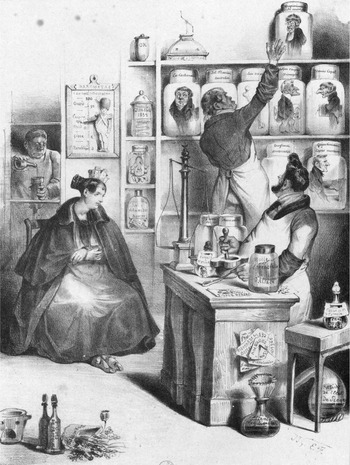
This close relationship between the struggle for democracy on the one hand and a new healthcare system on the other is reflective not only of Raspail’s personal goals, but of the period in which Raspail was active. Raspail’s popularity rose to prominence during the Monarchie de Juillet (1830-1848) - a period that saw both the rise of democratic movements and democratic revendications (which resulted in the 1848 revolution, the abolition of slavery and the adoption of the universal suffrage), and a great moment for the consolidation of medical and pharmaceutical monopolies.Footnote 3 This combination explains why new images that combine politics and medical issues appeared in French society at this time. For instance, Grandville was an artist who drew caricatures of health professionals. In this image dating from 1832 (fig. 1), King Louis-Philippe is depicted as a pharmacist. During this period, France was changing its leaders, and consumers were changing their remedies. The correlation between the two is evident in this caricature’s symbolism: France is represented as a sick patient, the King is depicted as a pharmacist and the political choice of government is depicted as a medical remedy.
Grandville, « Donnez moi la première chose venue » (la scène se passe chez le pharmacien royal. Il s’agit de composer un remède), La Caricature, n°101, 1832, BNF, Gallica.

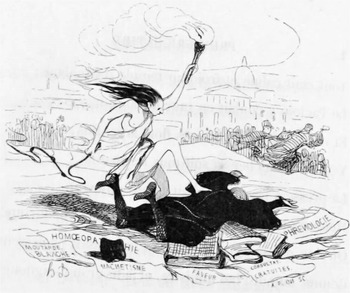
Raspail’s ideas are interesting not only in themselves but because they are a part of a period that had begun to reclaim democracy, particularly in the field of health. Indeed, denouncing the counter-productive effects of excessive medicalization of populations is contemporaneous with the development of nineteenth century medicine, as witnessed by the success of the aptly named Némésis médicale, illustrated by Daumier and written by François Fabre. The volume ironically describes the academy, with its degrees, its specialists, its hospitals and its pharmacists, the very targets of Raspail’s own publications. The picture below (fig. 2), illustrates the many competitors that medicine must have faced, including homeopathy, phrenology, magnetism, secret remedies or free medical consulting. This picture, and the book of which it was a part, represent the complex landscape in which Raspail’s ideology was allowed to spread: a weak and contested official medicine, a proliferation of alternative medicines, and a widespread demand for change in the regulation of the health care system.
F. Fabre, Némésis médicale illustrée, Reference Fabre1840 (vignettes par Honoré Daumier).

But why was Raspail’s system really democratic? Authors who have written about it (Poirier and Langlois Reference Poirier and Claude1992) have asserted that it was indeed democratic, firstly because it was an egalitarian system (defending free access to treatments for instance), secondly because it was founded on a type of scientific discourse that was very accessible to the reader, and finally because it was, at the same time, a system driven by a state that could guarantee an equal distribution of doctors within territories all over the country, and a system that encouraged decentralization; in other words, not an authoritarian state. It promoted an ideal type of medicine that gave power back to patients who recognized their own knowledge surrounding the subject of their health.
All these arguments are true and I will elaborate on some of these points later in this text. But Raspail’s work has also raised questions that have yet to be mentioned. The purpose of this paper is to bring light to their existence and to analyse them within their social and political contexts, in other words, within what was the growing demand for democracy in France during the 1840s. This paper also seeks to understand the influence of these ideas by studying the controversies to which they gave birth.
In the early 1840s, when François Vincent Raspail spoke publicly on the subject, he was the principal theoretical and political opponent of a form of medicine that had become known for its monopolistic leanings and minimal interest in therapy. This role had previously been taken up by François Broussais, a medical doctor who was, until his death in 1838, the proponent of a unifying theory of illness, founded on the notions of inflammation and irrigation and of the use of leeches - a therapeutic practice that was to become extremely popular (Broussais Reference Broussais1816, Faure Reference Faure1994, 85). As the spokesman for political liberalism, he gained favor among medical students and so became one of the targets of the government’s post 1823 attempt to regain control over the medical profession. While Raspail, unlike Broussais, was not a medical doctor, both men shared certain leanings that were emphasized by their detractors, one of them being an impassioned democratic statement of intent.
The history of alternative medicine as a political history
This article contributes to the history of alternative medicines and of medical pluralism, as it has been depicted by western historiography for over ten years (for instance: Bivins Reference Bivins2007, Monnais Reference Monnais2016, Jackson Reference Jackson2018). The present contribution owes much to French historiographical research, which has clearly shown that we must no longer consider these medicines as “parallels” (Guillemain and Faure Reference Guillemain and Olivier2018). Indeed, these practices are not far removed from the medical academic world. Most of the practitioners defending them were doctors, as we can see through the example of homeopathy. Most of practitioners were also social actors, trained in the field of health (herbalists, pharmacists, etc.). Along the same lines, patients were not able to see academic practices and alternative medicines as two very different worlds. The sick who had adopted these alternative practices did so with rational objectives that were linked to treatments, but also took into consideration economic, political and spiritual motives. There are multiple ways to rewrite this history and to include all of these additional actors (starting from women’s point of view, for instance). In addressing the historical figure of Raspail, I have chosen to evoke the political dimension of these alternative medicines.
The choice to cure oneself with alternative medicine is not only an act of consumption, but also a political act, as has been shown by the authors of the collective volume The Politics of Healing (Johnston Reference Johnston2004). This especially holds true when speaking of the nineteenth century. The almost simultaneous emergence of Mesmerism, homeopathy, acupuncture, and phrenology between the end of the eighteenth century and the first half of the nineteenth century in France, coincides not only with the French political turmoil (1789, 1830, 1848), but also with the professional reorganization in the world of health.
The social actors that can be found within medicine were often also political actors. As shown by Olivier Faure, the diffusion of homeopathy was part of a plan to build a new social order, which explains the tightly knit relationship between homeopathic practitioners and French socialists (Faure Reference Faure2018). In the United Kingdom, this practice was also supported by radical liberalism (Bivins Reference Bivins2007, 103). Raspail’s method, which appeared in the context of both revolution and the professional reorganization of the health system, can be studied from a similarly political point of view. In doing so, we may consider Raspail’s manuals as a form of expression that argues in favor of democratic and social equality with originality and force.
In what follows, this article will develop three questions: first, why Raspail considered the academic medicine of his time to be undemocratic and anti-modern; second, on which basis he proposed to organize an emancipating citizens’ medicine; and third, what kind of controversies his system generated. I shall base my analysis on four of Raspail’s works: Histoire naturelle de la santé et de la maladie (first edition, Reference Raspail1843), Médecine des familles (Reference Raspail1844), Manuel annuaire de la santé (Reference Raspail1845) and especially numerous articles from the Revue élémentaire de médecine et pharmacie domestique, published between June 1847 and May 1849. Moreover, I draw upon a corpus of books that were written in reaction to Raspail’s method between 1846 and 1874.
An academic medicine far from modernity and democracy
Medicine that doesn’t cure
Before establishing a new democratic system in the field of health, Raspail built democratic criticism surrounding contemporary medicine within two domains: therapy and economy. He positioned himself as the radical reformer of a discipline – medicine - the foundation of which seemed to him a pseudo-science without any capacity for progress, paralyzed by its respect for the Ancients. Raspail’s principal target was the Hippocratic roots of contemporary medicine. Despite the expansion of new anatomical and clinical knowledge based on the relationship between clinical symptoms and organic injuries, the early nineteenth century witnessed a Hippocratic revival, which consisted primarily of the rediscovery of thermal and mineral waters, but which also took the form of medical practices that were sometimes considered archaic.
In his Revue élémentaire de médecine et pharmacie domestique (Reference Raspail1847-1849), Raspail denounced several of these archaic practices as life threatening to patients. Among them were bloodletting, the source of the “Hippocratic visage” of those who succumbed to the practice (Raspail Reference Raspail1847, 29), and setons, an ancient revulsive practice, in which a strip of cloth, drawn through healthy tissue by means of a needle, is used to keep a wound open and so produce artificial suppuration, thereby facilitating the evacuation of unhealthy secretions. According to Raspail, this use of setons, recommended by doctors, was ineffective, irrational and painful:
Where the seton is practiced blindly, what good could it possibly serve, save creating either a wound or a sprain and so a disruption on an even larger scale than that of the subterranean disruption of the foreign body itself? And when the seton attains and crosses ligaments, tendons, the periosteum and other such organ near or surrounding a joint, imagine the consequences of the suffering that might arise from such an unfortunate solution of continuity. (Raspail Reference Raspail1848, 35)
Modern therapy, according to Raspail, was no better. The heading “correspondence” or “clinical” of the Revue élémentaire de médecine et pharmacie domestique presents numerous concrete case studies criticizing the recurrent, deleterious effects of the use of certain treatments termed “disrupters.” The massive use of mercury, for instance, is particularly criticized in this text:
In certain Parisian hospitals, to the utter astonishment of physicians themselves, the pernicious influences entailed mortality amongst patients who, otherwise, were in no danger of death…. By continuing to give patients disruptive treatments such as arsenic or mercury, they assuage their consciences, relieving patients of flaky scabs while poisoning their innards…. And so, contagion, not via illness but via medicines which saturated the bedding and which hospital laundries never managed to eradicate. And so, a patient enters the hospital with a scab and absorbs death simply by breathing and through every pore, a death conveyed by air and by perspiration. And so, death and autopsy. (Raspail Reference Raspail1847, 148)
Products based on mercury were delivered in a variety of forms (fumigations, ointments, plasters, baths, lotions, enemas and powders), in various doses and for numerous indications (Mérat Reference Mérat de Vaumartoise and Lens1832; Constant Reference Constant1864). The products were reputed to be dissolvents or evacuants recognized for their preventive powers against contagion, for skin conditions or venereal diseases.
Far from contenting himself with exposing, along with ever more numerous actors (Belliol Reference Belliol1829), the effects of long-term mercurial treatments and the iatrogenic production of mercurial affections, Raspail also considered the effects of a more wide-spread contamination of society due to the preventive treatment of wet-nurses, the multiplication of hospital-induced illness and the massive dumping of mercurial residue by hospital pharmacies (Raspail Reference Raspail1848, 151). To Raspail, camphor-alcohol would, among other things, serve as a milder palliative to the use of these practices. Thus, rather than advocating any form of therapeutic abstinence, and thereby succumbing to the prevalent temptation of expectant medicine, Raspail wanted to “restore to medicine the power of medication” (Raspail Reference Raspail1843, XLIX). His promotion of camphor was the reason the authorities accused him of “charlatanism” and it was also the result of his proposition to cure with efficiency, and without the use of invasive and intoxicating methods.
A medicine too close to its own interests
In his lengthy introduction to Histoire naturelle de la santé, Raspail summarized medicine as no more than a commercial activity. The commercial aspect of modern medicine, universally criticized by a public unable to adapt to paying cash for medical treatment, was, for him, the only reason for the existence of a profession whose privileges should have remained abolished by the French Revolution. Such is the origin of his virulent denunciation of the “paper” doctoral students who merely legitimize the abusive appropriation of the art of healing. Medicine, he claimed, is thus not a science, but merely a business based on a questionable and wholly outdated learned legacy, and on a usurped monopoly which must be exposed and circumvented (Reference Raspail1846, 73).
It must be acknowledged that Raspail was not as original as one would think, because his critique of a very expensive and inefficient medical establishment was commonplace at the beginning of the nineteenth century (Faure Reference Faure1993). What was more original, in contrast, was his critique regarding the new conflicts of interest born from the new French medical and pharmaceutical system. Of the many harmful effects of monopolistic medicalization as it took shape after the Revolution, Raspail chose to take aim at the ties between doctors and pharmacists. A prime example is his campaign against the methods employed by the pharmacist Boggio to commercialize kousso, a purgative used to expel tapeworms.
Our subscribers have asked us to tell them what we think of this kousso for which we’ve seen advertisements on the back cover of all the magazines…. The pharmacist sells 15 grams of the pulverulent substance for 40 francs. Kousso is sold for more than the price of gold, which is 40 francs for 13 grams. So, what is this expensive product for which the Academy of Medicine Report awards the monopoly to one single pharmacist? (Raspail Reference Raspail1848, 251).
In attacking the commercialization of a vegetable whose properties had long been known and which was simply the root of the pomegranate tree, Raspail is, admittedly, defending his private domain. The battle against the tapeworm – which, at the time, affected portions of the Parisian population – had become Raspail’s specialty. He had published numerous studies concerning the pathological effects of parasites, proposing to control them by the use of his products. He did so, nevertheless, either by advocating the use of substances which were less expensive than those of the official pharmacy, and therefore adapted to the purses of his Parisian clients, or by calling upon his readers from the South of France, who regularly supplied him with local pomegranate roots. Local versus global. Self-production versus a monopolistic economy.
Irrespective of the competitive context, Raspail used this campaign in order to expose the collusion between pharmacists and experts from the Academy of Medicine. Doctor François Victor Mérat de Vaumartoise (1780-1851), author of a comprehensive medical dictionary and a recognized specialist in the treatment of tenia (Mérat Reference Mérat de Vaumartoise and Lens1832), was also the author of the report concerning kousso, a report which transformed a natural product into a commodity distributed by a monopoly favorable to new pharmacists. Raspail emphasized this conflict of interest:
Since the root of the pomegranate tree is a native product, one which anyone can obtain without recourse to a pharmacist, in 1847, medicine, which has historically appreciated exotic, pricey cures, took to promoting the plant to which it had paid no attention at all in 1832. M. Mérat, the rapporteur for kousso, thus managed to applaud via an advertisement the very buyer who monopolized the sale of the merchandise…. The advertisement states in large type INFALLIBLE CURE FOR TAPE WORMS, APPROVED BY THE ACADEMY OF MEDICINE. From that point on, the advertisement is protected against criminal proceedings for the sale of secret cures. While perfectly academic, none of this is exactly ethical. (Raspail Reference Raspail1848, 252)
The above seems to represent the settling of accounts made by a “charlatan” who was losing his livelihood. But it is much more complex than that. This case took place during a period about to give way to the new Royal Academy of Medicine (1820) - a new power of expertise on “secret remedies.” These remedies had already been invented and used by “charlatans” for several decades and were very popular (Chauveau Reference Chauveau, Bonah and Rasmussen2005). Focusing on these conflicts of interest, Raspail contested the new political and medical order, which pretended to be able to differentiate the good and the bad remedies, including his own remedies against parasites.
In the name of a medicine that could be based on republican principles, he also strongly contested the unequal distribution of doctors throughout the French territory. Discussions on this last point were lively in the 1840s. In rural France, access to medical care was especially provided by women (midwives and nuns) or by second-class practitioners, known as officiers de santé (health officers). Some of these practitioners spoke provincial dialects, and were often criticized by representatives of the medical profession concerned with professional demography (Guillemain Reference Guillemain2009). The rapporteur for the sixth commission of the 1845 convention, Doctor Pierre Adolphe Piorry, was thus hostile to maintaining the status of health officers, a status he felt (with reason according to Jacques Léonard) had been usurped by charlatans who sold their cures throughout the countryside: “the designation must go” he explained in 1845 in the Gazette médicale de Paris. But he was also hostile to the generalization of free local medicine, financed by public funds and based on the model tested in several administrative divisions, for fear that it would supersede the already endangered corps of health officers. Thus, when Raspail published his method in the 1840s, the physicians reaffirmed the free-market and the monopolistic nature of medicine, in opposition to those who supported the development of a new local medicine (Guillaume Reference Guillaume1996, 53).Footnote 4 Though potential evolution towards a republican medicine was something of a utopian project in the 1840s, most of the new academic and associative medical authorities were resistant to this idea.
Individual emancipation and collective control: Civic medicine according to Raspail
Socialism or army? The models of Raspail’s reforms
Raspail wanted to destroy the theoretical system of modern medicine and questioned the benefits of certain practices, but that was not all. He also introduced an overall reform of the health-care system based on two pillars: the reorganization of public medicine and recourse to self-medication. Both challenged medical knowledge and the new way to educate young doctors.
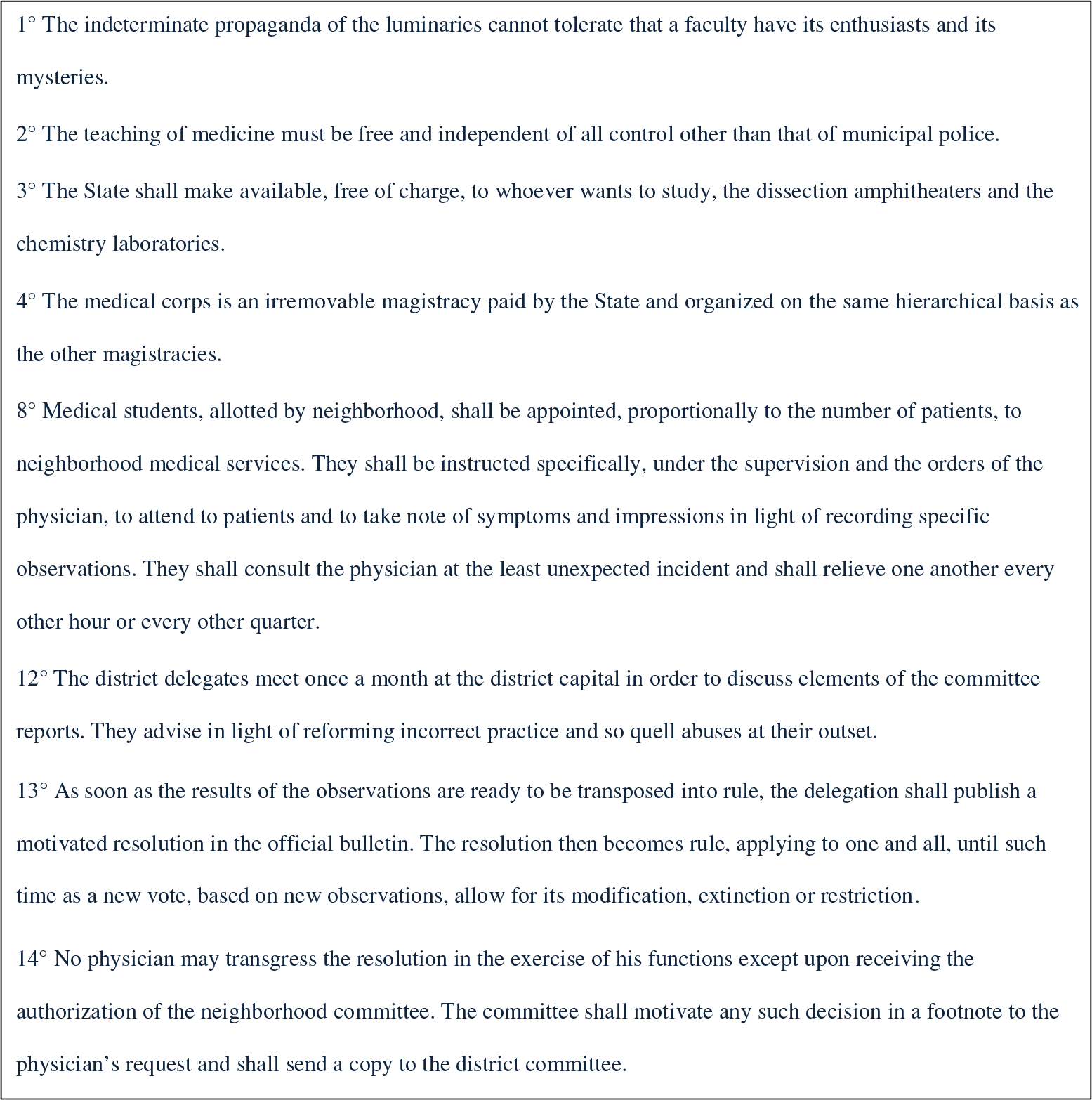
In the first edition of his Histoire naturelle de la santé et de la maladie (1843), Raspail developed an ambitious reform program based on 18 points (see excerpts in figure 3). This program was intended to transform the professional health system created during the Bonaparte Period. This system, created at the beginning of the nineteenth century, gave birth to a new way of educating young doctors – new schools, new methods of learning medicine, new knowledge - and of organizing the establishment of practitioners – very liberal for doctors, very restrictive for health officers. It determined who was able to officially contribute to curing people, including herbalists, pharmacists and midwives. This system had already existed for forty years when Raspail wrote his texts in the 1840s. Its potential reform was discussed during the Monarchie de Juillet: a great period of reform in other social fields like education (Guizot Law in 1833) and psychiatry (1838 law) to mention a few (about the “Guizot moment” see Rosanvallon Reference Rosanvallon1985). The 1845 medical congress also discussed the possibility of changing the system (Guillaume Reference Guillaume1996).
Excerpts of François Vincent Raspail’s reform program, Histoire naturelle de la santé et de la maladie, 1843, p. LVI-LVII.

In the course of this public debate, Raspail intervened against the supporters of free-market, monopolistic medicine, who sought to diminish the hold of other contributors to the system, be they health officers or supporters of Raspail’s own method for instance. In his counter-reform program, published in 1843, Raspail proposed that physicians be public magistrates financed by the state budget, whose responsibilities would be extended to include hygiene as well as the supervision of families and of public mores. He argued that state control and the democratization of the exercise of health care must, logically, be founded on an impressive bureaucratization in the form of neighborhood committees, inspectors, district committees and medical boards. The purpose of Raspail’s model thus corresponded to the aim of the state: mobilize doctors to contribute to the improvement of the population’s health. However, his proposition incorporated a revolutionary dimension as well.
Where did this model come from? Raspail was a republican and very close to the first French utopian socialists (Barbier Reference Barbier2016), though the influence of these socialists on Raspail’s project is not immediately perceptible because they were not focused on the healthcare system. The most likely model for this salaried medicine, relieved of commercial constraints, would have been military medicine, with its presumed role of offering equal services for soldiers and officers alike. For Raspail, it was a question of “transposing into the civil sector an improvement drawn from the military” (Raspail Reference Raspail1843, V). That is why Raspail appreciated health officers – those second-rank physicians whom doctors often confused with charlatans – as well as their practices, which might, he felt, be the mainstay of an equitable distribution of healthcare throughout the territory. Moreover, one should take note of the fourth point in Raspail’s program – “The medical corps is an irremovable magistracy paid by the State and organized on the same hierarchical basis as the other magistracies” – the basic principle of French republican ideology that was supposed to generalize the public recruitment of the social elites (see fig. 3). Nevertheless, there was a real limit to this clause: this recruitment was not based on a voting system, even though republicans asked for this during their political assemblies.
Medical Knowledge at stake
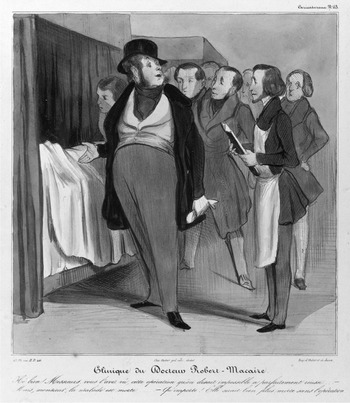
The social Republic could not condone unequal accessibility to health. But it could not deal with a sort of aristocratic conception of medical knowledge either. The freedom to teach medicine was one of the main points in Raspail’s program because medical students were his main target. Raspail was not alone in targeting this issue. The way of selecting medical students and the content of teaching in the new medical schools were objects of critiques in French society. For instance, in the Nemesis medicale volume (1840), already quoted in the article, four chapters were dedicated to these topics. Many caricatures reproduced in the French press mocked the clinical visit professors made to teach medical students in the hospitals. In figure 4, for instance, the assembly of students are taught by the professor Robert Macaire about the “successful” operation that led to death of the patient.
Clinique du Docteur Robert-Macaire par H. Daumier, 1847, Bibliothèque municipale de Lyon, open licence.

Along the same lines, Raspail criticized the education of young interns, dispatched to patients’ bedsides without any practical training. Raspail defended another model of learning, one linked more intentionally with personal experience. He proposed, for instance, opening teaching institutions, including their amphitheaters and laboratories, to the people, and advocated for the development of new methods of validating scientific discoveries. Academic learning and professionalization were the enemies of followers of domestic medicine. At the end of the day, who were the best health experts? Raspail argued that it was the patients and those near to them who were the true experts, an idea that he emphasized in his introduction to the review:
I’m convinced that maternal concern has always, and in every case, been what saved more children from ill-considered medical prescriptions than were saved by medicine, in spite of the anticipations of maternal concerns. The physician’s eye merely skims the surface of the symptoms of the illness. The mother’s eye delves into them and studies them continuously. The physician, who appears only once every twenty-four hours, is unaware of what the mother learned during his absence. Here the ignoramus is the physician. The learned person, by dint of plain common sense, is the mother. The instinct of a mother’s providential affection escapes the indifference of the profession. (Raspail Reference Raspail1847, 10-12)
Raspail also made space for non-professionals within his program. The attempt to constitute a network of auxiliary home nurses, or the use of advice from the commères – village women – were means of expanding a form of amateur care beyond the confines of the family. Thus Raspail’s program outlined the foundation of what might be considered the premise of democratic medical care by liberating education, questioning the foundations of clinical teaching, and associating families and amateurs with the process of curing.
Everybody is able to cure… themselves at least
The second element of Raspail’s proposed reform advocates promoting each citizen to the rank of caregiver. L’histoire naturelle de la santé et de la maladie opens with a proclamation in favor of reasoned self-medication: “this book hopes to hasten the advancement of your medical emancipation, to introduce medicine into education, to render it ordinary and domestic and to put each and every individual in the position of becoming, one day, and at modest cost, his own physician” (Raspail Reference Raspail1846, VI). One need only prolong, naturally, the tradition of “the physician within you,” a tradition that has existed since ancient times and which assimilates the act of healing into a form of daily hygiene, similar to the act of eating. As Raspail said in the introduction to the first volume of the Revue élémentaire de médecine et pharmacie domestique, “one can choose to heal oneself just as one can choose to eat at one’s whim” (Raspail Reference Raspail1847, 9). Clearly, in this period, the boundary between the medical and the alimentary spheres was in no way inviolable. But Raspail’s program revitalized this tradition since, for him, it would henceforth be necessary to fashion a popular science based on the observations of laymen who are themselves patients.
While Raspail’s defense of subjective medicine is clearly aimed at supporting the diffusion of his method, it is no less interesting in its affirmation of the patient’s role in the clinical realm and in treatment, elements which nineteenth century medicine was progressively eradicating. This espousal of self-diagnosis and self-medication is no easy gamble, given the nature of the laws that were governing the health-care system. Even so, by presenting himself as a health instructor, Raspail managed, to a certain extent, to circumvent accusations of practicing medicine without a license, since that implies taking consultation fees and the direct delivery of remedies. Here, in contrast, the consumer could easily be a producer as well.
Considering the patient as their own doctor or their own pharmacist ran contrary to the evolution that was taking place in the healthcare system. Nevertheless, this perception remained very common in the nineteenth century and into the twentieth century as well. Popular books about domestic and familial medicine, especially almanacs, grew increasingly numerous in the nineteenth century (Bensaude-Vincent and Rasmussen Reference Bensaude-Vincent and Anne1997). Some of them were produced by doctors themselves to educate people on modern medicine (Noirot Reference Noirot1841). Others were written by people who were not professionals, but who could be considered as auxiliaries of this medical discourse (Munié Reference Munié1911). Yet others, on the other hand, were more clearly demanding in their advocacy of practicing self-medication without a professional’s help (Chaupitre c. 1920). Frequently this discourse was carried out by defenders of alternative practices. Magnetism, naturism and homeopathy were the most common practices that engaged the patients in the recovery of part of their own power of curing (Guillemain and Faure Reference Guillemain and Olivier2018). Raspail’s program was part of this emergence of a reconsideration of patient power after the establishment of professionalization in the field of health. In a way, Raspail’s method was a side effect of medical history.
Beyond controversies: The political survival of Raspail’s method
The massive distribution of the Raspail Method
Considering the way Raspail fought against the new healthcare system born at the beginning of the nineteenth century, how was his method received after its publication in the 1840s? Jonathan Barbier has clearly shown in his dissertation how powerful the distribution of Raspail’s most important text was. This book, the Manuel annuaire de la santé, sold 80,000 copies in just one year, and remained in print until 1935 (Barbier Reference Barbier2016, 326). A large number of translations were published: in Spanish (Manual de la salud in 1848), English (Annual diary of health in 1846), and in many European languages including Danish and Eskimo (1866). Flaubert, though an antisocialist author, was nevertheless interested in the democratic ideal of Raspail’s medical reform. He depicted Raspail’s main work as very popular in his novel Bouvard et Pécuchet (Sugaya Reference Sugaya2013). The last sign of this impressive diffusion: Vincent Van Gogh, in his Still-life with drawing board, pipe, onions and sealing wax, includes a copy of Raspail’s Manuel annuaire de la santé on his table. This was painted in 1889, half a century after the publication of the book. Obviously Raspail’s reputation persevered, despite his arrest 1848, six-year prison sentence, and enforced exile in Belgium between 1853 and 1863. Nevertheless, during these 15 years Raspail’s visibility clearly decreased in France, and there were few references to his method in the French press during the 1850s.
Despite his exile and his unbalanced fight against doctors, Raspail did receive support. Among doctors, Dr. Cottereau, who was professor at the faculty of medicine of Paris, was one of his best supporters (Barbier 319). Dr. Marquet, a military surgeon, became a practitioner of Raspail’s Method after he met him in a jail in Vincennes (Marquet Reference Marquet1851). At the same time, Henri Castel, who was beginning his studies in medicine in Lille to become a health officer, became one of Raspail’s disciples as well (Castel Reference Castel1858). Homeopathic practitioners also provided Raspail with a lot of support. Charles Labrune for instance, a homeopathic doctor, criticized Raspail’s scientific approach and his radicalism, but took into account several of his questions surrounding medical learning and conflicts of interests in medicine (Labrune Reference Labrune1854). In other words, according to Labrune, Raspail’s work, though not really scientific, was useful for all who wanted to bring a more republican and democratic vision to the medical profession. The same idea is also reflected in the Médecine pratique universelle, published in 1874 by the Dauphinois brothers, in which they proposed a medical strategy combining traditional plant medicine, homeopathy, official medicine and Raspail’s method (Dauphinois 1874), or in the Grand dictionnaire de la santé, which combined Raspail’s method and homeopathy (Parent Aubert Reference Parent1853).
Raspail in the realm of alternative medicines
This type of alliance between Raspail and other alternative medicines is not unexpected. Indeed, these alternative practitioners shared many similar ideas concerning the critical approach of medical modernity. For instance, in evoking the harmful effects of the massive use of mercury, Raspail developed a critique on the perverse effects of medicalization that could also be found in the work of Samuel Hahnemann, the founder of homeopathy (Hahnemann Reference Hahnemann1835, see Faure Reference Faure2015). The ideological companionship between Raspail and other alternative practitioners also concerned the new practice of anesthesia, which was considered innovative in the nineteenth century, but also controversial. Raspail, for instance, was not convinced of the benefits of the proliferation, in the late 1840s, of anesthesia by ether or by chloroform. The articles published between 1847 and 1849 in the Revue élémentaire de médecine et de pharmacie were contemporary with the rapid development of anesthesia. It was a revolutionary technique, which began in 1846 with the first American operations. Raspail saw in the welcome accorded to this practice a trend that it was imperative to resist:
In short, this innovation is not one at all. In comparable situations, whatever ether has to offer, any other inoffensive gas can do as well. Its use in surgery has no interest other than an appalling infatuation which may have served the interests of the medical community but which was, we can assure you, disastrous for the interests of mankind. (Raspail Reference Raspail1847, 34)
Raspail’s words, however critical they may be, are hardly surprising given the chorus of contemporary reactions. Indeed, even in its early stages, the practice of anesthesia gave rise to numerous oppositions. Catholics envisaged a genuine moral threat, since anesthesia leads to unconsciousness and thus to the suspension of free will. Surgeons were concerned that their practice would be adversely affected (Rey Reference Rey1993). Denouncing the numerous accidents that occurred in hospitals was hardly original (Raspail Reference Raspail1847, 210) since accidents were regularly mentioned in the popular press. More interesting is the attention given to the increase in surgical operations as a result of new forms of anesthesia. The various new methods of anesthesia would become, according to Raspail, a disguised means of multiplying the number of useless surgeries. The question, as was so often the case for Raspail, was one of defending his own method of anesthesia – camphor, of course –, but Raspail also introduced his readers to another, gentle means of anesthesia borrowed from other practitioners. When anesthesia does prove to be necessary, Raspail advocated somnambulism induced by magnetizers (Carroy Reference Carroy1991), as long as they do not act like peddlers.
Magnetic sleep was far more advantageous and far less dangerous than the sleep produced by ether! Why, then, did Parisian surgery not attempt to discover what might be genuine about it? (Raspail Reference Raspail1848, 248)
Thus, Raspail’s ideas were not as far off from those of doctors who advocated the surgical use of magnetism, like Jules Cloquet for instance (Cloquet Reference Cloquet1829). But from that sort of argumentation he also contributed to a widespread critique of medicine that emerged from all the alternative practices born during the past decades.
Resisting by practicing
Of course there were also many contradictions in Raspail’s method. From 1846, the date of the trial set by the French doctors against Raspail’s method, several papers and books were dedicated to its political and medical denunciation. One of the first, and probably the most violent, was written by the doctor Langlebert, who was trained by the Paris faculty of medicine and was a chemist as well (Langlebert 1846). In his Reply to Raspail, the chemist criticized Raspail’s defense of the existence of a panacea, a single remedy for a single cause of disease. This argument was not particularly original, as it was the usual criticism made by doctors against “charlatans.” To combat Raspail’s democratic ideology, the Parisian doctor defended the representation of his profession as a priesthood – an image frequently mobilized by doctors themselves to defend the medical corporation when confronted by its bad reputation in the nineteenth century. But Langlebert’s strongest argument against Raspail was political. According to Langlebert, like all revolutionaries and “insane innovators,” Raspail should be perceived as mad (Langlebert 3). This argument could certainly be understood as a conservative position, which is why doctor Langlebert did not forget to mention his own modest condition: he was not one of the respected doctors within the medical hierarchy who had sued Raspail, but a “proletarian” doctor fighting against his equal, who was considered as “the doctor of the people.” The medical press recognized Langlebert as the spokesman for academic medicine because he worked to convince the public that was “infected by camphor” – or, in other words, infected by Raspail’s ideas.
Most of these anti-Raspail books were written by second rank doctors in the 1850s and they repeated the same arguments. They sought to support the Hippocratic practices – bloodletting and purges - that Raspail wished to erase from the medical arsenal (Blanchon Reference Dr1853). They defended the existence of a special vocation for doctors, proclaiming that the profession was not simply a commercial activity, as Raspail asserted (Guillemain Reference Guillemain2009). They considered Raspail’s socialist ideology as a complete contradiction to medical liberalism.
In a way, the controversy that developed between 1846 and the end of the 1850s could be understood equally in medical and political terms. But one could also understand all these reactions in relation to the general mobilization of academic medicine against alternative medicines. We must recall that homeopathy was officially marginalized for the first time by the Royal Academy of Medicine in 1834. Then a special report was written in 1837 for the same academy by Dubois d’Amiens against the practice of magnetism (Berna Reference Berna1838). Five years later, Flourens wrote a refutation against phrenology (Flourens Reference Flourens1842). The battle against Raspail’s method cannot be understood without reference to this trend: academic authorities had to defend themselves from all these doctrinal and political attacks, from wherever they may come.
The third way of thinking about this controversy is to place it in the global context of two revolutions: the first was led by democrats, republicans and socialists and it gave birth to the second republic (with the help of Raspail); the second was led by Louis Napoléon Bonaparte and gave birth to the Second empire in 1852. Raspail’s method survived the political and medical reactions to it, and the exile of its founder. Moreover, it survived because of these reactions and his political exile. Indeed, during the authoritarian years of the Second Empire in the 1850s, practicing Raspail’s method was a way to resist French political power. Raspail gained the support of outlawed republicans after the foundation of the empire (Barbier Reference Barbier2016, 503). The publication of the Revue élémentaire de médecine et pharmacie domestique was thus the best way for Raspail to follow up his political work. It should be duly noted, for example, that this publication was read by French political refugees in Belgium.
Conclusion
In this article, I hoped to show that, given its cultural heterogeneity, the age-old tradition known as “charlatanism” — a tradition that constitutes an identifiable social group only through the recurrent attempts to condemn it — acquired a new dimension in the context of 1840s France. Several factors come to the fore. The creation of a new healthcare system based on professionalization and intended to foster monopoly carried significant consequences, the most notably the Raspail trial, which was held within months of an influential medical conference calling for improved repression of charlatans (Guillaume Reference Guillaume1996). Advances in knowledge and improved techniques born of the rapid development of clinical and anatomical medicine were widely disseminated. A new generation of urban, well-read healers gained legitimacy on the basis of their scientific culture, while their rural counterparts remained anchored in ancient practices (Léonard Reference Léonard1992, 75). Finally, the post-Napoleonic context was conducive to the desire for social and democratic aspirations (Becker and Candar Reference Becker and Gilles2004).
In his study of popular and professional medicine from 1770 to 1830, Ramsey suggests classifying non-professional healers as “bad boys” (Ramsey Reference Ramsey1988, 292). The sources which, at the time, stigmatized those diverse actors stressed not just the gamut of their failings (as libertines or heavy drinkers), but also their social marginality. At best, they were figureheads of their communities; at worst, madmen. François-Vincent Raspail, whose activity immediately follows that of the subjects of Ramsey’s study, modifies several dimensions of the healthcare “bad boy” profile. Raspail’s practice of popular medicine, bereft of any legality and depending upon his mass marketing of camphor as a universal treatment, echoes the practices of “charlatans” and their circles. That being said, as a scientist, a popularizer of encyclopedic knowledge and a political activist – given his engagement in favor of social utopia – he managed to blur traditional distinctions between science and politics and between popular and learned medicine. As a shameful subject of the king, whom he regularly defied, Raspail was also a constant thorn in the side of academic institutions and professional organizations that were struggling to gain legitimacy.
There are thus a number of different ways to understand Raspail’s place in the history of medicine. Viewed from afar and in the interest of establishing long-term continuities, he might be seen as the ultimate representative of the ancient tradition of self-care. But on the basis of a more discriminating contextualization, Raspail’s place in history takes on a new meaning. Raspail’s method was his response to the most recent institutional and therapeutic developments of the French healthcare system. His method was a reaction to the failings of the system in the eyes of social circles whose demands, in the nineteenth century, were becoming ever more insistent. That response took a political turn when Raspail combined, within a single project, his approach to treatment and his call for democratizing medical care. Raspail incarnated a new modernity for popular medicine. He acknowledged the importance of the patient’s contribution to the healing process, and he recognized the necessity of thwarting the occasionally deleterious effects of monopolistic medicalization and its neglect of therapeutics, engaged as it was in its irrational pursuit of technical progress.
It would thus be mistaken to consider the 1846 Raspail trial as yet another repetition of the time-worn conflict between physicians and charlatans. Instead, and much more tellingly in my opinion, it should be understood as a significant change of the tradition, based on a new definition of the boundary between scholars and laymen (Guillemain and Richard Reference Guillemain and Nathalie2016). This revision occurred in a far more comprehensive context than that defined within the confines of science and medicine. Presented as an outlaw and a charlatan throughout the trial, Raspail introduced a new dimension to the tradition by developing a form of popular medicine based on closely-connected fields, specifically chemistry and parasitology, and by proposing a thorough overhaul of healthcare, one intended to democratize the physician-patient relationship. He transgressed customary boundaries of knowledge. He brought to the practice of medicine knowledge drawn from diverse disciplines, such as chemistry, agriculture and education, in some of which he had gained genuine recognition.
How, then, should we approach these marginal figures in the process of writing the history of the science of medicine? In accordance with an approach from below, both to science and to social history, let us consider the diversity of healthcare actors and of each actor’s specific rationale. Seen in context, those specificities allow for producing a fuller and more subtle account of medical history, one which addresses, in particular, the occasionally pernicious effects of the medicalization of society. Studies of these healthcare actors constitute a viable antidote in the face of the ever-present risk of producing medically-centered accounts, even when, in the wake of Foucauldian reflections on the relationship between knowledge and power (Toms Reference Toms2009), those accounts are intrinsically medically critical. Furthermore, they constitute a renewed approach to the group of scientific amateurs, amongst whom figure charlatans and practitioners of alternative methods (Guillemain and Faure Reference Guillemain and Olivier2018). Those same figures lead to the study as much of the connections between orthodoxy and heterodoxy as of the disagreements between them, which heretofore have monopolized the attention of historians of medicine. Patients, furthermore, have long transgressed this boundary the two realms, via their strategic, well-reasoned and non-exclusive reliance on both (Ramsey Reference Ramsey1988, 280; Faure Reference Faure1993).
If the status of medical “bad boys” positions them firmly on the boundary between professionalism and amateurism, and between the learned and the popular, the sociology of the groups which champion them and the economic, political and religious questions they raised makes them a central element of social history. The healer is a major economic actor who, by stimulating self-production of diagnoses and of cures or by challenging the new health professions, wrests a portion, albeit limited, of the financial manna born of patients with sufficient means out of the control of the medical mainstream. He is a cultural agent, attuned to the curative aspirations of the sick influenced by the century’s new beliefs. Finally, he is also part and parcel of the political conflicts dividing French society. The connections between alternative medicine and social utopian yearnings, whether of homeopathic socialists (Faure Reference Faure2015) or anarchist naturists (Baubérot Reference Baubérot2014), are every bit as evident as the connections between the history of certain healers and the most reactionary circles. This can be seen, for instance, in the collusion between veterans galvanized by the hope of regenerating a 1930s society and conscious autosuggestion as practiced by Coué (Guillemain Reference Guillemain2010). Over and above their obvious theoretical and technical diversity, these actors must be considered as a coherent historical phenomenon intimately connected to the evolution of medicine and of society.
Hervé Guillemain is a professor of contemporary history at Le Mans University and a member of the TEMOS CNRS 9016 laboratory. Specialist in the history of health, he is the director of the Dictionary for a political history of health (online).