In social cognitive theory, humans are viewed as agentic, which means we are able to exert self-influence in the pursuit of valued outcomes (Bandura, Reference Bandura1997, Reference Bandura2002). Our capacity for agency is due to distinctive cognitive capacities, including the ability to think not only about our present but also about our future, and the ability to think not only about our world but also about ourselves as actors in that world. No cognitive skill plays a more central role in human agency than do judgments about ability to perform as actors in the world (Bandura, Reference Bandura1977, Reference Bandura1997). In both experimental and correlational research, self-efficacy judgments, or thoughts about abilities to perform specific actions in specific contexts, have been shown to influence decisions about which activities to pursue, how much effort and persistence is exerted once an activity is undertaken, and the ultimate quality or level of that performance (Bandura, Reference Bandura1997; Stajkovic & Luthans, Reference Stajkovic and Luthans1998). It is not surprising that low self-efficacy for valued actions also has important affective consequences (Caprara & Cervone, Reference Caprara and Cervone2000), and one of these may very well be depression (Bandura, Reference Bandura1997).
Low self-efficacy is thought to lead to depression via multiple mechanisms (Bandura, Reference Bandura1986). In general, though, individuals are thought to become depressed when they doubt their ability to perform actions required for valued outcomes (Ahrens, Reference Ahrens1987). In several longitudinal studies with adults, self-efficacy beliefs for parenting (Olioff & Aboud, Reference Olioff and Aboud1991), work-related goals (Pomaki, ter Doest, & Maes, Reference Pomaki, ter Doest and Maes2006) and other personally important domains (Olioff, Bryson, & Wadden, Reference Olioff, Bryson and Wadden1989) have been found to predict depressive symptoms. Self-efficacy is also thought to influence depression via its impact on social relationships. Doubting one's ability to interact and connect with other people makes it more difficult to form the types of positive social relationships that make one less vulnerable to depression (Segrin, Reference Segrin2000). It is not surprising that social self-efficacy has also been found to predict greater depressive symptoms in both adults (Holahan & Holahan, Reference Holahan and Holahan1987) and children (Bandura, Pastorelli, Barbaranelli, & Caprara, Reference Bandura, Pastorelli, Barbaranelli and Caprara1999).
Although a number of studies have found relationships between self-efficacy and depression (Bandura, Reference Bandura1997; Bandura, Caprara, Barbaranelli, Gerbino, & Pastorelli, Reference Bandura, Caprara, Barbaranelli, Gerbino and Pastorelli2003; Bandura et al., Reference Bandura, Pastorelli, Barbaranelli and Caprara1999; Muris, Reference Muris2002; Scott et al., Reference Scott, Dearing, Reynolds, Lindsay, Baird and Hamill2008), we believe there are three important areas in which this research could be advanced. First, there have been few studies that have examined the relationship between self-efficacy and depression in youths (Bandura et al., Reference Bandura, Pastorelli, Barbaranelli and Caprara1999; Ehrenberg, Cox, & Koopman, Reference Ehrenberg, Cox and Koopman1991; Muris, Reference Muris2002),Footnote 2 and none with minority youths. Second, there have been even fewer longitudinal studies examining the self-efficacy and depression relationship (Bandura et al., Reference Bandura, Pastorelli, Barbaranelli and Caprara1999, Reference Bandura, Caprara, Barbaranelli, Gerbino and Pastorelli2003). Moreover, all existing longitudinal studies of the self-efficacy–depression relationship in youths or in adults have relied on between-person analyses. A remaining question of both theoretical and clinical import is whether within-person changes in self-efficacy predict corresponding changes in depression. Third, no studies have examined potential moderators of the self-efficacy–depression relationship, even though Bandura (Reference Bandura1986, Reference Bandura1997) has emphasized that self-efficacy is not a single-factor theory and that it must be understood as potentially interacting with other personality characteristics.
Present Study
In this study, we attempt to address some of these limitations in the self-efficacy and depression literature. Specifically, in a longitudinal design, we examined both between- and within-person relations between self-efficacy and depression in an American Indian (AI) youth population. We also investigated the potential moderating roles of cultural identity and theories of intelligence on any association between self-efficacy and depression.
Role of Self-Efficacy in Depression in AI Youths
Despite the oft-made observation that depression is a serious mental health issue in AI communities (Whitbeck, McMorris, Hoyt, Stubben, LaFromboise, 2002; Yates, Reference Yates1987), we know very little about it (Manson, Reference Manson, Dixon and Roubideaux2001).Footnote 3 In understanding depression in AI youths, it is important to recognize the unique context that many AI youths experience. AI reservations are often contexts of poverty and instability (US Census, 2009). Much recent empirical work has demonstrated that such economic deprivation is likely not without costs to the mental health of AI youths (for reviews, see Dearing, Reference Dearing2008; Evans, Reference Evans2004). However, AI culture and communities may also offer their youths unique resources for optimal development (Caldwell et al., Reference Caldwell, Davis, Du Bois, Echo-Hawk, Erickson and Goins2005), particularly via traditional cultural values and practices (McDonald & Gonzalez, Reference McDonald, Gonzalez, Hays and Iwamasa2006; Whitbeck et al., Reference Whitbeck, McMorris, Hoyt, Stubben and LaFromboise2002). In short, studies of the development of depression in AI youths are critical given the unique risks and resources these children face. One key factor that appears likely to influence whether AI youths are able to capitalize on cultural resources, however, is how they think about their abilities to operate in this unique context (Bandura, Reference Bandura2002; Masten, Reference Masten2001).
Bandura (Reference Bandura1997) has argued that individuals can become depressed when doubting ability to perform actions related to valued outcomes. In youths, these valued outcomes are thought to involve age-salient developmental tasks that include performing well academically, socially, and behaviorally (Lerner, Phelps, Forman, & Bowers, Reference Lerner, Phelps, Forman, Bowers, Lerner and Steinberg's2009; Masten et al., Reference Masten, Hubbard, Gest, Tellegen, Garmezy and Ramirez1999).
Academically, developing youths increasingly consider the implications of their perceived academic abilities for their future, and they begin to consider whether they will pursue postsecondary education and what adult occupational roles are possible (Bandura, Reference Bandura1997). The importance of self-efficacy for academic activities is supported by studies showing that youths with higher academic self-efficacy report less depression (Ehrenberg et al., Reference Ehrenberg, Cox and Koopman1991; Muris, Reference Muris2002). In a prospective study with preteen Italian youths (Bandura et al., Reference Bandura, Pastorelli, Barbaranelli and Caprara1999), efficacy appraisals for academic activities directly predicted depression levels 1 year later, even though actual academic achievement did not. For AI youths, the importance of academic self-efficacy was supported in path analyses showing academic self-efficacy had both indirect and direct relations to depressive symptoms (Scott et al., Reference Scott, Dearing, Reynolds, Lindsay, Baird and Hamill2008).
Social interaction also presents new challenges and assumes new importance as youths progress into middle childhood and early adolescence. Youths increasingly view their status in social relationships to be a defining feature of the self, more important than physical or psychological characteristics (Harter, Reference Harter, Leary and Price2003). It is not surprising that youths lacking these skills are at risk for maladaptive outcomes (Elliot, Malecki, & Demaray, Reference Elliot, Malecki and Demaray2001), including depression (Segrin, Reference Segrin2000). Further, youths who have low self-efficacy for social skills (particularly in conflict situations) have higher levels of internalizing symptoms (Kim & Cicchetti, Reference Kim and Cicchetti2003). However, the only two studies to examine social self-efficacy and depression specifically have produced contradictory findings (Bandura et al., Reference Bandura, Pastorelli, Barbaranelli and Caprara1999; Ehrenberg et al., Reference Ehrenberg, Cox and Koopman1991). Whereas Bandura et al. (Reference Bandura, Pastorelli, Barbaranelli and Caprara1999) found that social self-efficacy predicted both concurrent and later depressive symptoms in a younger sample of Italian youths (average age = ~12 years), Ehrenberg found no association between social self-efficacy and youth depression in an older sample of American youths (average age = ~16 years). Finally, the influence of peers also assumes greater importance in early adolescence (Steinberg & Silverberg, Reference Steinberg and Silvergerg1986), particularly when it comes to engaging in transgressive behaviors, such as using substances or doing other activities that can lead to trouble (Capaldi & Shortt, Reference Capaldi, Shortt, Adams and Berzonsky2003). Children who succumb to such peer pressure fail to meet a major age-salient developmental task: behaving well (Masten et al., Reference Masten, Hubbard, Gest, Tellegen, Garmezy and Ramirez1999). Such negative conduct can lead to a variety of other negative consequences, including negative evaluations by parents and teachers, and rejection by peers (Kiesner, Reference Kiesner2002; Panak & Garber, Reference Panak and Garber1992).Footnote 4 Bandura et al. (Reference Bandura, Caprara, Barbaranelli, Gerbino and Pastorelli2003) found that youths who believed in their ability to resist such negative peer influences reported fewer depressive symptoms. Finally, no studies have reported on whether self-efficacy for either resisting negative peer influences or for social relations relate to depressive symptoms in AI youths.
Self-Efficacy and Youth Depression: The Value of Studying Within-Youth Change
A major limitation of all this empirical work on self-efficacy and depression is that it has been based entirely on between-person correlations. Even in methodologically sophisticated longitudinal studies (Bandura et al., Reference Bandura, Pastorelli, Barbaranelli and Caprara1999, Reference Bandura, Caprara, Barbaranelli, Gerbino and Pastorelli2003), it was between-child differences in self-efficacy that predicted between-child differences in both contemporaneous and later depressive symptoms (for similar empirical models estimated using adults; see Pomaki et al., Reference Pomaki, ter Doest and Maes2006). Longitudinal studies of within-youth associations between changes in self-efficacy and depressive symptoms would add to the field in two important ways. First, studying both of these phenomena as processes that may vary over time within the individual can help determine the extent to which changes in self-efficacy predict changes in youth depression. Demonstrating that youths with high self-efficacy have relatively low depressive symptom levels does not necessarily imply that changes in self-efficacy would lead to changes in depression. Second, using longitudinal data to estimate within-youth associations, which is referred to as individual fixed effects in the econometrics and, more recently, developmental psychology literatures, is a useful means of controlling for unobserved stable between-person heterogeneity, a source of potential bias endemic to nonexperimental between-person correlations (Angrist & Krueger, Reference Angrist, Krueger, Ashenfelter and Card1999; Duncan, Magnuson, & Ludwig, Reference Duncan, Magnuson and Ludwig2004; Hsaio, Reference Hsaio2003).Footnote 5 In addition, given the potential for reverse causation (i.e., depression influences self-efficacy rather than the reverse), lagged within-youth associations can be useful. More specifically, lagged within-youth associations can be used to answer questions such as do changes in self-efficacy predict later changes in depressive symptoms, even when controlling for preexisting depressive symptom levels?
Potential Moderators of Self-Efficacy/Depression Relationship
In addition to the above limitations in the literature, we were unable to find a single study, with youths or with adults, in which investigators examined potential moderating variables in the self-efficacy/depression relationship. However, within social–cognitive theory (Bandura, Reference Bandura1986, Reference Bandura1997), self-efficacy perceptions are viewed as operating within a larger self-system, in which they are thought to interact with other beliefs and knowledge representations to influence motivation, performance, and affect. Specifically, self-efficacy may interact with two important knowledge representations.
Cultural identity
One particularly important set of knowledge representations may be how one construes one's self and culture. With the exception of Scott et al. (Reference Scott, Dearing, Reynolds, Lindsay, Baird and Hamill2008), studies supportive of a relationship between self-efficacy and depression have been conducted with adult and youth samples from cultural contexts in which individuals are presumed to hold more individualistic value orientations (Suh, Diener, Oishi, & Triandis, Reference Suh, Diener, Oishi and Triandis1998). In recent years, however, a number of studies have found that predictors of emotional well-being can vary in different cultural contexts (Kitayama & Markus, Reference Kitayama, Markus, Diener and Suh2000). For instance, in European American cultural contexts, which emphasize self-autonomy and independence, adopting a more positive self-view is associated with affective well-being. However, in East Asian and Japanese cultural contexts, which emphasize social harmony and interdependence, the relationship between positive self-views and affective well-being may not be as strong (Heine & Lehman, Reference Heine and Lehman1999; Kitayama & Markus, Reference Kitayama, Markus, Diener and Suh2000). Therefore, for AI youths who strongly identify with AI culture, self-efficacy may not relate as strongly to depression.
In contrast to the view that culture moderates the relationship between self-efficacy and depressive symptoms, Bandura (Reference Bandura2002) has argued that possessing high self-efficacy is just as critical for collectivistic individuals. Even if an individual is more motivated by contributing to group-directed aims, Bandura has argued that he or she is just as dependent on a strong sense of personal self-efficacy. For instance, Gandhi, King, and Mandella each required robust personal efficacy for accomplishing collectivistic goals (Bandura, Reference Bandura2002).
Given that AI culture has been described as less individualistic and more collectivistic than Anglo cultures (Davis, Hoffman, & Nelson, Reference Davis, Hoffman and Nelson1990; Fryberg & Markus, Reference Fryberg and Markus2003), Scott et al.'s (2008) finding that academic self-efficacy directly predicted depressive symptoms in AI youths might be interpreted as lending support to Bandura's (2002) argument about the culture-free importance of robust self-efficacy. However, AI youths are exposed to both Indian and White cultural contexts, and there are individual differences in the degree to which AI youths identify with Indian culture, adopt its beliefs, and engage in its practices (Moran, Fleming, Somervell, & Manson, Reference Moran, Fleming, Somervell and Manson1999). Therefore, the possibility remains that AI youths who strongly identify with AI culture may show less strong relationships between self-efficacy and well-being.
Another reason for expecting a moderating role of AI cultural identity, particularly with self-efficacy beliefs related to both performing and behaving well in school, involves the historical genocidal efforts of the US Government against AI people and culture. Specifically, oppositional culture theory (Downey, Reference Downey2008; Ogbu, Reference Ogbu1978) argues that a minority group's valuing of and expectation toward school success is dependent on whether they were voluntarily assimilated or were forced to assimilate within the predominant culture. For minority groups who were antagonistically forced to assimilate, individuals may adopt a collective identity that perceives their group in opposition to current White-controlled institutions (i.e., school and educational settings). They also may be more likely to perceive obstacles from the majority culture and to view success in school as “acting White” (Fordham & Ogbu, Reference Fordham and Ogbu1986). In ethnographic research, scholars and researchers from diverse fields (Duran &Duran, Reference Duran and Duran1995; Whitbeck, Adams, Hoyt, & Chen, Reference Whitbeck, Adams, Hoyt and Chen2004; Yates, Reference Yates1987) have documented elements of oppositionality toward majority cultural participation among AIs, in which participating in the “modern Whiteman system” is even viewed as perhaps destructive for mental health (Gone, Reference Gone2007). Other AI scholars have commented that youths with high AI identity might reject the importance of academic success due to the historic meaning of mainstream educational systems for AI youths (i.e., forced acculturation; Whitesell, Mitchell, Spicer, & Voices of Indian Teens Project Team, 2009).
Finally, AI scholars and researchers have long theorized that engaging in traditional AI cultural practices promotes well-being and protects against the development of psychopathology more generally (McDonald & Gonzalez, Reference McDonald, Gonzalez, Hays and Iwamasa2006; O'Nell, Reference O'Nell1996; Yates, Reference Yates1987). Moreover, ethnographic interviews reveal this perspective to be common discourse among AI elders and tribal members (Gone, Reference Gone2007). There is some empirical support for these widely held viewpoints (e.g., Whitbeck et al., Reference Whitbeck, McMorris, Hoyt, Stubben and LaFromboise2002; Yu & Stiffman, Reference Yu and Stiffman2007). For instance, even when controlling for family background, income, parenting, negative life events, and other factors, AI youths who reported engaging in such traditional activities as dancing, singing, drumming at powwows, knowing and using tribal language, beading, spearfishing, and hunting reported lower levels of depressive symptoms (Whitbeck et al., Reference Whitbeck, McMorris, Hoyt, Stubben and LaFromboise2002). Therefore, to the extent AI youths identify with AI culture, they may be more immune from the otherwise deleterious consequences of low efficacy beliefs across domains.
Implicit theories of intelligence
Another important belief that may interact with academic self-efficacy, in particular, in predicting depression, is implicit theories of intelligence (Dweck, Reference Dweck1999). In addition to having thoughts about how well one is able to perform a given task, people have thoughts about smartness and other abilities. Entity theorists believe that ability is predominantly something you are born with, a finite quality that people either have or do not have. In contrast, incremental theorists believe that ability is something you can acquire through effort and learning, a malleable quality that one can develop. When coupled with low self-efficacy beliefs, these different ability conceptions (entity vs. incremental) are predicted to be associated with different motivational and affective reactions (Dweck, Reference Dweck1999). Specifically, because entity intelligence theorists believe intelligence is unchangeable, doubting one's current academic abilities may be particularly depressing. In contrast, the impact of low academic self-efficacy on depression may not be as detrimental for incremental theorists. Believing that intelligence is a skill that can be increased through effort and practice, incremental theorists who doubt academic abilities should view their current states as ultimately improvable, and therefore might be expected to continue to experience less depression.
Major Questions and Predictions
We used a cross-sequential longitudinal design to examine relations between self-efficacy judgments in several different domains (i.e., academic, social, and resisting negative peer influences to engage in problematic behaviors), AI cultural identity, theories of intelligence, and depressive symptoms in a group of young AI students residing on a Northern American Plains Indian reservation. We focused our study on three primary questions:
1. Do within-youth changes in academic, social, and resisting negative peer influences self-efficacy predict within-youth changes in depressive symptoms?
2. Do within-youth changes in academic, social, and resisting negative peer influences self-efficacy predict later within-youth changes in depressive symptoms?
3. Are associations between self-efficacy and depressive symptoms moderated by cultural identity or theories of intelligence?
For the first two research questions, we expected that increases in self-efficacy would predict decreases in depressive symptoms, both contemporaneously (our first research question) and in lagged models (our second research question). Although our study was focused on intraindividual change, we also examined between-youth differences in self-efficacy with the expectation that previous work (Bandura et al., Reference Bandura, Pastorelli, Barbaranelli and Caprara1999, Reference Bandura, Caprara, Barbaranelli, Gerbino and Pastorelli2003) would be replicated: youths with higher average levels of efficacy were expected to have lower average depressive symptom levels than youths with low efficacy. Thus, the proposed within-youth associations were expected to occur above and beyond any evident between-youth differences in levels of self-efficacy and depressive symptoms. Given the more consistent evidence supporting relations between academic self-efficacy and youth depressive symptoms (Ehrenberg et al., Reference Ehrenberg, Cox and Koopman1991; Muris, Reference Muris2002; Scott et al., Reference Scott, Dearing, Reynolds, Lindsay, Baird and Hamill2008), we expected the strongest support for these two questions to emerge for academic self-efficacy.
Regarding our third research question, we allowed associations between self-efficacy and depressive symptoms to vary by cultural identity and theories of intelligence. Given some literature points toward uniform effects across cultural identities (Bandura, Reference Bandura2002; Scott et al., Reference Scott, Dearing, Reynolds, Lindsay, Baird and Hamill2008) and other toward culture as potentially altering the effects of self-efficacy (Downey, Reference Downey2008; Kitayama & Markus, Reference Kitayama, Markus, Diener and Suh2000; Ogbu, Reference Ogbu1978), we did not predict an interaction. However, if an interaction were to be obtained, we expected that possessing high AI identity would lessen any relationship between self-efficacy and depression. On the other hand, we did expect an interaction between academic self-efficacy and theories of intelligence. Specifically, we expected that a relationship between academic self-efficacy and depression would only hold for individuals with higher levels of entity theories of intelligence. For youths with more incremental views of intelligence, we suspected that such beliefs would inoculate from the depressive consequences of low academic self-efficacy.
Method
Participants
Participants were 198 youths who attended a middle school on a reservation in the northern plains of the United States. All youths in this study were AI and were enrolled members of a northern plains tribe. Over a 3-year period from September of 2002 through May of 2005, we attempted to survey all fifth through eighth grade students at both the beginning (September) and end (May) of the school year (and also during December of the first year). Therefore, during both the second and third years of the study, a new group of fifth graders were surveyed (as they had been fourth graders the prior year) and the prior year's eighth graders were not surveyed (as they had graduated the prior year).
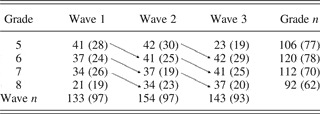
Table 1 displays this cross-sequential design, noting the number of children who were eligible to participate as well as the number with complete data. These data are displayed by wave, indicating the grades youths were in at these times. In total across the three waves of data collection, this design yielded complete data for 77 youths at fifth grade, 78 youths at sixth grade, 70 youths at seventh grade, and 62 youths at eighth grade. Consider, for example, the 106 youths who entered the study in the fifth grade: (a) 41 entered the study during Wave 1 and were eligible to participate in all three waves following them through the seventh grade, (b) 42 entered the study in Wave 2 and were in turn followed through their sixth grade year, and (c) 23 were observed only in the fifth grade during Wave 3 of the study.
Sample size by study wave and youth grade in school

Note: The number of participants with complete (no missing) data is in parentheses. For each wave, surveys were collected biannually (September and May) with the exception of Wave 1, in which three surveys were collected (September, December, and May).
Procedure
We administered surveys at the beginning (September) and end (May) of the school year for three consecutive years: 2002–2003, 2003–2004, and 2004–2005. In addition, for the 2002–2003 school year, an additional third survey was administered in December of 2002. The study was conducted in compliance with both the internal review board of the University of Wyoming and with both the administration at the school where the study was conducted, which included a tribal representative, and with the school board, which was composed entirely of tribal members. In addition, feedback was solicited from a tribal representative for this study's main findings as well as a draft of this publication.
Prior to administering all surveys, a passive informed consent procedure with the parents and guardians was followed. Specifically, 4 weeks prior to the study, we mailed a description of the study and its purposes to the parents and guardians. The parents/guardians had an opportunity to reject consent for participation either by phoning a specific phone number or by returning a signed attached form. In addition, for the students, we followed an active informed assent procedure in which after the study was described students had an opportunity to decline participation. As a result of these parental consent and student assent procedures, we had the following rates of potential participants who chose not to participate across each of the waves: 2002–2003 wave (6%), 2003–2004 wave (3%), and 2004–2005 wave (2%).
Graduate students enrolled in a doctoral clinical program administered the surveys in the student's classroom. In addition, teachers and school staff responsible for each classroom were present to assist with supervision.
Demographic variables
Participants responded to various demographic questions, including gender, grade level, age, and tribal affiliation.
Bicultural Ethnic Identity Scale (BEI)
Fourteen items on the BEI (Moran et al., Reference Moran, Fleming, Somervell and Manson1999) were used to assess student's level of identity with AI culture (8 items) and with the larger White culture (6 items). For each item, participants responded on a 4-point Likert scale (i.e., not at all, a little, some, a lot). Higher scores indicated a higher level of the respective identity: AI or White. The AI identity subscale is viewed as assessing the extent to which an individual possesses a collective self-appraisal as being AI. The scales have demonstrated acceptable levels of reliability and validity (Moran et al., Reference Moran, Fleming, Somervell and Manson1999; Whitesell, Mitchell, Kaufman, Spicer, & Voices of Indian Teens Project Team, 2006). In this study, across cohorts, the Cronbach α values ranged from 0.88 to 0.91 for the AI identity scale and from 0.83 to 0.91 for the White identity scale. The BEI, however, was not administered in the last wave (i.e., 2004–2005). For this reason and to reduce complexity in our models, we averaged cultural identity scores across waves.
In research using the BEI, AI and White cultural identities have been demonstrated to be orthogonal, and researchers have generally used the scale to identify four separate identity classifications (Moran et al., Reference Moran, Fleming, Somervell and Manson1999; Oetting & Beauvais, Reference Oetting and Beauvais1990; Whitesell et al., Reference Whitesell, Mitchell, Kaufman and Spicer2006). Following these procedures, we used median splits on both the AI and White cultural identity subscales to group participants into one of four groups: (a) bicultural identified, a high level of identification with both Indian and White cultures (n = 71, 35.9%); (b) ethnic identified, a high level of identification with Indian culture but a low level of identification with White culture (n = 51, 25.8%); (c) assimilated identified, a low level of identification with Indian culture but a high level of identification with White culture (n = 44; 22.2%); and (d) marginally identified, a low level of identification with both Indian and with White cultures (n = 32; 16.2%).
Implicit Theories of Intelligence Scale for Children—Self Form
Six items (Dweck, Reference Dweck1999) were used to assess student's theory of intelligence. For each item, students were asked to rate on a 6-point Likert scale (1 = strongly agree, 2 = agree, 3 = mostly agree, 4 = mostly disagree, 5 = disagree, 6 = strongly disagree) if they believed their intelligence was fixed or malleable. For instance, one of the items stated “you have a certain amount of intelligence, and you really can't do much to change it.” High scores on the Intelligence Scale for Children—Self Form indicated a higher endorsement of an incremental theory of intelligence. The scale has been found to be both valid and reliable (see Dweck, Chiu, & Hong, Reference Dweck, Chiu and Hong1995; Erdley, Cain, Loomis, Dumas-Hines, & Dweck, Reference Erdley, Cain, Loomis, Dumas-Hines and Dweck1997; Erdley & Dweck, Reference Erdley and Dweck1993). The Cronbach α values for our study across the cohorts ranged from 0.53 to 0.76. Note that although theories of intelligence were assessed longitudinally, we used average scores across waves to help reduce the complexity of our models.
Self-Efficacy Questionnaire—Modified (SEQ-M)
We used a subset of scales from a multidimensional self-efficacy questionnaire developed by Bandura and colleagues (1999). Based on pilot testing and feedback from focus groups conducted with AI students on the reservation in which this study was conducted, 42 items were selected that assessed self-efficacy in three domains: academic activities, social activities, and resisting negative peer influences. Each of the self-efficacy items asked participants how well they could perform a specific behavior. For academic activities, the self-efficacy items asked how confident students were for such activities as learning various subjects and self-regulating school work (e.g., planning, organizing, meeting deadlines). For social activities, self-efficacy items assessed confidence in such areas as making and keeping friends, carrying on conversations, and being effectively assertive. Finally, for resisting negative peer influences, self-efficacy items tapped confidence levels for resisting peer influences for engaging in high risk behaviors, such as using illegal substances, breaking rules, and having sex. Students were asked to rate their responses on a 7-point Likert scale with the following anchors: 1 = not well at all, 3 = not too well, 5 = pretty well, 7 = very well.
In research conducted by Bandura, Caprara, and colleagues (e.g., Bandura et al., 1999, 2003; Caprara, Regalia, & Bandura, Reference Caprara, Regalia and Bandura2002; Caprara et al., Reference Caprara, Scabini, Barbaranelli, Pastorelli, Regalia and Bandura1998), the SEQ has demonstrated acceptable levels of internal consistency, test–retest reliability, and validity. Further, Scott et al. (Reference Scott, Dearing, Reynolds, Lindsay, Baird and Hamill2008) found that the SEQ-M demonstrated acceptable levels of internal consistency and validity in another sample of AI youths from the same reservation in which the present study was conducted. The Cronbach α values for our study across the cohorts ranged as follows: academic self-efficacy (0.88–0.93), social self-efficacy (0.76–0.84), and resisting negative peer influences (0.82–0.88). Across all participants and observations, the mean self-efficacy scores were 4.93 (SD = 0.68) for academic, 5.15 (SD = 0.66) for social, and 4.97 (SD = 0.88) for resisting negative peer influences.
Childhood Depression Inventory (CDI)
To assess depressive symptoms, we administered the CDI (Kovacs, Reference Kovacs1985). The CDI is a 27-item questionnaire that measures the cognitive, affective, and behavioral symptoms of depression. Each item is presented in a multiple-choice format, with symptoms ranging from 0 to 2 in terms of intensity (e.g., 0 = I am sad once in a while, 1 = I am sad many times, 2 = I am sad all the time). Participants are asked to indicate which symptom is most true for them during the past 2 weeks. The CDI is a widely used self-report measure of childhood depression and it possesses adequate psychometric properties (Craighead, Craighead, Smucker, & Ilardi, Reference Craighead, Craighead, Smucker and Ilardi1998; Craighead, Curry, & Ilardi, Reference Craighead, Curry and Illardi1995; Saylor, Finch, Spirito, & Bennett, Reference Saylor, Finch, Spirito and Bennett1984). The CDI has been shown to possess good psychometric properties with a separate group of AI youths from the same tribe in which this study was conducted (Hamill, Scott, Dearing, & Pepper, Reference Hamill, Scott, Dearing and Pepper2009). Across all participants and observations, the mean CDI score for youths was 9.95 (SD = 5.77). The Cronbach α values for the CDI across the cohorts ranged from 0.87 to 0.92.
Self-reported grades
In order to assess grades, students were asked: “In general, how well do you do in school?” Participants chose from a scale that ranged from 1 (mostly As) to 4 (mostly Ds or lower). Responses were reverse scored so that higher scores indicated better grades.
Statistical analyses
Multilevel models were used to estimate time-varying associations between youth reports of their self-efficacy in three domains (academic, social, and resisting negative peer influences) and their depressive symptoms across the 3 years of the study, including fall and spring assessments each year; variance–covariance components of the models were estimated using the restricted maximum likelihood method. In the first levels of our models, we controlled for time trends in depressive symptoms, which were linear, quadratic, and cubic “growth,” and the season of the assessment (e.g., spring) as well as the time-varying effects of self-reported grade point average (GPA). In the second levels of these models, we controlled for child gender, study cohort, and grade in school at study entry.Footnote 6,Footnote 7 In these models, we first estimated main effects. Next, we estimated interactions between self-efficacy and two potential moderators: cultural identity (AI, White) and theories of intelligence.
One value of using the multilevel modeling strategy was that we were able examine both between-youth associations (i.e., across the study, did youths with higher average levels of self-efficacy have lower average levels of depressive symptoms?) and within-youth associations (i.e., across the study, were increases and decreases in self-efficacy associated with corresponding decreases and increases in depressive symptoms within youths?); the latter were estimated in the first level of the models and the former were estimated in the second level of the models. Moreover, in a follow-up set of analyses, we estimated lagged within-youth associations. Specifically, we simultaneously examined prior and contemporaneous increases in self-efficacy as predictors of decreases in depressive symptoms, while controlling for prior levels of depressive symptoms.
The following two-level equations (excluding higher order time parameters and covariates, for brevity) correspond to the models we estimated, including (a) models simultaneously examining average between-youth differences and within-youth changes in self-efficacy as predictors of depressive symptoms (Equation 1), (b) lagged models simultaneously examining prior and contemporaneous self-efficacy as predictors of depressive symptoms, controlling for prior depressive symptom levels (Equation 2), and (c) cross-level interaction models that included the potential moderating effects of cultural identity and theories of intelligence (Equation 3).Footnote 8
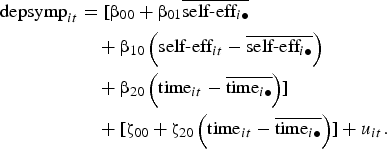
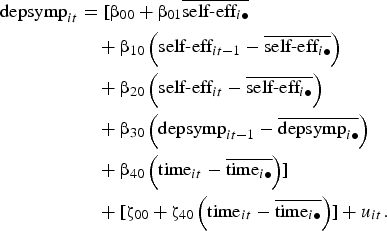
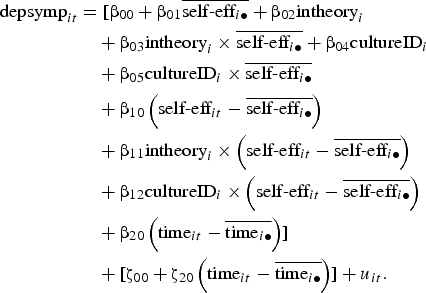
In these equations, note that we centered the Level 1 predictors within-youth (a centering strategy also referred to as group-mean centering or individual fixed effects). We estimated associations between average self-efficacy and average depressive symptoms by specifying average self-efficacy as a Level 2 predictor of the Level 1 intercept term (given the centering of time-varying predictors, the Level 1 intercept was the unadjusted mean of depressive symptoms). We estimated the interactions of self-efficacy with theories of intelligence and cultural identity by specifying the main effects and interaction terms as Level 2 predictors of the model intercepts as well as by specifying the main effects as Level 2 predictors of the Level 1 self-efficacy parameters (i.e., cross-level interactions). Note that in Equation 3 we have, for brevity, simply included one term for cultural identity. We examined the moderating effects of cultural identity by using three dummy variables that compared youths who were high on both AI and White identity with youths who were (a) low in both domains, (b) high only for AI identity, or (c) high only for White identity.
Conceptually, the within-youth associations specified at Level 1 addressed the question of whether increases and decreases in self-efficacy predicted decreases and increases in depressive symptoms (i.e., do changes in self-efficacy matter?) and the between-youth associations specified at Level 2 addressed the question of whether youths with relatively higher self-efficacy had relatively lower depressive symptoms (i.e., does average level of self-efficacy matter?). When considering these models, a methodological advantage to the within-youth estimates compared with the between-youth estimates is also worth noting. Although between-person estimates from nonexperimental data are always subject to potential omitted variable bias due to unobserved between-person heterogeneity, within-person estimates are not susceptible to omitted variable bias due to unobserved time-invariant heterogeneity (e.g., unobserved genetic differences between youths). In this study, for example, stable individual differences in youths (either observed or unobserved) could not bias our estimates of whether within-youth changes in self-efficacy predicted within-youth changes in depressive symptoms (for a review of this advantage, see Duncan et al., Reference Duncan, Magnuson and Ludwig2004 and for an empirical example using multilevel models, see Dearing, McCartney, & Taylor, Reference Dearing, McCartney and Taylor2006).
There is, however, the potential for within-person estimates to be biased by time-varying unobserved variables as well as reverse causation. We estimated the lagged models primarily to help adjust for these potential sources of bias. When examining whether increases in self-efficacy predicted later decreases in depressive symptoms, the lagged models controlled for previous depressive symptom levels and both contemporaneous and lagged associations between youth GPA and depressive symptoms. Thus, by estimating this series of models, we were able to take increasingly conservative approaches to determining whether associations between these two constructs were consistent with the following causal pathway: changes in self-efficacy → changes in depressive symptoms.
Regarding power, it is worth noting that the efficiency of our within-subjects, fixed-effects estimators in these multilevel models was greater than in a cross-sectional sampling design (one observation per person) of the same sample size (Snijders, Reference Snijders, Everitt and Howell2005). The multiple observations for each adolescent were a power advantage for detecting main effect associations between self-efficacy and depressive symptoms. In contrast, the multiple observations per youth and correlated observations within-youth (e.g., interclass correlation = 0.30 for depressive symptoms) limited our power to detect moderator effects at Level 2 compared with a cross-sectional study (Snijders, Reference Snijders, Everitt and Howell2005). Nonetheless, even for the moderating effects of cultural identity and theories of intelligence, we had sufficient power to detect moderately small effect sizes (d = 0.24, for power = 0.80; Liu, Spybrook, Congdon, Martinez, & Raudenbush, Reference Liu, Spybrook, Congdon, Martinez and Raudenbush2006).
Missing data
Across all variables and waves of data collection, 67% of participants had complete data on planned observations and 88% of observations were completed for the four primary variables of interest (i.e., the three self-efficacy predictors and depressive symptoms). For all multilevel models, we estimated two specifications that handled missing observations differently. In the first, we used multiple imputation (MI) by chained equations to replace missing values (Royston, Reference Royston2004), generating five complete data sets that combined observed and imputed values. We then combined estimates from these five data sets according to “Rubin's rules” (Rubin, Reference Rubin1987; Schafer & Graham, Reference Schafer and Graham2002). For the second specification, we used listwise deletion for unplanned missing data. Approximately 78% (n = 152) of youths had sufficient data to be included (i.e., these youths had at least two observations for longitudinal variables and complete data on all time-invariant variables). Because results from these two specifications were substantively identical we report only those using multiple imputation; the listwise deletion results are available from the authors upon request.
Results
Descriptive statistics, unconditional time models, and bivariate correlations
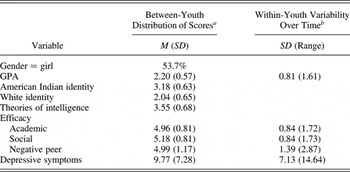
Prior to estimating our models of primary interest, we took three steps toward documenting general patterns of stability, change, and intercorrelation in the study variables. As presented in Table 2, we examined measures of central tendency and variability, including both the between-youth distribution of scores and within-youth variability over time for time-varying measures. One point regarding these descriptive statistics is particularly important to note: the within-youth and between-youth standard deviations were similar in size; youths were, on average, demonstrating changes over time in self-efficacy and depressive symptoms similar in magnitude to the average between-youth differences in these constructs.
Variable descriptive statistics following multiple imputation for missing values

Note: All descriptive statistics were averaged across five multiple imputation data sets.
aBetween-youth means and standard deviations describe the distribution of scores in the sample after first averaging time-varying scores.
bWithin-youth descriptive statistics indicate, on average, the extent to which adolescents' scores varied over time (i.e., standard deviations and ranges were calculated for every adolescent in the sample and then averaged across the sample).
The magnitude of changes and variability in the direction of those changes was further underscored in unconditional time models (i.e., multilevel models that included only time parameters). There were significant individual differences in linear rate of change (i.e., significant random effects) for all time-varying constructs in the study (e.g., standard deviations for the linear slopes, at 0.15 for depressive symptoms and ranging from 0.01 to 0.03 for self-efficacy, were significant at the 0.001 level). Consider, for example, that youths who experienced increases in self-efficacy at rates 1 standard deviation above the mean demonstrated yearly increases in self-efficacy as large as 35% of the between-youth standard deviations. For depressive symptoms, youths who experienced decreases one standard deviation below the mean demonstrated decreases of 2.21 points each year.
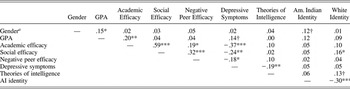
In Table 3, we present bivariate correlations among all study variables. The three self-efficacy variables were significantly and negatively associated with depressive symptoms. Youths with higher average levels of self-efficacy evidenced lower average levels of depressive symptoms. Note, however, that these bivariate correlations make between-youth comparisons and do not adjust for the covariates such as gender and GPA.
Average between-youth bivariate correlations

Note: Between-youth correlations for time-varying variables were estimated after averaging across time.
aGender was coded as follows: 1 = male, 2 = female.
†p < .10. *p < .05. **p < .01. ***p < .001.
Contemporaneous associations between self-efficacy and depressive symptoms
As a second step in our analytic plan, we estimated multilevel models of (a) between-youth associations for average level of self-efficacy and average level of depressive symptoms and (b) within-youth associations between changes in self-efficacy and cotemporaneous changes in depressive symptoms (see Equation 1, for which β01 provides the between-youth estimate and β10 provides the within-youth estimate). As part of this initial step, we first estimated separate multilevel models for each of the three self-efficacy predictors. This allowed us to start by examining the total associations between each type of self-efficacy and depressive symptoms prior to adjusting for covariation between the three types of self-efficacy. Next, we estimated all three predictors simultaneously in a single model.
In Table 4, we present the contemporaneous between-youth and within-youth associations from the models estimated separately for each self-efficacy predictor.Footnote 9
Multilevel model estimates of between-youth and within-youth associations between self-efficacy and depressive symptoms: Self-efficacy domains estimated separately

Note: Standard errors are presented in parentheses.
*p < .05. **p < .01. ***p < .001.
All three self-efficacy predictors were significantly and negatively associated with average level of depressive symptoms and changes in depressive symptoms in these models. Specifically, for between-youth differences in depressive symptoms, higher average levels of academic, social, and resisting negative peer self-efficacy predicted lower average levels of depressive symptoms. The effect sizes (i.e., partial correlations; McCartney & Rosenthal, Reference McCartney and Rosenthal2000) for these associations were largest for academic self-efficacy (r = −.38), followed by social self-efficacy (r = −.28) and resisting negative peer influences self-efficacy (r = −.17).
For within-youth changes in depressive symptoms, increases in self-efficacy predicted contemporaneous decreases in depressive symptoms and decreases in self-efficacy predicted contemporaneous increases in depressive symptoms. In general, the effect sizes for these within-youth associations were smaller than those for between-youth associations (i.e., for academic, r = −.21; for social, r = −.18; for resisting negative peer influences, r = −.24). With regard to the clinical implications of these estimates, however, it is important to keep in mind that the within-youth results control for between-youth heterogeneity that might bias the between-youth estimates. It is also important to keep in mind that this first set of models did not adjust for covariation among the three self-efficacy domains, an adjustment we made in our next model.
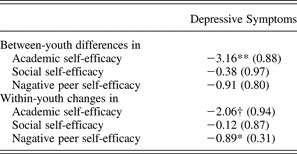
In Table 5, we present the results from the model in which all three self-efficacy predictors were estimated simultaneously. Given intercorrelations between the three types of efficacy, this simultaneous specification allowed us to determine which of the self-efficacy domains explained variance in depressive symptoms, when forced to compete with one another. Academic self-efficacy appeared the most robust predictor of between-youth differences in depressive symptom levels. Yet, underscoring that these self-efficacy domains covary, the effect sizes for all three predictors were smaller when they were estimated simultaneously (e.g., for academic self-efficacy, r = −.25). Regarding within-youth associations in the simultaneous estimation model, only changes in resisting negative peer influences self-efficacy were significant (r = −.13), with changes in academic self-efficacy approaching significance. Thus, increases in resisting negative peer influences efficacy appeared most robustly predictive of decreases in depressive symptoms when the three types of efficacy were estimated simultaneously, at least when considering contemporaneous associations across time.
Multilevel model estimates of between-youth and within-youth associations between self-efficacy and depressive symptoms: Self-efficacy domains estimated simultaneously

Note: Standard errors are presented in parentheses.
†p < .10. *p < .05. **p < .01.
Lagged within-youth associations
Following up on these contemporaneous models, we estimated lagged multilevel models (see Equation 2, for which β01 provides the lagged within-youth estimate). Specifically, we specified both contemporaneous and prior self-efficacy as predictors of depressive symptoms, while controlling for prior levels of depressive symptoms. These results are displayed in Table 6 with two particularly important results evident.
Multilevel model estimates of within-youth lagged associations

Note: Standard errors are presented in parentheses.
†p < .1. *p < .05.
First, as was evident in our initial models, increases in academic self-efficacy predicted contemporaneous decreases in depressive symptoms (r = −.17). This contemporaneous association also approached significance for negative peer self-efficacy, but it was null for social self-efficacy. Second, above and beyond contemporaneous associations, there was evidence that academic self-efficacy had lagged effects on youths depressive symptoms (r = −.15). Within youths, prior academic self-efficacy predicted later depressive symptoms. Given the lag in time, this was our strongest evidence consistent with the causal path: change in academic self-efficacy → change in depressive symptoms.Footnote 10
Moderating effects of theories of intelligence and cultural identity
As a final step in our analytic plan, we estimated the moderating effects of theories of intelligence and cultural identity for the between-youth and within-youth associations of self-efficacy and depressive symptoms (see Equation 3). As for our other models, we used listwise deletion and MI specifications. Also similar to our other models, we first estimated the self-efficacy predictors and their interactions in separate models and then estimated all main effects and interactions simultaneously. Across all of these specifications there was no evidence of moderation. The main effect associations between self-efficacy and depressive symptoms did not significantly differ, in strength or direction, as a function of either theories of intelligence or cultural identity.
Discussion
The present study extends evidence that youths with relatively high self-efficacy have fewer depressive symptoms than other youths by demonstrating that increases in efficacy beliefs also predict decreases in depressive symptoms within youths. As the first evidence that within-youth improvements in self-efficacy may have developmental benefits, our findings help fill an empty niche in the line of studies investigating the impact of efficacy beliefs on depressive symptoms. We believe this is promising news for researchers and practitioners aiming to improve the mental health of high-risk youth.
These findings on within-youth changes are of critical importance to clinical science and practice for at least three reasons. First, evidence of within-youth changes adds to our knowledge on both self-efficacy and depressive symptoms by demonstrating their malleability during adolescence; these interrelated psychological processes appear dynamic and in flux during youth rather than immutable. Second, given malleability, by studying within-youth changes our study goes beyond questions of whether youths with higher self-efficacy beliefs have lower depressive symptoms to directly address whether change in self-efficacy beliefs matters. Regardless of initial levels of self-efficacy, our results indicate that increased self-efficacy benefits youth mental health. From a clinical standpoint this affirmative answer is all the more valuable given our focus on AI youths, who have likely been exposed to exceptional quantities and qualities of contextual risk for mental health problems.
Third, by studying within-youth changes we were able to control for unobserved heterogeneity across youth, a potential source of bias in previous nonexperimental studies of individual differences in self-efficacy and mental health. With this advantage in mind, it is worth noting that even our lagged effects cannot be used to definitively rule out potential sources of bias due to time-varying omitted variables. Nonetheless, our findings are a powerful addition to increasingly strong evidence supporting a causal role for self-efficacy in youth mental health; there is now evidence from cross-lagged, between-person models and within-person change models that is consistent with this causal hypothesis (Bandura et al., Reference Bandura, Pastorelli, Barbaranelli and Caprara1999, Reference Bandura, Caprara, Barbaranelli, Gerbino and Pastorelli2003; Pomaki et al., Reference Pomaki, ter Doest and Maes2006).
Self-efficacy domains: Which are most important?
In terms of the relative influence of the three different types of self-efficacy beliefs (i.e., for academic and social activities and for resisting negative peer influences), our findings suggest that academic self-efficacy beliefs had the strongest and most consistent effects on depressive symptom levels, which is also consistent with some earlier findings (Bandura et al., Reference Bandura, Pastorelli, Barbaranelli and Caprara1999; Ehrenberg et al., Reference Ehrenberg, Cox and Koopman1991; Muris, Reference Muris2002; Scott et al., Reference Scott, Dearing, Reynolds, Lindsay, Baird and Hamill2008). This was particularly true for our between-child analyses. Specifically, compared to efficacy beliefs about social interactions and resisting negative peer influences, beliefs about academic competencies most consistently predicted depressive symptom levels across our various model specifications. Children with the lowest levels of confidence in academic abilities reported the highest levels of depressive symptoms. In the within-child analyses, whether contemporaneous or lagged, academic efficacy also emerged as the strongest predictor, with one exception. Efficacy for resisting negative peer influences was contemporaneously the strongest predictor of depressive symptoms when all three self-efficacy domains were estimated simultaneously.
In general, however, the academic domain appears to be an important one to these AI youth. In another study with AI youth from the same reservation, Scott et al. (Reference Scott, Dearing, Reynolds, Lindsay, Baird and Hamill2008) found that when asked to identify important goals, academic goals were by far the most frequently reported category (82% of the participants listed goals related to academics, next most frequent category was career with 38%). In value clarification interviews, a separate group of AI youth from the same reservation commonly expressed the belief that academic success was essential to attaining career aspirations that would enable returning to the reservation to offer needed skills to the tribe. In short, for these AI youth, academic success may be both valued and aspired to in order to meet collectivistic goals (i.e., betterment of the tribe); consequently, doubting ability to perform academically is distressing.
After academic self-efficacy, the next most important type of self-efficacy appeared to be for resisting negative peer influences. Although our within-child analyses supported its importance in predicting contemporaneous changes in depression, these models do not rule out possible reciprocal influences of depression or the possibility that time-varying omitted variables might better explain the relationship. For instance, externalizing behaviors are known correlates of both depressive symptoms (Fanti & Henrich, Reference Fanti and Henrich2010) and self-efficacy for resisting negative peer influences (Caprara et al., Reference Caprara, Scabini, Barbaranelli, Pastorelli, Regalia and Bandura1998). Future research could address this third variable.
All three domains of self-efficacy, however, were related to depressive symptoms when these domains were included in separate multilevel models (i.e., prior to adjusting for shared variance across the three domains). To the extent that self-efficacy in the domains of academics, social activities, and resisting negative peer influences operate together within youth (i.e., in a synergistic fashion), statistical models that assume variance can be uniquely ascribed to the three variables (e.g., our statistical models that force the three domains to compete for explained variance) may have limited external or ecological validity. Future work that disentangles the extent to which these three domains operate together or alone would benefit the field. For instance, Bandura et al. (Reference Bandura, Pastorelli, Barbaranelli and Caprara1999) demonstrated that although both academic and social self-efficacy influence subsequent depression through prosocial behavior and academic achievement, there were also some unique pathways: academic self-efficacy also influenced depression through its influence on problem behavior, yet this pathway was not found for social self-efficacy.
Neither AI cultural identity nor theories of intelligence moderates the self-efficacy/depression relationship
Contrary to what some theories might predict, AI cultural identity did not moderate the relation between academic self-efficacy and depression. Some would predict that AI youth who reported a strong AI cultural identity, who endorsed participating in tribal practices, traditions, and adopting AI spiritual beliefs, might be relatively immune from the affective distressing consequences of low academic self-efficacy beliefs (Downey, Reference Downey2008; Ogbu, Reference Ogbu1978; O'Nell, Reference O'Nell1996; Whitesell et al., Reference Whitesell, Mitchell and Spicer2009). That is, either because AI youth perceive academic performance as less relevant to more collectivistic values and aims, or instead because they perceive academic success as participating in an antagonistic majority culture (i.e., “acting White”), they might be less distressed by perceptions of low academic ability. However, in our study, possessing a strong AI cultural identity did not lessen the impact of doubting one's personal academic abilities on depressive symptoms.
Our main effect for self-efficacy, however, is consistent with Bandura's (2002) argument that a robust belief in personal efficacy is vital, regardless of value orientation:
Perceived self-efficacy does not come with a built-in individualistic value system . . . a sense of efficacy does not necessarily spawn an individualistic lifestyle, identity, or morality. If belief in the power to produce effects is put to social purposes, it fosters a communal life rather than erodes it. People with resilient efficacy and strong prosocial purpose often subordinate self-interest to the benefit of others (p. 277).
That is, even when individuals prefer more group-oriented goals and aims, they ought to continue to value their abilities to personally contribute to community needs and values.
Although believing that one is capable of producing valued actions may be just as important in collectivistic as it is in individualistic contexts, other evidence suggests cultural variations in the relationship between more abstract, global self-conceptions and well being do exist (Kitayama & Markus, Reference Kitayama, Markus, Diener and Suh2000). For instance, self-esteem appears to be less associated with well-being in more collectivistic/interdependent contexts (Diener & Diener, Reference Diener and Diener1995; Kitayama & Markus, Reference Kitayama, Markus, Diener and Suh2000). Similarly, a few studies have reported that when self-efficacy is assessed at a more global level—seeing oneself as generally competent, efficacious, and able to meet life's demands—this generalized form of self-efficacy appears to possess a weaker relationship with depression in more “collectivistic” cultures (e.g., Chen, Chan, Bond, & Stewart, Reference Chen, Chan, Bond and Stewart2006; Stewart et al., Reference Stewart, Kennard, Lee, Hughes, Mayes and Emslie2004). However, Bandura (Reference Bandura1997) has emphasized the importance of tailoring self-efficacy assessments for the specific performance domain of interest and in the specified contexts those performances typically occur. Assessed in this way, there is commonly great within-person variation in self-efficacy beliefs depending on the performance domain assessed. Self-efficacy is not intended to refer to global self-assessments or beliefs. These distinctions appear critical when it comes to the relationship between efficacy beliefs and depression across cultural contexts. Believing that you can perform an important action may be just as important for affective well-being in collectivistic as it is in individualistic contexts (Bandura, Reference Bandura2002). In contrast, possessing a more positive global self-evaluation may have more of an affective impact in individualistic cultural contexts (Kityama & Markus, 2000).
Our null findings for a moderating role of AI cultural identity also appear inconsistent with predictions based on oppositional culture theories (Downey, Reference Downey2008; Ogbu, Reference Ogbu1978). However, AI youth on this reservation may not perceive success in school as participating in an oppositional, majority cultural institution. Rather, they may perceive success as essential to furthering tribal community goals and values. As has been documented in earlier research (Scott et al., Reference Scott, Dearing, Reynolds, Lindsay, Baird and Hamill2008), AI tribal members express the desire to pursue academic goals in order to return to and improve life on their reservation. Therefore, AI youth may not view academic success as promoting majority cultural goals, but as actually fostering AI values and aims. For AI youth, then, doubting one's personal ability to perform various academic tasks perhaps threatens the prospect of realizing a communal goal—improving tribal welfare and life—and consequently is affectively distressing.
Contrary to our predictions and those of Dweck (Reference Dweck1999), we also found that theories of intelligence did not moderate the relationship between academic self-efficacy and depressive symptoms. Dweck's (1999) model indicates that the impact of low self-efficacy should depend on whether an individual subscribes to an incremental or entity view of intelligence (Dweck, Reference Dweck1999). Specifically, for those who believe that ability is something you can acquire through effort and learning, current low self-efficacy should not have the same affective consequences as it would for someone who believes that low ability is fixed and permanent (i.e., “Not only am I not very capable now, but I will never be very capable”). However, we found that low self-efficacy predicted depression as much for incremental theorists as it did for entity theorists.
In considering these null results, potential measurement and conceptual explanations are worth noting. First, although the theories of intelligence scale in this study demonstrated good internal reliability at most data collection points, it demonstrated marginal reliability in the first (α = 0.53) and last (α = 0.62) surveys. Although we conducted focus groups with AI youth to ensure scale comprehension and relevance, higher internal consistency (α > 0.85) has been demonstrated using this scale with White youth (Baird, Scott, Dearing, & Hamill, Reference Baird, Scott, Dearing and Hamill2009). Measurement invariance work in this area would be useful.
Of course, the other possibility is that the finding is real. This leads to the question: why might academic self-efficacy lead to greater depressive symptoms regardless of whether one believes intelligence is malleable or fixed? One possibility is that although some youth believe that intelligence is malleable, they may still doubt their ability to change or improve their own intelligence. That is, they may agree that in theory intelligence can be improved and agree to such questions as “no matter who you are, you can change your intelligence a lot,” yet they may perceive for whatever reasons (lack of motivation, lack of opportunities, etc.) in practice, they will not improve their intellectual abilities. In short, outcome expectations may remain low for increasing intelligence despite a belief that intelligence is in general a malleable quality that can be improved with effort. In this regard, it is important to note that our findings appear to conflict with studies of other youth populations in which a belief in the malleability of intelligence has been related to more optimal motivational patterns (e.g., Blackwell, Trzesniewski, & Dweck, Reference Blackwell, Trzesniewski and Dweck2007). However, these studies did not examine depressive symptoms and they did not include AI youth who may for various reasons possess more pessimistic expectancies.
As a final comment on the null moderator results, it is worth emphasizing the general difficulty of detecting moderator effects. As Whisman and McClelland (Reference Whisman and McClelland2005) point out, a variety of issues can downwardly bias estimates of interaction effects, particularly when main effects account for significant portions of variance in the outcome. Reliability and variability problems, for example, are compounded when estimating interactions. Although our study was adequately powered to detect moderately small interactions between our Level 1 and Level 2 predictors, these factors justify further study in this area.
Limitations and future directions
One potential limitation to our study is shared method variance: we assessed both self-efficacy and depression using youth self-reports. It is worth noting, however, that this problem arises because self-report is the preferred standard for measuring both of these internal processes (Bandura, Reference Bandura1997; Klein, Dougherty, & Olino, Reference Klein, Dougherty and Olino2005); alternative measures arguably raise more limitations than they solve (e.g., parent, teacher, or researcher observations of self-efficacy would lead to concerns over internal validity and measurement error). Further, our use of self-reported GPA as a statistical covariate likely helps control for bias due to shared method variance, because this measure was presumably impacted similarly by any shared variance problems. Nonetheless, our study of the intrapsychic links between efficacy and depression must be interpreted with the shared method in mind.
Although we did not find AI cultural identity to alter the impact of efficacy beliefs on depression, we must acknowledge the possibility that the construct of AI cultural identity is more multifaceted and complex (Ashmore, Deaux, & McLaughlin-Volpe, Reference Ashmore, Deaux and McLaughlin-Volpe2004; Whitesell et al., Reference Whitesell, Mitchell and Spicer2009). Additional research may shed light on other important aspects of AI cultural identity that may possess unique functional relationships with self-regulation and depression (N. R. Whitesell, personal communication, October 7, 2009). However, it is worth noting that in another study, which used the same AI cultural identity measure used in this study, individual differences in AI cultural identity did moderate the relationship between depressive symptoms and another depression risk factor in AI youth (Hamill et al., Reference Hamill, Scott, Dearing and Pepper2009). Specifically, as has been found in other youth populations (Coplan, Wilson, Frohlick, & Zelenski, Reference Coplan, Wilson, Frohlick and Zelenski2006; but see Muris, Meesters, de Kanter, & Timmerman, Reference Muris, Meesters, de Kanter and Timmerman2005), AI youth with low behavioral activation reported more depressive symptoms. However, for those AI youth who strongly identified with AI culture, low behavioral activation was not associated with depressive symptoms (Hamill et al, Reference Hamill, Scott, Dearing and Pepper2009). Therefore, in this case, a construct considered by many to confer depression vulnerability—low behavioral activation—did not confer such vulnerability to those AI youth who reported a strong AI cultural identity.
We also believe that future studies need to identify the mechanisms explaining relations between self-efficacy and depressive symptoms. With Italian youth, both academic and social self-efficacy appeared to influence depression by promoting prosocial behaviors and academic achievement (Bandura et al., Reference Bandura, Pastorelli, Barbaranelli and Caprara1999). Academic self-efficacy also led to reduced problem behaviors which influenced subsequent depression levels. In path analyses of cross-sectional data, Scott et al. (Reference Scott, Dearing, Reynolds, Lindsay, Baird and Hamill2008) found that academic self-efficacy appeared to influence depressive symptoms in AI youth through goal representations, although not in the expected direction. Specifically, although academic efficacy directly predicted lower depressive symptoms, older youth who were more confident in their academic abilities tended to set more intrinsically motivating goals that resulted in increased depressive symptoms. Future longitudinal investigations should extend this line of work to examine mediators of the within-youth associations linking self-efficacy with depressive symptoms.
The self-efficacy construct also needs to be understood in the broader context of social cognitive theory. In addition to examining how self-efficacy beliefs may operate through prosocial behavior, academic achievement, and goal representations to influence depressive symptoms in youth, future studies might also examine how efficacy beliefs interact with other beliefs, such as individual differences in value priorities (Schwartz & Bardi, Reference Schwartz and Bardi2001). AI scholars and researchers have often observed that internal conflict between AI and majority culture values likely contribute to depressive experiences for AI people (O'Nell, Reference O'Nell1996).
Finally, two notes of caution are warranted regarding the interpretation of results. First, with regard to causal inferences, potential problems of simultaneity (i.e., reciprocal causation) must be acknowledged for our models estimating contemporaneous associations. Our lagged models are useful in this regard and provide strong evidence of the positive consequences of increases in academic self-efficacy, but they should not be interpreted as definitive evidence that depressive symptoms have no consequences for self-efficacy; we would be surprised if reciprocal processes were not unfolding over time to some extent. Second, we must caution against the overgeneralization of our findings to all AI youth populations. Although there are some interesting pantribal similarities in social discourse and values (O'Nell, Reference O'Nell1996), there are over 500 federally recognized AI entities (US Department of the Interior, 2002). Clearly, there is likely to be significant variation in values, spiritual beliefs, and contexts that presumably might impact the relationship between self-efficacy and depressive symptoms (Norton & Manson, Reference Norton and Manson1996).
Conclusion
This was the first study to demonstrate that within-person changes in self-efficacy beliefs predict later within-person changes in depression, addressing a gap in the literature. Our findings illustrate that increased self-efficacy beliefs matter for youth at high-risk for depressive disorders. These findings aid our understanding of self-regulation and depression, and how it operates in this unique cultural context, informing programs for the enhancement of the well-being and resilience of AI youth (Caldwell et al., Reference Caldwell, Davis, Du Bois, Echo-Hawk, Erickson and Goins2005; Masten, Reference Masten2001).