Milk fat is an important dietary source of nutrients and energy. Recent research has focused on the importance of supplying lactating dairy cows with polyunsaturated fatty acids (FA) to increase their proportion in milk fat since they are considered health promoting (Ulbricht & Southgate, Reference Ulbricht and Southgate1991). However, supplementation with dietary lipids such as soybean oil (SBO) may result in both positive and adverse changes in the nutritional and dietetic properties of milk as shown by the increased unsaturated FA proportion and oxidation susceptibility (Chen et al. Reference Chen, Bobe, Zimmerman, Hammond, Luhman, Boylston, Freeman and Beitz2004; Bobe et al. Reference Bobe, Zimmerman, Hammond, Freeman, Porter, Luhman and Beitz2007). The oxidative deterioration of milk fat containing a high unsaturated FA proportion can increase the development of rancid odours and flavours in milk (Timmons et al. Reference Timmons, Weiss, Palmquist and Harper2001), which results in products of lower nutritional quality and safety due to the formation of secondary, potentially toxic compounds (Moure et al. Reference Moure, Cruz, Franco, Domínguez, Sineiro, Domínguez, José Núñez and Parajó2001; Chen et al. Reference Chen, Bobe, Zimmerman, Hammond, Luhman, Boylston, Freeman and Beitz2004). However, the presence of antioxidants such as α-tocopherol may prevent oxidation of milk enriched in polyunsaturated FA and the development of oxidised flavour as shown by Barrefors et al. (Reference Barrefors, Granelli, Appelqvist and Bjoerck1995). As recent studies have demonstrated that natural sources of antioxidants are effectively transferred from the diet to milk (Petit et al. Reference Petit, Côrtes, da Silva, Kazama, Gagnon, Benchaar, dos Santos and Zeoula2009; Côrtes et al. Reference Côrtes, Palin, Gagnon, Benchaar, Lacasse and Petit2012), they may then contribute to prevent or decrease oxidation of milk enriched in polyunsaturated FA.
Citrus pulp (CPP) is a byproduct from the food processing industry that has been widely used as a high energy feed in diets of lactating dairy cows (Bampidis & Robinson, Reference Bampidis and Robinson2006). This is also a source of the flavonoids hesperidin and naringin, which are antioxidants (Williams et al. Reference Williams, Spencer and Rice-Evans2004; Bampidis & Robinson, Reference Bampidis and Robinson2006). A recent study (Santos et al. Reference Santos, Lima, Schogor, Romero, Marchi, Grande, Santos, Santos and Kazama2014) has reported that CPP dietary administration increases total polyphenols and flavonoids concentration and antioxidant capacity in milk. Rumen microorganisms have been shown to play an important role in the transfer of antioxidants to milk such as the lignans present in flax (Gagnon et al. Reference Gagnon, Côrtes, da Silva, Kazama, Benchaar, dos Santos, Zeoula and Petit2009). Previously, Gladine et al. (Reference Gladine, Rock, Morand, Bauchart and Durand2007) had reported that, contrary to monogastrics, ruminants can benefit from antioxidants and that the ruminal microbiota may be involved in the metabolism of antioxidants. Thus, further experiments must be performed to better identify the principal site of absorption (e.g., rumen or small intestine) of antioxidants to increase their transfer in ruminant products such as milk.
The present study was performed to determine the involvement of rumen microorganisms in the transfer of antioxidants from CPP into milk when cows receive SBO as a source of polyunsaturated FA. Lactating cows fed CPP and administration of SBO in the rumen or abomasum were used to test the hypothesis that rumen microorganisms are required for the transfer of antioxidants from CPP and that antioxidants form CPP decrease oxidation of milk enriched with polyunsaturated FA from SBO. The yield of milk components and milk FA profile were also investigated as no information is available on the effect of CPP on proportions of FA in milk fat.
Material and methods
Cows and diets
The present study is part of a larger project where the results on intake and digestibility of nutrients and ruminal fermentation, along with the experimental procedures and feeding management, have been reported previously (Lima et al. Reference Lima, Santos, Schogor, Damasceno, Marchi, Santos, Santos and Petit2014). Four multiparous lactating Holstein cows fitted with ruminal cannulas (10 cm, Bar Diamond Inc., Parma, ID, USA) were assigned to a 4 × 4 Latin square design with four 21 d periods balanced for residual effects. Treatments were planned according to a 2 × 2 arrangement: (1) 0·2 kg SBO/d administered in the rumen and 15·0 kg/d of tap water infused in the abomasum; (2) 0·2 kg SBO/d and 15·0 kg tap water/d infused in the abomasum; (3) 0·2 kg SBO/d and 1·0 kg CPP/d administered in the rumen and 15·0 kg tap water/d infused in the abomasum; (4) 0·2 kg SBO/d, 1·0 kg/d of CPP and 14·0 kg tap water/d infused in the abomasum Citrus pulp is a commercially available product containing (on a dry matter basis) 783·51 mg polyphenols/100 g and 161·46 mg flavonoids/100 g, which resulted in a daily intake of 1·6 g polyphenols and 0·3 g flavonoids per cow. The total mixed diet has been described in detail previously (Lima et al. Reference Lima, Santos, Schogor, Damasceno, Marchi, Santos, Santos and Petit2014) and has been formulated to meet requirements for cows producing 30 kg/d of milk with 38 g/kg of fat (NRC, 2001). At the beginning of the experiment, the cows averaged (mean ± sd) 92 ± 13 d in milk, 29·0 ± 2·2 kg milk/d, and 559 ± 67 kg body weight. Cows were housed in individual stalls with free access to water. The Animal Care and Use Committee of the Universidade Estadual de Maringá approved all animal procedures.
Abomasal infusions were performed using infusion lines prepared and inserted as previously described by Gressley et al. (Reference Gressley, Reynal, Colmenero, Broderick and Armentano2006). Details on the infusion procedures have been published by Lima et al. (Reference Lima, Santos, Schogor, Damasceno, Marchi, Santos, Santos and Petit2014). Briefly, two different infusion lines were used to pump oil and the water/infusion mixture in a larger line using a Y-shape connection line leading to the abomasum as previously reported by Kazama et al. (Reference Kazama, Côrtes, da Silva-Kazama, Gagnon, Benchaar, Zeoula, Santos and Petit2010). Abomasal infusions consisted of 15 kg/d of solution (water or water + CPP) and the infusion mixtures were delivered at a rate of 1·25 l/h over a 12 h (from 0700 to 1900 h) period. For the infusion, CPP was ground through a 1 mm screen. Oil was pumped into the abomasum using a peristaltic pump and the ruminal administration was performed by adding one-third each of oil dose and citrus pulp 3 times daily (0700, 1300, and 1900 h). The FA profile of CPP, expressed as a percentage of FA, included 16:0 (29·6%), 18·0 (5·0%), cis9-18:1 (20·2%), cis6-18:2 (34·2%), and cis3-18:3 (7·9%) while that of soybean oil included 16:0 (11·8%), 18·0 (2·0%), cis9-18:1 (25·8%), cis6-18:2 (54·5%), and cis3-18:3 (4·6%).
Sampling
Milk samples were collected from the four consecutive milkings on d 18 and 19. Samples of the two am milkings were pooled together on a yield basis and those of the two pm milkings were pooled also on a yield basis. Pooled samples of the am and pm milkings were analysed separately and three aliquots of each were taken. One aliquot was kept frozen at −20 °C without any preservative for determination of FA profile in milk fat. The second aliquot was kept frozen at −20 °C with Na azide (0·2 g/kg) for determination of antioxidants (total polyphenols and flavonoids) and conjugated diene (CD) hydroperoxides. The third aliquot of milk samples was stored at +4 °C with bronopol-B2 until analysis of normal composition (fat, protein, and lactose).
Protein and lactose concentrations in milk were analysed by infrared spectrophotometry (Bentley model 2000; Bentley Instrument Inc., Chaska, MN, USA). Fat in milk was separated by centrifugation as described by Murphy et al. (Reference Murphy, Connolly and McNeill1995) and FA were methylated according to method 5509 of ISO (1978) using KOH/methanol (Synth, São Paulo, Brazil) and n-heptane (Vetec, Rio de Janeiro, RJ, Brazil). Fatty acid methyl esters were quantified by gas chromatography (Trace GC Ultra, Thermo Scientific, West Palm Beach, Florida, USA) equipped with an autosampler, a flame-ionisation and a Rt-2560 fused-silica capillary column (100 and 0·25 mm i.d., 0·20 μm film thickness). The column parameters were as follows: initial column temperature of 65 °C was maintained for 8 min; the temperature was then programmed at 50 °C/min to 170 °C; this temperature was maintained for 40 min and then increased 50 °C/min to 240 °C and remained at this temperature for 28·5 min. Injector and detector temperatures were 220 and 245 °C, respectively. The gas flow was 1·5 ml/min for hydrogen (carrier gas), 30 ml/min for N2 (auxiliary gas), 35 ml/min for H2 and 350 ml/min for compressed air. Fatty acid peaks were identified using pure methyl ester standards (Sigma, São Paulo, SP, Brazil).
Content of total polyphenols of the CPP and milk was determined using the Folin–Ciocalteu technique (Singleton & Rossi, Reference Singleton and Rossi1965) with the elimination of interfering substances using polyvinylpolypyrrolidone as reported by Han et al. (Reference Han, Britten, St-Gelais, Champagne, Fustier, Salmieri and Lacroix2011). Polyphenols were extracted from CPP by mixing 1 g sample (ground through a 1 mm screen) with methanol/water (90:10, v/v) and the volume was made up to 100 ml. Polyphenols were extracted from milk by mixing 1 ml of each sample with methanol/water (90:10, v/v) and the volume was made up to 10 ml. The extracts were then filtered on a 0·22 μm PTFE membrane filter (Spritzen, Shanghai, China) into a tube protected from light. The assay was performed using a UV-Vis spectrophotometer (Spectrum SP2000, Shanghai, China). The phenolic compound content was reported as Gallic acid equivalents (GAE; μg/ml of milk and mg/100 g citrus pulp).
Flavonoids were extracted from CPP and milk samples using the procedure described for polyphenols and flavonoids were measured at 425 nm by spectrophotometry after reaction with aluminium chloride as described by Woisky & Salatino (Reference Woisky and Salatino1998) and modified by Sánchez et al. (Reference Sánchez, Miranda, Vit and Rodríguez-Malaver2010). Quercetin was used as a standard for the calibration curve and results were reported as quercetin equivalents (QE; μg/ml of milk and mg/100 g citrus pulp).
Total reducing power was determined as described by Zhu et al. (Reference Zhu, Hackman, Ensunsa, Holt and Keen2002) with some modifications. Milk proteins were precipitated by adding 1 ml of a trichloroacetic acid solution (20%; v/v) to 1 ml milk. The mixture was vortex-mixed for 10 min and centrifuged at 1058 g for 10 min at 20 °C. Absorbance was measured at 700 nm on a UV-Vis spectrophotometer (Spectrum SP2000, Shanghai, China) and reducing power was reported as GAE (μg/ml). Production of conjugated diene (CD) hydroperoxides in milk was used to measure lipid oxidation according to the method of Kiokias et al. (Reference Kiokias, Dimakou, Tsaprouni and Oreopoulou2006) with some modifications. Briefly, samples (50 μl) were added to a mixture of 2·5 ml isooctane/2-propanol (2:1 v/v) and vortexed for 10 s. Samples then were filtered on a 0·22 μm PTFE membrane filter (Spritzen, Shanghai, China). The absorbance was measured at 232 nm using a UV-Vis (Spectrum SP2000, Shanghai, China). The production of CD was calculated as follows: CD (mmol/kg of fat) = (A/27)/[(a × b)/100 000 × (c + b/1000)]; where: A = absorbance at 232 nm; a = milk fat proportion (g/100 g); b = sample volume (μl); and c = mixture volume (ml).
The health-promoting index (HPI) was calculated as the inverse of the atherogenic index (Ulbricht & Southgate, Reference Ulbricht and Southgate1991) according to the equation described by Chen et al. (Reference Chen, Bobe, Zimmerman, Hammond, Luhman, Boylston, Freeman and Beitz2004), where the concentration of total unsaturated FA is divided by the sum of 12:0, 16:0, and 4 × 14:0.
Statistical analysis
All results were analysed using the MIXED procedure of SAS (SAS, 2000; SAS Institute) within a 2 × 2 factorial arrangement of treatments. Data were analysed using a 4 × 4 Latin square design with the following general model:
 $$y_{ijkl} = \mu + c_i + P_j + S_k + T_l + ST_{kl} + e_{ijkl} $$
where: y ijkl, the dependent variable; μ, overall mean; c i, random effect of cow (i = 1 to 4); P j, fixed effect of period (j = 1 to 4); S k, fixed effect of supplement (SBO vs. SBO + CPP); T l, fixed effect of site of administration (rumen vs. abomasum), ST kl, interaction, and e ijkl, random residual error. Results are reported as least squares means and sem. Significant differences were set at P ≤ 0·05 and trends at 0·05 < P ≤ 0·10.
Results and discussion
Yield of milk components and antioxidant properties
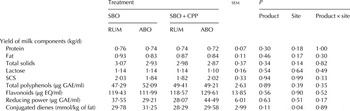
Milk yield averaged 24·1 kg/d and was similar between diets (Lima et al. Reference Lima, Santos, Schogor, Damasceno, Marchi, Santos, Santos and Petit2014). Abomasal infusion was carried out only over a 12-h period. Therefore, samples of milk (n = 2) were analysed separately for the morning and evening milkings to determine if the response to treatments was similar for both. As there was no interaction between milking time (am and pm milkings) and treatment for antioxidant properties and milk FA profile, only average values of the two milking times are reported for these parameters. There was no interaction between product and site for yield of milk components and product and site of administration had no effect (Table 1). The lack of effect of administration site of SBO on yield of milk components agrees with the results reported previously by Kazama et al. (Reference Kazama, Côrtes, da Silva-Kazama, Gagnon, Benchaar, Zeoula, Santos and Petit2010) where 400 g/d flax oil were administered three times daily in the rumen or infused over a 23-h period in the abomasum. Moreover, Bremmer et al. (Reference Bremmer, Ruppert, Clark and Drackley1998) reported that infusion of 445 g/d SBO in the abomasum of dairy cows has no effect on yield of milk components. Drackley et al. (Reference Drackley, Overton, Ortiz-Gonzalez, Beaulieu, Barbano, Lynch and Perkins2007) infused increasing amounts (0, 250, 500, 750, and 1000 g/d) of high oleic sunflower oil in the abomasum and reported that milk fat yield is unaffected when up to 500 g/d was infused, but then decreases sharply thereafter. Altogether, these data suggest that up to 500 g/d of polyunsaturated oil from plant origin may bypass the rumen without affecting milk fat synthesis in the mammary gland. This is corroborated by the similar expression of lipogenic genes in the mammary gland when dairy cows are infused or not with 250 g flax oil/d in the abomasum (Lima et al. unpublished) while a greater amount (550 g/d) of flax oil decreases gene expression (Palin et al. Reference Palin, Côrtes, Benchaar, Lacasse and Petit2014).
Milk production and milk composition of Holstein cows administered with soybean oil (SBO) or soybean oil + citrus pulp (SBO + CPP) in the rumen (RUM) or the abomasum (ABO)

Somatic cell score, log somatic cell count; GAE, gallic acid equivalen; EQ, quercetin equivalent
There was no interaction between product and site for the concentration of total polyphenols and flavonoids, reducing power and production of CD hydroperoxides in milk (Table 1). Product and site of administration had no effect on the concentration of total polyphenols and flavonoids and reducing power. Although CPP is rich in antioxidants (Manthey & Grohmann, Reference Manthey and Grohmann1996), its administration in the rumen and abomasum led to similar antioxidant properties of milk. Felgines et al. (Reference Felgines, Texier, Morand, Manach, Scalbert, Regerat and Remesy2000), using a rat model, suggested that hydrolysis of the glycosidic fraction of naringin, which is the main antioxidant present in CPP, is required before absorption in the large intestine. However, contrary to monogastric animals, it is likely that the hydrolysis of the glycosidic fraction occurs first in the rumen rather than the large intestine as the rumen microbiota is known to play a role in the metabolism of antioxidants such as plant lignans (Gagnon et al. Reference Gagnon, Côrtes, da Silva, Kazama, Benchaar, dos Santos, Zeoula and Petit2009) and isoflavones (Lundh, Reference Lundh1990; Dickinson et al. Reference Dickinson, Smith, Randel and Pemberton1988). As the presence of naringin in the plasma of sheep was obtained following administration in the rumen of an acute dose of citrus extract in the experiment of Gladine et al. (Reference Gladine, Rock, Morand, Bauchart and Durand2007), this suggests that a greater consumption of CPP than the one achieved in the present experiment may be required to positively affect the antioxidant properties of milk. Another hypothesis for the lack of difference in the antioxidant properties of milk when CPP was administered either in the rumen or the abomasum is that the absorption of flavonoids occurs similarly in the rumen and the intestine. Indeed, even if there is little information on the absorption of CPP antioxidants, the two antioxidants formononentin and daidzein from the isoflavone family are known to be absorbed in the rumen (Lundh, Reference Lundh1990) and the small intestine (Walsh et al. Reference Walsh, Haak, Fastinger, Bohn, Tian, Mahan, Schwartz and Failla2009).
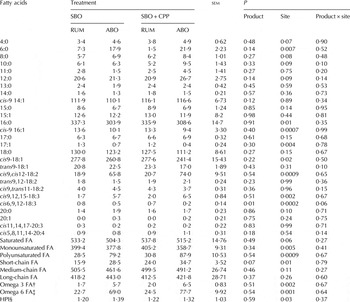
There was an effect (P = 0·04) of site for CD production in milk, with infusion in the abomasum resulting in lower production of CD compared with administration in the rumen. Production of CD represents the ability of antioxidants to delay oxidation of polyunsaturated FA (Gladine et al. Reference Gladine, Rock, Morand, Bauchart and Durand2007). Our results showed that milk from cows infused with products in the abomasum was more susceptible to lipoperoxidation than milk from those administered with products in the rumen, which agrees with the higher polyunsaturated FA proportion (Table 2) in milk fat when cows were on the former treatment. As previously shown by Shiota et al. (Reference Shiota, Konishi and Tatsumi1999) and Chen et al. (Reference Chen, Bobe, Zimmerman, Hammond, Luhman, Boylston, Freeman and Beitz2004), milk fat richer in polyunsaturated FA was more prone to oxidation.
Milk fatty acid (FA) concentration (g/kg of total fatty acids) of Holstein cows administered with soybean oil (SBO) or soybean oil + citrus pulp (SBO + CPP) in the rumen (ABO) or the abomasum (ABO)

† cis9,12,15-18:3 + cis5,8,11,14,17-20:5 + 22:5
‡ cis9,12-18:2 + cis6,9,12-18:3 + cis11,14-20:2 + cis8,11,14-20:3 + cis5,8,11,14-20:4
§ Health-promoting index: (sum of % of unsaturated fatty acids)/[12:0 + (4 × 14:0) + 16:0]; (Chen et al. Reference Chen, Bobe, Zimmerman, Hammond, Luhman, Boylston, Freeman and Beitz2004)
Milk fatty acid profile
There was no interaction between product and site for milk FA profile (Table 2). Milk fat from cows infused in the abomasum tended to have higher proportions of 4:0, 8:0, 10:0 and 12:0 (P = 0·07, 0·08, 0·09, and 0·09, respectively) than milk fat from those supplemented in the rumen. Proportions of 11:0, 13:0, 14:0, cis9-14:1, 15:0, 15:1, 17:0, 18:0, trans9-18:1, trans9,12-18:2, cis9, trans11-18:2, 20:0, 20:1, cis11,14,17-20:3 and cis5,8,11,14-20:4 in milk fat were similar among treatments. The proportions of 16:0, cis9-16:1, 17:1 and cis9-18:1 were decreased and those of cis9,12-18:2 and cis9,12,15-18:3 were increased when cows were infused in the abomasum compared with the rumen. There was a trend (P = 0·06) for an interaction between product and site for cis6,9,12-18:3 in milk; cows infused with SBO + CPP in the abomasum had lower proportion than those infused SBO only while administration of SBO and SBO + CPP in the rumen resulted in similar proportions but higher ones than when they were infused in the abomasum. Cows infused in the abomasum had higher proportions of short-chain, polyunsaturated, omega 3, and omega 6 FA than those administered with products in the rumen and the inverse was observed for proportions of monounsaturated FA. There was also a tendency (P = 0·06) for lower proportions of saturated FA in milk fat when the infusion was performed in the abomasum compared with administration in the rumen.
Changes in the FA profile of milk fat were typical of those reported in studies where cows were infused in the abomasum vs. the rumen with supplemental fats rich in polyunsaturated FA (Drackley et al. Reference Drackley, Overton, Ortiz-Gonzalez, Beaulieu, Barbano, Lynch and Perkins2007; Kazama et al. Reference Kazama, Côrtes, da Silva-Kazama, Gagnon, Benchaar, Zeoula, Santos and Petit2010; Côrtes et al. Reference Côrtes, Kazama, da Silva-Kazama, Benchaar, Zeoula, Santos and Petit2011). The increased proportion of cis9-18:1 when cows were administered with products in the rumen was probably related to metabolism of lipids in the rumen, specially the biohydrogenation process by rumen microbes. Linoleic acid is the most abundant polyunsaturated FA in SBO which, under rumen microbial activity, is isomerised to conjugated linoleic acid and then hydrogenated first to transvaccenic acid and then to stearic acid (C18:0) before being absorbed in the small intestine (Chilliard et al. Reference Chilliard, Ferlay, Mansbridge and Doreau2000). After absorption, stearic acid can be desaturated to cis9-18:1 by the action of the mammary stearoyl-CoA (Δ9) desaturase (Kinsella, Reference Kinsella1972). About 40% of the stearic acid taken up by the mammary gland is desaturated, thus contributing to more than 50% of the oleic acid that is secreted into milk fat (Enjalbert et al. Reference Enjalbert, Nicot, Bayourthe and Moncoulon1998; Bretillon et al. Reference Bretillon, Chardigny, Gregoire, Berdeaux and Sebedio1999). Furthermore, biohydrogenation may be incomplete with the production of trans isomers of 18:1 that are transferred to milk (Bauman & Griinari, Reference Bauman and Griinari2003). Although they were not detected in the present experiment, some unidentified trans isomers of 18:1 may have been among the total 18:1. About 5 to 15% of total 18:1 is of trans configuration in milk fat (Storry & Rook, Reference Storry and Rook1965; Selner & Schultz, Reference Selner and Schultz1980). An increased supply of 18:1 to mammary cells decreases de novo synthesis of short- and medium-chain FA (Chilliard et al. Reference Chilliard, Ferlay, Rouel and Lamberet2003), which may explain the lower proportion of short-chain FA and the trend for decreased 10:0 and 12:0. A mass-action effect on esterification also has been reported by Drackley et al. (Reference Drackley, Overton, Ortiz-Gonzalez, Beaulieu, Barbano, Lynch and Perkins2007) as a possible explanation for reductions of short and medium-chain FA when mammary cells are highly supplied with 18:1. According to these authors, esterification of oleic acid at all 3 sn-positions of glycerol to synthesise milk triglycerides would compete with short-chain FA that are found almost exclusively at the sn-3 position, thus decreasing the short-chain FA proportion in milk fat.
As expected, cows infused with SBO in the abomasum had higher milk fat proportions of cis9,12-18:2, cis6,9,12-18:3, omega 3, and omega 6 FA, and HPI than those administered with oil in the rumen. Indeed, rumen bypass of SBO, which has high concentration of cis9,12-18:2 (54·3/100 g of FA) and significant concentration of cis6,9-18:3 (4·6/100 g of FA), provided greater amounts of unsaturated FA for intestinal absorption and further transfer in milk than administration in the rumen that led to biohydrogenation of unsaturated FA as explained before. Although abomasal infusion is of experimental interest only, research on protection of unsaturated FA against biohydrogenation by rumen microbes has been going on for many years. Increased knowledge of the proportion of unsaturated FA in milk fat following infusion of oil in the abomasum may help to better determine the level of protection necessary in order to produce milk with desirable nutritional characteristics. However, effective and practical ways for these unsaturated FA to avoid ruminal biohydrogenation still need to be determined.
In conclusion, administration of SBO and CPP (0·2 + 1·0 kg/d) in the rumen or the abomasum resulted in similar milk antioxidant properties, thus suggesting that the rumen microbes are little involved in the metabolism of antioxidants from CPP. Moreover, protection of SBO against ruminal biohydrogenation may likely augment the proportion of polyunsaturated FA in milk fat as suggested by increased proportions when SBO is administered directly in the abomasum.
The present study was funded by the Conselho Nacional de Desenvolvimento Científico e Tecnológico – CNPq (Brasília, DF, Brazil). L.S. Lima was recipient of a studentship from Coordenação de Aperfeiçoamento de Pessoal de Nível Superior – CAPES (Brasília, DF, Brazil). The authors express their gratitude to the staff of the Universidade Estadual de Maringá (Maringá, PR, Brazil) for their contribution to the present study. We especially want to thank the Associação de Criadores de Bovinos da Raça Holandesa – APCBRH (Curitiba, PR, Brazil) for assistance in milk analysis and Steve Méthot for his assistance in the statistical analyses.