Introduction
Dementia is a neurodegenerative disorder characterized by impairment of memory, attention, insight and communication (Alzheimer Europe, 2007). As there is currently no cure for people with dementia, the focus of care is to promote well-being and quality of life (Rabins et al., Reference Rabins, Kasper, Kleinman, Black and Patrick1999; Ettema et al., Reference Ettema, Dröes, de Lange, Mellenbergh and Ribbe2005; Alzheimer Europe, 2007). Health-related quality of life (HRQL) is a multi-dimensional concept which includes physical and psychological health, independence, social functioning; the assessment should be subjective and include positive and negative aspects (WHOQOL Group, 1995; 1998; Whitehouse et al., Reference Whitehouse1997; Lucas-Carrasco, Reference Lucas-Carrasco1998; Brod et al., Reference Brod, Stewart, Sands and Walton1999).
Research on HRQL in dementia has progressed more slowly than in other chronic conditions because of concerns about the ability of persons with dementia to make judgments about their quality of life, comprehend questions or communicate their own subjective states (Rabins et al., Reference Rabins, Kasper, Kleinman, Black and Patrick1999; Logsdon et al., Reference Logsdon, Gibbons, McCurry and Teri2002). However, in the last decade several researchers have demonstrated that patients with mild-moderate dementia can provide reliable and valid self-reports about their HRQL (Brod et al., Reference Brod, Stewart, Sands and Walton1999; Smith et al., Reference Smith2005a; Trigg et al., Reference Trigg, Skevington and Jones2007a; Reference Trigg, Jones and Skevington2007b). Several measures of HRQL have been developed using lay panels of people with dementia, mainly in the U.S.A. and in the U.K. In the U.S.A., Brod et al. (Reference Brod, Stewart, Sands and Walton1999) developed the Dementia Quality of Life (DQOL) on the basis of focus groups with people with early stage dementia and their family/friends and professional caregivers. More recently in the U.K., Smith et al. (Reference Smith2005b; Reference Smith2007) developed the DEMQOL system (DEMQOL and DEMQOL-Proxy) using a combination of interviews with people with mild to severe dementia and their non-professional caregivers and a review of the literature and existing instruments. Trigg et al. (Reference Trigg, Skevington and Jones2007a) developed the Bath Assessment of Subjective Quality of Life in Dementia (BASQID) on the basis of interviews with people with mild to moderate stage dementia.
Our review of the literature (Lucas-Carrasco, Reference Lucas-Carrasco2007) found no dementia-specific measure of HRQL in Spanish. The aim of this study was to translate into Spanish and validate the two dementia-specific health-related quality of life measures that make up the DEMQOL system (Smith et al., Reference Smith2005b; Reference Smith2007) – DEMQOL and DEMQOL-Proxy – and to investigate further the factor structure of the instruments.
Methods
DEMQOL
The DEMQOL system consists of two interviewer-administered instruments: DEMQOL (28 items) is completed by the person with dementia and DEMQOL-Proxy (31 items) is completed by the main caregiver to provide a proxy report of the quality of life of the person with dementia. The original English language versions of DEMQOL and DEMQOL-Proxy have acceptable psychometric properties (internal consistency, test-retest reliability, construct validity) for people with mild to moderate dementia (defined as a Mini-mental State Examination (MMSE) score ≥10); DEMQOL-Proxy also shows promise for use with more severe cases, though this requires further testing.
We translated into Spanish and validated the DEMQOL and DEMQOL-Proxy. Two forward translations, a reconciled version, and a back translation were subjected to expert review.
Patients
Patients were recruited from six centers in Catalonia (Spain), including diagnostic dementia units, day centers and day hospitals providing care for patients with dementia. Patients were included if they had a diagnosis of dementia according with DSM-IIIR/DSM-IV Axis-I criteria (American Psychiatric Association, 1994), a MMSE ≥10, a known caregiver, and were living at home. Patients with severe dementia (MMSE <10) were excluded. Patients and caregivers were invited to take part in the study by a staff member, who explained the study and obtained patient consent. Ethical approval was obtained from the Ethics Committee of the Autonomous University of Barcelona. The recruitment period was from May to October 2007.
Procedures and measures
Dementia severity was assessed on the basis of chart review by a trained neurologist using the MMSE (Folstein et al., Reference Folstein, Folstein and McHugh1975). Information obtained from patients by interview by a psychologist or neuropsychologist, using Spanish translations of all instruments, included:
▪ Sociodemographic information: patient gender, age, marital status, education, previous occupation, and living conditions.
▪ Subjective perception of health: patient self-report about whether they felt healthy or unhealthy.
▪ Dementia-specific HRQL: interviewer-administered 28-item DEMQOL (Smith et al., Reference Smith2005b; Reference Smith2007), scored on a four-point response scale (1 = a lot, 2 = quite a bit, 3 = a little, 4 = not at all), and a global question; high scores indicate better quality of life.
▪ Generic HRQL: 24-item WHOQOL-BREF (WHOQOL Group 1995; 1998) covering four domains (physical, psychological, social relationships and environment) and two global questions about overall quality of life and satisfaction with health; high scores indicate better quality of life. Although the WHOQOL-BREF was not developed for use in dementia, preliminary analyses indicate that psychometric properties in dementia are encouraging (Lucas-Carrasco et al., Reference Lucas-Carrasco, Skevington, Gómez-Benito, Rejas and March2010).
▪ Depressive symptoms: 15-item Geriatric Depression Scale (GDS-15; Yesavage et al., Reference Yesavage, Brink and Rose1983), reported on a yes/no scale; high scores indicate more severe depression. A cut-off score of 6 (Yesavage et al., Reference Yesavage, Brink and Rose1983) was used to categorize patients as depressed (GDS-15 ≥ 6) or non-depressed (GDS-15 < 6).
▪ Functional ability: Barthel Index (Mahoney and Barthel, Reference Mahoney and Barthel1965); high scores indicate greater independence.
Following the patient interview, the caregiver was interviewed to obtain a proxy report about the patient's HRQL. The caregiver responded to an interviewer-administered Spanish version of the 31-item DEMQOL-Proxy (Smith et al., Reference Smith2005b; Reference Smith2007), scored on a four-point response scale (1 = a lot, 2 = quite a bit, 3 = a little, 4 = not at all), and a global question; high scores indicate better quality of life.
Test-retest reliability of the Spanish version of DEMQOL was assessed in a subsample of patients within 2 weeks ± 3 days after the initial evaluation. Twenty-five participants were interviewed for the DEMQOL retest.
Analysis
We assessed acceptability, reliability and validity using standard psychometric methods (WHOQOL 1998; Smith et al., Reference Smith2005b). To assess acceptability, we examined floor and ceiling effects and missing data for summary scores. We set a criterion of <5% missing data for DEMQOL-Proxy and, similar to other authors (Brod et al., Reference Brod, Stewart, Sands and Walton1999; Smith et al., Reference Smith2005b), accepted a higher percentage of missing data (20%) for the patient-reported DEMQOL. Reliability was assessed on the basis of internal consistency (Cronbach's α ≥0.70) and test-retest reliability (intra-class correlation coefficient, ICC ≥0.70).
To evaluate convergent and discriminant validity, we first examined the relationship between DEMQOL and the WHOQOL-BREF, depression and disability, then examined the association of DEMQOL with age, gender, education, occupation and marital status. To evaluate known groups validity, we compared mean DEMQOL scores for subgroups of patients defined on the basis of self-perceived health (healthy vs. unhealthy) and GDS scores (depressed vs. non-depressed). Patient-proxy agreement was assessed by examining the correlation between DEMQOL and DEMQOL-Proxy. Finally, we used factor analysis to examine dimensionality and evaluate support for subscales.
Results
Sample characteristics
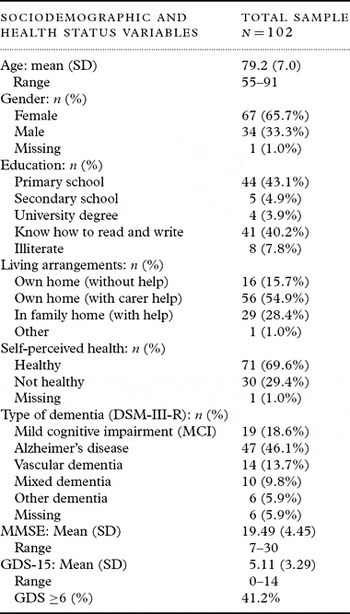
The sample consisted of 119 people with dementia; validation of the Spanish version of DEMQOL was undertaken among the 102 patients who completed DEMQOL (Table 1). Compared to participants who completed DEMQOL, those who did not complete had lower MMSE scores (19.5 vs 14.5; p < 0.001) and lower functional ability as measured by the Barthel Index (84.4 vs 65.5; p = 0.004). No significant differences were found with respect to sociodemographic variables. Patients who completed the DEMQOL ranged in age from 55 to 91 years (mean age 79.2, SD 7.0); 65.7% were female. Diagnoses included mild cognitive impairment (MCI) (18.6%), Alzheimer's disease (46.1%), vascular dementia (13.7%), mixed dementia (9.8%) and other dementia (5.9%). Diagnoses were not available for 5.9% of subjects who attended a community day care centre. A high percentage of patients (69.6%) considered themselves to be healthy; 41.2% of the sample had significant depressive symptoms (GDS ≥6). Twenty-five percent of patients completed the retest. The WHOQOL-BREF questionnaire was completed by 88 patients (missing rate 13.7%).
Patient characteristics

MMSE = Mini-mental State Examination; GDS = Geriatric Depression Scale.
Psychometric properties of DEMQOL and DEMQOL-Proxy
Table 2 summarizes results of the psychometric analyses.
Psychometric properties of the Spanish DEMQOL and DEMQOL-Proxy

ANOVA = analysis of variance; GDS = Geriatric Depression Scale; ICC = intra-class correlation coefficient; MMSE = Mini-mental State Examination; r = Pearson's correlation coefficient.
a Dichotomous variable (t-test) – healthy vs. unhealthy; b Categorical variable GDS-15 (t-test) – no depression (≤5), mild depression (≥6); c Assessed by DSM-IV (MCI/AD/Vascular dementia/Mix dementia/ Other dementia).
Acceptability: There were no floor/ceiling effects for either DEMQOL or DEMQOL-Proxy. As expected, missing data were higher for DEMQOL (14.3%) than for DEMQOL-Proxy (0%).
Reliability: Internal consistency was good for both DEMQOL (0.85) and DEMQOL-Proxy (0.86), and test–retest reliability for DEMQOL was acceptable (0.71).
Convergent validity: DEMQOL was significantly correlated with the WHOQOL-BREF psychological domain (r = 0.504, p < 0.001), physical domain (r = 0.393, p < 0.001) and environment domain (r = 0.312, p < 0.003), but not the social domain. DEMQOL-Proxy was also correlated with the WHOQOL-BREF psychological (r = 0.421, p < 0.001) and physical (r = 0.217, p < 0.03) domains, although correlations were lower than those for DEMQOL. Correlations with the GDS-15 were negative and significant for DEMQOL (r = –0.561, p < 0.001) and DEMQOL-Proxy (r = −0.391, p < 0.001), whereas correlations with the Barthel Index were positive and significant only for DEMQOL (r = 0.213, p = 0.03). Correlations with MMSE (as the continuous variable) were not significant for DEMQOL (r = 0.099, p = 0.361) or for DEMQOL-Proxy (r = −0.134, p = 0.207).
Discriminant validity: As expected, DEMQOL was not significantly associated with gender, education, occupation or marital status. DEMQOL-Proxy was moderately correlated with patient age (r = 0.326, p < 0.001).
Known groups validity: DEMQOL and DEMQOL-Proxy scores showed the predicted pattern amongst a priori known groups. DEMQOL scores were significantly higher (better quality of life) in: patients who perceived themselves to be healthy vs. unhealthy (84.5 vs. 78.9; p = 0.021); depressed vs. non-depressed (75.3 vs. 87.7; p < 0.001). There were no significant differences in DEMQOL scores according to type MCI vs. dementia (84.4 vs. 82.0; p = 0.35) or severity of dementia (MMSE <18 vs. MMSE ≥18). Similar results were found for DEMQOL-Proxy (Table 2).
Patient-proxy agreement: The correlation between DEMQOL and DEMQOL-Proxy scores was moderate (r = 0.50; n = 79) and similar to that reported by Smith et al. (Reference Smith2005b; Reference Smith2007).
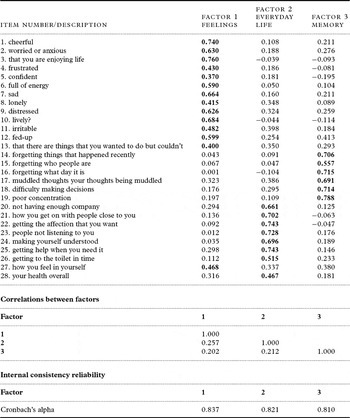
Dimensionality: The Kaiser-Meyer-Olkin statistic (KMO) was greater than 0.5 (KMO = 0.704) and the Bartlett test of sphericity was significant (p < 0.05), indicating an underlying structure in the two scales. Table 3 presents the factor solution for the Spanish version of DEMQOL. After principal components factor extraction and PROMAX rotation, the best solution we found indicated a model with three factors that accounted for 44.4% of the variance. All items, except item confident, loaded ≥0.40 on one factor, and only one item fed-up loaded ≥0.40 on two factors. These three factors, named Feelings, Memory and Everyday Life were weakly correlated each other and showed high internal consistency. These factors were different from those found by Smith et al. (Reference Smith2005b), which reported a four-factor solution accounting for 43.3% of the variance, with factors difficult to interpret given that some items did not load ≥0.40 and others cross-loaded. Smith et al. (Reference Smith2005b) found no alternative model, and concluded that subscales could not be supported.
Rotated factor matrix: Spanish DEMQOL

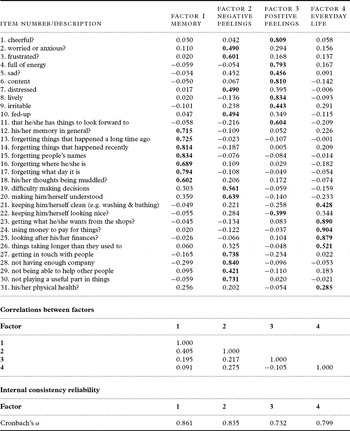
Table 4 presents the factor solution for the Spanish version of DEMQOL-Proxy. The model showed a four-factor solution that accounted for 53.3% of the variance. We labeled these four factors Memory, Positive feelings, Negative feelings and Everyday life. Five items (sad, distressed, fed-up, difficult making decisions, making him understood) loaded ≥0.40 on two scales. Four items related with Daily Activities in the original scale (getting in touch with people, not having enough company, not being able to help other people, not playing a useful part in things), loaded on the factor named Negative Feelings. Two negative items (sad and irritable) also loaded on the positive feelings factor.
Rotated factor matrix: Spanish DEMQOL-Proxy

Discussion
We translated into Spanish and validated DEMQOL and DEMQOL-Proxy. In people with mild-moderate dementia (MMSE ≥10), the Spanish versions of both instruments showed good psychometric properties. In general, these results were similar to those reported by Smith et al. (Reference Smith2005b; Reference Smith2007).
Associations between DEMQOL and DEMQOL-Proxy and the validating measures were generally relatively low. This may reflect a number of methodological points. First, one of the main validating measures was a generic measure (WHOQOL-BREF). It may therefore not have been sensitive enough to some of the disease-specific aspects of HRQL captured by DEMQOL and DEMQOL-Proxy. Secondly, the WHOQOL-BREF is self-reported. Method variance may have accounted for some of the lower correlations between DEMQOL-Proxy and WHOQOL-BREF. This lower association with reports from proxies has been found by other authors (Brod et al., Reference Brod, Stewart, Sands and Walton1999).
The higher correlations with GDS-15 and the WHOQOL-BREF psychological domain may reflect the psychological aspects of HRQL emphasized in DEMQOL. This is similar to the pattern reported by Smith et al. (Reference Smith2007) although they did not find such strong associations between DEMQOL and depression. The weaker association between DEMQOL and DEMQOL-Proxy and functional ability and physical variables was also similar to the pattern described by the developers of DEMQOL. Smith et al. (Reference Smith2007) attributed this to the smaller number of physical items in the questionnaire compared with psychological and social items. Lower correlations with functional status might also be due to the possibility that it is not a major determinant of HRQL in dementia (Banerjee et al., Reference Banerjee2009) compared to other variables, mainly those related to feelings and mood.
In relation to known groups differences, we found significant differences among groups a priori considered to be different in some aspects such as healthy vs. unhealthy, depressed vs. non-depressed. Respondents who reported being healthy and non-depressed showed higher HRQL scores, compared to those who self-reported as unhealthy and depressed, respectively. Depression and health status have been associated with lower HRQL scores in subjects without dementia (Bech et al., Reference Bech2003; Simon et al., Reference Simon, Fleck, Lucas and Bushnell2004). However, we found no significant differences by type or severity of cognitive impairment. There is increasing evidence that severity of dementia may not be a major determinant of HRQL in dementia, indicating that it is possible to have good life quality at all levels of severity in dementia (Brod et al., Reference Brod, Stewart, Sands and Walton1999; Smith et al., Reference Smith2005b; Banerjee et al., Reference Banerjee2006; Reference Banerjee2009).
Exploratory factor analysis of DEMQOL showed a three-factor structure that accounted for 44.4% of the variance. The first factor included all items related with Feelings (both Positive and Negative), the second factor included items related to Everyday Life, except item 27. How you feel in yourself which belongs to the first factor Feelings; and the third factor included Memory and Concentration-related items. Smith et al. (Reference Smith2007) reported a four-factor model for DEMQOL (Memory, Positive Feelings, Negative Feelings, Everyday Life), which accounted for 43.3% of the variance. The factor structure for DEMQOL-Proxy was also different from the two-factor model reported by Smith et al. (Reference Smith2005b). Our findings support those from the original development study that for both DEMQOL and DEMQOL-Proxy a single overall score should be derived as it is not appropriate to derive subscales.
One possible limitation is that as we did not include people with MMSE scores <10, we do not know whether DEMQOL is suitable for people with severe dementia. We followed the recommendation of the DEMQOL developers and others in using self-report measures with people with dementia (Brod et al., Reference Brod, Stewart, Sands and Walton1999; Smith et al., Reference Smith2005; Trigg et al., Reference Trigg, Skevington and Jones2007; Ready et al., Reference Ready, Ott and Grace2007). As we did not collect test-retest data from caregivers for DEMQOL Proxy, we cannot assess the stability of the DEMQOL-Proxy in this population.
None of the measures used to validate DEMQOL have been validated in Spanish for use with people with dementia. The Barthel Index is used to assess disability in people with dementia, but has not been validated in Spanish; there are also limited studies using the GDS-15 in patients with dementia. Although we used the best quality methodology we could within a Spanish language context, these factors may also have affected the lower than expected correlations between DEMQOL and DEMQOL Proxy and some of the validating measures.
To our knowledge this is the first study that has validated a self-report dementia-specific HRQL measure in Spanish. Our data suggest that, the Spanish versions of DEMQOL and DEMQOL-Proxy are suitable for use as dementia-specific quality of life measures in patients with cognitive impairment and mild to moderate dementia. Overall, the Spanish version of DEMQOL and DEMQOL-Proxy showed similar psychometric properties in people with mild-moderate cognitive impairment to the original English versions. Future research with larger samples is needed to confirm these findings.
Conflict of interest
Pfizer sponsored the field trial work of this study. Javier Rejas is an employee of Pfizer Spain. No other financial interests were involved.
Description of authors' roles
Dr. Lucas-Carrasco, Professor Gómez-Benito and Dr. Rejas had full access to the data and were responsible for carrying out the data analysis, interpretation of results and preparation of the draft manuscript. Professor Lamping, Dr. Smith and Professor Banerjee reviewed results and contributed to the drafting of the final manuscript by commenting on draft and final versions.
Acknowledgments
We thank all the Centers, and especially the people with dementia and their caregivers who participated in the study. The field trial study was funded by Pfizer (Madrid); financial support was used to pay interviewers at participating centers. The study was approved by the Ethics Committee at the Autonomous University of Barcelona.