INTRODUCTION
Brown heart is a physiological disorder appearing as a brown discolouration in marketable swede roots. The incidence of BH has been reported worldwide, particularly in Northern Europe, Australia, the USA, Canada and New Zealand (Gupta & Munro Reference Gupta and Munro1969). Brown heart has been attributed to an abiotic stress disorder related to localized boron (B) deficiency in the developing root; the first connection between B and BH was reported in 1936 by Hurst & MacLeod (Sanderson et al. Reference Sanderson, Sanderson and Gupta2002).
Acute B deficiency can cause problems in many crops and can lead to rapid termination of root elongation, shank leaf growth and low sexual fertility (Fujiwara et al. Reference Fujiwara, Tanaka, Miwa, Gilkes and Prakongkep2010; Al-Amery et al. Reference Al-Amery, Hamza and Fuller2011); these can all be attributed to a reduction in cell expansion and reflect the importance of B in cell wall development and function. In plant tissues, B is present in all subcellular compartments of the cytosol and vacuoles but the majority is in the apoplasm bound in cell walls (Dannel et al. Reference Dannel, Pfeffer and Mheld2002). Many studies have been carried out to determine the effect of B in Brassica napus and have proved that both rapeseed and swede are sensitive to B deficiency (Shelp & Shattuck Reference Shelp and Shattuck1987; Xu et al. Reference Xu, Wang, Ying and Meng2002; Miwa & Fujiwara Reference Miwa and Fujiwara2010). It was found that BH symptoms did not appear when root B content was >27 μg B/g (Shelp & Shattuck Reference Shelp and Shattuck1987), but when it fell to a range of 10–18 μg B/g it gave severe, moderate or slight internal signs of brown discolouration (Gupta & Munro Reference Gupta and Munro1969; Beauchamp & Hussain Reference Beauchamp and Hussain1974; Shelp & Shattuck Reference Shelp and Shattuck1987). There are also limitations on B availability from the soil to plants and this is particularly affected by soil acidity, which should ideally be in the range pH 5–6 (Bloom Reference Bloom, Taiz and Zeiger2002).
There appear to be variations between genotypes within a species in their response to B deficiency (Xu et al. Reference Xu, Wang and Li1998, Reference Xu, Wang and Meng2001). Shelp & Shattuck (Reference Shelp and Shattuck1987) maintained that swede genotypes with a good capacity for translocation of B from their leaves to developing roots always showed less sensitivity to B deficiency and BH disorders. Xu & Wang (Reference Xu, Wang, Calderon-Benavides, Yacaman and Calderon Benavides1998) showed that plant B utilization efficiency is a dominant trait. However, there are no recent studies and no reported studies examining the effects of B on the new generation of F1 swede hybrids being introduced and used by UK growers.
Swede roots exhibiting BH cannot be sold, as they are deemed to be unfit for human consumption. Unfortunately, there are no differences in the external appearance of BH affected and unaffected roots, either in the field or in post-harvest storage, and it is therefore not possible to identify roots with BH by external visual examination. Growers can only assess the marketability of a crop post-harvest and as a consequence the over-application of B is practised. Hence, it is important that breeders are able to select for BH resistance and present only resistant varieties to the market. The present work is part of an on-going project to examine the BH status of UK-bred varieties and reports both genetic and environmental influences on the incidence of BH from field trials.
MATERIALS AND METHODS
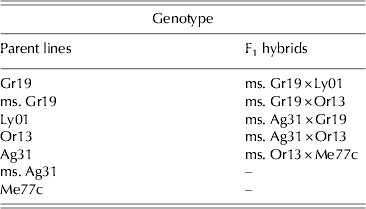
Data from 14 breeding trials recording the frequency of BH symptom appearance in the field for 353 swede genotypes over a 10-year period (2000–2010) in two different locations in the UK (North Berwick; 55°56′N, 02°44′W, 100 m asl and Spalding; 52°47′N, 00°10′W, 4 m asl) and one location in Germany (North Hamburg; 53°39′N, 10°02′E, 22 m asl) were collected by Elsoms Seeds Ltd. These data were analysed to investigate the frequency of BH appearance in relation to genotype. Following this analysis 12 swede genotypes were selected for inclusion in a large replicated field trial including five normal parent lines, two parent lines carrying cytoplasmic male sterility (ms), added using the radish Ogura system (Chiang & Crete Reference Chiang and Crete1987), and a selection of five F1 test hybrids (which are not yet commercially available) (Table 1). The trial was conducted within a commercial swede crop in Treburley, East Cornwall, UK (50°34′N, 04°19′W, 119 m asl) in association with Elsoms Seeds Ltd and the commercial swede growers Coles Ltd of Wellington, Somerset. The soil type was a silty-clay loam of the Denbigh series with a pH of 6·7. Representative soil sampling showed that soil contained 0·7 μg B/g, 23 μg calcium/g, 11·35 μg potassium/g, 6·6 μg phosphorus/g and 11 μg magnesium/g.
Swede genotypes used in the field trial (ms=male sterile)

Plots were established in raised beds according to current commercial practice in rows with inter-row spacing of 0·35 m and intra-row spacing of 0·15 m, giving a field plant population of c. 17 plants/m2. There were three replicate blocks and genotypes (12) (Table 1) were fully randomized within each replicate. The beds were covered with Enviromesh® to raise early season temperature and to prevent cabbage root fly infestation. A non-selective herbicide (Roundup Max) 1·6 kg/ha, a molluscicide (TDS Metarex Amba) 7 kg/ha and liquid fertilizer (04 : 10 : 12 N : P : K) 100 kg/ha were applied before sowing; a broadleaf herbicide (Springbok) 2·5 litres/ha was also applied.
Four B treatments (0·00, 1·35, 1·80 and 2·70 kg B/ha) were used (Table 2) in line with Sanderson et al. (Reference Sanderson, Sanderson and Gupta2002). Treatments included the growers’ commercial rate (1·80 kg B/ha). The B source used was a formulation of B-ethanolamine, which is the commercial source (VERDI-CROP, BORON 150, by Headland Agrochemicals Ltd. UK) used by swede growers. Boron was applied pre-sowing followed by two post-emergence sprays at 28 and 42 days after sowing (DAS) (Table 2).
Boron (B) treatments applied to the field trial (kg/ha)

DAS=days after sowing.
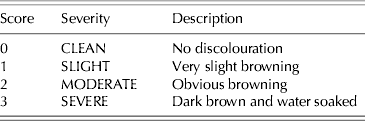
Scoring for BH symptoms was carried out just prior to harvest. Ten roots per plot were selected (avoiding outside rows and obvious crop gaps), sliced transversely and scored for internal browning using a 4-point scale 0–4 (Table 3).
Brown heart categories

Sub-samples of roots (both BH affected and healthy) were analysed for B content. The sub-samples were chopped into small pieces (1–5 cm) then frozen at −20 °C before freeze drying to constant weight for 3–5 days using an Edwards Super Modulyo freeze drier. Dried samples of 0·25 g were digested in 5 ml concentrated nitric acid for 2 h on a hot plate using special Teflon bombs made of material safe for B concentration determination. Cooled samples were diluted to 25 ml using 2% nitric acid. Boron concentration was determined using an ICP-OES (Varian 725-ES).
RESULTS
During the period 2000–2010, there were 46 recorded instances of BH in the breeders’ data. While symptoms were distributed between many genotypes, those showing some pedigree from three particular genotypes appeared more commonly than others (Fig. 1). Genotypes with Ag31 in their background appeared 17 times, those with Or13 in their background 13 times and those with Me77c 9 times. There were a further seven instances of BH across other different genotypes (Fig. 1).
Frequency chart of genotypic background in plots with the appearance of brown heart in breeders field trials data (2000–2010) (n=353). Values shown are proportions of the total number.

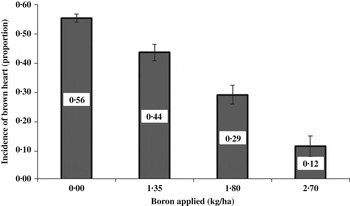
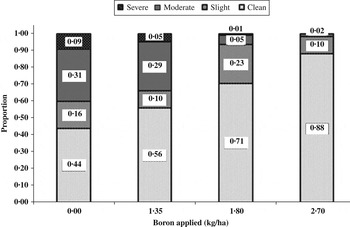
Field trial results of BH incidence divided genotypes into two groups: the group of resistant genotypes which included the parent lines Gr19, ms.Gr19, Ly01 and the hybrids ms.Gr19×Ly01, ms.Gr19×Or13 and ms.Ag31×Gr19. The group of susceptible genotypes comprised the parents Ag31, ms.Ag31, Or13 and Me77c and the hybrids ms.Or13×Me77c and ms.Ag31×Or13. The proportion of roots with BH appearance in the group of susceptible genotypes was ameliorated significantly (P<0·001) by B application (Fig. 2). The overall frequency of BH incidence (scores 1–3 combined) decreased from 56 at 0 B to 12 at 2·70 kg B/ha. Generally, the application of B decreased the overall incidence of BH with each increase in B level.
Overall incidence of brown heart in the group of susceptible genotypes at different boron application levels. Vertical bars represent±s.e.m.

The severity of BH was also affected by the level of B applied (Fig. 3). Symptoms of severe BH for all affected genotypes decreased significantly at 1·80 kg B/ha and disappeared at 2·70 kg B/ha. Moderate internal browning dropped from 0·31 at 0 B to 0·02 at 2·70 kg B/ha. The proportion of roots clean of BH was increased by 100% at 2·70 kg B/ha applied in comparison to the treatment without applied B.
Proportion of brown heart severity at different boron application levels.

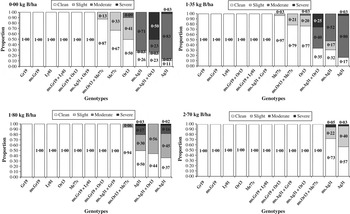
Genotypes demonstrated clear significant differences (P<0·01) in incidence of BH in their response to B application (Fig. 4). Increasing the level of B applied reduced the frequency of BH incidence. Among the parent lines, the highest proportions of BH recorded at 0 B were 0·89 and 0·74 by Ag31 and ms.Ag31, respectively, and they were the only genotypes that showed any BH infection symptoms at 2·70 kg B/ha (0·43 and 0·27 for Ag31 and ms.Ag31, respectively). In contrast, parent lines Gr19, ms.Gr19 and Ly01 had no affected roots at all B levels, including 0 B. Genotypes Me77c and Or13 were intermediate in their response: at 0 B, 0·33 of Me77c and 0·50 of Or13 roots were affected with BH disorder. At 1·35 kg B/ha applied, BH decreased to 0·03 for Me77c and 0·23 for Or13. Both Or13 and Me77c were completely clear of root internal browning at 1·80 and 2·70 kg B/ha applied.
The proportion incidence of brown heart in swede genotypes at different levels of applied boron.

The response to B treatment and the BH symptoms of F1 hybrids appeared to be influenced by their parent lines. The hybrids ms.Or13×Me77c and ms.Ag31×Or13 were the only ones to show BH symptoms and were also the only hybrids which combined parent genotypes susceptible to BH. The hybrids ms.Gr19×Ly01, ms.Gr19×Or13 and ms.Ag31×Gr19 showed no BH at any level of B applied.
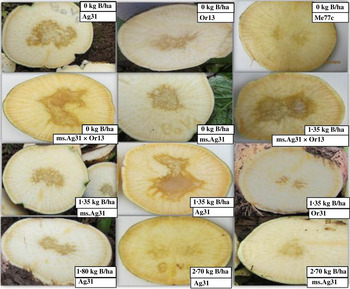
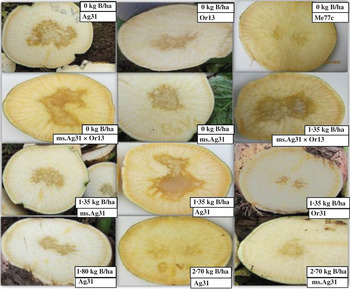
Overall, Gr19, ms.Gr19, Ly01, ms.Gr19×Ly01, ms.Gr19×Or13 and ms.Ag31×Gr19 can be considered as highly resistant genotypes to BH disorder, while Me77c, Or13 and ms.Or13×Me77c were intermediate and ms.Ag31×Or13, Ag31 and ms.Ag31 were very susceptible. Interestingly, genotypes susceptible to BH showed different levels of BH severity at the same level of B treatment (Fig. 5).
Internal browning severity of brown heart at different levels of boron treatment (colour version available online).

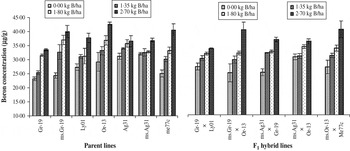
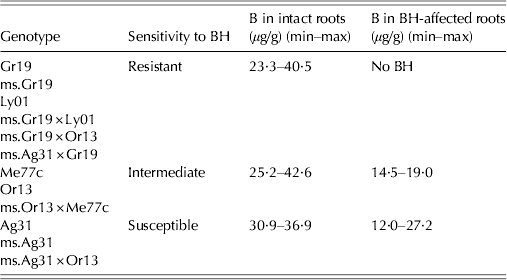
Boron concentration in healthy plant roots showed significant differences (P<0·05) between genotypes in their response to the levels of B applied and all genotypes increased their B root tissue concentration with each increasing level of B applied (Fig. 6). The minimum B concentration in roots not showing BH symptoms at 0 B was 23·3 μg B/g for Gr19, while the highest was 32·2 μg B/g for ms.Ag31. At 2·70 kg B/ha, Gr19 again showed the lowest root concentration of B (35·6 μg B/g), while the highest (42·6 μg B/g) was shown by Or13. The F1 hybrid plants showed a minimum root B concentration of 25·2 μg B/g (ms.Gr19×Or13 at 0 kg B/ha) while ms.Ag31×Or13 had the highest (30·9 μg B/g) at the same level of B applied. At 2·70 kg B/ha, ms.Gr19×Me77c and ms.Gr19×Or13 had the highest concentration of B in the root (40·7 and 40·6 μg B/g, respectively): the lowest concentration was 33·8 μg B/g in ms.Gr19×Ly01.
Boron concentration in swede roots not showing brown heart symptoms. Vertical bars represent±s.e.m.

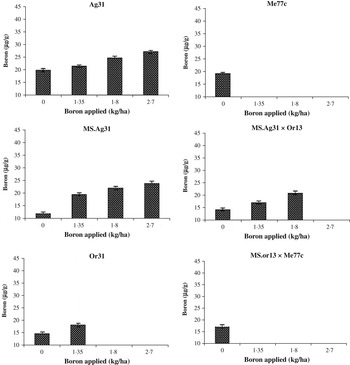
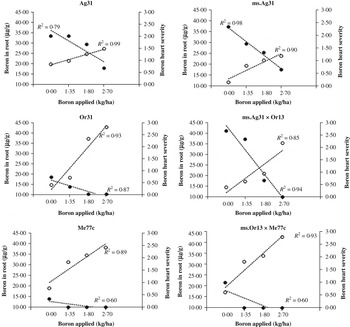
Roots showing BH disorder exhibited lower levels of tissue B compared with non-affected plants of the same genotype (Table 4). Genotypes also differed in their ability to respond to a scarcity of soil B (Fig. 7) and not all genotypes showed a propensity to be affected by BH disorder. Boron concentration in affected roots ranged from a minimum of 12 μg B/g in variety ms.Ag31 at 0 B to a maximum of 27·16 μg B/g in Ag31 at 2·70 kg B/ha, in contrast to a minimum for unaffected roots of 21·18 μg B/g in Me77c at 0 B and a maximum of 42·63 μg B/g in Or13 at 2·70 kg B/ha. The extent of the range of B concentration in roots affected with BH was 19·65 μg B/g compared with 32·88 μg B/g in healthy roots of the same genotype. Root B concentration increased as the level of B applied increased. There was an overall significant (P<0·001) negative correlation between BH severity and root B concentration for genotypes, which exhibited BH symptoms (r=−0·632). This negative correlation was evident for each of the individual susceptible genotypes (Fig. 8).
Boron concentration in brown heart affected roots of swede genotypes sensitive to brown heart disorder. Where no columns are shown there was no brown heart disorder. Vertical bars represent±s.e.m.

The relationship between swede root boron concentration (open circles) and brown heart severity (closed circles – 0 clean, 3 severe) in susceptible genotypes with different levels of boron fertilizer applied.

Boron (B) concentration ranges in intact and brown heart (BH) affected roots

The most susceptible genotypes all had Ag31 in their genetic background and the parent lines Ag31 and ms.Ag31 were affected by BH at all levels of B, even though the severity declined at higher levels of applied B (Fig. 8). Roots that were severely affected with BH disorder always showed low B content (12–21·5 μg B/g) but precise values differed between genotypes. Moderate internal browning (scores of 1·5–2) was also related to low root B concentration (19·5–24·8 μg B/g). Roots free of BH disorder were associated with B content >31 μg B/g for very susceptible genotypes, while others required a minimum of 23 μg B/g.
The genotype Or13 showed slight root discolouration at 0 B and 1·35 kg B/ha, but none at 1·80 kg B/ha, while Me77c was mostly free of BH at all levels of B with an average severity score of only 0·3 at 0 B. The hybrid ms.Ag31×Or13 was free of internal browning at 2·70 kg B/ha, while ms.Or13×Me77c was unaffected at all B treatments with only a few incidences of slight discolouration in treatments 0 B and 1·35 kg B/ha. Parent lines Gr19, ms.Gr19 and Ly01 and the hybrids ms.Gr19×Ly01, ms.Gr19×Or13 and ms.Ag31×Gr19 were free of BH at all levels of B applied, even at 0 B.
Male sterility in all of the studied genotypes (ms.Gr19, ms.Ag31 and ms.Or13) appeared to have no effect on BH symptom appearance. Hybrids having Gr19 or ms.Gr19 as a paternal or maternal parent showed the same resistant phenotype in terms of BH infection. Likewise, Ag31 and ms.Ag31 and Or13 and ms. Or13 were susceptible to BH disorder whether with or without ms and this was reflected in the hybrids from these susceptible parents. These findings suggest that cytoplasmic ms has no effect on swede susceptibility to BH, suggesting that BH susceptibility is a nuclear-controlled trait and not cytoplasmic.
DISCUSSION
The frequency of BH appearance over a 10-year period revealed that the occurrence of this disorder was associated with certain genotypes and not others. These results are consistent with other reports (Sanderson et al. Reference Sanderson, Sanderson and Gupta2002) which suggest that swede genotypes differ in their susceptibility to BH and that each cultivar could have its own particular response to B application to offset BH symptoms.
Both the level of B applied and the plant genotype significantly affected BH incidence and severity, as well as plant tissue B concentration. Xu et al. (Reference Xu, Wang and Meng2001) referred to the existence of genetic variation for B deficiency response within the B. napus germplasm, and this is confirmed in the present work. Cutcliffe & Gupta (Reference Cutcliffe and Gupta1987) reported a higher percentage of BH incidences at low levels of B application. Gupta & Cutcliffe (Reference Gupta and Cutcliffe1978) recorded a reduction in BH severity from very severe at no B added to free of BH at 4·48 kg B/ha. All genotypes in the present study clearly responded to increased levels of B application in terms of their root B concentration, which increased incrementally with each B application, and this is consistent with the findings of Gupta & Munro (Reference Gupta and Munro1969).
The swede genotypes tested exhibited different abilities to withstand low levels of applied B. Six of the 12 genotypes showed some BH at 0 B, whereas at 2·70 kg B/ha just two of them had BH (with both reduced incidence and severity). Roots with BH symptoms had lower concentrations of B than healthy ones and a root B content of 12–27·9 μg B/g was required for BH symptoms to appear in the susceptible genotypes. These results support those of Shelp & Shattuck (Reference Shelp and Shattuck1987) and Beauchamp & Hussain (Reference Beauchamp and Hussain1974). In the present experiment, the soil concentration of B was measured at 0·7 μg B/g and this seemed to be enough for some genotypes to be clear of any symptoms of BH. In most soils, B typically ranges from 0·5 to 1·0 μg B/g (Shiffler et al. Reference Shiffler, Jolley, Webb and Carter2003). The soil contents recorded in the present work were close to those recorded by Gupta & Cutcliffe (Reference Gupta and Cutcliffe1971), who stated that soil B concentrations of 0·8 μg B/g or greater are required to prevent the appearance of BH symptoms in swede, whereas Shelp & Shattuck (Reference Shelp and Shattuck1987) referred to BH occurrence when soil B ranged from 0·4 to 1·3 μg B/g.
The parent lines Gr19 (and ms.Gr19) and Ly01 and hybrids with this genetic background (ms.Gr19×Ly01, ms.Gr19×Or13 and ms.Ag31×Gr19) are considered as highly resistant genotypes to BH because they showed no internal browning symptoms even at 0 B. This is consistent with the findings of Xu et al. (Reference Xu, Wang, Ying and Meng2002) who showed that some B. napus cultivars can grow normally in limited B conditions. In contrast, Ag31 (and ms.Ag31) can be considered as a very susceptible genotype since it showed BH symptoms at all levels of B applied. Genotypes Or13 and Me77c showed intermediate susceptibility. Genotype variation within a species in respect of response to nutrient levels in the soil is not uncommon (Kelly & Gabelman Reference Kelly and Gabelman1960). A good capacity to translocate B from leaves to roots is thought to make a plant less sensitive to B deficiency and BH disorder (Shelp & Shattuck Reference Shelp and Shattuck1987). Interestingly, in the present experiment, the test hybrids that showed no BH symptoms included some genetic combinations between susceptible and resistant parent lines. The only test hybrids that showed BH (ms.Ag31×Or13 and ms.Or13×Me77c) were hybrids between two susceptible parent lines. These findings suggest that BH resistance is a dominant trait related to B availability: this is supported by Xu & Wang (Reference Xu, Wang, Calderon-Benavides, Yacaman and Calderon Benavides1998). It is suggested that the genotype for this trait can be considered as dominant resistant (BH) or recessive susceptible (bh) and that heterozygous hybrids (BHbh) would show resistant phenotypes. However there was clearly some quantitative variation in BH susceptibility among genotypes, suggesting that resistance was not a single gene effect.
Amongst the sensitive genotypes there was a negative and highly significant correlation between BH severity and root B concentration. Severe BH symptoms were associated with root B concentrations of 12–21·5 μg B/g at levels of 0 and 1·35 kg B/ha. Moderate discolouration was associated with B concentrations of 19·5–24·8 μg B/g. The B content of clean roots differed between susceptible and resistant genotypes, and susceptible genotypes always had root B concentrations >31 μg B/g while resistant genotypes showed a minimum of 23 μg B/g for clean roots. Clearly, severity of BH differed between genotypes and their B concentration, and affected genotypes differed in their resistance to BH at different levels of B applied. It is suggested that it is possible to define the term ‘boron stress’ as the root B concentration at which BH symptoms occur but it is important to recognize that the precise level varies for each particular genotype. Increasing B application levels generally increased the concentration of root B and assisted in reducing BH incidence, but did not overcome the problem completely in the sensitive genotypes. Where resistant varieties are used, B application in the field may be unnecessary.
The present results clearly showed that BH incidence and severity was primarily affected by swede genotype and for susceptible genotypes, the incidence of BH could be ameliorated by B application to the crop. It is clear that plant breeders should utilize BH-resistance dominant germplasm such as those offered by Gr19, Ly01 and Me77c when making new hybrid crosses with the susceptible germplasm of Ag31 or Or13. Also it is important that screening of hybrids and selections emanating from these should be made at low soil B levels in order to show susceptibilities without the ameliorating effect of high B availability. Cytoplasmic ms had no impact on genotype response to BH and is therefore acceptable for swede breeders to use in swede hybrid production programmes. Finally, it is suggested that commercial growers of swedes are frequently over-applying post-emergence B to genotypes that are highly resistant. It will become increasingly necessary for breeders to supply more variety information to growers so that when they choose F1 hybrids with a genetic background from susceptible parents, such hybrids will require a high input of B.