


Introduction
Political and, in some cases, institutional pressures to implement artificial intelligence (AI) have created unprecedented challenges and opportunities at the practical and professional intersections of regulatory science and clinical and translational research [Reference Askin, Burkhalter, Calado and El Dakrouni1]. These challenges vary by institution and are driven in part by (1) a changing regulatory and scientific landscape, (2) undeveloped pathways for appropriately balancing value with risk when implementing AI across professional workflows, and (3) the need to remain competitive in an increasingly high risk/high reward scientific environment. Because these challenges will evolve for the foreseeable future, opportunities have emerged to engage professionally in the development and adoption of best practices, key principles, and appropriately enabling guardrails.
Literature has become rich with guidance and best practices for ethical and equitable AI implementation in research and development settings [Reference Lekadir, Frangi and Porras2–Reference Hendricks-Sturrup, Simmons and Anders4]. Far scarcer is discourse in the form of shared learnings about how the clinical and translational research community of professionals is experimenting with AI to adapt, modify, or strengthen its day-to-day workflows. Sharing relevant tools and lessons learned broadly within this community matters for at least three reasons: (1) to offer exposure to tools and solutions that already exist, preventing duplicated effort, (2) to build a knowledge base of what does and does not work in local experimentation, and (3) to illustrate pathways toward technological capability, competency, and fluency in the use of AI.
The Association for Clinical and Translational Science (ACTS) Special Interest Groups (SIGs) are steady, trusted forums in which ACTS members discover, discuss, share, and disseminate relevant knowledge, resources, and guidance for clinical and translational science professionals [5]. They also provide a safe space in which members can pressure test proposed solutions and customize them for their respective institutions. The Regulatory Science SIG, for example, provides a “critical space for ACTS members to become and remain informed about current policy, including changes and shifts within the regulatory and policy landscapes over time.” [5] Similarly, the Clinical Research Professionals Taskforce (CRPT) provides an “ongoing forum for deliberate and meaningful discussions around the multifaceted, expanding role of clinical research professionals and highlights issues surrounding their support and training.” [5] In this brief report, we describe recent engagement among ACTS Regulatory Science and CRPT SIG members centered on the following question: how do clinical research and regulatory science professionals today support responsible uses of AI across clinical and translational science operations? We then reflect on the experiences shared to identify opportunities for high-value/low-risk AI implementation in this setting.
Methods
Engagement overview
The Regulatory Science and CRPT SIGs convened on April 20, 2026, at Translational Science 2026 (TS26) in Milwaukee, Wisconsin, during two SIG meetings (Regulatory Science SIG and CRPT SIG, with the former held first and the latter second; the CRPT SIG meeting was convened under the session title “What’s Brewing in AI”). SIG member engagement involved a combination of PowerPoint slide presentations, live polling using an interactive platform (Slido; https://www.slido.com/), and open and interactive discussions.
Interactive polling
Slido questions were embedded within PowerPoint slides presented during the Regulatory Science and CRPT SIG meetings. SIG meeting members were specifically asked the following questions via the interactive poll (response options/convention):
-
• Do you use AI to support your work or workflows? (yes, no, unsure)
-
◦ For those who responded yes, describe in a few words where AI has worked well to support your work or workflows. (word cloud)
-
-
• Does your institution have an AI policy that affects your work or workflows? (yes, no, maybe, I do not know)
To avoid redundant poll responses between SIG meetings, Regulatory Science SIG members who (1) completed the poll during the preceding Regulatory Science SIG, and (2) attended the subsequent CRPT SIG meeting, were specifically instructed to abstain from completing the interactive poll during CRPT SIG meeting. Responses to poll questions informed the general group discussion on areas in which AI has worked well/not so well based on attendees’ experiences shared.
Post-polling discussion
An audio recording was captured for the CRPT SIG meeting only due to technological limitations experienced during the Regulatory Science SIG meeting. Using the recording, manual notes were synthesized by six Regulatory Science (n = 3) and CRPT SIG (n = 3) meeting presenters (including R.M.H-S., S.W., and J.P.F.) to identify key discussion themes and reflections. Specifically, the six meeting presenters held regular, iterative post-event discussions via email and videoconferencing amongst themselves, to synthesize key themes and reflections and articulate their perspectives in reaction to those themes. Given the nature of the work being largely engagement-driven (versus research-driven), no specialized thematic analysis software or AI tools, or specific theory-based, qualitative research approach, were used to develop and articulate key discussion themes.
Ethical considerations
The present work centered exclusively on ACTS Regulatory Science and CRPT SIG member engagement during TS26 and was not intended as human subjects research. Member engagement and responses to poll questions were wholly voluntary (non-compulsory), and all comments and experiences shared are subject to further assessment to establish general knowledge on this topic. Poll respondents received no compensation or other monetary incentives before, during, or after the SIG meetings.
Results
Interactive poll results
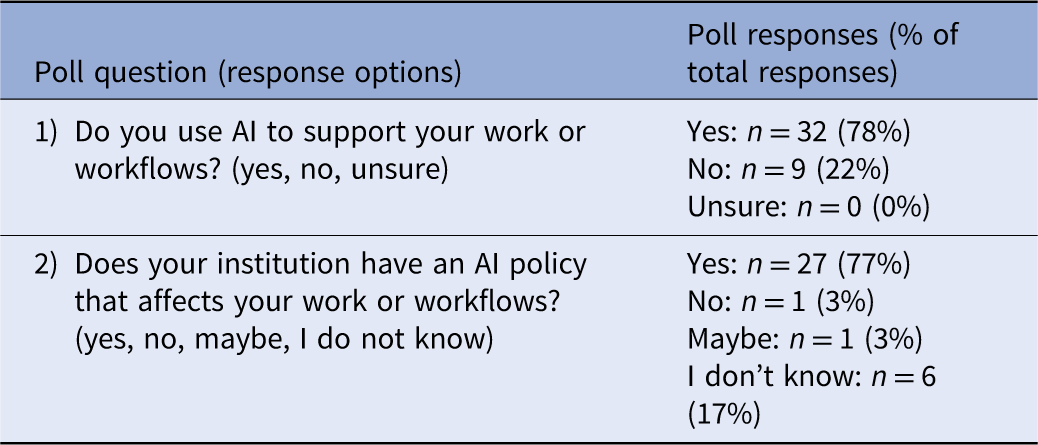
A total of 43 individuals engaged in the interactive poll, with the total number of respondents per question ranging between n = 35 (Question 2) to n = 41 (Question 1; see Table 1). Most individuals engaged in the interactive poll (n = 32) reported using AI to support their workflows (see Table 1). Among these 32 respondents, multiple use-case examples were shared (n = 70 responses; respondents could share more than one example). Use cases shared were summarized as follows:
-
• Writing assistance and editorial and literature search support
-
• Summarizing content
-
• Converting writing into plain language
-
• Creating presentations, graphs, data summaries or visualizations, and simulations
-
• Drafting meeting transcriptions and minutes
-
• Podcasting
-
• Collating information across disparate sources to support internal workflows
Poll responses among Regulatory Sciences and Clinical Research Professional Taskforce Special Interest Groups at Translational Science 2026 in Milwaukee, Wisconsin, regarding their use of AI to support research operations within their respective institutions

Table 1. Long description
A table with two rows and three columns. The first column lists poll questions with response options. The second column shows the number of respondents and their percentages for each response option. The first question asks if AI is used to support work or workflows, with responses: Yes: n = 32 (78 percent), No: n = 9 (22 percent), Unsure: n = 0 (0 percent). The second question asks if the institution has an AI policy affecting work or workflows, with responses: Yes: n = 27 (77 percent), No: n = 1 (3 percent), Maybe: n = 1 (3 percent), I don’t know: n = 6 (17 percent).
Of 35 respondents, most (77%) reported that their institution has an AI policy that applies to their work or workflows (17%, n = 6, reported that they don’t know).
Key discussion themes
The following four key discussion themes were captured: (1) concerns about AI as a technocratic approach, (2) AI as an efficiency tool versus capability multiplier; (3) evaluating AI value, cost, and safety; and (4) peer-to-peer engagement (or lack thereof) around AI solutioning. We discuss these themes below.
Discussion theme 1: concerns about AI as a technocratic approach
SIG members discussed key concerns about AI being implemented as a technocratic (versus humanistic) approach or solution to performing clinical research operations. Themes around specific concerns were summarized as follows:
-
• Output accuracy: Are my AI outputs reliable, accurate, and substantially aligned with my original input/query?
-
• Hallucination: Are my AI outputs verifiable against source material(s) to correct for potential AI fabrication, misinterpretation, or other illusory and therefore unreliable details?
-
• Cognitive offloading: Am I over-relying on AI to dictate my thoughts or finalize my conclusions, or support/guide my own rationale thinking and thought process(es)?
-
• Hype over real-world value: Am I exploring AI tools with the intent to be open-minded yet judicious about discovering and disseminating the actual value of those AI tools in my specific work setting(s)?
-
• Authenticity in AI-driven patient engagement, selection, and outreach: Am I replacing authentic, human-level patient engagement with AI-based engagement or using AI to support authentic patient engagement?
-
• Research contract provisions on AI use disclosure: Is AI use expressly prohibited or allowed, and/or am I required to disclose any uses of AI, pursuant to any contract provisions with research collaborators?
Each of these concerns, and the questions they raise, highlight opportunities for research professionals to more closely examine and, perhaps where necessary, self-or course-correct to ensure AI is applied as a solutioning tool (versus AI functioning as the solution itself).
Discussion theme 2: AI as an efficiency tool versus capability multiplier
A central distinction emerged during the session between two questions that professionals can ask of AI: “Can AI do this faster?” and “Can AI let us do something we could not do at all?” The discussion converged on the second question as the more useful test for directing limited time and resources toward AI experimentation. Four questions were offered to support evaluations of whether a candidate AI application represents a genuine capability gain:
-
• Is this enabling high-value work at a scale that was not previously possible?
-
• What is critically important that we currently cannot do?
-
• What constrictions or bottlenecks does the AI application create elsewhere in the workflow?
-
• Does this AI application help us effectively advance the mission of improving clinical and translational research?
Where AI reveals that an existing process or workflow is not performing as intended – that insight is an opportunity to strengthen the process itself. In those scenarios, whether AI can be used as a capability multiplier to strengthen that process is a question worth raising and addressing within research operation teams and sharing broadly with this community.
Discussion theme 3: evaluating value, cost, and safety
SIG members discussed how they evaluate the value, cost, and safety of AI, noting one particularly important point: People will spend time using AI tools when they experience actual value in doing (e.g., eliminating pain points along workflows). Discussions around costs centered on token-based uses of AI, whereas in such cases tokens that are consumed quickly, perhaps due to highly implementing teams, might drive up actual costs and therefore become cost prohibitive regardless of value.
Also, the group discussed that AI applications in research operations remain largely a “data-free zone,” perhaps in contrast to AI applications used to evaluate drugs and devices. Therefore, decisions to implement AI in professional research operation settings are often made ahead of the evidence base (perhaps contrary to other research settings). This seeming circumvention highlights the need to connect, with respect to AI implementation in research operation settings, the safety and cost conversation to the value measurement conversation. The former conversation might imply responsible use/application of an AI application; however, the latter might imply scrutiny around determining whether an AI application actually works or holds value in research operations relative to safety/cost. Also in the latter case, return on investment measures might account for costs associated with AI de-implementation or nonuse, whereas in such cases research operations could become substantially affected by the lack of AI utilization (i.e., reduced speed in completing repetitive administrative tasks, etc.).
Discussion theme 4: peer-to-peer engagement (or lack thereof) around AI solutioning
Attendees described a range of concrete, institution-specific applications during the session, including automated ClinicalTrials.gov registration workflows, AI-assisted conversion of consent documents, and competency-based educational podcasts, and setting institution-level guardrails. Each represents local experimentation whose lessons, both successes and failures, rarely travel beyond the originating institution. This pattern reinforces the case for structured peer engagement. Without a forum where professionals can ask whether a problem has already been solved elsewhere, institutions duplicate effort and repeat one another’s mistakes.
Institutions also create missed opportunities to establish shared language and semantics based on grounded experiences among peers. Shared language is critical to drive the development of, and consistency across, institution-level policies that govern AI utilization in research operations. Therefore, the importance of shared language developed mainly through peer-to-peer engagement should not be understated, underappreciated, or undervalued.
An attendee shared an example of their institution’s information technology office negotiating contracts with third-party AI service providers and working internally with IRB teams to set specific AI utilization guardrails on a case-by-case basis. Other attendees responded noting that institutional AI governance rarely covers day-to-day use cases, thereby causing staff to often make independent judgment calls. This is especially true in cases where there is no prespecified entity within an institution tasked to address AI utilization-related inquiries from research staff or departments. Therefore, structured peer engagement centered on surfacing and classifying these challenges will serve as an important measure toward establishing or refining institutional AI governance.
Discussion
Here, we describe how peer-to-peer, professional engagement during meetings held at an annual conference can be useful and helpful to learn how research professionals are currently using AI to navigate the changing regulatory landscape, as well as understand attitudes about and awareness or adoption of AI across specific research operations and workflows. We also describe, based on ACTS member experience, where AI used as a supportive tool is opening doors to conduct or perform research operations with greater efficiency and, in some cases, to carry out operations that have not been previously possible. Moving forward, and consistent with perspectives and conclusions presented in related work [Reference Grambow, Desai and Weinfurt6–Reference Chumki, Smith and Ridenour8], it will be important for research professionals broadly to regularly engage to explore where high-value/low-risk AI solutions (e.g., repetitive tasks easily accomplishable with high fidelity) can be automated, and where high-value/high-medium-risk AI solutions (e.g., democratized programming solutions that incorporate structured and unstructured data across disparate sources, merging/consolidating institutional informed consent forms, etc.) require humans in the loop.
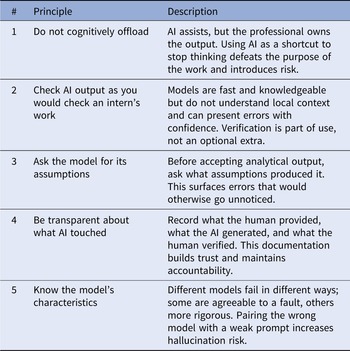
Additionally, it will be important for research professionals to build and enforce/reinforce appropriate guardrails (versus prohibitions) through governance. Governance, for example, may take the form of research contracts containing provisions that prohibit the use of AI in any and all aspects of trial/study-related operations (i.e., “shall not utilize any artificial intelligence (‘AI’) solutions, including GenAI, for any Study-related purpose, including but not limited to patient identification and recruitment purposes without Sponsor’s prior written approval.”). This could happen despite emerging research highlighting the significant potential of AI to enhance trial recruitment and retention [Reference Yin, Liu and Liew9]. Such provisions point to a broader misalignment: AI capabilities are outpacing governance at many institutions, and enterprise-level policy discussions often remain theoretical while the frontline staff conducting studies need concrete, use-case-driven guidance [Reference Idnay, Xu and Adams10]. It will also be important to revisit or update key implementation principles and best practices that deviate from the main goal, which is better research operations. AI should be and remain as a supportive, capability-enhancing tool to accomplish this goal (versus centering AI implementation as the primary goal), and the professional research community should remain empowered in its pursuit to identify, share, disseminate, and implement high-value/low-risk AI-supported solutions. We propose practical principles for responsible professional use of AI in research operations, described in detail in Table 2. These principles were first presented by S.W. during the “What’s Brewing in AI” session (CRPT SIG meeting), drawn from her hands-on experience applying AI across research operations, and were refined through the presenters’ post-event discussions.
Practical principles for responsible professional use of AI in research operations. Adapted from materials presented during the “What’s Brewing in AI” session (CRPT SIG meeting) at Translational Science 2026 (April 20, 2026)

Table 2. Long description
A table with five rows and three columns. The columns are labeled Principle, Description, and a number. Row 1: Principle 1, Do not cognitively offload, AI assists, but the professional owns the output. Using AI as a shortcut to stop thinking defeats the purpose of the work and introduces risk. Row 2: Principle 2, Check AI output as you would check an intern’s work, Models are fast and knowledgeable but do not understand local context and can present errors with confidence. Verification is part of use, not an optional extra. Row 3: Principle 3, Ask the model for its assumptions, Before accepting analytical output, ask what assumptions produced it. This surfaces errors that would otherwise go unnoticed. Row 4: Principle 4, Be transparent about what AI touched, Record what the human provided, what the AI generated, and what the human verified. This documentation builds trust and maintains accountability. Row 5: Principle 5, Know the model’s characteristics, Different models fail in different ways; some are agreeable to a fault, others more rigorous. Pairing the wrong model with a weak prompt increases hallucination risk.
When attendees were asked how many had adopted an AI solution developed at another institution, almost none indicated they had. For a professional community organized around sharing knowledge and approaches, this is a striking gap: the technology currently having the largest effect on daily workflows is the one for which cross-institutional sharing is weakest. However, this gap does not reflect a lack of material; it rather reflects a remarkable and timely opportunity to address this gap through strengthened engagement.
Limitations
Our work is accompanied by limitations that should be noted. First, our work reflects key takeaways from professional meetings held during an annual conference, thereby also reflecting methods that are more purposeful towards promoting meeting attendee engagement (versus systematic research and evaluation). Therefore, future work might involve the application of a rigorous research approach to potentially support or validate the results presented. Second, given technical limitations experienced during the Regulatory Science SIG meeting that led to our inability to synthesize key discussion themes from that discussion, we recommend that future work/engagement seek to capture, using a rigorous research approach, key themes reflecting regulatory professional experiences in using AI to support their operational workflows.
Summary
Our AI-centered engagement approach described here addresses barriers in translational research in two ways. First, the evaluative questions and principles help professionals focus AI on operational bottlenecks that slow translation or the rate at which operational lessons can be learned. Second, structured peer engagement provides a way for approaches that work at one institution to be shared and adapted elsewhere, rather than recreated from scratch. Further engagement will be necessary to ensure the full scope and range of AI implementation across institutional research operations is appropriately categorized and strategically applied.
Acknowledgements
We want to acknowledge the following Clinical Research Professional Taskforce (CRPT) members for hosting and partnering on engagement during the “What’s Brewing in AI” session at the ACTS TS26 Meeting in Milwaukee, WI: Michelle Jenkerson, Shirley Helm, Tony Keyes.
Author contributions
Rachele M. Hendricks-Sturrup: Conceptualization, Data curation, Formal analysis, Methodology, Project administration, Resources, Supervision, Writing – original draft, Writing – review & editing; Sandra M. Wells: Conceptualization, Formal analysis, Methodology, Supervision, Writing – original draft, Writing – review & editing; Joshua P, Fessel: Conceptualization, Formal analysis, Methodology, Project administration, Writing – original draft, Writing – review & editing.
Funding statement
S.W. is supported in part by the University of Minnesota’s NIH Clinical and Translational Science Award (UM1TR004405).
Competing interests
R.M.H-S. discloses honorarium received from Journal of Medical Internet Research and conference travel support from AstraZeneca. All other authors report no disclosures.

 Open access

