Nomenclature
-
 $M_i,i\in \mathbb{N}^{+}$
-
the i-th interceptor
-
$T_j,j\in \mathbb{N}^{+}$
-
the j-th ground target
- R
-
the relative range between the interceptor and the target
-
$\lambda$
-
the line-of-sight (LOS) angle between the interceptor and the target
-
$V_M$
-
the speed of the interceptor
-
$V_T$
-
the speed of the target
-
$\gamma$
-
the path angle of the interceptor
-
$\eta$
-
the speed deflection angle of the interceptor


1. Introduction
A cooperative attack can organise multiple interceptors in exchanging and sharing combat information, leading to improvement in the attack effectiveness on enemy targets, which has attracted considerable attention in modern warfare [Reference Shiyu and Rui1–Reference An, Guo, Huang and Xu4]. When multiple interceptors cooperatively attack multiple enemy targets, the important problem of assigning interceptor attack targets must be addressed; this is referred to as the weapon target allocation (WTA) problem. The goal of WTA is to optimise the advantages of the interceptors attacking the targets to maximise the combat effectiveness, which plays an important role in intelligent automated decision-making. WTA has become a current study hotspot [Reference Lee5–Reference Chen, Xin, Peng, Dou and Zhang9] and attracted several scholars to conduct corresponding research, especially showing great significance and value in military applications [Reference Sonuc, Sen and Bayir10,Reference Kline, Ahner and Hill11].
WTA has been proven to be a nondeterministic polynomial (NP)-complete [Reference Kong, Wang and Zhao12] problem. Currently, numerous traditional solving algorithms have been applied to solve the WTA problem, such as goal programming [Reference Kong, Wang and Zhao12], game-theoretic framework [Reference Kalmár-Nagy, Giardini and Bak13], and Lagrangian relaxation method [Reference Hocaoğlu14]. However, there are two main disadvantages in using these traditional algorithms: (1) They are only suitable for solving WTA problems with smaller dimensions; optimisation performance is ineffective once the dimension is increased, and (2) they have weak performance in global optimisation abilities even though they can provide an allocation strategy to the WTA problem. The multitarget allocation problem is a WTA problem with a higher dimension, requiring solving algorithms with significant effects on the convergence speed and global optimisation ability. Thus, the above traditional solving algorithms are not suitable for solving the multitarget allocation problem with a higher dimension in cooperative attack scenarios.
Multitarget allocation can essentially be considered an optimisation problem aiming to provide an optimal strategy for each interceptor to attack its assigned target. Currently, various intelligent algorithms are widely being utilised in solving optimisation problems to effectively overcome the shortcomings of the above traditional algorithms. The intelligent algorithm is considered a random search algorithm that imitates the behaviour patterns of nature or living organisms; the algorithm does not rely on gradient descent as the search direction and adopts a fitness function as a standard.
Particle swarm optimisation (PSO) is a typical random optimisation algorithm based on swarms with advantages of fast calculation speed and strong optimisation ability; it has a wide range of applications for solving optimisation problems [Reference Kumarappan and Suresh15]. Based on an evaluation index system for the cooperative engagement effectiveness of unmanned surface vehicles, Yuanming et al. [Reference Yuanming, Chengyang, Qian and Min16] combined a fuzzy analysis method and a back propagation (BP) neural network to establish an effectiveness evaluation model based on a PSO-BP neural network. Cheng et al. [Reference Cheng, Fan and Zhang17] studied the structure and functions of the ballistic missile defence system by using an agent-based modelling method and adopted the PSO algorithm to establish a multiagent decision support system that included a missile agent, radar agent and command centre agent. Based on the PSO algorithm, Zheng et al. [Reference Zheng, Gao, Jing and Wang18] proposed a heuristic optimisation model for surface-to-air missile path planning under a three-degree-of-freedom model to achieve the maximum range and optimal height of a missile. By constructing a master–slave population coevolution model, Fu et al. [Reference Fu, Wang, Zhang, Zhao and Wang19] proposed a multipopulation coevolution-based multiobjective particle swarm optimisation (MOPSO) algorithm to solve WTA problems with multiple optimisation objectives. Liu et al. [Reference Liu, Shi, Wu and Xiao20] proposed a firepower unit correlation matrix and designed a hybrid-optimised algorithm based on the PSO and tabu search algorithms, which demonstrated that the algorithm was more efficient than existing methods and could output optimisation results at any time. However, in solving a complex and high-dimensional optimisation problem, the PSO algorithm easily falls into a local extreme point, and the convergence accuracy is weak.
The amount of calculation for solving WTA increases exponentially as the dimension gets higher [Reference Kong, Wang and Zhao12]. When multiple interceptors cooperatively attack multiple enemy targets, the process of multitarget allocation is timely and effective to realise the real-time reconstruction and mission planning of the battlefield situation. Therefore, to effectively solve the problem of multitarget allocation, we consider the following two aspects: (1) establishing a fitness function to comprehensively describe the situation between the interceptors and the targets so that each interceptor can optimally attack its assigned target to achieve a maximised attack effectiveness, and (2) solving the multitarget allocation problem based on the established fitness function to ensure that each target is effectively and quickly allocated to its assigned interceptor.
Therefore, based on the issue of multitarget allocation, we propose an adaptive simulated annealing-particle swarm optimisation (SA-PSO) algorithm to find an optimal method to allocate each target to its specific interceptor to guarantee maximised attack effectiveness of each interceptor. The main contributions are as follows:
-
1. A fitness function is established based on the seeker’s characteristics of an interceptor and the situation between the interceptor and its target by comprehensively considering the relative range, relative angle, speed, capture probability, and radiation source matching performance. As a result, it is necessary to provide the basis for solving the multitarget allocation problem.
-
2. Given the multitarget allocation problem with a large dimension, an adaptive SA-PSO algorithm is proposed in combination with the PSO and SA algorithms to enhance the convergence speed and overcome the disadvantage of the PSO algorithm and improve the global optimisation ability.
The remainder of this paper is organised as follows: Section 2 addresses the problem of multitarget allocation and establishes a fitness function to evaluate the advantage for the allocation results. The design of the adaptive SA-PSO algorithm is outlined in Section 3. Comparative simulation studies are presented in Section 4. Conclusions are drawn in Section 5.
2. Problem formulation
In a scenario where multiple interceptors cooperatively attack multiple targets, it is essential to implement an optimal multitarget allocation strategy to maximise attack effectiveness by comprehensively evaluating the characteristics of interceptors and targets. In this study, we consider the situation between the interceptors and the targets from five aspects: relative range, relative angle, speed, capture probability performance and radiation source matching performance. Then, we establish corresponding performance functions to obtain a fitness function to evaluate the advantage of an i-th interceptor attacking a j-th target; it is assumed that multiple interceptors cooperatively attack multiple ground targets. The relative motion relationship between the i-th interceptor and the j-th target in a longitude plane is presented in Fig. 1; some assumptions are made in advance for the convenience of modelling and analysing.
Relative motion between interceptor and target.

Assumption 1. Since the encounter time between an interceptor and its target is extremely short (usually only a few seconds), it is assumed that target allocation is completed only once, which means that the target will not be changed after a missile is assigned a target.
Assumption 2. Interceptors and targets are treated as ideal particle models, ignoring their shape and weight.
Assumption 3. Interceptors and the targets are moving at a constant speed, ignoring the external disturbance on them.
2.1 Angle performance function
The angle in the speed direction of an interceptor plays an enormous role in evaluating the attack effectiveness between the interceptor and its target. When the interceptor moves towards the target, if the speed direction of the interceptor is closer to the line of sight (LOS) direction, it can effectively attack the target. In turn, when
 $\eta=0$
holds, the angle advantage of the interceptor for attacking the target is highly effective. Thus, the angle performance function is described as follows:
 \begin{equation} f_{\eta}={e^{\left(-\frac{\eta}{a \pi}\right)}}^{2}\end{equation}
where a is a variable parameter that needs to be designed and is related to the relative range R.
2.2 Distance performance function
An interceptor with detection capability has the chance to complete an attack mission only when the target is located within the interceptor detection bound zone. Once the target moves into the interceptor detection blind zone, the interceptor cannot directly detect the target, thus resulting in a failed attack mission. Let the lower and upper bounds of the interceptor’s detection capability be
 $R_{\min}$
and
 $R_{\max}$
, respectively. It is assumed that when the relative range between an interceptor and a target is
 $(R_{\min}+R_{\max})/{2}$
, the detection capability is the strongest, implying the interceptor distance performance is most notable. Thus, the distance performance function is described as follows:
 \begin{equation} f_{R}=e^{-\left(\frac{R-R_{0}}{\sigma_{R}}\right)^{2}}\end{equation}
where
 $R_0=(R_{\min}+R_{\max})/{2}$
, and
 $\sigma_{R}$
is determined by the detection range, which is associated with a seeker equipped with the interceptor.
2.3 Speed performance function
When attacking a target in a real scenario, an interceptor is generally required to move faster than the target, which means that
 $V_T<V_M$
holds. Thus, the speed performance function is described as follows:
 \begin{equation} f_{V}=1-\frac{V_{T}}{V_{M}}\end{equation}
It can be seen from Equation (3) that when interceptor speed is the same as that of its target, the speed performance function is 0; when the target is stationary, the speed performance function is equal to 1.
2.4 Capture probability performance function
During interceptor formation, each interceptor can exchange and share information with its neighbours through a communication network. As a result, although each interceptor has a detection blind zone restricted by its seeker, a larger range of situational awareness associated with its target can be obtained through the information interaction from other interceptors. Therefore, the communication network enlarges the capture probability of each interceptor. However, there are also inevitable communication delays and packet loss problems in the formation of a communication network, which decreases the capture probability of each interceptor. Thus, it is necessary to comprehensively analyse the capture probability performance of each interceptor, including its own capture probability and the communication network capture probability. The capture probability performance function is described as follows:
 \begin{equation} f_c=\left\{\begin{array}{rc} p_{sc} & \\ \\[-7pt] p_{nc} & \\\end{array} \right.\end{equation}
where
 $p_{sc},(0 \le p_{sc} \le 1)$
denotes the probability that an interceptor captures its target by itself, and
 $p_{nc},(0 \le p_{nc} \le 1)$
denotes the probability that it captures using the communication network.
2.5 Radiation source matching performance function
Generally, typical targets can be classified into electromagnetic radiation, infrared radiation, and visible light radiation sources according to radiation types. However, different types of detection equipment are required to capture a target with different radiation sources. Similarly, seekers can be classified into radars, infrared imaging and visible light. As a result, when multiple interceptors cooperate to attack their targets, the combination format of the seekers needs to be considered to enhance the cooperative detection and disturbance countermeasure capabilities. In this study, we appropriately simplify radiation source matching performance and stipulate its corresponding performance function as follows:
 \begin{equation} f_s=\left\{ \begin{array}{rc} 1 & \\ 0 & \\ \end{array} \right.\end{equation}
where
 $f_s=1$
denotes that the target radiation source is matched with the seeker, and
 $f_s=0$
denotes that it is unmatched with the seeker.
Therefore, based on the above-established five performance functions, the fitness function can be described as Equation (6). Moreover, we can ensure the result of the multitarget allocation, optimise the fitness function and realise maximised attack effectiveness.
 \begin{equation} F=f_c \left(\rho_1 \,f_{\eta} \,f_R + \rho_2 \,f_{\eta} \,f_V + \rho_3 \,f_s \right)\end{equation}
where
 $\rho_1$
 $\rho_2$
and
 $\rho_3$
are weight coefficients determined by the influence of each performance function on the comprehensive fitness function.
 $0 \le\ \rho_{i} \le 1, \left(i=1,2,3 \right)$
and
 $\sum\limits_{i=1}^{3}\rho_i = 1 $
.
Remark 1. For an interceptor, the established fitness function reveals the optimal probability of implementing the attack on the target, which is fundamental to conducting the multitarget allocation.
Remark 2. When an interceptor has the advantage in distance and speed, the fitness function is not notable once the speed deflection angle
 $\eta$
deviates significantly. Therefore, Equation (6) shows that both the distance and speed performance functions are multiplied by the angle performance function to comprehensively reflect the coupling relationship between them, which is closer to real cooperative combat scenarios.
In this study, it is assumed that the numbers of interceptors and targets are
 $m,m\in \mathbb{N}^{+}$
and
 $n,n\in \mathbb{N}^{+}$
, respectively
 $\left(n<m\right)$
. Based on Equation (6), we can obtain the value of the fitness function between an i-th interceptor and a j-th target, thereby constructing the comprehensive matrix between the i-th interceptor and the j-th target as follows:
 \begin{equation} \left( \begin{array}{c@{\quad}c@{\quad}c} F_{11} & \cdots & F_{1n}\\ \\[-7pt] \vdots & \vdots & \vdots\\ \\[-7pt] & F_{ij} & \\ \\[-7pt] \vdots & \vdots & \vdots\\ \\[-7pt] F_{m1} & \cdots & F_{mn}\\ \\[-7pt] \end{array} \right)\end{equation}
Therefore, the objective of the multitarget allocation can be described as follows:
 \begin{equation} F_{\max}=\sum \limits_{i=1}^m \sum \limits_{j=1}^n F_{ij}X_{ij}\end{equation}
 \begin{equation} s.t=\left\{ \begin{array}{rcl} \sum \limits_{j=1}^n X_{ij}=1& ,& \left(i=1,2,\cdots,m\right) \\ \\[-9pt] \sum \limits_{i=1}^m X_{ij}\le T_{j}&, & \left(j=1,2,\cdots,n\right) \\ \\[-9pt] X_{ij}=\left \{0,1\right\}& \end{array} \right.\end{equation}
It can be seen from Equation (9) that there are three restrictions in the objective of the multitarget allocation. The first constraint denotes that each interceptor can only attack a single target. The second constraint denotes that a j-th target can be attacked by
 $T_j$
at most, which implies that its ammunition need is
 $T_j$
in turn.
 $X_{ij}$
denotes the probability that the i-th interceptor will be allocated to the j-th target, which can either be 0 or 1.
3 Multitarget allocation strategy
In this section, based on the fitness function established in Equation (6), we propose an adaptive SA-PSO algorithm to allocate a target to a specific interceptor to realise the maximised attack effectiveness. Firstly, we briefly introduce the PSO algorithm and adaptively improve it to promote its performance in practical applications. Secondly, based on the disadvantage of the PSO algorithm, which easily falls into a local extreme point, and problems of low search accuracy and slow convergence speed, we combine the SA and adaptive PSO algorithms to propose a novel swarm intelligence algorithm. Finally, a detailed solution process of the adaptive SA-PSO algorithm is introduced.
3.1 PSO algorithm
The PSO algorithm, derived from the laws of the movement of birds, is a swarm intelligence algorithm. First proposed by James Kennedy and Russell Eherhart [Reference Kennedy and Eberhart21,Reference Eberhart and Kennedy22], it is assumed that each bird is a single particle. Then, the process of a particle searching for the global optimal space is analogous to a bird looking for its favourite food. Firstly, it is necessary to initialise a certain number of randomly moving populations, in which the position of each particle is a feasible solution in a search space. Then, the fitness value of an i-th particle is recorded in the process of iterating, and its optimal value during all iterations before the current position is memorised, called the individual extreme value (
 $p_{best}$
). Simultaneously, other particles exchange information with each other so that an optimal value occurs among all particles in the current iteration process, called the global extreme value (
 $g_{best}$
). Finally, each particle adopts these two extreme values to update the speed of the next iteration, thereby adjusting the position of the particle’s movement to move closer to the optimal point.
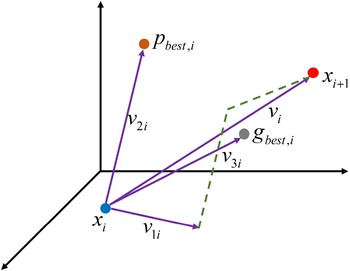
Figure 2 illustrates the position change of an i-th particle in the iteration process.
 $x_i$
and
 $v_i$
denote its position and speed, respectively. For any particle, their speed is composed of three components:
 $v_{1i}$
,
 $v_{2i}$
and
 $v_{3i}$
.
 $v_{1i}$
represents the particle speed components,
 $v_{2i}$
represents the self-recognition learning component of the individual extreme value obtained by the particle in its iterative process and
 $v_{3i}$
represents the social experience component in the populations.
Diagram of particle motion.

Assuming that in a D-dimensional space, the total number of particles is n. The next iteration of each particle is determined by its experience and the best experience of other particles. Each iteration uses Equations (10)–(11) to update its speed and position.
 \begin{equation} \begin{array}{ccc} &v_{id}(t+1)=\omega v_{id}(t)+c_{1} r_{1}\left(p_{i}(t)-x_{id}(t)\right)+c_{2} r_{2}\left(g_{i}(t)-x_{id}(t)\right)\\ \\[-7pt] &v_{i d}(t+1)=v_{\max }, v_{i d}(t+1)>v_{\max } \\ \\[-7pt] &v_{i d}(t+1)=v_{\min }, v_{i d}(t+1)<v_{\min } \end{array}\end{equation}
 \begin{equation} \begin{array}{ccc} &x_{i d}(t+1)=x_{i d}(t)+v_{i d}(t)\\ \\[-7pt] &x_{i d}(t+1)=x_{\max }, x_{i d}(t+1)>x_{\max }\\ \\[-7pt] &x_{i d}(t+1)=x_{\min }, x_{i d}(t+1)<x_{\min } \end{array}\end{equation}
where the subscript i denotes the i-th particle. t denotes the number of particle iterations.
 $\omega$
denotes an inertia weight factor.
 $c_1,c_2\in\mathbb{R}^{+}$
denotes the acceleration factor.
 $r_1,r_2\in\mathbb{R}^{+}$
denote two random uniformly disturbed in the interval (0,1).
 $\left[x_{\min }, x_{\max }\right]$
and
 $\left[v_{\min }, v_{\max }\right]$
denote the upper and lower bounds of the particle search range, respectively. The speed of the i-th particle is denoted by
 $v_{i}=\left(v_{i 1}, v_{i 2}, \cdots , v_{i D}\right)$
, and the position of the i-th particle is denoted by
 $x_{i}=\left(x_{i 1}, x_{i 2}, \cdots , x_{i D}\right)$
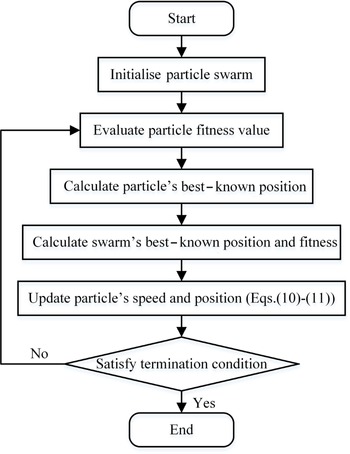
. The calculation process of the PSO algorithm is presented in Fig. 3.
PSO algorithm diagram.

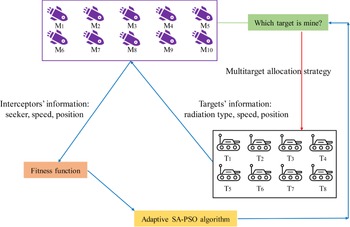
Diagram of multitarget allocation based on adaptive SA-PSO algorithm.

3.2 Adaptive improvement of PSO algorithm
Considering the PSO algorithm disadvantage, which converges slowly in optimisation performance, an adaptive improvement is made in this study. The adjustable parameter C(k) is added to the PSO algorithm to adaptively adjust the inertia weight factor
 $\omega$
and the acceleration factors
 $c_1$
and
 $c_2$
. The principle is described as Equation (12).
 \begin{equation} \left\{\begin{array}{l}D(k)=\dfrac{\sum_{i=1}^{N} \sqrt{\sum_{j-1}^{D}\left[x_{i}(j)-P_{b}^{i}(j)\right]^{2}}}{N} \\ \\[-9pt] C(k)=\dfrac{D(k)}{\max (D)} \\ \\[-9pt] \omega=C(k) \\ \\[-9pt] c_{1}=2 \times C(k) \\ \\[-9pt] c_{2}=2-c_{1}\end{array}\right.\end{equation}
Remark 3. As shown in Equation (12), the inertia weight factor
 $\omega$
and the acceleration factors
 $c_1$
and
 $c_2$
are simultaneously influenced by C(k) to adaptively vary in the optimisation process and improve the convergence speed.
3.3 Multitarget allocation strategy based on adaptive SA-PSO algorithm
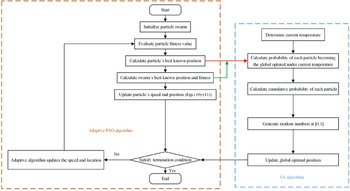
To further improve the performance of the PSO algorithm, a simulated annealing (SA) algorithm is introduced. The SA algorithm is a heuristic algorithm that allows the particle to accept a solution worse than the current solution with a certain probability. Thus, it is possible to break away from a local optimal solution and obtain a global optimal solution, effectively overcoming the disadvantage of the PSO algorithm easily falling into a local extreme point [Reference Wu, Wu and Zhang23,Reference Lu, Yang, Sun, Ding and Zhao24]. In addition, the roulette rules are applied to improve selection of optimal particles. While obtaining a better particle, inferior particles can also be obtained with a certain probability. Then, the particle speed can be adapted to appear from the local extremum and quickly converge to the global optimal point. The calculation process of the adaptive SA-PSO algorithm is presented in Fig. 4. The optimisation strategy for multitarget allocation based on the proposed adaptive SA-PSO algorithm is as follows:
-
a. Initialising the position and speed of each particle in the population
-
b. Calculating the fitness value of each particle, storing the current particle position and particle fitness value in
${p_i}$
, and storing the optimal individual position and fitness value of all
${p_b}$
in
${P_b}$
-
c. Determining the initial temperature
$t_0$
:(13)
\begin{equation} t_{0}=\frac{f\left(p_{b}\right)}{\ln 5}\end{equation}
-
d. Determining the adaptation value of each
$p_i$
at the current temperature: (14)
\begin{equation} T_{F}\left(p_{i}\right)=\frac{\mathrm{e}^{-\left(f\left(p_{i}\right)-f\left(p_{b}\right)\right) / t}}{\sum_{i=1}^{N} \mathrm{e}^{-\left(f\left(p_{i}\right)-f\left(p_{b}\right)\right){/ t}}}\end{equation}
-
e. Applying the roulette rules to determine the global optimal substitute value
$p_{b}^{\prime}$
from all
$p_i$
and then updating the speed and position of each particle according to Equations (10)–(11) -
f. Applying an attenuation coefficient method for the temperature-reducing process:
(15)
\begin{equation} t_{k+1}=0.6 t_k\end{equation}
-
g. Halting the optimization process and outputting the results if the termination conditions are met; else, returning to step d to continue the optimization search


Initial conditions of the interceptors

Simulation block diagram.

4 Simulation analysis
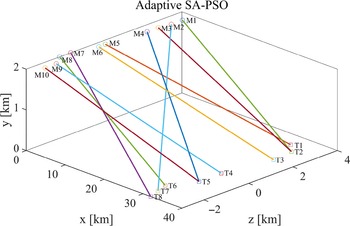
In this section, we assume ten interceptors are attempting to attack eight ground targets in a three-dimensional plane. The proposed adaptive SA-PSO algorithm is applied to assign appropriate targets to each interceptor to achieve maximised attack effectiveness. The simulation block diagram is presented in Fig. 5; comparative experiments are conducted with the PSO algorithm to verify the feasibility and superiority of the proposed adaptive SA-PSO algorithm. The initial conditions of the interceptors and targets are presented in Tables 1–2. The parameters of the fitness function in Equation (6) is presented in Table 3. a and
 $\sigma_{R}$
are defined as follows:
 \begin{equation} a=0.003 R\end{equation}
 \begin{equation} \sigma_{R}=\frac{R_{\min}+R_{\max}}{2}\end{equation}
Initial conditions of the targets

Parameters of fitness function

Thus, the comprehensive matrix F between the i-th interceptor and the j-th target can be obtained as follows:
 \begin{equation} F=\left(\begin{array}{l@{\quad}l@{\quad}l@{\quad}l@{\quad}l@{\quad}l@{\quad}l@{\quad}l}0.8593 & 0.8386 & 0.5575 & 0.8445 & 0.5689 & 0.8976 & 0.8636 & 0.5767 \\ \\[-7pt] 0.9068 & 0.9061 & 0.6297 & 0.9018 & 0.6281 & 0.9354 & 0.9086 & 0.6312 \\ \\[-7pt] 0.7884 & 0.7611 & 0.4811 & 0.7707 & 0.4969 & 0.8402 & 0.7976 & 0.5081 \\ \\[-7pt] 0.6233 & 0.6359 & 0.9339 & 0.6233 & 0.9222 & 0.6493 & 0.6229 & 0.9223 \\ \\[-7pt] 0.9045 & 0.9163 & 0.6454 & 0.9039 & 0.6340 & 0.9341 & 0.9046 & 0.6346 \\ \\[-7pt] 0.5535 & 0.5314 & 0.8214 & 0.5426 & 0.8385 & 0.6015 & 0.5670 & 0.8499 \\ \\[-7pt] 0.6041 & 0.5971 & 0.8904 & 0.5989 & 0.8959 & 0.6412 & 0.6120 & 0.9025 \\ \\[-7pt] 0.7428 & 0.7193 & 0.3254 & 0.7323 & 0.4606 & 0.8060 & 0.7641 & 0.4756 \\ \\[-7pt] 0.9084 & 0.9194 & 0.6474 & 0.9080 & 0.6369 & 0.9346 & 0.9081 & 0.6373 \\ \\[-7pt] 0.6196 & 0.6317 & 0.9310 & 0.6192 & 0.9194 & 0.6484 & 0.6193 & 0.9198\end{array}\right)\end{equation}
Optimisation results.

Multitarget allocation based on adaptive SA-PSO algorithm.

Multitarget allocation based on PSO algorithm.

In the simulations, we choose 30 particles to implement 500 iterations. The parameters of the PSO algorithm are selected as
 $\omega=1$
,
 $c_1=1.5$
, and
 $c_2=1.5$
. The simulation results are presented in Figs 6–8. In Fig. 6, it can be seen that the fitness function F calculated by the PSO algorithm converges to an optimal value of 17.5725 after 328 iterations. However, based on the adaptive SA-PSO algorithm, the fitness function F can be iterated to approximately 16 iterations, causing a sudden change in which the solution quickly converges to an optimal value of 18.6923. This shows that the convergence speed is promoted by over 20-fold compared with the PSO algorithm, and the fitness function is improved by 1.1198. Thus, the proposed adaptive SA-PSO algorithm can effectively emerge from the local extreme point and converge to the optimal point with better global search capabilities and faster convergence speed, achieving maximum interceptor attack effectiveness. As is shown in Figs 7–8, the multitarget allocation results are described in the three-dimensional plane based on the adaptive SA-PSO and the PSO algorithms. Each target is allocated to at least one interceptor, guaranteeing the ammunition need as shown in Table 2. Nevertheless, only targets (3, 4 and 8) are assigned the same interceptors missiles (6, 9 and 7, respectively), which indicates that, under the premise that the ammunition need of the targets can be achieved, the proposed adaptive SA-PSO algorithm can both promote the convergence speed and improve the allocated results of the missiles.
5 Conclusion
Cooperative engagement is an effective approach for improving combat effectiveness using information development conditions. An adaptive SA-PSO algorithm was proposed in this study to address the multitarget allocation problem in a cooperative attack for multiple interceptors. We comprehensively considered the situation between the interceptors and the targets and chose the relative range, relative angle, speed, capture probability and radiation source matching performance to establish a comprehensive fitness function. Additionally, an adaptive SA-PSO algorithm was proposed, in which we made adaptive improvements in the PSO algorithm and combined the SA algorithm with the adaptive PSO algorithm. The proposed adaptive SA-PSO algorithm can obtain the optimal solution for the fitness function quickly and effectively. The simulation results demonstrated that the proposed adaptive PSO algorithm convergence speed was improved by over 20-fold compared with the PSO algorithm; an improvement in the order of 1.1198 is obtained in the fitness function, realising the maximised attack effectiveness.
Acknowledgements
The authors would like to appreciate the financial support from the National Natural Science Foundation of China (NSFC) (62173274) Natural Science Foundation of Shaanxi Province (2020JQ-219) and Aviation Fund (20200001053005).
Conflicts of Interest
All the authors declare that they have no known competing financial interests or personal relationships that could have appeared to influence the work reported in this paper.