Elections by definition create winners and losers. Besides having important implications for who gets what, when, and how (Laswell Reference Laswell1936), a rich literature demonstrates that electoral outcomes have implications for how voters experience democracy and society at large (Anderson et al. Reference Anderson, Blais, Bowler, Donovan and Listhaug2005). Voters who support losers at elections are less satisfied with democracy (Anderson and Guillory Reference Anderson and Guillory1997; Curini et al. Reference Curini, Jou and Memoli2012) and government services (Jilke and Baekgaard Reference Jilke and Baekgaard2020), exhibit less trust in government (Anderson and LoTempio Reference Anderson and LoTempio2002) and tend to consider societal challenges as more severe (Hansen et al. Reference Hansen, Klemmensen and Serritzlew2019).
However, while the consequences of being winners and losers are well documented, we know little about why voters consider their preferred party either a winner or a loser (Dahlberg and Linde Reference Dahlberg and Linde2017: 630). While objective indicators of electoral success, such as winning/losing office or parliamentary seats, are likely to contribute to explaining how voters evaluate the electoral success of their preferred party, I draw on research on partisan-motivated reasoning (e.g. Bisgaard Reference Bisgaard2015; Tilley and Hobolt Reference Tilley and Hobolt2011) to argue that voters are prone to an ‘own-party bias’ that makes them evaluate the electoral fate of their party more favourably than that of other parties. To study this proposition, I use data on how a representative panel of citizens eligible for voting evaluated the electoral outcomes of nine parties elected to the Danish parliament in the aftermath of the 2015 Danish parliamentary election. I combine this information with information on individual vote choice and data gathered in a separate survey shortly before the election about partisan attachment and political knowledge.
Overall, the findings are consistent with the theory of own-party bias in evaluations of electoral success. The stronger their party attachment, the more inclined voters are to interpret the election outcome as successful for their preferred party. Even voters whose preferred party was a loser in terms of both office and parliamentary seats tend to evaluate the electoral outcome of their preferred party more positively than that of other parties. Own-party bias is particularly pronounced among the less politically knowledgeable, who also assign less importance to objective indicators of electoral success.
The findings suggest that bias may counteract potential backlash from poor election results on party support. In extension, the findings also have implications for democracy and, in particular, the question about acceptance of electoral defeats (e.g. Alvarez et al. Reference Alvarez, Hall and Llewellyn2015; Sances and Stewart Reference Sances and Stewart2015; Sinclair et al. Reference Sinclair, Smith and Tucker2018). In this respect, own-party bias and voter neglect of objective criteria for winning and losing may serve as a mechanism fuelling a refusal to accept electoral defeats, particularly among the least politically knowledgeable.
Next, I briefly discuss the literature on the winner–loser gap in satisfaction with democracy to establish the claim that assessments of winning and losing are likely to be based on highly subjective criteria. I then draw on research on partisan-motivated reasoning to develop theoretical expectations about own-party bias in evaluations of party electoral outcomes. Afterwards, I introduce a research design that combines data on evaluations of party electoral success with individual vote choice, to consider partisan divides in evaluations of electoral success. Before concluding, I discuss alternative explanations of the findings as well as limitations.
The winner–loser gap in satisfaction with democracy
Several studies have examined how voters who support winning and losing parties at elections differ in their support for democracy (Curini et al. Reference Curini, Jou and Memoli2012: 244; Esaiasson Reference Esaiasson2011; Hansen et al. Reference Hansen, Klemmensen and Serritzlew2019). While it is almost always found that voters who are ‘winners’ report higher levels of support for democracy than ‘losers’ (Anderson and Guillory Reference Anderson and Guillory1997; Anderson and Tverdova Reference Anderson and Tverdova2003; Curini et al. Reference Curini, Jou and Memoli2012: 244), there has been some discussion about how to conceptualize winners and losers (Hansen et al. Reference Hansen, Klemmensen and Serritzlew2019: 1174).
Most often, winners and losers are classified using a dichotomous understanding where winners are defined as those who support parties winning office (as well as other parties supporting the government), while the category of losers consists of voters who support any other parties (Esaiasson Reference Esaiasson2011: 105). Obviously, dichotomizing winner–loser status in this way comes at a risk of missing important nuances between voters. Thus, Curini et al. (Reference Curini, Jou and Memoli2012) and Curini and Jou (Reference Curini and Jou2016) find that the distance in policy space between voters and parties winning office matters. They find that losers (in terms of office) will be less dissatisfied with democracy the closer they are ideologically to the winning party. Similarly, Moehler (Reference Moehler2009) distinguishes between voters who feel close to the parties that make up government, those who do not feel close to any parties, and those who feel close to opposition parties.
Even more importantly, especially in multiparty systems with proportional representation, winning may have different meanings. Because some parties and candidates may lose office despite having won additional parliamentary seats, while others may win office even though they have experienced a decline in votes and parliamentary seats, it is ambiguous whether winning/losing should be characterized in terms of office or parliamentary seats (Singh et al. Reference Singh, Karakoç and Blais2012). This depends completely on what the voter considers more important.
Even in majoritarian democracies with two-party systems, winning and losing may not be characterized by office only. Sometimes, losers of office in such systems may also receive more votes than expected, which may make them winners in the eyes of some voters. And often an election involves more than one contest (Blais and Gélineau Reference Blais and Gélineau2007: 427). In presidential systems such as in the US, the winner of the presidency may not always obtain majorities in the parliamentary chambers. Adding to the complexity, many voters may also experience winning at the district level but losing at the national level (or the reverse) (Rich and Treece Reference Rich and Treece2018). In such situations, overall winner–loser status will depend on what the voter deems more significant. This points to the importance of subjective evaluations of election results. Voters may to varying degrees rely on other criteria than gaining office when evaluating the electoral outcomes for parties and candidates.
Bias in evaluations of electoral success
When considering how voters reason about electoral outcomes, we need to acknowledge that voters may feel differently about the party they voted for and other parties. While differences in assessments of party electoral outcomes have not previously been examined, research has found that citizens perceive democracy (e.g. Anderson et al. Reference Anderson, Blais, Bowler, Donovan and Listhaug2005), the severity of societal problems and political outcomes radically differently depending on whether their preferred party is in office (Bisgaard Reference Bisgaard2015; Jerit and Barabas Reference Jerit and Barabas2012; Tilley and Hobolt Reference Tilley and Hobolt2011). Thus, individuals often engage in partisan-motivated resistance to facts that they consider unpleasant or uncomfortable (Nyhan and Reifler Reference Nyhan and Reifler2019: 225). They perceive the world through partisan lenses and, accordingly, interpret the world in a way that is consistent with their party doing well (Campbell et al. Reference Campbell, Converse, Miller and Stokes1960). As emphasized by Bisgaard (Reference Bisgaard2015: 850), ‘because people want to think that their party is performing relatively well, they tend to reject and counterargue information that does not conform to their predefined conclusions, and to seek out as well as uncritically accept information that does’. This process does not require conscious effort but happens as an implicit process in which the brain arrives at conclusions that reduce cognitive dissonance and negative emotions (Taber and Lodge Reference Taber and Lodge2006: 757). In doing so, they engage in defensive processing to protect their self-integrity and self-worth from the threat of unwelcome information that questions their beliefs and attitudes (Nyhan and Reifler Reference Nyhan and Reifler2019). In the context of electoral evaluations, partisan-biased voters will assign importance to the fact that they have voted for a party that they believe is fundamentally striving for the best policies and, hence, ought to be successful. This, in turn, can lead to assessing their preferred party as overly successful, while other parties are interpreted as less successful. Thus, voters at large are expected to be prone to what I label own-party bias, where they evaluate the electoral outcome of their own party more favourably than that of other parties (Hypothesis 1).
Partisan-motivated reasoning takes place because people feel attached to a specific party (Petersen et al. Reference Petersen, Skov, Serritzlew and Ramsøy2013). Conceptually, party attachment (or party identification) is ‘an attitude that disposes the individual both to dependably vote for a particular political party in different elections and to interpret new political information in ways that are consistent with the party's interests and policy stances’ (Anderson et al. Reference Anderson, Blais, Bowler, Donovan and Listhaug2005: 75). Thus, people with strong party attachment will have stronger prior values and find it even harder to accept inconvenient facts about the fate of their party. Thus, I expect bias to be more prevalent the stronger the voters feel attached to the party they voted for (Hypothesis 2).
Relatedly, objective facts about election outcomes will be harder to ignore for the politically knowledgeable, who will both be better able than the less politically knowledgeable to separate real from false information, putting outcomes into context, and have more knowledge about how and why the electoral outcome came about (Vegetti and Mancosu Reference Vegetti and Mancosu2020). Overall, I therefore expect that own-party bias is more pronounced among voters with less political knowledge (Hypothesis 3).
Finally, research on partisan-motivated reasoning suggests that when evidence is strong enough, people may be persuaded, even in cases where this is unpleasant because it contradicts their prior beliefs (Redlawsk et al. Reference Redlawsk, Civettini and Emmerson2010). In the context of electoral outcome assessments, evidence is particularly strong when parties are either unambiguous winners or unambiguous losers of elections on all available objective criteria. Therefore, own-party bias is expected to be more pronounced among people who voted for parties that are neither absolute winners nor absolute losers on all available objective criteria as compared to people who voted for absolute winners or losers (Hypothesis 4).
The parliamentary election in Denmark in 2015
To study evaluations of electoral success, I rely on data from the parliamentary election in Denmark in 2015. Denmark is a consensual democracy with a one-chamber parliament and strong proportional representation, meaning that electoral outcomes in terms of votes have a direct impact on the distribution of parliamentary seats. With a low electoral threshold of 2% for winning parliamentary seats, the parliament usually consists of between seven and ten parties. Minority governments supported by other parties in parliament are common. Indeed, the governments before and after the 2015 election were minority governments.
The day after the 2015 election, a majority declared their support for a new government led by the Liberal Party. Thus, the election led to considerable changes in the distribution of seats in parliament across parties and a change in government, as the centre-left government led by the Social Democrat Helle Thorning Schmidt was replaced by the Liberal Party and a new prime minister, Lars Løkke Rasmussen, who was supported by parties on the right wing. This makes the election well suited for studying perceptions of winning and losing under various conditions, as the election created four different configurations of winners and losers based on objective characteristics. Two parties, the Liberal Alliance and the Danish People's Party, experienced considerable progress in terms of parliamentary seats and can also – in accordance with conventional conceptualizations of winners as parties winning office and their supporting parties (Esaiasson Reference Esaiasson2011) – be considered winners in terms of office since they were part of the coalition supporting the new right-wing government. Likewise, two other parties, the Liberal Party and the Conservative People's Party, were winners of office, but paradoxically experienced a massive decline in terms of parliamentary seats. In contrast, the party that had had the prime minister post until the election, the Social Democrats, as well as its supporters, the Red–Green Alliance and the Alternative, all experienced increases in terms of parliamentary seats. Finally, two left-wing parties, the Social Liberal Party and the Socialist People's Party, were losers both in terms of office and seats, as both were reduced to less than half their previous size.
Data
I collected data as part of a three-wave survey administered by the company Userneeds. The surveys use a sample drawn from the firm's panel that is representative of the voting-age population in gender, age and geography. Data from the first survey were collected shortly before the election on 18 June, in the period between 28 May and 9 June 2015, and received 1,009 responses. Exactly the same sample was resurveyed right after the election in the period 20–30 June 2015 and produced 862 full responses (reinterview response rate = 85.4%). A third round of responses was collected approximately four months after the election and produced 721 full responses (reinterview response rate = 71.5%). The surveys all contained questions about vote choice, satisfaction with democracy and perceptions of societal problems. For the purpose of this research, responses from Surveys 1 and 2 are the most important, as they contained questions about party attachment (Survey 1), expectations to the election outcome (Survey 1, used in the supplementary analyses: see the discussion section), vote choice (Survey 2) and voter assessments of the electoral outcomes for each of the nine Danish parties elected to the Danish parliament (Survey 2). Furthermore, I include a measure of political knowledge from Survey 3 to test Hypothesis 3.
The dependent variable
To measure evaluations of electoral outcomes, I asked respondents to assess on a five-point scale if they considered each of the nine Danish parties in parliament either a winner or a loser of the recent election (response categories: a clear winner; more a winner than a loser; neither a winner nor a loser; more a loser than a winner; a clear loser; don't know). In by far the most cases (92%), the respondents felt capable of providing a meaningful response other than a ‘don't know’. Expectedly, there is some cross-party variation, as 95–96% were able to provide a response other than ‘don't know’ for the three large parties, the Social Democrats, the Liberal Party and the Danish People's Party, while the percentage is somewhat smaller (89–91%) for the other six parties. To facilitate comparisons between the party that respondents voted for and other parties, I treat each evaluation of a party's electoral success as an observation, entailing that the data set contains nine party observations per individual or a total of 7,758 observations (of which 622 are not included in the analysis because of ‘don't know’ responses on the dependent variable) nested in 862 respondents.
Independent variables
To measure differences between how respondents evaluate their own party and other parties, I rely on a standard question about self-reported vote choice. I then compute a dummy variable measuring whether each observation is the party that the respondent voted for or another party. This variable then captures the evaluation of one's own party compared to all other parties. The variable in itself does not capture an isolated effect of bias but is also likely to be influenced by, for instance, objective differences in party electoral outcomes. Thus, evidence of bias is only strong if voters who supported parties that lost on objective characteristics tend to consider their party a winner as compared to all other parties and if voters tend to consider their party a clearer winner relative to other parties the more they feel attached to the party that they voted for.
Party attachment is measured using a question from Survey 1. The first question asks if respondents consider themselves strong supporters of a party (coded 2), lean more towards one party than other parties (coded 1) or do not consider themselves supporters of a specific party (coded 0). For each individual, party attachment is coded as a constant across the nine party observations, denoting whether respondents are attached to a specific party. I then exploit information from a subsequent question in Survey 1 in which party attachment is linked to specific parties for those who responded either that they consider themselves strong supporters or lean more towards one party than others. This allows me to test Hypothesis 2 – according to which bias is expected to be more prevalent, the stronger the voters feel attached to the party they voted for – by studying whether there is a difference in own-party assessments depending on party attachment.
Following previous research (e.g. Delli Carpini and Keeter Reference Delli Carpini and Keeter1996; Zaller Reference Zaller1992), I measure political knowledge by a series of factual questions. Specifically, I use five close-ended knowledge questions about politics. Each question has one and only one correct answer. Political knowledge is then computed as the sum of correct answers.Footnote 1 Finally, in the supplementary analyses, I include a measure from Survey 1 about respondent expectations to the outcome of the upcoming election. The question focuses on whether either of the two parties, the Liberal Party and the Social Democrats, were expected to be part of the government after the election. To measure expectations about the Social Democrats, I compute a variable taking the value 1 if the Social Democrats but not the Liberal Party is expected to become part of government and 0 otherwise. To measure expectations about the Liberal Party, I compute another variable taking the value 1 if the Liberal Party but not the Social Democrats is expected to become part of government and 0 otherwise.
Table 1 presents some descriptive statistics of the sample. As a point of comparison, the table also presents some summary statistics for variables measured in Survey 1 only. As is evident, the sample is, on average, very similar to the statistics from Survey 1, indicating that systematic attrition from Survey 1 to Survey 2 is likely not a problem.
Summary Statistics

Specification
Because of the hierarchical nature of the data, where evaluations of each of the nine parties are nested in individuals, I specify the analysis using a multilevel specification. Some respondents may tend to report consistently either higher or lower evaluations of electoral outcomes than others, regardless of whether the party in question is the party they voted for or not. To account for bias arising from such response behaviour and to control for other individual level confounders, I include respondent-fixed effects whenever possible. By doing so, I obtain within-respondent estimates of how respondents evaluate their preferred parties relative to other parties. Furthermore, to account for potential party confounders, I include party fixed effects. For ease of interpretation, I report results from a linear specification. In robustness tests, I find that results replicate if data are analysed for each party in separate analyses (Figure 1 below) or if the analyses are specified using multilevel ordered logit regression (see the Online Appendix, Tables A1–A4). Formally, the main models with respondent fixed effects and party fixed effects are estimated as follows:

Differences between Winner Assessments for Own Party and Other Parties
Notes: Model 1 is based on a respondent and party fixed effects analysis. Models 2–10 present regression estimates from separate OLS regressions for each party with control for gender, age, educational length, party attachment and political knowledge. 95% confidence intervals.

Y rp is the evaluation by each respondent r (r = 1, 2, …, 862) of each party p (p = 1, 2, …, 9) as either an electoral winner or an electoral loser. OP rp is a dummy variable taking the value 1 if the party is the party that the respondent voted for and 0 if not. Thus, β 1 is the main estimator of interest. γ r is a set of dummies for each respondent to control for respondent fixed effects, while δ p is a set of dummies to control for party fixed effects. ɛ rp is the error term.
In analyses where focus is explicitly on how party attachment correlates with evaluations of electoral success, respondent fixed effects is not an option, because party attachment is coded as a constant across all observations for each respondent. In these specifications, γ r is replaced with controls at the respondent level for gender, age, length of education, party attachment and political knowledge. Finally, to test Hypothesis 4 about winner–loser ambiguity, I replace δ p with a set of dummies categorizing the winner–loser ambiguity of parties in some specifications.
Analysis
Figure 1 examines the difference in evaluations of the party that the respondents voted for, compared to their evaluation of other parties. As is evident from Model 1, voters tend to consider the election outcome considerably more successful for their own party than for other parties. This is consistent with Hypothesis 1. The estimated effect of 0.516 corresponds to around a third of a standard deviation of the dependent variable. Models 2–10 furthermore present estimates from separate regressions for each of the nine parties. As is evident from the figure, for all parties, voters tend to consider their own party a winner relative to other parties. Thus, own-party bias appears to be of relevance to voters from all parties, albeit to a somewhat different extent.
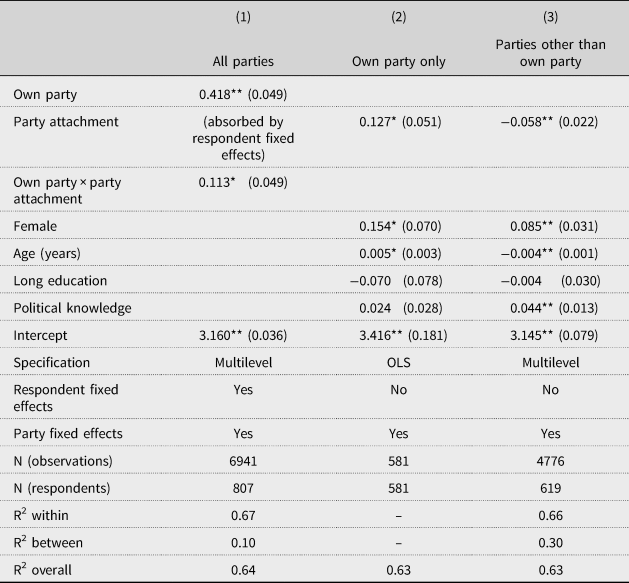
Moving on to Hypothesis 2, Table 2 examines how party attachment influences the assessment of one's preferred party relative to other parties. As shown in Model 1, voters are more inclined to evaluate the electoral outcome of their preferred party as favourable relative to that of other parties, the more they feel attached to the party. In fact, the interaction term between ‘own party’ and ‘party attachment’ suggests that voters with strong party attachment are around 50% more positive in their evaluation of the party that they voted for as compared to other parties than are voters who do not feel attached to any party. Importantly, however, own-party bias can be found for all respondents regardless of party attachment, suggesting that voting for a given party is enough to cause a biased evaluation while strong party attachment is only strengthening this pattern. Lending further support to the importance of party attachment, the remaining two models in Table 2 report from a split-sample analysis in which either those parties that voters voted for (Model 2) or those that they did not vote for (Model 3) are examined. Party attachment is positively associated with the assessment of the election outcome in the first case but negative in the other, suggesting that voters, the more they feel attached to the party they voted for, tend to assess the election outcome for that party more favourably and the outcomes for other parties less favourably.
Party Attachment and Evaluations of Own-Party Electoral Outcomes

Notes: Entries are estimates from multilevel linear regressions. Robust standard errors in parentheses; * p < 0.05, ** p < 0.01.
Table 3 turns to the question of whether own-party bias is more pronounced among voters with less political knowledge (Hypothesis 3). To look into this question, I conduct a split-sample analysis in which two groups of as similar a size as possible are compared: those who had four or five correct responses are categorized as highly knowledgeable (403 individuals – 3,508 observations), whereas those with less than four correct responses were categorized as less politically knowledgeable (428 individuals – 3,628 observations). The results suggest that own-party bias among voters as a whole is mainly driven by those with low political knowledge, since the estimate of the main effect in Model 2 is considerably larger than in Model 1, and since the effect conditioned by party attachment can only be identified among those with less political knowledge (Model 4). Moreover, Models 5 and 6 use party random effects to estimate whether objective winner–loser characteristics matter differently for those with high and low political knowledge. The analysis supports this prediction, as objective winner–loser dummies matter considerably and significantly less among the less politically knowledgeable. In conclusion, the analysis suggests that own-party bias is present among all respondents but to a higher extent among the less politically knowledgeable, who also attend less to objective winner–loser characteristics.
Political Knowledge and Own-Party Bias

Notes: Entries are estimates from multilevel linear regressions. Robust standard errors in parentheses; * p < 0.05, ** p < 0.01.
Finally, Table 4 looks into the question of how ambiguity in objective winner–loser characteristics influences own-party bias estimates. To this end, Model 1 uses party random effects to present estimates for different configurations of objective winners and losers in terms of government and parliamentary seats. First, the analysis suggests that people have some sense of winners and losers at the election and are able to make fairly meaningful predictions based on this knowledge. Supporting this conclusion, objective winners of both office and seats are considered winners to a much higher extent than those who are only objective winners of either seats or government or not objective winners at all. Adding to this, the explanatory power of the objective winner–loser dummies is much stronger than that of the own-party dummy. Thus, the R2 drops from 0.57 to 0.03 if the objective winner–loser dummies are removed from this analysis. However, winning and losing office and seats are also very strong signals of electoral success, and notably the own-party estimate is comparable in size to that of winning government among those who are losers of seats, suggesting that it makes a substantial difference whether respondents assess their own or another party. On balance, while bias seems to be only partly explaining winner–loser assessments, it contributes substantially to such assessments.
Evaluation of Own-Party Electoral Outcomes

Notes: Entries are estimates from multilevel linear regressions. Robust standard errors in parentheses; * p < 0.05, ** p < 0.01.
To further explore if bias in evaluations of one's own party depends on the ambiguity of winners and losers, Models 2–5 split the main analysis into four sub-analyses, each focusing on one specific configuration of parties. Two analyses focus on unambiguous winner–loser configurations (i.e. winners or losers both in terms of government and seats), while the remaining two focus on ambiguous configurations where the party in question is either a winner in terms of government but a loser in terms of seats or a loser in terms of government but a winner in terms of seats. Notably, regardless of the ambiguity of objective winner–loser status, voters evaluate the election outcome of their own parties as significantly more positive than that of other parties. This suggests that own-party bias is relevant even when objective winner–loser status is largely unambiguous. Overall, the findings lend support to the presence of own-party bias as even voters who support parties that were losers both in terms of office and votes tend to consider their party a winner relative to other parties (Model 2).
Furthermore, the analysis also lends some support to Hypothesis 4, according to which own-party bias is conditional on whether objective winner–loser status is ambiguous. Thus, the difference in evaluations of the success of one's own party relative to that of others is considerably more pronounced in Models 3 and 4, where the parties covered are either: (1) winners of government but losers of parliamentary seats or (2) losers of government but winners of parliamentary seats, than in Models 2 and 5. Indeed, a model in which interaction terms between own-party assessments and winner–loser ambiguity is included (see Table A4 in the Online Appendix) demonstrates that own-party bias is significantly less pronounced in Model 2, where loser status is unambiguous, than in Models 3 and 4, where winner–loser status is ambiguous. Also, it is significantly less pronounced in Model 5, where objective winner status is unambiguous, than in Model 3, while the estimates in Models 4 and 5 are not significantly different.
Discussion
It is one of the strong findings in political science that voters are affected differently by election outcomes depending on whether they support winning or losing parties. It has successfully been replicated several times using different designs and in different institutional settings (Anderson et al. Reference Anderson, Blais, Bowler, Donovan and Listhaug2005; Esaiasson Reference Esaiasson2011; Hansen et al. Reference Hansen, Klemmensen and Serritzlew2019: 1172). Yet, little is known about why some voters consider themselves winners and others consider themselves losers. While objective characteristics of the election outcome obviously shape winner–loser perceptions, the analysis shows that there is an additional subjective and rather strong component to winner–loser perceptions. This finding has implications for how we should understand party support in the aftermath of elections. Literature on the bandwagon effect suggests that people mainly want to support winners (Meffert et al. Reference Meffert, Huber, Gschwend and Pappi2011). For instance, it has been shown how front-runner status in polls attracts voters to the candidate in the lead (Bartels Reference Bartels1988). However, if voters are generally inclined to make positive assessments of the electoral outcomes of their parties and even do so in cases where their parties are losers based on objective characteristics, it suggests that negative electoral outcomes may not lead to as strong backlash effects on party support as the bandwagon literature would suggest.
The results also have important implications for the winner–loser literature. While this literature conceptualizes winners and losers based on characteristics such as gaining power, seats or votes, or the policy distance between voters and the party that won the election (Curini et al. Reference Curini, Jou and Memoli2012; Curini and Jou Reference Curini and Jou2016; Moehler Reference Moehler2009), the findings point to a more nuanced approach. To better understand winner–loser dynamics, we need to attend to the subjective dimension of feeling either like a winner or a loser. In this respect, the findings are somewhat puzzling. Those few instances when research has conceptualized winners and losers based on their subjective perceptions (Singh et al. Reference Singh, Karakoç and Blais2012) are also among the rare cases where no differences between winners and losers in satisfaction with democracy have been identified. Maybe the conceptual lenses of winners and losers should be replaced with partisan reasoning to understand why voters differ in satisfaction with democracy?
While the findings consistently show that voters consider the election outcome a greater success for the party they voted for than for other parties, one issue is whether the estimated coefficients can be taken as evidence of causal effects. While the design does not rely on randomized experiments, the fact that significantly larger own-party evaluations can be identified for parties with very different profiles, and even for parties that are clear losers on objective characteristics, makes selection bias a much less likely explanation of the findings.
Also, theory suggests a number of alternatives to ignorance and the drive for cognitive consistency that can potentially explain why voters consider the election outcome a greater success for their own party. First, results can be interpreted as a case of wishful thinking. Dating back to the study of Lazarsfeld et al. (Reference Lazarsfeld, Berelson and Gaudet1948), survey research has shown that voters with strong partisan preferences tend to have higher expectations about the election outcomes for their preferred party than for other parties (Levine Reference Levine2007; Meffert et al. Reference Meffert, Huber, Gschwend and Pappi2011; Mutz Reference Mutz1998). Thus, one interpretation of the findings here is that voters tend to have stronger expectations of electoral success for their parties and that such expectations colour subsequent interpretations of the electoral outcome. Moreover, expectations may be even stronger among the less politically knowledgeable, who are less likely to form a nuanced conclusion about the likelihood of electoral success. Accordingly, own-party bias may be more pronounced among those who had strong pre-election expectations about electoral success. Since respondents were asked about their expectations regarding the electoral outcome for the two main parties competing for the prime minister post, the Social Democrats and the Liberal Party, in a pre-election survey conducted in the two weeks leading up to the election, the data offer an opportunity to look more into the influence of expectations (see Tables A5 and A6 in the Online Appendix). Overall, the analysis does not produce any evidence that pre-election expectations matter to own-party assessments relative to that of other parties.
Second, scholars have recently suggested partisan cheerleading as an alternative to partisan-motivated reasoning (e.g. Bullock and Lenz Reference Bullock and Lenz2019). According to this perspective, partisan differences in interpretations of facts are largely illusory. Partisans who know the correct response to knowledge questions will offer incorrect responses to offer support for their preferred party. However, surveys designed to discriminate between motivated reasoning and cheerleading overall support the motivated-reasoning explanation (Peterson and Iyengar Reference Peterson and Iyengar2021). In the context of partisan differences in interpretations of election results, the cheerleading mechanism – although it cannot entirely be eliminated – is an unlikely explanation for two reasons. In contrast to interpretations of facts about phenomena such as the economy (e.g. Bisgaard Reference Bisgaard2015; Tilley and Hobolt Reference Tilley and Hobolt2011), the interpretation of election results does not involve support of the party line, and hence there is less reason to offer incorrect responses. Also, the fact that partisan differences in interpretations of election results are driven by the least knowledgeable is inconsistent with the cheerleading perspective.
Third, it is possible that findings are to some extent driven by the party leadership, who may emphasize the good news and successes while toning down electoral losses. Indeed, research has shown that partisan elites are able to shape partisan attitudes by their messaging (Bisgaard and Slothuus Reference Bisgaard and Slothuus2018; Fortuna Reference Fortuna2019; Sinclair et al. Reference Sinclair, Smith and Tucker2018). According to Zaller's (Reference Zaller1992) Receive–Accept–Sample model, we should expect that more politically aware individuals are more likely to be influenced by elite messages. Again, this is inconsistent with the empirical evidence, which demonstrates that the findings are driven by the least politically knowledgeable. Also, from a substantive point of view, party leaderships do not operate in a vacuum. Other parties as well as internal opposition in the party will have equal access to framing the election results, and the outcomes will also be intensely covered and analysed in news media, meaning that any positive framing of the results will be continually challenged. On balance, I thus consider this a less likely explanation of the findings.
Another question concerns whether findings generalize to other settings. First, bias is likely to be even stronger in more polarized systems where people may not even believe that the election outcomes represent the actual vote than in the balanced democracy of Denmark, where people generally have high trust in the political and electoral institutions. Indeed, the low faith among Republican voters in the legitimacy of the US 2020 presidential election result (Arceneaux and Truex Reference Arceneaux and Truex2021) may be evidence of exactly this. Second, while we should expect bias to be less pronounced in majoritarian systems, where the distinction between winners and losers is more clear cut, it is notable that bias can be found in data even for parties that are either unambiguous losers or unambiguous winners, albeit to a lesser extent than for other parties. Thus, one interpretation of the findings is that the bias is of general relevance but somewhat stronger in proportional systems relative to majoritarian systems.
Conclusion
This article is the first to study voter assessments of party electoral outcomes. Overall, the article makes three contributions. First, it adds to a rich literature (e.g. Anderson et al. Reference Anderson, Blais, Bowler, Donovan and Listhaug2005; Anderson and LoTempio Reference Anderson and LoTempio2002; Hansen et al. Reference Hansen, Klemmensen and Serritzlew2019; Martini and Quaranta Reference Martini and Quaranta2019) on the winner–loser gap in satisfaction with democracy by focusing specifically on voters' evaluations of whether parties are electoral winners or losers. A main finding is that while objective winner–loser cues have a strong impact on voter evaluations, there is also a considerable subjective component in evaluations: voters tend to evaluate the electoral outcome for their preferred party as more favourable than the outcomes for other parties. This tendency increases the stronger the party attachment of voters. Also, it is more pronounced among voters with less political knowledge. Thus, the findings question whether the conceptual distinction in the winner–loser gap literature between winners and losers, which is overwhelmingly based on objective characteristics, actually reflects what voters consider winners and losers. Also, bias stemming from the ambiguity which is typical for proportional systems may paradoxically make more people feel like winners and thus in part help explain why the winner–loser gap is smaller in proportion relative to majoritarian systems (Anderson et al. Reference Anderson, Blais, Bowler, Donovan and Listhaug2005).
Second, the findings contribute to research on voter competence and ignorance (Delli Carpini and Keeter Reference Delli Carpini and Keeter1996; Lupia Reference Lupia2016) by emphasizing that ignorance extends beyond the understanding of abstract political facts to very recent election outcomes. In that respect, they may also be important to research on voter polarization (e.g. Fortuna Reference Fortuna2019; McCarty Reference McCarty2019; Schwalbe et al. Reference Schwalbe, Cohen and Ross2020). The findings thus reflect a tendency to perceive the world through partisan lenses, which may ultimately fuel debates about the fairness of actual election outcomes.
Third, the article contributes to our understanding of bias in partisan assessments more generally. Previous research has uncovered that, in particular, voters with strong party attachment tend to overestimate the chances of electoral success for their preferred party, while on the other hand, they tend to underestimate the chances of other parties (Meffert et al. Reference Meffert, Huber, Gschwend and Pappi2011). Other research has shown how, for instance, facts about the economy (Bisgaard Reference Bisgaard2015) or public service performance (Baekgaard et al. Reference Baekgaard, Christensen, Dahlmann, Mathiasen and Petersen2019) are interpreted through partisan lenses. The findings here demonstrate that partisan reasoning extends beyond facts with an ambiguous interpretation and wishful thinking about future election outcomes to reasoning about certain and clear signals about election outcomes. In this respect, they demonstrate the profound influence of prior values when people interpret even very clear political facts.
The findings call for further research. If voters' assessments of election outcomes are biased, future research should focus on the nature, consequences and antecedents of such bias. First, is bias in nature a result of affective polarization? If this is the case, it should be possible to identify a similar bias for the least preferred parties, where voters may consider them unsuccessful even when they have objectively good election outcomes. Future research may study this question by using more fine-grained measures of party support. A second question concerns whether the bias of winners and losers differs. Do objective losers tend to underestimate their loss more than winners overestimate their win, as one might expect based on theories of loss aversion? Survey experiments in which people are randomly allocated to scenarios in which their preferred party experiences wins/losses of varying size may help answering this question. Third, how do assessments of election outcomes affect partisan support? What is the role of own-party bias in maintaining stable support for the party line over time, and to what extent is own-party bias related to neglect of election outcomes? Fourth, what are the cultural, political and institutional underpinnings of own-party bias? To answer these questions, future research may study bias using a combination of comparative and longitudinal designs, which will allow for explorations across settings as well as tracking how biases are related to consecutive support and voting behaviour.
Supplementary material
The supplementary material for this article can be found at https://doi.org/10.1017/gov.2021.55.
Acknowledgements
This article has benefited greatly from comments and suggestions from editors and three anonymous reviewers at Government and Opposition: An International Journal of Comparative Politics as well as from colleagues in the Public Administration Section at the Department of Political Science, Aarhus University. The author, of course, is solely responsible for any mistakes or flawed interpretations.