INTRODUCTION
Feeding is one of the most important functions of organisms, since other basic functions such as growth, development and reproduction depend on the energy obtained through feeding (Nikolsky, Reference Nikolsky1963). Chiefly, diet information is crucial to understanding the species ecology, trophic inter-relationships, food webs, and ultimately, the flow of energy through ecosystems (Brown et al., Reference Brown, Bizzarro, Cailliet and Ebert2012).
The study of the feeding habits of elasmobranch populations should help to elucidate the ecological role of these fishes in the marine system. Despite this, batoids have received considerably less attention than sharks and little is known about the feeding ecology of these species (Bizzarro et al., Reference Bizzarro, Robinson, Rinewalt and Ebert2007). The reasons for the lack of quantitative studies include a scarcity of adequate systematic knowledge of the group and a lack of interest in studying non-target species or those of little economic value (Ebert & Bizzarro, Reference Ebert and Bizzarro2007).
In general, most batoids are benthic predators and consume a wide range of prey found near the sea floor, with invertebrates being the most important food component for many species (Muto et al., Reference Muto, Soares and Gotein2001; Bizzarro, Reference Bizzarro2005; Scenna et al., Reference Scenna, García de la Rosa and Díaz de Astarloa2006; Ruocco et al., Reference Ruocco, Lucifora, Díaz de Astarloa and Bremec2007; Bornatowski et al., Reference Bornatowski, Robert and Costa2010; Navia et al., Reference Navia, Torres, Mejía-Falla and Giraldo2011; Delpiani et al., Reference Delpiani, Spath and Figueroa2013; Spath et al., Reference Spath, Barbini and Figueroa2013). Torpediniformes in particular show marked differences in diet between Narcinidae and Torpedinidae families. While the first feed primarily on fish, crabs and small invertebrates (Bigelow & Schroeder, Reference Bigelow and Schroeder1948; Cousseau & Bastida, Reference Cousseau and Bastida1982; Abdel-Aziz, Reference Abdel-Aziz1994; Capapé et al., Reference Capapé, Guelorget, Siau, Vergne and Quignard2007; Belleggia et al., Reference Belleggia, Mabragaña, Figueroa, Scenna, Barbini and Díaz de Astarloa2008), the second, consume smaller benthic invertebrates (Valadez et al., Reference Valadez, Aguilar and Hernández2000; Valadez-Gonzalez, Reference Valadez-Gonzalez2007; Moreno et al., Reference Moreno, Acevedo, Grijalba-Bendeck, Polo-Silva and Acero2009; Yick et al., Reference Yick, Tracey and White2011). These differences could be attributed mainly to the size of the mouth in each family, since Narcinidae presents a narrow, transverse and protractile mouth and in Torpedinidae the mouth is broad, transverse and only slightly protractile (McEachran & Fechhelm, Reference McEachran and Fechhelm1998).
The apron ray, Discopyge tschudii (Narcinidae) is found mainly in coastal waters below 120 m (Menni & Stehmann, Reference Menni and Stehmann2000; Cousseau et al., Reference Cousseau, Figueroa, Díaz de Astarloa, Mabragaña and Lucifora2007), being endemic to South America. It inhabits the South-west Atlantic, from southern Brazil to southern Argentina, and the South-east Pacific, from Peru to southern Chile (Figuereido, Reference Figuereido1977; Menni & Gosztonyi, Reference Menni and Gosztonyi1982; Menni & López, Reference Menni and López1984; Pequeño et al., Reference Pequeño, Navarro and Oporto1988; Cousseau et al., Reference Cousseau, Figueroa, Díaz de Astarloa, Mabragaña and Lucifora2007). According to the zoogeographic scheme proposed for the South-west Atlantic, D. tschudii belongs to the fauna of the Magellanic Province and it is grouped with the fish assemblage that composes the mixed fauna of the inner shelf (Menni & Gosztonyi, Reference Menni and Gosztonyi1982; Menni & López, Reference Menni and López1984; Menni et al., Reference Menni, Jaureguizar, Stehmann and Lucifora2010). The International Union for Conservation of Nature (IUCN) categorized D. tschudii as ‘Near Threatened’ (Massa et al., Reference Massa, Hozbor and Lamilla2004a). Moreover, the population inhabiting the South-west Atlantic is considered ‘Vulnerable’ due to the remarkable decrease in its abundance during 1994–1999 (Massa et al., Reference Massa, Lucifora, Hozbor, Sanchez and Veis2004b).
The aims of this study are to provide a quantitative analysis of the diet composition of D. tschudii and to assess the effects of sex, maturity stage, body size and season on the diet.
MATERIALS AND METHODS
Study area and sampling
Individuals of D. tschudii were collected from scientific trawl surveys (N = 58) conducted by the Instituto Nacional de Investigación y Desarrollo Pesquero (INIDEP, Argentina) during January and August 2012 and by scientific observers on commercial vessels (N = 32, Figure 1) during September and October 2010.
Map of study area showing positions of trawl station where individuals of Discopyge tschudii were collected from San Jorge Gulf, Argentina. The black triangles and circles represent commercial vessels and scientific trawl respectively. The solid line represents the 50 m isobath and the dotted line the 100 m isobaths.

The study area, encompassing the San Jorge Gulf and surroundings (44.5–47.5°S and 65.5°W), is the largest semi-open basin in the South-west Atlantic (Fernandez et al., Reference Fernandez, Carreto, Mora and Roux2005; Vinuesa, Reference Vinuesa2005) and is one of the most important fishing grounds in Argentina. These waters belong to shelf waters, as amended by the contributions of coastal waters from the Strait of Magellan.
Stomach contents analysis and sample size sufficiency
For each individual, total length (TL, mm), sex and maturity stage were recorded. Maturity stage (immature or mature) was determined according to the degree of calcification of the claspers and development of testes and reproductive ducts in males, and observation of the uteri and ovarian follicles in females (Colonello, Reference Colonello2009). The stomachs were excised and frozen at −20°C for subsequent analyses in the laboratory.
Stomach contents were sorted and identified to the lowest possible taxonomic level, using a published catalogue (Boschi et al., Reference Boschi, Fischbach and Iorio1992) and reference collections preserved at the Laboratorio de Ictiología, Universidad Nacional de Mar del Plata, Argentina. Prey were counted and their wet weights recorded (±0.01 g).
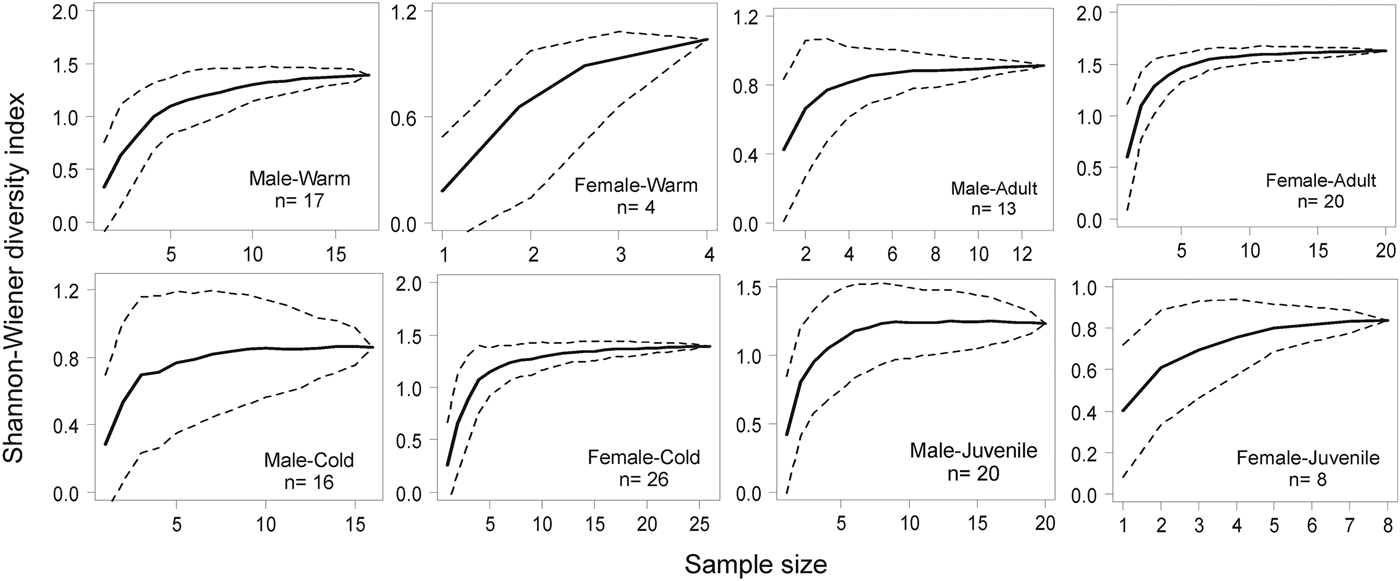
To determine whether a sufficient number of D. tschudii was sampled, the stomachs sampled were randomized 1000 times and the sample size was plotted against the mean cumulative Shannon–Wiener diversity index (Magurran, Reference Magurran2004). Sample size was considered sufficient to describe diet and to conduct statistical analyses if the curve reached an asymptote.
Statistical analysis of diet variation
Prey were grouped into five categories: polychaetes, clam siphons (Amiantis purpurata), amphipods, lobster krill (Munida gregaria) and stomatopods.
To evaluate the importance of each prey and allow for comparison with other studies the composition of diet was presented as percentage by number (%N), percentage by mass (%M), percentage frequency of occurrence (%FO) and index of relative importance (IRI) (Pinkas et al., Reference Pinkas, Oliphant and Ivenson1971). The IRI was expressed in percentage (%IRI; Cortés, Reference Cortés1997).
Dietary variability of D. tschudii with sex, maturity stage (immature and mature), TL and season (warm = October–March; cold = April–September) were evaluated using generalized linear models (GLM; Venables & Ripley, Reference Venables and Ripley2002). For each prey category, models were built where response variable was the number of prey consumed and the independent variables were sex, maturity stage, TL and season. Also, a model without any of the independent variables (i.e. null model) was fitted to test the hypothesis that none of the variables tested had an effect on the consumption of the prey category (Lucifora et al., Reference Lucifora, García, Menni, Escalante and Hozbor2009). The response variable as number of prey had a large variance because of the great number of zero values in the samples; therefore a negative binomial error distribution was specified (Crawley, Reference Crawley2005). A log link was used in the models since response variables could only take zero or positive values (Crawley, Reference Crawley2005).
A multiple-hypothesis model approach was used to identify the best model explaining the consumption of a given prey (Anderson et al., Reference Anderson, Burnham and Thompson2000; Franklin et al., Reference Franklin, Shenk, Anderson, Burnham, Shenk and Franklin2001; Johnson & Omland, Reference Johnson and Omland2004). For each competing model, the Akaike Information Criterion (AIC) was calculated and the model with the lowest AIC was selected as the best model (Crawley, Reference Crawley2005). Also, the Akaike's weight (w) was calculated to obtain the likelihood of each competing model given the data (Franklin et al., Reference Franklin, Shenk, Anderson, Burnham, Shenk and Franklin2001; Johnson & Omland, Reference Johnson and Omland2004).
RESULTS
Sampling description
A total of 90 stomachs of D. tschudii were examined. Of all specimens with stomach contents, 43 were females (96–411 mm TL) and 38 were males (141–495 mm TL). Overall, 243 prey with a total weight of 138.78 g were found in the stomachs. The cumulative curves of prey diversity reached an asymptote for all groups, except for ‘Female-Warm’, indicating that sample size was sufficient to describe the diet (Figure 2).
Cumulative mean Shannon–Wiener diversity index (continuous lines) and standard deviation (dashed lines) as a function of sample size of Discopyge tschudii from the San Jorge Gulf, Argentina.

Diet description
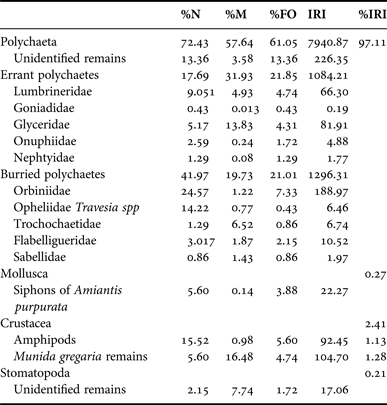
Polychaetes were the most important prey in terms of %N, %M, %FO and %IRI in the diet composition of D. tschudii. Less important were clam siphons, amphipods, lobster krill and stomatopods (Table 1). Nine families of polychaetes were identified: five families of errant polychaetes and four families of burying polychaetes. Among errant polychaetes, Glyceridae was the main family consumed followed by Lumbrineridae. Orbiniidae were the most important burying polychaetes followed by Flabelligeridae.
Diet composition of Discopyge tschudii from the San Jorge Gulf, Argentina. %N, percentage by number; %M, percentage by mass; %FO, percentage of frequency of occurrence; IRI, the index of relative importance; %IRI, percentage of IRI.

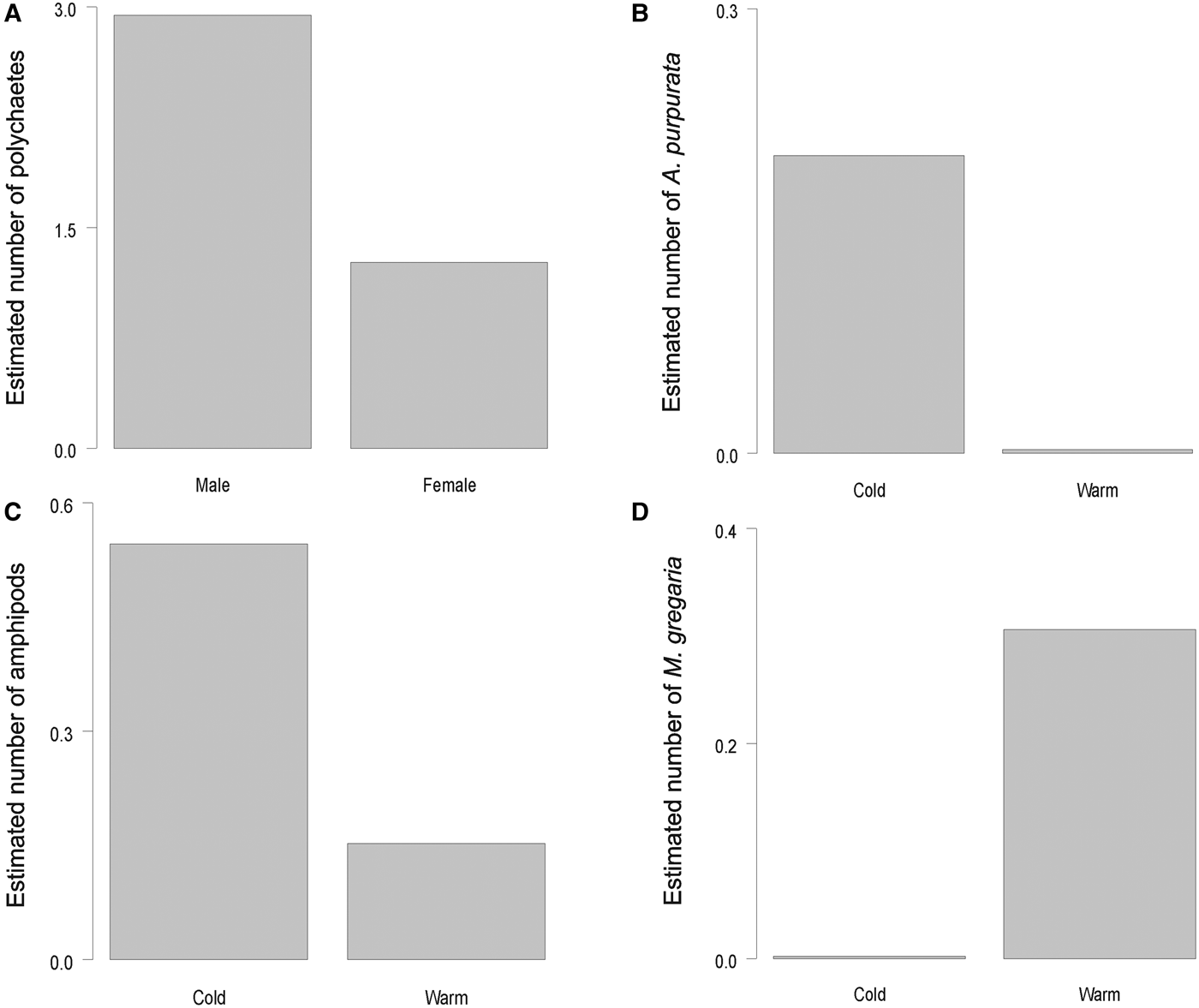
Several patterns were found in the relationships between number of prey consumed with TL and season (Table 2). The consumption of polychaetes was higher in males than females (Figure 3A). The number of siphons of Amiantis purpurata and amphipods consumed was higher in the cold season than in the warm season (Figure 3B, C). On the other hand, M. gregaria was predated more heavily in the warm season than in the cold season (Figure 3D). The consumption of stomatopods increased as D. tschudii increased its size. Sexual maturity of D. tschudii was not related to the comsumption of any prey.
Changes in the consumption of (A) polychaetes (in number), (B) siphons of Amiantis purpurata, (C) amphipods and (D) Munida gregaria (in number) by Discopyge tschudii from San Jorge Gulf, Argentina, estimated by generalized linear models. The models had a log link and a negative binomial distribution.

Best models explaining the consumption of prey categories in number of Discopyge tschudii from the San Jorge Gulf, Argentina. The intercept and coefficient for the variables are given. TL, total length (mm); AIC, Akaike information criterion; w, Akaike's weights; standard errors in parentheses.

DISCUSSION
It was observed that in the San Jorge Gulf, Discopyge tschudii was a benthic feeder, preying mainly on benthic invertebrates such as polychaetes, siphons of clams, amphipods, lobster krill and stomatopods. The diet composition of D. tschudii showed changes between sexes, seasons and also with increasing body size.
The ecology of D. tschudii is poorly known and there are only a few studies on their feeding habits (García, Reference García1984; Arrighetti et al., Reference Arrighetti, Livore and Penchaszadeh2005; Spath et al., Reference Spath, Barbini and Figueroa2013). García (Reference García1984) and Spath et al. (Reference Spath, Barbini and Figueroa2013) observed that the diet of D. tschudii was characterized mainly by the consumption of polychaetes, followed by a variety of invertebrates. In contrast, Arrighetti et al. (Reference Arrighetti, Livore and Penchaszadeh2005) found that the diet of D. tschudii was dominated by the presence of siphons of A. purpurata. These differences in the most important prey may be due to two factors: the season when the work was done, and the study area. Concerning the first and most important factor, Arrighetti et al. (Reference Arrighetti, Livore and Penchaszadeh2005) conducted the study almost exclusively in the cold season, when the consumption of clam siphons is higher according to the present results. With regard to the second factor, the extent of the study area (38°20′S – 57°37′W, Mar del Plata, Argentina) in which Arrighetti et al. (Reference Arrighetti, Livore and Penchaszadeh2005) did their work was very restricted. In agreement with García (Reference García1984) and Spath et al. (Reference Spath, Barbini and Figueroa2013) our results showed that the most important prey were polychaetes.
Previous studies about the diet of Narcinidae showed that the family preys mostly on benthic invertebrates such as crustaceans, polychaetes, amphipods, molluscs and stomatopods (Valadez et al., Reference Valadez, Aguilar and Hernández2000; Bornatowski et al., Reference Bornatowski, Abilhoa and Freitas2006; Valadez-Gonzalez, Reference Valadez-Gonzalez2007; Payán et al., Reference Payán, Mejía-Falla and Navia2010). These results suggest that this group of electric rays is highly specialized in its feeding habits. Additionally, diet and foraging behaviour may differ between individuals of different sex, reproductive status or age (Begg et al., Reference Begg, Begg, Du Toit and Mills2003). Sexual differences in prey preferences have been previously observed in elasmobranchs (Ezzart et al., Reference Ezzart, Abed-Aziz, El-Gharabawy and Hussein1987; Klimley, Reference Klimley1987; Sims et al., Reference Sims, Nash and Morritt2001; Bohórquez-Herrera, Reference Bohórquez-Herrera2006; Delpiani et al., Reference Delpiani, Spath and Figueroa2013). The variation in the diet of chondrichthyans can be attributed to intrinsic and extrinsic factors (Di Giacomo & Perier, Reference Di Giácomo and Perier1996; Lucifora, Reference Lucifora2003). Intrinsic factors are features of the predator, such as sex, stage of maturity and body size and extrinsic ones are characteristic of the prey or the environment that affects the availability of prey. The diet of predators may differ between the sexes due to sexual dimorphism by size (Begg et al., Reference Begg, Begg, Du Toit and Mills2003), differences in the predatory ability of males and females (Floeter & Temming, Reference Floeter and Temming2003), spatial-temporal differences in foraging activity of males and females (Braccini et al., Reference Braccini, Gillanders and Walker2005) and/or habitat use (Wetherbee & Cortés, Reference Wetherbee, Cortés, Carrier, Musick and Heithaus2004). In D. tschudii, polychaetes were more consumed by males than females. In support of the hypothesis that sexual size dimorphism reduced intersexual resource competition, in D. tschudii males have larger sizes than females (Cousseau et al., Reference Cousseau, Figueroa, Díaz de Astarloa, Mabragaña and Lucifora2007), and consequently could have more capability to take polychaetes from the substrate than females. Alternatively, these differences might be a consequence of sexual differences in the spatial distribution. This sexual segregation was previously reported in D. tschudii (Menni et al., Reference Menni, López and García1981; Cousseau et al., Reference Cousseau, Figueroa, Díaz de Astarloa, Mabragaña and Lucifora2007; Estalles et al., Reference Estalles, Coller, Di Giácomo and Perier2011) and may have an effect on their feeding habits.
The diet composition of D. tschudii showed seasonal variation. This seasonal pattern is characterized by a higher consumption of siphons of A. purpurata and amphipods in the cold season and high consumption of M. gregaria in the warm season. Similar seasonal shifts in diet have been previously documented in D. tschudii (Spath et al., Reference Spath, Barbini and Figueroa2013). Diet composition will differ seasonally between alternative prey species depending on which are currently more available (Taylor, Reference Taylor1984), in response to the decreased availability of preferred food types (Perry & Pianka, Reference Perry and Pianka1997). Another explanation could be related to the migration pattern of the predator (Muto et al., Reference Muto, Soares and Gotein2001). Seasonal migrations are common in elasmobranchs and can be driven by temperature, reproduction or foraging needs (Heithaus, Reference Heithaus, Carrier, Musick and Heithaus2004). Related to this, Cortés et al. (Reference Cortés, Jaureguizar, Guerrero and Dogliotti2011) found that D. tschudii makes onshore-offshore movements related to change in salinity and temperature in the South-west Atlantic. These onshore-offshore movements could explain the seasonal pattern observed in the diet composition. However, specific studies are needed in the area to test this hypothesis.
The protrusible jaw apparatus present in electric rays (Rudloe, Reference Rudloe1989; Rudloe & Rudloe, Reference Rudloe and Rudloe1993) generates negative pressures in the oral cavity to suck the food into the mouth (Dean & Motta, Reference Dean and Motta2004). Some phases during feeding, like capture, clamping force or suction of prey improve as a predator increases its size (Scharf et al., Reference Scharf, Juanes and Rountree2000). This could explain the rise in the consumption of stomatopods in D. tschudii with increasing body size.
Finally, several factors may influence the feeding of D. tschudii. This species occurs sympatrically with other species of elasmobranchs (e.g. Bathyraja macloviana, Scenna et al., Reference Scenna, García de la Rosa and Díaz de Astarloa2006, Ruocco et al., Reference Ruocco, Lucifora, Díaz de Astarloa, Mabragaña and Delpiani2012; Psammobatis normani and P. rudis, Mabragaña & Giberto, Reference Mabragaña and Giberto2007, Sánchez & Prenski, Reference Sánchez and Prenski1996; Callorhinchus callorhynchus, Di Giácomo & Perier, Reference Di Giácomo and Perier1996) and bony fishes (e.g. Cheilodactylus bergi, Bruno et al., Reference Bruno, Cousseau and Bremec2000) that consumed the same prey categories, and they could be competitors for trophic resources.
The San Jorge Gulf is an important fishing ground in Argentina. Discopyge tschudii is not a commercial resource but it is captured as bycatch together with other species and discarded on board (Massa et al., Reference Massa, Lucifora, Hozbor, Sanchez and Veis2004b; Tamini et al., Reference Tamini, Chiaramonte, Pérez and Cappozzo2006), which has resulted in a significant decrease in abundance. The fisheries affect marine populations both directly through removal of individuals and indirectly though loss of habitat and modification of the trophic structure (Stevens et al., Reference Stevens, Bonfil, Dulvy and Walker2000). Since our results showed that the diet of D. tschudii is composed exclusively of benthic prey, it is very important to study in detail the damage to the bottom caused by commercial fisheries in order to analyse the possible consequences on benthic populations.
ACKNOWLEDGEMENTS
We thank the Instituto Nacional de Investigación y Desarrollo Pesquero (INIDEP, Argentina), Dr Nelson Bovcon (Universidad Nacional de la Patagonia San Juan Bosco, Argentina) and all anonymous scientific observers that provided us with samples for this paper.
FINANCIAL SUPPORT
M. C. Spath and G. Delpiani were supported by CONICET.