It has been argued that males obtained higher average IQs than females in the past in economically developed nations but that in recent decades the male advantage has declined or disappeared. For instance, a male advantage of 0.40 d (equivalent in mathematical ability in the SAT-M) in the United States in the 1980s was reported in a meta-analysis by Hyde et al. (Reference Hyde, Fennema and Lamon1990), while more recent data showed that this had declined to 0.32 d (Royer & Garofoli, Reference Royer and Garofoli2005). Mackintosh (Reference Mackintosh2011, pp. 378–80) stated that in successive American standardizations of the DAT (Differential Aptitude Test) ‘there has been a consistent and substantial decline in male superiority on the two spatial tests, and the complete disappearance (or even reversal) of the earlier male superiority on tests of abstract, verbal and numerical reasoning’. He concluded in his discussion of this issue that ‘at least some cognitive differences have diminished in the past 50 years or more’ and attributed this to ‘substantial changes in society’s attitude to women since the 1960s’. Flynn (Reference Flynn2012, p. 184) also contended that the former higher average abilities of males has disappeared in recent decades: ‘There is strong evidence that females match males on Raven’s Progressive Matrices even at maturity, unless their societies have not undergone modernity, as in developing nations, or women have been shielded from the effects of modernity (like Orthodox women in Israel)’.
The present paper examines the contention that the male advantage in intelligence is greater in traditional and economically developing countries than in modern and economically developed countries. Gender differences on the Coloured Progressive Matrices for primary school children were given in a meta-analysis of fifteen studies in economically developed nations in which boys had an advantage of 0.21 d (equivalent to 3.2 IQ points) (Lynn & Irwing, Reference Lynn and Irwing2004). Here data are reported for gender differences on this test in Egypt, a traditional Muslim, economically developing country. The hypothesis tested was that the male advantage in this population would be greater than that in the economically developed nations reported by Lynn and Irwing (Reference Lynn and Irwing2004).
The sample consisted of 1756 Egyptian school children (863 boys and 893 girls) aged 5–11 years attending three village primary schools in the province of Menoufia in the north of Egypt. The sample was selected randomly from the three regions by selecting schools and then selecting classes. The children’s intelligence was assessed in early 2017 with Raven’s Coloured Progressive Matrices (CPM) – a British non-verbal reasoning test designed for children aged 5–11 years (Raven, Reference Raven2008). The children were tested individually without a time limit. All the children completed the test within 35 minutes. Examination of the school records established that all the children came from traditional Muslim families.
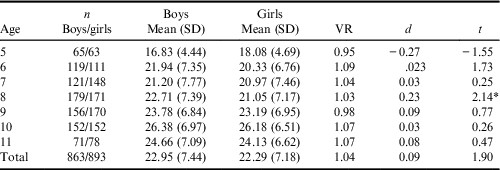
Table 1 shows, for boys and girls, numbers of children, mean CPM scores with standard deviations, variance ratios (VR) calculated as the standard deviation of the boys divided by the standard deviation of the girls, d values (differences between the scores of the boys and girls divided by the standard deviations) and the t-values for the statistical significance of the differences between the scores of the boys and girls.
Gender differences on the Coloured Progressive Matrices for 5- to 11-year-olds in Egypt
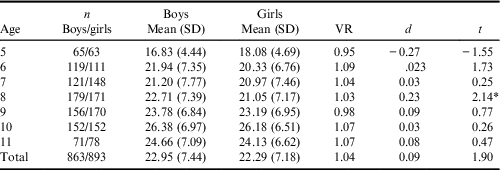
*p<0.05.
There are three points of interest in the results. First, in six of the seven age groups the boys obtained higher average scores than the girls. This result is consistent with the meta-analysis by Lynn and Irwing (Reference Lynn and Irwing2004). However, it is only in the 8-year-olds that the boys’ advantage is statistically significant at p<0.05. The boys’ advantage for the whole sample is 0.09 d and is equivalent to 1.35 IQ points and is not statistically significant. Second, the male advantage is less than the 0.21 d (3.2 IQ points) male advantage in the fifteen studies in economically developed nations given in the meta-analysis by Lynn and Irwing (Reference Lynn and Irwing2004). This result therefore refutes the hypothesis of the study that the male advantage would be greater in Egypt as a traditional, Muslim economically developing country than that in economically developed nations. Third, boys showed greater variability than girls in five of the seven age groups and in the total sample, shown by the variability ratios greater than unity. These results confirm numerous studies reporting greater male variance of intelligence, e.g. Arden and Plomin (Reference Arden and Plomin2006) and Deary et al. (Reference Deary, Penke and Johnson2010).
Acknowledgment
The authors are grateful to the Deanship of Scientific Research, College of Education Research Center at King Saud University for funding this research.
Ethical Approval. The authors assert that all procedures contributing to this work comply with the ethical standards of the relevant national and institutional committees on human experimentation and with the Helsinki Declaration of 1975, as revised in 2008.
Conflicts of Interest. The authors have no conflicts of interest to declare.
Funding. This research received no specific grant from any funding agency, commercial entity or not-for-profit organization.