INTRODUCTION
Sharks are widely distributed worldwide, occupying demersal and pelagic habitats in tropical, subtropical, temperate and cold waters. Sharks comprise eight orders and 34 families, and approximately 500 species (Compagno, Reference Compagno and Hamlett2005). Rays and skates, also known as batoids, are represented globally by around 574 species. They are widespread in marine environments, and also occur in many inland freshwater habitats (Compagno, Reference Compagno and Hamlett1999; Ebert & Compagno, Reference Ebert and Compagno2007).
In Brazilian coastal waters, there are 136 described species of elasmobranchs, of which 81 are sharks and 55 are batoids (Menezes et al., Reference Menezes, Buckup, Figueiredo and Moura2003). Off the southern coast of the country between Cabo de São Tomé (RJ) and Chuí (RS), six orders of sharks are represented by 19 families and 61 species (Gadig, Reference Gadig2001), and one order of batoids is represented by eight families and 43 species (Menezes et al., Reference Menezes, Buckup, Figueiredo and Moura2003).
The coast of the State of Paraná is located in the south of Brazil. The coastal limits are the Ararapira village (25°12′44″S–48°01′15″W), to the north, and the mouth of Saí-Guaçú River (25°58′38″S–48°35′26″W), to the south (Lana et al., Reference Lana, Marone, Lopes, Machado, Seeliger and Kjerfee2001). In the 105 km of oceanic coast, a great contrast is observed among the urbanized areas in the southern region and the preserved areas in the northern region (Bigarella, Reference Bigarella1978; Maack, Reference Maack1981).
This paper presents a checklist of elasmobranch species from the coast of Paraná State in southern Brazil. It was based on fish collections, literature data, and anecdotal data obtained during field surveys. It provides a contribution to the understanding of regional species diversity and therefore to management and conservation plans.
MATERIALS AND METHODS
The species list was based on records of elasmobranchs deposited in the collections of: Museu de História Natural Capão da Imbuia (MHNCI, Curitiba, PR), Museu de Ciências Naturais da Universidade Federal do Paraná (MCN–UFPR, Curitiba, PR), Museu Oceanográfico do Vale do Itajaí (MOVI, Itajaí, SC), Museu da Universidade do Estado do Rio de Janeiro (UERJ, Rio de Janeiro, RJ), Museu Nacional do Rio de Janeiro (MNRJ, Rio de Janeiro, RJ), Museu de Zoologia de São Paulo (MZUSP, São Paulo, SP) and Núcleo de Pesquisa e Estudo em Chondrichtyes (NUPEC, Santos, SP). Literature data available were included (Bigarella, Reference Bigarella1991; Charvet, Reference Charvet1995a,Reference Charvetb; Chaves & Corrêa, Reference Chaves and Corrêa1998; Mazzoleni & Schwingel, Reference Mazzoleni and Schwingel1999; Gadig, Reference Gadig2001; Gomes & Paragó, Reference Gomes and Paragó2001; Rincon et al., Reference Rincon, Stehmann and Vooren2001; Soto, Reference Soto2001; Haluch et al., Reference Haluch, Abilhoa and Pina2004; Santos & Carvalho, Reference Santos and Carvalho2004; Soto & Mincarone, Reference Soto and Mincarone2004; Costa & Chaves, Reference Costa and Chaves2006; Mancini et al., Reference Mancini, Casas and Amorim2006; Oddone et al., Reference Oddone, Norbis, Mancini and Amorim2008a,Reference Oddone, Amorim and Mancinib). Unpublished data, field survey, personal observations and landings information were also included.
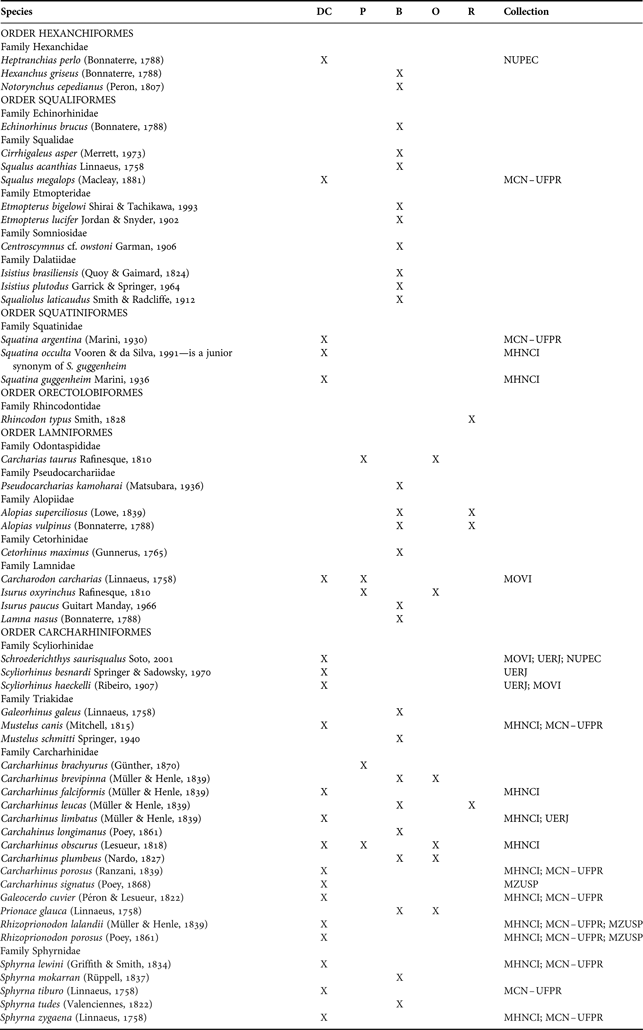
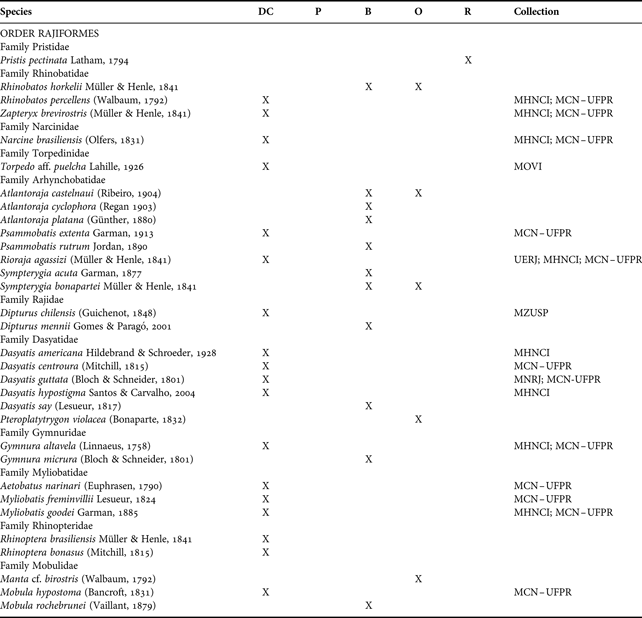
Species identification followed Figueiredo (Reference Figueiredo1997), Compagno (Reference Compagno1984, Reference Compagno2001), Vooren & da Silva (Reference Vooren and da Silva1991), Compagno & Niem (Reference Compagno, Niem, Carpenter and Niem1998), McEachran & Dunn (Reference McEachran and Dunn1998), McEachran & Carvalho (Reference McEachran, Carvalho, Carpenter and Niem1999), Gadig (Reference Gadig2001), Santos & Carvalho (Reference Santos and Carvalho2004) and Colonello et al. (Reference Colonello, Lucifora and Massa2007). The taxonomic organization of Tables 1 & 2 followed Compagno (Reference Compagno and Hamlett2005) and Ebert & Compagno (Reference Ebert and Compagno2007). An abbreviated code was placed by the name of each species to indicate the source of the species register of occurrence. The abbreviations used were: DC, deposited in collection; P, photograph; B, literature; O, authors' observation; and R, report.
List of sharks of the Paraná Coast, southern Brazil, south-western Atlantic. DC, deposited in collection; P, photograph; B, literature (Charvet, Reference Charvet1995a; Mazzoleni & Schwingel, Reference Mazzoleni and Schwingel1999; Gadig, Reference Gadig2001; Soto, Reference Soto2001); O, authors' observation; R, report.

List of batoids of the Paraná Coast, southern Brazil, south-western Atlantic. DC, deposited in collection; P, photograph; B, literature (Charvet, Reference Charvet1995a; Mazzoleni & Schwingel, Reference Mazzoleni and Schwingel1999; Oddone et al., Reference Oddone, Norbis, Mancini and Amorim2008a,Reference Oddone, Amorim and Mancinib); O, authors' observation; R, report.

RESULTS AND DISCUSSION
According to the results 51 species belonging to six orders and 17 families of sharks, and 32 species belonging to one order and eleven families of rays occur in this region. The orders recorded were Hexanchiformes (three species), Squaliformes (ten species), Squatiniformes (three species), Orectolobiformes (one species), Lamniformes (nine species), Carcharhiniformes (25 species) and Rajiformes (32 species) (Tables 1 & 2). The families of sharks with the greatest number of observed species were Carcharhinidae (14 species) and Sphyrnidae (five species). Among batoids, the dominant families were Arhynchobatidae (eight species) and Dasyatidae (six species). The total number of species assigned for the Paraná coast should increase or decrease when groups taxonomically poorly known as Dasyatis, Mustelus, Myliobatis, Scyliorhinus, Squalus and Squatina are properly revised, which is beyond the scope of this paper.
The species Scyliorhinus besnardi and S. haeckelli were shown separated in the list, even though Gadig (Reference Gadig2001) stated that they belong to a complex of species S. besnardi/haeckelli. According to this author, the genus Scyliorhinus need a taxonomic revision, which is also beyond the scope of this paper. Despite the fact that Soto (Reference Soto2001) stated that the name S. guggenheim Marini, 1936 is a senior synonym of S. occulta Vooren & da Silva, Reference Vooren and da Silva1991, and suggested the utilization of the name S. punctata Marini, 1936 for this species, we decided to follow Vooren & da Silva (Reference Vooren and da Silva1991) for the angel sharks' classification until the relationship into the group can be tested through systematic analyses in order to support more stable taxonomic decisions.
The record of the white shark Carcharodon carcharias was based on a photograph published in Bigarella (Reference Bigarella1991). The specimen was captured with gillnet in Praia Mansa, Matinhos city, and was approximately 3–3.5 m in length. This species is cosmopolitan, but occurs mostly in cooler temperate waters (Compagno, Reference Compagno2001). Its occurrence on the Brazilian coast is considered rare, and its records are probably related to penetration of cold waters, as a function of seasonal upwelling at Rio de Janeiro and Espírito Santo States (Gadig & Rosa, Reference Gadig, Rosa, Klimley and Ainley1996; Gadig, Reference Gadig2001). The register of the whiptailed stingray Dasyatis americana in Guaratuba, Paraná State, corresponds to the southernmost distribution record of the species (Costa & Chaves, Reference Costa and Chaves2006). The record of the smalltooth sawfish Pristis pectinata is based only on anecdotal data provided by the fishermen community. This species is found in tropical and subtropical waters of the Atlantic Ocean (Compagno, Reference Compagno and Hamlett1999), and on the Brazilian coast; the species is more common in the north, where it suffers the impacts caused by over-fishing (Adams et al., Reference Adams, Fowler, Charvet-Almeida, Faria, Soto and Furtado2006). The genus is assigned in archaeological sites on the coast of São Paulo (Gonzalez, Reference Gonzalez2005).
The south-east and southern coasts contain the highest species richness for sharks (64 species in the south-east and 61 species in the south) (Gadig, Reference Gadig2001). Mazzoleni & Schwingel (Reference Mazzoleni and Schwingel1999) studied elasmobranch species landed in Itajaí harbour in southern Brazil, and recorded 54 sharks and 31 batoids. The number of sharks recorded (51) for the Paraná coast represents 62.9% of the species recorded from Brazilian coastal waters (Gadig, Reference Gadig2001; Menezes et al., Reference Menezes, Buckup, Figueiredo and Moura2003), and the number of rays (32) corresponds to 58.2% of known Brazilian batoids (Menezes et al., Reference Menezes, Buckup, Figueiredo and Moura2003). These numbers demonstrate a relatively large number of elasmobranchs from the Paraná region.
Mazzoleni & Schwingel (Reference Mazzoleni and Schwingel1999) reported that fishing activities capture many shark species in the wide coastal and offshore area in southern Brazil. These authors indicated that double bottom gillnet, pair trawl, double rig trawl and bottom longline are the main fishing techniques that capture elasmobranch species in this region. Itajaí harbour (Santa Catarina State, southern Brazil) hosts a diversified fleet of fishing boats, and many species of elamobranchs captured in southern Brazil are landed in this harbour (Andrade, Reference Andrade1998; Mazzoleni & Schwingel, Reference Mazzoleni and Schwingel1999). On the other hand, fishing in Paraná State is dominated by artisanal fisheries (Chaves & Robert, Reference Chaves and Robert2003; Andriguetto-Filho et al., Reference Andriguetto-Filho, Chaves, Santos, Liberati, Victória, Martins, Haimovici and Andriguetto-Filho2006; Robert & Chaves, Reference Robert and Chaves2006; Robert, Reference Robert2008), and large catches of neonate and juvenile elasmobranchs are registered (Charvet, Reference Charvet1995b; Costa & Chaves, Reference Costa and Chaves2006; Bornatowski et al., Reference Bornatowski, Robert and Costa2007; Robert, Reference Robert2008).
Several elasmobranchs that occur off Paraná State seem to use the southern coast of Brazil for their reproductive cycle (Silva & Lessa, Reference Silva and Lessa1991; Charvet, Reference Charvet1995b; Vooren & Klippel, Reference Vooren, Klippel, Vooren and Klippel2005a; Vooren et al., Reference Vooren, Lessa, Klippel, Vooren and Klippel2005a; Costa & Chaves, Reference Costa and Chaves2006; Abilhoa et al., Reference Abilhoa, Bornatowski and Freitas2007; Bornatowski, Reference Bornatowski2008). Vooren et al. (Reference Vooren, Klippel, Galina, Vooren and Klippel2005b) recorded 21 species that use areas for reproduction on the southern continental shelf. According to Charvet (Reference Charvet1995b), Costa & Chaves (Reference Costa and Chaves2006) and Bornatowski (Reference Bornatowski2008), Carcharhinus limbatus, Galeocerdo cuvier, Rhizoprionodon lalandii, Sphyrna lewini, Narcine brasiliensis, Rioraja agassizi, Rhinobatos percellens and Zapteryx brevirostris use the studied area for parturition and as a nursery site, indicating that the reproductive cycle is exposed to fisheries impact. It is suspected that several species also use the Paraná coast as parturition and nursery grounds, but more studies of the reproductive biology and ecology of these elasmobranchs are necessary to evaluate this hypothesis.
The large number of elasmobranchs assigned to the Paraná region and the occurrence of several threatened species (e.g. Rhinoptera brasiliensis, Rhinobatos horkelii, Squatina guggenheim, S. occulta, S. argentina, Carcharias taurus, Mustelus schmitti and Galeorhinus galeus) (Vooren & Klippel, Reference Vooren, Klippel, Vooren and Klippel2005b), indicates the need for an effective monitoring of regional fishing activities, to provide information on the specific composition, conservation status and total fishing effort employed in the State. Only then will it be possible to develop and implement efficient conservation measures and sustainable fisheries. It is also imperative that the data on elasmobranch catches be species-specific and not categorized in a general ‘shark’ category, as it is done currently in official statistical reports (Paiva, Reference Paiva1997; IBAMA, 2005, 2007).
ACKNOWLEDGEMENTS
We thank Dr Ulisses Leite Gomes and Dr Hugo Ricardo Secioso (Universidade Estadual do Rio de Janeiro); Dr Michael Mincarone (Museu Oceanográfico do Vale do Itajaí); MSc Rodrigo Mazzoleni and MSc Neil Aschliman (Florida State University, Tallahassee, Florida) for critical suggestions for the manuscript.