In a healthy democracy, one would expect to see roughly equal levels of political participation among men and women. Yet—aside from voting—women are significantly less politically engaged than men at both the mass and elite levels (Atkeson Reference Atkeson2003; Bennett and Bennett Reference Bennett and Bennett1989; Burns, Schlozman, and Verba Reference Burns, Schlozman and Verba2001; Lawless and Fox Reference Lawless and Fox2010; Verba, Burns, and Schlozman Reference Verba, Burns and Schlozman1997). The political engagement gender gap suggests that some form of “adverse selection” is at play in the system (Mansbridge Reference Mansbridge1999, 632). This takes many forms: women have traditionally had less access to resources, more burdensome family obligations, and fewer relevant role models. However, emerging research demonstrates that even when accounting for many of these factors, women remain less engaged with politics than similarly situated men. This suggests that changing these structural factors is not enough to close the gender gap in political engagement—we must address the “gendered psyche” that prevents many women from fully participating in civic life (Lawless and Fox Reference Lawless and Fox2010, 12).
Recent studies on women's political disengagement have pointed to psychological explanations but have yet to fully explore the mechanisms. This paper considers one psychological underpinning of the political engagement gender gap: internal self-efficacy, or one's confidence that he or she has the ability “to understand and to participate effectively in politics” (Craig, Niemi, and Silver Reference Craig, Niemi and Silver1990, 290; see also Morrell Reference Morrell2003). Because people prefer to engage in activities in which they are confident they will succeed, if women have lower levels of political self-efficacy than men, then they will be less likely to engage in political activities. This has the potential to create a negative feedback loop because engaging with politics is how one becomes more knowledgeable, capable, and efficacious in the domain of politics.
Hence, this paper presents the results of a two-pronged survey experiment designed to provide exogenous shocks to internal self-efficacy and then measure whether this influences the gender gap in interest in politics. The first experimental intervention tests the effect of giving respondents positive feedback about their performance on a test of political knowledge. The second tests the effect of giving respondents accurate comparison feedback about their performance on the test (Bylsma and Major Reference Bylsma and Major1992).
Both treatments close the gender gap in self-reported interest in politics, but they do so in different ways. Positive feedback increases women's political engagement enough to close the gap; accurate comparison information decreases men's political engagement enough to close the gap. These results point to the significant influence gendered patterns in self-efficacy have on political engagement. Men's and women's perceptions of how they fit into the political realm are different—but malleable—and this likely has implications for their behavior. More broadly, the findings suggest the importance of integrating psychological perspectives when assessing gaps in political engagement.
The remainder of the paper outlines the existing research on gender and political engagement, describes the ways in which self-efficacy contributes to the gender gap in political orientation, presents the results of the experiment, and then discusses the implications of those results.
GENDER, POLITICAL ENGAGEMENT, AND SELF-EFFICACY
Political Engagement
With the important exception of voting, women's level of engagement with politics is, on average, lower than men's (Atkeson and Rapoport Reference Atekson and Rapoport2003; Bennett and Bennett Reference Bennett and Bennett1989; Burns, Schlozman, and Verba Reference Burns, Schlozman and Verba2001; Fox and Lawless Reference Fox and Lawless2010, Reference Fox and Lawless2011; Verba, Burns, and Schlozman Reference Verba, Burns and Schlozman1997). There are a variety of factors that contribute to these disparities, including situational, structural, and socialization reasons (Bennett and Bennet Reference Bennett and Bennett1989). Women have had not traditionally had access to socioeconomic resources to the same degree as men (Schlozman, Burns, and Verba Reference Schlozman, Burns and Verba1994; Burns, Schlozman, and Verba Reference Burns, Schlozman and Verba2001). The resource gap has narrowed, however, as women have outpaced men in educational attainment and entered the workforce in greater numbers, though they still make less money than men (Pew Research Center 2013). Women's disproportionate childcare and family obligations also contribute to their disengagement with politics, especially among women who are not in the paid workforce (Burt-Way and Kelly Reference Burt-Way and Kelly1992; Gidengil, Giles, and Thomas Reference Gidengil, Giles and Thomas2008; Lawless and Fox Reference Lawless and Fox2010; Sapiro Reference Sapiro1982; Silbermann Reference Silbermann2015; Thomas Reference Thomas2012). Scholars also commonly credit the lack of female role models in politics for women's lack of engagement (Atkeson Reference Atkeson2003; Burns, Schlozman, and Verba Reference Burns, Schlozman and Verba2001; Campbell and Wolbrecht Reference Campbell and Wolbrecht2006; Karp and Banducci Reference Karp and Banducci2008; Wolbrecht and Campbell Reference Wolbrecht and Campbell2007). The lack of visible women in politics socializes women to believe that “politics, like football, is not for them” (Burns, Schlozman, and Verba Reference Burns, Schlozman and Verba2001, 8). And, this socialization begins well before adulthood (Fox and Lawless Reference Fox and Lawless2014).
Despite the fact that these explanations provide crucial pieces of the puzzle, simply increasing women's access to resources, decreasing their childcare burdens, and/or providing role models may not automatically close the gender gap in political engagement. For example, Atkeson and Rapoport (Reference Atekson and Rapoport2003) still find a gender gap in political engagement, even after controlling for socioeconomic resources. Perhaps most interestingly, Dow finds that men and women's political knowledge gains from socioeconomic gains are not the same—education actually exacerbates the political knowledge gap because men benefit from it much more than women (Reference Dow2009). Furthermore, Wolak and McDevitt (Reference Wolak and McDevitt2011) find that adolescent women are much less likely than adolescent men to show gains in political knowledge in an environment marked by partisan conflict.
Gidengil, Giles, and Thomas point out the problem: even after decades of advances in women's status and resources since the arrival of second-wave feminism, women “remain more likely than men to think that politics is too complicated for them to understand” (Reference Gidengil, Giles and Thomas2008, 536). And Thomas (Reference Thomas2012) similarly finds that the gender gap in subjective political competence persists over time and across socioeconomic strata. This suggests that there are deeper issues at play—that simply creating an environment that is open to women's political participation will not necessarily lead to women's greater participation. To close the gender gap, it may be necessary to change the way that women think about their relationship to politics.
Self-Efficacy and the “Gendered Psyche”
One way to begin to alter women's orientation toward politics may be to alter their sense of internal self-efficacy. A person's sense of self-efficacy—the perception that one can succeed at a given task—greatly influences one's behavior. Bandura explains that “self-efficacy judgments, whether accurate or faulty, influence choice of activities and environment. People avoid activities that they believe exceed their coping capabilities, but they undertake and perform assuredly those that they judge themselves capable of managing” (Reference Bandura1982, 123). In other words, people “tend to engage in tasks about which they feel confident and avoid those in which they do not” (Pajares Reference Pajares2002, 18). The result is that if women believe that they are underqualified to engage in politics, they are unlikely to engage in politics.
In fact, there is good evidence to suggest that there is a gender gap in self-efficacy. In the context of the candidate emergence process, scholars have dubbed this the “gendered psyche”—“a deeply embedded imprint that propels men into politics but relegates women to the electoral arena's periphery” (Lawless and Fox Reference Lawless and Fox2010, 12). Even women who are objectively well qualified to run for political office are less likely than their male counterparts to perceive themselves as well-qualified (Lawless and Fox Reference Lawless and Fox2010; Fox and Lawless Reference Fox and Lawless2011). Laboratory experiments confirm this finding—while women and men are equally likely to volunteer to represent a group, they are much less likely to be willing to compete to represent a group (Kanthak and Woon Reference Kanthak and Woon2015). Interestingly, this gender gap is largest among the best-qualified men and women. Preece and Stoddard (Reference Preece and Stoddard2015) find similar experimental evidence for women's aversion to political competition.
Might the gendered psyche apply at the mass level as well? Given the long history of women's exclusion from the “obligations of citizenship,” it would not be surprising to find that it does (Kerber Reference Kerber1998). When Burns, Schlozman, and Verba discuss women's perception that politics “isn't for them,” they are essentially making this argument (Reference Burns, Schlozman and Verba2001). Karpowitz finds that even after controlling for civic and social abilities, women are less likely to believe that they are able to effectively speak up at public meetings (Reference Karpowitz2006). And they are also less likely to see themselves as having an authoritative voice worth raising in other deliberative contexts (Karpowitz and Mendelberg Reference Karpowitz and Mendelberg2014). Further, Gidengi, Giles, and Thomas find that American women who are stay-at-home mothers are particularly vulnerable to lower feelings of political self-efficacy (Reference Gidengil, Giles and Thomas2008).
Women do tend to score lower than men on measures of political knowledge (Barabas et al. Reference Barabas, Jerit, Pollock and Rainey2014; Delli Carpini and Keeter Reference Delli Carpini and Keeter1996, Reference Delli Carpini, Keeter, Tolleson-Rinehard and Josephson2000; Hannagan, Littvay, and Popa Reference Hannagan, Littvay and Popa2014; Lizotte and Sidman Reference Lizotte and Sidman2009; Mondak Reference Mondak1999; Ondercin, Garand, and Crapanzano Reference Ondercin, Garand and Crapanzano2011), so one might argue that their lower levels of self-efficacy are justified. But there is a growing body of literature that suggests that some of this gap in political knowledge may actually be a product of women's lower self-efficacy. For example, men are more likely to guess when they do not know the answer on political quizzes, while women are more likely to respond “I don't know,” thereby lowering their scores (Lizotte and Sidman Reference Lizotte and Sidman2009; Mondak and Anderson Reference Mondak and Anderson2004). There is evidence that measures of political knowledge may induce stereotype threat, which dampens women's scores (McGlone, Aronson, and Kobrynowicz Reference McGlone, Aronson and Kobrynowicz2006). Furthermore, when respondents are asked questions that are pertinent to or about women, the gender gap disappears or reverses (Burns, Schlozman, and Verba Reference Burns, Schlozman and Verba2001, 102; Dolan Reference Dolan2011; Stolle and Gidengil Reference Stolle and Gidengil2010).
Interrupting the Negative Feedback Loop
In short, if women believe that they know less about politics and are less competent than men, they are unlikely to be as interested and engaged in political activities. Opting out of participating in political activities yields lower levels of political experience and knowledge, which leads to lower levels of self-efficacy—creating a negative feedback loop.
This implies that one way to begin to close the gender gap in political engagement is to turn a vicious cycle into a virtuous cycle by addressing underlying gender disparities in self-efficacy. If women's sense of confidence in their political knowledge can be increased, they may feel more willing to engage with politics.
Other researchers have found that simple interventions can shape women's political engagement, particularly in educational settings. Rios, Stewart, and Winter (Reference Rios, Stewart and Winter2010) find that gender-inclusive curriculum increases female students’ identification with the material. Greenlee, Holman, and VanSickle-Ward find that classroom writing exercises that help female students contextualize their experiences within the broader literature on gender and political ambition lead to greater desire to run for office (Reference Greenlee, Holman and VanSickle-Ward2014). And internship programs that place female university students with female state legislators increase the young women's interest in participating in the political process in the future (Reference Doherty2011). Hence, there is reason to believe that women's political interest and engagement is, indeed, malleable.
How might one design an experimental intervention that increases women's sense of self-efficacy in regard to politics? Bylsma and Major successfully close the gender gap in salary expectations by providing men and women with the same performance feedback. They also close the gap when both men and women are informed about what comparable employees earn (Reference Bylsma and Major1992, 196). In other words, in the absence of independent information, men and women rely on gendered perceptions of self-efficacy as they judge the value of their performance. But both performance feedback and accurate comparison information level the playing field by reducing men's and women's reliance on these gendered self-perceptions.
It is possible that this positive feedback/accurate comparison information approach could operate in a similar manner for political engagement?
EXPERIMENTAL DESIGN
We recruited 646 respondentsFootnote 1 to participate in an online survey “about civic involvement” through Amazon.com's Mechanical Turk (MTurk) during December 2012.Footnote 2 All respondents were United States residents over the age of 18. Respondents were paid $0.60 to complete the survey; it took them, on average, just under 10 minutes to complete the survey.
Appendix 1 shows a demographic breakdown of our experimental sample. While our sample is diverse, it does not mirror the U.S. population at large; in particular, it is younger, less likely to be married, better educated, less religious, and more Democratic. We acknowledge that our external validity is limited because of this. However, Berinsky, Huber, and Lenz (Reference Berinsky, Huber and Lenz2012) show that MTurk does provide a more representative sample than in-person convenience samples (frequently university students recruited through classes), the most common sampling method for experiments in political science. They also replicate several prominent experiments on MTurk and find little difference in results.
Despite the external validity limitations, we believe that this paper provides an important initial test of how to close the gender gap in political engagement. Furthermore, the experimental nature of our research design ensures exceptionally high internal validity. Within a given range of confidence, we can be sure that it is the treatment—and only the treatment—that is causing differences in outcomes. In the field of gender studies, this level of internal validity is often hard to come by because gender is closely correlated with so many other important “independent” variables. Hence, this paper is intended to prompt future research that probes the extent to which our findings transfer to other settings.
Respondents were randomly assignedFootnote 3 to a control group (Nc = 285) or one of two treatment groups (NT1 = 142; NT2 = 144).Footnote 4 They began by answering a variety of demographic questions. They then took a 16-question multiple-choice test of political knowledge.Footnote 5
After the test, the control group (C) was thanked for taking the test.Footnote 6 The first treatment group (T1) was praised for their performance on the test (regardless of their score).Footnote 7 The second treatment group (T2) was told their actual test score—as well as the average test score—giving them accurate comparison information about their relative performance on the test.Footnote 8
Immediately after receiving this feedback, respondents were asked, “Generally speaking, how interested are you in what is going on in government and political affairs? Extremely interested, very interested, moderately interested, occasionally interested, or not interested at all?” This question serves as the dependent variable in all of the analysis below. The full survey instrument is available in Appendix 2.Footnote 9
HYPOTHESES
There are several ways that scholars commonly talk about gendered political engagement. The first focuses on women—that is, whether a variable increases women's levels of political engagement. The second focuses on the gender gap—that is, whether a variable closes the gender gap between women and men in levels of political engagement. Much less commonly, scholars specifically consider men and hypothesize about the effects of interventions on their attitudes and behavior.
This creates the potential for several types of hypotheses. There is evidence that women's self-perceptions of their abilities are artificially low, especially in masculine-stereotyped domains (Beyer Reference Beyer1990; Beyer and Bowden Reference Beyer and Bowden1997). This suggests that both the positive feedback and accurate comparison information treatments should increase their sense of self-efficacy by decreasing their reliance on their own gendered self-perceptions. All else equal, that should narrow the gender gap in political interest.
However, the size of the gender gap also depends on the way men react to the treatments. Because men's behavior is assumed to be normative, there is a dearth of research specifically on men and masculinity in politics (Kimmel, Hearn, and Connell Reference Michael, Hearn and Connell2004; Peace Reference Peace2002). With little existing research to guide hypotheses formation, we remain formally agnostic about the way in which men will react to our treatments. At the same time, because we hypothesize that the treatments will narrow the gender gap, we imply that the treatments will have little to no effect on the men; research suggests that men are significantly less responsive to performance feedback than women (Roberts and Noelen-Hoeksema Reference Roberts and Nolen-Hoeksema1994). In short, we view this study as important exploratory research that points to the importance of more systematically considering men's political engagement and the role that plays in the gender gap.
This leads us to the following hypotheses:
Women
H1:
T1 will increase women's level of political interest, compared to women in the control group.
H2:
T2 will increase women's level of political interest, compared to women in the control group.
H2a:
This effect will be conditional on the women's performance on the test.
Men
There are no formal a priori hypotheses.
Gender Gap
H3:
T1 will narrow the gender gap in political interest.
H4:
T2 will narrow the gender gap in political interest.
EXPERIMENTAL RESULTS
Control Group
Before discussing the experimental results, it is helpful to understand the findings that appear in the control group. This provides a baseline comparison group against which the other findings can be judged. After answering a series of demographic questions and taking the political knowledge quiz, respondents randomly assigned to the control group were told, “Thank you for taking the quiz. We have a few more questions for you.” They were then immediately asked, “Generally speaking, how interested are you in what is going on in government and political affairs: Extremely interested, very interested, moderately interested, occasionally interested, not at all interested?”
Consistent with other researchers’ findings, there was a significant gender gap between women's and men's responses to the political interest question in the control group, with men responding with an average score of 2.250 on the 5-point scale (between “moderately interested” and “occasionally interested”) and women responding with an average score of 1.925 on the 5-point scale (between “not at all interested” and “occasionally interested”). With about a third of a point difference between men and women, this gender gap is highly statistically significant (two-sided p-value = .0143).
Influence of Treatments on Women
Positive Feedback
After taking the political knowledge test, all respondents in the positive feedback treatment (T1) were told, “Great job! You did very well on this difficult quiz. Very few people do well on it.”
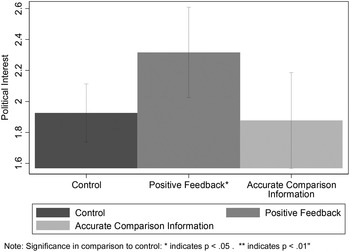
Women responded positively to this treatment vis-à-vis the control condition, increasing their level of political interest from 1.925 to 2.317 (two-side p-value = .0219), an average of .391 points on a 5-point scale. Hence, we find solid support for H 1 , with the implication that women's levels of political interest can be increased through reassuring them about their competence in the domain of politics.
Accurate Comparison Information
After taking the political knowledge test, respondents assigned to the accurate comparison information treatment (T2) were told, “You got [their actual score] out of 16 multiple choice questions correct. On average, people get 9 out of 16 correct.”Footnote 10
This treatment had no statistically significant effect on women. The women in the control group reported a mean interest in politics of 1.925, while the women in T2 reported a mean interest in politics of 1.877 (two-sided p-value = .7811). Hence, we find no support for H 2 in the data.
Figure 1 presents the results of these tests graphically. Women's significant response to the positive feedback condition is clearly apparent, while the null results of the accurate comparison information is also clear.
Experimental results for women.

Influence of Treatments by Score
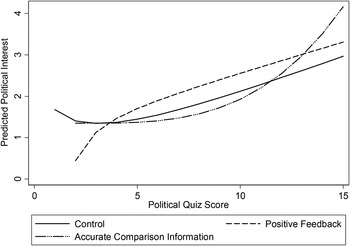
Hypothesis 2a notes that the content of the comparison feedback differs depending on the score that the respondent earned. Respondents with high scores received relatively good news about their performance, while respondents with low scores received relatively bad news about their performance. Figure 2 shows the predicted values of the dependent variable, self-reported interest in politics, by score for each of the treatments. As is clear, the positive feedback line is consistently above the control condition line, with the exception of the very lowest scorers. In contrast, the comparison feedback line tracks closely the control condition line, with the exception of the very highest scorers.
Experimental results for women, by score.

Influence of Treatments on Men
Because men have traditionally been considered the normative baseline category and are thus understudied, we did not have a priori expectations for the effect of the treatments on men. However, we report our findings here with the hope that this will aid future researchers interested in men's levels of political interest.
Positive Feedback
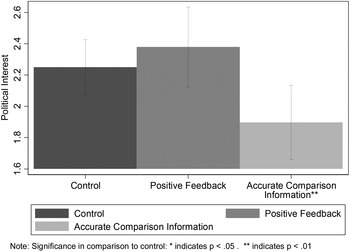
Men did not appear to have a statistically significant response to T1. In the control condition, their mean level of interest in politics was 2.250 on a 5-point scale. In the positive feedback condition, their mean level of interest in politics was 2.378 (two-side p-value = .410).
Accurate Comparison Information
Men did, however, respond to the comparison information. While their mean level of political interest in the control was 2.250, in T2 it was a statistically significantly lower mean of 1.896 (two-sided p-value = .0143).
Figure 3 displays these results graphically. While men in the positive feedback condition were slightly more interested in politics, the most dramatic result is for T2. Accurate comparison information dramatically lowered men's level of interest in politics.
Experimental results for men.

Influence of Treatments by Score
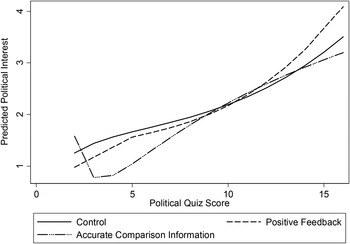
As with the women, it is interesting to note the heterogeneous effects of the treatment by the number of questions the respondent got correct on the political quiz. Figure 4 shows the predicted vales of the dependent variable, by score, for each treatment. The most interesting finding from this is the source of the effect of T2: low-scoring men. Men who scored below average on the political quiz and then were told that they scored below average became dramatically less interested in politics.
Experimental results for men, by score.

Influence of Treatments on the Gender Gap
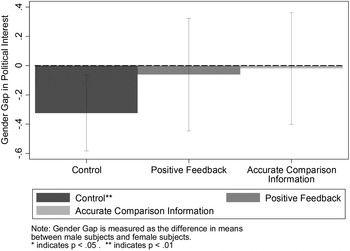
A final way of discussing political outcomes is to consider the gender gap. Treatments that increase women's interest in politics may nevertheless widen the gender gap if men are even more responsive than women are. These two treatments, however, narrowed the gender gap, though not quite statistically significantly. Among respondents randomly assigned to the control condition, women's average level of political interest was 1.925, while men's was 2.250—a difference of .324 points (two-sided p-value = .0143). In contrast, in the positive feedback condition the difference between men and women shrunk to .061 points, with women's average being 2.317 and men's average being 2.378 (two-sided p-value = .7533). And, in the accurate comparison feedback condition, the gender gap was also not statistically significant. Women reported an average level of political interest of 1.877, while men reported 1.897 (two-sided p-value = .9203). Figure 5 shows these differences graphically.
Size of gender gap, by treatment.

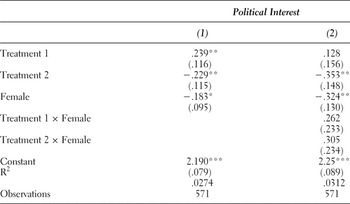
However, to understand whether these changes in the gender gap between the control group and the treatment groups were statistically significant, it is necessary to consider the difference-in-difference, as measured by interaction terms in an OLS regression. Table 1 shows the results of this analysis. While the treatments wield a statistically significant effect in Model 1, the interaction terms in Model 2 fall short of standard levels of statistical significance. So, while the gender gap is statistically significant in the control group and not in the treatment groups, the change in the gender gap between the treatments and the control is not statistically significant.
Effect of treatments on political interest

Notes: Robust standard errors are in parentheses. * indicates statistical significance at the 10% level. ** indicates statistical significance at the 5% level. *** indicates statistical significance at the 1% level.
IMPLICATIONS AND CONCLUSIONS
The literature on the underrepresentation of women in politics and the gender gap in political engagement is vast, and it is gradually coalescing around the idea that one of the most significant reasons for women's lower levels of participation is that they choose to “opt out” of politics—even compared to men with similar levels of resources and qualifications. One reason they may be opting out is that women may lack the confidence to participate fully in the political arena. A lack of self-efficacy could cause women to disengage from politics because individuals dislike participating in activities when they doubt they can succeed. However, this experiment suggests that political interest is malleable—interventions designed to provide an exogenous shock to self-efficacy change self-reported political interest in significant ways. Positive feedback increases women's levels of political interest; accurate comparison information decreases men's levels of political interest.
While this experiment is necessarily abstract, there is a variety of ways in which men and women receive feedback about their understanding of politics in real life. The most obvious, of course, is in educational settings, and the experimental results have implications for how educators approach performance feedback. Perhaps more importantly, though, is the way this dynamic may play out in adult conversations about politics and in deliberative settings. When women participate in deliberative settings, they frequently experience negative reactions from other group members that undermine their influence and authority (Mendelberg, Karpowitz, and Oliphant Reference Mendelberg, Karpowitz and Oliphant2014). Given this dynamic, it is not surprising that women enjoy political conversations significantly less than men and participate in them less frequently (Burns, Schlozman, and Verba Reference Burns, Schlozman and Verba2001, 102). The results from this experiment suggest that some of this gender gap in enjoyment and participation may be alleviated if women who enter into a political conversation receive positive feedback about their performance rather than the negative interruptions that are more common.
Interestingly, these results also suggest that men's level of political interest may be artificially high, given their qualifications. In effect, accurate comparison information serves as negative feedback for many men, especially those who scored lower on the test of political knowledge. These findings are consistent with the psychology literature that suggests that there is a small but significant gender gap in self-confidence (Kling et al. Reference Kling, Hyde, Showers and Buswell1999) and that men often overestimate their abilities (Furnham and Rawles Reference Furnham and Rawles1995; Petrides and Furnham Reference Petrides and Furnham2000; see also Mondak and Anderson Reference Mondak and Anderson2004). However, the political science literature rarely directly studies men because it generally assumes that they are the default, normative category against which women's performance is judged. These results highlight that failing to seriously consider men in their own right is a mistake for empirical, not just theoretical, reasons. The gender gap depends on the behavior of both women and men, so it is not necessarily the case that an intervention that increases political engagement in women will close the gender gap. Similarly, it is not necessarily the case that a treatment that closes the gender gap will do so by increasing women's levels of political engagement. As Burns, Schlozman, and Verba (Reference Burns, Schlozman and Verba2001) noted, we must consider both men and women if we wish to understand gendered political outcomes.
Though the experimental methods used in this study provide a high level of confidence that these treatments are what is causing the changes in the outcomes between groups, the sample is not representative of the broader American population, which limits this study's generalizability. This sample is younger, more liberal, better educated, and less religious than the general population—all factors that might be correlated with lower levels of traditional gender socialization and a smaller aggregate gender gap than in the general population. Nevertheless, the control group still shows a significant gender gap in political interest, suggesting that the “gendered psyche” permeates even the more liberal parts of American society. It is possible, however, that the stronger norms of gender egalitarianism present in this portion of the population might be a necessary condition for the interventions to work. An examination of a more conservative population may, therefore, be a particularly interesting setting to replicate this experiment.
Despite questions surrounding generalizability, the results do highlight the importance of considering psychological factors such as self-efficacy when discussing the gender gap in political engagement. They also emphasize the need to move away from the model of assuming men to be the normative or baseline category against which women are measured. Both men and women's levels of interest in politics are malleable, albeit in different ways. This influences the gender gap and must be kept in mind any time the gender gap in political interest is discussed.