

Introduction
The genus Antimora (Moridae, Gadiformes) in accordance with the modern concepts (Small, Reference Small1981; Cohen, Inada, Iwamoto, & Scialabba, 1990; Orlov, Grigorov, & Lazareva, Reference Orlov, Grigorov and Lazareva2018a) involves two species, Pacific flatnose A. microlepis and blue hake A. rostrata. Antimora microlepis inhabits the North Pacific Ocean. Antimora rostrata occurs in many other parts of the world, being most abundant in temperate and cold waters, but not present in most tropical and subtropical areas (with the exception of the Gulf of Guinea, the Canary Islands and Madeira, the Indian Ocean underwater ridges, Hawaii, Taiwan and the northern coast of South America), as well as in the Arctic Ocean and semi-enclosed seas: Sea of Japan, the Caribbean and the Mediterranean seas (Biscoito, personal communication; Cohen et al., Reference Cohen, Inada, Iwamoto and Scialabba1990; Gonzalez et al., Reference González, Santana, García-Mederos, Tuset, Lozano, Jiménez and Biscoito2008; Orlov et al., Reference Orlov, Sytov, Mari, Figueroa, Barbini, Costa, Marin and Mincarone2019; Parin, Timokhin, Novikov, & Shcherbachev, Reference Parin, Timokhin, Novikov and Shcherbachev2008; Piotrovsky, Reference Piotrovsky, Parin and Novikov1989; Shcherbachev, Reference Shcherbachev1987; Small, Reference Small1981; Yeh & Drazen, Reference Yeh and Drazen2009). Blue hake is a bentho-pelagic deep-sea species that is capable of forming dense concentrations and is caught as bycatch in bottom trawl and longline fisheries (Fossen & Bergstad, Reference Fossen and Bergstad2006; Horn & Sutton, Reference Horn and Sutton2015; Iwamoto, Reference Iwamoto1975; Kulka, Simpson, & Inkpen, Reference Kulka, Simpson and Inkpen2003) and is considered as a promising commercial target (Novikov, Panov, Rebik, & Timokhin, Reference Novikov, Panov, Rebik and Timokhin2010; Novikov & Timokhin, Reference Novikov and Timokhin2009).
Published information about the features of the life cycle of the species under consideration is extremely scarce and fragmentary (Collins, Priede, & Bagley, Reference Collins, Priede and Bagley1999; Gordon & Duncan, Reference Gordon and Duncan1985; Iwamoto, Reference Iwamoto1975; Kulka et al., Reference Kulka, Simpson and Inkpen2003; Novikov & Timokhin, Reference Novikov and Timokhin2009; Wenner & Musick, Reference Wenner and Musick1977). Despite its wide distribution in the world ocean and high occurrence in catches, the growth and age of blue hake have been studied only in the waters of Iceland (Magnusson, Reference Magnússon1998, Reference Magnússon2001), the Ross Sea and New Zealand waters (Horn & Sutton, Reference Horn and Sutton2015), as well as in several areas of the North Atlantic, including the waters of both coasts of Greenland and the Mid-Atlantic ridge (Fossen & Bergstad, Reference Fossen and Bergstad2006; Orlov, Vedishcheva, Trofimova, & Orlova, Reference Orlov, Vedishcheva, Trofimova, Orlova and Yu2018b). However, no age validations were provided in those publications. It is assumed that this species has low productivity due to its long life span and late maturity, which makes its populations highly vulnerable to fishing (Devine, Baker, & Haedrich, Reference Devine, Baker and Haedrich2006).
The purpose of this paper is to, for the first time, report data on the age and growth of blue hake from the Lazarev and Weddell seas (Atlantic sector of the Antarctic), as well as its length–weight relationship and sex ratio.
Materials and methods
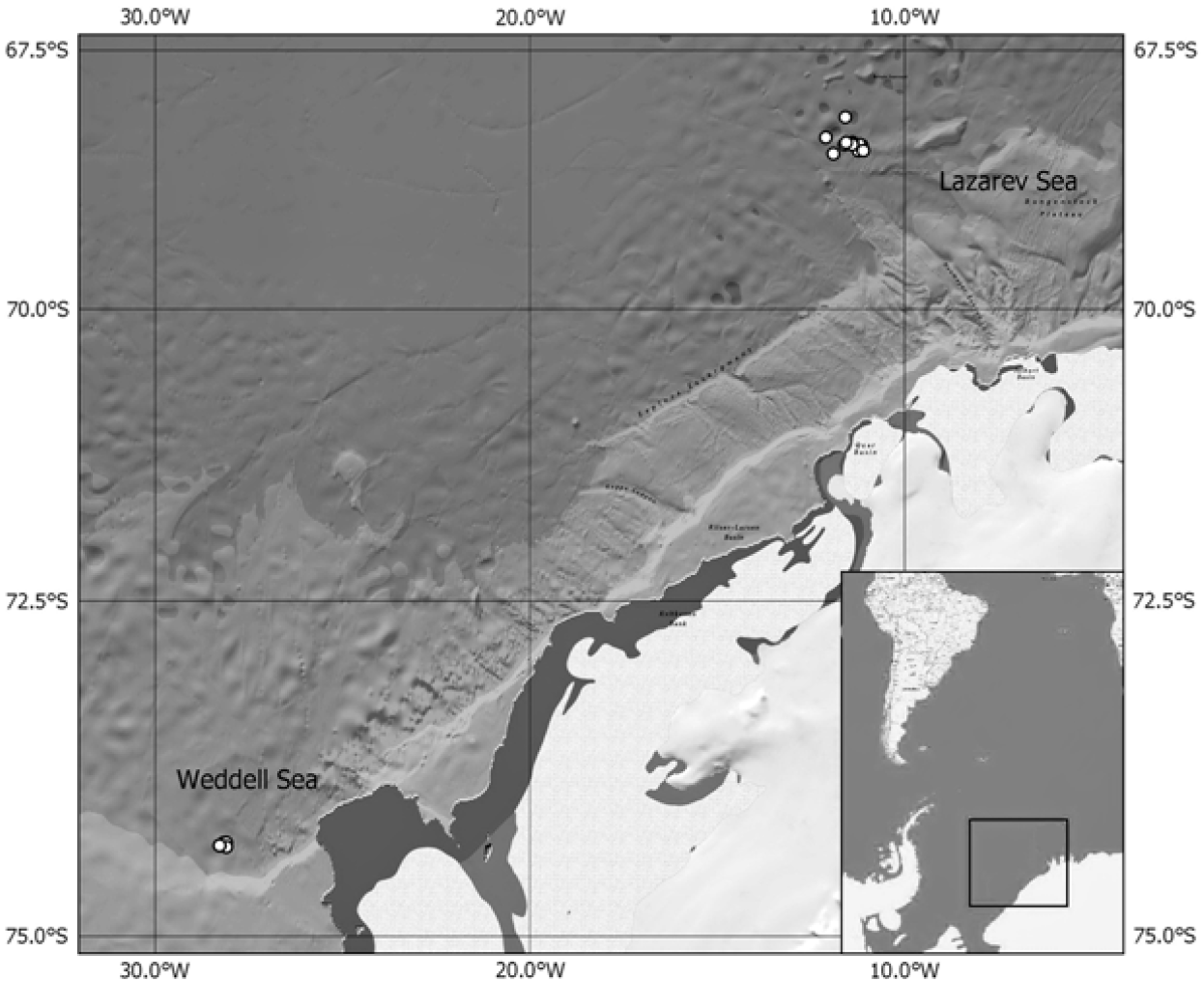
Samples of blue hake were collected as bycatch from longline commercial fishing for Antarctic toothfish Dissostichus mawsoni in the Convention area of CCAMLR (Commission for the Conservation of Antarctic Marine Living Resources). Samples were collected in February–March 2009 on the fishing vessel “Insung 22” in the Lazarev Sea and in February 2013 on the vessel “Yantar 35” in the Weddell Sea (Fig. 1). A total of 121 individuals caught from depths of 1,109–1,798 m were analysed, including 25 from the Lazarev Sea and 96 from the Weddell Sea. All fish were subjected to complete biological analysis using standard methods (Laevatsu, Reference Laevastu1965; Pravdin, Reference Pravdin1966). Measurements included total body length (TL), body weight, sex, and gonadal maturation stage. Of 121 fish caught, sex was determined in 77 specimens. In order to compare our results of age estimations with the length distributions of blue hake, data on hake length from longline catches, provided by the CCAMLR Secretariat, for the areas 48.5 and 48.6 of CCAMLR for 2005–2016 were used.
The sites (circles) where otoliths of blue hake Antimora rostrata in the waters of the Lazarev (February–March 2009) and Weddell (February 2013) seas were sampled.

Sagittal otoliths were extracted from freshly caught fish during the biological analyses aboard the ship. Age was determined in the laboratory. Since the beginning of the 1980s, when determining the age of fish, a “break and burn” method of age determination on otoliths has been widely used, which has proved to be good for demersal (including deep-water) fish of the west coast of the USA and Canada (Beamish & McFarlane, Reference Beamish, McFarlane, Summerfelt and Hall1987). Taking into account that blue hake, like many deep-sea fish, are long-lived species (Devine et al., Reference Devine, Baker and Haedrich2006), ages were determined in accordance with the methods developed specifically for some long-lived deep-sea fish (Beamish & Chilton, Reference Beamish and Chilton1982; Rodriguez Mendosa, Reference Rodríguez Mendoza2006).
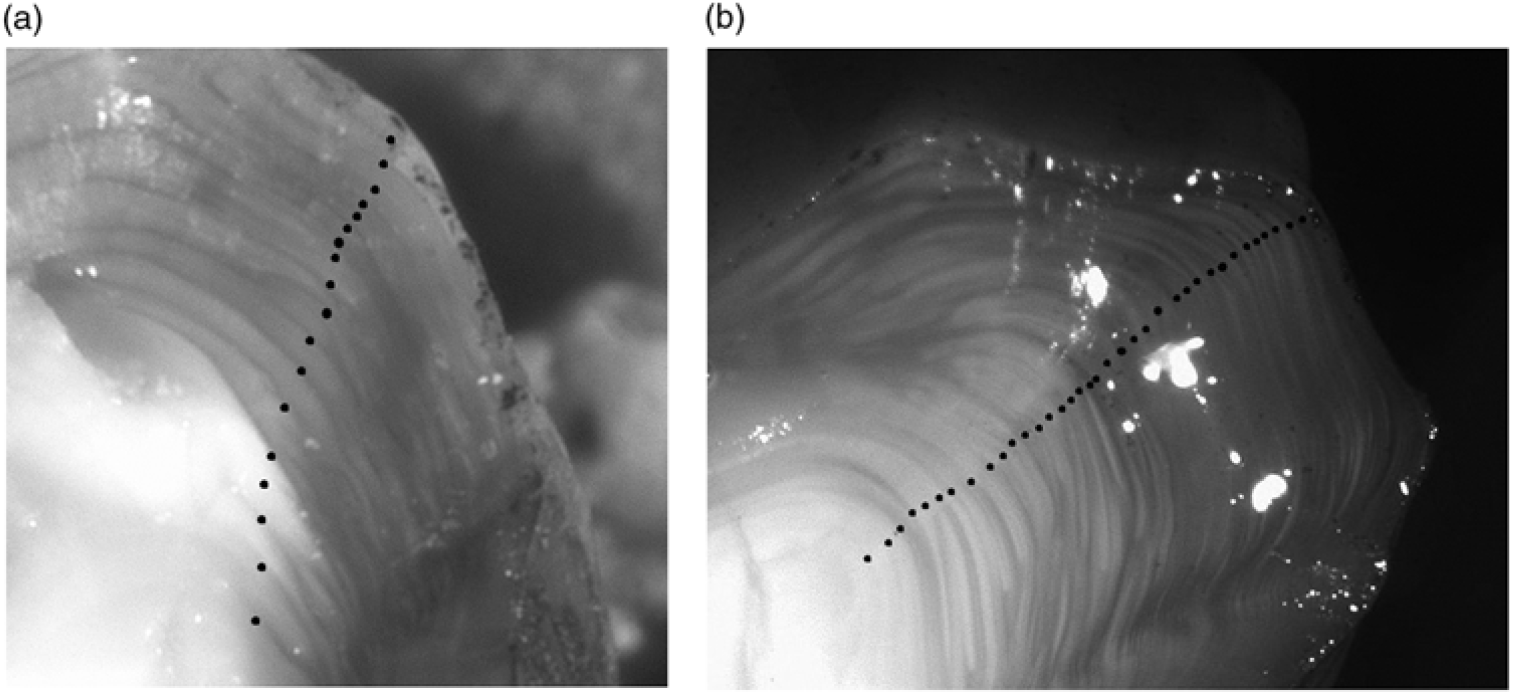
Accordingly, otoliths were broken in the central part and baked, then polished, if necessary. Otoliths were baked in the flame of an alcohol burner. The readiness of each otolith for further analysis was determined individually on the basis of visual observations. For the preparation of polished cross-sections of the otoliths, abrasive disks with aluminum-oxide or silicon-carbide-coated grit of 0.1−0.9 µm (Buehler, USA) were used. We used a trinocular microscope (Olympus SXZ12) with a DFPLAPO 1 × PF lens to view the cross-sections at 1 × 20–40 magnification. Otolith cross-sections were coated with glycerine and illuminated with reflected light (Fig. 2). In total, 121 otoliths were analysed.
Cross-sections of otoliths of blue hake Antimora rostrata from Lazarev and Weddell seas. (a) TL 47 cm, 18 years. (b) TL 69.0 cm, 36 years. Dots are annual growth zones, TL = total length.

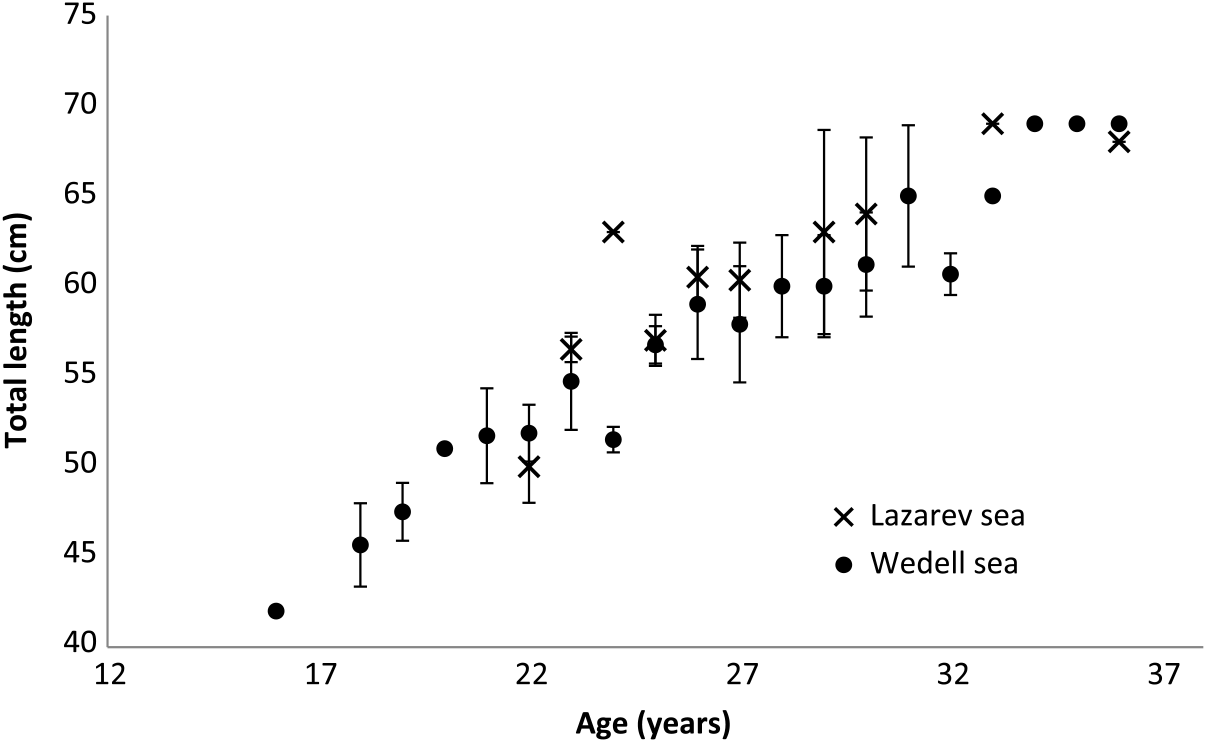
Before comparing samples from the Lazarev and Weddell seas, the ratios between age and total length were tested for normality using Shapiro–Wilk tests, with significance set at p ≤ 0.05. Data from the Lazarev Sea were normally distributed (W = 0.941, p = 0.233), and the data from the Weddell Sea (W = 0.968, p = 0.026) were not normally distributed. For further comparison, we therefore used non-parametric Mann–Whitney U tests. We found no support for a statistically significant difference in ratios between the age and total length between samples from the Lazarev and Weddell seas (Mann–Whitney U test, W = 0.695, p = 0.05) (Fig. 3). We therefore subsequently pooled data from both areas for further analyses.
Comparison of age estimations (mean size at age) of blue hake Antimora rostrata in the Lazarev and Weddell seas.

Fisher’s exact tests were used to assess relationships between the total length and body weight, length and weight of the otolith, total length and otolith weight, as well as the age and otolith weight. Test outputs were calculated in MS Excel.
Age curves were plotted and the coefficients of von Bertalanffy growth equations were calculated using PAST ver. 3.14 software (Hammer, Harper, & Ryan, Reference Hammer, Harper and Ryan2001).
Results
Blue hake were sampled from commercial bottom longline catches. Given the selectivity of the fishing gear, sampled individuals were generally large with total lengths between 42 and 69 cm, and weighing between 420 and 2,900 g. Males (54.97 ± 5.66 cm total length) were smaller than females (59.76 ± 5.34 cm total length) (Student’s t-test, df = 65, p < 0.01). Similarly, females (1848.3 ± 569.2 g) were heavier than males (1284.5 ± 487.9 g) (Student’s t-test, df = 65, p < 0.01).
The relationship between length and weight of blue hake was better described (R 2 = 0.809, statistically significant at p < 0.01) by a power function:
 $$BW = \,0.001\, \times T{L^{3.492}}$$
where BW – body weight (g), TL – total length (cm).
Males were caught more often than females (males: 55.7% vs. females: 44.3%). At the same time, no juvenile individuals were observed in catches. Gonads of all males and females were in the second stage of maturity. However, we acknowledge that it is difficult to distinguish immature individuals from post-spawning ones without histological analyses. Therefore, post-spawning fish may also have been included in our sample.
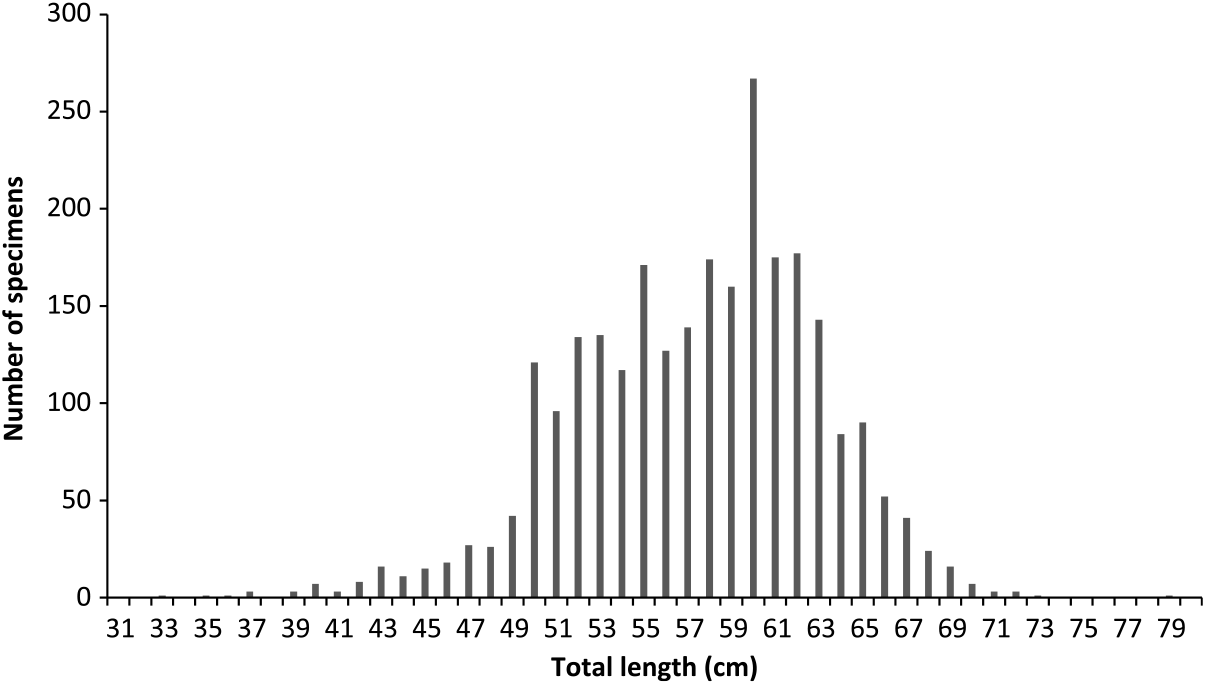
The distribution of blue hake size classes was characterised by a peak in abundance of fish sized between 55 and 66 cm (Fig. 4). The mean total length (range) of caught fish was 57.4 cm (30–79 cm). At the same time, the complex structure of the size composition, with the presence of numerous peaks, should be noted, which probably reflects the complex size–age structure of the species (Fig. 4).
Length-frequency distribution (n = 2,641 inds.) of blue hake Antimora rostrata in CCAMLR 48.5 and 48.6 areas (data provided by CCAMLR Secretariat).

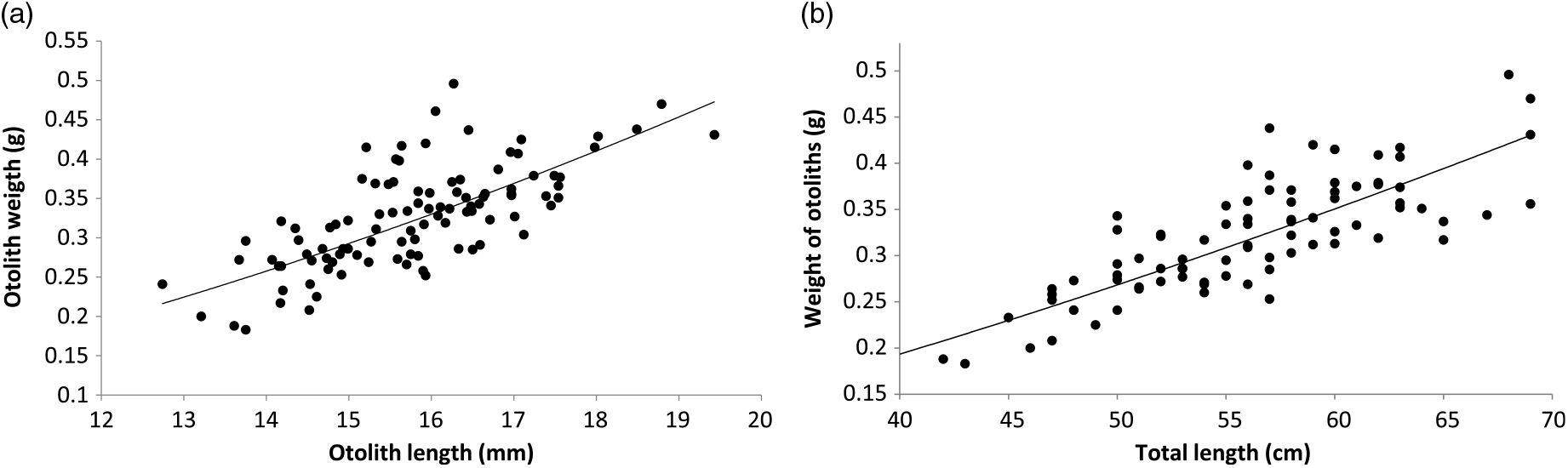
The weight of otoliths ranged between 0.183 and 0.496 g, with a mean weight of 0.326 g; while the length of otoliths ranged between 12.74 and 19.43 mm, with a mean of 15.79 mm. The relationship between the length and weight of otoliths (Fig. 5a) might be described by the power equation (R 2 = 0.52, p < 0.001):
 $${W_O} = 0.0019 \times L_o^{{1.8535}}$$
where Wo – otolith weight (g), Lo – otolith length (mm).
Relationships between (a) weight and length otoliths and (b) between otolith weight and total length of blue hake Antimora rostrata from Lazarev and Weddell seas.

The otolith weight positively correlated with the total length (R 2 = 0.65, p < 0.001), and the relationship between the considered parameters (Fig. 5b) might be described by the power equation:
 $${W_O} = 0.001 \times T{L^{1.4314}}$$
where Wo – weight of otolith (g) and TL – total length (cm).
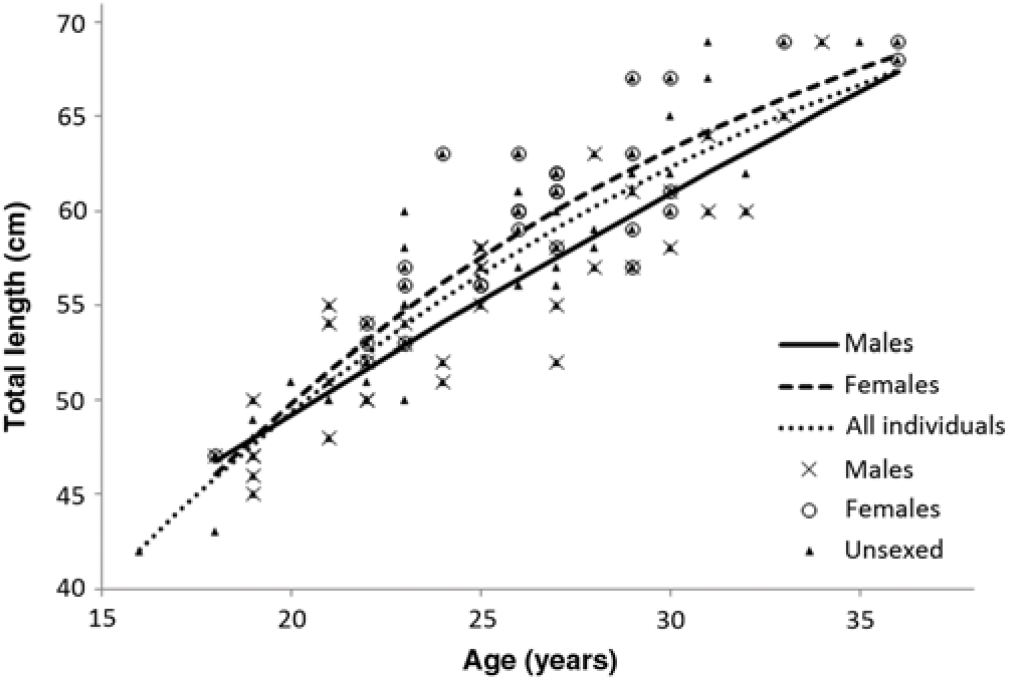
According to our data, in longline catches in the Lazarev and Weddell seas blue hake was aged 16–36 years (Fig. 6) with a mean age of 25.4 years. The most numerous (29%) were fish aged 25–27 years.
Linear growth of blue hake Antimora rostrata in Lazarev and Weddell seas.

The youngest male in the catches was 18 years and was calculated for an individual with total length of 47 cm and a weight of 450 g. The oldest male was calculated to be 34 years for a fish with total length of 69 cm and a weight of 2,140 g. The mean age of males was 24.9 years. The youngest female in catches was also 18 years and was calculated for a fish with total length of 47 cm and a weight of 670 g; while the oldest age of 36 years was recorded for a female individual with total length of 69 cm and a weight of 2,280 g. The mean age of females amounted to 26.8 years.
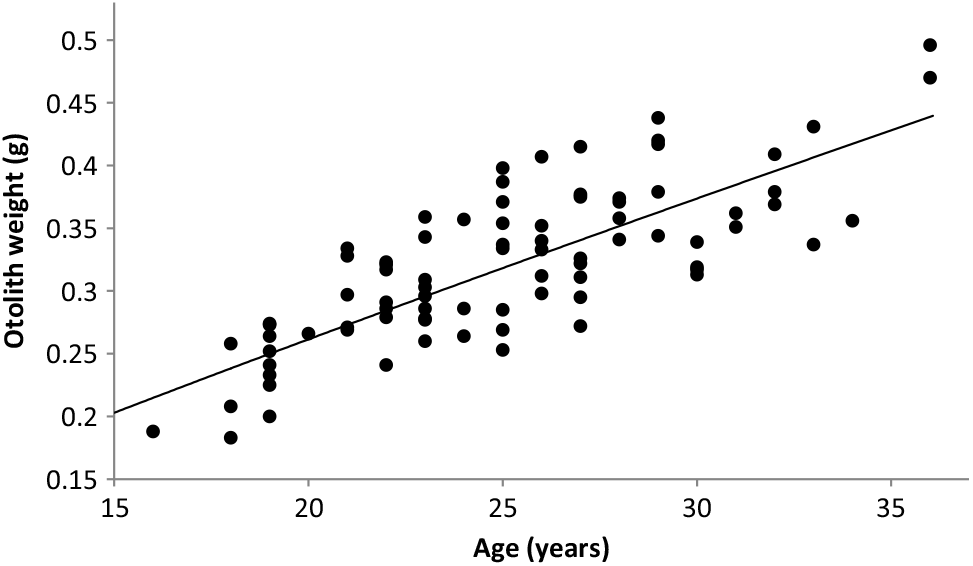
The relationship between the age of fish and the weight of otoliths (Fig. 7) might be described (R 2 = 0.62) by power function:
 $${W_O} = 0.0196 \times {A^{0.8675}}$$
where Wo – otolith weight (g), A – age (years).
Relationships between age and otolith weight of blue hake Antimora rostrata in Lazarev and Weddell seas.

Discussion
The sex ratio of blue hake catches depends on the study area and depths surveyed. Thus, males dominated at depths of 500 m off the northwestern Atlantic, while the proportion of females increased with increasing depth (Kulka et al., Reference Kulka, Simpson and Inkpen2003). In Greenland waters, depths deeper than 900 m were also dominated by females (Orlov et al., Reference Orlov, Vedishcheva, Trofimova, Orlova and Yu2018b). In the waters of the North Atlantic coast of the United States at depths up to 1,500 m, the number of males was higher than females (Wenner & Musick, Reference Wenner and Musick1977). The Indo-Oceanic blue hake significantly differs from the North Atlantic in sex ratio. According to Novikov and Timokhin (Reference Novikov and Timokhin2009), on the underwater ridges of the Indian Ocean, the sex ratio is close to 1:1 with some predominance of females. According to our data, the number of males was higher than females at depths of 1,100–1,800 m in catches in the Lazarev and Weddell seas. At the same time, at depths of 800–2,000 m of the Ross Sea, the share of females was up to 90% (Horn & Sutton, Reference Horn and Sutton2015). As recent studies of closely related species of Pacific flatnose Antimora microlepis in the northeastern Pacific Ocean show (Frey, Keller, & Simon, Reference Frey, Keller and Simon2017), the sex ratio of this species may also experience strong inter-annual fluctuations under the influence of the emergence of high recruitment levels (for example, the share of females in surveys in this area decreased from 40% in 2013 to 25% in 2015).
The actual absence in our catches of fish with ripe, spawning and post-spawning gonads is not something unique. Gordon and Duncan (Reference Gordon and Duncan1985) paid attention to this fact, conducting research in the northeastern Atlantic, as well as Novikov and Timokhin (Reference Novikov and Timokhin2009), analysing catches on underwater ridges of the Indian Ocean. All these authors believe that the absence of such individuals in the catches is due to their location outside of the study depths. However, if Gordon and Duncan (Reference Gordon and Duncan1985) attribute this to the spawning of blue hake in the lower parts of the slope, Novikov and Timokhin (Reference Novikov and Timokhin2009) suggest that the reproduction of this species occurs in the water column.
The majority of authors, who studied the age of blue hake using otoliths (Fossen & Bergstad, Reference Fossen and Bergstad2006; Horn & Sutton, Reference Horn and Sutton2015; Orlov et al., Reference Orlov, Vedishcheva, Trofimova, Orlova and Yu2018b) note the challenges associated with the difficulties of interpretation of the results of age estimations, which was quite evident in our studies.
Given that in the process of longline fishing catches consist mainly of large-size fish, our samples of the blue hake were represented by a narrow size range, which can explain the low coefficient of reliable approximation of the equation of relationship between the length of the blue hake and the weight of its otoliths, as well as between the weight of otoliths and age. The example from the waters of southwestern Greenland can serve as a confirmation of this (Orlov et al., Reference Orlov, Vedishcheva, Trofimova, Orlova and Yu2018b): the R2 value for juvenile individuals with a length of 18–42 cm was equal to 0.58, while for females with a broader size range (21–70 cm) it was already 0.95.
The information available in the literature on the growth rates of female and male blue hake is quite contradictory. In the waters off Iceland it is noted that males are smaller than females of the same age (Magnusson, Reference Magnússon2001), while no such differences were found in the waters off Greenland and the Mid-Atlantic Ridge (Fossen & Bergstad, Reference Fossen and Bergstad2006), as well as in the Ross Sea and off New Zealand (Horn & Sutton, Reference Horn and Sutton2015). Male blue hake (up to the age of 14 years) off southwestern Greenland grow faster than females, but individuals of 15–16 years have a comparable growth rate both in length and weight between sexes. In subsequent years, females are noticeably longer and heavier than males of the same age (Orlov et al., Reference Orlov, Vedishcheva, Trofimova, Orlova and Yu2018b). In our study area, female blue hakes were much larger than males and slightly older (26.8 vs. 24.9 years on the average), which is probably due to females growing larger than males and the life cycle of males being considerably shorter (Fossen & Bergstad, Reference Fossen and Bergstad2006; Horn & Sutton, Reference Horn and Sutton2015).
The age composition of the catches of blue hake in various areas is different. In the waters of the Mid-Atlantic Ridge catches were represented by individuals aged 6–25 years with a predominance of fish older than 10 years; in the waters off Greenland, the age of fish varied within 1–20 years with a predominance of individuals under 10 years (Fossen & Bergstad, Reference Fossen and Bergstad2006). In general, in both areas, catches were dominated by individuals aged 7 to 14 years. In the Ross Sea, catches of blue hake ranged in age between 11 and 41 years; and in the waters off New Zealand between 4 and 28 years (Horn & Sutton, Reference Horn and Sutton2015). In catches from southwestern Greenland, individuals aged 7 to 38 years with a numerical dominance of fish aged from 11 to 21 years were observed (Orlov et al., Reference Orlov, Vedishcheva, Trofimova, Orlova and Yu2018b). In general, according to our data, 25- to 27-year-old individuals of blue hake were most numerous in catches in the Lazarev and Weddell seas. Since larger and older individuals of this species are known to generally occur at deeper depths (Cohen et al., Reference Cohen, Inada, Iwamoto and Scialabba1990), the described differences in the age composition of the catches are likely to be associated with obtaining the studied material by various authors in different bathymetric ranges. These differences might also partly be explained by different fishing gear (trawls and longlines) used in the various research studies. Longlines selectively caught larger and older fish and thus blue hake from Ross, Lazarev, and Weddell seas (Horn & Sutton, Reference Horn and Sutton2015; our data) was older than fish caught by trawls in the North Atlantic, off Greenland, and New Zealand (Fossen & Bergstad, Reference Fossen and Bergstad2006; Horn & Sutton, Reference Horn and Sutton2015; Orlov et al., Reference Orlov, Vedishcheva, Trofimova, Orlova and Yu2018b).
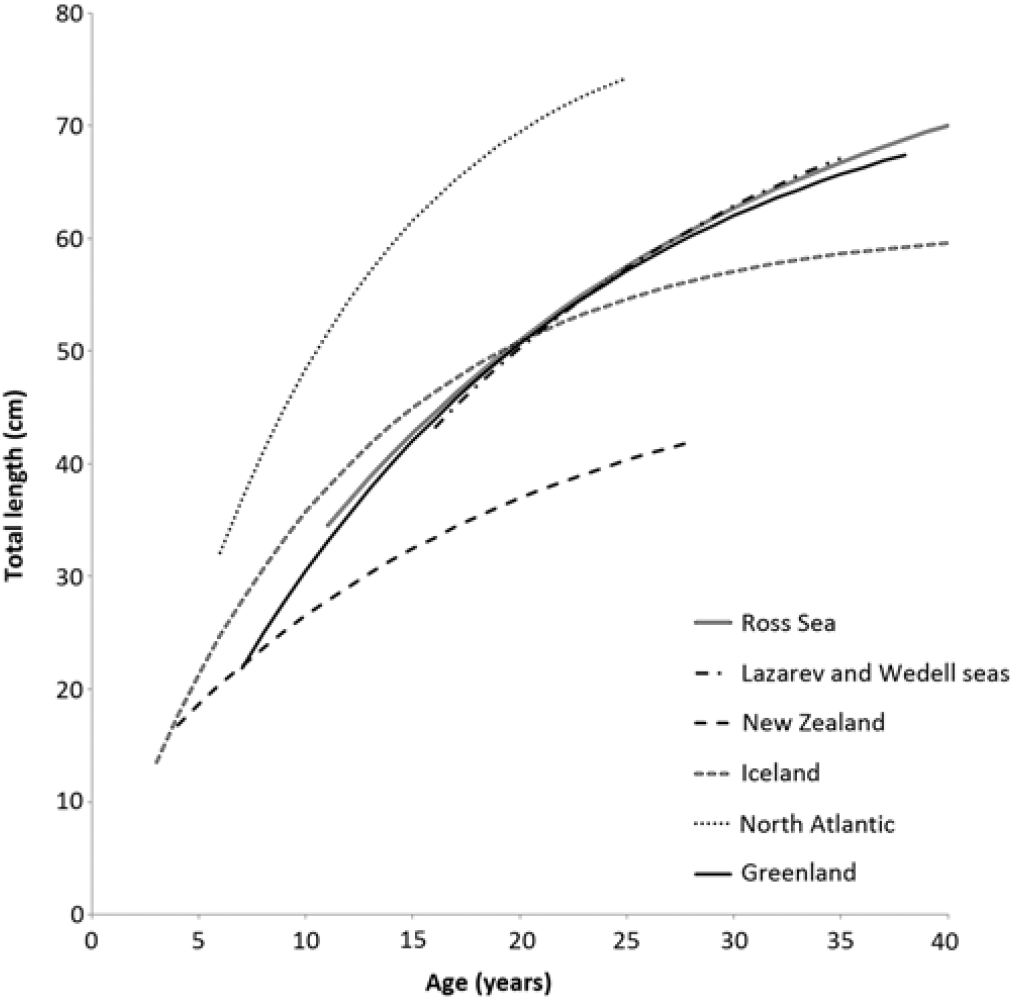
A comparison of blue hake growth in different parts of its range (Fig. 8; Table 1) shows that growth curves for Lazarev and Weddell seas (our data) are very similar to those for the Ross Sea (Horn & Sutton, Reference Horn and Sutton2015) and waters off Greenland (Orlov et al., Reference Orlov, Vedishcheva, Trofimova, Orlova and Yu2018b). On the other hand, our data differ quite substantially from those obtained off the coast of New Zealand (Horn & Sutton, Reference Horn and Sutton2015), Iceland (Magnusson, Reference Magnússon2001), and North Atlantic (Fossen & Bergstad, Reference Fossen and Bergstad2006). Blue hake from New Zealand waters (Horn & Sutton, Reference Horn and Sutton2015) shows slower growth rates compared to our results, while in the North Atlantic (Fossen & Bergstad, Reference Fossen and Bergstad2006) this species demonstrates faster growth than in the Lazarev and Weddell seas. In Icelandic waters (Magnusson, Reference Magnússon2001), blue hake grows faster up to about 20 years, followed by a slower growth rate in older individuals as compared to our data. The similarity of blue hake growth patterns in the Ross, Lazarev, and Weddell seas and off Greenland might be due to similar environmental conditions of these areas (temperature, forage conditions, etc.). While our results are relatively similar to previously published ones (Horn & Sutton, Reference Horn and Sutton2015; Orlov et al., Reference Orlov, Vedishcheva, Trofimova, Orlova and Yu2018b), the age determination of A. rostrata remains unvalidated and requires further research to determine age using other structures such as the bones of the head, pelvic girdle, and vertebrae.
The parameters of von Bertalanffi growth equation of blue hake Antimora rostrata in different regions of the world ocean

MAR = Mid-Atlantic ridge; M = males; F = females; J = juveniles.
Number of fish is given in parentheses.
The growth of blue hake Antimora rostrata in various parts of species’ range (North Atlantic – Fossen & Bergstad, Reference Fossen and Bergstad2006; Ross Sea – Horn & Sutton, Reference Horn and Sutton2015; New Zealand – Horn & Sutton, Reference Horn and Sutton2015; Iceland – Magnusson, Reference Magnússon2001; Greenland – Orlov et al., Reference Orlov, Vedishcheva, Trofimova, Orlova and Yu2018b; Lazarev and Weddell seas – our data).

Acknowledgements
The authors are sincerely grateful to Dr. Andrei Petrov (Department of Science and Education of the Federal Agency for Fisheries, Moscow, Russia) for the materials used in this paper, as well as to Manuel Biscoito (Faculty of Sciences of the University of Lisbon, Funchal, Madeira, Portugal) for the information about the occurrence of blue hake in the waters off Madeira. They also thank CCAMLR Secretariat for the data on blue hake lengths in areas 48.5 and 48.6. Special thanks to Alexander Sytov (VNIRO) who prepared the map of sampling sites. The authors are also thankful to two anonymous reviewers for critical reading of the manuscript and valuable comments and to the International Fisheries Section of the American Fisheries Society for their editorial assistance with the English language.
Financial support
This work was supported by the Russian Fund of Basic Research (grant no. 16-04-0516).
Conflict of interest
None.
Ethical standards
The authors assert that all procedures contributing to this work comply with the ethical standards of the relevant national and institutional guides on the care and use of laboratory animals.