Introduction
Anemone nemorosa L. is an herbaceous, woodland, perennial herb widely distributed in Europe, with the exception of the Mediterranean region, where it is rare (Tutin et al., Reference Tutin, Heywood, Burges, Valentine, Walters and Webb1964). It is an early flowering plant that develops leaves and flower shoots from buds on perennial rhizomes. In northern Italy, it is found in shady and damp deciduous woodlands (Abrami, Reference Abrami1971; Shirreffs, Reference Shirreffs1985), in lowlands and in mountains (northern Apennines and Alps).
Various aspects of the biology of A. nemorosa have been studied, including population biology (Ernst, 1983), rhizome growth and clone development (Shirreffs and Bell, Reference Shirreffs and Bell1984), demography (Piroznikov, Reference Piroznikov1994), growth dynamics (Cowie et al., Reference Cowie, Watkinson and Sutherland1995), seedling recruitment (Eriksson, Reference Eriksson1995; Holderegger, Reference Holderegger1996), the importance of sexual and vegetative reproduction (Holderegger et al., Reference Holderegger, Stehlik and Schneller1998), genetic structure (Stehlik and Holderegger, Reference Stehlik and Holderegger2000) and embryo growth and seed desiccation tolerance (Ali et al., Reference Ali, Probert, Hay, Davies and Stuppy2007). However, few studies present data on seed germination and seedling development, and even then information tends to be rather contradictory. For example, earlier papers state that A. nemorosa germinates slowly in laboratory experiments and that seedlings are rare and infrequent in mature forests, vegetative reproduction being the main method of local dispersal (Grime et al., Reference Grime, Mason, Curtis, Rodman, Band, Mowforth, Neal and Shaw1981; Ernst, Reference Ernst1983; Shirreffs and Bell, Reference Shirreffs and Bell1984; Shirreffs, Reference Shirreffs1985). However, more recent studies (Eriksson, Reference Eriksson1995; Holderegger, Reference Holderegger1996) report high rates of seed germination and seedling recruitment under natural conditions, and Holderegger et al. (Reference Holderegger, Stehlik and Schneller1998) observed high levels of genetic variability. Therefore, sexual reproduction and seed germination are perhaps more important than previously considered. Ali et al. (Reference Ali, Probert, Hay, Davies and Stuppy2007) reported that embryos of A. nemorosa were undifferentiated at the time of dispersal and that they began to differentiate and grow immediately after collection in laboratory and field post-harvest treatments. Embryos reached full size, and seeds exhibited the first evidence of germination after 112 d in the field. Consequently, these authors concluded that radicles were non-dormant, with seeds germinating as soon as temperatures dropped to suitable values in the autumn. However, shoots did not appear in any of their experiments, and they speculated that seeds of A. nemorosa might exhibit epicotyl dormancy. The conditions controlling the expression of such dormancy and important questions regarding dormancy classification remain unresolved.
A number of studies have investigated the relationship between intra-specific variation in seed germination behaviour and habitat preference. For example, in Bromus tectorum (Meyer et al., Reference Meyer, Allen and Beckstead1997) and Penstemon Section Glabri (Meyer and Kitchen, Reference Meyer and Kitchen1994; Meyer et al., Reference Meyer, Kitchen and Carlson1995), differences between populations were related to habitat, and there was strong evidence that such differences are determined genetically. Dormancy can also be related to altitude, with populations that experience prolonged snow cover requiring longer periods of cold stratification (Borghetti et al., Reference Borghetti, Vendramin, Giannini and Schettino1989; Cavieres and Arroyo, Reference Cavieres and Arroyo2000). Somewhat surprisingly, there is also evidence in some species that seeds from populations from cold areas germinate best at high rather than low temperatures (Kibe and Masuzawa, Reference Kibe and Masuzawa1994; Cavieres and Arroyo, Reference Cavieres and Arroyo2000). However, in a study of germination behaviour in 13 European populations of Carex canescens, Schütz and Milberg (Reference Schütz and Milberg1997) failed to find any correlation with local climate. In this species, populations experiencing more severe winters did not require longer periods of cold stratification. Despite the conflicting evidence, there seems little doubt that the timing of germination is a highly adaptive trait, and although seed germination has a genetic basis, its expression can be modified by maturation and the post-dispersal environment (Donohue, Reference Donohue2005).
In this study, germination phenology, including embryo development and radicle and shoot emergence of A. nemorosa, were investigated using laboratory and field experiments similar to those reported by Ali et al. (Reference Ali, Probert, Hay, Davies and Stuppy2007). To test the hypothesis that germination responses are related to climate differences associated with altitude, seeds were collected from two different geographical and altitudinal areas in northern Italy: the Ticino Natural Park [Po plain; c. 74 m above sea level (asl)] and at Mt Lesima (northern Apennines; c. 1350 m asl) in Lombardy. The leaves of A. nemorosa expand quickly in early March in the Ticino Natural Park, where the plant flowers from mid-March to early April, and seed set is completed by the end of April. The phenology of A. nemorosa in the mountain area was delayed by approximately 1 month.
Materials and methods
Seed collection
Collections of achenes (hereafter referred to as seeds) were made at the time of natural dispersal (Baskin and Baskin, Reference Baskin and Baskin1998; Smith et al., Reference Smith, Dickie, Linington, Pritchard and Probert2003) on 2 May 2006 from three lowland populations (Po Plain) and on 8 June 2006 from one mountain population (northern Apennines). The distance between each lowland population was about 3 km. The purpose was to test the hypothesis that closely located populations in the same ecological region would not show significant differences in germination behaviour. If this was shown to be the case, it would increase the statistical robustness of the data, thus enabling more confident comparison between results from lowland and mountain populations. On the day of harvest, samples of seeds were either sown on agar in the laboratory or buried in leaf litter and soil at the collecting site.
Phenology of embryo growth and of radicle and shoot emergence in the laboratory
Laboratory treatments involved sowing three replicates of 50 seeds each on 1% distilled water–agar held in 90 mm diameter Petri dishes. Treatments were incubated in temperature- and light-controlled incubators using a 12 h daily photoperiod (photosynthetically active radiation 40–50 μmol m− 2 s− 1).
From the time of collection, seeds were exposed to a temperature cycle simulating seasonal changes occurring in the West Po plain. Summer conditions (May to September) were simulated by 150 d at 20°C; early autumn (October) by 30 d at 15°C; late autumn (November) by 30 d at 10°C; winter (December to February) by 90 d at 4°C; early spring (March) by 30 d at 10°C; and late spring (April) by 30 d at 15°C (Mariani et al., Reference Mariani, Paolillo and Rasio2001). Constant temperatures were used because the forest cover and surface leaf litter are effective insulators of daily temperature variations (Daws et al., Reference Daws, Burslem, Crabtree, Kirkman, Mullins and Dalling2002), and because it was assumed that seeds would be more responsive to seasonal rather than diurnal temperature variations.
On the same day, 20 seeds were dissected (Kondo et al., Reference Kondo, Miura, Okubo, Shimada, Baskin and Baskin2004; Toshikazu et al., Reference Toshikazu, Yoshiji and Eriko2004), and the embryo length and the entire mucilaginous endosperm length were measured under a binocular microscope equipped with a micrometer. Observations on embryo growth and on root and shoot emergence were made every 30 d during summer and then at 5-d intervals.
To serve as controls, additional germination tests were set up to investigate the effects of prolonged incubation at each of the mean seasonal temperatures (4, 10, 15 and 20°C) on seed germination. Seeds were checked for root and shoot emergence at regular intervals for 360 d.
Effects of summer and autumn conditions on root emergence
To examine the importance of summer conditions, samples of seeds were held at 20°C for 0, 30, 60, 90, 120 and 150 d. After each period, seeds were moved to autumn and then winter conditions.
The importance of autumn conditions was examined after seeds had experienced the simulated summer condition (150 d at 20°C), moving seeds to the other seasonal conditions, either skipping the early autumn (15°C), the late autumn (10°C) or both. The number of seeds and replications for each test, method of sowing, light conditions and observations were as described above.
The importance of winter for shoot emergence
The aim of this experiment was to investigate whether cold stratification affects shoot emergence. Freshly collected seeds were placed in summer conditions (20°C) for 150 d, and then subsequently moved to the early autumn (30 d at 15°C) and late autumn (30 d at 10°C). At the end of this sequence, the seeds were given 0, 30, 60 or 90 d of cold stratification, and then they were moved to early spring (30 d at 10°C), followed by late spring conditions (30 d at 15°C). To examine the level of physiological dormancy in the shoots, seeds were placed on 1% distilled water–agar containing gibberellic acid (GA3, 722μM) during the early spring period in the absence of preceding winter. The number of seeds and replications for each test and other details were the same as before.
Phenology of embryo growth and of radicle and shoot emergence in the wild
At the time of collection, 25 fine-mesh polyester bags with 50 seeds each were buried approximately 5 cm under leaf litter in the natural habitat. Sachets were retrieved at 30-d intervals from May to September, and then at weekly intervals for the lowland populations, and every 2 weeks for the mountain population. Embryo growth, radicle emergence and shoot emergence were monitored throughout. Soil temperature at the level of the sachets was recorded at hourly intervals using Tiny Tag data loggers (Gemini, Chichester, West Sussex, UK).
Data analysis
Linear and non-linear regression analyses were carried out using Genstat 9.1. Linear regression analysis was carried out on embryo growth data. In order to determine whether there were differences between populations, analysis of residual deviance (variance ratio test which follows the F-distribution) was used to test for significance when constraining data for multiple populations to a single line.
To describe the dynamics of germination in the laboratory, the Weibull function (Weibull, Reference Weibull1951; Johnson and Kotz, Reference Johnson and Kotz1970) was fitted to cumulative germination data (the most appropriate function to describe germination dynamics; Brown and Mayer, Reference Brown and Mayer1988), according to the following formula:

where y = germination percentage at time t (d); M = final germination; z = germination delay; k = germination rate and a = curve shape parameter ranging from 0 to 3, obtained by optimizing the sum of squared differences. As before, analysis of residual deviance was carried out to determine whether there were significant differences in the behaviour of seeds from the four populations.
Results
Phenology of embryo growth and of radicle and shoot emergence in the laboratory
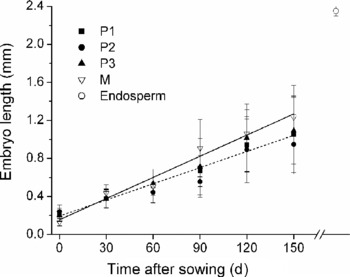
Embryos of A. nemorosa, undeveloped at the time of dispersal, started to grow more or less immediately, and grew continuously under simulated summer conditions in the laboratory. After 150 d at 20°C, embryos had grown linearly from about 0.2 to 1.0 mm in all the populations, occupying nearly 43% of the whole seed length (2.35 mm; Fig. 1). Differences between the lowland populations were not significant (P = 0.474), but the rate of embryo growth of these lowland populations was significantly slower than that of the mountain population (P < 0.05; Fig. 1).
Linear regressions of embryo growth for seeds of A. nemorosa from one mountain (M; continuous line) and three lowland (P1, P2, P3; broken line) populations in the laboratory at 20°C. Data shown are the mean ± SE of 20 seeds. A single line of regression could be used to describe the embryo growth of seeds from the three lowland populations without a significant increase of residual deviance (P>0.05). Also shown is the length of the mucilaginous endosperm (open circle), within which the embryo develops.

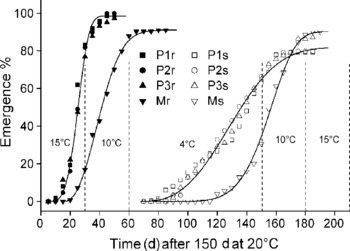
Germination did not occur under continuous summer conditions (20°C). However, following 150 d at 20°C, radicles emerged rapidly in the lowland populations after seeds were transferred to the early autumn conditions (15°C; Fig. 2). By the time lowland seeds were transferred to the late simulated autumn conditions (10°C), 30 d later, 80% of them had germinated. The germination dynamics of the three lowland populations were not significantly different (F 6.17 = 0.752; P>0.05), but the germination progress curve was significantly different from that recorded for the mountain population (F 3.16 = 23.438; P < 0.001). In the mountain population, radicle emergence was delayed, with only about 20% of the seeds germinating at 15°C, while the majority of radicles emerged after transfer to 10°C (Fig. 2).
Germination progress curves for seeds of A. nemorosa held at simulated seasonal temperatures. Radicle (closed symbols) and shoot (open symbols) emergence at simulated autumn and winter conditions follow 150 d at 20°C (simulated summer) in one mountain (M) and three lowland (P1, P2, P3) populations. Curves were fitted using the Weibull function. The data for radicle and shoot emergence for seeds of the three lowland populations could be constrained into single lines without a significant increase of residual deviance (P>0.05).

For seeds from all populations, shoot emergence did not begin until seeds were transferred to simulated winter conditions (4°C). Again, there was no significant difference between seeds from the three lowland populations, and shoot emergence began approximately 40 d earlier than for seeds from the mountain population (F 3.29 = 6.611; P < 0.01). However, although shoot emergence in the mountain population did not begin until near the end of the winter phase, the progress of shoot emergence was faster and more complete compared with the lowland populations.
Effects of summer conditions on root emergence
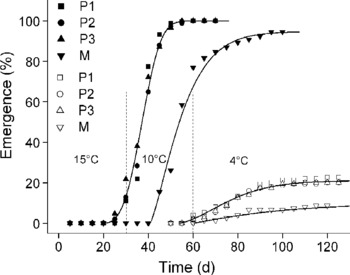
In the absence of summer conditions (20°C), only low amounts of germination were recorded in both lowland and mountain populations when seeds were incubated under winter conditions (4°C), following sequential exposure at 15°C and 10°C. Radicle emergence did not exceed 20% or 10% in the lowland or mountain populations, respectively, even after 130 d of incubation (Fig. 3). In contrast, after 30 d of warm stratification at 20°C, there was 100% or 94% germination for the lowland and mountain populations, respectively, when seeds were transferred to autumn conditions (Fig. 3). However, germination of the mountain population was significantly delayed compared with that of the lowland populations (F 3.13 = 108.94; P < 0.001). In the lowland populations, germination began 25 d after seeds were transferred to 15°C, with c. 15% of the seeds having germinated by the time they were transferred to 10°C. Germination in the mountain population began 15 d after seeds were moved to late autumn conditions (10°C).
Germination progress curves for seeds of the one mountain (M) and three lowland (P1, P2, P3) populations of A. nemorosa held at simulated autumn and winter seasonal temperatures after 0 d (open symbols) and 30 d of summer pre-treatment at 20°C (closed symbols). Curves were fitted using the Weibull function. The data for radicle emergence for seeds of the three lowland populations could be constrained to single lines without a significant increase of residual deviance (P>0.05).

With progressively longer summer conditions, up to 150 d, germination of seeds from the lowland populations increased during the warmest autumn condition of 15°C from about 15% to 80%. However, germination in the mountain population was increasingly delayed, with most seeds germinating at 10°C (>80%), even after 150 d of summer conditions. Differences between collection sites in the lowland were again not significant (data not shown).
Effects of autumn conditions on root emergence
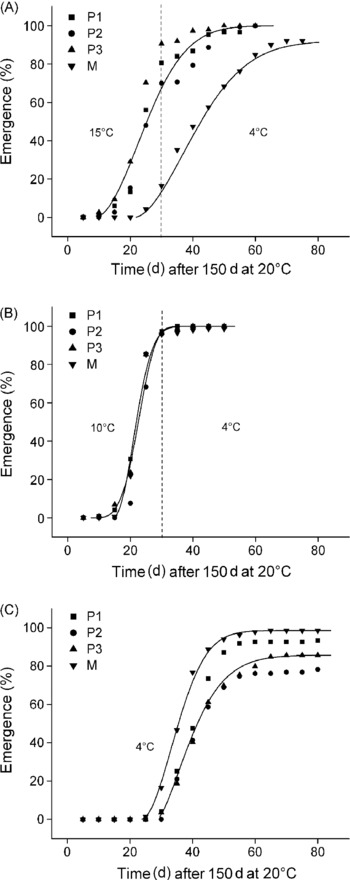
Radicle emergence in seeds of the mountain population was significantly delayed compared with the lowland populations (F 3.15 = 14.819; P < 0.01) (Figs 2 and 4A) when seeds were placed at early autumn conditions (15°C) following summer conditions (150 d at 20°C). In the lowland populations, c. 70% of seeds had germinated by the time they were transferred to 4°C, whereas in the mountain population < 20% of the seeds had germinated before the end of the 15°C phase, and the majority of them germinated after transfer to 4°C.
Germination progress curves for one mountain (M) and three lowland (P1, P2, P3) populations of A. nemorosa given 150 d of summer pre-treatment at 20°C, and then incubated in (A) early autumn (15°C) and winter (4°C) conditions; (B) late autumn (10°C) and winter (4°C) temperatures; or (C) winter (4°C). Curves were fitted using the Weibull function. The data for radicle emergence for seeds of the three lowland populations could be constrained to single lines without a significant increase of residual deviance (P>0.05).

By contrast, there was no difference between seeds from lowland or mountain populations in the progress of radicle emergence (F 3.7 = 1.911; P>0.05) when placed at late autumn (10°C) conditions (Fig. 4B), and germination was notably faster, with 100% of seeds germinating prior to transfer to 4°C. High germination (>80%) also occurred when seeds were placed directly at winter (4°C) conditions (Fig. 4C), but it was slower. However, in this case radicle emergence in the mountain population was advanced and more complete (F 3.13 = 25.118; P < 0.01) compared with the lowland populations.
The importance of winter for shoot emergence
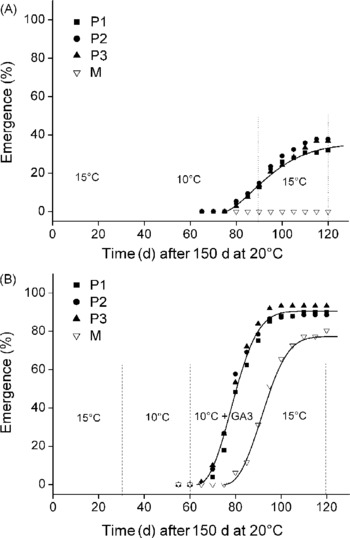
In the absence of winter conditions, shoot emergence did not exceed 37% in the lowland populations, and no shoot emergence occurred in the mountain population (Fig. 5A). Short winter periods of 30 or 60 d at 4°C were sufficient to elicit high levels of shoot emergence (60 and 80%, respectively) in seeds from all populations (data not shown). However, whereas seeds of the lowland populations showed significant levels of emergence at 4°C (45% after 60 d at 4°C), shoot emergence of seeds in the mountain population was largely delayed until seeds were transferred to early spring conditions. After 90 d of winter conditions (4°C), shoot emergence did not increase further in any of the populations.
Shoot emergence progress curves for seeds of one mountain population (M, open symbols) and three lowland populations (P1, P2, P3, closed symbols) of A. nemorosa held at simulated seasonal temperatures (A) in the absence of winter conditions, and (B) under the same conditions, but with applied GA3, during a phase representing early spring. Curves were fitted using the Weibull function. The data for shoot emergence for seeds of the three lowland populations could be constrained to single lines without a significant increase of residual deviance (P>0.05).

Application of GA3 substituted for cold stratification (Fig. 5B), with c. 80% of shoots emerging in the lowland population by the end of the simulated early spring conditions (10°C). Again, there was no significant difference between the three lowland populations, and shoots began to emerge c. 10 d earlier than they did in the mountain population. Differences between mountain and lowland populations were significant (F 3.12 = 393.985; P < 0.01), with 80% of shoots of the mountain seeds emerged by the end of the simulated late spring conditions (15°C).
Controls
Germination tests at continuous 4°C and 20°C failed completely. After 60 d at 15°C, seeds of the lowland populations began to germinate, with 100% radicle emergence recorded after a further 30 d or so; in the mountain population, germination began 30 d later, but only 50% of seeds had germinated by the end of the experiment (365 d). At continuous 10°C, there was only c. 20% germination of seeds from the lowland populations, whereas c. 60% germination was recorded in the mountain population after 1 year of incubation. Shoot emergence did not occur at continuous 10°C or 15°C.
Phenology of embryo growth and of radicle and shoot emergence in the wild
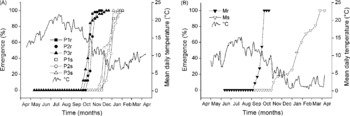
In agreement with the germination phenology observed in the laboratory, embryos in seeds of A. nemorosa buried in the wild grew continuously during the summer season (May–September), both in the lowland and the mountain populations (data not shown). Radicle emergence was first recorded at the beginning of autumn, when soil temperatures had dropped to c. 15°C in the lowlands and c. 10°C at the mountain site. Shoot emergence was delayed under natural conditions until late autumn/early winter, when soil temperatures had dropped to c. 10°C in the lowlands and c. 5°C at the mountain site (Fig. 6A and B).
Radicle (closed symbols) and shoot (open symbol) emergence in (A) three lowland populations and (B) one mountain population of A. nemorosa in the wild. Also shown are the mean daily soil temperatures calculated from measurements made at hourly intervals at the study sites.

The faster embryo growth of the mountain seed lot under simulated summer conditions in the laboratory was mirrored in the field experiment, which showed that although the summer season was shorter and cooler at the mountain site, seeds germinated approximately 1 month earlier, at the beginning of September, than the lowland populations.
Discussion
In agreement with the findings of Ali et al. (Reference Ali, Probert, Hay, Davies and Stuppy2007), we have shown that embryos of A. nemorosa are undifferentiated at the time of natural dispersal. Under natural conditions or simulated conditions in the laboratory, embryos quickly differentiate and begin to grow immediately after dispersal. Under natural conditions, embryos continue to grow throughout the summer, and radicle emergence occurs when temperatures fall in the autumn, irrespective of whether populations originate from lowland or mountain sites.
The dichotomous key for classifying seed dormancy (Baskin and Baskin, Reference Baskin, Baskin, Smith, Dickie, Linington, Pritchard and Probert2003) indicates that seeds with undifferentiated or underdeveloped embryos that fail to germinate within about 30 d should be classified as having morphological or morphophysiological dormancy. To be morphologically dormant: ‘embryos in freshly matured seeds [must] begin to grow within a period of a few days to 1–2 weeks, and seeds germinate within about 30 days’ (Baskin and Baskin, Reference Baskin, Baskin, Smith, Dickie, Linington, Pritchard and Probert2003). While seeds of A. nemorosa meet the first criterion, the fact that germination is delayed for at least 2 months rules out this classification. On the other hand, to be morphophysiologically dormant: ‘embryos in freshly matured seeds do not begin to grow within a period of even a few weeks, and seeds do not germinate within 30 d’ (Baskin and Baskin, Reference Baskin, Baskin, Smith, Dickie, Linington, Pritchard and Probert2003). In this case, A. nemorosa fails to meet the first criterion (because embryos start to grow more or less immediately after dispersal), but meets the second.
A requirement for warm or cold stratification is one of the important indicators for physiological dormancy (Baskin and Baskin, Reference Baskin, Baskin, Smith, Dickie, Linington, Pritchard and Probert2003). While laboratory tests showed that maximum germination occurred at autumn temperatures following a prolonged pre-treatment at summer temperatures, thus suggesting that warm stratification may be a prerequisite for germination, constant temperature controls at 15°C (lowland) and 10°C (mountain) also showed that germination was possible when freshly harvested seeds were incubated under continuous autumn conditions. This evidence, combined with the fact that embryos of A. nemorosa develop and begin to grow without a period of developmental arrest, leads us to agree with the proposal of Ali et al. (Reference Ali, Probert, Hay, Davies and Stuppy2007) that radicles of A. nemorosa should be regarded as non-dormant. However, the clear evidence that epicotyls are not capable of growth during the summer or autumn, and require a period of cold stratification at winter temperatures to initiate growth, confirms that [sensu Baskin and Baskin (Reference Baskin and Baskin1998)] seeds of A. nemorosa should be described as having ‘epicotyl morphophysiogical dormancy’. Moreover, since GA3 substituted for winter temperature (Fig. 5), the type of physiological dormancy residing in the epicotyl is best described as non-deep.
Epicotyl dormancy has been documented in five species of Ranunculaceae (Baskin and Baskin, Reference Baskin and Baskin1998): Actaea spicata L. (Eriksson, Reference Eriksson1994), Actaea pachypoda Elliot [Baskin and Baskin, Reference Baskin and Baskin1998 (unpublished result)], Cimicifuga racemosa (L.) Nutt. (Baskin and Baskin, Reference Baskin and Baskin1985), Cimicifuga rubifolia Kearney (Cook, Reference Cook1993) and Hepatica acutiloba DC (Baskin and Baskin, Reference Baskin and Baskin1985). This is the first report of epicotyl dormancy for the genus Anemone.
Differences in the pattern and timing of radicle and shoot emergence in lowland and mountain populations of A. nemorosa under natural conditions were reflected in laboratory experiments using simulated seasonal temperatures (Figs 2 and 6). Under natural conditions, radicle emergence in the mountain population occurred 1 month earlier and at lower temperatures compared with the lowland populations. Laboratory simulations confirmed that seeds from the mountain population were well adapted for embryo development, radicle emergence and shoot emergence at lower temperatures, compared with the lowland populations.
Temperature is the overriding control in mediating differences in germination rates between mountain and lowland populations. As is well demonstrated in Fig. 4, once embryo growth is complete, the relative germination rate of mountain versus lowland populations is directly controlled by temperature, with the mountain seed lot germinating faster after transfer to a lower temperature (4°C). Temperature data recorded at the two sites revealed that the summer was c. 2 months shorter and c. 6°C cooler at the mountain site compared with the lowlands. Despite this, radicle emergence was almost a month earlier (Fig. 6) at the mountain site, and laboratory tests confirmed that seeds from this mountain population were capable of significantly faster embryo development under identical conditions (Fig. 1).
The clear preference for germination at cooler temperatures in the mountain population contrasts with previous reports of other species, indicating that populations adapted to cold environments tend to germinate at higher temperatures (e.g. Kibe and Masuzawa, Reference Kibe and Masuzawa1994; Cavieres and Arroyo, Reference Cavieres and Arroyo2000). However, in these and other studies, the general conclusion was that a germination preference for warmer temperatures ensures that germination is delayed until the threat of frost is passed. Woodland geophytes, such as A. nemorosa, have a very short growing season, and therefore any delay in germination would jeopardize the completion of life-cycle events before canopy closure. The subtle differences in germination response reported here reveal that the timing of germination at the lowland and mountain sites is finely tuned to the local climate. In both cases, radicle emergence is programmed to occur in autumn. This strategy presumably ensures that seedlings are well placed to grow quickly when temperatures begin to rise in early spring. However, the mountain population is adapted to the shorter growing seasons at high altitude, with radicle emergence occurring nearly a month earlier than it did in the lowland populations. Epicotyl dormancy in A. nemorosa probably ensures that shoots emerging from seeds during late winter remain below the leaf litter or snow cover, where they will be insulated from damaging frosts. Again, there appears to be a clear adaptive difference between the lowland and mountain populations. Epicotyl dormancy was more pronounced in the mountain population (Figs 2 and 5), which required a longer period of cold stratification before shoots were able to grow. This observation is consistent with previous reports that populations of species from high-altitude sites tend to require longer periods of stratification to overcome dormancy (Borghetti et al., Reference Borghetti, Vendramin, Giannini and Schettino1989; Cavieres and Arroyo, Reference Cavieres and Arroyo2000).
Our results on A. nemorosa agree with a number of previous studies (Baskin and Baskin, Reference Baskin and Baskin1973; Dorne, Reference Dorne1981; Fenner, Reference Fenner1991; Meyer, Reference Meyer1992; Meyer and Kitchen, Reference Meyer and Kitchen1994; Meyer et al., Reference Meyer, Kitchen and Carlson1995, Reference Meyer, Allen and Beckstead1997) that intraspecific variation in seed germination behaviour in A. nemorosa reflects adaptation to local climate. However, the extent to which the observed differences in behaviour reflect genetic differences between the lowland and mountain populations of A. nemorosa cannot be known in the absence of reciprocal transplant experiments and genetic analysis. Thus, any discussion of the possible effects of climate change on the survival of these populations is purely speculative. That said, the marked differences in temperature dependence for shoot emergence are worthy of comment. In the lowland populations, 50% shoot emergence occurred under natural conditions when temperatures were between 7 and 10°C (Fig. 6A). By contrast, 50% of shoot emergence in the mountain population was not recorded until the temperature had dropped to below 5°C, and in this case, seeds were dependent on a period of cold stratification before shoot emergence was possible. Thus, while shoot emergence occurred in the lowland populations before winter, the mountain population appeared to be adapted so that shoot emergence is delayed until late winter/early spring. Fenner and Thompson (Reference Fenner and Thompson2005) suggested that one possible effect of climate change is that seeds might experience winter temperatures too high to break dormancy. In support of this, our data suggest that seedling establishment in populations of A. nemorosa could be compromised if average winter temperatures rose above 5°C in the mountains of northern Italy.
The effects of other factors associated with climate warming, such as soil moisture availability and competition from other species, are just as likely to be important and are hard to predict. Reductions in rainfall and, consequently, soil moisture content are predicted in several mid-latitude areas of Europe (IPCC, 2007) where A. nemorosa is currently found. Hotter and dryer summer seasons could mean that seed moisture content will drop during the summer period to a level where embryo development cannot proceed, and this would undoubtedly delay or prevent radicle emergence in the autumn. While asexual reproduction via rhizomes is clearly important in A. nemorosa, Holderegger et al. (Reference Holderegger, Stehlik and Schneller1998) showed that recruitment from sexual reproduction is also important in the maintenance of populations. Our data have revealed the sensitivity of A. nemorosa seed populations to seasonal temperatures and subtle differences between populations that are clearly linked to habitat-related climate differences. Given the predicted changes in season temperature due to climate warming, there is an urgent need for further research on the likely impact of such changes on the reproductive success of plant species in regions, such as alpine habitats, that are particularly vulnerable (Pauli et al., Reference Pauli, Gottfried, Reiter, Klettner and Grabherr2006).
Ali et al. (Reference Ali, Probert, Hay, Davies and Stuppy2007) reported that the long term, ex situ conservation of seeds of A. nemorosa will be problematic using standard seed-bank conditions, because mature seeds are barely desiccation tolerant and extremely short lived. Consequently, the maintenance of a suitable woodland habitat and long-term monitoring of the possible effects of climate change on reproductive success will be essential if populations of A. nemorosa are to be maintained at the current levels.
Acknowledgements
We thank Mathew Daws for his constructive comments. Financial support was provided by the University of Pavia and the Centro Flora Autoctona della Regione Lombardia.