Introduction
Antenatal depression and anxiety, the prenatal environment and child development
The prenatal environment, including maternal mental health, is increasingly recognized as having an important influence on fetal development and later offspring outcomes.Reference Glover 1 – Reference Stein, Pearson and Goodman 3 Maternal mental health can lead to adverse child outcomes through altered placental function, epigenetic changes in the fetus and stress reactivity. Depression and anxiety are the most common mental health disorders in pregnancyReference Bennett, Einarson, Taddio, Koren and Einarson 4 , Reference Howard, Molyneaux and Dennis 5 and while they may present independently, they are often co-morbid.Reference Biaggi, Conroy, Pawlby and Pariante 6 Research has historically focussed on postnatal depression, while more recent studies are finding prevalence rates of antenatal depression to be similar, if not higher, than postnatal depression.Reference Bennett, Einarson, Taddio, Koren and Einarson 4 A growing body of literature finds antenatal depression and anxiety associated with poor uptake of antenatal care, increased maternal tobacco and alcohol use, as well as adverse fetal, birth and child outcomes.Reference Stein, Pearson and Goodman 3 , Reference Grigoriadis, VonderPorten and Mamisashvili 7 – Reference Ding, Wu and Xu 9 Antenatal depression and anxiety symptoms can also increase risk of postnatal depression,Reference Milgrom, Gemmill and Bilszta 10 which in turn is associated with poor maternal and child outcomes.Reference Bennett, Einarson, Taddio, Koren and Einarson 4 As a result, antenatal depression and anxiety are an important public health research priority in both high-income countries (HIC) and in low- and middle-income countries (LMIC).
In the African region poverty, structural violence and threat of disease is already highReference Black, Walker and Fernald 11 and the additional burden of antenatal depression and anxiety may worsen outcomes.Reference Gelaye, Rondon, Araya and Williams 12 Effective and timely interventions have the potential to mitigate these effects on mother and fetus with significant benefits for children, families and society.Reference Hancock, Mitrou, Shipley, Lawrence and Zubrick 13 , Reference Bauer, Parsonage, Knapp, Iemmi and Adelaja 14
Prevalence of antenatal depression and anxiety in HIC v. LMIC
In HIC depression and anxiety affect between 7 and 20% of pregnant mothers.Reference Bennett, Einarson, Taddio, Koren and Einarson 4 , Reference Howard, Molyneaux and Dennis 5 As reported in two recent systematic reviews,Reference Gelaye, Rondon, Araya and Williams 12 , Reference Fisher, Cabral de Mello and Patel 15 each using slightly different selection criteria, studies in LMIC have consistently reported higher rates of both depression and anxiety in pregnancy. The Bennett et al. review grouped antenatal depression and anxiety as perinatal mental disorders reporting a prevalence of 15.6%,Reference Fisher, Cabral de Mello and Patel 15 whereas the Howard et al. review reported a prevalence for antenatal depression specifically as 25.3%.Reference Gelaye, Rondon, Araya and Williams 12 Reported risks factors in LMIC include domestic violence, negative life events, low socio-economic status (SES), absence of social support, unplanned pregnancy, prior history of mental illness, anxiety during pregnancy and being younger in age.Reference Gelaye, Rondon, Araya and Williams 12 , Reference Sawyer, Ayers and Smith 16 It has also been shown that low support and marital/family conflict are associated with both antenatal depression and antenatal anxiety, whereas evidence for factors such as socio-demographic (age, education) and obstetric variables are less conclusive.Reference Gelaye, Rondon, Araya and Williams 12 , Reference Sawyer, Ayers and Smith 16
Antenatal depression and antenatal anxiety on the African continent
The majority of research in LMIC has emanated from Asia and South America, with less than a quarter of all LMIC perinatal mental health studies being undertaken on the African continent. A systematic review of perinatal mood disorders in the African region in 2010 found only 35 antenatal and postnatal studies across eight of the 54 African countries. Only a handful of these (n=11) focussed on the antenatal period, at least half of which had been undertaken between 1972 and 1998.Reference Sawyer, Ayers and Smith 16 The review found a mean prevalence of 11.3% for antenatal depression and 18.3% for postnatal depression. Similar mean prevalence was reported for antenatal (14.8%) and postnatal anxiety (14%) based on two available studies, both from Nigeria.
In South Africa there have been several studies measuring antenatal depression in recent years which are not featured in these reviews. Almost all have focussed on the third trimester of pregnancy, some have focussed on antenatal depression in special populations (e.g. HIV-infected women), but none have examined antenatal anxiety. The prevalence of antenatal depression in these studies is between 21 and 41%.Reference Brittain, Myer and Koen 17 – Reference van Heyningen, Myer and Onah 21 There are no studies which have looked specifically at the first trimester of pregnancy, at least in the last 5 years. It is important to look at current estimates because of evidence that rates of depression are rising.Reference McManus, Bebbington, Jenkins and Brugha 22
There is a dearth of data from Africa and an urgent need for studies which document both depression and anxiety in pregnancy, measuring these from earliest stages of pregnancy could enhance intervention and prevention efforts. The aim of this research is to investigate the prevalence of, and factors associated with, first trimester depression and anxiety in an under-researched population of African women in an urban setting in South Africa.
Methods
Recruitment
The analysis reports on baseline data collected from the Soweto First 1000 Days Cohort (S1000), a prospective pregnancy cohort of women residing in Soweto, South Africa. Soweto is the most populous urban residential area in South Africa, established under Apartheid and is predominantly Black African. The S1000 cohort is a prospective sample recruited from the Fetal Medicine Unit at Chris Hani Baragwanath Academic Hospital (CHBAH). CHBAH is a tertiary care centre, the largest hospital in Africa, with ~24,000 deliveries annually. A consecutive series of pregnant women attending CHBAH antenatal clinic (June 2014 to July 2016) were screened to establish potential eligibility for S1000. To be included in the cohort, women were required to be: Black, residents of Soweto, ⩾18 years of age, ⩽14 weeks pregnant and carrying a singleton pregnancy. Exclusion criteria included fetal abnormalities, major maternal physical disabilities or maternal conditions such as Type 1 diabetes and epilepsy.
Data collection
Enrolled pregnant women were assessed at the Developmental Pathways for Health Research Unit (DPHRU), within walking distance of the antenatal clinic. Trained research assistants with several years experience in data collection, including working with cohort participants, collected data. All mothers were assessed in a separate private room in English or their home language when required, and the depression and anxiety measures were completed using an interviewer method. Responses were recorded on paper forms and entered into an electronic data set by data entry staff.
Measurements
The four measures used in this analysis include two commonly used psychological scales, one for depression and one for anxiety. The depression scale, the Edinburgh Postnatal Depression Scale (EPDS) has been used previously in South African and African perinatal populations, and has been found to be a reliable measure with good sensitivity and specificity in local populations.Reference Rochat, Tomlinson, Newell and Stein 23 – Reference Chibanda, Mangezi and Tshimanga 26 It is a brief 10-item psychometric scale, which was developed to be used by primary health care professionals to screen for depression in the postnatal period but has been shown to be accurate in detecting both antenatal and postnatal depression in LMIC, including South Africa.Reference Tsai, Scott and Hung 24 The measure is scored on a severity scale (0–3) which is totalled for a maximum score of 30. The internationally recognized threshold score for probable depression of ⩾13 was used in this analysis.Reference Rochat, Tomlinson, Newell and Stein 23 , Reference Shrestha, Pradhan, Tran, Gualano and Fisher 25 The EPDS showed good internal reliability in this analysis (Cronbach’s α 0.80). The anxiety measure was a six-item version of the state subscale of the State-Trait Anxiety Inventory (STAI), which has been constructed and validated for use in pregnant populations, and has shown high reliability (Cronbach’s α 0.82) with the original scale.Reference Marteau and Bekker 27 The measure assesses the presence of state anxiety symptoms using a Likert scale (1–4), and a summed scored is calculated. For this analysis, Cronbach’s α was 0.64. These two scales were supplemented by two study-specific questionnaires to measure social support and recent (previous 6 months) social stressors experienced by mothers (including relationship, family, economic and societal stressors), which were developed in previous cohort work at DPHRU and are considered reliable measures of social support and stress.Reference Ramchandani, Richter, Norris and Stein 28
Social support was measured using a series of nine questions to identify the absence or presence of instrumental and emotional support, including: people available to help, a confidante, being able to speak to her partner, belonging to a community organization/ church and having a friend with a baby. Items were used individually in the analysis. Social stress was measured using a series of 16 questions based on common stressors, and a yes/no response indicated either the presence or absence of a stressor in the 6 months before the interview (prenatal and antenatal). In previous work, it was found that 10 particular stressors had a direct impact on mothers.Reference Ramchandani, Richter, Norris and Stein 28 , Reference Ramchandani, Richter, Stein and Norris 29 These stressors were grouped into four categories as follows: relationship stress (partner violence or relationship break-up); family stress (having a fight with/being alienated from family, having a family member with a substance abuse problem, having a disabled family member); economic stress (being in debt, having too little money for basics, having to support family members in financial need); and societal stress (being in danger of being killed, witnessing a violent crime). Cronbach α for this analysis was 0.54.
A wide range of socio-demographic, socio-economic and medical data were collected on the S1000 cohort. Findings from systematic reviews on factors associated with depression or anxiety in pregnancy informed a theoretical model which guided the selection of socio-demographic, socio-economic and health-related variables to be tested in this analysis.Reference Howard, Molyneaux and Dennis 5 , Reference Ding, Wu and Xu 9 , Reference Gelaye, Rondon, Araya and Williams 12 , Reference Fisher, Cabral de Mello and Patel 15 , Reference Sawyer, Ayers and Smith 16
These included:
Socio-demographic status
Maternal age, level of education, household composition and marital status.
Socio-economic status
SES was assessed by an asset index derived from Demographic and Health Surveys.Reference Booysen, Van Der Berg, Burger, Von Maltitz and Du Rand 30 The asset score was made up of items owned by the household (electricity, radio, television, refrigerator, cell phone, personal computer, farm animals, agricultural land, bicycle, motorcycle/scooter and vehicle). The total score is used as a continuous variable in the analyses, higher scores represent higher SES.
Health
Over and above the detailed measurement of depression, anxiety, social stressors and supports, data on maternal health also included parity, reproductive intent (planned or unplanned), smoking and alcohol use in pregnancy, history of mental illness and HIV (self-report and treatment confirmation from clinic card).
Data cleaning and imputation
In line with guidance for the imputation of psychometric data, individual missing items on the depression and anxiety scales were imputed using the individual participant’s available item series mean, derived from non-missing items for that individual on the scale. A total of 20 (2%) individual scale items were imputed (13 items on depression scale; seven items on anxiety scale) across all participants. If a participant was missing >20% of the individual items on either the depression (n=9) or the anxiety scale (n=1), data were not imputed; instead the entire scale was treated as missing for that participant. No imputation was undertaken for non-scale questionnaire data.
Ethics
The Human Ethics Research Committee of the University of the Witwatersrand approved the study (M120524) and all participants provided written consent.
Data analysis
Statistical analyses were conducted using STATA version 13. 31 Descriptive analysis was used to examine sample characteristics; sensitivity analysis used t-tests and Wilcoxon rank-sum tests. Depression ‘cases’ were determined as present (1) or absent (0) using the internationally recommended cut-off ⩾13 on the EPDS.Reference Rochat, Tomlinson, Bärnighausen, Newell and Stein 19 , Reference Rochat, Tomlinson, Newell and Stein 23 Anxiety ‘cases’ were determined as present (1) or absent (0) using a cut-off of ⩾12/24. This cut-off score was calculated using the same cut-off ratio as the original STAI, >40/80.Reference Meades and Ayers 32 Using these dichotomous variables for cases of depression and anxiety, univariate analysis was performed to examine associations between depression and anxiety and the women’s socio-demographic, socio-economic, pregnancy and health characteristics, social support and stress variables. Thereafter, we tested multivariable models using depression (model 1) and anxiety (model 2) as outcomes controlling for all variables in order to account for residual confounding.
Results
Sample characteristics
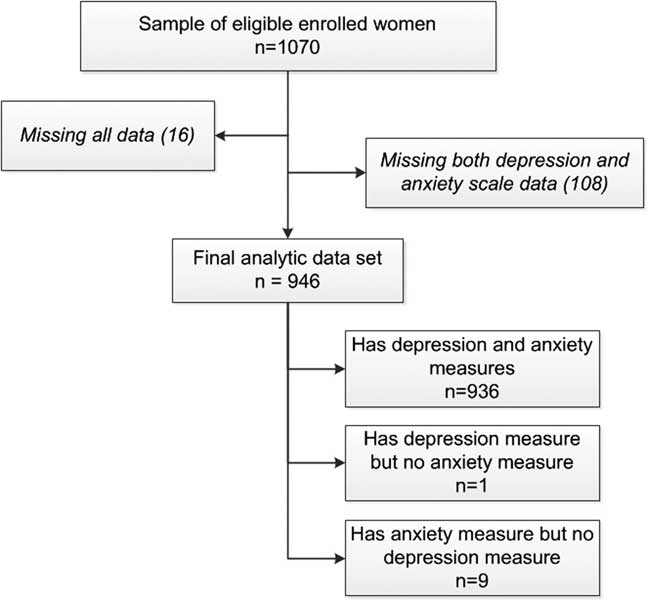
As illustrated in the consort diagram (Fig. 1) 1070 women were enrolled in the S1000 cohort, of whom 946 women had completed some or all of the mental health and social support questionnaires, whereas 124 (12%) had missing data (16 missing all data; 108 missing both mental health measures). Statistical analysis found no evidence for significant differences when comparing those with and without missing mental health data with regards to maternal age, education, SES, marital status, parity and reproductive intention. The final analytic sample (n=946) includes women who had either one or both mental health measures, all of whom were included in univariate associations. This provides the best estimate with all available data for each individual association. However, a complete case sample across all covariates of 800 for depression data and 802 for anxiety data was used in multivariate models. In addition, we ran univariate analysis on this complete case sample to ensure that differences between the univariate and the multivariate associations were not due to the reduced numbers (i.e. reducing from 946 to 800 or 802).
Consort diagram of participating women included in the analytic data set.

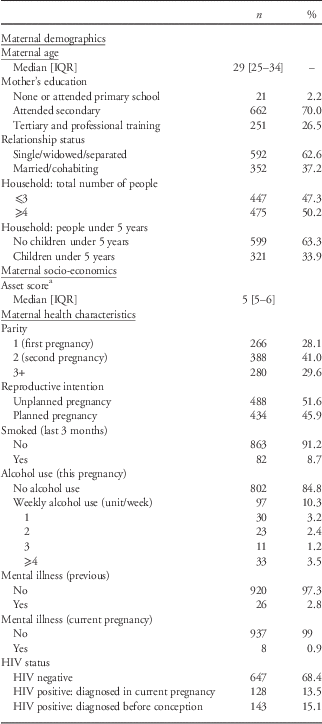
Baseline socio-demographic and health characteristics are presented in Table 1. The age of women in the study ranged from 18 to 44 years (mean=29.7). Most women (63%) were single or separated from their partners, 28% were primiparous and over half (52%) of the pregnancies were planned; 9% of women had smoked in the past 3 months and 10% of women had drunk alcohol since finding out they were pregnant, with 3.5% drinking more than 4 units of alcohol per week. A small percentage of women (3%) had previously been diagnosed with a mental illness. The prevalence of HIV in the sample was 29% (n=271), with 48% (n=128) of these women being diagnosed HIV positive in the current pregnancy, and 52% (n=143) diagnosed before current pregnancy.
Sample characteristics of mothers (n=946)

IQR, interquartile range.
a Asset score ranges from 0 to 11 and is calculated by adding the items in the household including, electricity, radio, television, refrigerator, cell phone, personal computer, farm animals, agricultural land, bicycle, motorcycle/scooter and vehicle.
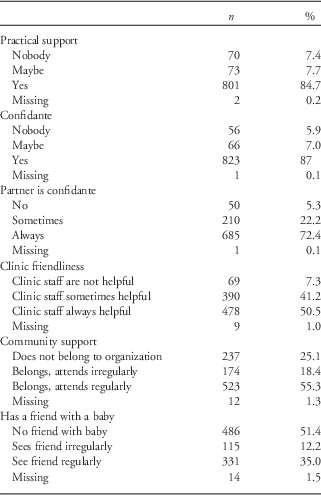
In terms of social support (Table 2), most women had a confidante and someone to help with a problem, and the majority could also talk to their partners. In terms of support outside of the home, three quarters of women belonged to an organization such as a church, and half had a friend with a baby. Nearly all women (92%) reported that the staff at the antenatal clinic they attend were helpful either some or all of the time.
Social support questionnaire

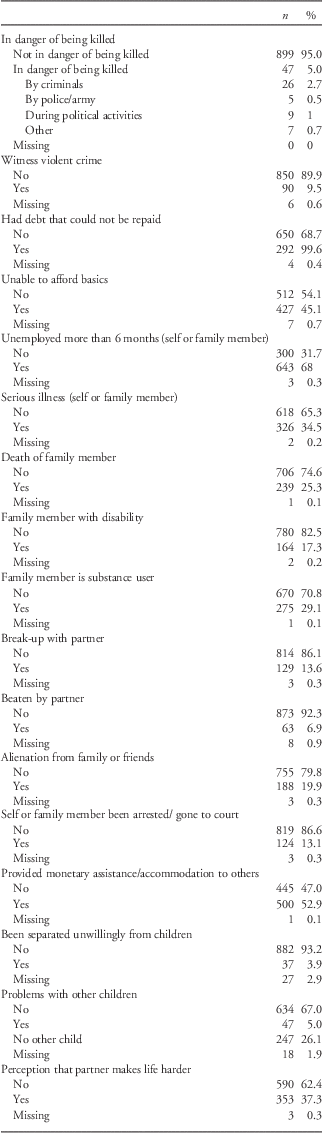
Examining the stressors reported by women (Table 3) we see that in the 6 months before the first assessment, economic stress was highest, with 75% of women reporting either being in debt, not having enough money for basics or having to support family members in financial need. This was followed by family stress, with about half of all women (48%) reporting fighting with or being alienated from family, having a family member with a substance abuse problem or having a disabled family member. With regards to partnerships, 18% of women had recently experienced intimate partner violence (IPV) or had broken up with their partner. A further 37% of women said that they felt their partner made their life harder – 80% of these women had recently experienced IPV, and 69% of them had recent breakups. Societal stress, in particular exposure to violence, was the least common stressor reported by women in the cohort, with 12% of women reporting having witnessed a violent crime or being in danger of being killed.
Antenatal stress questionnaire

Prevalence of antenatal depression and anxiety
Depression
In total, 253 out of 937 or 27.0% [95% confidence interval (CI) 24.2–29.8] of women scored above the threshold for probable depression using the cut-off of ⩾13 on the EPDS.
Anxiety
In total, 144 out of 945 or 15.2% (95% CI 12.9–17.5) of women scored above the threshold for probable anxiety using the cut-off of ⩾12 on the six-item short form of the STAI.
Co-morbid depression and anxiety
In total, 321 out of 936 (34.3%) of women scored above the threshold for either depression or anxiety. When accounting for comorbidity we note that:
-
∙ Of 936 women with both depression and anxiety measures, 68 (7.3%) had co-morbid antenatal depression and anxiety.
-
∙ Out of the 253 women with antenatal depression, a quarter (68, 26.9%) also had anxiety
-
∙ Out of the 136 women with antenatal anxiety, half (68, 50.0%) also had antenatal depression.
Factors associated with antenatal depression
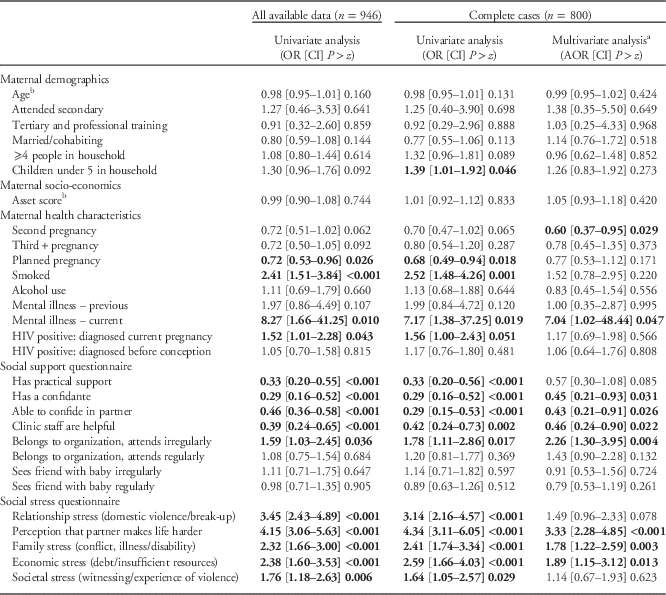
In the multivariate model (Table 4) no socio-demographic or socio-economic factors were associated with antenatal depression. Two health characteristics were significantly associated with increased odds of depression: As compared with primigravidas, mothers in their second pregnancy were 40% less likely to score above the threshold for depression; and women who had a current diagnosis of mental illness at baseline, had substantially increased odds of scoring above the threshold, although numbers were small (n=26 out of 946, 2.8%) and confidence intervals wide. HIV was not significantly associated with either depression or anxiety in the final adjusted model.
Model 1: depression univariate and multivariate logistic regression

OR, odds ratio; CI, confidence interval; AOR, adjusted odds ratio.
Bold values indicate statistical significance at P<0.05.
a All variables were put into the multivariate regression analysis in order to account for residual confounding, for readability only those variables which had a significant association are shown.
b Both age and the asset score were used as continuous variables in the analysis.
In terms of social support, reporting a supportive relationship with a partner and having a confidante (someone to talk to) significantly decreased the odds of depression, as did reporting a helpful relationship with antenatal care nurses. If women belonged to a community organization, which offered them support (such as a church) but visited irregularly, then they had increased odds of depression.
Moreover, in the multivariate analysis we see that amongst the stressors, difficulties in the partner relationship were strongly associated with women’s odds of probable depression. If a woman reported that her partner made her life harder, her odds of depression increased more than three-fold. Similarly, relationship stress (experiencing IPV and/or breaking up with her partner) increased the odds of depression, but this was attenuated when the perception that partners made their lives harder variable was included in the model. This is not surprising given that most women experiencing IPV reported that their partner made their life harder. Family stress and economic stress were also independently associated with increasing odds of depression.
The direction of relationships are similar to those evident in the literature although some commonly reported risk factors from the literature were significant in the univariate analysis only. For example, being tested HIV positive in the current pregnancy, having an unplanned pregnancy, a lack of practical support and smoking were significantly associated with increased odds of depression in univariate, but not multivariate analysis. This suggests that these factors are explained by other variables in the model.
Factors associated with antenatal anxiety
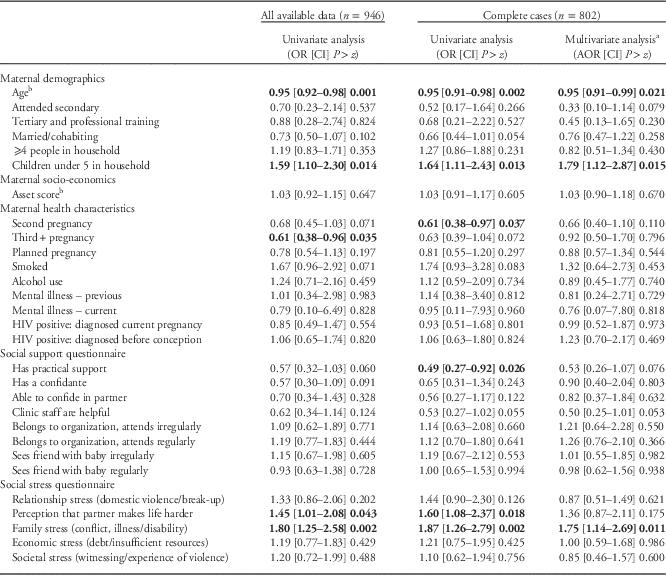
In the multivariate model (Table 5) having more children under the age of 5 years in the household significantly increased the odds of anxiety, as did family stress, whereas increasing age reduced odds of anxiety.
Model 2: anxiety univariate and multivariate logistic regression

OR, odds ratio; CI, confidence interval; AOR, adjusted odds ratio.
Bold values indicate statistical significance at P<0.05.
a All variables were put into the multivariate regression analysis in order to account for residual confounding, for readability only those variables which had a significant association are shown.
b Both age and the asset score were used as continuous variables in the analysis.
As with depression, the direction of effects for risk and protective factors were similar to the existing literature and factors such as increased number of pregnancies and having practical support reduced odds, whereas the perception that your partner was making your life harder increased odds but only in univariate and not multivariate analysis. HIV was not significantly associated with anxiety in univariate or multivariate analysis.
Discussion
The prevalence of antenatal depression and antenatal anxiety
We report a prevalence of 27% first trimester antenatal depression in a prospective pregnancy cohort of women residing in Soweto, South Africa. This is very similar to the prevalence (25%) reported in a meta-analysis of antenatal depression across all LMIC including mostly South American and Asian studies.Reference Gelaye, Rondon, Araya and Williams 12 However, it is almost three times higher than the previously reported antenatal prevalences from Africa (11%)Reference Sawyer, Ayers and Smith 16 and is instead similar to reported prevalence’s (23.4%) amongst high-risk groups of HIV-infected pregnant women in Africa.Reference Sowa, Cholera, Pence and Gaynes 33 In terms of antenatal anxiety we find a similar prevalence (15.2%) to that reported in a systematic review of African studies (14.8%).Reference Sawyer, Ayers and Smith 16
That depression and anxiety emerge early in the pregnancy is important given that they may continue throughout the pregnancy, into the postnatal period and beyond. Antenatal depression and anxiety are associated with poor uptake of antenatal services,Reference Grote, Bridge and Gavin 8 higher risks of premature birth, low birth weight, intrauterine growth restriction, child emotional and behavioural problems, cognitive difficulties and later depression.Reference Stein, Pearson and Goodman 3
The importance of the partner relationship
We find that a women’s relationship with her partner has the strongest influence on her risk of antenatal depression and anxiety. Over a third (37%) of women reported that they felt their partners made their lives harder, and this was associated with a four-fold greater risk for antenatal depression. A smaller group of women reported more explicit levels of relationship stress (13.6% relationship termination; 6.9% IPV), which substantially increased the risk of depression in univariate analysis, in line with previous research.Reference Mitchell, Wight, Van Heerden and Rochat 34 When additional covariates, and particularly women’s perception of whether their partners made their life harder, were included in the model the association with relationship stress was substantially reduced. This does not undermine the importance of relationship termination or IPV for mental health, rather it suggests that the impact of IPV could be largely explained by women who experience IPV feeling like their partners make their lives harder and other surrounding risks. Importantly, perceptions that partners made their life harder, was an independent risk factor in multivariate analysis, suggesting that this variable is important even outside of the context of IPV or relationship termination. Further research is needed to understand the meaning of perceiving that your partner makes life harder, and whether this reflects negatively biased perceptions that are a consequence of the depression itselfReference Rochat, Richter and Doll 35 or objectively reflect the actual lived experiences of many women in these contexts. It also highlights the importance of including measures which potentially capture the subjective experience and impact of relationship problems as concurrent covariates in studies of antenatal depression and IPV.Reference Howard, Oram, Galley, Trevillion and Feder 36
Conversely, having a supportive partner can act as a buffer against maternal mental health problems in pregnancyReference Bilszta, Tang and Meyer 37 and in this analysis we show that being able to confide in your partner halves the risk for antenatal depression. This suggests that the engagement of male partners in antenatal services is important.
We provide evidence that problems in the partner relationship might not need to be explicit in order for it to have a substantial effect on a woman’s mental health. A better understanding of these variables may inform the extent to which partner relationships may or may not be malleable to intervention and what intervention might be needed.
Social support and family impact
We illustrate that good social support provided by family and to some extent the broader social environment reduces the odds of both antenatal depression and anxiety. The literature on antenatal depression and anxiety suggests that social support is multifacetedReference Biaggi, Conroy, Pawlby and Pariante 6 and can include instrumental (practical) support, informational support and emotional support. In this study having someone to talk to was somewhat more important than having people to practically help you, suggesting that emotional support is as essential to coping with pregnancy as practical support, even in under-resourced communities. In this research we also show that family stress (family conflict, substance abuse or illness/disability in family) had the strongest association with antenatal anxiety, and was also associated with antenatal depression.
There is also evidence that families with a high burden of care for young children have increased odds of anxiety in pregnant women. Although we do not find this association in the existing literature, it may reflect the limited number of studies of antenatal anxiety, as we do see that in other LMIC research, having more children in the home has been associated with antenatal depression.Reference Rahman, Iqbal and Harrington 38 , Reference Coll, da Silveira and Bassani 39
SES and economic stressors
The LMIC literature available on associations between antenatal depression and antenatal anxiety, and income or financial hardships shows contradictory evidence.Reference Biaggi, Conroy, Pawlby and Pariante 6 , Reference Gelaye, Rondon, Araya and Williams 12 Although we find no significant association between SES (measured by asset ownership) and either antenatal depression or anxiety, similar to another South African study,Reference van Heyningen, Myer and Onah 21 we show that economic stress (being in debt or having insufficient resources) is associated with antenatal depression. It is possible that by including more detailed data on not only SES but also economic stressors, we are able to illustrate that regardless of SES, the presence of economic stressors (which is possible even if not poor but perhaps highly in debt) is associated with antenatal depression.
Role of HIV
In line with previous researchReference Rochat, Tomlinson, Bärnighausen, Newell and Stein 19 we report increased odds of depression in women with a recent HIV diagnosis in pregnancy, albeit it relatively small (1.5). However, this was attenuated once wider social and familial stress and support were adjusted for, suggesting the impact of HIV is explained by the association between HIV and these contextual factors.
Impact of the study
This research adds weight to calls to make screening, treatment and prevention of antenatal depression and antenatal anxiety a public health priority for Africa.Reference Gelaye, Rondon, Araya and Williams 12 As with the findings of other high-risk groups, our findings demonstrate the value of broader universal screening of mental health in pregnancy regardless of HIV status, SES or evidence of IPV. Although there is this evidence to support universal screening for antenatal mental health disorders,Reference Breedlove and Fryzelka 40 challenges to feasibility in LMIC include time pressure and strained resources.Reference Kagee, Tsai, Lund and Tomlinson 41 The effectiveness of screening is also undermined if treatment cannot be accessed, which means that intervention in LMIC should be cost-effective and easily integrated into current services. Interventions which are integrated in routine antenatal care, and those delivered by non-specialist health care workers have been shown to be effective in LMIC.Reference Chowdhary, Sikander and Atif 42 , Reference Chibanda, Weiss and Verhey 43
Strengths and limitations
Strengths of the study include being a large contemporary cohort of women. The study uses validated measures and collects a large number of variables, which enables disentangling independence of multiple well-known risk factors. The analysis is limited in that data is from one timepoint and is thus cross-sectional. This means that we are unable to determine causal relationships, or establish the direction of effect of associations. It is also possible that results may reflect adjustments to pregnancy rather than persistent symptomology, and further research should examine later trimesters to explore these issues. Despite being well validated, the EPDS and STAI remain screening tools and not diagnostic measures. Although this is an urban sample, certain demographics, including a high number of single women, and high HIV prevalence, make it similar to other rural samples in other parts of South Africa, Sub-Saharan Africa or Africa. This, however, also makes it less generalizable to HIC where pregnancies often occur within a stable relationship, and where HIV prevalence is low.
Conclusion
We illustrate for the first time in Sub-Saharan Africa that both depression and anxiety are prevalent in early pregnancy; risk for antenatal depression and antenatal anxiety is particularly high regardless of HIV status and importantly, that partnerships and family relationships are critical to ensuring women’s mental health in pregnancy. Health interventions which engage and elicit family and partner support are thus potentially important for women during pregnancy which may also have benefits for delivery and offspring outcomes.
Acknowledgements
The authors would like to thank the women who participated in this study. The authors would also like to acknowledge and thank the staff at the Developmental Pathways to Health Research Unit for their involvement in the collection and curation of data.
Financial Support
S1000 was funded by the UK MRC/DfID African Research Leader Scheme, the Medical Research Council of South Africa and the Gates Foundation. Additional support of the DST-NRF Centre of Excellence (CoE) in Human Development (OPP20160035 awarded to T.R.) towards manuscript development is acknowledged. Opinions expressed and conclusions arrived at are those of the authors and are not necessarily to be attributed to the funders. S.R. is supported by Centre for Excellence in Human Development (University of Witwatersrand, South Africa) Masters Scholarship (M20160059). T.R. receives salary support from the Human Sciences Research Council and is supported by the Newton Advanced Fellowship Scheme (AF160108).
Conflicts of Interest
None.
Ethical Standards
Ethical permissions were granted by the Human Research Ethics Committee (Medical) of the University of the Witwatersrand (M160670).