Tetralogy of Fallot is the most common form of cyanotic CHD affecting 7–10% of all infants born with CHD.Reference Bailliard and Anderson 1 The first reported surgical repair was in 1955,Reference Lillehei, Cohen and Warden 2 and with the current surgical technique the reported mortality is <2%.Reference Starr 3 Despite surgical advances including pulmonary valve sparing techniques, trans-atrial approach, and infant repair, the right ventricle continues to demonstrate significant functional compromise secondary to progressive right ventricular dilation from pulmonary insufficiency. These patients often undergo additional interventions, including pulmonary valve replacement.Reference Apitz, Webb and Redington 4 Cardiopulmonary exercise testing has been useful in identifying patients in need of pulmonary valve replacement and predicting prognosis in repaired tetralogy of Fallot patients.Reference Buys, Van De Bruaene, De Meester, Budts and Vanhees 5 , Reference Muller, Hager and Diller 6
Cardiopulmonary exercise testing is a valuable tool to gain information on a patient’s cardiopulmonary function and aerobic fitness and to determine how the cardiac and pulmonary systems respond to the stress of exercise.Reference Eisenmann, Guseman, Morrison, Tucker, Smith and Stratbucker 7 In the cardiopulmonary exercise laboratory, the test is performed to assess functional capacity, aerobic fitness level, disease diagnosis, determination of disease severity, and monitoring the effects of therapies and rehabilitation.Reference Washington, Bricker and Alpert 8 Pulmonary function tests are performed at rest before testing. During exercise, various calculations are performed to determine primary determinates of cardiac function, including peak oxygen consumption and peak oxygen pulse.Reference Washington, Bricker and Alpert 8 Sub-maximal indicators of cardiac function may also be useful in certain patient populations, particularly those de-conditioned or unable to complete a maximum effort cardiopulmonary exercise testing. Repaired tetralogy of Fallot patients thus may benefit from sub-maximal testing to estimate functional capacity.
Although the cardiac limitations to exercise in repaired tetralogy of Fallot patients are well described, less is known about the pulmonary limitations and how this may affect exercise testing. Published studies are limited to evaluating pulmonary function and the potential impact on functional capacity in tetralogy of Fallot patients repaired with a transannular patch and without subsequent pulmonary valve replacement. The primary aim of this study was to assess the pulmonary function of tetralogy of Fallot patients repaired with a transannular patch and before pulmonary valve replacement using pulmonary function testing and to determine how it affects maximal and sub-maximal exercise capacity on cardiopulmonary exercise testing. The secondary aim of this study was to assess the functional capacity in repaired tetralogy of Fallot patients using both maximal and sub-maximal exercise testing parameters.
Materials and methods
We performed a retrospective chart review of all tetralogy of Fallot patients who underwent pulmonary function testing immediately before their cardiopulmonary exercise testing at Cincinnati Children’s Hospital Medical Center from 2015 to 2017. The exclusion criteria included sub-maximal tests and incomplete data. The tetralogy of Fallot patients were compared with gender, age- and size-matched normal controls selected from patients with normal cardiac anatomy and function who underwent cardiopulmonary exercise testing. The pulmonary function testing was performed using a metabolic cart (TrueMax 2400; Parvo Medics, Sandy, Utah, United States of America or Ultima Cardi02; Medgraphics, Saint Paul, Minnesota, United States of America). Each patient performed three tests with the best result used for analysis. Forced vital capacity and forced expiratory volume in one second were measured before exercise in a standing position. Predicted forced vital capacity and forced expiratory volume in one second were based on gender, age, and height.Reference Goldman and Becklake 9 Maximal voluntary ventilation was calculated by forced expiratory volume in one second multiplied by 40.Reference Campbell 10 The percentage of exercise breathing reserve was defined as followsReference Wasserman, Hansen, Sue, Casaburi and Whipp 11 :
Maximal voluntary ventilation − maximum exercise ventilation / maximal voluntary ventilation × 100
All patients underwent exercise testing on a stationary cycle ergometer using a ramp protocol. Metabolic measures were continuously assessed by breath‐by‐breath gas analysis throughout the study using a metabolic cart TrueMax 2400; Parvo Medics. The ramp cycle ergometry protocol uses an upright cycle ergometer Lode Corival and consists of setting an initial work rate based on patient’s body surface area with linear increases, with a goal to reach peak exercise after 10 minutes. Criteria for a maximal exercise test were that two of the following three criteria should be met: Respiratory exchange ratio >1.1, maximal heart rate ⩾85% of the age-predicted maximal heart rate, that is 220-age in years, and maximal rating of perceived exertion >18.Reference Borg 12 The sub-maximal measurements were taken by recording the ventilatory efficiency and oxygen uptake efficiency slope at anaerobic threshold. Additional sub-maximal measures included the oxygen consumption at both anaerobic threshold and respiratory exchange ratio of 1.0. The oxygen consumption at respiratory exchange ratio of 1.0 <−2 SD below normal was used to identify individuals likely to have a predicted peak oxygen consumption <70% based on the regression analysis.Reference Chin, Kazmucha, Kim, Suryani and Olson 13 The predicted peak oxygen consumption was calculated using prediction equations described by Wasserman et al (1999)Reference Wasserman, Hansen, Sue, Casaburi and Whipp 11 and Cooper et al (1984).Reference Cooper, Weiler-Ravell, Whipp and Wasserman 14 The percent predicted maximum load was calculated by dividing the total watts by weight (kg) and then dividing by three for females and prepubescent males and 3.5 if pubertal males.Reference Bar-Or and Rowland 15
Demographic data were obtained from chart review for all patients on age, sex, size, and date of testing. Chart review was also performed on the tetralogy of Fallot patients to determine date and type of surgical repair and subsequent revisions, whether the patient has undergone either surgical or transcatheter pulmonary valve placement, date and results of cardiac imaging at nearest to the time of cardiopulmonary exercise testing, and the QRS duration on electrocardiogram at the time of exercise testing. In addition to assist in determining whether study patients had baseline lung disease, a chart review for possible respiratory comorbidities and baseline chest X-rays were recorded, if applicable.
Data are presented as mean ± SD. Differences between study and control patients were tested with the unpaired Student’s t-test. All tests were performed two-sided. A p-value of <0.05 was considered significant. Correlations were determined using the Pearson’s correlation coefficient test.
Results
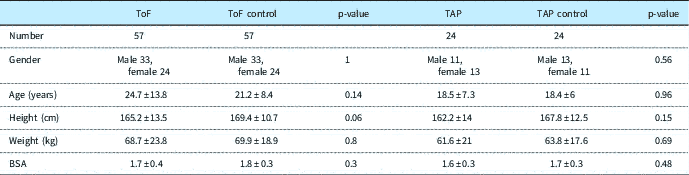
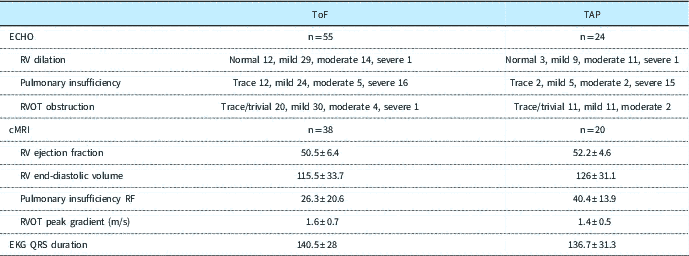
A total of 57 tetralogy of Fallot patients aged 9–69 years and mean 24.7 ± 13.8 years of age met inclusion criteria for this study. There were 33 male and 24 female patients tested. There were no statistically significant differences in the age, gender, and size between the tetralogy of Fallot patients and the age-matched normal controls (Table 1). In the tetralogy of Fallot group, 56 out of 57 patients had an electrocardiogram, 55 out of 57 patients had an echocardiogram, and 38 out of 57 patients had a cardiac MRI within 1 month of their cardiopulmonary exercise testing (Table 2). When evaluating the surgical demographics in the tetralogy of Fallot group, complete repair was the first cardiac surgery in 47 out of 57 patients with other initial surgeries, including modified Blaylock–Taussig shunt (n = 8), Mee shunt (n = 1), and Potts shunt (n = 1). The types of definitive repair used by patients were as follows: 30 out of 57 used repair using a transannular patch type, 12 out 57 used right ventricle to pulmonary artery conduit placement type, 10 out of 57 with complete repair using valve sparing ventricular patches, and 5 out of 57 without adequate surgical records detailing their initial repair. In addition, nine patients underwent transcatheter pulmonary valve replacement, including four patients who underwent repair with a transannular patch.
Baseline demographics.

BSA = body surface area; ToF = tetralogy of Fallot patients; TAP = tetralogy of Fallot patients repaired with transannular patch
Results of cardiac imaging and electrocardiogram.

cMRI = cardiac magnetic resonance imaging; ECHO = echocardiogram; EKG = electrocardiogram; RF regurgitant fraction; RV = right ventricle; RVOT = right ventricular outflow tract; TAP = tetralogy of Fallot patients repaired with transannular patch; ToF = tetralogy of Fallot patients
Pulmonary data
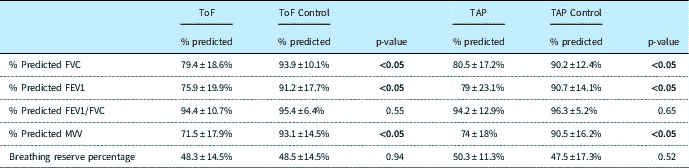
On demographic review of tetralogy of Fallot patients, three patients had mild intermittent asthma not requiring daily controller medications, three patients were smokers, and two patients had scoliosis. In the tetralogy of Fallot group, 37 out of 57 patients had a chest X-ray within 3 months of their pulmonary function testing, with 36 out of 37 demonstrating clear lung fields and one demonstrating mild atelectasis. Comparing the results between the study groups, the tetralogy of Fallot patients demonstrated both abnormal and significantly lower predicted forced vital capacity (79.4 ± 18.6% versus 93.9 ± 10.1%, p<0.05), predicted forced expiratory volume in one second (75.9 ± 19.9% versus 91.2 ± 17.7%, p<0.05), predicted forced expiratory volume in one second/forced vital capacity (81.8 ± 9.9% versus 95.4 ± 6.4%, p<0.05), and predicted maximal voluntary ventilation (71.5 ± 17.9% versus 93.1 ± 14.5%, p<0.05) while having a normal breathing reserve percentage (48.3 ± 14.5% versus 48.5 ± 14.5%, p = 0.94) (Table 3). Among the 57 patients, 30 had abnormal pulmonary function testing, wherein 28 patients had restrictive pattern, 1 had obstructive pattern, and 1 mixed pattern, compared to 5 out of 57 control patients where all are restrictive pattern (p<0.05). In addition, there were 24 patients who underwent repair with a transannular patch without subsequent pulmonary valve replacement to-date and they demonstrated abnormal predicted forced expiratory volume in one second (79 ± 23.1% versus 90.7 ± 14.1%, p<0.05), predicted maximal voluntary ventilation (74 ± 18% versus 90.5 ± 16.2%, p<0.05) while having low-normal predicted forced vital capacity (80.5 ± 17.2% versus 90.2 ± 12.4%, p<0.05) and normal breathing reserve percentage (50.3 ± 11.3% versus 47.5 ± 17.3%, p = 0.52) (Table 3). Among the patients repaired with a transannular patch, 10 out of 24 had a restrictive pattern on pulmonary function testing compared to 4 out of 24 control patients (p = 0.05). There was no tetralogy of Fallot patients that had an abnormal breathing reserve percentage, defined as <20%, indicating that there were no primary pulmonary limitations to exercise. There was no statistically significant difference between the pulmonary function test results in patients repaired with transannular patch versus those repaired by other techniques.
Results of pulmonary function testing.

FEV = forced expiratory volume; FVC = forced vital capacity; MVV = maximum voluntary ventilation; TAP = tetralogy of Fallot patients repaired with transannular patch; ToF = tetralogy of Fallot patients
Exercise data
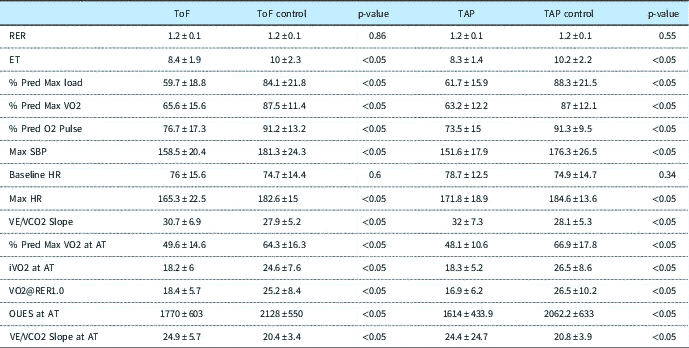
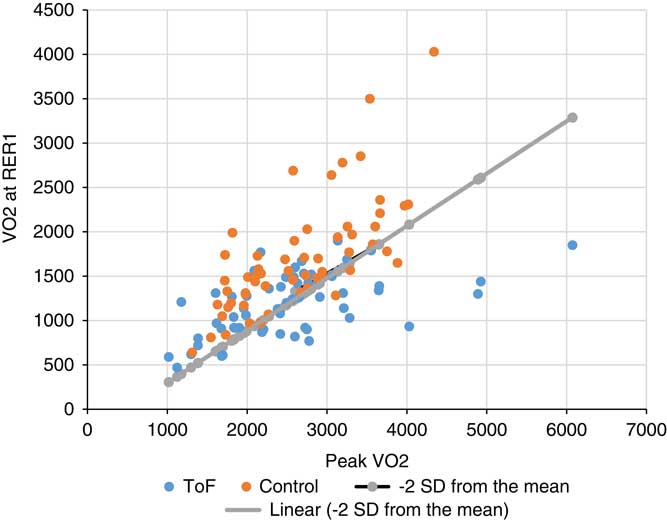
All tetralogy of Fallot and control patients exercised until they reached maximal effort testing. Pulse oximetry was recorded at rest (98.5 ± 2.4%) and during peak exercise (97.3 ± 4.2%). The tetralogy of Fallot group demonstrated significantly lower percent predicted oxygen consumption (65.6 ± 15.6% versus 87.5 ± 11.4%, p<0.05), percent predicted oxygen pulse (76.7 ± 17.3% versus 91.2 ± 13.2%, p<0.05), maximal systolic blood pressure (158.5 ± 20.4 mmHg versus 181.3 ± 24.3 mmHg, p<0.05), maximal heart rate (165.3 ± 22.5 bpm versus 182.6 ± 15 bpm, p<0.05), percent predicted maximum load (59.7 ± 18.8% versus 84.1 ± 21.8%, p<0.05), and significantly higher ventilatory efficiency (30.7 ± 6.6 versus 27.9 ± 5.2, p<0.05) (Table 4). There were no strong correlations between the percentage peak oxygen consumption and the peak heart rate (r = −0.02) and the percent predicted working capacity (r = 0.37). For the sub-maximal testing parameters evaluated, the tetralogy of Fallot group demonstrated significantly lower oxygen uptake efficiency slope (1770 ± 603 versus 2128 ± 550, p<0.05) and higher ventilatory efficiency at anaerobic threshold (24.9 ± 5.7 versus 20.4 ± 3.4, p<0.05) (Table 4). The ventilatory efficiency at anaerobic threshold weakly correlated with the ventilatory efficiency at maximal exercise (r = 0.512, p<0.0005). There were 23 out of 57 tetralogy of Fallot patients that were <−2 SD from the mean for oxygen consumption at respiratory exchange ratio 1.0 versus 5 out of 57 control patients (p<0.05) (Fig 1). In the tetralogy of Fallot patients that were <−2 SD from the mean, 21 out of 23 had a peak oxygen consumption that was <70% predicted versus 12 out of 34 tetralogy of Fallot patients that were >−2 SD from the mean (p<0.05), indicating that tetralogy of Fallot patients who had an oxygen consumption at respiratory exchange ratio 1.0 and <−2 SD were more likely to have an impaired maximum oxygen consumption.
Results of exercise testing.

AT = anaerobic threshold; ET = exercise time; HR = heart rate; O2 pulse = oxygen pulse; OUES = oxygen uptake efficiency slope; % Pred = percent predicted; RER = respiratory exchange ratio; SBP = systolic blood pressure; TAP = tetralogy of Fallot patients repaired with transannular patch; ToF = tetralogy of Fallot patients; VE/VCO2 slope = ventilatory efficiency; VO2 = oxygen consumption
Data from ToF and control groups plotted on a graph. Solid line is <2 SD from the mean derived by the regression equation for calculating the VO2 @ RER 1.0 described by Chin et al, 2009. RER = respiratory exchange ratio; ToF = tetralogy of Fallot; VO2 = oxygen consumption.
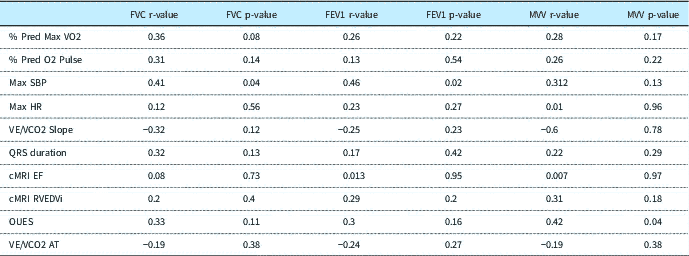
When comparing the 24 patients who underwent repair with a transannular patch without subsequent pulmonary valve replacement with age, gender, and size-matched controls, there remained significantly lower percent predicted oxygen consumption (63.2 ± 12.2% versus 87 ± 12.1%, p<0.05), percent predicted oxygen pulse (73.5 ± 15% versus 91.3 ± 9.5%, p<0.05), maximal systolic blood pressure (151.6 ± 17.9 versus 176.3 ± 26.5, p<0.05), maximal heart rate (171.8 ± 18.9 versus 184.6 ± 13.6, p<0.05), percent predicted maximum load (61.7 ± 15.9% versus 88.3 ± 21.5%, p<0.05), and significantly higher ventilatory efficiency (32 ± 7.3 versus 28.1 ± 5.3, p<0.05). For the sub-maximal outcome measured, there was lower oxygen uptake efficiency slope (1614 ± 433.9 versus 2062.2 ± 633, p<0.05) and higher ventilatory efficiency at anaerobic threshold (24.4 ± 4.7 versus 20.8 ± 3.9, p<0.05) (Table 4). The ventilatory efficiency at anaerobic threshold weakly correlated with the maximum effort ventilatory efficiency (r = 0.51, p<0.01). When comparing patients repaired using transannular patch and without subsequent pulmonary valve replacements, there were no significant correlations between the cardiopulmonary exercise testing and the pulmonary function test or cMRI parameters studied (Table 5).
Analysis of correlation in the tetralogy of Fallot patients repaired with transannular patch using Pearson’s correlation coefficient (r) and a p-value of <0.05 as statistically significant.

AT = anaerobic threshold; ET = exercise time; HR = heart rate; O2 pulse = oxygen pulse; OUES = oxygen uptake efficiency slope; % Pred = percent predicted; RER = respiratory exchange ratio; RVEDVi = right ventricular end-diastolic volume (indexed); SBP = systolic blood pressure; VE/VCO2 slope = ventilatory efficiency; VO2 = oxygen consumption
Discussion
Abnormal pulmonary function has been previously described in cohorts with tetralogy of Fallot.Reference Gaultier, Boule, Thibert and Leca 16 – Reference Demirpence, Guven and Yilmazer 18 The mechanism for the abnormal pulmonary function after surgical repair is not well understood, but it likely involves a combination of developmental, mechanical, and functional factors affecting both the pulmonary vasculature and lung parenchyma. As alveolar growth begins in the last trimester and continues for the first several years of life, disruption of vascular development during this time could inhibit alveolar growth.Reference Shaheen and Barker 19 Many tetralogy of Fallot patients undergo cardiopulmonary bypass surgery at a young age, potentially inhibiting pulmonary growth. Mechanical and functional factors include congenital chest wall deformities and post-surgical limitations of respiratory muscle movements through phrenic nerve injury or altered respiratory muscle movement.Reference Opotowsky, Landzberg and Earing 20 , Reference Kristjansdottir, Ragnarsdottir, Hannesson, Beck and Torfason 21 It has also been suggested that cardiopulmonary bypass causes a temporal interruption and reduction in pulmonary blood flow which triggers an inflammatory response that can lead to residual ventilatory dysfunction years after surgery.Reference Alonso-Gonzalez, Borgia and Diller 22 Specific for tetralogy of Fallot patients, increased right ventricular volumes from moderate to severe pulmonary insufficiency may contribute to decreased lung compliance, exercise dyspnoea, and worsened pulmonary function test values.Reference Rowe, Zahka, Manolio, Horneffer and Kidd 23
There have been only few published literatures evaluating the relationship between pulmonary function and exercise capacity in tetralogy of Fallot patients repaired after transannular patch repair and before having pulmonary valve replacement. The most notable study has demonstrated that this population of patients while having abnormal resting pulmonary function testing are mostly limited by cardiac limitations.Reference Mulla, Simpson, Sullivan and Paridon 24 These patients tend to have worsening degrees of pulmonary insufficiency with increased right ventricular volumes. The resulting impaired functional capacity is a known sequela of tetralogy of Fallot patients whom have had this repair.Reference Buys, Van De Bruaene, De Meester, Budts and Vanhees 5 , Reference Muller, Hager and Diller 6 Our study demonstrates that abnormal pulmonary function may not be the primary limiting factor of functional capacity in tetralogy of Fallot patients repaired with a transannular patch and without pulmonary valve replacement. This is evidenced by the normal breathing reserve, despite abnormal baseline pulmonary function, and the lack of significant correlation between pulmonary function test variables and the cardiopulmonary exercise testing outcomes. Further studies are needed to determine the aetiology of tetralogy of Fallot associated with pulmonary impairment.
The primary aim of this study was to examine the pulmonary and exercise characteristics in tetralogy of Fallot patients repaired with a transannular patch, and this study further demonstrates that abnormalities in cardiopulmonary exercise testing among repaired tetralogy of Fallot patients are multifactorial and complicated. Although tetralogy of Fallot patients have restrictive lung disease, significant chronotropic incompetence, and impaired skeletal muscular conditioning, none of these outcomes correlated strongly with abnormal functional capacity highlighting the multifactorial nature of exercise intolerance in this cohort. The cardiac limitations to exercise are well described and often emphasised in these patients, as reduced peak oxygen consumption is an indication for pulmonary valve replacement.Reference Buys, Van De Bruaene, De Meester, Budts and Vanhees 5 , Reference Muller, Hager and Diller 6 Although the functional capacity improves somewhat after pulmonary valve replacement, the peak oxygen consumption often remains abnormal.Reference Cheatham, Hellenbrand and Zahn 25 This implies that cardiac limitation from right ventricular overload is not the sole aetiology for exercise intolerance and that comorbid lung disease and musculoskeletal deconditioning are likely factors for the impaired functional capacity.Reference Cheatham, Hellenbrand and Zahn 25 As the exact aetiology of impaired functional capacity in the individual patient remains ambiguous, treatment strategies should focus on correction of any abnormality in the pulmonary, cardiology or musculoskeletal systems as they likely all contribute somewhat to exercise abnormalities in repaired tetralogy of Fallot patients.
Finally, meaningful and easy to interpret sub-maximal exercise values can be established for these patients, which reflected the secondary aim of the study. De-conditioned tetralogy of Fallot patients often cannot exercise to maximum effort, and if sub-maximal parameters can be established it could increase the potential for useful clinical data to be derived from an otherwise sub-optimal test. It has been shown that tetralogy of Fallot patients can have an abnormal oxygen consumption at the anaerobic threshold and oxygen uptake efficiency slope.Reference Mulla, Simpson, Sullivan and Paridon 24 , Reference Tsai, Li, Tuan, Liao and Lin 26 This is the first study to authors’ knowledge to show that tetralogy of Fallot patients have a significant difference in the ventilatory efficiency at anaerobic threshold compared to controls, and this correlated with an abnormal ventilatory efficiency at maximum exercise in our population. The ventilatory efficiency is often calculated with values from rest to peak exercise as opposed to calculating from rest to anaerobic threshold. In the heart failure population, the ventilatory efficiency at maximum exercise has been shown to be higher than ventilatory efficiency at anaerobic threshold with both values showing prognostic significance.Reference Ross, Myers, Aslem, Varughese and Peberdy 27 This is the first study to demonstrate the relationship between ventilatory efficiency values at both maximum exercise and anaerobic threshold in the tetralogy of Fallot population, and the ventilatory efficiency at anaerobic threshold could be an additional sub-maximal variable to consider. A decreased oxygen consumption at respiratory exchange ratio 1.0 is a novel finding in this population and has not been previously reported. Although oxygen consumption at anaerobic threshold is generally accepted as a sub-maximal measure, a major limitation is in the difficulty to reliably and consistently identify and may lead to significant inter-observer variability. The advantage of oxygen consumption at respiratory exchange ratio 1.0 is ease to consistently determine.Reference Chin, Kazmucha, Kim, Suryani and Olson 13 The abnormal oxygen consumption at respiratory exchange ratio 1.0 values in this study reflect another potentially useful sub-maximal exercise test parameter to study in tetralogy of Fallot patients.
There are limitations to our study. The studied patients may have additional lung pathology that could account for abnormal pulmonary function testing that was not captured by our medical chart and chest X-ray review. This would add an additional variable to consider while interrupting the abnormal pulmonary function testing in this group. Tetralogy of Fallot is a rather heterogenous disease with multiple subtypes and our population had multiple types of surgical approaches. We attempted to minimise this limitation by further narrowing our sub-analysis to include patients repaired with a transannular patch and without subsequent pulmonary valve replacement. Finally, it is worth noting that the oxygen consumption at respiratory exchange ratio 1.0 normal values are based on the regression equations that was developed in children, and that this study group consisted of children and adult patients. The original article by Chin et al used a predicted peak oxygen consumption based on prediction equations described by Cooper et al in children.Reference Chin, Kazmucha, Kim, Suryani and Olson 13 For the adult patients in this study we used the prediction equation for peak oxygen consumption described by Wasserman et al, which is a change from the way the oxygen consumption at respiratory exchange ratio 1.0 was originally described.Reference Wasserman, Hansen, Sue, Casaburi and Whipp 11 While we were able to show a statistically significant difference between the tetralogy of Fallot and normal controls in this project, there should be additional research to validate this measure further using Wasserman prediction equations in the adult population.
Acknowledgements
The Exercise Laboratory staff at Cincinnati Children’s Hospital Medical Center for their assistance in this project. Special thanks to the Ohio chapter of the ACC for allowing me to present this data at their annual meeting.
Financial Support
This research received no specific grant from any funding agency, or from commercial or not-for-profit sectors.
Conflicts of Interest
None.
Ethical standards
The authors assert that all procedures contributing to this work comply with the ethical standards of the relevant national guidelines on human experimentation and with the Helsinki Declaration of 1975, as revised in 2008, and has been approved by the Cincinnati Children’s Hospital Medical Center institutional review board.