I. INTRODUCTION
As potential high-temperature structural materials, TiAl-based alloys (γ-TiAl + α2-Ti3Al) belong to a group of remarkable materials for their unique properties such as low density, high specific strength and stiffness, and good creep strength.Reference Xiang, Wang, Zhu and Wang1–Reference Claussen, Garcia and Janssen6 These superiorities make them become excellent candidates to replace Ni-based super-alloys used at temperatures up to 900 °C. Moreover, the density of TiAl alloys (∼4 g/cm3) are relatively lower than that of Ni-based alloys (∼8 g/cm3).Reference Heshmati-Manesh, Nili Ahmadabadi, Ghasemiarmaki and Jafarian3 Therefore, they are expected to apply in various fields such as aerospace, automotive, and engine applications.Reference Peng, Li, Li, Wang and Gong2,Reference Yeh and Li5,Reference Claussen, Garcia and Janssen6 However, the relatively low ductility and poor fracture toughness at room temperature limit the extensive application of TiAl-based alloys.Reference Xiang, Wang, Zhu and Wang1,Reference Shu, Qiu, Xing, Jin, Wang and Jiang4,Reference Wang, Lin, He, Lu, Wang and Chen7
It is well known that the mechanical properties of TiAl-based alloys are very sensitive to their constituents and the microstructure and the approaches to control the microstructure and design of the TiAl alloys have been broadly researched to optimize their processing ability in recent years.Reference Kim8,Reference Wang, Wang, Zhu and Xiang9 On one hand, much works have been devoted to study the effects of major microalloying elements, such as W, Nb, Mo, Cr, and Mn in TiAl alloys. The most likely elements, Cr and Mn, are considered to realize microstructure control and some in-service properties optimization, especially for toughness at an ambient temperature.Reference Shu, Qiu, Xing, Jin, Wang and Jiang4,Reference Chen, Niu, Kong and Xiao10 On the other hand, the intermetallic matrix composites (IMCs) are very effective to provide the right combination of high-temperature strength and creep resistance, and to resolve the problem of poor strength and toughness at ambient temperatures. Significant attention has been paid to developing IMCs reinforced with addition of ceramic particles such as TiB2, Ti5Si3, and Al2O3.Reference Van Meter, Kampe and Christodoulou11–Reference Forouzanmehr, Karimzadeh and Enayati13 Among them, Al2O3 possesses the most useful properties such as high specific modulus, excellent thermal shock and high-temperature oxidation resistance. Moreover, the density and thermal expansion coefficient of Al2O3 (3.97 g/cm3 and 8.3 × 10⁻⁶/K) are close to those of TiAl (3.8 g/cm3 and 12 × 10−6/K), which could partly avoid the phenomena of segregation of the reinforcement particles and reduce the inner stress between ceramic and matrix during the fabrication of the TiAl-based composites in comparison with other ceramic particles.Reference Chen and Zhou14,Reference Travitzkya, Gotmanb and Claussen15 Shen et al.Reference Shena, Zou, Xiao, Liu, Long and Wu16 successfully prepared the Al2O3/TiAl composites by the in situ SHS process from the Al–TiO2 system, in which the flexural strength and toughness of as-synthesized products reached to 466 MPa and 7.9 MPa m1/2, respectively. But the excessive Al2O3 particles and the big grain size of the TiAl matrix were relatively harmful for the mechanical properties.
In addition, Mn, as a common alloying element in TiAl alloy, the strengthening mechanism on the mechanical properties of the (Ti,Mn)Al/Al2O3 composite was still rarely reported. In consideration of low energy requirement, contaminant-free interface, and stable chemical compatibility, in situ hot pressingReference Du, Li, Zhang and Lu17,Reference Emamy, Mahta and Rasizadeh18 is ultimately adopted to synthesize the TiAl/Al2O3 composites. In this work, the (Ti,Mn)Al/Al2O3 in situ composites were produced by reactive synthesis with elemental powder mixtures of Ti, Al, TiO2, and MnO2. The role of Mn content on the microstructure and mechanical properties of the (Ti,Mn)Al/Al2O3 composites was investigated, and the reinforcing mechanism were also discussed in detail.
II. EXPERIMENTAL PROCEDURES
Commercially available powders Ti (99.3%, 52 µm), Al (99.5%, 75 µm) and TiO2 (99%, 0.5 µm), MnO2 (97.5%, 50 µm) reagents were selected as the raw materials for synthesis of (Ti,Mn)Al/Al2O3 composites. The elemental powder mixtures containing Ti, Al, TiO2, and MnO2 were formulated with stoichiometry according to the following basal reaction 1. The MnO2 content of 0, 1.62, 2.32, 3.02, and 3.72 wt% was introduced to adjust the final composition, and the detailed component mixtures were listed in Table I. It should be mentioned that the theoretical target Al2O3 content was controlled at 10 wt% by the thermit reactions between the TiO2, MnO2, and Al.
 $$x{\rm{Ti}} + {\rm{(}}x + {\rm{4}}y + {\rm{7)Al}} + {\rm{3TiO}}_{\rm{2}} + {\rm{3}}y{\rm{MnO}}_{\rm{2}} \to {\rm{(}}x + {\rm{3)TiAl}} + {\rm{(2}} + {\rm{2}}y{\rm{)Al}}_{\rm{2}} {\rm{O}}_{\rm{3}} + {\rm{3}}y{\rm{Mn}}\quad {\rm{.}}$$
The component of the samples (wt%).

The elemental powders were ball-milled in ethanol for 1 h with Al2O3 balls, and the weight ratio of the milling balls to alcohol to powders is 3:1:1. The rotational speed of the vial was 800 rpm. The as-milled mixtures were dried at 40 °C for 8 h, sieved through a 200 µm mesh and uniaxially die-pressed under 10 MPa in a graphite mold presprayed with a layer of BN. Then the green cylindrical compacts were hot-pressed in a vacuum atmosphere (∼6.0 × 10⁻² Pa) at a rate of 5 °C/min from room temperature to 1300 °C and held for 2 h with a pressure of 17.5 MPa. Finally, the products were cooled down to the ambient temperature in furnace. The surface of the as-prepared composites was polished to remove the contaminants prior to characterization. Phase identification of the as-sintered samples was performed by an x-ray diffractometer (XRD, D/max-2200PCX, Rigaku, Osaka, Japan) with Cu Kα irradiation at a scan rate of 0.02°/min. And the microstructure analyses were conducted in a scanning electron microscope (SEM, JEOL JSM-6700F, Tokyo, Japan) equipped with an energy-dispersive spectroscopy (EDS, EDAX GENESIS, San Diego, CA).
The density of (Ti,Mn)Al/Al2O3 composites with various MnO2 was measured by the Archimedes method. The test of Vickers-hardness was performed on a tester (HXD-1000, Shanghai second optical Ltd., Shanghai, China) at a load of 10 N with the dwell time of 15 s. The flexural strength (σb) and fracture toughness (K IC) were evaluated using the three-point bending method with the use of a universal testing machine (PT-1036PC, Perfect Instrument Co. Ltd, Taiwan, China) at room temperature. The loading span was maintained at 20 mm for each test. The dimensions of samples for the flexural strength and fracture toughness testing were 30 × 4 × 4 mm3, and the corresponding crosshead speeds were 0.5 and 0.05 mm/min, respectively. K IC was measured using the single-edge notch beam (SENB) method with a notch depth of 0.45W (W represents the width of the specimen) and a width of 0.15 mm. At least four samples were measured for each kind of tests. The flexural strength and fracture toughness were determined by the following equations, respectively.
 $${\rm{\sigma }}_{\rm{b}} = {\rm{3}}PL{\rm{/(2}}bh^{\rm{2}} {\rm{)}}\quad {\rm{,}}$$
 $$K_{{\rm{IC}}} = Y{\rm{ \times 3}}PLa^{{\rm{1/2}}} {\rm{/(2}}BW^{\rm{2}} {\rm{)}}\quad {\rm{,}}$$
where P is the breaking load of the specimen, and L, b, h, Y, and a denote the span, width, height, form factor, and notch depth of the specimen, respectively.
III. RESULTS AND DISCUSSION
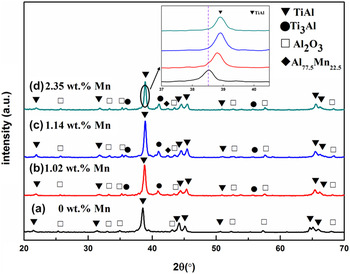
Figure 1 shows the x-ray diffraction (XRD) patterns of (Ti,Mn)Al/Al2O3 composites hot pressing at 1300 °C for 2 h with various Mn contents. No residual impurity phases like Ti, Al, or TiO2 are present in the composites, and the detectable phases mainly consist of TiAl and Al2O3. According to similar research results,Reference Forouzanmehr, Karimzadeh and Enayati13,Reference Travitzkya, Gotmanb and Claussen15 in the TiO2–Al system, first reaction of TiO2/Al led to the formation of Ti and Al2O3, and then Ti reacted with Al to generate TiAl. So the main reactions could be expressed as the following equations:
 $${\rm{3TiO}}_{\rm{2}} + {\rm{4Al}} \to {\rm{3Ti}} + {\rm{2Al}}_{\rm{2}} {\rm{O}}_{\rm{3}} \quad ,$$
 $${\rm{Al}} + {\rm{Ti}} \to {\rm{TiAl}}\quad {\rm{.}}$$
XRD patterns for (Ti,Mn)Al/Al2O3 samples with different Mn content. (a) 0 wt%, (b) 1.02 wt%, (c) 1.41 wt%, (d) 2.35 wt% after hot-pressed under 17.5 MPa at 1300 °C for 1 h.

With the MnO2 additions, the thermit reaction of Al and MnO2 takes place during the sintering process, the hence formed Mn dissolves into the (Ti,Mn)Al matrix and gradually appears as a small amount of Al77.2Mn22.5 phase [Figs. 1(b)–1(d)]. In addition, the detected Ti3Al could be mainly attributed to the consumption of Al (the new Al77.2Mn22.5). The previous worksReference Wang, Wang, Zhu and Xiang9,Reference Ai19 also revealed that the Ti3Al phase often existed in the final products as a final phase for synthesis of Al2O3/TiAl composites. The reactions in the Al–MnO2 system are expressed as follows:
 $${\rm{4Al}} + {\rm{3MnO}}_{\rm{2}} \to {\rm{3Mn}} + {\rm{2Al}}_{\rm{2}} {\rm{O}}_{\rm{3}} \quad ,$$
 $${\rm{Al}} + {\rm{3Mn}} \to {\rm{Al}}_{{\rm{77}}{\rm{.5}}} {\rm{Mn}}_{{\rm{22}}{\rm{.5}}} \quad .$$
Moreover, as indicated in the inset in Fig. 1 with step-scan, the peak position of the TiAl (111) plane shifts gradually to high 2θ values with the increase in the MnO2 content, implying a decrease in the lattice constant of the (Ti,Mn)Al matrix. It is believed that most amount of Mn element could exist in the TiAl matrix in the form of (Ti,Mn)Al solid solution, and the residual Mn reacts with Al to form precipitated Al77.2Mn22.5 phase when the Mn content exceeds the limited solid solubility of (Ti,Mn)Al matrix.
Table II lists the calculated TiAl parameters of (Ti,Mn)Al/Al2O3 samples in this work, together with Ti2AlC/TiAl-Mn from Shu et al.Reference Shu, Qiu, Xing, Jin, Wang and Jiang4 for comparison. As shown in Table II, lattice constant a changes linearly from 3.98417 to 3.99287 Å, which reduces the c/a ratio of the crystal lattice and therefore reduces the lattice tetragonality of TiAl. Moreover, the c/a ratio and lattice tetragonality of the TiAl matrix decreases with the increase of Mn content. As reported from the results of Shu et al.Reference Shu, Qiu, Xing, Jin, Wang and Jiang4 and Zhou et al.,Reference Zhou, Dong, He and Zhang20 Mn is found to preferably occupy the Al sites and results in the lattice shrink due to its smaller atomic radius than Al (0.179 nm for Mn and 0.182 nm for Al), which is well consistent with the XRD results in this work. These results are in good agreement with previous theoretical calculations.Reference Zhou, Dong, He and Zhang20 Finally, the lattice tetragonality decrease from 64.5302 to 64.1928 Å, which is smaller than the previous work.Reference Shu, Qiu, Xing, Jin, Wang and Jiang4 The contraction of the lattice tetragonality is believed to be beneficial for the ductility improvement because new glide systems could be activated.Reference Xiang, Wang, Zhu and Wang1,Reference Zhou, Dong, He and Zhang20 It is confirmed that diffraction patterns for the shift of TiAl phases based on the following equationReference Mao, McMinn and Wu21:
 $${\rm{sin2\theta }} = {\rm{\lambda }}^{\rm{2}} {\rm{/4}}a^{\rm{2}} {\rm{(}}h^{\rm{2}} + k^{\rm{2}} + l^{\rm{2}} {\rm{)}}\quad {\rm{,}}$$
where θ is the diffraction angle, a represents the lattice constant, h, k, and l belong to the Miller induces, and λ is the x-ray wave length (Cu Kα, 1.540598 Å). With the values of 2θ shifted to high-angle, the lattice constant a and interplanar spacing diminishes linearly with increase of Mn content. Based on the above related analysis, the refinement of (Ti,Mn)Al grain could be attributed to the effect of Mn.
Lattice parameters of TiAl in the (Ti,Mn)Al/Al2O3 composites calculated by XRD experiment, along with Ti2AlC/TiAl compositesReference Shu, Qiu, Xing, Jin, Wang and Jiang4 for comparison.

In Ref. Reference Shu, Qiu, Xing, Jin, Wang and Jiang4 and this work, X represents Mn atom fraction in Ti2AlC/TiAl composites.
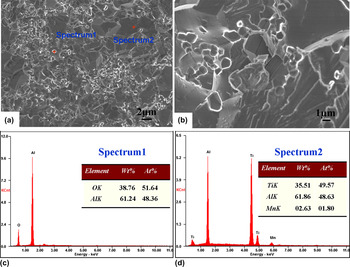
Figure 2 displays the SEM micrographs of the fracture surface and the EDS chemical analysis of the (Ti,Mn)Al/Al2O3 composites with 1.41 wt% Mn content due to the fact that EDS only detects ∼1% x-rayReference Lin, Li and Zhou22 and the signal is quite weak for the phase of relatively low content. But, it is obvious that the material consists of the fine light particle-like phase and gray-layered matrix phase in Fig. 2(a). The fine particles disperse homogeneously throughout the material and present a typical interpenetrating network microstructure. From the high magnification of Fig. 2(b), it can also be observed that the rarely single particles disperse within matrix grains and the gathered ones distribute along the grain boundaries. The size of the fine particles is less than 1 μm, and the matrix grains are less than 10 μm in size. Figures 2(c)–2(d) presents the EDS spot-scanning of white particles and gray matrix. The matrix phase is enriched with Ti, Al, together with a small amount of Mn (marked spectrum 1), and the atomic ratio of Ti and Al is quite close to stoichiometric TiAl. Combined with the XRD analysis in Fig. 1, it is concluded that some Mn dissolve into TiAl and form (Ti,Mn)Al solid solution. In addition, Al77.2Mn22.5 and Ti3Al phase can change the ratio of matrix. Conversely, the atomic ratio of Al and O in fine particles is 48.36:51.64 (marked spectrum 2), which is quite consistent with Al2O3. These results agree well with the XRD results shown in Fig. 1.
EDS analysis of the fracture surface of the (Ti,Mn)Al/Al2O3 composites with 1.41 wt% Mn.

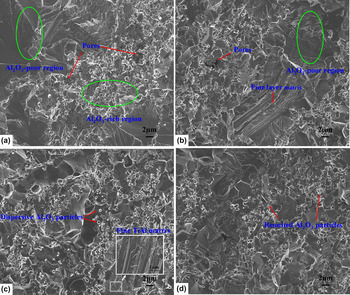
The SEM micrographs of the in situ hot-pressed (Ti,Mn)Al/Al2O3 composites with various Mn content are shown in Fig. 3. In the Mn-free specimen, the TiAl matrix reveals the relatively large grain size (much higher than 10 μm) and the Al2O3 particles incline to aggregate on the side of TiAl [Fig. 3(a)]. Moreover, it is obviously seen that a few amount of small pores hide in the composite. With the increase of Mn content, the remaining pores gradually disappear in the products, the grain size of the (Ti,Mn)Al matrix decreases and the fine Al2O3 particles distribute more homogeneously on the boundaries of (Ti,Mn)Al matrix. It is worth noting that the fine-layered (Ti,Mn)Al matrix is clear in the partial magnification of Fig. 3(c). The grain refinement of the (Ti,Mn)Al matrix could be attributed to the reduction of lattice constant and the improvement of the wettability in materials by the effect of Mn. The wettability of Al2O3 ceramics by molten Al is usually very poorReference Yu, Wu, Sun and Jiang23 and leads to the lower properties of Al2O3/TiAl composites. But, alloying element Mn can comparatively improve the lattice tetragonality, interfacial wettability, and bond strength. Most of similar work on wetting behavior is largely applied to aluminum matrix composites, such as Mg, Ni, Co, and Pd.Reference Yu, Wu, Sun and Jiang23,Reference Contreras, Bedolla and Pérez24 Combined with the analysis of the lattice constant in Table II, the TiAl matrix is signally decreased from 20 to 10 μm [Figs. 3(a)–3(c)]. When the content of Mn increases to 2.35 wt%, the Al2O3 particles tend to slightly agglomerate again at the grain boundaries as shown in Fig. 3(d), which is detrimental to the mechanical properties of the in situ composites.
SEM microstructures of the hot-pressed (Ti,Mn)Al/Al2O3 with different Mn content. (a) 0 wt%, (b) 1.02 wt%, (c) 1.41 wt%, (d) 2.35 wt%.

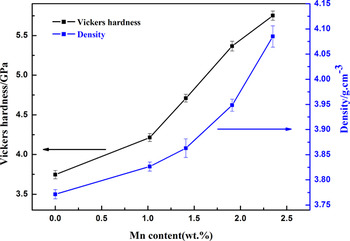
Figure 4 shows the density and hardness curves of the (Ti,Mn)Al/Al2O3 composites as a function of the MnO2 content. The measurement errors are around 2–4% in corresponding tests. The density and Vickers hardness of the as-synthesized specimens increase linearly from 3.77 to 4.09 g/cm3 and from 3.75 to 5.76 GPa with the increase of Mn, respectively. By incorporation of Mn, residual pores in (Ti,Mn)Al/Al2O3 can be partly eliminated and the grain refining in microstructure makes the samples more compacted. In addition, the formation of Ti3Al also increases the density of (Ti,Mn)Al/Al2O3 owing to its higher density (4.18 g/cm3) than that of 3.8 g/cm3 for TiAl. As a result, the density of the composites is increased and the measured density of all products is above 97% of the theoretical density, which means that the as-sintered composites are nearly fully dense. The increment in hardness is due to the refined duplex microstructure (α2-Ti3Al/γ-TiAl) and the relative densification of the (Ti,Mn)Al/Al2O3 composites.
The density and Vickers hardness of the (Ti,Mn)Al/Al2O3 with varying content of Mn.

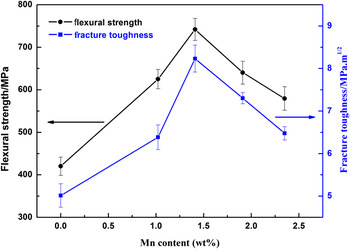
Figure 5 shows the flexural strength (σb) and fracture toughness (K IC) of the (Ti,Mn)Al/Al2O3 composites with various Mn content. In the range of 0–1.41 wt% Mn, it is clearly seen that σb and K IC increase from 420.45 to 742.00 MPa and from 5.02 to 8.8 MPa m1/2, respectively. Both of them reach the maximum values of 742.00 MPa and 8.8 MPa m1/2 with 1.41 wt% Mn and then decreases dramatically with further increasing the Mn content. Compared with the Mn-free samples, the values of fracture toughness and flexural strength were increased significantly by 176.49% and 164.21%, respectively.
The fracture toughness and flexural strength of in situ (Ti,Mn)Al/Al2O3 composites with various content of Mn.

The properties of as-sintered (Ti,Mn)Al/Al2O3 samples with 1.41 wt% Mn are summarized in Table III. For comparison, those results of TiAl-based composites are also included. The previous samples contained excessive Al2O3 content in Ref. Reference Peng, Li, Li, Wang and Gong2, and serious agglomeration of Al2O3 and some residual porosity result in evident reduction in the flexural strength and fracture toughness. Moreover, impure phases of the formed Al2Ti4C2 and TiC can also affect the performance of composites due to lower sintering temperature. In Ref. Reference Mao, McMinn and Wu21, the big size of TiAl (much higher than 20 μm) along with subsistent pores leads to the weakened strength in NiAl/TiAl composites. So, it is reasonable that present samples possess much higher mechanical strengths.
Summary of typical properties of the as-prepared Al2O3/TiAl composite with 1.41 wt% Mn, together with those TiAl-based composites from Peng et al.Reference Peng, Li, Li, Wang and Gong2 and Mao et al.Reference Mao, McMinn and Wu21 for comparison.

In Ref. Reference Peng, Li, Li, Wang and Gong2 and this work, Al2O3 content are about 20 and 10 wt%, respectively.
The effective enhancement of the strength with Mn is mainly due to the solid solution strengthening of the Mn element, second phase strengthening of the fine Al2O3 particles, the grain refining of the (Ti,Mn)Al matrix and precipitation strengthening of Al77.5Mn22.5 phases, while the grain refining of the (Ti,Mn)Al matrix and the more homogenous distribution of the Al2O3 particles could induce the improvement of the fracture toughness. The effect of Al77.5Mn22.5, as a new phase, may be similar to the generated NbAl3 phase in the Ti–Al–TiO2–Nb2O5 system,Reference Ai19 which can improve the strength of Al2O3/TiAl composites.
The introduction of Mn restrains the abnormal growth of (Ti,Mn)Al matrix and makes Al2O3 disperse more uniformly, which plays a great critical role in strengthening of (Ti,Mn)Al/Al2O3 composites according to the Hall–Petch equationReference Bohn, Klassen and Bormann25,Reference Paradkar, Kamat, Gogia and Kashyap26 expressed as follows:
 $${\rm{\sigma }}_f = {\rm{\sigma }}_{\rm{0}} + Kd^{ - {\rm{1/2}}} \quad ,$$
where σ0 and K are both material constants, and σf and d is the flexural strength and grain diameter, respectively. It can be seen from the formula that when the grain size d decreases, the flexural strength σf will be improved. Furthermore, the lattice parameters are reduced by incorporation of Mn and the different bond energy between Mn and Al makes the bond energy of Ti–Al intermetallics stronger, which is also a reason for the improvement of the toughness of the composites.Reference Xiang, Wang, Zhu and Wang1,Reference Shu, Qiu, Xing, Jin, Wang and Jiang4 , Reference Bohn, Klassen and Bormann25 Finally, as a result of a p < a m (a p is 8.3 × 10⁻⁶/K for Al2O3 and a m is 12 × 10−6/K for TiAl), it can induce a ligament zone of residual compressive stress, which is also advantageous to the strength and toughness of the composites.Reference Zhu, Yang, Yang and Wang27 These results are in good agreement with the above XRD and relevant SEM analysis, as shown in Figs. 1 and 3.
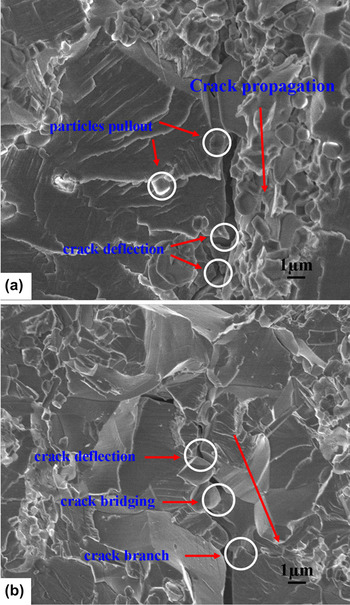
The crack propagation patterns of the (Ti,Mn)Al/Al2O3 composites with 1.41 wt% Mn are presented in Fig. 6, in which some mixed complex fracture modes are found, such as intergranular and transgranular cracks. The delaminating fractures with crack-bridging, branch, deflection, and particles pullout are both in (Ti,Mn)Al boundary and its intracrystal regions. The zigzag crack propagation in the in situ composites is caused by the refined matrix and dispersed fine Al2O3 grains at (Ti,Mn)Al grain boundaries with appropriate Mn content. Such a tortuous crack path as well as the bridging and pullout of Al2O3 grains lead to an increase in the propagation distance of the cracks and then enhance the mechanical properties in the specimens.
Typical crack propagation patterns of the (Ti,Mn)Al/Al2O3 composite with 1.41 wt% Mn. (a) the region of TiAl boundary, (b) TiAl intracrystal region.

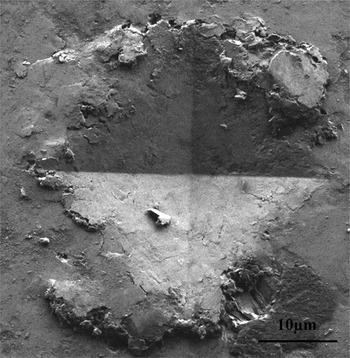
Figure 7 shows the SEM micrograph of the Vickers indentation at a load of with 10 N for the (Ti,Mn)Al/Al2O3 sample with 1.41 wt% Mn. There are no obvious cracks along the diagonals of the indent and the micro-damage is confined in the immediate vicinity of the indentation. This is consistent with the examined results of the TiAl/NiAl composites.Reference Mao, McMinn and Wu21 Combined with the SEM analysis (in Fig. 6), a number of energy-absorbing mechanisms enabled (Ti,Mn)Al/Al2O3 composites to inhibit crack formation including delamination, pull-out of Al2O3 particles along with sliding of TiAl grains, which indicates that (Ti,Mn)Al/Al2O3 is a kind of excellent damage tolerant material.
The Vickers indent produced at a load of 10 N with addition 1.41 wt% Mn content.

IV. CONCLUSIONS
(1) The (Ti,Mn)Al/Al2O3 composites were successfully fabricated by the reactive hot pressing at 1300 °C for 2 h in the Ti–Al–TiO2–MnO2 system. By incorporation of Mn, the grain size of TiAl obviously decreased and the fine Al2O3 particles distributed homogenously throughout the boundaries of the (Ti,Mn)Al matrix. The in situ formed Mn dissolved into (Ti,Mn)Al, reduced the lattice tetragonality in (Ti,Mn)Al matrix, and formed a small amount of Al77.5Mn22.5 phases.
(2) The flexural strength and fracture toughness reached the maximum of 742.0 MPa and 8.8 MPa·m1/2 in the composite with 1.41 wt% Mn content, which were enhanced to 176.49% and 164.21%, respectively, due to the combination effect of solid solution, grain refining of the (Ti,Mn)Al matrix and the dispersive Al2O3 phases by incorporation of Mn.
(3) The toughening mechanism of as-fabricated samples was attributed to zigzag crack propagation patterns by delaminating fractures with crack-bridging, branch, deflection, and particles pullout. The Vickers indentation analysis of the composites indicated that (Ti,Mn)Al/Al2O3 had the attractive superiority of damage resistance.
ACKNOWLEDGMENTS
This work was supported by the National Foundation of Natural Science, China (Grant Nos. 51171096, 50802057) and the Graduate Innovation Fund of Shaanxi University of Science and Technology.