The poem above represents a fantastic scene in which a virtuoso pianist animates a lifeless instrument with her magical fingers. Dedicated to Anna Caroline de Belleville (1806–80) after her successful 1833 Moscow concert, this supernatural depiction by Russian writer, journalist, and publisher Prince Peter Ivanovich Shalikov (1768?–1852) highlights Belleville’s miraculous power over her piano.Footnote 2 Yet the relationships between virtuoso pianists and their pianos are anything but unilateral. Following the praise of Belleville’s virtuosity in her 1830 Vienna concert, the reviewer recognized her piano and its role in the success of the performance:
The excellent, sonorous instrument, a Streicher-patented pianoforte, with the hammer stroke from above, proved to be most suitable for such production (considering the location of the performance, namely the theatre), and heightened the charm of the enjoyment which the virtuoso’s treatment created.Footnote 3
The critic’s note on the Streicher piano’s contribution to Belleville’s concert is quite a common observation throughout reviews of her concerts. In fact, Belleville’s widely recognized virtuosity — her sensitive touch and control, vigour and power, precision and clarity, and rapidity and certainty — would not have been fully realized or perceived by the audience without the natural advantages of the pianos, which were rapidly evolving in various aspects of mechanism, material, and design in the early nineteenth century.
Indeed, pianos and pianists in the early nineteenth century shared a highly dependent relationship, one that was more complex and interwoven than is often recognized in modern piano culture. Robert Adelson, for instance, illustrates not only how Franz Liszt’s captivating techniques highlighted the merits of Érard’s piano but also how the enhanced action and powerful tone of the instrument in turn elevated Liszt’s virtuosity to new levels.Footnote 4 Similarly, Belleville, a highly reputable yet underresearched virtuoso pianist, left behind a wealth of rich and revealing documentation detailing her strategic engagement with various makes of piano. These documents further enrich our understanding of the intricate relationship between pianists and their instruments during that era. Expanding on existing scholarship about the reciprocal benefits shared between pianists and pianos, this article introduces Belleville’s experience as a new lens to view this dynamic interplay. Drawing on nineteenth-century concert reports, including underexplored Russian, German, and English sources, along with some unpublished letters, diaries, and other writings, it delves into the symbiotic relationships Belleville cultivated with her pianos, particularly with two piano brands, Streicher and Érard. This study reveals how the technological developments in these pianos augmented and broadened Belleville’s virtuosity, while simultaneously, her active engagement with and promotion of these instruments substantially boosted their reputation and commercial success. This illuminating story about the interdependency between the virtuoso and her instruments (and instrument makers) enriches our understanding of nineteenth-century performance culture, underscoring the inextricable connections between technology, virtuosity, commerciality, and entrepreneurship.
Pianos and Pianistic Styles in the Early Nineteenth Century
As the most popular instrument in both public and private musical life, the nineteenth-century piano was under constant development, with attention paid to its size, range, shape, material, and mechanism. Piano manufacturers’ relentless pursuit of improved construction was driven by a variety of factors, including the search for a louder sound and greater durability. The increased volume, for instance, allowed the piano to compete with a large orchestra and project more powerfully in a grand concert hall. These developments required the piano to accommodate higher tension from thicker strings and larger hammers, thus necessitating a more robust and resilient design.Footnote 5
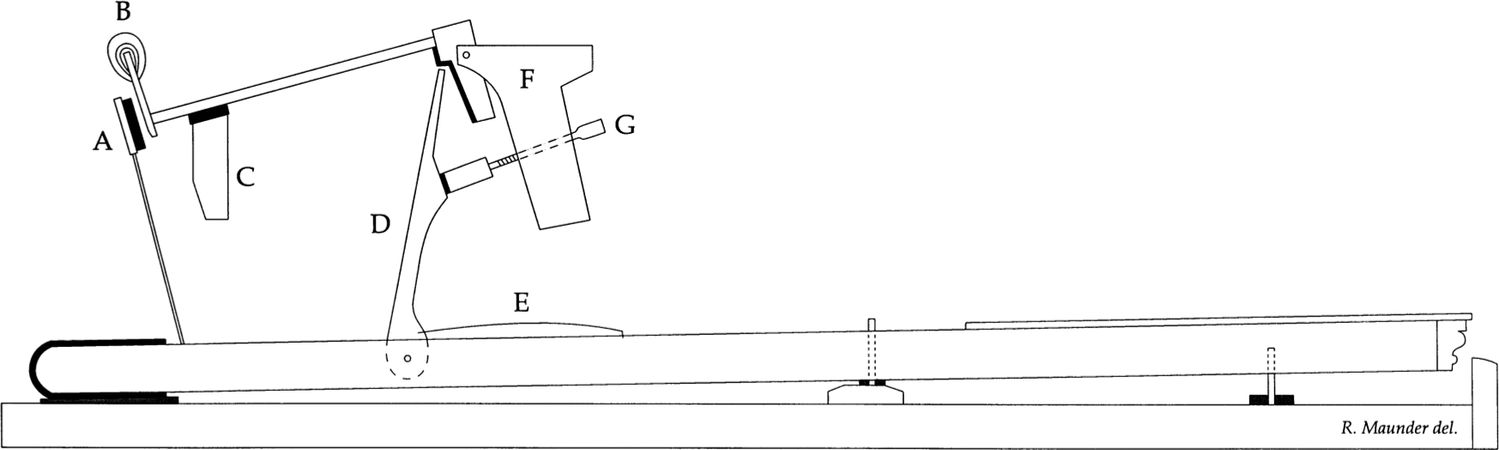
Despite these broadly common construction goals, European pianos of the early nineteenth century reflected varying musical tastes across different countries, resulting in two principal schools of piano-making: the Viennese (German and Austrian pianos) and the English (British and nearly all French pianos).Footnote 6 One of the main differences between the schools lay in the pianos’ action.Footnote 7 Broadly speaking, the Viennese school features a simple action called Prellmechanik (Prell means ‘bounce’; see Figure 1) with light hammers, while the English school employs a complex action built upon the principle of Stoßmechanik (‘push mechanics’; see Figure 2) with heavy hammers.Footnote 8 This technological distinction between the Viennese and English pianos, along with other differences in terms of damping mechanism, hammerheads and coverings, stringing, soundboard, and tone colours, cultivated different approaches to pianism and differing musical ideals.Footnote 9 In his 1828 piano treatise, Johann Nepomuk Hummel compared the different mechanisms of these two types of pianos and highlighted their distinctive advantages:
It cannot be denied but that each of these mechanisms has its peculiar advantages. The German piano may be played upon with ease by the weakest hand. It allows the performer to impart to his execution every possible degree of light and shade, speaks clearly and promptly, has a round fluty tone, which in a large room contrasts well with the accompanying orchestra, and does not impede rapidity of execution by requiring too great an effort. These instruments are likewise durable, and cost but about half the price of the English piano forte.
Viennese grand piano action by Rosenberger, Vienna, c. 1800. A = escapement spring; B = escapement lever; C = Kapsel; D = hammer; E = check rail. From The Cambridge Companion to the Piano, ed. by David Rowland (Cambridge University Press, 1998), p. 24.

English grand piano action by Broadwood, London, 1798. A = check; B = hammer; C = hammer rest rail; D = escapement lever; E = escapement spring; F = hammer pivot rail; G = escapement adjustment. From The Cambridge Companion to the Piano, ed. by David Rowland (Cambridge University Press, 1998), p. 25.

To the English construction however, we must not refuse the praises due on the score of its durability and fullness of tone. Nevertheless this instrument does not admit of the same facility of execution as the German; the touch is much heavier, the keys sink much deeper, and, consequently, the return of the hammer upon the repetition of a note, cannot take place so quickly […] This mechanism is not capable of such numerous modifications as to degree of tone as ours.Footnote 10
Compared to the English piano with its heavier touch and slower repeating mechanism, the merit of the Viennese piano mainly lay in its lighter action with a quicker response. The Viennese piano facilitated the rapidity and clarity of touch embraced by the so-called ‘brilliant style’. On the other hand, the relatively sluggish damping mechanism in the English piano gave its sound a ‘peculiar charm and harmonious sweetness’, which was particularly evident in performances by pianists from the cantabile London piano school like John Baptist Cramer (who was particularly distinguished by his tender and singing adagio), Muzio Clementi, and John Field.Footnote 11 In 1830, Friedrich Kalkbrenner outlined how the stylistic differences between Viennese and English pianists grew out of their respectively distinctive pianos:
The pianists of Vienna are especially distinguished for the precision, clearness and rapidity of their execution; the instruments fabricated in that city are extremely easy to play, and in order to avoid confusion of sound, they are made with mufflers [dampers] up to the last high note; from this results a great dryness in sostenuto passages, as one sound does not flow into another. In Germany the use of the pedals is scarcely known. English pianos possess rounder sounds and a somewhat heavier touch; they have caused the professors of that country to adopt a grander style, and that beautiful manner of singing which distinguishes them; to succeed in this, the use of the loud pedal is indispensable, in order to conceal the dryness inherent to the pianoforte.Footnote 12
Admittedly, professional virtuoso pianists were generally trained by a specific piano school and often showed their preference for a particular make of piano at an early stage of their careers. The bipartite division between the brilliant and cantabile styles in the early nineteenth century captures a general picture of different piano-making practices and their impact on performance style. However, many other factors greatly complicated this divide, or any categorical division of piano schools, as well as complicating an invariant correspondence between a virtuoso pianist and a particular make of piano. For instance, Adelson notes Ignaz Moscheles’s preference for Clementi’s pianos, a predilection he nurtured in London and which lasted until 1830, at which point Moscheles became captivated by the improved design of Érard pianos, subsequently aligning himself with the cohort of ‘Érard pianists’.Footnote 13 Indeed, professional pianists toured extensively throughout Europe and often had to engage with different makes of pianos — a mixed blessing for many aspiring virtuosos. These travels would increase their exposure to and familiarity with divergent mechanisms and instrument timbres. Although this was potentially intimidating to a virtuoso trained in only one school, their interactions with other performers, updated techniques, and different musical works would only enrich and diversify their existing pianism. Over time, the tendency for piano makers to combine various advantages from different pianos (for example, Streicher’s intense work to increase the volume of its instruments and Érard’s efforts to make its sluggish English action more responsive) ultimately led to the standardization of piano construction in Europe around the end of the nineteenth century, further problematizing any distinctions of pianistic styles based on piano preferences.
Belleville’s rich experiences with different pianos throughout her career exemplifies this complexity. Trained in Vienna under Czerny in the so-called ‘brilliant’ style and well acquainted with the famous Streicher piano-making family, Belleville’s early pianism was formed on light-actioned Viennese pianos known for their crystal-clear onsets.Footnote 14 However, her later concert tours outside Austria and Germany exposed her to other makes of piano, particularly Érard’s. These instruments played a pivotal role in shaping her pluralistic pianism and advancing her professional concert career. The continual evolution of piano technology during this period became a driving force in cultivating Belleville’s artistry and performing career. In turn, her active engagement with various piano brands in concerts significantly boosted their reputation, fostering a symbiotic relationship.
‘Becoming its better master’: Belleville and Érard’s Pianos
Belleville’s earliest exposure to a non-Viennese-action piano was likely in 1821, when the 15-year-old pianist reached Paris for the first time after a series of concerts in Stuttgart, Frankfurt, Brussels, Amsterdam, and Berlin. During her six-month stay in Paris, she had the chance to play French pianos. Without much prior experience with heavy English-action pianos, Belleville may have found it difficult to display the brand of pianism she had developed on the Viennese pianos, marked by rapidity, clarity, fluency, and light execution. Either Jean-Baptiste Érard (1750–1826) or his brother, Sébastien Érard (1752–1831), both French piano and harp makers and the hosts of Belleville’s concerts, prepared a piano with a lighter action for her. Johann Baptist Streicher (1796–1871), a Viennese piano maker who later became the sole owner of the Streicher firm, briefly mentioned Belleville’s unpleasant early experiences with French pianos in his travel diaries:
I visited Mr Érard, who kindly welcomed me. He said to me that Miss Belleville lives in the house, whom I also visited. She complained of the French pianos, and Mr Érard had to prepare a lighter one expressly for her […] He [Belleville’s father] spoke to me a great deal about his daughter, that people here prefer her to Moscheles, etc., etc., that she prefers to play our [Viennese] instruments, and that in Brussels a piano had been ordered by her.Footnote 15
Belleville’s initial challenges with Érard’s heavy-actioned pianos and her explicit preference for Viennese ones were by no means an exceptional experience among pianists, particularly those based in Vienna. For example, Hummel’s comparison between Viennese and English pianos shows his clear preference for the former. Even Beethoven’s experience with his first English-action piano in 1803 was similarly complicated. According to Tilman Skowroneck, Beethoven was initially excited about his new Érard grand piano, but he nonetheless had to overcome its action, which was not as ‘supple and elastic’ as Viennese instruments.Footnote 16 In a letter to Johann Andreas Streicher, Beethoven grumbled about this ‘useless’ piano, and he sent it to his brother, Nikolaus Johann van Beethoven, so that he could save a space for a new Graf piano.Footnote 17 Moscheles, one of the leading virtuoso pianists, who lived primarily in Vienna from 1808 to 1816, also struggled with Érard’s heavy-action pianos, as will be discussed later.
Despite some initial struggles with Érard’s piano, Belleville soon adapted to the instrument and achieved great command of it in her concert on 14 January 1822 at the Érard brothers’ soirée musicale. In this concert, Belleville performed one of Hummel’s works with orchestral accompaniment and one of her own compositions, both presumably written on a Viennese piano. After attending the concert, J. B. Streicher praised her treatment of Érard’s piano, although the instrument itself displeased him due to its ‘furry tone’, ‘quite woody’ treble register, and ‘rattling’ sound in the second octave.Footnote 18 Belleville’s successful concert on Érard’s piano was also verified by another music critic, who wrote that she ‘won the approval of all the listeners’ and ‘raises the fairest hopes’.Footnote 19 This positive feedback certainly made her more confident in playing Érard’s piano. After another concert at Érard’s on 27 January, where she played Hummel’s Septet, op. 74, her father even proudly claimed to J. B. Streicher ‘how much she had reestablished the reputation of the Érardian instruments that Moscheles had damaged’.Footnote 20 This account of Belleville’s superior control of Érard’s piano compared to Moscheles was not an isolated case. Many years later, a well-known German critic, Ludwig Rellstab, praised Belleville for overcoming a tough Érard piano by evoking Moscheles’s frustrating prior experiences on the same instrument. In a review of Belleville’s 1834 Berlin concert, Rellstab highlighted her skilful command of Gaspare Spontini’s Érard piano that is ‘so difficult to deal with that even Moscheles once almost got stuck on it’; he concluded that she ‘became its better master’.Footnote 21 Indeed, Moscheles chose not to play Érard’s piano when he first visited Paris in 1820; while he acknowledged the great value and promising future of Érard’s newly invented double-escapement action, he still disliked the heavy touch. He observed,
This quicker action of the hammer seems to me so important that I prophesy a new era in the manufacture of pianofortes. I still complain of some heaviness in the touch, and therefore prefer to play upon Pâpe’s and Petzold’s instruments; I admired the Érards, but am not thoroughly satisfied, and urged him to make new improvements.Footnote 22
Moscheles’s dissatisfaction with the heavy action and somewhat dry tone of the higher notes in Érard’s grand piano persisted until about 1830, when he found that the touch had been significantly improved, and he was soon attracted to its ‘organ-like tone and full resonant sound’.Footnote 23
Belleville’s ‘taming’ of Érard’s pianos only tells half of the story; she did not merely cope with Érard’s pianos but capitalized upon them. On many occasions, Érard’s pianos were perceived to heighten, not hinder, Belleville’s virtuosity. The rapid developments of Érard’s piano throughout the 1820s and 30s, particularly with the patent for the double-escapement action in 1822, conferred an attractive feature on it, for it was now equipped with a quick facility of repetition and a powerful sound.Footnote 24 The advantages of this new piano significantly benefited many virtuoso performers, including Belleville. In her 1825 Parisian concert, a music critic was amazed by Belleville’s ‘lightness and vigour, so rarely combined advantages’, and credited the realization of this technical possibility to Érard’s improved escapement piano.Footnote 25 This narrative reverses the idea of Belleville ‘taming’ the piano; rather, her rounded virtuosity was perceived as a direct result of the advantages of Érard’s piano.
Belleville continued to perform on Érard’s pianos and seemed to keep up with the most recent developments. Érard pianos often became her preference when performing in England. Notably, press reviews of her British concerts often highlighted her use of Érard pianos, which undoubtedly enhanced Érard’s local reputation. The focus on particular piano makes in concert reviews is remarkable, further accentuating the importance of instruments in shaping the reception of pianists’ performances. For example, Belleville joined Thalberg at his concert in Brighton in 1839 for his grand duet from Norma, which they played on two of Érard’s grand pianos.Footnote 26 In two concerts in Norfolk, she also played one of the new patent grand pianos by Pierre Érard (1794–1855), who took over the business after his uncle’s death in 1831 and was appointed ‘Pianoforte Maker to Her Majesty’ in 1839. In the same year, Pierre Érard won a gold medal at the Paris Exposition de l’industrie publique, ‘not only for the quality of the sounds of his pianos, but also for the finish of the work, the arrangement of the mechanism, and the solidity of all the parts that constitute them’.Footnote 27 On 27 January 1843, Belleville and her husband, English violinist Antonio James Oury, gave a matinée musicale at their Brighton home for an audience of nearly a hundred of their friends and pupils, where she played on ‘one of Érard’s much admired new patent 80 keys oblique grand pianofortes’, likely a piano she owned herself.Footnote 28 The press recognized this superb pianoforte for its combination of rich quality and strong tone, as well as its elegant form and economy of price and space.Footnote 29 On 29 May 1851, Belleville also performed on a magnificent Érard piano in her London residence for her matinée musicale d’invitation. The following year, one of Érard’s 1851 London Exhibition pianos was featured in Belleville’s matinée musicale at the residence of Lady Vassall Webster in Brighton.Footnote 30 Although it cannot be known how much financial benefit Belleville directly brought to Érard through her public engagement with his pianos, her continued performance on this brand — particularly as Érard refined its mechanism — nonetheless showcased the advantages of the instrument and widened its reputation in Britain.
Forging a Reciprocal Bond with Streicher’s Pianos
Belleville’s growing interaction and familiarity with Érard’s pianos did not prevent her from taking advantage of Streicher’s pianos, the piano on which she developed her earliest pianism while studying with Czerny in Vienna from 1816 to 1819. At least before the 1840s, Belleville’s appreciation of and even predilection for Streicher pianos were indisputable. Evidence from this period indicates that she often chose Streicher’s pianos for her concerts outside of Vienna, including in Berlin, Brussels, Warsaw, Moscow, and St Petersburg (see Table 1).Footnote 31 Belleville’s abundant experience with Streicher’s pianos from the beginning of her career naturally allowed her to display her virtuosity comfortably. Her ability to subdue these pianos to serve her musical gifts was favourably recognized in reviews; a writer expressed of her 1830 Warsaw concert that ‘one is tempted to believe that it [Streicher’s piano] was invented for Miss Belleville, so much does it obey every touch of this rare pianist’.Footnote 32
KNOWN CONCERTS IN WHICH BELLEVILLE PLAYED STREICHER’S PIANOS
| Date | Location | Source |
|---|---|---|
| 1822 | Brussels | J. B. Streicher’s letters (Goebl-Streicher, Das Reisetagebuch, p. 101) |
| 29 April 1829 | Vienna, k.k. Hoftheater, nächst dem Kärnthnerthore | Wiener Zeitschrift, 1829, pp. 471–72 |
| 29 May 1829 |
Vienna, k.k. Hoftheater, nächst dem Kärnthnerthore | Wiener Theater-Zeitung, 1829, p. 296 |
| 14 April 1830 | Vienna, k.k. Hoftheater, nächst dem Kärnthnerthore | Wiener Zeitschrift, 1830, p. 451 |
| 27 June 1830 | Warsaw, National Theatre | Wiener Zeitschrift, 31 July 1830, p. 740 |
| 21 November 1830 | Berlin, Königlichen Theater (Opera House) | Wiener Theater-Zeitung, 11 December 1830, p. 606 |
| 1832–1833 | St Petersburg and Moscow | Belleville’s letters to J. B. Streicher, 30 September 1832, 17 October 1832, 9 November 1832, 30 April 1833 |
| 9 May 1834 | Vienna, k.k. Hoftheater, nächst dem Kärnthnerthore | Wiener Zeitschrift, 1834, p. 479 |
| 12 May 1834 | Vienna, k.k. Hoftheater, nächst dem Kärnthnerthore | Wiener Theater-Zeitung, 1834, p. 385 |
Belleville’s preference for Streicher’s pianos was further demonstrated in her St Petersburg concerts (1832–33), as Streicher’s new developments in piano construction eminently facilitated her virtuosity. According to her letters to J. B. Streicher, she played both a Streicher piano for Hummel’s Septet and her own Érard piano (brought from London) for Pixis’s Variations in her third concert, which the audience would have inevitably perceived as a competition between these two instruments. This practice of showcasing different piano makes in a single concert was also seen in instances like Moscheles’s concert on 15 December 1823 in the Imperial Kärnthnerthor Theatre in Vienna, where he played both a Viennese piano by Leschen and an English one by Broadwood (lent by Beethoven) before a large Viennese audience. The purpose for such an arrangement was explicitly explained by Moscheles: he wanted to show the audience different effects produced on these two different types of pianos. For pianists, such action surely provided another opportunity to display their virtuosity — that of mastering pianos of different characters.Footnote 33 Although both Streicher’s and Érard’s pianos were admired by the Russian public, Belleville believed that Streicher’s piano won the victory because ‘it is impossible to sing on any instrument’ other than his.Footnote 34 The perceived singing quality of Streicher’s piano was credited to the ongoing adjustments made since the 1820s (notably the down-striking patent made by J. B. Streicher in 1823; see Figure 3 and Figure 4), which probably offered Belleville an ideal instrument to display her virtuosity.Footnote 35 A review of Belleville’s Viennese concert in 1829 describes in detail the peculiarities and natural advantages of Streicher’s newly patented piano:
The instrument from which Miss von [sic] Belleville elicited so many beauties was a down-striking patent pianoforte from the factory of Madame Nanette Streicher née Stein and Son. It has already often been our conviction, and again tonight through Miss von Belleville, that the player on this kind of pianoforte is able not only to portray the most difficult and fastest passages with certainty and greatest ease but also to let every note sing through the whole sequence of steps, striking very forcefully as well as very lightly, and thereby producing shadings. All these effects, to be sure, are also possible to produce on a pianoforte built in the usual way, but not nearly with this sweetness and enchantment. The higher and freer position of the keyboard of this patent pianoforte, moreover, permitted the enjoyment of observing in the most advantageous light the beautiful posture and training of the artful hands of this graceful artist and of admiring the speed, that our eyes were hardly able to follow, with which she was able to perform passages and difficulties of all kinds.Footnote 36
Streicher’s grand piano with down-striking mechanism, 1827; the range is F1–F7. Chris Maene Collection, CM 21 163 <https://www.chrismaenecollection.com/en/catalog/nannette-streicher-n-e-stein-downstriking-grand/124/> [accessed 20 May 2024].

The down-striking action of Streicher’s piano. C = check; D = damper lifter; E = escapement; H = hammer; K = key; S = escapement key; W = wrestplank. Latcham, ‘The Check in Some Early Pianos’, p. 38.

Another review of Belleville’s successful concert in Warsaw in 1830 also confirmed these observations:
In this second concert, Miss Belleville is heard on a patent piano, a new invention by N. v. Streicher and Son in Vienna, which had arrived here only a few days earlier. There is but one voice about the excellence of this instrument, about its beauty and delicacy of form, about its harmonious sound, loveliness, purity, strength, and equality in the whole extent of its notes […] and one could not help giving all the praises that were given to her to this instrument, which is undoubtedly the best one ever heard in Poland and perhaps in Europe.Footnote 37
These reviews clearly recognize the profound impact of Streicher’s newly patented sonorous piano on Belleville’s virtuosic display in many ways. Indeed, as Rudolf Hopfner comments, ‘the impact of the hammer from above facilitated a more efficient transmission of energy from the string into the soundboard […] The tonal results proved him [Streicher] right.’Footnote 38 Therefore this new mechanism not only facilitated a confident and effortless rendition of the most technically demanding passages but also allowed her the flexibility to produce a variety of tone colours and to ‘sing’ on the instrument. A key feature of this piano was its innovative keyboard design: raised to nearly the same level as the case frame, the keyboard was particularly conducive to public concerts. This elevation allowed the audience to witness the pianist’s bustling hands, thus fully showcasing her skills and heightening the audience’s experience.
While the down-striking piano, a characteristic of Streicher’s design, offered these visual and acoustic advantages, it also had its limitations. The redesigned case structure of this piano, which placed the keyboard and hammers above the strings and wrestplank, effectively reduced the gap between the soundboard and the wrestplank and utilized springs for the hammer return. This mechanism, however, as noted by Stewart Pollens, did not significantly enhance the responsiveness of the key-touch, leading to the eventual discontinuation of this production.Footnote 39 As Hopfner also recognizes, ‘the maintenance of a mechanism of this type and the tuning procedure turned out to be too complicated’.Footnote 40 Thus, while Streicher’s modifications in piano design offered considerable benefits for performers like Belleville, as evident in her concert reviews, it is crucial to recognize the drawbacks and ongoing challenges associated with these innovations.
Belleville’s choice to present both Streicher’s and Érard’s piano at the same St Petersburg concert did not just demonstrate the different sounds and mechanisms of these two instruments for Russian audiences. Her decision was also business-driven: her letters show that she endeavoured to promote Streicher’s pianos in Russia. In the early 1830s, Streicher’s piano was an unfamiliar make to Russian audiences, partially due to economic policies that protected domestic manufacturers against foreign ones. High import taxes and protective tariffs introduced in the 1820s created a de facto monopoly for Russian piano makers.Footnote 41 Consequently, the early nineteenth-century Russian piano trade only left a tiny market share for foreign piano manufacturers, which explains the audience’s unfamiliarity with many Western and Central European pianos. Streicher’s piano therefore created great excitement among audiences in both St Petersburg and Moscow, if not among local piano makers. In an advertisement for Belleville’s second concert in St Petersburg in 1832, the writer explicitly expressed his excitement about a ‘grand piano of a mechanism still unknown here’.Footnote 42 A similar announcement appeared in the press before Belleville’s Moscow concert the same year:
Madame Belleville-Oury, who has arrived in Moscow, will give a concert on 29 December in the Assembly of the Nobility Hall. Those who have heard her playing her own piano say that they have never heard anything like it: for the instrument itself is considered magnificent.Footnote 43
Belleville’s frequent performances on Streicher’s pianos, along with the enhanced quality of the instrument itself, contributed to the increasingly positive reception of these pianos in Russia. French musician and music critic Joseph Guillou (1787–1853), who had resided in St Petersburg since 1831, recognized in his review of Belleville’s concert both the pianist’s predilection for Streicher pianos and some advantages of the instrument:
Although St Petersburg is full of very good pianos, of which the ones that come out of M. Tischner’s establishment are particularly notable, in public, Mme Belleville-Oury usually plays an instrument made by Schreicher [Streicher] from Vienna, which has long been popular and even famous in Germany. These pianos comprise a softness of execution together with the advantage that their sounds are uniform and full in all octaves. I do not know whether they could have had the same success in a large hall such as the Alexandrinsky Theatre; but in anticipation of this experience, I do not hesitate to give them the advantage because of the hum of sounds resonating without any tapping of the keys, especially in forceful octaves. During the last concert, before his departure, M. Schoberlechner played this instrument. The choice of this famous and great artist justifies the choice of Mme Belleville-Oury. These virtuosos belong precisely to the limited number of genius talents that make their instruments sing, and therefore both Schoberlechner and Belleville-Oury prefer to play Schreicher’s pianos, the mechanism of which is both durable and elaborate.Footnote 44
According to Guillou, Streicher’s piano possessed a soft execution yet a durable and elaborate mechanism, coupled with uniform, full, and resonant sounds, which enabled the player to ‘sing’ on it — an impressive quality that Belleville also acknowledged and favoured. His description of the piano’s mechanism and sound directly relates to the distinct features of Streicher’s down-striking pianos, as detailed above.
However, Guillou’s favourable comments on Streicher’s pianos were challenged by an anonymous critic, identified as Vladimir Odoyevsky (1803–69), who preferred the pianos of Johann August Tischner (1774–1852), a German piano manufacturer who had been operating a piano factory in St Petersburg since at least 1823:
Now I turn to Mr Guillou’s judgement of the very instrument played by Mme Belleville-Oury during her concerts, with the exception of the first, I also find this judgement to be quite unfair. Could it really be that our artists and the entire musical audience are not able to understand the superiority of Viennese instruments over those of Mr Tischner? Mr Streicher’s pianos are not only less expensive, but they are even cheaper locally than Mr Tischner’s instruments. So why is there a particular [and] incomprehensible blind predilection to keep buying from Mr Tischner?Footnote 45
The affordability of Streicher’s pianos was likely a marketing strategy to compete with local Russian pianos, particularly given Russia’s protectionist policies for domestic manufacturers. While acknowledging Streicher’s fine piano for its clean tones, Odoyevsky denigrated its failure to ‘satisfy the desire of a true connoisseur’, for it did not ‘have the full purity of sounds that distinguish English Broadwoods and Russian Tischners’.Footnote 46
Belleville may have recognized the fine quality of Tischner’s pianos as well as their eminent status in Russia — a gesture that could be seen as an acknowledgement of local craftsmanship and consumer preferences — which partly accounts for her decision to play a Tischner piano in her first St Petersburg concert at the Bolshoi Theatre. Tischner’s pianos were not only favourites of Irish pianist and composer John Field (active in Russia between 1802 and 1829) and Mikhail Glinka (the first internationally recognized Russian composer and pianist) but also won the highest award in the All-Russian Exposition in both 1829 and 1831.Footnote 47 Belleville’s performance on a Tischner piano was met with praise; in a review of this concert, Prince Shalikov unreservedly expressed his admiration for her marvellous engagement with the Tischner piano. In his passionate, fantastical, and metaphorical words:
We do not understand what we could still wish for the playing of Mme de Belleville; and, without analysing here the clever mechanism, we will say that under her fingers the keyboard takes a voice, becomes animated, becomes passionate. — It is no longer a docile instrument whose sonorous strings vibrate at the touch of the artist; it is the artist’s soul that communicates to the instrument, which cries, groans, bursts into sobs, crawls on its knees, rises, smiles, shivers, indulges in joy, happiness, delirium, throws itself into the abysses of the sky […] And don’t laugh at metaphors; let us rather think that the one who gave birth to them under our pen can recall in her instrumental speciality the prodigies of Paganini on his. This is fame. — Paganini! You understand; that’s saying enough, and you see what one has every right to expect from Madame de Belleville, and whether there are any passions in the keyboard she plays.Footnote 48
Odoyevsky also pointed out how Tischner’s piano contributed to Belleville’s performance, particularly of Henri Herz’s Variations de bravoure sur la romance de ‘Joseph’, op. 20. In a hall as large as the Bolshoi Theatre, the writer noted, ‘Tischner’s instrument was heard everywhere, and despite the fact that the height of the stage absorbed the power of resonance, we were quite satisfied with the excellent purity of Mme Belleville-Oury’s piano-playing.’Footnote 49
The rich yet clear sound of Tischner’s piano, particularly its capacity to project powerfully in a large hall, according to Odoyevsky, appears to have afforded it a competitive advantage over Streicher’s pianos.Footnote 50 In the subsequent concert given by Belleville in the hall of the Philharmonic Society, Odoyevsky argued that the relatively feeble sound of Streicher’s instrument, particularly in its thin, weak lower octaves, made it difficult for the audience to hear the instrument in such a large space. He specifically referred to two musical excerpts from Herz’s William Tell variations, op. 57, to support his claim:
While in the subsequent concert given by Mme Belleville-Oury in the hall of the Philharmonic Society on a Viennese instrument, the left-hand passages in the second half of the third variation on a theme from Wilhelm Tell were heard very faintly; and the presto in the finale was completely inaudible. — Knowing the distinctive quality of Mme Belleville-Oury’s talent, specifically the strong, clean, and fast piano-playing technique, we cannot reproach her in this case: therefore, for her first success, Mme Belleville-Oury and the rest of us should be grateful for M. Tischner’s excellent instrument, and in the latter case, blame the weakness of M. Streicher’s instrument.Footnote 51
According to the writer, the relentless octave arpeggios in a forceful staccato in the bass, starting in bar 9 in Example 1, were heard very faintly. The second excerpt, where the extremely fast soft passages featuring repeated notes in the treble are accompanied by left-hand chordal jumps in staccato (starting at the Prestissimo; Example 2), was, allegedly, completely inaudible. Odoyevsky suggested that this failure indicated the weakness of the instrument but not that of Belleville.
Henri Herz, Variations de concert sur une marche favorite de ‘Guillaume Tell’, op. 57 (1831), Variation 3, bars 1–26.

Henri Herz, Variations de concert sur une marche favorite de ‘Guillaume Tell’, op. 57 (1831), Finale, Prestissimo, bars 1–22.

While Odoyevsky’s subjective perception of Streicher’s piano as relatively weak in the large hall does not necessarily represent the entire audience’s experience, the volume of the piano might indeed have been a disadvantage, particularly compared to pianos with English action. Streicher’s efforts to increase his piano’s volume were evident in his newly patented action called ‘rear jack mechanics’ (hinterständige Stoßzungenmechanik) in 1831. As the document of Streicher’s patent reveals, this new mechanism used
a movable catcher to attach the well-known English mechanism with separate hammer chairs and jacks so that the hammer chair is on the back of the keyboard, and the attack of the hammers takes place in the same position as the so-called Viennese mechanism.Footnote 52
This piano could therefore produce a tone that combined the ‘light brilliant variety of the Viennese mechanics […] with the power of the English one’.Footnote 53 Streicher shipped his new piano to Belleville, who had a chance to examine it in St Petersburg in 1833. However, she chose to play Beethoven’s ‘Emperor’ Concerto on one of Streicher’s mahogany pianos — one with a down-striking mechanism, instead of this newly patented one — for her farewell concert. She explained her choice in a letter to Streicher, with a description of each piano’s different advantages for different performing spaces. By tactfully downplaying any implied critique of the new design, Belleville’s letter demonstrates her professional diplomacy:
Don’t hold it against me, dear friend, but I’m so used to these delightful sounds that I can’t yet get used to others! I am convinced that for a large room the former [Streicher’s down-striking piano] will have the advantage, the sound is pure, it pierces through clearly like silver, whereas your piano with English action has a more velvety, perhaps fuller sound that can be charming in an apartment, but for the singing and the brilliance, the other surpasses it!Footnote 54
Interestingly, Belleville’s perspective on Streicher’s down-striking piano was almost the opposite of Odoyevsky’s; she was not so much concerned with the overall sonority of the instrument as with its clear, piercing, and singing tone. An anonymous Russian writer, later identified as Prince Nikolay Borisovich Galitzin (1794–1866), compared the upper octaves of Streicher’s piano to ‘the ringing of a small silver bell’, which ‘sound very pleasantly, both near and afar’.Footnote 55 This distinctive quality lent Streicher’s down-striking pianos an advantage in a large space and better suited Belleville’s pianism, compared to the mellow sound of his new English-action piano, which, despite being more powerful, would in a large room lose the clarity and brilliancy that Belleville valued.
Despite the hostile review that Streicher’s piano received from Odoyevsky, Belleville’s concerts successfully promoted these pianos in Russia. It was quite common for piano makers in the nineteenth century to advertise their new pianos by supplying one to a prestigious or well-connected pianist, with the hope that the pianist’s successful public concerts would help spread the fame of their instruments to a broader public. Belleville noted in an 1832 letter to Streicher how her concerts contributed to the increasing sales and popularity of his pianos in Russia:
Your beautiful instrument, which arrived in time for my second concert, produced an extraordinary effect, we are delighted and Paez has already had five or six ordered. You will have a great demand here as a consequence and I sincerely rejoice in it. I am doing my utmost to contribute to it, by doing justice everywhere to the excellence of your instruments, which are truly inimitable and increasingly perfect […] If I stayed in Petersburg (which is unlikely) I would build a house and bring your pianos[.] I am sure I will sell a lot in a year!Footnote 56
In another letter, written from Moscow about half a year later, Belleville mentioned orders from Johann Paez, the owner of a leading music-publishing firm in St Petersburg, for more Streicher pianos:
I learned from a letter that he [Paez] wrote to me a few days ago that he expects about fifteen of your beautiful instruments at the end of June, and I look forward to it with him. There’s no doubt that you’re making a big show of it in this country, where people have no idea what a good piano is. Besides, the success that yours obtained in my concerts proves that people knew how to appreciate the excellence of this instrument, and I am delighted in myself for being the organ through which the Russians have become acquainted with everything there is that is most perfect in the piano!Footnote 57
Belleville’s successful promotion of Streicher’s pianos was most prominently corroborated by the Russian tsarina’s purchase of a Streicher piano right after attending Belleville’s performance in St Petersburg in 1833, an event the pianist reported in her letter to Streicher on 19 December:Footnote 58
I know that M. Paez informed you of the latest events, the success that your instrument as well as the one who played it obtained at the court a month ago? The Empress [Alexandra Feodorovna] acquired it (as you probably know) three days after the evening at the court. She repeatedly expressed to me her great satisfaction, telling me the prettiest things about my talent and assuring me at the same time that she had never heard such a delightful piano. It was the first time that Her Majesty had heard me since my stay in Russia. I was extremely flattered by the success I got and I think I have now finished my stay here.Footnote 59
Belleville’s direct involvement in the sales of Streicher’s pianos reveals the commercial and materialistic side of the virtuoso’s career, one that is often read as conflicting with the romantic ideal of the nineteenth century. However, the story of Belleville’s relationship with her pianos demonstrates the compatibility of commerciality and artistry that helped sustain her professionally.
After her Russian trip, Belleville continued to play Streicher pianos in her concerts. Although it remains unclear why she was rarely reported to perform on these pianos after the mid-1830s — possibly a result of her settlement in Britain since 1840, outside of the main reach of Streicher’s business — her involvement with Streicher nonetheless played a vital role in the early reputation of this Viennese brand, both within German-speaking lands and abroad. In the latest document available about her performance on a Streicher piano, an 1834 concert in Vienna, the distinctive, all-round quality of Streicher’s piano was again commended by the critic:
Mme Belleville played on a Streicher instrument which, immediately after the first notes, aroused the public’s attention by combining beauty, fullness, equality, and purity of tone, all the advantages which we usually only have to admire individually with other pianofortes. The general appreciation which Streicher’s instrument found in contemporary production, and the name of the maker, equally valued domestically and abroad, relieves us from the difficulty of distinguishing the excellence of this latest work and his earlier works; we can only assure so much with good reason that such an instrument, played by such an artist, gives a double pleasure to the unprejudiced listener.Footnote 60
The critic’s observations here only further substantiate the dedicated attention given to the instrument in early nineteenth-century music criticism, particularly the instrument’s role in enhancing the audience’s concert experience alongside the virtuoso’s showmanship.
Conclusion
The story of Belleville’s engagement with different pianos, particularly Érard’s and Streicher’s, discloses a profound and reciprocal relationship between the artist and her instruments. On the one hand, the distinct advantages of each piano provided opportunities to expand her pianism. By skilfully navigating the strengths of both Streicher’s and Érard’s pianos, she developed a well-rounded pianism that combined both brilliancy and lyricism — two previously divided techniques embraced by German and English pianists respectively — and won her a place among the most distinguished pianists of the nineteenth century. On the other hand, her adept performances on each instrument widely raised their reputations and subsequently brought financial profit for the makers. Furthermore, Belleville’s ability to move between French- and Viennese-style pianos reflects the commercial savvy required to sustain an international career as a pianist during this era. It underscores her adaptability to the diverse piano trends and musical tastes of various regions, which was a vital aspect of a pianist’s versatility and appeal across different musical landscapes.
Although the interdependency of pianists and pianos has become increasingly neglected since the standardization of pianos in the late nineteenth century, it was integral to the criticism of piano performance during the first decades of the century, a time when piano makers throughout Europe competed against one another in the effort to improve their instruments. More importantly, the story of Belleville and her pianos offers a fresh perspective on the career of professional virtuosos in the early nineteenth century. It challenges the prevailing narrative that often assumes idealistic aesthetics as the principal impetus guiding the decisions of Romantic artists, revealing a pragmatic dimension where artistry intersects with materialistic and commercial considerations. Belleville’s career thus offers invaluable insights into the intricate balance between aesthetic ideals and commercial viability, enriching our understanding of the complex dynamics that shaped the music culture of the era.