


Introduction
Adolescent depression is associated with poor functioning across important life domains and predicts poor psychological adjustment in adulthood (Gotlib and Hammen, Reference Gotlib and Hammen1992; Sheeber, Hops and Davis, Reference Sheeber, Hops and Davis2001). However, there is a dearth of research into developmental pathways (Sander and McCarty, Reference Sander and McCarty2005). Psychosocial risk factors for depression have been noted and include a family history of depression, childhood trauma and loss experiences and negative parenting and family relationships (Goodyer, Reference Goodyer2001).
Families of a child with depression are reported to be more rejecting and hostile and perceived more negatively by the child, though findings regarding perceptions and interactions are mixed (Gotlib and Hammen, Reference Gotlib and Hammen1992; Kaslow, Deering and Racusin, Reference Kaslow, Deering and Racusin1994; McCauley, Pavlidis and Kendall, Reference McCauley, Pavlidis, Kendall and Goodyer2001; Sheeber et al., Reference Sheeber, Hops and Davis2001). The literature reflects a range of factors within the family context that increase risk for depression in adolescents including levels of family conflict and support, reduced parental warmth and availability (Sander and McCarty, Reference Sander and McCarty2005). Research indicates that family factors predict persistence of symptoms and a less successful outcome following treatment for youth depression (Connell and Dishion, Reference Connell and Dishion2008). Negative parenting experiences and parent-child interactions contribute to increased risk of depression for the child (Goodman and Gotlib, Reference Goodman and Gotlib1999; Lovejoy, Graczyk, O'Hare and Neuman, Reference Lovejoy, Graczyk, O'Hare and Neuman2000).
There is an increasing emphasis on developmental perspectives in understanding depression, and on how interpersonal relationships become internalized as vulnerability to depression (Ingram, Reference Ingram2003; Roberts, Gotlib and Kassel, Reference Roberts, Gotlib and Kassel1996). The present study examined the potential role of adolescent self-evaluation in understanding the relationship between parental criticism and adolescent depressive symptoms, by examining parental expressed emotion, and self-evaluation and perceived criticism in adolescents showing signs of depression.
There is a large body of literature relating depression and cognitive variables (Alloy, Reference Alloy1999; Abramson et al., Reference Abramson, Alloy, Hogan, Whitehouse, Donovan, Rose, Panzarella and Raniere1999; Brewin, Reference Brewin1988). Observations of the association between family relationships and risk for depression have been used to support theories proposing that parent-child relationships engender risk for depression by their influence on the child's cognitive representations of the self and others. Cognitive vulnerability is reflected in an individual's typical style for interpreting experiences and the standards through which self-esteem is achieved and maintained; cognitions that predispose an individual to interpret negative events in a way that lowers self-esteem are linked to vulnerability to depression. There has however been little empirical investigation of the developmental origins of these models in young people (e.g. Alloy, Reference Alloy2001).
One important aspect of cognitive vulnerability that has been theoretically linked to depression is low self-esteem. Self-esteem has been defined as the attitude a person holds toward oneself and reflects a person's evaluation of their self-concept in terms of social roles, personal qualities and relationships (Andrews, Reference Andrews1998; Andrews and Brown, Reference Andrews and Brown1993; Markus and Wurf, Reference Markus and Wurf1987; Pelham and Swann, Reference Pelham and Swann1989). Self-esteem and similar constructs have been postulated as central features in the development, maintenance and course of depression (Roberts and Monroe, Reference Roberts and Monroe1994). While early studies examining the link between self-esteem and depression have been hampered by methodological and conceptual difficulties, and measurement of self-evaluation has involved global measures that are subject to mood biases, more complex and sensitive measures of self-evaluation have been shown to predict the onset of depression in controlled, systematic studies (Brown, Andrews, Bifulco and Veiel, Reference Brown, Andrews, Bifulco and Veiel1990; Brown, Bifulco and Andrews, Reference Brown, Bifulco and Andrews1990a, Reference Brown, Bifulco and Andrews1990b; Brown, Bifulco, Veiel and Andrews, Reference Brown, Bifulco, Veiel and Andrews1990).
As with the literature on self-evaluation and depression in adults, there are mixed findings in young samples. In children of mothers with depression, self-cognitions predicted diagnosis of depression at 6-month follow-up (Hammen, Reference Hammen1988). However, a recent study with school children found self-reported depressive symptoms predicted changes in negative self-perceptions; contrary to prediction, negative self-perceptions did not correlate with later changes in depression (McGrath and Repetti, Reference McGrath and Repetti2002). A comprehensive review concluded that parental behaviour was the strongest psychosocial influence on the development of self-esteem (Emler, Reference Emler2001). Other studies, including those considering more extreme parental behaviour including maltreatment, conclude that negative parenting influences development of self-related cognitions predisposing an individual to depression (Gibb, Reference Gibb2002). This is consistent with existing models including Young's schema theory (Young, Reference Young1999). This describes how childhood experiences contribute to the development of enduring cognitive schemas reflecting core beliefs about the self that influence how future experiences are interpreted and the person's emotional and behavioural responses.
One mechanism may lie in the development of cognitions about the self that mediate the association between family factors and depression. Mediator models seek to statistically examine theoretically proposed effects accounting for relationships between a predictor and outcome. Despite the hypothesized importance of self-esteem in depression, most studies have not specifically examined self-esteem as a potential mediator.
Brewin, Andrews and Furnham (Reference Brewin, Andrews and Furnham1996) reported that perceived criticism from parents predicted self-criticism; there was little evidence of a relationship between perceived parental criticism and depression, which precluded the authors from examining mediational models of parenting, self-criticism and depression. Garber, Robinson and Valentiner (Reference Garber, Robinson and Valentiner1997) observed that child self-worth partially mediated relationships between reports of parenting and depression. Longitudinal studies have also offered support for self-evaluation as a mediator between measures of the interpersonal environment and child self-reports of depression (Cole, Martin and Powers, Reference Cole, Martin and Powers1997; Cole, Jacquez and Maschman, Reference Cole, Jacquez and Maschman2001). A study with adults found that self-criticism mediated the relationship between retrospective reports of parental verbal abuse and internalizing symptoms (Sachs-Ericsson, Verona, Joiner and Preacher, Reference Sachs-Ericsson, Verona, Joiner and Preacher2006).
Some studies have produced contradictory findings and methodological limitations have been highlighted. Global measures of self-esteem reflect a generalized sense of self-worth encompassing positive and negative feelings about the self. Global self-esteem and specific self-views are strongly related but distinct (Pelham and Swann, Reference Pelham and Swann1989). Cognitive vulnerability involves self-evaluations grounded in specific domains (e.g. academic), social roles (e.g. mother) and personalized memories and these are not captured by routinely used questionnaires assessing global self-esteem. Research indicates that global measures of self-esteem are susceptible to mood bias and once initial depression levels are controlled they are poor predictors of subsequent depression (Andrews and Brown, Reference Andrews and Brown1993).
Further, the majority of studies have solely employed self-report measures of parenting, so that knowledge relates to perceived rather than actual parental behaviours. Parental constructs under study have been over-general and global in definition and measurement (Rapee, Reference Rapee1997). The measure of Expressed Emotion (EE) has been endorsed as particularly appropriate for research linking “child-specific psychosocial influences” and risk for child psychological problems (Rutter, Reference Rutter1999, p.489).
EE has been systematically employed to assess family relationships in psychological and physical problems across the lifespan (Wearden, Tarrier, Barrowclough, Zastowney and Rahill, Reference Wearden, Tarrier, Barrowclough, Zastowney and Rahill2000). EE can be defined as the emotional attitude one person holds towards another and is a measure of the emotional quality of a relationship including criticism, hostility, emotional over-involvement (EOI) and warmth (Vaughn and Leff, Reference Vaughn and Leff1976). The EE construct is an established measure of family relationships and may also measure some aspects of parenting (Calam, Bolton and Roberts, Reference Calam, Bolton and Roberts2002). EE is measured from a standardized interview with a relative (Camberwell Family Interview; CFI; Vaughn and Leff, Reference Vaughn and Leff1976). EE is rated according to established guidelines and based on content and tone of comments about the family member by the relative.
A short measure of EE has also been developed, the Five Minute Speech Sample (FMSS; Magana et al., Reference Magana, Goldstein, Karno, Miklowitz, Jenkins and Falloon1986). This has been widely employed, particularly with younger populations. Reviews conclude that parental EE is a risk factor for long-term outcome in child psychopathology and research has documented associations between parental EE and presence and outcome of child and adolescent psychological and medical problems (Wearden et al., Reference Wearden, Tarrier, Barrowclough, Zastowney and Rahill2000; Weintraub and Wamboldt, Reference Weintraub and Wamboldt1996).
Studies by Arsarnow et al. (Arsarnow, Goldstein, Tompson and Guthrie, Reference Asarnow, Goldstein, Tompson and Guthrie1993; Arsarnow, Tompson, Hamilton, Goldstein and Guthrie, Reference Asarnow, Tompson, Hamilton, Goldstein and Guthrie1994; Arsarnow, Tompson, Woo and Cantwell, Reference Asarnow, Tompson, Woo and Cantwell2001) compared levels of parental criticism across a number of diagnostic groups. Parents of children diagnosed with depression had higher rates of EE, particularly criticism, compared to community controls and other psychiatric diagnoses. A longitudinal study with child psychiatric in-patients with depressive disorder demonstrated that children returning to a high EE home showed higher rates of continuing mood disorder and relapse at one-year follow-up (Asarnow et al., Reference Asarnow, Goldstein, Tompson and Guthrie1993). Frye and Garber (Reference Frye and Garber2005) reported that maternal criticism as measured by the FMSS was significantly related to adolescent internalizing symptoms in a community sample of adolescents.
There are mixed findings in this area; a more recent study did not observe an overall association between EE level and persistence of depression (McCleary and Sanford, Reference McCleary and Sanford2002) and controlling for the contribution of maternal depression, there was no significant relationship between adolescent internalizing symptoms and EE maternal criticism (Nelson, Hammen, Brennan and Ullman, Reference Nelson, Hammen, Brennan and Ullman2003).
Parental criticism may be internalized by the child causing lowered self-esteem that predisposes the child to depression (Asarnow et al., Reference Asarnow, Tompson, Woo and Cantwell2001). This model, however, remains to be tested empirically. Self-evaluation as a mediator between EE and psychological symptomatology was supported in a sample diagnosed with schizophrenia. Barrowclough et al. (Reference Barrowclough, Tarrier, Humphreys, Ward, Gregg and Andrews2003) explored relatives' EE in relation to self-evaluation and symptomatology. Analyses revealed that negative self-evaluation mediated the relationship between relative's criticism and positive symptomatology. This study provided important evidence of one potential mechanism (self-evaluation) through which interpersonal environment might influence expressions of psychological symptoms. The researchers noted that measurement of self-evaluation grounded in social roles and relationships was notably superior in predicting symptomatology to a standard global self-esteem questionnaire.
In summary, studies implicate family relationships as a factor influencing risk for depression. Some evidence supports negative self-evaluation as one potential mechanism through which family relationships may affect risk for depression. Few studies have concurrently examined parenting, self-evaluation and depressive symptoms; Garber et al. (Reference Garber, Robinson and Valentiner1997) concluded that associations between subjective perceptions of parenting and observable behaviours, and their relationships to the child's self-esteem and depression, require further investigation. Perceived criticism may be one important variable in understanding the relationship between parental variables and child outcomes.
The current study examined associations between parent-child emotional relationships, self-evaluation and depression in 11 to 16 year olds. This was a preliminary study seeking to test a model where self-evaluation mediates the relationship between measures of parenting and depressive symptoms. It was predicted first that there would be a significant relationship between parental criticism and adolescent negative self-evaluation and between parental criticism and adolescent depressive symptoms. Second, there would be a significant negative relationship between adolescent negative self-evaluation and adolescent depression, and third, adolescent negative self-evaluation would explain a significant proportion of the hypothesized relationships between parental criticism and adolescent depressive symptoms. In addition, analyses examined possible patterns of mediation between variables.
Method
Approval for the study was granted by the Local Research Ethics Committee.
Participants
Participants were adolescents aged 11–16 referred to outpatient clinical psychology and/or psychiatry (N = 28) and their mothers (N = 28). Presenting problems included behavioural and mood difficulties. Families were excluded if the adolescent was living in residential care, had not lived with the primary female caretaker for 12 months or more, if the adolescent had moderate/severe developmental delay, or if the adolescent was suffering from a severe physical illness or disability.
Description of the sample
There were 13 (46%) female and 15 (54%) male adolescents with a mean age of 13.1 (SD 1.7). Eighty-nine percent of adolescents were Caucasian and 11%, mixed ethnic origin. Mean age of mothers was 39.5 (range 29–48). Fifty-four percent of mothers classified themselves as one-parent family and 64% were employed outside the home.
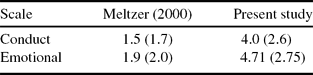
The Strengths and Difficulties Questionnaire (SDQ; Goodman, Reference Goodman1994) provided a parent self-report measure of overall levels of psychological difficulties. Four subscales (conduct problems, inattention-hyperactivity, emotional symptoms, peer problems) are summed to provide a total difficulties score.
Reliability and validity data indicate that the SDQ has utility as a brief measure of psychopathology in children and adolescents (Goodman, Reference Goodman2001). Table 1 summarizes published normative data for British 11–15 year olds (Meltzer, Gatward, Goodman and Ford, Reference Meltzer, Gatward, Goodman and Ford2000) and scores from the present study. This suggests that participants were experiencing higher than normal levels of both emotional and conduct problems.
Means and standard deviations for parent report Strengths and Difficulties scale

Recruitment
Participants were recruited from four services from incoming referrals. Following guidelines issued by local ethics committees and specific services, potential participants were either contacted by letter or approached directly by their clinician and invited to participate in the research. Response rates were higher for services approaching families directly; only two families declined to participate. For services requiring families to return an opt-in slip to the researcher, uptake ranged from 18–36%. Both mother and young person's consent was required prior to participation.
Measures
Five Minute Speech Sample (FMSS; Magana et al., Reference Magana, Goldstein, Karno, Miklowitz, Jenkins and Falloon1986). The mother was asked to speak uninterrupted for 5 minutes about the adolescent and “how they get along together”. Speakers are not aware of the methods of coding verbal and non-verbal elements when completing the task. This was audio-taped and later coded for criticism. Other ratings can be made from this sample though evidence shows most support for the role of criticism in relationship to child symptomatology (Frye and Garber, Reference Frye and Garber2005). Criticism is defined as a frequency count of negative comments regarding the person's behaviour and/or personality. Criticism can be scored on the basis of critical content and/or critical tone. Examples of critical comments include “He gets me so mad when he says those things” and “She is constantly moody and it gets on my nerves”. Tone of voice is taken into account in coding.
A body of literature has emerged demonstrating validity of the FMSS and good inter-rater agreement with child and adolescent samples (Arsanow et al., 1993; Jacobsen, Hibbs and Ziegenhain, Reference Jacobsen, Hibbs and Ziegenhain2000; Marshall, Longwell, Goldstein and Swanson, Reference Marshall, Longwell, Goldstein and Swanson1990). To obtain inter-rater reliability for the criticism scale, the researcher blind-rated 15 randomly selected tapes of FMSS from a separate study of mothers of children attending psychiatric services previously rated by a criterion rater in the United States. Reliability statistics were; overall EE classification: kappa = 1, critical comments: Spearmans rSpearmans r = .91. This established the current study rater's reliability for coding FMSS for the present study. The rater had also previously achieved good levels of inter-rater reliability for extracting critical comments from an interview measure of EE (Bolton et al., Reference Bolton, Calam, Barrowclough, Peters, Roberts and Wearden2003).
In addition, correlations were conducted between investigator rated FMSS critical comments and maternal self-reports of criticism directed towards their child, as measured by a simple rating scale, similar in format to a “perceived parental criticism” scale completed by adolescents. The frequency of maternal critical comments coded from the FMSS was significantly positively related to maternal self-report ratings of child-directed criticism (Spearmans r = .41, p = .03).
Children's Depression Inventory (CDI; Kovacs, Reference Kovacs1992). The CDI was selected for the present study due to widely established reliability and validity and wide usage in the depression literature (Fristad, Emery and Beck, Reference Fristad, Emery and Beck1997; Sitarenios and Kovacs, Reference Sitarenios, Kovacs and Maruish1999). The measure included items regarding the affective, cognitive and behavioural aspects of depression. The CDI total score can range from 0–54.
Self-Perception Profile for Children: Global self-worth scale (SPP; Harter, Reference Harter1985). This was used as a measure of global negative self-evaluation. The questionnaire contains six subscales, which include global self-worth and five specific domains of perceived competence. For each item the adolescent is presented with two sentences. The adolescent must decide which of the two sentences best describes them. The adolescent then needs to decide whether this sentence is “sort of true for you” or “really true for you”. Studies have employed the SPP global self-worth scale individually in analyses (e.g. Garber et al., Reference Garber, Robinson and Valentiner1997) and the use of the global scale complemented the domain-specific self-criticism scale (SCS).
Self-Criticism Scale (SCS; adapted from Brewin et al., Reference Brewin, Andrews and Furnham1996). This measure of specific negative self-evaluation was slightly adapted from Brewin et al. (Reference Brewin, Andrews and Furnham1996) for a younger population with approval from the authors. Two questions were excluded that were not directly relevant and potentially difficult to comprehend for a younger sample. The measure required the adolescent to make ratings of negative and positive self-evaluation in the areas of appearance, behaviour with family, behaviour with friends, and schoolwork. Ratings were made on a 7-point scale anchored by “Not at all” and “A great deal”.
Perceived parental criticism: (PPC; adapted from Brewin et al., Reference Brewin, Andrews and Furnham1996). This measure was designed to be similar to the measure of self-criticism. Participants were required to rate the degree to which their mother criticized them in each of the domains described as for the measure of self-criticism. They also made global ratings of their perceptions of how much praise and criticism they received from their mother in response to “Overall, how much criticism does your mother give you?” Again, ratings were made on a 7-point scale anchored by “Not at all” and “A great deal”.
Reliability analyses
There were significant associations between the measures of negative self-evaluation. SPP global self-worth was significantly negatively related to domain-specific self-criticism (r = ˗.51, p = .008). This provided some evidence for the validity for the measure of self-criticism obtained from scales adapted from Brewin et al. (Reference Brewin, Andrews and Furnham1996).
Good levels of internal reliability were demonstrated for negative scales of the perceived criticism (PPC) and the self-criticism (SCS) measure. Item-total correlations (coefficient alpha) were in the range.73 to.77, which is within the desirable range (Streiner and Norman, Reference Streiner and Norman1995). However, fewer scale items entail lower expected alpha values and for the present scales, item total equalled four. Brewin et al. (Reference Brewin, Andrews and Furnham1996) have also argued that the focus on specific roles and qualities within the measure would preclude very high levels of internal reliability. Given these considerations, the alpha values obtained in the present analyses appear acceptable.
Following Brewin et al. (Reference Brewin, Andrews and Furnham1996), ratings for each domain were summed to yield overall scores (domain specific self-criticism and domain-specific perceived maternal criticism), with higher numbers indicating greater negative evaluation (Brewin et al., Reference Brewin, Andrews and Furnham1996).
Procedure
The mother and young person were interviewed independently with administration of the FMSS with the mother by one of the authors of the study (CB). Completion of self-reports by the adolescent was supported by a research assistant. Questionnaires were completed in random order to reduce any potential effect of questionnaire order.
Results
Parametric and non-parametric statistics were applied as appropriate to the distribution of the variables; where variables have been transformed this is indicated in the text. Descriptive statistics are presented, followed by correlational and regression analyses as outlined by Baron and Kenny (Reference Baron and Kenny1986).
Maternal criticism
FMSS EE criticism. Mothers made a mean number of 1 critical comment (SD = 2.58, range 0–8). Twenty-one (75%) mothers made no critical comments. Recent studies with children of varying levels of risk have found the mean number of critical comments to be less than one (Kim Park, Garber, Ciesla and Ellis, Reference Kim Park, Garber, Ciesla and Ellis2008; Nelson et al., Reference Nelson, Hammen, Brennan and Ullman2003). Due to the relatively high percentage of mothers who scored 0 on the critical comments scale, the resulting distribution was highly positively skewed and it was not possible to transform the data to a normal distribution. Thus, analyses for this scale were confined to non-parametric statistics.
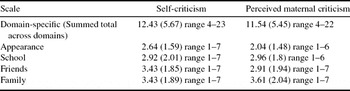
Perceived maternal criticism (PPC). For global ratings of perceived maternal criticism, the mean score was 2.82 (SD 1.63) with range 3–7. For domain-specific ratings the mean score was 11.56 (SD5.46) with range 4–22. Table 1 summarises scores for total domain-specific ratings and by individual domains.
Adolescent self-evaluation
Global self-worth scale (SPP). Two adolescent males completed the questionnaire incorrectly despite offered assistance. Thus, N is reduced by 2 for analyses employing this scale. The overall group mean for the SPP global self-worth scale was 2.87 (SD.69), slightly above the midpoint for the scale (2.5) and roughly similar to the mean for normative samples: approximately 3 with SD .51 –.88 (Harter and Whitesell, Reference Harter and Whitesell1996). Scores range from 1–4 and scores between 1 and 1.75 are viewed as reflecting very low self-esteem (Harter, Reference Harter and Baumeister1993).
Self-criticism (SCS). Domain-specific scores (scores totalled across 4 domains) are summarised in Table 2.
Means and standard deviations for self-criticism and perceived maternal criticism

Adolescent depression
CDI. Mean CDI score was 12.39 (SD = 8.45, range 3–33). Cut-off points of 12 or 13 have been suggested for clinical samples as indicative of levels of depressive symptomatology consistent with the presence of diagnosable depressive disorders (Kovacs, Reference Kovacs1992). Eleven (39%) of the adolescents scored 12 or above on the CDI.
CDI scores were positively skewed and therefore transformed using natural log transformation. In order to test specificity for depressive symptoms, one previous study excluded two items reflecting self-esteem and three relating to conduct symptoms from total CDI score. They also excluded the item reflecting suicidal ideation for practical reasons (Robinson et al., Reference Robinson, Garber and Hilsman1995). For the present study, CDI scores excluding self-esteem items and CDI scores excluding externalizing items were created. Analyses were replicated with the modified CDI scores and there were no differences in the results obtained. Thus, analyses used the unmodified CDI. Independent t-tests confirmed no significant gender differences in negative self-evaluation or depression scores: SPP global self-worth scores (t = −1.6, p = .12), self-criticism summed domain scores (t = .56, p = .58), CDI scores (t = 1.38, p = .18).
Negative self-evaluation as a mediator between parental emotional attitudes and adolescent depression
Parental emotional attitudes and adolescent depression. Due to non-normal distributions, a Spearmans correlation was used to examine correlations between maternal EE criticism and CDI scores. There was no significant correlation between EE criticism and CDI scores (Spearmans r = .24, p = .20). Similarly, there was no significant correlation between domain-specific ratings of perceived maternal criticism and CDI scores (r = .29, p = .13). However, global ratings of perceived maternal criticism by adolescents were significantly positively related to CDI scores (r = .41, p = .03).
Parental emotional attitudes and adolescent negative self-evaluation. Two measures of self-evaluation were included in the present study, SPP global self-worth and self-criticism. Maternal EE criticism was not significantly related to either the SPP global self-worth scale (Spearmans r = −.11, p = .59) or self-criticism (Spearmans r = .10, p = .62).
Perceived domain-specific maternal criticism was positively associated with self-criticism (r = .55, p = .003). Global perceived maternal criticism was also positively related to self-criticism, though this relationship fell marginally below conventional significance levels (r = .37, p = .05). There were no significant relationships between perceived maternal criticism and SPP global self-worth ratings.
Adolescent depressive symptoms and negative self-evaluation. As predicted, scores on the CDI were significantly negatively related to SPP global self-worth (r = −.69, p <.001) and significantly positively related to self-criticism (r = .53, p = .004). Thus, higher ratings of depressive symptoms were associated with lower global self-worth and higher levels of self-criticism.
Mediational model of perceived maternal criticism – adolescent negative self-evaluation – adolescent depression
The model proposed that parental emotional attitudes influence adolescent negative self-evaluation, which is associated with the presence of depressive symptoms. However, since there was no association between maternal EE criticism and negative self-evaluation this model was not fully supported. There was an association between perceived maternal criticism and negative self-evaluation and this could have been accounted for by the impact of the mother's criticism on the child. Alternatively, the reverse might be true with adolescent depression serving to influence negative self-evaluation and, possibly, perceived maternal criticism. Both models were tested to explore this possibility.
Correlational analyses confirmed predicted associations between perceived maternal criticism and negative self-evaluation, perceived maternal criticism and depressive symptomatology, and negative self-evaluation and depressive symptomatology. The relationship between perceived maternal criticism and adolescent self-criticism was marginally below conventional significance (p = .05). Regression analyses were conducted to test the mediational hypothesis whereby negative self-evaluation mediated the relationship between perceived maternal criticism and depressive symptoms.
Preliminary individual regression analyses confirmed perceived maternal criticism predicts self-criticism (β = 1.29, t = 2.04, p = .05) and that both perceived maternal criticism (β = .072, t = 3.3, p = .03) and self-criticism (β = .0027, t = 3.19, p = .004) significantly predicted depressive symptomatology. When perceived maternal criticism was regressed on depressive symptomatology controlling for negative self-evaluation, the relationship between perceived maternal criticism and depressive symptomatology was reduced and became non-significant (reduced from β = .072, t = 3.3, p = .03 to β = .043, t = 1.4, p = .17). Negative self-evaluation remained a significant predictor of depressive symptomatology (β = .021, t = 2.49, p = .02). Thus, negative self-evaluation mediates the relation between perceived maternal criticism and adolescent depression.
Depression as a predictor of negative self-evaluation
In the original mediational model, perceived maternal criticism influences negative self-evaluation, which is associated with depression. Within mediator models there is an assumption that the dependent variable (depression) does not cause the mediator (self-evaluation). However, it always remains possible that the mediator and the dependent variable role have been assigned to the wrong variables (Baron and Kenny, Reference Baron and Kenny1986). One possible model is a reverse causality model whereby adolescent depression influences negative self-evaluation.
A standard multiple regression analysis was conducted seeking to predict self-criticism. Only depression remained a significant predictor when perceived maternal criticism and depression were entered simultaneously. Depression significantly predicted self-criticism (β = 8.9, t = 2.49, p = .02) accounting for 26% of the variance in self-criticism (adjusted r 2 = .26).
Additional evidence for the key role of depression in understanding observed relationships between perceived parental criticism and negative self-evaluation was provided by partial correlations controlling for depression in the relationship between perceived maternal criticism and negative self-evaluation. The relationship between perceived maternal criticism and self-criticism became non-significant (from r = .37, p = .05 to r = .19, p = .34) when CDI scores were controlled.
Taken together, these analyses support a potential model whereby depression may influence self-evaluation and may also play a role in explaining the associations among perceived criticism, negative self-evaluation and depression.
Discussion
This study is one of the first to examine relationships between independently rated parental EE and perceived EE in depressed adolescents. A model of relationships between parenting, negative self-evaluation and depression was tested. Specifically, the model proposed that adolescent negative self-evaluation would mediate the relationship between measures of parenting and adolescent depression. There was partial support for the main hypotheses; ratings of perceived maternal criticism were significantly associated with both adolescent negative self-evaluation and depression and these relationships formed the basis for testing the hypothesized mediator model. The present study offered support for a mechanism whereby perceived parenting might create cognitive vulnerability to depression. There was also evidence supporting a model that perceptions of parenting may become internalized in the form of negative self-evaluation, which then predisposes the adolescent to depressive symptomatology.
However, data also supported an alternative mechanism whereby depression influences negative self-evaluation and perceptions of parenting. Depression might influence negative self-evaluation, and potentially influence the relationship between perceived criticism and negative self-evaluation. When this alternative model was explored, there was evidence for the role of depression in accounting for the relationships between perceptions of parenting and negative self-evaluation. Depression emerged as the only significant statistical predictor when depression and perceived parenting were simultaneously entered into a regression analysis seeking to predict self-criticism.
As this is a cross-sectional study, directions of causality cannot be stated with certainty. However, a model where depression may influence negative self-evaluation is consistent with longitudinal data showing that child self-reports of depression are predictive of changes in negative self-evaluation over time (McGrath and Repetti, Reference McGrath and Repetti2002). Depression was involved in the relationship between perceived criticism from the parent and negative self-evaluation. Within the alternative model, depression might act to cause increased negative self-evaluation. Negative self-evaluation could then predispose the individual to process social experiences in a manner consistent with their self-worth so that parental experiences are more likely to be perceived as critical. This is consistent with theory and evidence indicating that self-congruent information is attended to and remembered and information that is incongruent with the self-concept is rejected (Markus, Reference Markus1977; Markus and Wurf, Reference Markus and Wurf1987).
There may be a circular process where perceived parental criticism causes further devaluing of the self, in turn contributing to lower mood and increased depressive symptoms. Within this model, depression would play a central role in influencing negative appraisal of the self and social experiences (e.g. Beck, Rush, Shaw and Emery, Reference Beck, Rush, Shaw and Emery1979). This offers no information on developmental origins of depression but has explanatory value for factors likely to maintain adolescent depressed mood. Cognitive models assume that cognitions cause depression but such cognitions can be a symptom or consequence of depressed affect (Coyne and Gotlib, Reference Coyne and Gotlib1983).
Contemporary theories of developmental mechanisms underlying the expression of cognitive vulnerability have focused on reciprocal links between cognition structures and the experience of affect (e.g. Ingram, Miranda and Segal, Reference Ingram, Miranda and Segal1998; Ingram and Ritter, Reference Ingram and Ritter2000). Our finding of support for the alternative hypothesis is consistent with theory describing reciprocal causal relations between cognitive constructs and depression that serve to maintain depression once established (Teasdale, Reference Teasdale1983).
One unique aspect of this study was the combined use of investigator-ratings (EE) and adolescent ratings of parenting variables. Contrary to predictions, there were no significant relationships between interviewer-elicited EE and negative self-evaluation or between EE and depression. Perceptions of parenting rather than investigator ratings were most closely related to self-evaluation and depression. This is consistent with findings where ratings of perceived spousal criticism, rather than spousal EE were the best predictor of relapse in depression (Hooley and Teasdale, Reference Hooley and Teasdale1989).
The present findings strongly support symbolic interaction theory, which postulates that a person's perception of the views of others affects self-evaluation (Cooley, Reference Cooley1902; Mead, Reference Mead1934). The literature recommends the use of measures assessing parental experiences and emotions unique to particular children (e.g. Rapee, Reference Rapee1997; Rutter, Reference Rutter1999; Wamboldt and Wamboldt, Reference Wamboldt and Wamboldt2000). Within this study, independently measured maternal EE made a minimal contribution to predicting outcomes of interest. The pattern of results in this study indicated that it was the adolescents' reconstructions of parental experiences that were significant in contributing to mood.
Limitations
An important consideration is that depression might be influential across all adolescent self-reports. For instance, depressed mood may have negatively biased ratings of self-evaluation and perceived criticism, thus causing the observed relationships among the variables. From the limited evidence available to date, reports of childhood experiences are unaffected by mood (Brewin, Andrews and Gotlib, Reference Brewin, Andrews and Gotlib1993) although this conclusion is based on retrospective material reported by adults and it is not clear whether this conclusion would generalize to adolescent samples reporting on current experiences of parent-child relationships. Self-report measures of depression might also risk measuring non-specific distress.
The causal relationship between self-evaluation and depression remains controversial (Coyne, and Gotlib, Reference Coyne and Gotlib1983; Teasdale, Reference Teasdale1983). Low self-esteem may be a symptom or correlate of depression, self-esteem may predict depression onset or depression may result in lowering of self-esteem over time. Causal modelling suggests both variables are mutually influential although the relationship might be more highly influenced by the effect of depression on self-esteem (Rosenberg, Reference Rosenberg1995), although this could also be due to the potential influence of depression on measurement of self-esteem.
There are other considerations that limit the conclusions that can be drawn. This study was correlational, precluding statements on causality. Hence, while we can draw some inferences based on statistical prediction, our ability to draw conclusions is limited, and detailed longitudinal studies would be preferable. Other processes are likely to influence adolescent self-evaluation and depression; we offer the proposed models as possible explanations for how family relationships might be influential in adolescent depression. Furthermore, this exploratory study only examined possible relationships within a depressed group. It cannot be assumed that these findings would extend to non-depressed adolescents, and a comparison with a non-depressed group would be valuable; indeed, different processes might be observed.
However, adolescent self-reports of depressive symptoms indicated that only 39% scored above the cut-off for consideration of significant depressive symptoms. It is possible that within a sample where depression was more closely assessed via clinical interview, depression may have shown an association with interview-elicited EE.
We employed a convenience clinical sample and hence need to be cautious about the generalizability of our findings. Families with the most distressed relationships may not have opted into the study because of the degree of cooperation necessary to participate. Inclusion criteria may have led to sampling a range of psychological difficulties, which may mask effects specific to particular types of problems. It also cannot be assumed that the findings from the present study apply to adolescents from different cultural backgrounds or across gender.
As with related studies (see McCleary and Sanford, Reference McCleary and Sanford2002), because of the small sample size the findings require replication. However, retrospective analyses have indicated that the sample size is likely to be sufficient, due to the small differences observed. Based on the observed difference in self-criticism scores for these adolescents from low and high EE families, analyses indicate that for the study to have 80% power to detect the observed difference in scores to be statistically significant, an overall sample of 1,748 would have been required. With respect to measurement, the validity of the FMSS criticism scale has been supported but some have questioned the validity of the EE classification (Kershner, Cohen and Coyne, Reference Kersner, Cohen and Coyne1996; Van Furth et al., Reference Van-Furth, van Strien, van Son and van Engeland1993; Wamboldt, O'Connor, Wamboldt, Gavin and Klinnert, Reference Wamboldt, O'Connor, Wamboldt, Gavin and Klinnert2000). Findings for the criticism scale only are reported here, and we found that EE classification added little to the overall findings.
The questionnaires used to rate criticism and self-criticism would benefit from further psychometric evaluation.
Implications
This study suggests that adolescents' perceptions of relationships show important links with negative self-evaluation and depressive symptoms. The process whereby children and adolescents translate parenting experiences into perceptions that may have an impact upon their self-evaluation and risk for depression is an important focus for future research. Evidence highlights the mutual influence of parents and children in determining child outcomes (e.g. Hammen, Burge and Stansbury, Reference Hammen, Burge and Stansbury1991) and behavioural observations would contribute to understanding parent-child interaction and risk for adolescent depression (Allen et al., Reference Allen, Insabella, Porter, Smith, Land and Phillips2006). Measuring the mutual contributions of parent and child would offer more valid assessments of relationships associated with adolescent vulnerability. Future research might also consider alternative measures of the quality of parent-child relationships. Attachment security is linked to negative self-evaluation and depressive symptoms in adults (Roberts et al., Reference Roberts, Gotlib and Kassel1996) and recent literature has highlighted the potential importance of attachment in understanding adolescent depression (Shaw and Dallos, Reference Shaw and Dallos2005; Shirk, Gretchen, Gudmundsen and Burwell, Reference Shirk, Gudmundsen, Gretchen and Burwell2005; Smith, Calam and Bolton, Reference Smith, Calam and Bolton2009). This may provide a conceptual framework for understanding how cognitive vulnerability develops.
Understanding the degree of exposure to negative experiences necessary to cause adverse outcomes and protective factors would also be useful. Emotional maltreatment involves explicitly supplying negative cognitions to the child (Rose and Abramson, Reference Rose, Abramson, Cichetti and Toth1992). Different levels of emotional expression in parenting and their relation with self-cognitions should be explored further alongside the processes determining how parental behaviours are perceived by the adolescent.
Further exploration of other potential mechanisms accounting for the relationship between parenting and risk of depression might also include observations of parental comments in relation to their own self (Hammen et al., Reference Hammen, Burge and Stansbury1991; Garber and Flynn, Reference Garber and Flynn2001; Goodman and Gotlib, Reference Goodman and Gotlib1999). There would be value in further examination of models linking parenting, risk for depression and adolescent attribution and coping styles (Muris, Schmidt, Lambrichs and Meesters, Reference Muris, Schmidt, Lambrichs and Meesters2001) and of the ways in which different aspects of cognitive vulnerability interrelate to determine risk for depression. Identification of the relative contribution of experiences with different family members or peers to risk for depression would be of value to clinicians. Future research should also seek to assess different aspects of the self-esteem construct (for example, stability, future selves, Roberts and Monroe, Reference Roberts and Monroe1994) and consider alternative methodologies for capturing cognitive vulnerability. An enhanced understanding of the psychological impact of family relationships and the mechanisms accounting for risk for depression should inform the future understanding contributing to effective therapeutic and preventative interventions with young people and their families and communities.



Comments
No Comments have been published for this article.