Preserving bone health throughout aging is a crucial factor for maintenance of independence and functional capacity in activities of daily living (Burger et al., Reference Burger, De Laet, Van Daele, Weel, Witteman, Hofman and Pols1998) and for lowering risk of osteoporosis and fragility fractures (Sànchez-Riera et al., Reference Sànchez-Riera, Wilson, Kamalaraj, Nolla, Kok, Li and March2010). Mechanical loading through physical activity promotes the accumulation and preservation of bone mineral density (BMD) throughout the life cycle (Dalén & Olsson, Reference Dalén and Olsson1974); however, factors such as age, gender, diet, sedentary lifestyles, illness, and injury can all contribute to a decline in skeletal health, and place individuals at risk for developing osteoporosis later in life (McGraw & Riggs, Reference McGraw and Riggs1994). As osteoporosis progresses, individuals are at increased risk for fracture and disability. After an initial fracture, the risk for further fractures is fivefold, advancing the severity of osteoporosis and creating a vicious cycle (Lindsay et al., Reference Lindsay, Silverman, Cooper, Hanley, Barton, Broy and Stracke2001; Kanis et al., Reference Kanis, Johnell, De Laet, Johansson, Odén, Delmas and McCloskey2004). As disability increases in osteoporotic populations, it becomes increasingly challenging to provide a sufficient mechanical load to the skeleton to preserve normal bone metabolism, creating a need for medical intervention. Osteoporosis risk is inversely correlated with satisfaction and quality of life (Martin et al., Reference Martin, Sornay-Rendu, Chandler, Duboeuf, Girman and Delmas2002). If the skeleton of older adults can be preserved as they age, it may allow for more physically active, independent, and fulfilling lives.
Endogenous growth hormone (GH) is released by the pituitary gland and is responsible for the growth, maintenance, and repair of almost all tissues in the body, explaining how hypopituitary populations are at high risk for osteoporosis and other musculoskeletal and systemic illnesses (Beshyah et al., Reference Beshyah, Thomas, Kyd, Sharp, Fairney and Johnston1994). GH mediates bone metabolism through both formation and resorption, acting directly on osteoblastic GH receptors to stimulate formation, and indirectly by GH-mediated insulin-like growth factor I (IGF-I) (Ohlsson, Bengtsson, Isaksson, Andreassen, & Slootweg, Reference Ohlsson, Bengtsson, Isaksson, Andreassen and Slootweg1998). It is not known exactly how GH affects bone resorption, but recent animal studies show that GH induces osteoclast differentiation in vitro, increasing the potential for resorption (Nishiyama et al., Reference Nishiyama, Sugimoto, Kaji, Kanatani, Kobayashi and Chihara1996).
GH secretion is known to decline with age (Corpas, Harman, & Blackman, Reference Corpas, Harman and Blackman1993). This phenomenon, known as somatopause, typically begins at a low rate in early adulthood once appendicular and axial skeletal growth ceases. GH levels decrease yearly, following a pattern of exponential decay, eventually reaching asymptotic serum levels in late adulthood (Anawalt & Merriam, Reference Anawalt and Merriam2001). The decline of serum GH levels is associated with sarcopenia, thinning of the skin (Rudman et al., Reference Rudman, Feller, Nagraj, Gergans, Lalitha, Goldberg and Mattson1990), dynapenia, visceral fat accumulation, insulin sensitivity (Mitchell et al., Reference Mitchell, Williams, Atherton, Larvin, Lund and Narici2012), arteriosclerosis, osteoporosis (Wüster, Slenczka, & Ziegler, Reference Wüster, Slenczka and Ziegler1991), and other age-related health issues. There has been extensive research on the “anti-aging” effects of recombinant human GH on several health-related conditions, including strength, body composition, bone health, lipid profile, and glucose metabolism with somewhat encouraging effects, but which do not reach statistical significance (Liu et al., Reference Liu, Bravata, Olkin, Nayak, Roberts, Garber and Hoffman2007). GH treatment also includes common adverse effects previously seen in GH-deficient subjects, including joint pain, edema, arthralgia, carpal tunnel syndrome, and reduced insulin sensitivity (Takala et al., Reference Takala, Ruokonen, Webster, Nielsen, Zandstra, Vundelinckx and Hinds1999), that appear to be dose-dependent (Rosen, Johannsson, Johannsson, & Bengtsson, Reference Rosen, Johannsson, Johansson and Bengtsson1995).
Recent research suggests significant improvements in body composition are obtained with the use of GH (Liu et al., Reference Liu, Bravata, Olkin, Nayak, Roberts, Garber and Hoffman2007), often resulting in a reduction of fat mass and an increase in lean body mass. Despite the improvements in body composition, the evidence is unclear as to how exogenous GH affects BMD, especially in older populations (Barake, Klibanski, & Tritos, Reference Barake, Klibanski and Tritos2014). Some research suggests that recombinant human GH treatment in GH-deficient patients initially results in a decrease in BMD, but requires long-term treatment durations to accrue net increases in BMD (Ohlsson et al., Reference Ohlsson, Bengtsson, Isaksson, Andreassen and Slootweg1998). Although endogenous GH is a known anabolic catalyst in healthy bone metabolism, exogenous GH treatment for osteoporosis still remains inconclusive as to whether it improves bone density or fracture rates, and if potential benefits outweigh the risk for adverse events.
Previous systematic reviews have evaluated the effects of growth hormone on bone metabolism in GH-deficient subjects (Liu et al., Reference Liu, Bravata, Olkin, Nayak, Roberts, Garber and Hoffman2007; Barake et al., Reference Barake, Klibanski and Tritos2014). Existing reviews have specifically excluded populations diagnosed with osteoporosis. Additionally, previous reviews have not assessed study quality using validated quality assessment tools. Therefore, the current evidence must be reviewed to address the clinically relevant question of GH treatment for osteoporotic and at-risk populations. The purpose of the present systematic review with meta-analyses was to investigate the effect of recombinant human GH on BMD, bone metabolism, fracture risk, and adverse events in persons age 50 or older living with osteoporosis and osteopenia, who are otherwise pituitary-healthy subjects.
Methods
Literature Search
The following electronic search databases were systematically reviewed from their inception to November 2015: MEDLINE, EMBASE, Web of Science, Scopus, CINAHL, and SPORTDiscus. Combined and truncated keywords and subject headings were used such as “osteoporosis OR fragility fracture” AND “bone mineral density OR osteocalcin” AND “growth hormone” AND “randomized controlled trial”. A full example of a search strategy is provided in Appendix 1. Reference lists of potentially eligible articles were manually searched for additional studies to include in the review.
Study Selection
Randomized controlled trials (RCTs) were included that compared GH therapy to placebo, bisphosphonates, sex hormone replacement, exercise, or no treatment. Studies with a mean sample age of 50 years or more, provided data on bone mineral density (BMD), and in people with osteoporosis, osteopenia, or a condition that negatively affects bone metabolism were included. We used an age cutoff of 50 years to represent the approximate age of menopause onset in North America and Europe (Palacios, Henderson, Siseles, Tan, & Villaseca, Reference Palacios, Henderson, Siseles, Tan and Villaseca2010), which comes with a substantial increase in osteoporosis risk due to the reduction of estrogen levels (Richelson, Wahner, Melton III, & Riggs, Reference Richelson, Wahner, Melton and Riggs1984). Studies that used GH secretagogues, which did not identify BMD as an outcome measure, or where the mean sample age was less than 50 years, were excluded. Two authors, blinded to journal title and authorship, independently reviewed the eligibility of each article in two stages. First, all titles and abstracts were reviewed. Studies that met the inclusion criteria, according to both authors, were obtained as full-text manuscripts for further review. Disagreements between reviewers were discussed and a consensus was achieved. Details of the literature search are reported using the Preferred Reporting Items for Systematic Reviews and Meta-Analyses (PRISMA) guidelines (Liberati et al., Reference Liberati, Altman, Tetzlaff, Mulrow, Gøtzsche, Ioannidis and Moher2009). A summary of the PRISMA guidelines can be found in Appendix 2.
Data Extraction
The primary outcome measures of interest were lumbar and femoral neck BMD. Secondary outcome measures included bone metabolism, fracture, and adverse events. Data were extracted by one author using an extraction form, and then reviewed by another author to ensure accuracy. Disagreements between reviewers were discussed and a consensus was achieved. Independent authors extracted means and standard deviations pre- and immediately post-intervention, or mean differences, for the primary outcomes. The same reviewers also extracted the following information from each article: study design, sample size, patient demographics, osteoporosis and menopause status, treatment type and duration, and GH dosage. Data on adverse events, bone metabolism biomarkers, and fracture history were also extracted. Authors were contacted when sufficient data were not reported. If data were not provided, estimates were made from figures when available.
Quality Assessment
Two reviewers independently evaluated the methodological quality of each study using the Cochrane Risk of Bias Tool (Higgins et al., Reference Higgins, Altman, Gøtzsche, Jüni, Moher, Oxman and Sterne2011), consisting of seven items to assess the internal validity of each study (sequence generation, allocation concealment, blinding of patients and outcome assessors, outcome reporting, selective reporting, and other sources of bias). Each item was evaluated as a low, unclear, or high risk of bias. We assessed the strength of the clinical recommendation and the quality of the evidence using the Grading of Recommendations, Assessment, Development and Evaluations (GRADE) approach (Guyatt et al., Reference Guyatt, Oxman, Vist, Kunz, Falck-Ytter, Alonso-Coello and Schünemann2008). A strong, moderate, or weak recommendation for lumbar and femoral neck BMD was determined for or against GH treatment. Disagreements were discussed and a consensus was achieved.
Data Analysis
Agreement between reviewers was calculated using the kappa (κ) statistic. Pooled estimates and 95 per cent confidence intervals (95% CIs) for standardized mean differences (SMDs) for increases in lumbar and femoral neck BMD were calculated using random-effects models. The SMD was calculated using the difference in BMD change between the GH treatment group and the comparator group divided by the pooled standard deviation (SD). Reported sample sizes, pre- and post-intervention means and standard deviations, or mean differences, were used. Sensitivity analyses were performed to evaluate the effect of multiple comparisons within a single study on the overall pooled effect size. We randomly selected a single comparison from each study and included it in the analysis. This resampling technique was then repeated in various combinations of studies. Publication bias was assessed using the Egger’s Regression test (Rothstein, Sutton, & Borenstein, Reference Rothstein, Sutton, Borenstein, Rothstein, Sutton and Borenstein2006), and if present, further analyses were planned to explore treatment effects adjusted for selective reporting. Heterogeneity was assessed using the I2 statistic and Q statistic (Higgins, Thompson, Deeks, & Altman, Reference Higgins, Thompson, Deeks and Altman2003). Heterogeneity was evaluated by meta-regression using five study characteristics identified a priori including participant age, GH dosage, treatment duration, postmenopausal status, or diagnosis of osteoporosis. We performed additional sensitivity analyses to investigate potential differences in effect sizes between persons diagnosed with osteoporosis or osteopenia.
Data for secondary outcomes including fracture, bone metabolism biomarkers, and adverse events were collected based on author reporting. Fracture data were extracted for fractures reported before, during, and after treatment where available. Bone metabolism biomarker data were extracted based on author reporting, and expressed as no change, nonsignificant change, or significant change. We assessed adverse events following GH treatment quantitatively from risk differences using the number of events and total sample size for each study group. Each meta-analysis was performed using the Comprehensive Meta-Analysis software program (V3, Biostat; https://www.meta-analysis.com/). All statistical tests were conducted at a significance level of p < .05, or the 95 per cent CI failed to cross the line of no significance.
Results
Study Selection and Article Screening
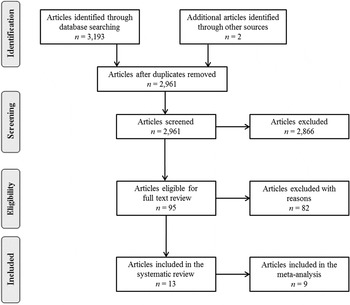
After we removed duplicates, the database searches identified 2,959 articles, plus an additional two articles that were identified during our manual search. After title and abstract reviews, 2,866 articles were excluded, and 95 articles were obtained for full-text review. Of the 95 articles, 13 articles met our inclusion criteria (Figure 1). Inter-rater agreement was very good to excellent for determining eligibility of title and abstract (κ = 0.954) and full-text manuscripts (κ = 0.895). Full-text manuscripts were excluded for the following reasons: age less than 50 years or unclear (n = 42), review article (n = 15), no GH-only treatment group (n = 5), GH-deficient patients only (n = 5), alternate study design (i.e., prospective cohort [n = 4], cross-sectional [n = 1]), BMD not assessed (n = 3), not in English (n = 3), and a duplicate population (n = 1). Articles included in the systematic review but excluded from the meta-analysis either lacked sufficient quantitative data (n = 4) or were from a duplicate population of another included article (n = 2).
PRISMA (Preferred Reporting Items for Systematic Reviews and Meta-Analyses) flowchart quantifying studies accepted and rejected at different phases of review

Study Characteristics
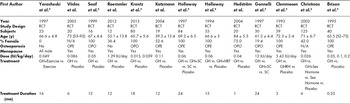
Characteristics of all studies included in the systematic review are described in Table 1. A total of nine studies were included in the meta-analysis, including data from 472 patients (353 females, 119 males). The mean age was 67.1 years (SD = 6.0, range = 24–88). All studies included menopausal women, other than one study that included all males. Four studies included patients with osteopenia, three included patients with osteoporosis, one did not report osteoporosis status, and one included patients at risk for developing osteopenia or osteoporosis.
Characteristics of studies’ subjects included in the systematic review and meta-analysis

GH = growth hormone; GHRH = growth hormone releasing hormone; HRT = hormone replacement therapy; IU = international units; OPE = osteopenia; OPO = osteoporosis; RCT = randomized controlled trial; SC = salmon calcitonin
* included in the meta-analysis
Quality Assessment
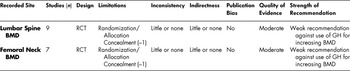
Inter-rater agreement for the Cochrane Risk of Bias tool was moderate (κ = 0.460). Disagreements were more frequent in studies with unclear and high risks of bias. Consensus was achieved following discussion of disagreements. The consensus ratings are reported in Appendix 1. Table 2 summarizes the quality of evidence using the GRADE. Although the overall quality of evidence was moderate, effect sizes were low with significant risk for adverse events. Therefore, there is a weak recommendation for the use of recombinant GH for increasing lumbar spine and femoral neck BMD.
Quality assessment (Grading of Recommendations, Assessment, Development and Evaluations; GRADE) of studies included in the meta-analysis

BMD = bone mineral density; GH = growth hormone; RCT = randomized controlled trial
Treatment Effect Sizes for Lumbar BMD
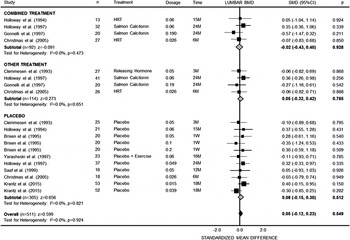
An overall pooled effect size for all studies and all comparisons was small (SMD = 0.05 [95% CI: –0.1207, 0.23], p = .549; I2 = 0.0%, p = .924) suggesting that GH has little to no effect on lumbar BMD in patients with or at risk for osteoporosis (Figure 2). Sensitivity analyses removed multiple comparisons from individual studies such that only one comparison per study was included in the overall pooled effect size. This resampling technique was repeated in various combinations with little to no change in treatment effect for lumbar BMD (SMD = –0.02–0.11). Therefore, all studies and comparisons were included for investigations of publication bias and heterogeneity. Publication bias was not significant according to the regression test (intercept = –0.96 [95% CI: –2.91, 0.99], p = .312 and there was minimal heterogeneity among studies. A meta-regression analysis examined several study characteristics that may mediate the effects of GH on lumbar BMD; however, there were no significant associations of treatment effect size with participant age, GH dosage, treatment duration, postmenopausal status, or diagnosis of osteoporosis (p = .222 – .682).
Forest plots illustrating individual and pooled effect sizes for improvements in lumbar bone mineral density (BMD) for GH treatment compared to a combined treatment, alternate treatment, or placebo. An overall pooled effect size is also illustrated. SMD = standardized mean difference; 95% CI = 95% confidence interval; HRT = hormone replacement therapy; W = week; M = month; Dosage = IU/kg/day

Nine studies in total compared the effects of GH to either a placebo (n = 8), another treatment alone (n = 4) or GH in combination with another treatment (n = 4). Regardless of the comparator group, the pooled effect sizes for GH were small and not statistically significant (Figure 2). Compared to GH plus another treatment (SMD = –0.02 [95% CI: –0.43, 0.40], p = .928; I2 = 0.0%, p = .473), another treatment alone (SMD = 0.05 [95% CI: –0.32, 0.42], p = .785; I2 = 0.0%, p = .651), or placebo (SMD = 0.08 [95% CI: –0.15, 0.30], p = .512; I2 = 0.0%, p = .821), these effect sizes did not favour GH as a treatment for increasing BMD in the lumbar spine. Importantly, there was a positive shift in effect size when GH was compared to a placebo, but this did not reach statistical significance. Heterogeneity and publication bias were not significant for any meta-analysis (p = .312 – .821).
Effect Sizes for Lumbar BMD in Persons with Osteoporosis vs. Osteopenia
Although heterogeneity was not statistically significant among studies, the pooled effect sizes for studies including participants with a confirmed diagnosis of osteoporosis were smaller than the effect sizes for participants with osteopenia. In participants with osteoporosis, the pooled effect sizes for GH compared to GH plus another treatment, another treatment alone, or placebo were SMD = –0.57, SMD = –0.27, and SMD = 0.05 respectively. In participants with osteopenia, the pooled effect sizes were SMD = 0.26, SMD = 0.19, and SMD = 0.15 respectively, suggesting GH may have a slightly different effect on lumbar BMD in patients with, versus being at risk for developing, osteoporosis.
Treatment Effect Sizes for Femoral Neck BMD
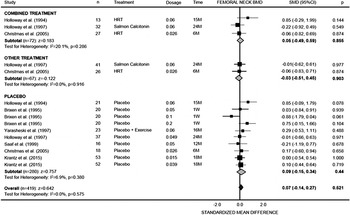
An overall pooled effect size across all studies and all comparisons was small (SMD = 0.07 [95% CI: –0.14, 0.27], p = .521; I2 = 0.0%, p = .575) suggesting that GH has little to no effect on femoral neck BMD in patients with or at high risk for osteoporosis (Figure 3). Sensitivity analyses indicated little to no change in treatment effect for femoral neck BMD (SMD = –0.03–0.13); therefore, we included all studies and comparisons for investigations of publication bias and heterogeneity. Publication bias was not significant according to the regression test (intercept = 1.15 [95% CI: –1.34, 3.64], p = .337), and there was minimal heterogeneity among studies. A second meta-regression examined the same five study characteristics. No significant associations of treatment effect size with participant age, GH dosage, treatment duration, postmenopausal status, or diagnosis of osteoporosis were observed (p = .384 – .975).
Forest plots illustrating individual and pooled effect sizes for improvements in femoral neck bone mineral density (BMD) for GH treatment compared to a combined treatment, alternate treatment, or placebo. An overall pooled effect size is also illustrated. SMD = standardized mean difference; 95% CI = 95% confidence interval; HRT = hormone replacement therapy; W = week; M = month; Dosage = IU/kg/day

Pooled effect sizes for GH on femoral neck BMD, by comparator group, were small and not statistically significant (Figure 3). Compared to GH plus another treatment (SMD = 0.05 [95% CI: –0.49, 0.59], p = .855; I2 = 20.1%, p = .286), another treatment alone (SMD = –0.03 [95% CI: –0.51, 0.45], p = .903; I2 = 0.0%, p = .916), or placebo (SMD = 0.09 [95% CI: –0.15, 0.34], p = .44; I2 = 6.9%, p = .380), these effect sizes did not favour GH as a treatment for increasing BMD in the femoral neck. Heterogeneity and publication bias were not significant for any meta-analysis (p = .119 – .753).
Effect Sizes for Femoral Neck BMD in Persons with Osteoporosis vs. Osteopenia
Although heterogeneity among studies was not explained by diagnosis of osteoporosis, the pooled effect sizes for studies including participants with a confirmed diagnosis of osteoporosis were smaller than the effect sizes for participants with osteopenia. In participants with osteoporosis, the pooled effect sizes for GH compared to GH plus another treatment, another treatment alone, or placebo were SMD = –0.06, SMD = –0.06, and SMD = 0.08 respectively. In participants with osteopenia, the pooled effect sizes were SMD = 0.22, SMD = –0.01, and SMD = 0.14 respectively, suggesting GH may have a slightly different effect on femoral neck BMD in patients with, versus at risk for developing, osteoporosis; however, these differences are less apparent than the effects on lumbar BMD.
Secondary Outcome Measures
Treatment Effects for Alternate BMD Outcomes
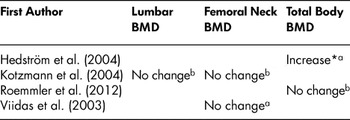
Four of the reviewed studies measuring BMD were not included in the meta-analysis. Reasons for exclusion from the meta-analysis were a lack of presented quantifiable data, lack of baseline BMD measures, presenting the data as a T-score or Z-score with no reference point or group mean, or a lack of presentation of comparator group data. Available data from those studies are reported in Table 3.
Changes in BMD and BMC in studies not included in the meta-analysis

* p < .05
BMC = bone mineral content; BMD = bone mineral density,
a = compared to control group
b = compared to baseline
Bone Metabolism Biomarkers
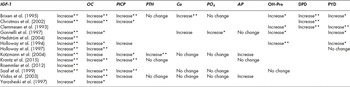
Data of reported biomarkers, which are surrogate outcomes for bone formation and resorption, were extracted as a secondary outcome measure. IGF-I, osteocalcin (OC), and type I procollagen peptide (PICP), all markers of bone formation, increased significantly in almost all treatment groups when reported. Conversely, hydroxyproline, pyridinoline, and deoxypyridinoline – all markers of bone resorption – also increased significantly in almost all studies that measured these biomarkers. Results are reported in Table 4.
Bone metabolism biomarkers (italicized and bolded biomarkers represent bone formation; un-italicized and bolded biomarkers represent bone resorption)

* p < .05, ** p < .01
AP = alkaline phosphatase
Ca = calcium
DPD = deoxypyridinoline
IGF-I = insulin-like growth factor 1
OC = osteocalcin
OH-Pro = hydroxyproline
PICP = type I procollagen peptide
PO4 = phosphate
PTH = parathyroid hormone
PYD = pyridinoline
Fracture History and Outcomes
Two studies provided a fracture history and subsequent treatment outcomes (Table 5). One of these studies performed a follow-up on their patients after treatment cessation (Krantz, Trimpou, & Landin-Wilhelmsen, Reference Krantz, Trimpou and Landin-Wilhelmsen2015), where they observed a fracture rate of 28 per cent in the treatment group seven years after treatment, improved from 56 per cent of the treatment group experiencing fragility fractures prior to treatment, a significant improvement (p < .0003). The control group’s fracture rate increased from 8 per cent to 31 per cent over the total 10 years of treatment and follow-up, a significant increase (p < .0008).
Pre- and post-treatment fracture rates at last follow-up

GH = growth hormone
Adverse Events
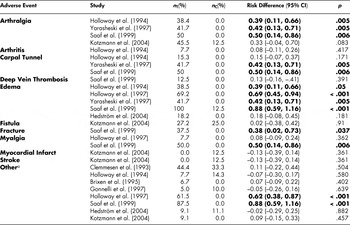
Adverse events occurred at significantly higher rates for persons receiving GH treatment (24.8 ± 28.6% in treatment groups vs. 6.1 ± 7.8% in control groups, p = .001). However, there were no consistently significant risk differences between treatment and control group across all studies (Table 6). The adverse events most commonly reported to have increased risk for persons receiving GH treatment included for arthralgia, carpal tunnel, edema, fracture, and myalgia.
Adverse event rates and risk difference between treatment and control groups

n T = proportion of adverse events in the treatment group, n C = proportion of adverse events in the control group
a “Other” adverse events include events not categorized or reported by the authors, or a rare event unlikely due to treatment.
Discussion
The results of the meta-analysis suggest that GH is not an effective treatment option to improve bone mineral density in osteoporotic or at-risk populations when compared to placebo or other known effective medical interventions. Even when combined with other treatment, the pooled evidence demonstrates that GH failed to induce a significant increase in BMD in either the lumbar spine or femoral neck. Even in the best of individual cases, the significantly higher risk of adverse events with GH treatment make it an unattractive treatment option focused on increasing BMD for those diagnosed with or at risk for osteoporosis.
No studies proved to have a significant treatment effect on lumbar or femoral neck BMD when compared to placebo. The pooled effect size favoured GH, but results were insignificant. Any other comparison of treatment, including comparison of GH to other treatments, or GH in combination with other treatments, was not statistically significant. Outside of the meta-analysis, results were similar, with only one study reporting a significant increase in BMD (Hedström et al., Reference Hedström, Sääf, Brosjö, Hurtig, Sjöberg, Wesslau and Dalén2004), and the remaining three studies reporting no significant change in BMD at the end of each respective treatment period (Kotzmann et al., Reference Kotzmann, Riedl, Pietschmann, Schmidt, Schuster, Kreuzer and Mayer2004; Roemmler, Gockel, Otto, Bidlingmaier, & Schopohl, Reference Roemmler, Gockel, Otto, Bidlingmaier and Schopohl2012; Viidas, Johannsson, Mattsson-Hultén, & Ahlmén, Reference Viidas, Johannsson, Mattsson-Hultén and Ahlmén2003). A meta-analysis from Barake et al. (Reference Barake, Klibanski and Tritos2014) reported a significant pooled treatment effect in RCTs of GH at the lumbar spine and femoral neck in adults undergoing GH therapy for 12 months or longer. Encouraging as those results may be, it is important to note that the study analysis excluded osteoporotic patients, included adults of any age, and also included GH-deficient patients. Liu et al. (Reference Liu, Bravata, Olkin, Nayak, Roberts, Garber and Hoffman2007) conducted a systematic review and meta-analysis on the effect of GH treatment in the healthy elderly (> age 50, but excluded samples with osteoporotic patients), and found no significant treatment effect of GH on BMD. An explanation for a lack of effect in our population of interest may be a lack of growth hormone receptor signal transduction in bone tissue with increased age, as seen previously in mice (Xu, Bennett, Ingram, & Sonntag, Reference Xu, Bennett, Ingram and Sonntag1995), resulting in a diminished ability to stimulate bone formation factors. Additionally, estrogen, or hormone replacement therapy (HRT), is known to inhibit GH-induced IGF-I synthesis (Leung et al., Reference Leung, Doyle, Ballesteros, Sjogren, Watts, Low and Ho2003), potentially affecting bone metabolism of postmenopausal women concurrently using GH and HRT.
Our meta-regression analysis found no significant relationship between treatment duration and change in BMD among studies included in our meta-analysis, despite treatment durations varying between one week and 24 months. The difference in treatment effect between the meta-analyses and positive effects reported by authors may lie in the comparison groups. Our meta-analysis compared the effect of GH treatment on BMD with either a placebo or other treatment (between-groups comparison), whereas many authors reported their effects in terms of change in BMD from baseline values (within-groups comparison), which could explain the lack of a time-sensitive response to GH treatment observed in our data.
Slightly larger, positive effect sizes (although still low) were observed in persons with osteopenia compared to persons with osteoporosis. These findings may suggest that those individuals with osteopenia may experience a more favourable treatment response to GH, and subjects with more advanced bone loss have a poorer metabolic response, which in this case is contrary to the epidemiologic paradigm that patients with a worse baseline status have a greater potential to benefit from treatment.
All studies recording GH-dependent IGF-I levels reported a significant increase in IGF-I, which is a positive outcome in terms of measuring bone formation. Other bone formation biomarkers include osteocalcin, type I procollagen peptide, parathyroid hormone, calcium, phosphate, and alkaline phosphatase. Significant increases in these biomarkers were observed in most studies, with some cases of no change or significant decreases (Table 4). Despite these favourable changes, increase in bone formation biomarkers were met with a high prevalence of bone resorption biomarkers. Many of the studies only reported biomarker values at the end of treatment or at a single time point. Examining the interaction of bone metabolism biomarkers over a long-term treatment period to evaluate fluctuations in bone formation and resorption, and to identify at what time point formation exceeds resorption, is warranted.
Two studies provided a record of fracture prevalence and incidence. These studies reported a reduction in fracture rate with GH treatment, and one of the studies performed a 10-year follow-up (Krantz et al., Reference Krantz, Trimpou and Landin-Wilhelmsen2015; Landin-Wilhelmsen, Nilsson, Bosaeus, & Bengtsson, Reference Landin-Wilhelmsen, Nilsson, Bosaeus and Bengtsson2003). These studies observed a significant reduction fracture incidence over the 10-year treatment and follow-up period, and a significant increase in fracture rate in the control group, suggesting that GH may have a positive clinical effect on fracture risk. Holloway, Kohlmeier, Kent, and Marcus (Reference Holloway, Kohlmeier, Kent and Marcus1997) estimated that every 2 per cent increase in BMD is predicted to reduce fracture risk by 16 per cent. Therefore, despite our lack of significant treatment effects in BMD, important reductions in fracture risk may still be occurring. Unfortunately, data on fracture incidence rates during and after GH treatment are limited. An alternative explanation for a fracture reduction is the benefits of GH to the muscular system (Welle, Thornton, Statt, & McHenry, Reference Welle, Thornton, Statt and McHenry1996), improving strength. Despite strength gains, there is no current evidence that this increase in strength translates to improved performance on functional tasks (Papadakis et al., Reference Papadakis, Grady, Black, Tierney, Gooding, Schambelan and Grunfeld1996).
The high rate of adverse events with GH treatment is concerning, especially in our population of interest, who frequently have existing co-morbidities. Despite the high rate of adverse events, most studies reported a reduction in side effects after reducing the dose.
Our review and meta-analyses were limited by the lack of clinical and patient-important outcomes. There is a substantial lack of fracture outcome data, limiting our ability to determine the effect of GH on fracture risk following treatment. BMD measurement by dual energy X-ray absorptiometry (DEXA) is also limited by the fact that it cannot measure the volumetric BMD; it is instead a function of area, which makes DEXA susceptible to imperfections in measuring BMD (Syed & Khan, Reference Syed and Khan2002). Another limitation of using DEXA to determine BMD is that DEXA measures only BMD, and misses information on bone collagen (Dougherty, Reference Dougherty1996), another highly important factor in terms of bone quality rather than quantity. Studies by Kotzmann et al. (Reference Kotzmann, Riedl, Pietschmann, Schmidt, Schuster, Kreuzer and Mayer2004) and by Viidas et al. (Reference Viidas, Johannsson, Mattsson-Hultén and Ahlmén2003) also included patients on chronic dialysis and hemodialysis, respectively, introducing the potential for co-intervention, possibly obscuring the effects of GH treatment. Other limitations include an inability to obtain more detailed data from authors, resulting in fewer studies being included in the meta-analysis. However, results of studies not included in the meta-analysis were consistent with the meta-analysis results in terms of BMD changes.
In conclusion, the present systematic review and meta-analysis suggests that GH treatment does not increase lumbar and femoral neck BMD in persons age 50 or older with ordinary pituitary function, with or at risk of osteoporosis, and that adverse events are numerous. BMD at both sites of interest showed no significant increase compared to placebo or other treatments. Adverse events occurred at a significantly higher rate during GH treatment. Fracture outcome data were minimal, but reductions in fracture rates were observed in the GH group in two studies. Based on the available evidence, GH should not be recommended for osteoporotic and at-risk populations for the purpose of increasing BMD.
Supplementary Material
To view supplementary material for this article, please visit https://doi.org/10.1017/S0714980816000696