Implications
Most of the male piglets in the European Union are surgically castrated without anaesthesia up to the age of 7 days. Earlier reports and reviews on this subject concluded that castration induces physiological and behavioural reactions indicative of pain, and also involves stress and discomfort prior to and following the procedure. This review is intended to provide an update and evaluation of research work in order to illustrate the welfare consequences of surgical castration without anaesthesia and its alternatives. The interpretative conclusions suggest further research priorities and strategies to follow for future sustainable and welfare-friendly alternatives to the current practice.
Introduction: review of recent literature on surgical castration and its alternatives
This research review constitutes an update of a previous EFSA (European Food Safety Authority) report on the welfare aspects of castration of piglets (EFSA, 2004) and a peer-reviewed review on this subject based on the EFSA Report outcome (Prunier et al., Reference Prunier, Bonneau, von Borell, Cinotti, Gunn, Fredriksen, Giersing, Morton, Tuyttens and Velarde2006). At that time it was concluded that castration induces physiological and behavioural reactions indicative of pain, and also involves stress and discomfort prior to and following the procedure. These reactions are of great magnitude during castration and the initial hours following surgical castration, but decrease rapidly thereafter; however, some behavioural alterations persist for several days. It was suggested to further evaluate methods for reducing castration related pain and other alternatives to surgical castration. In the present review we will evaluate successively surgical castration without anaesthesia, surgical castration under general anaesthesia, local anaesthesia and analgesia, immunocastration as well as raising entire males or raising only females after sperm sexing. The local destruction of testicular tissue by chemical compounds will not be evaluated in this review as there are no recent data available. It was concluded from earlier reports that this procedure is very likely to cause pain.
Surgical castration without anaesthesia
Existence of pain and stress
Characteristics of vocalisations (peak frequency, pureness and entropy of the sound) emitted by 2-week-old piglets during the surgical period of castration, and comparisons to those emitted during the pre- and post-surgical handling periods, have been analysed in detail by Puppe et al. (Reference Puppe, Schön, Tuchscherer and Manteuffel2005). They observed subtle alterations like lower entropy of high-frequency calls. Such alterations are believed to be under the control of brainstem centres that receive information from higher sensory and emotional brain areas (Manteuffel et al., Reference Manteuffel, Puppe and Schön2004). Therefore, they are probably indicators of an acute pain provoked by surgical castration. Differences in the vocal type distributions (grunting, squealing and screaming) between piglets castrated with and without anaesthesia were reported by von Borell et al. (Reference von Borell, Bünger, Schmidt and Horn2009). Piglets that were not anaesthetised during castration produced a higher proportion of screaming sounds.
Carroll et al. (Reference Carroll, Berg, Strauch, Roberts and Kattesh2006) compared profiles of cortisol, cortico-binding globulin (CBG) and free cortisol index (FCI) in surgically castrated and sham-handled pigs, with castration treatment applied between 3 and 12 days of age. Animals were previously implanted with a jugular catheter. The authors confirmed that cortisol increases during the initial hours following castration and showed that the FCI increases. They observed very limited changes in behaviour, with a trend for castrated pigs to be less active.
Very recently, Llamas Moya et al. (Reference Llamas Moya, Boyle, Lynch and Arkins2008a) confirmed that behaviour of piglets castrated at 5 days of age is modified after castration. Some modifications were detectable only during the initial hours following the surgery (less locomotion, more trembling and spasms, more ‘huddled-up’ and scratching the rump), whereas others were observable until 3 days after castration (more isolation and desynchronisation of behavioural activity, less social interaction and dog-sitting). In general, these behavioural alterations are of low or moderate extent but allow a reduction in the stimulation of the painful area by a direct effect (e.g. more huddling, less locomotion and dog-sitting) or by the avoidance of littermates (e.g. isolation and desynchronisation). The increase of scratching the rump seems paradoxical, but this behaviour may inhibit the activation of nociceptive receptors through the simultaneous activation of mechanoreceptors as suggested earlier (Hay et al., Reference Hay, Vulin, Génin, Sales and Prunier2003). In order to evaluate the reaction of the adrenal axis, and of the inflammatory system, to surgical castration, Llamas Moya et al. (Reference Llamas Moya, Boyle, Lynch and Arkins2008a) measured plasma concentrations of cortisol, pro-inflammatory cytokines (interleukin-1β (IL-1β) and tumour necrosis factor-α (TNF-α)) and acute phase proteins (haptoglobin and C-reactive protein (CRP)) just before, and at various times after, castration or handling. They did not observe any difference between castrated and sham-handled pigs for cortisol and cytokines measured at 1, 2, 3 and 4 h following castration or handling, nor for acute phase proteins measured at 12, 24, 48 and 72 h after this treatment. However, the number of pigs per sampling was low (n = 4) and animals were sampled by venipuncture, which may in itself induce a response.
Growth and health of the piglets
Carroll et al. (Reference Carroll, Berg, Strauch, Roberts and Kattesh2006) did not find any effect of castration on the growth rate of piglets during the 24 h following castration.
In order to determine whether the acute stress related to castration may be immunosuppressive, Llamas Moya et al. (Reference Llamas Moya, Boyle, Lynch and Arkins2008b) compared the behavioural and endocrine responses of castrated or intact pigs to an endotoxin challenge (lipopolysaccharide (LPS) intraperitoneal injection) given 24 days after treatment (castration or handling), on the day after weaning. The sickness behaviour response to the LPS challenge (e.g. anorexia and lower general activity) was attenuated in the castrated group, suggesting an inhibitory influence of castration on the inflammatory response that elicits this behaviour. However, the levels of cortisol and TNF-α increased equally after the LPS treatment in castrated and handled piglets, and levels of acute phase proteins (CRP, serum amyloid A) and IL-1β were modified neither by LPS treatment, nor by castration. As mentioned before, the number of pigs in this study was low (n = 4) and venipuncture may have itself induced a response.
Effect of age
When comparing piglets submitted to surgical castration at 3, 6, 9 or 12 days of age, Carroll et al. (Reference Carroll, Berg, Strauch, Roberts and Kattesh2006) observed similar increases in plasma levels of cortisol. This increase in plasma cortisol after castration was accompanied by an increase in the FCI, regardless the age of the piglets. Similarly, there was no influence of age at castration on the growth rate of the piglets during the following days.
Data from Heinritzi et al. (Reference Heinritzi, Ritzmann and Otten2006a) have shown a better wound healing in piglets submitted to surgical castration at 4 days of age compared to 7, 10 and 28 days of age.
Surgical castration with anaesthesia and analgesia
General anaesthesia
General anaesthesia by inhalation and intranasal spray
Hodgson (Reference Hodgson2007) published new data comparing isoflurane anaesthesia with sevoflurane using the liquid injection technique. Sevoflurane is a new volatile anaesthetic, which has the fastest onset and is therefore very attractive for mask induction in human anaesthesia. Anaesthesia in the piglets was, however, induced faster with isoflurane (44 s v. 47.5 s in the sevoflurane group), although recovery was slightly longer (140 s v. 122 s for sevoflurane).
Schulz (Reference Schulz2007) and Schulz et al. (Reference Schulz, Ritzmann, Palzer, Heinritzi and Zöls2007a and Reference Schulz, Ritzmann, Palzer, Otten and Heinritzi K2007b) evaluated stress effects of isoflurane anaesthesia during piglet castration by means of adrenaline and cortisol concentrations in the blood. Results showed no elevation in catecholamine concentration during isoflurane anaesthesia without castration, in comparison to handling without anaesthesia. They concluded that isoflurane anaesthesia itself does not elicit stress. However, it does not seem to suppress pain as indicated by similar degree of cortisol elevation in anaesthetised and non-anaesthetised castrated piglets. Intramuscular (i.m.) administration of the non-steroidal drug Meloxicam (0.4 mg/kg BW i.m.) reduced cortisol concentrations significantly.
The routine castration under isoflurane anaesthesia with a specially designed system was investigated in Switzerland (Kupper and Spring, Reference Kupper and Spring2008). Most piglets were anaesthetised within 84 s and castration could be performed in 92% of the piglets without any movement. Additional pain treatment (Meloxicam) was given before anaesthesia.
Carbon dioxide has been proposed as an alternative inhalation method of anaesthesia. The optimal concentration of CO2 for piglet castration was studied by Kluivers-Poodt et al. (Reference Kluivers-Poodt, Hopster and Spoolder2007) and Gerritzen et al. (Reference Gerritzen, Kluivers-Poodt, Reimert, Hindle and Lambooij2008). They found 30% oxygen combined with 70% CO2 to be the most effective. In their experiment, 25 piglets were used for evaluation of electrocardiography (ECG), blood gases and electroencephalography (EEG). Consciousness was lost after 30 s when the EEG showed suppression of theta and delta frequencies. Heart rate came close to zero during the experiment. Thirty seconds after loss of consciousness, piglets were taken out and castrated, showing no reaction in the ECG and EEG. They were awake after 59 s. When leaving the animals longer than 2 min in the CO2 chamber, one animal out of four died; incidence of deaths increased as exposure time increased.
For practical use, further research on CO2 anaesthesia is needed but the safety margin of this gas appears small. However, this is in contrast to Svendsen (Reference Svendsen2006) who had no incidence of deaths with exposure time of up to 4 min with the same concentration of gases. In his study, piglets lost consciousness in 15 s and recovered 30 to 40 s after removing them from the chamber. He counted the Fos-positive neurons in the spinal cord after castration. Piglets were castrated after 1 or 2 min exposure to the gas and demonstrated a lower number of neurons expressing Fos (1152 ± 778 Fos-positive neurons after 1 min exposure and 503 ± 641 after 2 min exposure) than in piglets castrated without anaesthesia (14 140 ± 5690 neurons) or under local anaesthesia (4760 ± 4465 neurons).
The aversiveness of CO2 exposure prior to slaughter has been reported to cause distress until loss of consciousness in slaughter pigs (EFSA, 2005; Rodríguez et al., Reference Rodríguez, Dalmau, Ruiz-de-la-Torre, Manteca, Jensen, Rodríguez, Litvan and Velarde2008) raising concerns about this technique which requires further evaluation.
The administration of an anaesthetic mixture (Ketamine, Azaperone and Climazolame) via nasal spray was investigated by Axiak et al. (Reference Axiak, Jäggin, Wenger, Doherr and Schatzmann2007). Anaesthesia was induced in 10 min and recovery was fast. Anaesthesia depth was, however, insufficient and negatively correlated with room temperature.
General anaesthesia by injection
Lahrmann et al. (Reference Lahrmann, Kmiec and Stecher2006) presented a study with injection anaesthesia (25 mg/kg Ketamine BW plus 2 mg/kg BW Azaperone i.m.) in 2340 piglets undergoing castration. Anaesthesia was easily given by an injection pistol and the analgesia was satisfactory. Recovery took 3 h and losses were reported at a level of 3% to 5%. More recent studies indicate that general anaesthesia using the same dosages of Azaperone and Ketamine, i.m. and i.v. (intravenous), was not sufficient to induce adequate depth of anaesthesia in a significant number of piglets, as measured by pedal reflex and jaw tone (Leeb et al., Reference Leeb, Gößler, Czech and Baumgartner2008) or vocalisations and withdrawal movements (Schmidt and von Borell, Reference Schmidt and von Borell2008).
Analgesia and local anaesthesia
The effects of analgesia and/or local anaesthesia were reviewed by EFSA (2004) (see also Prunier et al., Reference Prunier, Bonneau, von Borell, Cinotti, Gunn, Fredriksen, Giersing, Morton, Tuyttens and Velarde2006). It was recommended that local anaesthesia and analgesia should be used for castration of piglets. The local anaesthetic, lidocaine, injected into the testis and/or spermatic cord was considered effective in reducing acute pain induced by castration. However, the advantages (less pain at castration) and drawbacks (more handling, pain due to injection, side effects) had not been evaluated on a large scale with piglets under commercial conditions. There was also no validated protocol for the use of long-lasting analgesics which could be applied in commercial herds for reducing mid- and long-term pain due to castration. Since the review by EFSA (2004), several research groups have investigated further the consequences of the use of analgesia and/or local anaesthesia prior to castration, for the welfare of pigs.
Haga and Ranheim (Reference Haga and Ranheim2005) evaluated the analgesic effect of intratesticular and intrafunicular lidocaine injection for surgical castration in pigs under general halothane anaesthesia (in order to isolate the effect of nociceptive stimulation upon cardiovascular and EEG variables). Mean arterial blood pressure, pulse rate and EEG responses to castration were similar for intratesticular and intrafunicular administration of lidocaine but lower than those for the control group (castration without local anaesthetic). The authors concluded that injecting lidocaine into the funiculus spermaticus or into the testes is effective in reducing signs of nociception caused by castration. Moreover, the EEG and cardiovascular responses to lidocaine injection were less than the responses to castration without local anaesthesia, indicating that piglet castration without local anaesthesia is more painful than injecting lidocaine into the testis or the funiculus spermaticus.
Other studies, in which serum concentration of cortisol was used as the only indicator of pain, did not find evidence of castration-pain relief by the use of local anaesthesia. Zankl et al. (Reference Zankl, Ritzmann, Zöls and Heinritzi2007), for example, compared the wound healing process and serum concentrations of cortisol, creatinkinase (CK) and aspartataminotransferase (AST), 1, 4 and 24 h after castration/fixation in sham castrated piglets v. piglets castrated without anaesthesia v. piglets castrated with various local anaesthetics (Procaine Hydrochloride, Procaine Hydrochloride + Epinephrin, Lidocaine Hydrochloride), injected intratesticularly or intrascrotally, 15 min before surgery. The administration of local anaesthetics prior to castration showed a good tissue tolerance (CK and AST indicated no tissue damage) and did not affect the wound healing process. The rise in cortisol concentration following castration, however, was not reduced (and sometimes increased) by the use of anaesthesia, suggesting that the products offered little castration-pain relief. Zöls et al. (Reference Zöls, Ritzmann and Heinritzi2006a) also reported that intratesticular local anaesthesia with procaine hydrochloride did not significantly reduce cortisol levels 1 and 4 h after castration.
Heinritzi et al. (Reference Heinritzi, Zöls and Ritzmann2006b) investigated the impact of preoperative administration of analgesics (Meloxicam, Metamizol) and a local anaesthetic (Procaine hydrochloride). Meloxicam is a non-steroidal anti-inflammatory drug with a half-life of 15 to 20 h, which blocks the enzyme cyclooxygenase, whereas Metamizol is a non-opioid pyrazolone derivate with analgesic and antipyretic properties, and a half-life of only 2.5 h. Post- and intra-operative castration pain of the piglets was evaluated by comparing cortisol concentration in the blood sera of piglets subjected to five different treatments: control sham castrated (Group 1), control castrated (Group 2), application of 2 mg/kg BW Meloxicam i.m. 15 min before castration (Group 3), application of 0.5 mg/kg BW Metamizol i.m. 15 min before castration (Group 4) and application of 10 mg Procaine hydrochloride in each testis 15 min before castration (Group 5). Cortisol concentrations 1, 4 and 28 h after castration did not differ between Group 5 and Group 2, indicating that Procaine hydrochloride caused no alleviation of castration pain. Metamizol seemed to reduce castration pain only after 4 h. Piglets castrated after Meloxicam administration showed no significant increase in cortisol concentration during the entire experiment, suggesting effective pain relief. Unfortunately, Heinritzi et al. (Reference Heinritzi, Zöls and Ritzmann2006b) did not report whether other indicators of pain/stress were measured apart from cortisol concentration.
Recently, the results of a Dutch study on the use of anaesthesia and/or analgesia during castration have been reported (Kluivers-Poodt et al., Reference Kluivers-Poodt, Hopster and Spoolder2007). Specific parameters such as vocalisations, physiology and behaviour related to pain were compared between male piglets randomly assigned to one of the following five treatments: castration without anaesthesia (Group 1), castration 15 min after lidocaine (local anaesthetic) injection (Group 2), castration 15 min after lidocaine injection and Meloxicam (analgesic) administration (Group 3), castration 15 min after Meloxicam administration (Group 4) and sham castration (Group 5). The pain and stress response during castration was significantly reduced, but certainly not eliminated, by the local anaesthetic, whereas the effect of the analgesic was very limited. Regarding pain after castration, the authors failed to demonstrate clear effects of local anaesthesia and Meloxicam treatments on pain-related behaviour during the initial days after castration.
The study by Zöls et al. (Reference Zöls, Ritzmann and Heinritzi2006b) about the use of Meloxicam as a ‘stand-alone’ analgesic confirmed the promising findings of Heinritzi et al. (Reference Heinritzi, Zöls and Ritzmann2006b) rather than the contrary result of Kluivers-Poodt et al. (Reference Kluivers-Poodt, Hopster and Spoolder2007). In contrast with piglets that were castrated without pre-operative analgesia, piglets castrated after administration of Meloxicam showed no significant increase in the serum concentration of cortisol 1 and 4 h after surgery.
Assuming negligible effects of anaesthesia/analgesia on immune function and health, the net welfare benefit of using local anaesthesia and/or analgesia is the reduction of acute pain/distress caused by castration minus the additional induction of pain and stress before (and possibly shortly after) surgery. Both aspects may differ in large-scale, on-farm routine applications from the studies mentioned earlier, which were conducted in more controlled experimental conditions. For example, in commercial situations it is more difficult to optimise the time between administration of anaesthesia/analgesia and surgery than it is under experimental conditions. Variations in this time delay can affect the degree to which the stress response to castration pain is reduced. Indeed, Ranheim et al. (Reference Ranheim, Haga and Ingebrigtsen2005) have shown that radiolabelled lidocaine with adrenaline injected into the testicle rapidly diffuses proximally into the spermatic cord vascular structures, so that concentrations are highest 3 min after injection but significantly lower after 10, 20 and 40 min. To our knowledge, the only study on the routine use of local anaesthesia in commercial piggeries concerns a survey of Norwegian veterinarians and pig producers 2 years after the mandatory use of anaesthesia for piglet castration was implemented (Fredriksen and Nafstad, Reference Fredriksen and Nafstad2006). The effect of the anaesthesia (predominantly a subcutaneous and intratesticular injection of lidocaine with adrenaline) was subjectively evaluated to be good by 54% of the veterinarians and 19% of the producers. Two-thirds of the veterinarians, but only one-third of the producers, evaluated the use of anaesthesia to represent an improvement in animal welfare. The reported frequencies of complications after castration with local anaesthesia were low. The most common complication was abscesses, reported to occur ‘occasionally’ by 58% of the veterinarians and 66% of the producers.
Immunocastration (vaccination against boar taint)
The welfare aspect of immunisation of young male pigs against gonadotropin-releasing hormone (GnRH) has been poorly investigated (Prunier et al., Reference Prunier, Bonneau, von Borell, Cinotti, Gunn, Fredriksen, Giersing, Morton, Tuyttens and Velarde2006; EFSA, 2004). A commercial vaccine is now available for this purpose, and is licensed for use in a number of countries (Improvac®; Pfizer Ltd, Sandwich, Kent, UK). The immunisation regimen comprises two subcutaneous injections in the neck, at least 4 weeks apart. While the first vaccination only ‘primes’ the pig’s immune system, the second one administered 4 to 5 weeks before slaughter stimulates high levels of GnRH antibodies that neutralise the pig’s natural GnRH, inhibiting testicular function. Regarding animal welfare, the effects of immunocastration on behaviour and any pathological consequences (skin reactions at the injection site and tissue damage away from the injection site) must be taken into account.
Behavioural consequences
Einarsson (Reference Einarsson2006) compared the behaviour of entire males, immunocastrated males (Improvac® injection at 14 and 18 weeks of age) and surgically castrated males. After the second vaccination, the Improvac® vaccinated pigs spent less time engaged in socio-sexual behaviour than intact male pigs (when recorded at 21 weeks of age); at this age there was no difference in socio-sexual or feeding behaviour between the Improvac®-vaccinated and the surgically castrated male pigs.
Velarde et al. (Reference Velarde, Gispert, Oliver, Soler, Tibau and Fàbrega2007) compared entire males (EM), immunocastrated males treated with Improvac® at weeks 11 and 21 of age (IM), surgically castrated males (CM) and females (FE). Twelve group-housed pigs for each treatment were video recorded at weeks 9, 11, 20, 21, 23 and 25. Before immunocastration, activity was higher in IM and EM than in CM, although not different to FE. Nevertheless, the number of aggressive interactions was similar among treatments. From 2 weeks after the second administration of Improvac®, activity was similar and significantly lower in IM, CM and FE groups compared to EM. The number of mounting events in IM was significantly lower than EM, and similar to the other groups. In the same study, Velarde et al. (Reference Velarde, Gispert, Font i Furnols, Dalmau, Soler, Tibau and Fàbrega2008) found that immunocastrated pigs showed an increase in general inactivity during the days after the first administration of Improvac® compared with entire males. They suggested that this could result from the pain caused by the inflammatory reaction to the subcutaneous injection.
Zamaratskaia et al. (Reference Zamaratskaia, Rydhmer, Andersson, Chen, Lowagie, Andersson and Lundstrom2008) evaluated the long-term effect of Improvac® on social and sexual behaviour. The pigs were kept either 16 or 22 weeks after vaccination. Immunocastrated pigs showed less social, manipulating and aggressive behaviour than entire male pigs. The immunocastrated pigs remained sexually inactive in a mating test throughout the study.
From the results of studies on the behaviour of immunocastrated pigs, it is concluded that the behaviour of effectively immunised male pigs is similar to that of surgically castrated ones. Both exhibit reduced aggressive and mounting behaviours, and increased feeding behaviour compared with entire males. Until the second administration of the GnRH vaccine, the pigs behave like entire males. Hence, the literature on entire male pigs can be used to evaluate animal welfare aspects of immunocastrated males up to the second vaccination (see ahead).
Health consequences
Einarsson (Reference Einarsson2006) inspected the skin of immunocastrated males, a placebo group (entire males) and surgically castrated males at slaughter. ‘Fighting lesions’ around the head and shoulders were observed in 32 pigs; 26 of these belonged to the entire male group and six were Improvac®-treated boars. No fighting scars were found among the barrows. In the study of Velarde et al. (Reference Velarde, Gispert, Oliver, Soler, Tibau and Fàbrega2007), the number of skin lesions on the carcass caused by fighting was scored after slaughter. The number of ‘fighting lesions’ was lower in immunocastrated males and in females as compared to entire males. Einarsson (Reference Einarsson2006) investigated the injection sites by repeated inspection and reported that the majority of Improvac®-vaccinated boars showed no reaction following subcutaneous treatment. Many of the pigs that exhibited site reactions did so at only one point of time. At slaughter, there were no visible site reactions in any pigs, whereas in 12 out of 192 vaccinated pigs there was a reaction that could be detected by palpation.
However, because GnRH vaccines are directed against hormones produced by tissues of the animal, they may induce cellular damage away from the injection site or testicular areas. Since the EFSA report (2004), there have been no new data on this subject reported for pigs. However, data from rats immunised against GnRH did not show any damage at the hypothalamus (median eminence) level (Vargas et al., Reference Vargas, Sewell, Marshall, Galatioto, Tsang, Catterall and Hunnicut2005).
Entire males
The raising of entire males improves welfare of these animals in early life, in that they are not subjected to the pain and discomfort of castration. On the other hand, welfare of fattening/slaughter pigs may be impaired because entire males are more aggressive and perform more mounting behaviour than castrates (EFSA, 2004).
General behavioural trends
Rydhmer et al. (Reference Rydhmer, Zamaratskaia, Andersson, Algers, Guillemet and Lundström2006), in a study of 406 pigs housed as either single-sex pens of females or entire males, or as mixed sex groups, confirmed that aggression in pigs is positively related to growth rate and that entire males are more aggressive than females. In addition, there was more mounting behaviour and lameness amongst males in both mixed and single-sex groups; in 15% of entire males and 6% of females there were health problems involving lameness or injured legs or feet. Aggression decreased late in the growing period, but when the three fastest growing animals were removed from a pen of nine pigs at 155 days of age, aggression increased in the remaining pigs. Likewise, Boyle and Björklund (Reference Boyle and Björklund2007) found higher aggression and mounting behaviour in male and mixed-sex groups of 10 pigs than in female groups. Aggression and skin lesions increased in male groups after the three heaviest pigs had been removed for slaughter at 100 kg (split marketing). A similar result was also found by Fredriksen and Hexeberg (Reference Fredriksen and Hexeberg2008) when the heaviest pigs were removed for slaughter; the frequency of fighting increased from 2.6 to 6.8 occurrences per pig per hour in male pens, and from 1.0 to 1.8 occurrences per pig per hour in female pens. Although fighting also increased in females, it had consequences for skin lesions only in the males. Salmon and Edwards (Reference Salmon and Edwards2006) also found higher aggression in male groups than in females, as well as more frequent mounting behaviour, but no difference in skin lesions. These results indicate that aggression in entire males may be a welfare problem and that the problem will be exacerbated by split marketing of entire males. Tuyttens et al. (Reference Tuyttens, De Groot, Van Reenen, De Bourdeaud’huy and Struelens2008) also confirmed that entire males are generally more aggressive than females and castrates, when studying pigs kept in sibling groups from farrowing until slaughter. They reported that the castration of male pigs reduced aggression even during the time they were kept in the nursery pens between 4 and 10 weeks of age, as well as sexual behaviour when they reached puberty.
Influence of the environment on behaviour
Rydhmer et al. (Reference Rydhmer, Zamaratskaia, Andersson, Algers, Guillemet and Lundström2006) showed that aggression was lowest in single-sex female groups. Salmon and Edwards (Reference Salmon and Edwards2006) compared single-sex groups of eight animals housed with or without visual and olfactory contact to neighbours of the opposite sex. They demonstrated that entire males were more sexually mature, indicated by testis weight at slaughter, and mounted each other more frequently when reared without contact to females, whereas female maturity was unaffected by these rearing conditions from 57 to 125 kg live weight. An overall conclusion of this and the previous section may be that the welfare of females is best secured by rearing them in all female groups.
Fredriksen et al. (Reference Fredriksen, Lium, Marka, Mosveen and Nafstad2008) found reduced levels of aggression and skin lesions shortly before slaughter in groups of pigs in two commercial herds that stayed in the same pen from birth to slaughter, when compared with groups where pigs were mixed at 25 kg from three different litters. However, entire male siblings in the farrow-to-finish system still exhibited a higher degree of aggression than castrates. Salmon and Edwards (Reference Salmon and Edwards2007) compared single litter groups with mixed litter groups formed at weaning, after both had been transferred to finishing pens in either slatted or straw-bedded housing. They found significantly greater skin lesion scores, reproductive behaviours and physiological maturity at slaughter in boars from the mixed groups, compared to the single litter groups.
Fredriksen et al. (Reference Fredriksen, Nafstad, Marka, Dahl, Choinski and Lium2006) found that activity, aggressive behaviour and injuries were increased in entire males submitted to decreasing day length as compared to males submitted to increasing day length, resulting in poorer welfare. Delaying sexual maturity to reduce boar taint risk by decreasing artificial light does, therefore, not seem to be a good solution on welfare grounds.
Genetic control
The status regarding knowledge on genetic selection for low boar taint, and therefore possibly also for reduced sexual activity, via genetic markers or traditional breeding schemes is reviewed elsewhere (Zamaratskaia and Squires, Reference Zamaratskaia and Squires2009). Short-term solutions are not apparent, although genetic control of boar taint may provide a long-term welfare-friendly solution, removing the need for castration if acceptably low levels of taint compounds can be guaranteed. The selection of breeds that have a naturally low incidence of boar taint could only provide a short-term solution if pain prevention and integrity of the pig is granted the highest priority of concern, and some tainted carcasses are viewed as an acceptable price to achieve this.
Sperm sexing
Sperm sexing of boar semen would offer the opportunity to produce only female pigs that would not need to undergo painful castration.
While sexed sperm is commercially available for cattle, this is not the case for pigs. The reason for this is the huge number of sperm needed for insemination of sows with the ordinary insemination technique (about two billion sperm per dose). The high number of sperm needed for a satisfactory result is partly a consequence of the anatomy of the reproductive organs of the sow, with very long uterus horns, and partly because of large losses of live sperm during storage and transport and also after insemination. Therefore, low dose insemination techniques (with a minimum of 50 million spermatozoa per dose) such as deep-uterine insemination (DUI) have been developed (Rath, Reference Rath2002). Hedeboe et al. (Reference Hedeboe, Thorup, Greve and Jensen2004) have shown that sows that were inseminated with this technique showed no differences in pain reactions and scratches in the mucosa of the cervix compared to the conventional methods. Johnson et al. (Reference Johnson, Rath, Vazquez, Maxwell and Dobrinsky2005) and Martinez et al. (Reference Martinez, Vazquez, Roca, Cuello, Gil, Parrilla and Vazquez2005) concluded that currently the number of available flow sorted spermatozoa (maximum apparatus capacity of 15 million/h) is still too low for an extensive use in pork production, even when DUI methodology is used. More recently, a UK based Company (Ovasort Ltd, Cambridge) has developed a high-volume sperm separation technology acting at the cell surface, allowing production of male-enriched or female-enriched pig semen. The technology, which is not yet on the market, will produce specific molecules which bind together X chromosome bearing (female) sperm cells, leaving unbound Y-chromosome bearing (male) cells free to be filtered from the sample (http://www.britishlivestockgenetics.com/semensexing.html). Non-surgical in vitro production of embryos with subsequent embryo transfer might be another alternative (e.g. for breeding animals) to sperm sexing for the near future (D. Rath, personal communication). However, the possibility of reduced offspring health and survival with these methods requires careful evaluation.
Interpretative conclusions on welfare implications of surgical castration and its alternatives
Recent data support the earlier reports on the welfare implications of surgical castration, which indicated that this procedure is painful even in piglets younger than 8 days of age. However, castrating at a younger age allows better wound healing. The pain felt by the animals during surgical castration is very intense. Pain is still very obvious in the initial hours following castration (short-term pain) but thereafter it is not clear whether animals still suffer from pain (mid-term pain) or from ‘discomfort’. The duration and intensity of the pain in the days following castration are not clearly determined. In addition, it is not known whether the age at castration and the application of other routine practices (e.g. tail docking and tooth resection) can influence the existence of this mid-term pain. Better knowledge on this mid-term pain is necessary to determine an appropriate strategy for pain management after surgical castration.
General and local anaesthesia, in combination with long-term analgesia, has been shown to reduce pain deriving from surgical castration but the additional handling and injection/inhalation of the anaesthetic, the effectiveness and limited safety margins of the products used, along with the impact on the viability of piglets has to be considered against the welfare benefits of these methods.
Inhalation anaesthesia, especially in combination with an analgesic drug, has been investigated with good welfare results. Specially designed machines are on the market and ready to be used. The optimal mixture for CO2 anaesthesia has been established and showed good results concerning the analgesic properties during castration. However, the issue of aversiveness of this gas prior to loss of consciousness remains. With injection anaesthesia, there are some doubts about the depth of anaesthesia and some practical issues that require solutions. The main problem with the injection anaesthesia is the fact that Ketamine is still the drug of choice in any mixture presented and, because it is a psychoactive drug, its handling will soon be restricted in many countries of the European Union. Because human abuse potential is very high, it will not be permissible for farmers to obtain and use this drug.
Recent studies on the effect of local anaesthesia administered prior to piglet castration have revealed inconsistent results regarding the effectiveness of this method for alleviating pain, depending on the specific treatment designs and measurements taken as indicators for pain. It has been shown that the administration of local anaesthesia does not fully eliminate pain during surgical castration, but does reduce it. These effects are not apparent when using serum cortisol as the only indicator of pain. It has also been shown that the mode of administration (intratesticular v. intrafunicular) does not significantly affect the degree of nociceptive stimulation, and that the timing of injection of anaesthesia relative to surgery is probably more important.
The behaviour of effectively immunocastrated male pigs is similar to that of surgically castrated ones. Both exhibit reduced aggressive and mounting behaviours and increased feeding behaviour compared with entire males. Until the second administration of the GnRH vaccine, the pigs behave like entire males. Only a few studies have been conducted to evaluate welfare aspects of immunocastration, including the stress associated with extra handling of finishing pigs for vaccine administration. Hence, the results of these studies cannot reflect the huge variety of pig production systems in Europe and abroad, with the diversity of associated potential welfare problems. However, it can be assumed that solutions to minimise undesirable behaviour developed for entire males should also benefit immunocastrated males before effective immunisation.
Raising entire males improves their welfare in early life, as they are not subjected to pain and discomfort of castration. However, their subsequent welfare may be impaired because of increased aggressiveness and mounting behaviour as they mature, leading to a higher prevalence of injuries. Entire males show greater sexual activity, with increased mountings, when reared without females. Management methods (including factors concerning space, stocking rate, grouping method and enrichment provision) to minimise the level of aggression, sexual behaviour and boar taint in the production of entire males, and thus improve welfare of the animals, require further research. Marketing of entire males from a pen at different times towards the end of the fattening period may enhance the problem of aggressiveness due to hierarchy reformation. There is thus a particular need to investigate strategies for dealing with potential problems associated with mixing and split marketing. More research should be carried out into practical birth to slaughter systems (farrow-to-finish), because of the proven benefits of single-litter groups in reducing sexual activity.
Other alternatives such as sperm sexing are not ready for implementation in the near future. However, sperm sexing to produce only female offspring would have a great potential for a sustainable and welfare-friendly long-term alternative to the current practice of pig castration. This alternative depends on further research into new insemination techniques for sows (provided that they do not cause additional pain) along with the development of more efficient methods for sexing sperm.
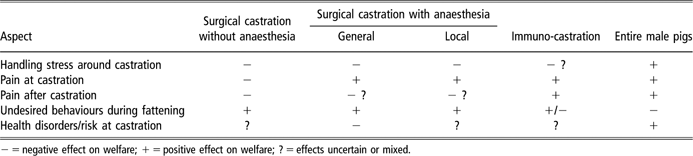
The following table (Table 1) summarises the relative positive and negative impact of surgical castration and its alternatives on the welfare of pigs.
Summary of the relative strengths and weaknesses in relation to the welfare consequences of surgical castration and its alternatives (risk assessment)
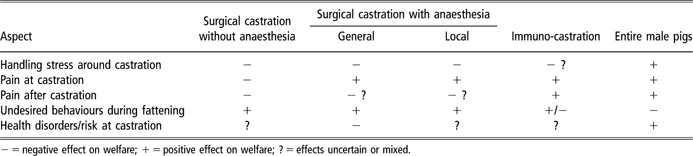
− = negative effect on welfare; + = positive effect on welfare; ? = effects uncertain or mixed.