Introduction
Previous research has provided positive evidence regarding an effect of bilingualism on cognitive control processes (e.g., Bialystok, Craik, Klein and Viswanathan, Reference Bialystok, Craik, Klein and Viswanathan2004; Bialystok, Martin and Viswanathan Reference Bialystok, Martin and Viswanathan2005a; Bialystok, Craik, Grady, Chau, Ishii, Grunji et al., Reference Bialystok, Craik, Grady, Chau, Ishii and Gunji2005b; Bialystok, Reference Bialystok2006; Martin-Rhee and Bialystok, Reference Martin-Rhee and Bialystok2008; Costa, Hernández and Sebastián-Gallés, Reference Costa, Hernández and Sebastián-Gallés2008; Costa, Hernández, Costa-Faidella and Sebastián-Gallés, Reference Costa, Hernández, Costa-Faidella and Sebastián-Gallés2009). These advantages are usually attributed to the processes involved in what is often referred to as the executive control network of attention (see below), and are usually indexed by the better performance of bilinguals in tasks that require conflict resolution (e.g., Simon and flanker tasks). In these tasks, adult bilinguals are usually faster (e.g., Bialystok et al., Reference Bialystok, Craik, Klein and Viswanathan2004; Bialystok et al., Reference Bialystok, Martin and Viswanathan2005a; Bialystok, Reference Bialystok2006; Costa et al., Reference Costa, Hernández and Sebastián-Gallés2008; Martin-Rhee and Bialystok, Reference Martin-Rhee and Bialystok2008), and/or they show a reduced conflict effect (Bialystok et al., Reference Bialystok, Craik, Klein and Viswanathan2004; Bialystok, Craik and Luk, Reference Bialystok, Craik and Luk2008; Costa et al., Reference Costa, Hernández and Sebastián-Gallés2008). Although little is known about the origin of the bilingual advantage, researchers often relate it to the cognitive mechanisms involved in bilingual language control. That is, the fact that bilinguals need to choose between two alternative representations (a word and its translation) may engage some of the same cognitive and brain mechanisms that are involved in the domain-general executive control system (e.g., Green, Reference Green1998; Bialystok et al., Reference Bialystok, Craik, Klein and Viswanathan2004; Abutalebi and Green, Reference Abutalebi and Green2007, Reference Abutalebi and Green2008; Kroll, Bobb, Misra and Guo, Reference Kroll, Bobb, Misra and Guo2008).
Despite these observations, concerns have been raised regarding the reliability and replicability of the bilingual advantage, especially in the case of young adults that are at the peak of their attentional capacities (Morton and Harper, Reference Morton and Harper2007; Colzato et al., Reference Colzato, Bajo, van den Wildenberg, Paolieri, Nieuwenhuis, La Heij and Hommel2008). For example, Colzato et al. rightly pointed out failures to replicate the bilingual advantage in conflict resolution (e.g., Bialystok et al., Reference Bialystok, Martin and Viswanathan2005a). Thus, it is still important to bring new, robust evidence about the attentional effects of bilingualism in young adults.
Granting the presence of a bilingual advantage, we still need to determine its boundaries. There are at least two ways to proceed. First, we need to identify which components of the theoretical construct called executive control are affected by bilingualism. This is a difficult task since there does not seem to be a unified view regarding these processes, and researchers often merely relate them to specific task demands (e.g., Bialystok, Reference Bialystok2006). However, progress might be made by using an experimental approach that explores the effects of bilingualism in different experimental paradigms. This strategy will hopefully enable robust empirical generalizations, eventually leading to the identification of the specific processes that are responsible for the bilingual advantage. The second avenue is to explore the extent to which bilingualism affects other attentional processes outside the executive control network. Given that some cross-talk (see below) seems to exist between the processes involved in different attentional components, it is conceivable that bilingualism actually exerts an effect beyond the executive control network. The present article takes both of these approaches. First, we assess the effects of bilingualism in young adulthood in a task that has not yet been explored (Experiment 1) and that is supposed to involve some of the processes in which bilinguals excel (conflict monitoring and resolution). Second, we explore the presence of a bilingual effect on a task that indexes the functioning of processes outside executive control (Experiment 2).
In the following, a brief overview of a general framework of the attentional system is presented, followed by a discussion of the potential effects of bilingualism on the orienting network of attention.
Components of the attentional system
One of the most influential frameworks regarding the organization of the attentional system is that proposed by Posner and collaborators (Posner and Boies, Reference Posner and Boies1971; Posner and Petersen, Reference Posner and Petersen1990). According to this framework, the attentional system can be fractionated in three different cognitive and anatomical networks sustaining different cognitive abilities: the alerting, the orienting and the executive networks. The executive network is mainly sustained by the anterior cingulate cortex (ACC) and bilateral frontal areas. The brain areas involved in the orienting network are parietal sites and frontal eye fields. Finally, the alerting network is more distributed in the brain, across the thalamus and both the anterior and posterior cortical sites (e.g., Fan, McCandliss and Fossella, Reference Fan, McCandliss and Fossella2005).
From a cognitive point of view, the executive network groups together those processes involved in driving the behavior of the individual in a goal-oriented manner. This network will be mostly involved in planning goals, developing strategies, sustaining goals and adjusting them to novel context demands when needed, while avoiding distracting information irrelevant to the desired objective (Posner and Boies, Reference Posner and Boies1971). These abilities are often explored by means of tasks that require switching goals, resolving conflict between two incompatible responses, avoiding response to salient stimuli, withholding preponderant responses, etc. (e.g., Stroop, Reference Stroop1935; Simon and Rudell, Reference Simon and Rudell1967; Fan, McCandliss, Sommer, Raz and Posner, Reference Fan, McCandliss, Sommer, Raz and Posner2002; Barceló, Reference Barceló2003). Perhaps because we lack a unitary account of the functioning of the executive control network, our knowledge about the specific processes that are affected by bilingualism is rather limited. Nevertheless, the bilingual advantage on executive control has been linked to the efficiency of inhibitory control processes. In fact, various models of bilingual speech production posit that selection of the target word in the desired language involves the inhibition of the competing translation words (Green, Reference Green1986, Reference Green1998; Meuter and Allport, Reference Meuter and Allport1999; Lee and Williams, Reference Lee and Williams2001; Costa, Santesteban and Ivanova, Reference Costa, Santesteban and Ivanova2006; Kroll, Bobb and Wodniecka, Reference Kroll, Bobb and Wodniecka2006; Kroll et al., Reference Kroll, Bobb, Misra and Guo2008; but see Roelofs, Reference Roelofs1998; Costa and Caramazza, Reference Costa and Caramazza1999; Costa, Miozzo and Caramazza, Reference Costa, Miozzo and Caramazza1999; Finkbeiner, Gollan and Caramazza, Reference Finkbeiner, Gollan and Caramazza2006). However, further studies are required in order to advance in our understanding of how bilingualism affects the executive control network.
The orienting network is mainly involved in the allocation of cognitive resources towards potentially relevant stimuli according to their specific sensory properties (e.g., unique features, novelty or abruptness; see Ruz and Lupiáñez, Reference Ruz and Lupiáñez2002). In a way, the processes implicated in this network are mostly driven by bottom-up environmental stimuli surrounding the individual, rather than by internally generated goal-oriented factors. Finally, the alerting network leads to the achievement and maintenance of the alert state necessary for quick detection of the expected stimulus.
Although these three networks are anatomically and functionally distinct, they work in an orchestrated manner. For example, the efficiency of the processes involved in ignoring potentially distracting information (executive control network) is affected by the alerting level (alert network); if the alert level is high, ignoring distracting information appears to be harder (see footnote 1). Along the same lines, the processes involved in the executive function may be affected by orienting attention to the relevant stimuli (the resolution of the conflict created by distracting information seems to be better when attention is oriented towards the experimental stimulus).Footnote 1
Considering this cross-talk between the networks, one may think that external factors affecting one of them might percolate to the others. Hence, it is conceivable that bilingualism, by affecting the functioning of the executive control network, may somehow modify the functioning of other attentional processes. In fact, there is at least one empirical observation supporting this view. In Costa et al. (Reference Costa, Hernández and Sebastián-Gallés2008), bilinguals appeared to have larger alerting effects than monolinguals. That is, bilinguals benefit more (responded faster to the target) than monolinguals upon the presentation of an alerting cue.Footnote 2 In Experiment 2, we assess whether this cross-talk between attentional networks may actually lead to an effect of bilingualism on the orienting network of attention.
The bilingual effect on the orienting network
The available experimental evidence regarding the effects of bilingualism on the orienting network of attention is contradictory. Let us discuss this evidence in detail.
In a recent study, Colzato et al. (Reference Colzato, Bajo, van den Wildenberg, Paolieri, Nieuwenhuis, La Heij and Hommel2008, Experiment 2), explored the effect of bilingualism on the visual cueing effects in target detection. In this task, participants were asked to detect a target that could appear above or below a fixation point. The target was preceded, at different Stimulus Onset Asynchronies (SOAs), by a visual cue that appeared in the same (valid cue) or opposite location (invalid cue). In this setting, it is possible to calculate the effect on response times of valid and invalid cues. Interestingly, whether or not a valid cue facilitates or hampers the detection of a target stimulus (always in comparison to an invalid cue) depends on the SOA between cue and target. When a valid cue is presented very shortly before the target, target detection is facilitated in comparison to when the cue is invalid – the cueing facilitation effect. In contrast, when the SOA increases, valid cues delay target detection in comparison to invalid cues (the Inhibition of Return effect – IOR). Colzato's study explored whether these two cueing effects were modulated by bilingualism. The authors predicted that “although both groups should show comparable performance at short SOAs . . . bilinguals should show a more pronounced IOR at longer SOAs that monolinguals do” (p. 305). This predicted pattern was not found. However, there was a very interesting observation in this study: bilinguals and monolinguals were affected differently by valid and invalid cues as indexed by the interaction between Type of Cue and Group of Participants, leading the authors to conclude that “it is clear that cueing effects were affected by bilingualism” (p. 307).
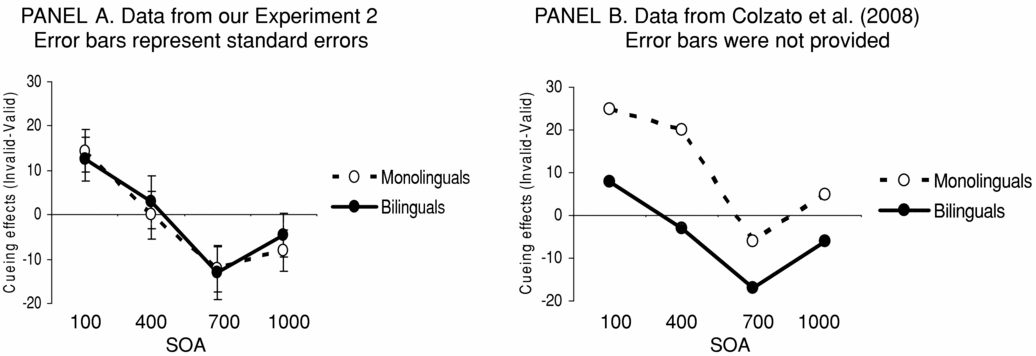
The way in which bilingualism affected the cueing effects in Colzato et al.'s study was unfortunately complex. At short SOAs (100 ms), cueing facilitation effects were found only for monolinguals. Second, at long SOAs (700 ms), IOR effects were present only for bilinguals.
The cueing facilitation effects are at odds with previous results by Costa et al. (Reference Costa, Hernández and Sebastián-Gallés2008). In that study, conducted with 200 participants, we did not observe any impact of bilingualism on visual cueing effects. Unlike Colzato et al.'s study, in which cueing facilitation effects were present only in monolingual speakers (25 ms for monolinguals and 8 ms for bilinguals), in Costa et al.'s study these effects were identical for both groups (76 ms for monolinguals and 80 ms for bilinguals).
Given these contrasting results, the conclusion reached by Costa et al. (Reference Costa, Hernández and Sebastián-Gallés2008) may be premature. Unfortunately, a direct comparison between these two studies is difficult because of the many differences between the experimental designs used. For example, the two studies differ in the number of SOAs used (four vs. one), the task that participants had to perform (detect the inclination of a line vs. detect the direction of an arrow), and even the engagement of conflict resolution processes (absence vs. presence of conflict stimuli). If anything, the design of Colzato et al. appears to be more suited for exploring the cueing effects, and consequently one may take their observations as positive evidence of the effects of bilingualism on the orienting network.
The present study has two main goals. First, we aim at providing new evidence of the effect of bilingualism on executive control processes (Experiment 1). This will enable alleviation of the concerns raised by several authors about the replicability of such observations in young adults, and will also help to assess the generalization of the phenomenon itself. Second, we aim to assess the boundaries of the bilingual advantage in attentional processes by testing whether bilingualism impacts the processes involved in the orienting network of attention (Experiment 2).
Experiment 1. Does bilingualism exert an effect on executive control?
The aim of this experiment is to examine the impact of bilingualism on executive control by means of a numerical version of the Stroop task (Stroop, Reference Stroop1935). In this context, it is important to note the existence of some recent evidence revealing that bilingualism may reduce the color-word Stroop effect (Bialystok et al., Reference Bialystok, Craik and Luk2008). Importantly, however, the version of this Stroop paradigm included linguistic material (the classical color-word interference). It is possible then that the bilingual advantage in this task reveals just a better control of linguistic representations by bilingual speakers, rather than a general effect of bilingualism on executive control processes. Our study complements and extends this previous study by exploring the effect of bilingualism on a version of the Stroop task that does not involve linguistic material. It is also relevant to point out that, unlike in most of the previous studies that have addressed the bilingual impact on conflict resolution tasks, in this experiment the conflicting dimensions are not spatial in nature (e.g., arrow flanker task, or Simon task) but they are relatively more iconic (number and magnitude of the items). This manipulation allows us to extend the potential bilingual advantage to a conflict resolution task in which the source of the conflicting information is different from the one previously studied, therefore helping to build a body of evidence upon which to draw robust empirical generalizations.
Of special interest in this experiment is the interaction between the Stroop interference effect (SIE) and the Group of Participants. That is, an effect of bilingualism in this task will be indexed by an interaction between the factor Stroop interference effectFootnote 3 (neutral vs. incongruent trials) and Group of Participants (bilingual, monolingual).
Method
Participants
Eighty-two participants performed the experiment (41 Catalan–Spanish bilinguals: 37 women and 4 men, ranging in age between eighteen and thirty years; and 41 Spanish monolinguals: 31 women and 10 men ranging in age between seventeen and twenty-nine years) (see Appendix for a detailed description of the participants in all experiments).
Design and procedure
Participants were asked to indicate, as fast and accurately as possible, how many items appeared in each trial. The number of items ranged from 1 to 3, and participants had to press the keys 1, 2 or 3 on the keyboard with the index, middle and ring fingers of their dominant hand, respectively. There was a Distractor variable with three conditions: (a) alphabetic characters (neutral condition: e.g., Z, GGG, MM); (b) digits whose value matched the number of items (congruent condition: 1, 22, 333); and (c) digits whose value did not match the number of items (incongruent condition: e.g., 2, 33, 111, etc.). The experiment consisted of two blocks of 84 trials each (preceded by a training block of 24 trials). The three distractor conditions were represented the same number of times in each block in a random fashion. On each trial, a central fixation cross appeared for 1000 ms, immediately followed by the target, which was presented for 2000 ms or until a response was given.
Results and discussion
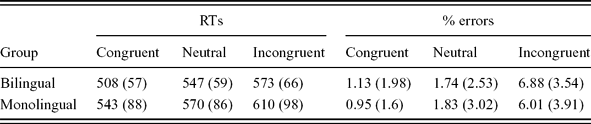
Latencies faster than 250 ms or slower than 1500 ms were excluded from the analyses (.55% of the trials). An ANOVA with Distractor (neutral, congruent, incongruent) as a within-subject variable, and Group of Participants (monolingual vs. bilingual) as a between-subject variable was conducted. In the error analyses, the only significant main effect was that of Distractor (F(2,160) = 148.34, MSE = 4.74, p < .0001), revealing more errors in the incongruent (6.45%) than in the neutral (1.79%; t(81) = 13.57, p < .0001) and congruent (1.05%; t(81) = 13.11, p < .0001) conditions. Also, the neutral condition elicited more errors than the congruent one (t(81) = 3.06, p < .003) (see Table 1).
Means of reaction times (RTs) and percentage of errors (% errors) as a function of Distractor (congruent, neutral and incongruent) and Group of Participants (bilinguals and monolinguals). Values in brackets refer to standard errors.

In the analyses of reaction times (RTs), the main effect of Distractor was significant (F(2,160) = 253.62, MSE = 350.79, p < .0001); the responses in the neutral condition were 33 ms faster than in the incongruent condition (the SIE; t(81) = 11.06, p < .0001) and 33 ms slower than in the congruent condition (the Stroop facilitation effect – SFE; t(81) = 12.27, p < .0001).
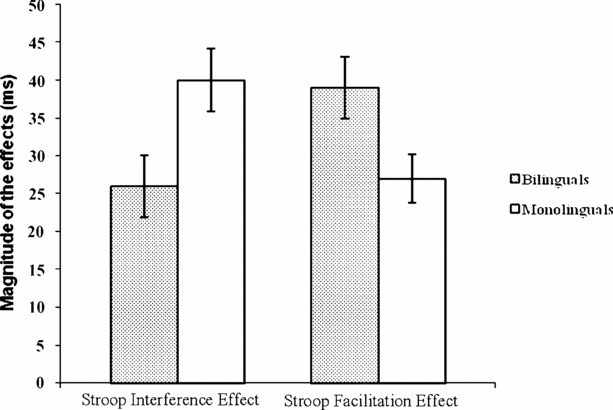
Bilingual participants had a tendency to be faster (543 ms) than monolinguals (574 ms) (Group of Participants: F(1,80) = 3.59, MSE = 17248.99, p = .061). Interestingly, the interaction between Distractor and Group of Participants was significant (F(2,160) = 3.48, MSE = 350.79, p <. 05). As this interaction suggests differences between the groups in either the SIE or the SFE (or both), we conducted two separate ANOVAs for each of these effects, including the RTs of the relevant conditions of the Distractor factor as a within-subject variable and the Group of Participants as a between-subject variable. The main effect of the “SIE” (incongruent vs. neutral condition) was significant (F(1,80) = 130.19, MSE = 346.77, p < .0001). More importantly, the SIE interacted with the variable Group of Participants, revealing that its magnitude was smaller for bilinguals (26 ms) than for monolinguals (40 ms; F(1,80) = 6.14, MSE = 346.76, p < .015). The main effect of the SFE (congruent vs. neutral condition) was also significant (F(1,80) = 158.82, MSE = 275.96, p < .0001). Interestingly, this effect also interacted with the factor Group of Participants, revealing that its magnitude was larger for bilinguals (39 ms) than for monolinguals (27 ms; F(1,80) = 5.37, MSE = 275.96, p < .023) (see Figure 1).
The Stroop Interference Effect is calculated by subtracting responses to “neutral trials” from those to “incongruent trials”. The Stroop Facilitation Effect is calculated by subtracting responses to “neutral trials” from those to “congruent trials”. Error bars represent standard error.

The present experiment revealed three main results. First, bilinguals showed a reduced SIE in comparison to monolinguals, revealing a bilingual advantage in conflict resolution. Second, we also observed a larger SFE for bilingual speakers. Third, bilinguals appear to be somewhat faster than monolinguals across all experimental conditions.
The bilingual advantage in resolving conflict produced by irrelevant information (indexed by the SIE) is consistent with the bilingual advantage observed in other tasks – Simon and flanker tasks (e.g., Bialystok et al., Reference Bialystok, Craik, Klein and Viswanathan2004; Costa et al., Reference Costa, Hernández and Sebastián-Gallés2008). In particular, our results extend the observation of Bialystok et al. (Reference Bialystok, Craik and Luk2008) to experimental conditions in which, arguably, very little linguistic processing is present. The bilingual advantage when the irrelevant dimension is congruent with the required response (indexed by the SFE) is also in line with Bialystok et al. (Reference Bialystok, Craik and Luk2008), who found larger SFE in bilinguals in the classical Stroop color-naming task. This latter observation suggests that the impact of bilingualism is not limited to conditions in which inhibitory processes (either active or reactive) are engaged (see “General Discussion”).
We also found a tendency for bilinguals to be faster overall than monolinguals. As discussed in the “Introduction”, this is a rather common finding and has been taken as indexing a bilingual advantage in the monitoring processes put at play in tasks that involve different types of stimuli.Footnote 4
Experiment 2: Does bilingualism aid orienting processes of attention?
In this experiment we assess whether bilingualism influences the orienting network of attention by exploring the effects of valid and invalid visual cues on target detection. Participants were asked to decide whether a target stimulus was a straight line or a tilted one. The target could appear above or below a fixation point. Before the target, a visual cue was presented, either at the same position as the target (valid cue) or at the opposite position (invalid cue). By subtracting responses in these two conditions, several cueing effects can be observed, depending on the time interval between cue and target. When the cue is presented shortly before the target, valid cues lead to faster RTs (the cueing facilitation effect). However, when the time interval between cue and target increases, responses to trials preceded by a valid cue start to get slower than those to trials preceded by an invalid cue (the IOR effect).
An effect of bilingualism on the functioning of the orienting network will be primarily indexed by an interaction between the factors Type of cue (valid vs. invalid) and Group of Participants (bilinguals and monolinguals). In fact, this interaction was significant in Colzato et al.'s (Reference Colzato, Bajo, van den Wildenberg, Paolieri, Nieuwenhuis, La Heij and Hommel2008) Experiment 2 (see “Introduction”). Thus, following their arguments, we will take the presence of such an interaction as indexing differential cueing effects in both groups of participants. To the extent that cueing effects reveal the functioning of the orienting network, the presence of such an interaction should be taken as positive evidence of the effects of bilingualism on this network.
Method
Participants
Fifty-six participants completed the experiment (28 Catalan–Spanish bilinguals: 24 women and 4 men, mean age twenty years; and 28 Spanish monolinguals: 23 women and 5 men, mean age twenty-one years).
Design and procedure
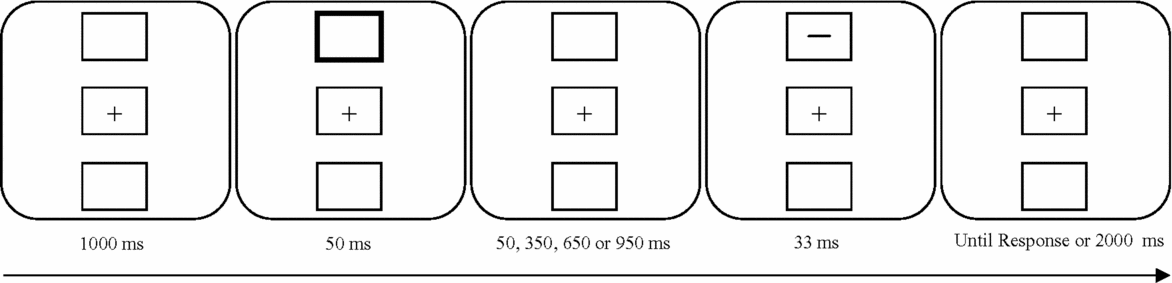
The design and procedure were identical to that used by Colzato et al.'s (Reference Colzato, Bajo, van den Wildenberg, Paolieri, Nieuwenhuis, La Heij and Hommel2008) Experiment 2. Each trial started with three boxes, one in the center of the screen and one above and below. This display was present for 1000 ms. Thereafter, one of the peripheral boxes became thicker for 50 ms (the peripheral cue). Subsequently, the two peripheral boxes and the central fixation remained on the screen with the same thickness for 50, 350, 650 or 950 ms, depending on the SOA, and were followed by the target. The effective SOAs were therefore 100, 400, 700 and 1000 ms and these were randomized across trials. The target consisted of a white line (2.6 × 3.0 cm from a viewing distance of 60 cm), and could appear either inside of the top or bottom box. The target appeared for 33 ms, and right after there was a display with three boxes and the fixation cross, which was present until response or until 2000 ms had elapsed. Participants had to indicate the orientation of a line (horizontal or vertical), by pressing the key A or L. The mapping key-to-response was counterbalanced across participants. If participants made a mistake there was a beep, and they were instructed to be as fast as possible but without making mistakes. We also instructed participants to keep their eyes fixated at the center throughout the experiment (see Figure 2).
Schematic representation of the events in a trial of Experiment 2. The example represents a trial with a valid cue.

There were one practice block and eight experimental blocks of 40 trials each. Cues and targets were presented an equal number of times in the top and bottom peripheral boxes in each SOA. In each experimental block, there were 32 trials where the target was present and 8 trials where the target was absent, in order to discourage anticipated responses. In the present trials, there were 8 trials for each SOA condition. In half of these trials (4) the target was presented at the cued location, and it was presented at the uncued location in the remaining trials.
Results and discussion
Following the same criteria as Colzato et al. (Reference Colzato, Bajo, van den Wildenberg, Paolieri, Nieuwenhuis, La Heij and Hommel2008), responses faster than 100 ms or slower than 900 ms were excluded from the analyses (3% of the trials). An ANOVA with Type of cue (valid vs. invalid) and SOA (100, 400, 700, 1000) as within-subject variables, and Group of Participants (monolingual vs. bilingual) as between-subject variable, was conducted.
In the error analyses, a main effect of Type of cue (F(1,54) = 10.79, MSE = 15.77, p < .002) was observed, reflecting worse performance for invalid (6.0% errors) than for valid trials (4.8% errors). There was also a main effect of SOA (F(3,162) = 4.04, MSE = 24.57, p < .008), revealing more errors at SOA 100 than at SOA 400 and 700 (all ps < .03). No other effects were significant (Fs < 1).
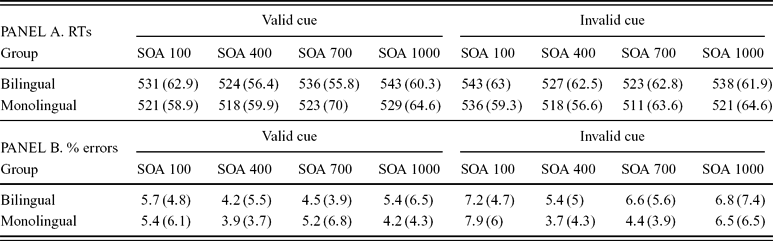
The RT analyses revealed a main effect of SOA (F(3,162) = 7.64, MSE = 521.28, p < .0001). The main effects of Type of cue and Group of Participants were not significant (Fs < 1). The only significant interaction was the one between Type of cue and SOA (F(3,162) = 11.68, MSE = 302.49, p < .0001). This interaction revealed that at SOA 100, RTs for valid trials were significantly faster (13 ms) than for invalid trials (the cueing facilitation effect; t(55) = 3.9, p < .0001), while at SOA 700, RTs for valid trials were significantly slower (14 ms) than for invalid trials (the IOR effect; t(55) = 3.18, p < .002). No effects of Type of cue were observed in the other two SOAs (see Table 2 for a report of RTs and percentage of errors). Thus, facilitatory and inhibitory effects of valid cues were both present in this experiment.
PANEL A: Means of reaction times (RTs) as a function of Type of Cue (valid and invalid), SOAs (100, 400, 700 and 1000) and Group of Participants (bilinguals and monolinguals). PANEL B: Means of percentage of errors (% errors) as a function of Type of Cue (valid and invalid), SOAs and Group of Participants. Values in brackets refer to standard errors.

What is fundamental for our purpose here is that none of the main effects (neither SOA nor Type of cue) interacted with the variable Group of Participants (all Fs < 1). As can be easily appreciated in Figure 3 (Panel A), the magnitude of the cueing facilitation and inhibition (IOR) effects were exactly the same for bilinguals and monolinguals. This simple pattern clearly contrasts with the complex one reported by Colzato et al. (Reference Colzato, Bajo, van den Wildenberg, Paolieri, Nieuwenhuis, La Heij and Hommel2008), in which bilinguals did not show the cueing facilitation effect and monolinguals did not show the cueing inhibition effect (see Figure 3 Panels A and B). Further, our observationsFootnote 5 are inconsistent with the conclusion reached by Colzato et al. (“it is clear that cueing effects were affected by bilingualism”, p. 307). We find no significant effect of bilingualism on cueing effects.
Magnitude of the cueing effects (in ms) as a function of SOA and Group of Participants.

General discussion
The main objective of the present article was to provide evidence regarding the effects of bilingualism on the attentional system. In Experiment 1, we explored the effects of bilingualism on the executive control network, by means of the Numerical Stroop Task. In Experiment 2, we assessed the effects of bilingualism on the orienting network through a detection task involving visual cues. The results of the two experiments alleviate concerns about the robustness and replicability of a bilingual advantage on executive control and delimit the scope of the impact of bilingualism on other components of the attentional system.
In a nutshell, three main results were observed in our experiments. First, bilinguals exhibited a reduced Stroop interference effect compared to monolinguals. Second, bilinguals experienced a larger Stroop facilitation effect than monolinguals. Third, the pattern of cueing effects was the same for both groups. We discuss the implications of these findings in turn.
The effect of bilingualism on the executive network
The observation of a bilingual advantage in the SIE fits well with previous observations revealing a benefit of bilingualism in tasks that involve conflict resolution (Bialystok et al., Reference Bialystok, Craik, Klein and Viswanathan2004, Reference Bialystok, Martin and Viswanathan2005a, Reference Bialystok, Craik, Grady, Chau, Ishii and Gunjib; Bialystok, Reference Bialystok2006; Costa et al., Reference Costa, Hernández and Sebastián-Gallés2008; Bilaystok et al., 2008). Our observation is important given the concerns that have been raised about the replicability of the advantage on conflict resolution in adult young bilinguals. The fact that we were not only able to find such a bilingual advantage, but also that we did so with a task that departs in some ways from those already used (mostly of spatial or linguistic nature), helps to increase our confidence on the reliability and generalizability of the bilingual impact on conflict resolution tasks.
As advanced in the “Introduction”, the bilingual advantage in conflict resolution has often been attributed to the collateral effects of bilingual language control. In particular, it has been argued that bilinguals may resort to inhibitory control during language production in order to suppress the activation of the non-intended language (e.g., Green, Reference Green1998; Bialystok et al., Reference Bialystok, Craik, Klein and Viswanathan2004; Kroll et al., Reference Kroll, Bobb, Misra and Guo2008). This mechanism would allow bilinguals to select the target word in the intended language while avoiding massive interference from alternative “incompatible” translation words. Moreover, such inhibitory processes may be the same as those implicated on resolving the conflict created by irrelevant incongruent stimuli. Hence, the continuous use of inhibitory processes by bilinguals during language production may result in the observed advantage in language-free conflict resolution tasks.
Although this explanation adequately captures a large body of experimental evidence, it also leaves several results unaccounted for. In particular, it does not account for the bilingual effect in conditions in which conflict resolution is not needed. For example, in our Experiment 1, the magnitude of the SFE was modulated by bilingualism: monolinguals took advantage of congruent irrelevant stimuli to a lesser extent than bilinguals (see also Bialystok et al., Reference Bialystok, Craik and Luk2008). Arguably, in this condition inhibitory processes are not necessary since the two dimensions (the target and the distractor) call for the same response. Why then do bilinguals outperform monolinguals in these conditions? One possibility is that bilingualism has an impact on some aspects of executive control other than inhibitory processes such as those responsible for adjusting or regulating behavior (i.e., monitoring processes; see Roelofs, van Turennout and Coles (Reference Roelofs, van Turennout and Coles2006) for a pertinent discussion of this possibility in the light of neuroimaging data). Under this view, the larger SFE for bilinguals may be interpreted as revealing a more efficient functioning of this regulative process involved in response selection. That is, bilinguals may be better not only at inhibiting competing conflicting responses, but also at boosting the correct response according to the task demands; hence, their larger SFE. Admittedly, this is a tentative explanation that needs further research. Nevertheless, what this result reveals is a bilingual effect on conditions in which conflict resolution is not required, suggesting an effect of bilingualism beyond inhibitory processes.
The impact of bilingualism on the orienting network
In the “Introduction”, we argued that one way to explore the origin of the bilingual advantage in attentional processes is to advance in our knowledge of its limits. We further argued that given the orchestrated manner in which the different attention networks work, it is conceivable that the effects of bilingualism on the executive network percolate, to some extent, to the other networks and, in particular, to the orienting network. Given that the available results regarding the effects of bilingualism on the orienting network of attention were mixed (Colzato et al., Reference Colzato, Bajo, van den Wildenberg, Paolieri, Nieuwenhuis, La Heij and Hommel2008; Costa et al., Reference Costa, Hernández and Sebastián-Gallés2008), it was fundamental to further explore this issue.
Unlike the complex pattern of findings in the Colzato et al. (Reference Colzato, Bajo, van den Wildenberg, Paolieri, Nieuwenhuis, La Heij and Hommel2008) study, where cueing effects interacted with group of participants, Experiment 2 found that the magnitude or time course of benefits and costs of visual cues was unaffected by bilingualism. A closer look at the whole pattern of results reveals important differences between the two studies. First, in Colzato et al.'s study, the benefit produced by valid cues at short SOAs seemed to be present only for monolinguals (while in our study, it was present for both groups and to the same extent). Second, the cueing inhibition effect produced by valid cues at long SOAs was only present for bilinguals in Colzato et al. (while in our study, it was present for both groups and to the same extent). Given that previous studies have consistently found a cueing facilitation effect for bilinguals (Costa et al., Reference Costa, Hernández and Sebastián-Gallés2008) and cueing inhibition effect for monolinguals (see Lupiáñez, Milliken, Solano, Weaver and Tipper, Reference Lupiáñez, Milliken, Solano, Weaver and Tipper2001), the source of the group variability in Colzato et al.'s study is surprising and it is not accounted for by the authors. Interestingly, however, if one averages the performance of bilinguals and monolinguals in their study, the results remarkably mimic the ones reported in our Experiment 2, namely cueing facilitation and inhibition effects for both monolinguals and bilinguals.
Several differences between the two studies, in terms of the populations tested, seemed to not be able to account for the different pattern of results. Both groups of bilinguals were early and high-proficient bilinguals that used the two languages on daily basis. Although Colzato et al. compare bilinguals and monolinguals of different national backgrounds (Dutch–German or Dutch–English bilinguals vs. Spanish monolinguals), while we tested groups of the same national background (Catalan–Spanish bilinguals living in Barcelona and Spanish monolinguals living in Murcia, 500 km from Barcelona), such differences are unlikely to account for the different pattern of results. Finally, IQ values for the two groups in Colzato et al.'s Experiment 2 are not reported, but a difference in IQ values between the two groups seems unlikely.
At this point, and given the available results (Experiment 2; see also footnote 4 and Costa et al., Reference Costa, Hernández and Sebastián-Gallés2008) it appears that little evidence is present to conclude that the cueing effects for monolinguals and bilinguals are different. Thus, we have good grounds to conclude that the attentional orienting processes with exogenous cues that depend on the orienting network are not affected by bilingualism.
Conclusion
The results reported in this article help to constrain the potential effect of bilingualism on the attentional system in two relevant ways. First, they provide new evidence revealing that bilingualism exerts an effect in the executive control network (at least as it is indexed by conflict resolution tasks). Second, they strongly suggest that bilingualism does not exert any effect in the processes involved in the orienting network of attention (at least as it is indexed by cueing effects). Future research is required to determine which of the processes under the umbrella of executive control are indeed being modulated by bilingualism.
Appendix. Description of participants from all experiments
Bilingual and monolingual participants in all three experiments differed in their language history. The monolinguals of all experiments were Spanish and were Psychology undergraduates in the University of Murcia (Spain). The bilinguals of all experiments were Catalan-Spanish early and high-proficient bilinguals and were Psychology undergraduates in the University of Barcelona (Spain). All participants were young individuals ranging from seventeen to thirty years. Bilinguals and monolinguals did not differ in age either in Experiment 1 (bilinguals: 20.9 years, monolinguals: 21.4 years; t(80) = 0.92, p < .36) or in Experiment 2 (bilinguals: 20.2, monolinguals: 20.9; t(54) = 1.25, p < .21).
All bilinguals were exposed to two languages at a very early age and received their education in the two languages. Information about bilinguals’ language use was obtained by means of a questionnaire administered after the experiment, where scores represent the amount of the time participants used each language, indicated on a 7-point scale (1 = only Spanish, 7 = only Catalan). Mean scores showed that they have used Catalan around 75% of time and Spanish around 25% across their lifespan (Experiment 1: 5.1 in preschool age, 5.2 in childhood, 5.1 in adolescence and 5.1 in adulthood; Experiment 2: 5.1 in preschool age, 5.2 in childhood, 5 in adolescence and 4.9 in adulthood). Neither bilinguals nor monolinguals were functionally fluent in any other language despite foreign language instruction in school. Importantly, specific care was taken to match both groups of the three experiments in general intelligence and video-game experience.
General intelligence was assessed by means of the Superior Scale I of the Raven's Advanced Progressive Matrices (Raven, Raven and Court, Reference Raven, Raven and Court1998), which participants completed after the experimental session. The task was composed of 12 items containing a picture with a missing piece. Participants were asked to indicate which of the 8 possible pieces arranged below the picture completed it correctly. Both groups of participants were comparable in the scores obtained in this task in Experiment 1 (bilinguals: 10.7, monolinguals: 10.6; t(80) = 0.24, p < .81; which, according to Spanish normative data (Seisdedos, Reference Seisdedos1995), means that both groups had as an IQ average of 114), and Experiment 2 (bilinguals: 10.9, monolinguals: 10.6; t(54) = 1.08, p < .29; which, according to Spanish normative data (Seisdedos, Reference Seisdedos1995), means that both groups had as an IQ average of 114). Also, all participants had conducted a common mandatory exam to be enrolled in university. No differences between groups were observed in the grades obtained on this exam either in Experiment 1 (bilinguals: 6.8, monolinguals: 6.7; t(80) = 0.89, p < .37) or Experiment 2 (bilinguals: 6.7, monolinguals: 6.6; t(54) < 1).
An additional questionnaire was administered to all participants to determine the level of computer video-game experience (see Green and Bavelier, Reference Green and Bavelier2003). Participants specified the extent to which they played speeded video games in the previous six months. They were asked to estimate the time they spend playing computer video-games per week a on a 4-point scale (0 = none, 4 = daily). Participants also indicated how many hours they spend playing video-games in those days they play, on a 4-point scale (0 = none, 4 = more than three hours). The total score is the sum of Times/week and Time/day for each subject. No significant differences between groups were found in computer video-game experience either in Experiment 1 (bilinguals: 1.02, monolinguals: 1.41; t(80) = 1.11, p < 0.27), or Experiment 2 (bilinguals: 1, monolinguals: 1.41; t(54) < 1).