


In the last two decades, corporate social responsibility (CSR) has become a key topic in the literature, referring to how organizations integrate environmental, social, and economic considerations into their business activities (Carlini & Grace, Reference Carlini and Grace2021). Although institutional discourse often presents CSR as a consensual and non-confrontational approach, its implementation remains complex. Organizations may adopt CSR strategies to improve financial performance, gain a competitive advantage, and enhance their reputation, legitimacy, and social acceptability, while prioritizing environmental, social, or economic dimensions to varying degrees. Moreover, CSR approaches differ significantly across national and cultural contexts, with historically distinct practices and motivations between developed and developing countries (Gond & Igalens, Reference Gond and Igalens2012; Hofman & Newman, Reference Hofman and Newman2014; Jamali et al., Reference Jamali, Ahmad, Aboelmaged and Usman2024). For example, while French companies tend to emphasize CSR as an opportunity, Moroccan firms often focus on mitigating CSR-related constraints such as additional costs and competitiveness pressures (Cherkaoui, Reference Cherkaoui2019; El Baz et al., Reference El Baz, Laguir, Marais and Stagliano2012). Nevertheless, numerous instances of social and greenwashing reveal a persistent gap between CSR discourse and actual practices (Donia & Sirsly, Reference Donia and Sirsly2016), underscoring issues of organizational hypocrisy (Christensen et al., Reference Christensen, Morsing and Thyssen2020).
Employees play a central role in detecting and evaluating the (in)congruence and (in)consistency of their organization’s CSR actions (El Akremi et al., Reference El Akremi, Gond, Swaen, De Roeck and Igalens2018), as they are both key stakeholders in implementing CSR and, in some cases, its direct beneficiaries. Through their daily roles and interactions, employees can significantly influence organizational outcomes (Lee et al., Reference Lee, Park and Lee2013). CSR can be examined from three complementary perspectives: objective, referring to verifiable corporate actions or external assessments; normative, reflecting ethical judgments about what organizations ought to do; and subjective, capturing individual perceptions of CSR practices. This study adopts a subjective perspective by focusing on employees’ interpretations of their organization’s CSR initiatives, in line with micro-CSR research that emphasizes the role of cognition and affect in shaping attitudes and behaviors (Aguinis et al., Reference Aguinis, Rupp and Glavas2024). Indeed, perceived CSR has been shown to exert a more direct and substantial influence on employee attitudes and behaviors than objective CSR measures (Liang & Yoon, Reference Liang and Yoon2023). When employees perceive inconsistencies or hypocrisy in CSR practices, these perceptions can undermine their commitment and contribute to emotional exhaustion and turnover intentions (Christensen et al., Reference Christensen, Morsing and Thyssen2020; Grant et al., Reference Grant, Dutton and Rosso2008).
Employee perceptions of CSR are shaped by individual and organizational factors, such as CSR sensitivity, which reflects individual predispositions and awareness of CSR issues (Carlini & Grace, Reference Carlini and Grace2021), and CSR information sharing, which reflects the quality and frequency of CSR-related communication within the organization (ter Hoeven & Verhoeven, Reference ter Hoeven and Verhoeven2013). The more employees perceive congruence between their expectations and perceptions of CSR practices, the more they will respond by modifying their behavior, increasing their commitment, and strengthening their alignment with company values through organizational identification (Gond et al., Reference Gond, El Akremi, Swaen and Babu2017).
There is a lack of empirical research on this topic (El Baz et al., Reference El Baz, Laguir, Marais and Stagliano2012), as well as on the similarities and differences between developed and developing countries (Jamali et al., Reference Jamali, Ahmad, Aboelmaged and Usman2024). However, most cited studies are based on Western contexts, and the impact of CSR may differ due to cultural and structural elements specific to developing countries (Rupp et al., Reference Rupp, Shao, Thornton and Skarlicki2013; Wojtczuk-Turek et al., Reference Wojtczuk-Turek, Turek, Edgar, Klein, Bosak, Okay-Somerville, Fu, Raeder, Jurek, Lupina-Wegener, Dvorakova, Gutiérrez-Crocco, Kekkonen, Leiva, Mynaříková, Sánchez-Apellániz, Shafique, al-Romeedy, Wee and Karamustafa-Köse2024). This gap highlights the need for cross-cultural micro-CSR studies that examine employees’ psychological and attitudinal responses (Wang et al., Reference Wang, Zhang, Lu and Tang2024). Based on micro-CSR theory (Aguinis et al., Reference Aguinis, Rupp and Glavas2024; Gond et al., Reference Gond, El Akremi, Swaen and Babu2017) and signaling theory (Bergh et al., Reference Bergh, Connelly, Ketchen and Shannon2014), our study proposes to interculturally investigate the effects of (in)congruence between employees’ representations and evaluations of CSR practices and their relationship with turnover intentions.
A thorough examination of the extant literature indicates that although the relationship between CSR and organizational commitment is empirically recognized, there remains a paucity of research elucidating the theoretical mechanisms that explain why and how this relationship unfolds (Aguinis et al., Reference Aguinis, Rupp and Glavas2024; Jamali et al., Reference Jamali, Ahmad, Aboelmaged and Usman2024). Despite growing interest in CSR and employee outcomes, several research gaps persist. First, we deepen the micro-CSR foundation by introducing CSR sensitivity and CSR information sharing into the turnover model. These constructs are conceptually distinct: sensitivity refers to an employee’s predisposition, while information sharing reflects organizational communication practices. Their combined role in shaping perceived CSR provides a more granular understanding of internal CSR signaling processes. While signaling theory has been applied in prior work, we extend it by treating CSR sensitivity as a boundary condition in how employees decode CSR signals (De Roeck & Delobbe, Reference De Roeck and Delobbe2012). Second, although CSR is generally associated with reduced turnover intentions across settings, recent studies (e.g., Mueller et al., Reference Mueller, Hattrup, Spiess and Lin-Hi2012; Wojtczuk-Turek et al., Reference Wojtczuk-Turek, Turek, Edgar, Klein, Bosak, Okay-Somerville, Fu, Raeder, Jurek, Lupina-Wegener, Dvorakova, Gutiérrez-Crocco, Kekkonen, Leiva, Mynaříková, Sánchez-Apellániz, Shafique, al-Romeedy, Wee and Karamustafa-Köse2024) suggest that cultural values significantly moderate the strength and mechanisms of CSR’s influence. We address this call by comparing France (a highly individualistic culture) and Morocco (a predominantly collectivist culture). This approach is informed by CSR meta-analyses (e.g., Wen et al., Reference Wen, Huo, Xu, Zhang and Liu2025; Zhao et al., Reference Zhao, Wu, Chen and Zhou2022) and answers recent calls to contextualize micro-CSR theory within national cultural boundaries. While it is true that globalization has reduced some cultural boundaries, and that France and Morocco share strong commercial ties and historical links (e.g., the French protectorate) as well as significant flows of students and immigrants, it is still important to recognize that each country maintains distinct cultural specificities in terms of customs, religion, language, and social practices. In fact, despite a growing body of literature emphasizing the importance of CSR for employee commitment in developed economies (Hofman & Newman, Reference Hofman and Newman2014), relatively little research has examined this relationship in developing contexts such as Morocco. Yet, in 2023, French investments in Morocco reached €20 billion, while trade between the two countries amounted to €14.1 billion, nearly double the level of 2015, confirming Morocco’s position as a key partner for France (Le Point, 2024). These close ties do not eliminate cultural differences, which remain highly relevant.
The contribution of our study is threefold. First, this study examines the mediating role of person-organization fit (PO-fit) in the relationship between perceived CSR and turnover intention. In France, CSR sensitivity directly shapes PO-fit, whereas in Morocco, CSR information sharing primarily drives PO-fit. Differences are observed in the direct relationships between antecedents and perceived CSR across countries. Secondly, our research examines the strategic importance of transparent CSR communication in aligning employee and organizational values. Our results suggest that effective CSR communication is associated with lower turnover intention, particularly through its positive association with perceived CSR and PO-fit, regardless of country development status. Thirdly, our study explores the robustness of CSR’s role in employee retention in developed and underdeveloped contexts. Despite contextual differences, our results reveal that effective CSR communication, whether stimulated by CSR sensitivity or information sharing, consistently improves PO-fit and lowers turnover intention. In summary, we extend the literature on CSR’s role in employee retention (Kristof-Brown et al., Reference Kristof-Brown, Zimmerman and Johnson2005) by elucidating dual pathways and cultural nuances underlying its effectiveness.
Theoretical Background
Perceived CSR is key in organizational commitment by reducing turnover (Closon, Reference Closon2010) and shaping perceptions of organizational values, identity, and fairness (Ouerdian & Gaha, Reference Ouerdian and Gaha2009). From a global cultural perspective, micro-CSR emphasizes the need to consider the psychological mechanisms that explain how CSR influences employee attitudes and behaviors (Rupp & Mallory, Reference Rupp and Mallory2015; Wang et al., Reference Wang, Xu and Wang2020). Indeed, employees feel pride and identify with socially responsible organizations (Ng et al., Reference Ng, Yam and Aguinis2019). This congruence between personal and organizational values (PO-fit) (Kristof, Reference Kristof1996) fosters employees’ affective commitment (Ashforth & Mael, Reference Ashforth and Mael1989). The perception that their organization addresses environmental issues or contributes to society links them to its mission and values (Aït Razouk et al., Reference Aït Razouk, Bayad and Wannenmacher2009). However, CSR actions enhance employees’ perceptions of fairness and reduce intention to quit (Chaudhary, Reference Chaudhary2017; Rupp et al., Reference Rupp, Shao, Thornton and Skarlicki2013).
CSR interpretation and implementation vary across developed and developing countries in the current era of globalization, due to different historical contexts, economic conditions, and social factors (Gond & Igalens, Reference Gond and Igalens2012). In France, state legislation has strengthened the obligation for listed companies to disclose their CSR actions, demonstrating the country’s commitment to sustainable development (Capron & Quairel-Lanoizelée, Reference Capron and Quairel-Lanoizelée2020). Although France embraces European values (e.g., environmental protection and human rights), its organizational culture remains individualistic (Hofstede, Reference Hofstede2011; Wojtczuk-Turek et al., Reference Wojtczuk-Turek, Turek, Edgar, Klein, Bosak, Okay-Somerville, Fu, Raeder, Jurek, Lupina-Wegener, Dvorakova, Gutiérrez-Crocco, Kekkonen, Leiva, Mynaříková, Sánchez-Apellániz, Shafique, al-Romeedy, Wee and Karamustafa-Köse2024). This is reflected in respect for individual rights, equal opportunities, and employee well-being, while reconciling economic and social objectives (Liang & Yoon, Reference Liang and Yoon2023). However, the tension between profitability and sustainability remains an issue for French organizations. Nevertheless, many French companies view CSR as a management investment that could improve the company’s image and shareholder confidence.
Morocco’s CSR framework stems from its sociocultural context, defined by paternalistic and collectivist values, particularly solidarity ( tadamoun ). Rather than being dictated by strict regulations, Moroccan CSR is rooted in traditions that prioritize community support and collective well-being. Moroccan CSR actions primarily focus on financing social projects (e.g., education, health, community programs) in a paternalistic, collectivist manner. Managers make decisions for the collective, with minimal direct involvement from employees or stakeholders (Cherkaoui, Reference Cherkaoui2019). However, under the influence of international standards and the royal desire to modernize the economic fabric, some Moroccan companies, particularly subsidiaries of international groups, are strengthening their CSR commitments (El Baz et al., Reference El Baz, Laguir, Marais and Stagliano2012).
CSR practices in France and Morocco differ (Mezouar, Reference Mezouar2002), mainly because of their cultural contexts: French individualism values rights and individual performance, while Moroccan collectivism favors community interest and interpersonal relationships. In France, employees and trade unions actively develop CSR strategies, while in Morocco, CSR often remains a top-down, management-driven initiative. There is room for improvement in both countries. In France, CSR is well implemented but is usually perceived as greenwashing or hypocrisy masking economic interests (Comeau & Davister, Reference Comeau and Davister2008). Despite progress in CSR in Morocco, most non-multinational companies lack a formal CSR policy integrated into their business model (Cherkaoui, Reference Cherkaoui2019). However, both countries share a growing desire to align their practices with international standards, whether through French legislation (Ouerdian & Gaha, Reference Ouerdian and Gaha2009) or Moroccan efforts to meet the expectations of foreign investors (Cherkaoui, Reference Cherkaoui2019). However, we formulate the following exploratory research question:
RQ1: Are there differences between France (i.e., individualistic culture) and Morocco (i.e., collectivist culture) in perceiving CSR and its relationship with turnover intention?
The Role of Sensitivity and Information Sharing
Prior research suggests that examining individual contingency factors, such as sensitivity to CSR issues, helps clarify when and for whom CSR initiatives are most likely to influence employee attitudes (De Roeck & Delobbe, Reference De Roeck and Delobbe2012). Employees differ in their knowledge, expectations, and interpretations of CSR practices, and these differences shape how they attend to and respond to CSR-related information (Cropanzano et al., Reference Cropanzano, Byrne, Bobocel and Rupp2001).
CSR sensitivity refers to the degree to which employees care about, pay attention to, and seek to understand their organization’s CSR practices. It captures an individual’s attentional and motivational orientation toward CSR and is conceptually distinct from general prosocial tendencies or evaluations of CSR performance. Whereas prosocialness reflects a broad disposition to help others (Caprara et al., Reference Caprara, Steca, Zelli and Capanna2005), and perceived CSR reflects assessments of organizational practices (Turker, Reference Turker2009), CSR sensitivity specifically concerns how salient and personally meaningful CSR is to employees in their work context. This conceptualization aligns with research on CSR internal branding, which emphasizes the importance of employees’ awareness, knowledge, and experience of CSR in shaping engagement and performance outcomes (Carlini & Grace, Reference Carlini and Grace2021).
Employees with higher CSR sensitivity are more likely to attend to CSR-related cues and actively seek signals of value congruence with their organization (Wells & Kipnis, Reference Wells and Kipnis2001). When CSR practices are perceived as consistent with personal values, they foster organizational pride and PO-fit (Ng et al., Reference Ng, Yam and Aguinis2019). Conversely, perceived inconsistencies between stated CSR values and actual practices may lead sensitive employees to question organizational integrity, potentially increasing turnover intentions (Hericher & Bridoux, Reference Hericher and Bridoux2023).
Because employees vary in their sensitivity to and valuation of CSR, CSR practices are unlikely to resonate uniformly across individuals. Prior research identifies a range of employee orientations toward CSR, from highly committed to indifferent or even critical positions (Rodrigo & Arenas, Reference Rodrigo and Arenas2008). Accordingly, employees’ perceptions of their organization’s CSR practices are expected to differ as a function of their CSR sensitivity (Lu et al., Reference Lu, Guo, Qu, Lin and Lev2023). We therefore propose:
H1: Sensitivity to CSR is positively associated with perceived CSR.
Although organizations may engage in CSR activities, employees often remain partially informed due to ineffective internal communication, which can weaken engagement (Sen et al., Reference Sen, Bhattacharya and Korschun2006). From a signaling theory perspective, information sharing serves as an organizational signal that helps employees interpret whether stated CSR values align with actual practices (Bergh et al., Reference Bergh, Connelly, Ketchen and Shannon2014; Marescaux et al., Reference Marescaux, De Winne and Sels2012). Accordingly, CSR information sharing refers to how organizations communicate their CSR actions, practices, and goals to employees, including policies, initiatives, and work-related objectives.
Clear, transparent CSR communication supports employees’ understanding of organizational expectations and their own roles in CSR initiatives (Gioia & Chittipeddi, Reference Gioia and Chittipeddi1991). When employees are well informed, they are better able to assess value congruence with the organization, which strengthens perceived PO-fit and is associated with lower turnover intention (ter Hoeven & Verhoeven, Reference ter Hoeven and Verhoeven2013). Prior research further suggests that effective internal CSR communication fosters dialogue, participation, and involvement in CSR-related activities, thereby reinforcing employees’ perceptions of organizational commitment to social responsibility (Maon et al., Reference Maon, Lindgreen and Swaen2009; Shen & Benson, Reference Shen and Benson2016). Taken together, these arguments suggest that the extent and quality of CSR information sharing play a key role in shaping employees’ perceptions of their organization’s CSR efforts (Battistelli et al., Reference Battistelli, Odoardi, Vandenberghe, Di Napoli and Piccione2019; Boudi & Aît Soudane, Reference Boudi and Aît Soudane2019). We therefore propose:
H2: CSR information sharing is positively associated with perceived CSR.
The Mediating Role of PO-fit
Perceived CSR contributes to employees’ sense of alignment with their organization by reinforcing the legitimacy and authenticity of its actions. When CSR communication accurately reflects organizational practices, it strengthens trust and enhances PO-fit. Conversely, inconsistencies between stated CSR values and actual practices, such as greenwashing or social washing, may undermine perceived legitimacy, erode trust, and weaken PO-fit (De Roeck & Delobbe, Reference De Roeck and Delobbe2012; Hudson & Descubes, Reference Hudson and Descubes2021).
Prior research shows that perceptions of social irresponsibility are associated with disengagement and counterproductive behaviors, whereas consistent and responsible CSR practices foster value congruence, identification, and commitment (Aguilera et al., Reference Aguilera, Rupp, Williams and Ganapathi2007; Aït Saïd, Reference Aït Saïd, Jacquinot, Janand and Said2025; Hericher & Bridoux, Reference Hericher and Bridoux2023). From a social exchange perspective, employees who perceive their organization as legitimate and ethical are more likely to reciprocate with positive attitudes and behaviors (Ashforth & Mael, Reference Ashforth and Mael1989). We therefore propose:
H3: Perceived CSR is positively related to PO-fit.
Employees’ perceptions of their company’s CSR are closely associated with their attitudes and behaviors (Cropanzano et al., Reference Cropanzano, Byrne, Bobocel and Rupp2001). When employees perceive inconsistencies between CSR discourse and actual practices, feelings of hypocrisy may emerge, weakening PO-fit and increasing turnover intention (Christensen et al., Reference Christensen, Morsing and Thyssen2020; Hericher et al., Reference Hericher, Bridoux and Raineri2023). Such misalignment can generate cognitive dissonance and undermine employee identification with the organization (Donia & Sirsly, Reference Donia and Sirsly2016). Conversely, when CSR practices are perceived as authentic and value-consistent, employees are more likely to experience pride, identification, and PO-fit, which in turn is associated with stronger commitment and a greater likelihood of remaining in the organization (Lee et al., Reference Lee, Park and Lee2013; ter Hoeven & Verhoeven, Reference ter Hoeven and Verhoeven2013).
H4: PO-fit is negatively related to turnover intention.
From Sensitivity and Information Sharing to Turnover Intention
Highly sensitive employees critically evaluate the organization’s social and environmental efforts, perceiving them as reflecting its core values. Thus, the employees’ personal values intertwine with their perception of CSR, fostering a strong PO-fit (Kristof, Reference Kristof1996) and reducing their intention to quit (Rupp et al., Reference Rupp, Shao, Thornton and Skarlicki2013). Therefore, we propose:
H5: CSR sensitivity is indirectly negatively related to turnover intention.
Effective CSR communication establishes a transparent environment where employees understand the organization’s commitment to ethical practices. This clarity demystifies the strategic intent behind CSR efforts and initiates a psychological alignment between employees’ values and the corporate mission (Rupp & Mallory, Reference Rupp and Mallory2015). Consequently, employees experience an enhanced PO-fit (Kristof, Reference Kristof1996), which solidifies their emotional attachment and reduces turnover intentions (Rupp et al., Reference Rupp, Shao, Thornton and Skarlicki2013). Therefore, we propose:
H6: CSR information sharing is indirectly negatively related to turnover intention.
Method
Sample and Procedure
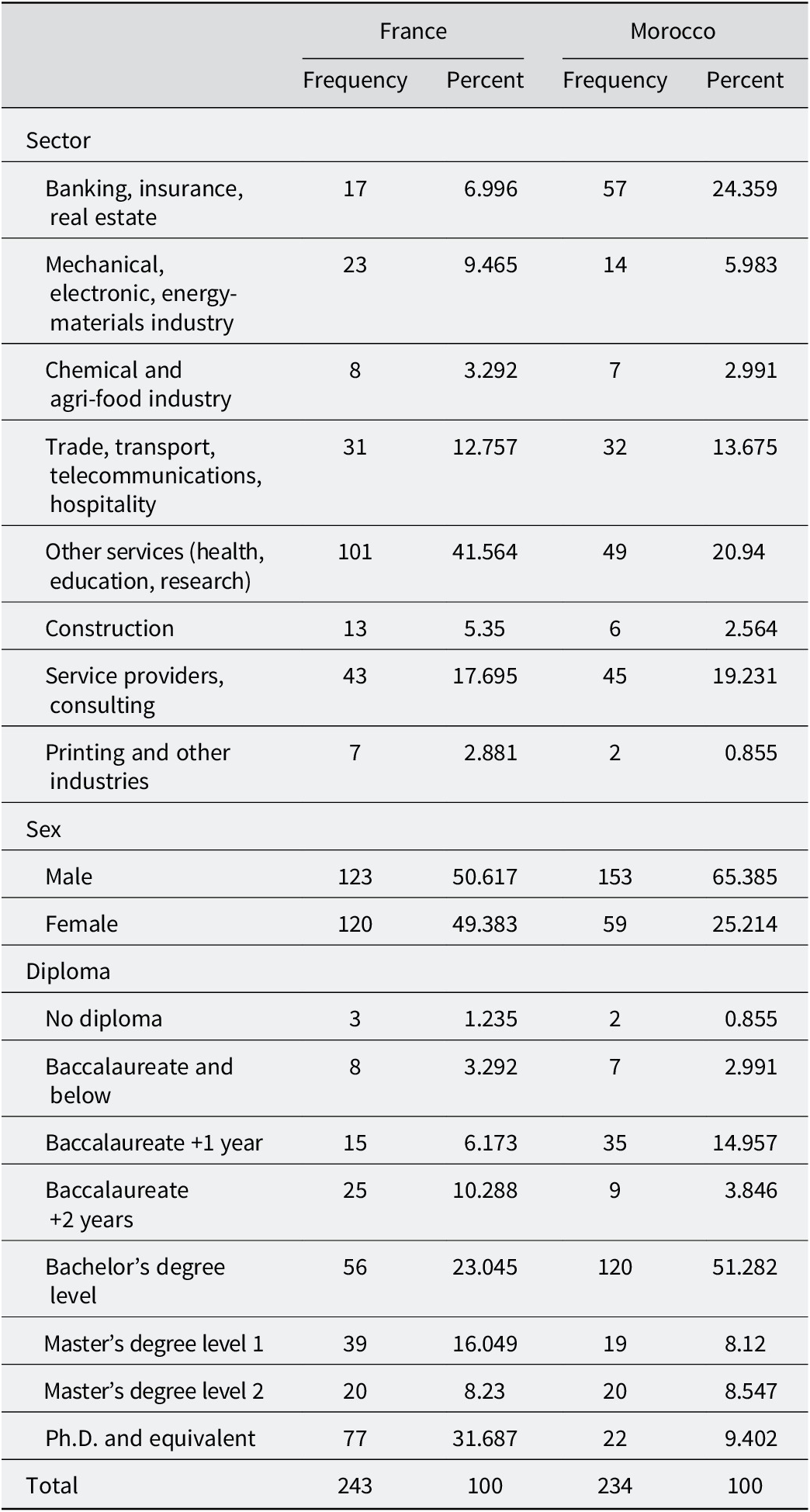
We collected data from two voluntary samples of full-time workers from individualist (France) and collectivist (Morocco) cultures using LimeSurvey. The French sample (N = 243) was recruited via the online platform Crowdpanel and was remunerated at 2.60 euros per participant. The Moroccan sample (N = 234) was recruited through social media (i.e., LinkedIn, Facebook) and was not remunerated. While this may introduce some variability in responses, both approaches are established in cross-national research, and the impact on comparability is likely limited. Participants had to be salaried French or Moroccan citizens, working at least 35 hours per week, and affiliated with a small or medium-sized company (see Table 1).
Sociodemographic variables

Table 1. Long description
The table compares frequency and percentage data for France (N = 243) and Morocco (N = 234).
Sector distribution:
* Banking, insurance, real estate: France 6.996 percent; Morocco 24.359 percent.
* Mechanical, electronic, energy-materials industry: France 9.465 percent; Morocco 5.983 percent.
* Chemical and agri-food industry: France 3.292 percent; Morocco 2.991 percent.
* Trade, transport, telecommunications, hospitality: France 12.757 percent; Morocco 13.675 percent.
* Other services (health, education, research): France 41.564 percent; Morocco 20.94 percent.
* Construction: France 5.35 percent; Morocco 2.564 percent.
* Service providers, consulting: France 17.695 percent; Morocco 19.231 percent.
* Printing and other industries: France 2.881 percent; Morocco 0.855 percent.
Sex distribution:
* Male: France 50.617 percent; Morocco 65.385 percent.
* Female: France 49.383 percent; Morocco 25.214 percent.
Diploma levels:
* No diploma: France 1.235 percent; Morocco 0.855 percent.
* Baccalaureate and below: France 3.292 percent; Morocco 2.991 percent.
* Baccalaureate plus 1 year: France 6.173 percent; Morocco 14.957 percent.
* Baccalaureate plus 2 years: France 10.288 percent; Morocco 3.846 percent.
* Bachelor’s degree level: France 23.045 percent; Morocco 51.282 percent.
* Master’s degree level 1: France 16.049 percent; Morocco 8.12 percent.
* Master’s degree level 2: France 8.23 percent; Morocco 8.547 percent.
* P h D and equivalent: France 31.687 percent; Morocco 9.402 percent.
Note. N French = 243, N Moroc = 234.
French respondents (Mage = 40.61 years, SD = 10.78; 51% male; 62% private organization workers; M tenure = 9.18, SD = 8.21) were employed in healthcare and teaching (42%), social services (18%), finance and insurance (8%), trade (13%), and miscellaneous (19%). Most respondents (62%) were employed in organizations with over 100 employees, while the remainder were employed in organizations with 20–99 employees.
Moroccan respondents (Mage = 30.57 years, SD = 8.42; 73% male; 66% private organization workers; M tenure = 5.20, SD = 4.29) were employed in healthcare and teaching (23%), social services (21%), finance and insurance (27%), trade (15%), and miscellaneous (14%). As for the French sample, most respondents (68%) were employed in organizations with over 100 employees.
Because the French and Moroccan samples differ in average age, cross-group comparisons should be interpreted cautiously, as age-related and career-stage differences may partially account for observed variations.
Measures
All variables were assessed in French using self-report methods using a 7-point Likert scale (1 = strongly disagree; 7 = totally agree) (See Appendix 1).
CSR perception was measured via Igalens and Tahri’s (Reference Igalens and Tahri2010) 9-item scale, composed of three subscales: economic (3 items; ωFrance = .65; ωMorocco = .75), environment (3 items; ωFrance = .78; ωMorocco = .84), and social (3 items; ωFrance = .72; ωMorocco = .70). Typical items are “My organization guarantees product or service safety to its customers,” “My organization prioritizes renewable energy sources,” and “My organization promotes workforce diversity (age, gender, ethnic origin),” respectively. The analyses showed that for the French (χ2(24) = 62.560, p < .01; RMSEA = .08; CFI = .91, TLI = .87; SRMR = .05, AIC = 7243.43, BIC = 7348.22) and Moroccan (χ2(24) = 70.578, p < .01; RMSEA = .09; CFI = .93, TLI = .89; SRMR = .04, AIC = 7359.44, BIC = 7463.10) samples, the use of a second-order factor (French: ∆CFI = .02; ∆TLI = .03; Moroccan: ∆RMSEA = −.02; ∆TLI = .02) improved the fit of the model, and reduced observed collinearity from first-order analysis (i.e., .75 < r french < .90; .80 < r moroccan < .91).
CSR sensitivity was a newly created 3-item scale. In the French and Moroccan contexts, no existing measure directly captures employees’ sensitivity and attentiveness to their organization’s CSR practices, distinct from general prosocial orientation or evaluations of CSR performance. Previous instruments have assessed either broad prosocial tendencies (e.g., Caprara et al., Reference Caprara, Steca, Zelli and Capanna2005) or perceptions of organizational CSR practices (e.g., Turker, Reference Turker2009). However, these approaches do not align with our operational definition of CSR sensitivity, which is the degree to which an individual cares about, pays attention to, and seeks to understand their organization’s CSR practices. This conceptualization is consistent with recent work on CSR internal branding, which emphasizes the importance of employees’ awareness, knowledge, and personal engagement with CSR as a precursor to positive employee outcomes (Carlini & Grace, Reference Carlini and Grace2021). Guided by this definition, we generated candidate items by reviewing literature on CSR perceptions and employee responses to CSR (Aguinis & Glavas, Reference Aguinis and Glavas2012; Carlini & Grace, Reference Carlini and Grace2021; Rupp et al., Reference Rupp, Ganapathi, Aguilera and Williams2006). We then drafted items to reflect three facets of sensitivity: affective concern, cognitive interest, and behavioral inquiry. Items included “I am sensitive to my organization’s CSR practices,” “I am interested in my organization’s CSR practices,” and “I inquire about my organization’s CSR practices.” The scale had adequate reliability (ωFrance = .84; ωMorocco = .71).
CSR information sharing was measured via an adapted version of the 4-item scale from Boselie et al. (Reference Boselie, Paauwe and Jansen2001). Item example included “I am well informed about the company’s CSR vision and mission” (ωFrance = .89; ωMorocco = .92).
PO-fit was measured using Cable and deRue’s (Reference Cable and DeRue2002) 3-item scale. Item example included “My personal values match my organization’s values and culture” (ωFrance = .92; ωMorocco = .90).
Turnover intention was collected through Vandenberghe and Bentein’s (Reference Vandenberghe and Bentein2009) 3-item scale. Item example included “I often think about quitting this organization.” The reliability coefficient was good (ωFrance = .92; ωMorocco = .93).
Control variables: We controlled gender, age, tenure, and sector as these variables relate to PO-fit and turnover intention (Cable & deRue, Reference Cable and DeRue2002; Thanacoody et al., Reference Thanacoody, Newman and Fuchs2014). However, in line with Bernerth and Aguinis’s (Reference Bernerth and Aguinis2016) recommendations, our analyses revealed that these variables were not significantly related to the dependent variables. Therefore, they were excluded from further analysis.
Results
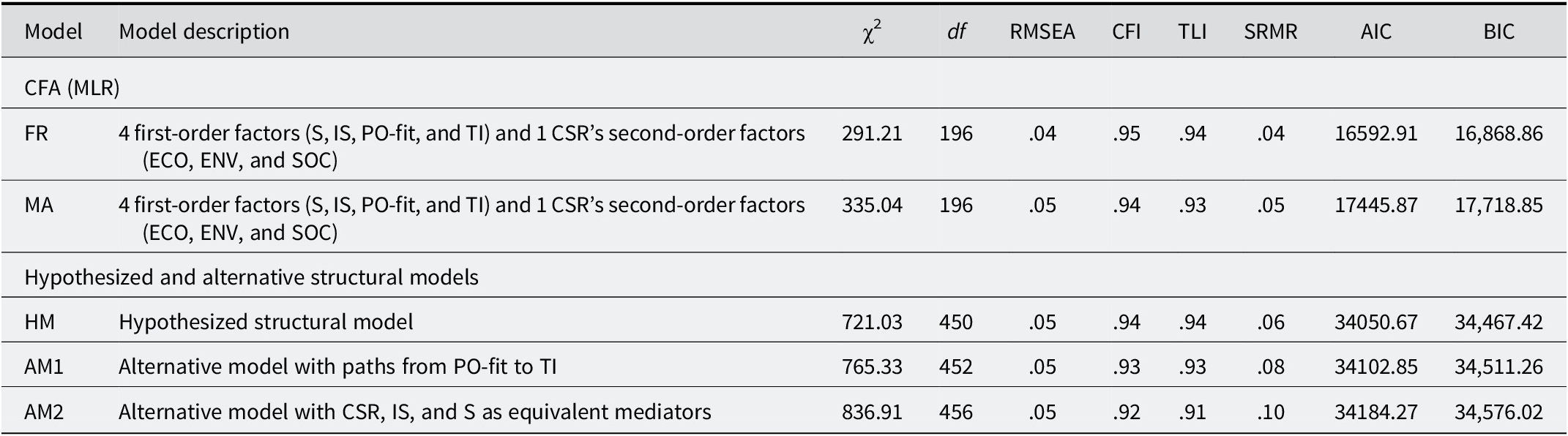
Confirmatory factor analysis (CFA) using maximum likelihood with robust standard errors (MLR) was conducted in Mplus 8.11 to assess the viability of the five-factor CFA model (Table 2: M7) for the French and Moroccan samples. The model showed an acceptable fit for French sample (χ2(196) = 291.21, p < .01; RMSEA = .04; CFI = .95, TLI = .94; SRMR = .04, AIC = 16592.91, BIC = 16868.86) and Moroccan sample (χ2(196) = 335.04, p < .01; RMSEA = .05; CFI = .94, TLI = .93; SRMR = .05, AIC = 17445.87, BIC = 17718.85) (see Table 2).
Fit indices for CFA and structural models

Table 2. Long description
The table contains 10 columns: Model, Model description, chi-squared, d f, R M S E A, C F I, T L I, S R M R, A I C, and B I C.
Section 1: C F A (M L R)
* Model F R: 4 first-order factors (S, I S, P O-fit, and T I) and 1 CSR’s second-order factors (E C O, E N V, and S O C). Chi-squared 291.21, d f 196, R M S E A .04, C F I .95, T L I .94, S R M R .04, A I C 16592.91, B I C 16,868.86.
* Model M A: Same description as F R. Chi-squared 335.04, d f 196, R M S E A .05, C F I .94, T L I .93, S R M R .05, A I C 17445.87, B I C 17,718.85.
Section 2: Hypothesized and alternative structural models
* Model H M: Hypothesized structural model. Chi-squared 721.03, d f 450, R M S E A .05, C F I .94, T L I .94, S R M R .06, A I C 34050.67, B I C 34,467.42.
* Model A M 1: Alternative model with paths from P O-fit to T I. Chi-squared 765.33, d f 452, R M S E A .05, C F I .93, T L I .93, S R M R .08, A I C 34102.85, B I C 34,511.26.
* Model A M 2: Alternative model with C S R, I S, and S as equivalent mediators. Chi-squared 836.91, d f 456, R M S E A .05, C F I .92, T L I .91, S R M R .10, A I C 34184.27, B I C 34,576.02.
Note. AIC = Akaike information criterion; AM = alternative model; BIC = Bayesian information criterion; CFI = comparative fit index; CSR = corporate social responsibility; Eco = economic; ENV = environment; HM = hypothesized model; IS = information sharing; MLR = maximum likelihood robust; PO-fit = person-organization fit; RMSEA = root mean square error of approximation; S = sensitivity; SOC = social; SRMR: standardized root mean square residual; TI = turnover intent; TLI = Tucker–Lewis index.
We tested nationality invariance using Vandenberg and Lance’s (Reference Vandenberg and Lance2000) recommendations. The configural invariance was evaluated by allowing all parameters to be freely estimated across groups. The model fit indices indicated an acceptable fit across groups (χ2(398) = 632.74, p < .01; RMSEA = .050; CFI = .948, TLI = .943; SRMR = .068, AIC = 34035.93, BIC = 34590.21), thereby supporting the configural invariance hypothesis. Weak invariance (metric) was tested by constraining factor loadings to be equal across groups. The change in fit indices (Δχ2SB = 2.14, Δdf = 10, p > .05; ΔRMSEA = −0.001; ΔCFI = .003; ΔTLI = .002) fell within the acceptable limits, thereby supporting the weak invariance hypothesis. Strong (scalar) invariance was examined by constraining the item intercepts to be equal. Even though the chi-square difference test yielded a significant result (Δχ2SB = 39.75, Δdf = 10, p < .01), the model fit indices (ΔRMSEA = .002; ΔCFI = −.005; ΔTLI = .003; ΔSRMR = .005) remained below the recommended thresholds, thereby confirming the scalar invariance. The hypothesis of strict invariance was tested by constraining item residuals across groups. The fit indices demonstrated minimal change (Δχ2SB = 10.34, Δdf = 17, p > .05; ΔRMSEA = −.001; ΔCFI = .001; ΔTLI = −.002; ΔSRMR = −.006), indicating that strict invariance was partially supported. However, given that the scalar model fit was only slightly inferior to the configural and metric models, we conducted partial scalar invariance (mean) to assess the extent of non-invariance (Van de Schoot et al., Reference Van de Schoot, Lugtig and Hox2012). We initially relaxed the intercept that exhibited the highest measure of invariance (ΔRMSEA = .001; ΔCFI = .003; ΔTLI = −.001; ΔSRMR = .001). Secondly, as partial scalar invariance was observed (Edwards & Wirth, Reference Edwards and Wirth2009), we tested the partial residual invariance model (ΔRMSEA = .00; ΔCFI = .00; ΔTLI = .00; ΔSRMR = .00). The results of the invariance analysis indicated that the scales could be utilized by both French and Moroccan workers, thereby enabling the conduct of multigroup analyses, and partially answering RQ1.
We examined descriptive statistics and correlations for the study variables (Table 3). Internal consistency was indicated with the Omega (ω) coefficient. The reliability of all variables was high (ω = .71), except for the French CSR-economic factor (ω = .65). Concerning the French sample (−.62 ≤ r ≤ −.20; .35 ≤ r ≤ .66) and the Moroccan sample (−.41 ≤ r ≤ −.19; .42 ≤ r ≤ .61), all the correlations were significant (p < .01).
Means, standard deviations, and estimated correlations matrix for the latent variables

Table 3. Long description
The table presents data for five variables: 1. Sensitivity, 2. Information sharing, 3. Corporate social responsibility, 4. Person-organization fit, and 5. Turnover intent.
Descriptive Statistics (M sub Fr, S D sub Fr, M sub Mo, S D sub Mo):
* Sensitivity: 4.40, 1.22, 4.92, 1.28.
* Information sharing: 3.93, 1.25, 4.26, 1.56.
* Corporate social responsibility: 4.47, 0.93, 4.66, 1.23.
* Person-organization fit: 4.05, 1.35, 4.07, 1.62.
* Turnover intent: 3.24, 1.64, 4.07, 1.89.
Correlation Matrix (French sample in upper right diagonal; Moroccan sample in lower left diagonal):
* Sensitivity (1) correlations: with (2) .56 French / .48 Moroccan; with (3) .61 French / .40 Moroccan; with (4) .47 French / .35 Moroccan; with (5) minus .25 French / minus .15 Moroccan.
* Information sharing (2) correlations: with (3) .61 French / .56 Moroccan; with (4) .54 French / .31 Moroccan; with (5) minus .33 French / minus .16 Moroccan.
* Corporate social responsibility (3) correlations: with (4) .60 French / .56 Moroccan; with (5) minus .23 French / minus .34 Moroccan.
* Person-organization fit (4) correlations: with (5) minus .45 French / minus .57 Moroccan.
Sample sizes are N sub French equals 243 and N sub Moroc equals 234. Significance levels are indicated by asterisks where * p < .05 and ** p < .01.
Note. N French = 243, N Moroc = 234; *p < .05, **p < .01. The French are in the upper right diagonal.
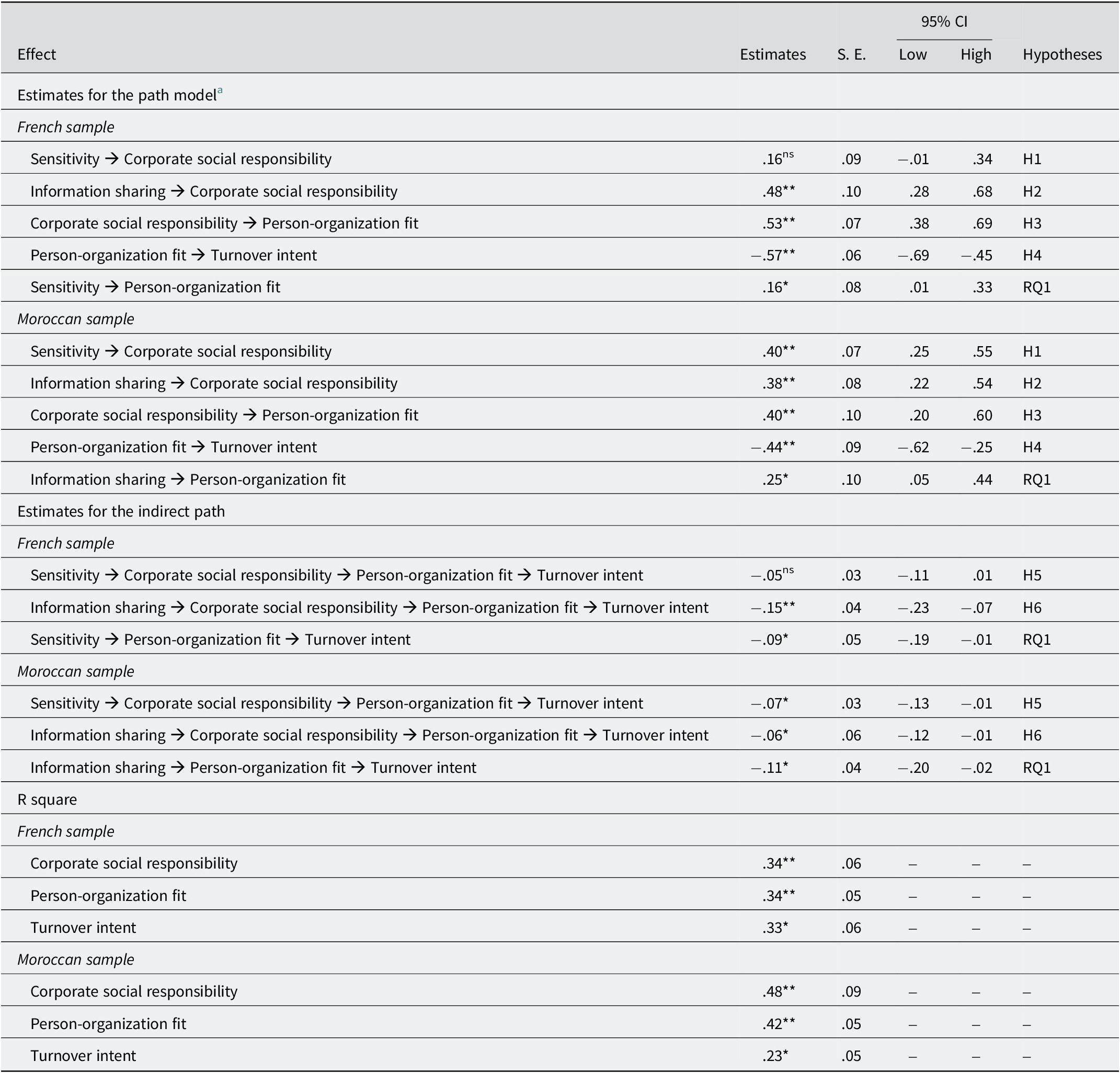
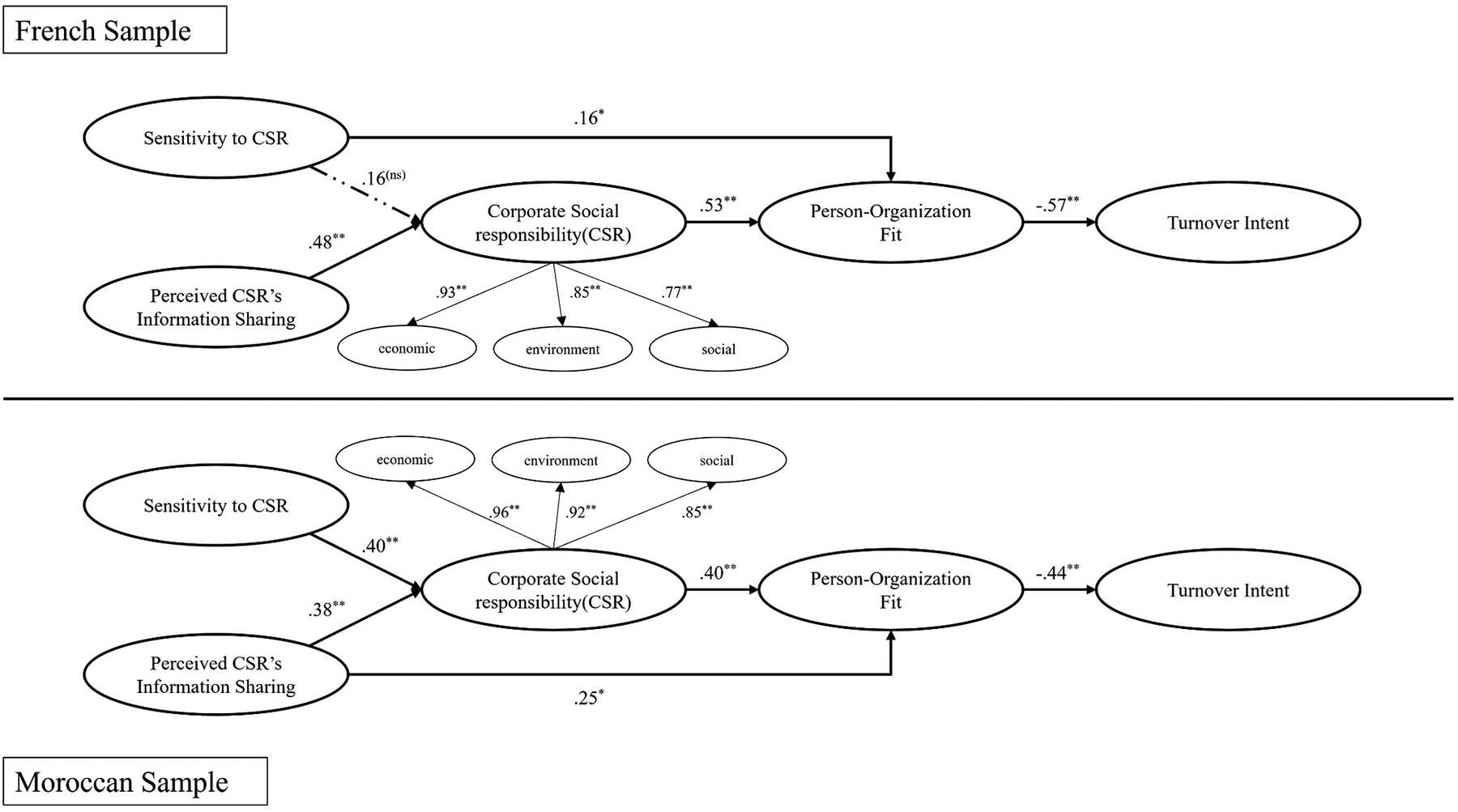
We used multigroup structural equation modeling (SEM) with MLR estimator to test our mediation path model. The hypothesized model (HM) fitted the data well (Table 2: HM), χ2(450) = 721.03, p < .001, RMSEA = .05, CFI = .94, TLI = .94, SRMR = .06, AIC = 34050.67, BIC = 34467.42. Alternative models (AMs) were examined to determine whether this model was the best (Table 2). The AM1 reversed the order of PO-fit mediator as an antecedent, thereby testing the hypothesis that sensitivity and information sharing act as first mediators, and CSR as second mediators in the relationship between PO-fit and turnover intention. This model is theoretically supported by micro-CSR (Gond et al., Reference Gond, El Akremi, Swaen and Babu2017) and organizational identification (Ashforth & Mael, Reference Ashforth and Mael1989) literature, emphasizing that employees’ initial sense of fit with the organization can shape how they interpret and internalize organizational messages, including CSR-related cues (e.g., Cable & DeRue, Reference Cable and DeRue2002; Kristof-Brown et al., Reference Kristof-Brown, Zimmerman and Johnson2005). Although the model demonstrated an acceptable fit (χ2(452) = 765.33, p < .01; RMSEA = .05; CFI = .93, TLI = .93; SRMR = .08, AIC = 34102.85, BIC = 34511.26), it was not the optimal model (ΔCFI = −.01, ΔTLI = −.01, ΔSRMR = .02, ΔAIC = 52.18, ΔBIC = 43.84). Additionally, the model indicated that CSR was not associated with turnover intention (βMoroccan = .16, p = .23; βFrench = −.04, p = .62). The AM2 followed the same path and anticipated that CSR would mediate at the same level as sensitivity and information sharing. AM2 represents a non-hierarchical model in which CSR perceptions, sensitivity, and information sharing each exert direct and independent associations with employees’ turnover intentions. Grounded in social exchange theory, this perspective suggests that when employees perceive their organization as acting responsibly and authentically (Luo et al., Reference Luo, Jiang and Zeng2023), they reciprocate with stronger commitment and lower turnover intention (ter Hoeven & Verhoeven, Reference ter Hoeven and Verhoeven2013). Crucially, this model also underscores that CSR can shape employee outcomes independently, as visible and reputable CSR practices are salient signals that strengthen organizational attachment even without prior attitudinal predispositions such as CSR sensitivity. The results were comparable to those of AM1 (χ2(456) = 836.91, p < .01; RMSEA = .05; CFI = .92, TLI = .91; SRMR = .10, AIC = 34184.27, BIC = 34576.02) (ΔCFI = −.02, ΔTLI = −.03, ΔSRMR = .04, ΔAIC = 133.60, ΔBIC = 108.60), with no discernible relationship between the mediators and turnover intent (CSR: βFrench = −.03, p = .68, βMoroccan = .16, p = .20; Sensitivity: βFrench = .06, p = .34, βMoroccan = −.03, p = .73; turnover: βFrench = .02, p = .67, βMoroccan = −.14, p = .10). Therefore, the HM was retained. The standardized path coefficients for this model are presented in Figure 2, and the standardized indirect effects and 95% confidence intervals (CIs) are reported in Table 4.
Mediation model and indirect path estimates

Table 4. Long description
The table is divided into three primary sections.
1. Estimates for the path model:
* French sample: Sensitivity to Corporate social responsibility (C S R) is .16 (not significant). Information sharing to C S R is .48 (p < .01). C S R to Person-organization (P-O) fit is .53 (p < .01). P-O fit to Turnover intent is -.57 (p < .01). Sensitivity to P-O fit is .16 (p < .05).
* Moroccan sample: Sensitivity to C S R is .40 (p < .01). Information sharing to C S R is .38 (p < .01). C S R to P-O fit is .40 (p < .01). P-O fit to Turnover intent is -.44 (p < .01). Information sharing to P-O fit is .25 (p < .05).
2. Estimates for the indirect path:
* French sample: Information sharing through C S R and P-O fit to Turnover intent is -.15 (p < .01). Sensitivity through P-O fit to Turnover intent is -.09 (p < .05).
* Moroccan sample: Sensitivity through C S R and P-O fit to Turnover intent is -.07 (p < .05). Information sharing through C S R and P-O fit to Turnover intent is -.06 (p < .05). Information sharing through P-O fit to Turnover intent is -.11 (p < .05).
3. R square values:
* French sample: C S R (.34), P-O fit (.34), Turnover intent (.33).
* Moroccan sample: C S R (.48), P-O fit (.42), Turnover intent (.23).
Sample sizes are N French = 243 and N Moroccan = 234. C I stands for confidence interval.
Note. N French = 243, N Moroc = 234; CI = confidence interval; *p < .05, **p < .01.
a The SEM model allows the estimation of hypothetical paths of influence but does not demonstrate temporal causality.
Hypothesis 1 was partially supported, as sensitivity was only positively related for the Moroccan sample to CSR (βFrench = .16, p = .06, βMoroccan = .40, p < .01). As predicted by Hypothesis 2, perceived CSR’s information sharing was also positively related to CSR (β French = .48, p < .01, βMoroccan = .38, p < .01). Hypothesis 3 was also supported, as CSR was related to PO-fit. Finally, Hypothesis 4 was confirmed, as PO-fit was negatively associated with turnover intent. Information sharing (βMoroccan = .16, p < .05) and PO-fit were related, as was sensitivity (βFrench = .16, p < .05). Furthermore, as shown in Table 4, the indirect effect of sensitivity on turnover intent (H5) through CSR and PO-fit was negative only for the Moroccan sample (French: −.05, 95% CI = −.11, .01; Moroccan: −.07, 95% CI = −.13, −.01). A negative indirect association between sensitivity and turnover intent through PO-fit was also observed (French: −.09, 95% CI = −.19, −.01). The indirect effect of information sharing on turnover intent through CSR and PO-fit (H6) was negative (French: −.15, 95% CI = −.23, −.07; Moroccan: −.06, 95% CI = −.12, −.01). A negative indirect effect of information sharing on turnover intent involving PO-fit was also observed (Moroccan: −.11, 95% CI = −.20, −.02). Finally, the various indirect paths observed between French and Moroccan contexts facilitate answering RQ1.
As noted by Kline (Reference Kline2023), directional paths in SEM represent theoretically informed hypotheses about relational ordering and should not be interpreted as evidence of causal effects when estimated using cross-sectional data. Additionally, cross-cultural comparisons should be interpreted with caution due to differences in sample composition, particularly in age. The French sample was, on average, older than the Moroccan sample (41 versus 31 years), which may reflect differences in career stage and labor-market positioning. Although age and tenure were not significant in the structural model, cohort-related factors may still shape CSR perceptions, PO-fit, and turnover intention. Accordingly, cross-national differences should be viewed as indicative rather than purely culture driven.
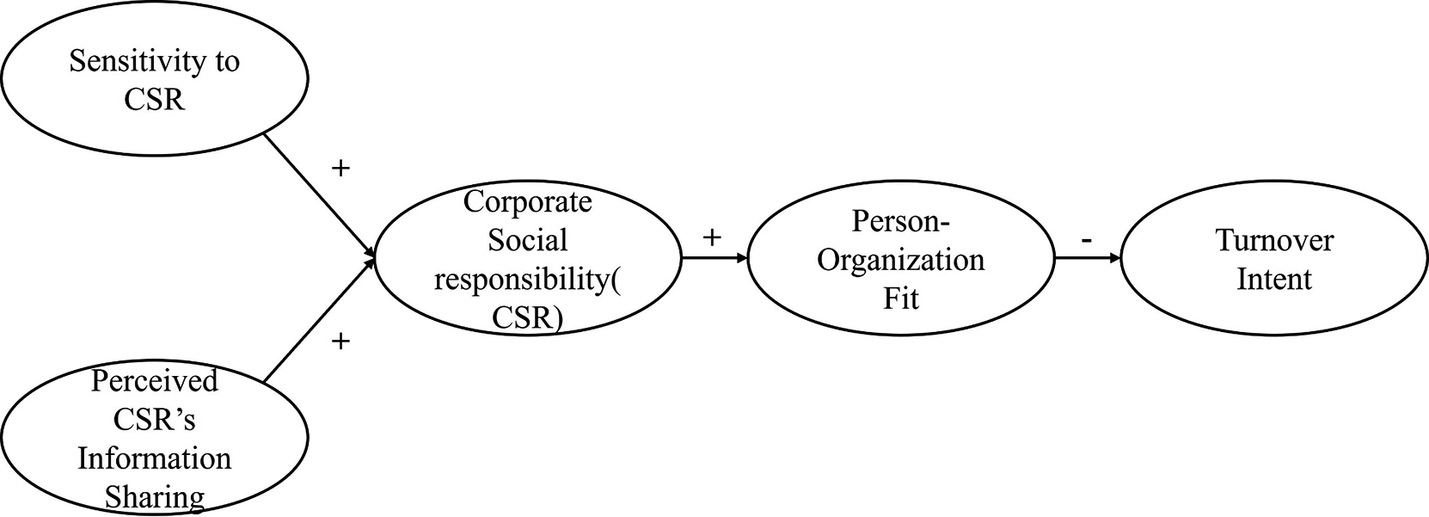
Hypothesized model.

Results from the French and Moroccan path model using SEM.

Figure 2. Long description
A multi-panel figure showing two structural equation models.
Top Panel: French Sample.
On the far left, two ovals represent Sensitivity to C S R and Perceived C S R’s Information Sharing. Sensitivity to C S R has a solid arrow to Person-Organization Fit with a coefficient of .16* and a dashed arrow to Corporate Social responsibility (C S R) with .16(ns). Perceived C S R’s Information Sharing points to Corporate Social responsibility (C S R) with .48**.
At the center, Corporate Social responsibility (C S R) branches down to three smaller ovals: economic (.93**), environment (.85**), and social (.77**). It also points right to Person-Organization Fit with .53**.
On the right, Person-Organization Fit points to Turnover Intent with -.57**.
Bottom Panel: Moroccan Sample.
On the far left, Sensitivity to C S R points to Corporate Social responsibility (C S R) with .40**. Perceived C S R’s Information Sharing points to Corporate Social responsibility (C S R) with .38** and has a long arrow pointing directly to Person-Organization Fit with .25*.
At the center, Corporate Social responsibility (C S R) branches up to three smaller ovals: economic (.96**), environment (.92**), and social (.85**). It points right to Person-Organization Fit with .40**.
On the right, Person-Organization Fit points to Turnover Intent with -.44**.
Discussion
While earlier studies show that CSR enhances employee commitment (George et al., Reference George, Aboobaker and Edward2021), little is known about the mechanisms behind this effect. This study examined the associations between perceived CSR and turnover intention in France and Morocco, focusing on the indirect relationships involving CSR sensitivity, CSR information sharing, and PO-fit. SEM analyses supported the hypothesized pattern of relationships specified in the model (Figure 1) and highlighted differences between the French and Moroccan samples (Figure 2).
Theoretical Implications
The findings answer RQ1 by indicating that perceived CSR is systematically associated with lower turnover intention involving PO-fit, with variations across cultural contexts. PO-fit emerges as a central intervening construct in the association between CSR and turnover intention (Aït Saïd, Reference Aït Saïd, Jacquinot, Janand and Said2025; Lu et al., Reference Lu, Guo, Qu, Lin and Lev2023).
Across the two samples, different configurations of CSR-related processes were observed. In France, perceived CSR was primarily associated with information sharing, highlighting the importance of visible, transparent organizational communication. In Morocco, individual sensitivity to CSR played a more central role in shaping CSR perceptions. In contrast, the relationship between CSR sensitivity and CSR perception was not observed in the French sample, where CSR sensitivity operates primarily through value alignment with the organization, rather than through direct evaluations of CSR practices. This divergence suggests that employees rely on different cues when forming CSR perceptions, with individual predispositions playing a stronger role in the Moroccan context. Accordingly, employees with higher CSR sensitivity tend to attach greater importance to their organization’s ethical, environmental, and social commitments, whereas employees with lower sensitivity may view CSR initiatives as less central (De Roeck & Maon, Reference De Roeck and Maon2018; Gond et al., Reference Gond, El Akremi, Swaen and Babu2017).
CSR information sharing emerges as a key correlate of perceived CSR and PO-fit within the proposed model. Across both contexts, stronger CSR communication was associated with more favorable CSR perceptions and higher PO-fit, though its relative importance varied by country. In France, CSR perception was predominantly associated with information sharing, whereas in Morocco, it was more closely related to employees’ CSR sensitivity and personal values. These relationships indicate that CSR information sharing helps employees make sense of organizational values, thereby strengthening perceptions of value congruence.
Taken together, these findings emphasize that PO-fit plays a pivotal role in linking CSR perceptions to turnover intention, while the antecedents contributing to PO-fit vary across cultural contexts. Rather than supporting a uniform CSR process, the results highlight culturally contingent pathways through which CSR-related perceptions influence employee retention. This underscores the importance of adopting CSR strategies that are sensitive to both employee predispositions and national context, rather than assuming homogeneous responses to CSR initiatives (De Roeck & Maon, Reference De Roeck and Maon2018).
Managerial Implications
Several managerial implications emerge from this cross-cultural analysis of perceived CSR. Overall, the findings suggest that organizations should tailor their CSR strategies to the local cultural, legal, and institutional environment to ensure legitimacy and effectiveness.
In France, a context characterized by higher individualism, employees tend to evaluate CSR initiatives based on their alignment with formal standards, procedural fairness, and individual ethical values. This reflects a normative and rule-based management culture in which legitimacy is reinforced through transparency, accountability, and compliance with recognized standards (Žukauskas et al., Reference Žukauskas, Vveinhardt and Andriukaitienė2018). Consistent with prior research showing stronger links between perceived CSR and affective commitment in individualist cultures (Mueller et al., Reference Mueller, Hattrup, Spiess and Lin-Hi2012), French managers may benefit from emphasizing formal communication channels such as CSR reports, public disclosures, and performance indicators aligned with ISO standards. When CSR initiatives are perceived as authentic and consistent with individual values, these practices can strengthen organizational identification and employee attachment (Wojtczuk-Turek et al., Reference Wojtczuk-Turek, Turek, Edgar, Klein, Bosak, Okay-Somerville, Fu, Raeder, Jurek, Lupina-Wegener, Dvorakova, Gutiérrez-Crocco, Kekkonen, Leiva, Mynaříková, Sánchez-Apellániz, Shafique, al-Romeedy, Wee and Karamustafa-Köse2024).
In Morocco, a more collectivist context, CSR practices are more closely embedded in traditional and paternalistic values. Employees tend to respond more positively to CSR initiatives that emphasize relational harmony, group loyalty, and moral leadership (Albawwat, Reference Albawwat2023). Accordingly, Moroccan managers may benefit from highlighting the social and emotional dimensions of CSR through initiatives that resonate with local values, such as community support, education, and healthcare projects. In this context, CSR also serves as an important signal of organizational modernity and alignment with international standards, making reputation management a particularly salient consideration (El Baz et al., Reference El Baz, Laguir, Marais and Stagliano2012). These culturally embedded CSR practices are especially relevant for strengthening organizational identification, which is particularly influential in collectivist settings (Wojtczuk-Turek et al., Reference Wojtczuk-Turek, Turek, Edgar, Klein, Bosak, Okay-Somerville, Fu, Raeder, Jurek, Lupina-Wegener, Dvorakova, Gutiérrez-Crocco, Kekkonen, Leiva, Mynaříková, Sánchez-Apellániz, Shafique, al-Romeedy, Wee and Karamustafa-Köse2024).
For multinational organizations, these findings indicate that CSR strategies cannot be uniformly applied across countries without risking cultural misalignment. Cross-cultural training may therefore help managers adapt CSR communication and implementation to local expectations. More broadly, organizations may benefit from adopting dual communication strategies, combining structured, data-driven approaches (e.g., reports, workshops, presentations) in France with more relational, narrative-based approaches (e.g., testimonials, informal exchanges) in Morocco.
Finally, integrating CSR initiatives into broader sustainable development strategies can enhance organizational reputation and employer branding. During recruitment, organizations may highlight their ethical commitments and CSR initiatives to attract candidates whose personal values align with the organization’s values. Adopting responsible, sustainable CSR practices that emphasize authenticity and consistency is likely to strengthen organizational reputation in an increasingly dynamic social and institutional environment (Aït Razouk et al., Reference Aït Razouk, Bayad and Wannenmacher2009).
Limits and Future Orientation
This study has limitations. First, CSR sensitivity was modeled as a direct antecedent of perceived CSR. While this approach allowed us to examine its independent contribution, future research could explore CSR sensitivity as a moderator, examining whether employees interpret CSR information differently based on their CSR predisposition. Conditional process modeling, using larger and more diverse samples, could clarify these interaction effects. Subsequent studies could examine the development of CSR sensitivity over time. For instance, it is necessary to ascertain whether employees become more sensitive as they gain experience in the organization, or as CSR practices become more visible. The application of longitudinal research methodologies has the potential to provide clarity regarding whether sensitivity constitutes a relatively stable orientation or is context dependent. Moreover, the identification of factors that contribute to variations in employee sensitivity toward CSR could offer significant insights. Possible antecedents may include personal values (e.g., environmental concern), prior experiences with CSR, leadership signals, or organizational communication strategies.
Second, while our research reveals distinct differences in CSR perception and PO-fit between France and Morocco, these findings are specific to these cultural and economic contexts. Future research should include a broader range of cultural contexts, such as Asian and Latin American countries, to assess whether similar dynamics emerge across diverse cultures. Although we did not include a direct cultural values scale, future research should incorporate individual-level cultural orientation measures and quantitative cultural variables to provide deeper insights into how cultural differences shape the relationship between CSR and turnover intention.
Third, although this study focused on individual perceptions, it did not account for organizational or sectoral dynamics that may influence CSR-related attitudes. Drawing on social exchange theory (Cropanzano et al., Reference Cropanzano, Anthony, Daniels and Hall2017), we recommend adopting a multilevel approach in future research to explore how internal CSR policies, leadership practices, or team climate interact with employee-level constructs to shape turnover intentions.
Fourth, the present study relies on cross-sectional data, which limit the ability to explore how relationships between variables evolve. Future research should adopt a longitudinal approach to examine the organizational attachment’s dynamic, evolving, or potentially decaying nature. Using a time-lagged panel would also help to avoid potential common method bias variance (Podsakoff et al., Reference Podsakoff, MacKenzie, Lee and Podsakoff2003). Moreover, investigating the potential existence of slope profiles through advanced methods such as growth mixture modeling could provide valuable insights into cross-cultural differences.
Finally, our study examines how CSR sensitivity and information sharing affect perceived CSR and their link to PO-fit. It will therefore be necessary to identify factors hindering the influence of CSR on commitment, such as the lack of consistency between stated values and actual corporate practices (De Roeck & Maon, Reference De Roeck and Maon2018). Moreover, Gond et al. (Reference Gond, El Akremi, Swaen and Babu2017) suggest that employees often doubt the motives behind CSR initiatives, viewing them as greenwashing and social washing. We encourage future research to explore the role of organizational cynicism in studying this phenomenon, particularly within the context of France.
Supplementary material
The supplementary material for this article can be found at http://doi.org/10.1017/SJP.2026.10046.
Data availability statement
Data will be shared on request.
Author contribution
K.A.S.: Co-writing, conceptualization, responsibility for coordinating research activity, data collection, and obtaining funding. A.C.: Commentary and review, data collection, and co-writing. G.R.M.D.: Co-writing, study administration, commentary and review, conceptualization, statistical techniques applied to study data, and corresponding Author.
Funding statement
This research was partially funded by the University of Bordeaux through the ECOR-Jeune chercheur project call.
Competing interests
None.



 Open access

