Introduction
In situ time-lapse studies in Polar Regions are uncommon because of the intrinsic limitations of scientific SCUBA diving at sub-zero temperatures and the logistical challenges linked to the deployment of underwater time-lapse systems, which are typically large and heavy. In Antarctica, a number of non-invasive approaches have been adopted to document the behaviour of benthic organisms. For example, in the McMurdo Sound, Ross Sea, Kim et al. (Reference Kim, Thurber, Hammerstrom and Conlan2007) employed time-lapse arrays to study the movement of sea-stars Odontaster validus Koehler in response to organic enrichment, and McClintock et al. (Reference McClintock, Tackett and Bowser2010) recorded valve clap frequency in scallops Adamussium colbecki (E.A. Smith). At King George Island, Antarctic Peninsula, Schories (unpublished, https://www.youtube.com/watch?v=rKV8s00SFL8) conducted a time-lapse analysis (6 hours) of limpet Nacella concinna (Strebel) and sea urchin Sterechinus neumayeri (Meissner) movement. Here we present a simple and portable time-lapse apparatus, which was tested in Terra Nova Bay, Ross Sea, at a depth of 20 m below the pack ice.
Materials and methods
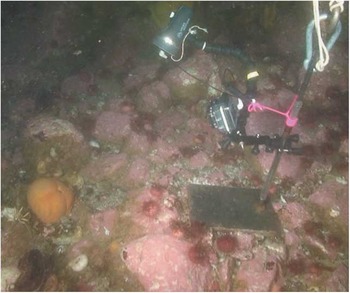
The study was conducted in Tethys Bay (74°41.410'S, 164°06.233'E) in front of a north-west facing granite cliff. The bottom is characterized by a gentle slope with scattered gigantic boulders. The time-lapse apparatus was composed of an action-cam GoPro Hero3+B model, a modified CamDo time-lapse intervalometer controller placed inside the GoPro housing and a modified underwater Light&Motion SOLA 2000 flood light, which was activated by the controller through an infrared optical trigger and a Sea&Sea fibre-optic cable (technical details are provided in the supplemental material at http://dx.doi.org/10.1017/S0954102016000377). The controller was programmed to turn on the light and shoot a 4000×3000 pixel photograph every six minutes, thus extending the camera battery life from 2 hours to ~50 hours. Exposure parameters (shutter speed, aperture and ISO) were automatically adjusted by the camera firmware. The time-lapse apparatus was fastened to a laboratory support stand, modified by the addition of a ring welded to the top to facilitate underwater carrying (Fig. 1). The total weight of the system was ~3 kg in air. To test the time-lapse apparatus in the field, it was deployed by SCUBA divers to ~20 m on: 30 November–1 December, 2–4 December, 6–8 December and 14–15 December 2015. The camera was positioned on the bottom to frame an area of ~50×50 cm (see supplemental material for photos and a video). Each time-lapse sequence included 24 hours (12h30 to 12h30) of macrozoobenthos activity. Images were analysed with Canon Digital Photo Professional 4 software and activity scores were recorded. For mobile species, a positive score of 1 was given to individuals moving on the bottom, otherwise 0 was assigned. For fishes, a score of 1 or 0 corresponded to presence or absence in images. For anthozoans, a score of 1 was assigned to individuals with extended tentacles (in anemones) or polyps (in soft corals); otherwise 0 was assigned. Species aggregations, e.g. asteroids eating sponges or other asteroids, were not considered. Total percent activity (TA) of each individual was computed as:
 $${\rm TA\,{\equals}\,}\left( {\mathop{\sum}{{\rm of \ positive\ scores)}} {\rm /}\mathop{\sum}{{\rm of\ images\ of \ the \ individual}{\times}{\rm 100}} {\rm }} \right){\rm ,}$$
and arcsine transformed. There was a clear daily light/dark cycle and the time-lapse sequences were analysed separately for the lighter and darker periods. When data satisfied homoscedasticity assumptions (Levene’s test, P>0.05) differences were analysed with a t-test for independent groups or, in the opposite case, with the non-parametric Mann-Whitney U test.
The time-lapse apparatus positioned on the bottom.

Results
During the recording period the pack ice was 2.7 m thick with ~1 m of platelet ice that started to melt at the beginning of December when an increase in water turbidity occurred. The time-lapse sequences showed a common light trend with a darker period from ~22h00 until ~06h00. The darker period varied from 6.6–8.6 hours. On 14–15 December, the duration of darkness reached a maximum of 15.7 hours.
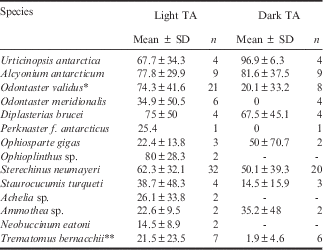
Overall, 14 species were identified in the images and are consistent with those previously observed in the area, in the upper and lower sublittoral zones with hard bottom communities. Differences in activity during the light vs dark periods (Table I) were only observed for two species, the sea-star O. validus and the fish Trematomus bernacchii Boulenger (this species is attracted by artificial light, as directly observed by divers).
Diurnal light vs dark activity (total percent activity, TA) in macrozoobenthos species.

SD = standard deviation, *P<0.5, **P≤0.01 – >0.001.
Species authorities: Urticinopsis antarctica (Verrill), Alcyonium antarcticum Wright & Studer, Odontaster meridionalis (E.A. Smith), Diplasterias brucei (Koehler), Perknaster f. antarcticus (Koehler), Ophiosparte gigas Koehler, Staurocucumis turqueti (Vaney), Neobuccinum eatoni (E.A. Smith).
Discussion
The proposed time-lapse apparatus is robust and affordable. As the apparatus is lightweight and relatively small it can be deployed and recovered by SCUBA divers in minutes. The simplified deployment and recovery operations enable multiple deployments to be completed during the same dive, and hence, a ‘network’ of cameras can be established to replicate observations within a specific area. The deployments in our study area documented a daily light cycle that was previously unknown, even during summer. The shadowing effect seems to be due to the position of the cliff in respect to the sun. The 6 minute time-lapse interval, well above the 30 second interval adopted by Dumont (Reference Dumont, Himmelman and Robinson2007) and below the 10 minute interval adopted by Kim et al. (Reference Kim, Thurber, Hammerstrom and Conlan2007), was a compromise to study the movement of all the macrozoobenthos species. The image storage capacity and the battery life allow the collection of time-lapse images for up to 2 days, greatly improving the possibility of in situ underwater time-lapse research in an extremely challenging environment.
Acknowledgements
This work was part of the Ice-Lapse Project 2013/AZ1.16 completed during the XXXI PNRA (Italian National Antarctic Programme) expedition. A special thank you is due to the divers G. Tangari, T. Pischedda, G. Oggero and R. Pini. We would also like to thank G. Bianchi Fasani, all of the members of the Italian Mario Zucchelli Station, and an anonymous reviewer of the paper.
Author contribution
The authors were all involved in the project and writing the paper.
Supplemental material
Supplemental technical details, figures and a time-lapse video will be found at http://dx.doi.org/10.1017/S0954102016000377.