Implications
Many traits associated with domesticated animals may have originated as correlated side effects of reduced fearfulness. We recorded social behaviour, weight and reproductive traits in Red Junglefowl selected for high or low tameness. Birds with low fear were more dominant in social encounters, weighed more, laid larger eggs and produced larger offspring and had a better plumage condition. Birds selected for low fearfulness may therefore be better adapted to the environment in which they are selected, and low fearfulness may be an important aspect to consider when assessing animal welfare.
Introduction
During domestication, animals have undergone immense changes in physiology, morphology and behaviour, creating an unprecedented within-species variation in an evolutionary short time (Price, Reference Price1999). A set of seemingly correlated traits have developed in a similar way in most domesticated species, which is often referred to as the domesticated phenotype (Jackson and Diamond, Reference Jensen, Keeling, Schütz, Andersson, Mormède, Brändström, Forkman, Kerje, Fredriksson, Ohlsson, Larsson, Mallmin and Kindmark1996; Clutton-Brock, Reference Collias and Collias1999; Price, Reference Price1999). Examples of such traits are changes in reproductive physiology, pigmentation, body size and proportions and, in mammals, increased frequency of floppy ears, and short and curly tails.
It remains an open question whether the domesticated phenotype is a result of human selection on each of the separate traits independently, or whether selection has been focused on one or a few traits with others developing because of genetic correlations caused by, for example, linkage or pleiotropy. One trait that could potentially have such a master role is the tameness of the animal, defined as the degree of fear response towards humans. It would appear that tameness could have been a prerequisite for successive breeding and domestication, since it would allow human handling and relaxing the stress associated with human proximity. Although a tame animal is of course not domesticated, tameness may represent an essential first step towards domestication.
It is also possible that some of the domestic phenotypes arise due to shared genetic mechanisms with tameness. A famous example of the importance of reduced fear of humans during the early phases of domestication, is the suite of correlated phenotypic responses related to tameness in silver foxes (Vulpes vulpes) (Belyaev et al., Reference Boitani and Ciucci1985). Traits typical of domesticates emerged in few generations, such as piebaldness, modified body proportions, floppy ears and modifications of the jaw, in spite of selection being targeted only on tameness (Trut et al., Reference Trut, Plyusnina and Oskina2004), suggesting genetic correlations between reduced fear of humans and important aspects of the domesticated phenotype. Hence, although the foxes should not be regarded as domesticated already after the first few generations, they showed correlated responses that might indicate shared genetic mechanisms. Other selective breeding projects focusing on fear in other species have shown similar results, for example, in rats (Rattus norvegicus) (Albert et al., Reference Albert, Shchepina, Winter, Römpler, Teupser, Palme, Ceglarek, Kratzsch, Sohr, Trut, Thiery, Morgenstern, Plyusnina, Schöneberg and Pääbo2008), mink (Neovison vison) (Malmkvist and Hansen, Reference Müller, Eising, Dijkstra and Groothuis2002) and quail (Coturnix japonica) (Jones et al., Reference Kerje, Carlborg, Jacobsson, Schütz, Hartmann, Jensen and Andersson2002).
Some important aspects of the domesticated phenotype consist of changes in behavioural frequencies and intensities. For example, feralized dogs show a less rigid social organization than wolves (Boitani and Ciucci, Reference Broom1995) and domesticated chickens are generally less explorative and less active than their ancestors, and show more crowing and wing display in a social situation although the Red Junglefowl show a larger variety of social behaviour (Schütz et al., Reference Schütz, Forkman and Jensen2001; Väisänen et al., Reference Väisänen, Håkansson and Jensen2005). Recently, we reported significant genetic correlations between fear of humans and several other behavioural traits in chickens, among others, the propensity to search for hidden high energy feed v. visually presented commercial chicken feed (Agnvall et al., Reference Agnvall, Jöngren, Strandberg and Jensen2012) that resembles the differences earlier reported between Red Junglefowl and White Leghorn (Lindqvist et al., Reference Malmkvist and Hansen2002). The significant genetic correlations between fear of humans and these traits ranged from 0.6 to 0.95 (Agnvall et al., Reference Agnvall, Jöngren, Strandberg and Jensen2012). This suggests that many behaviours may have been modified secondarily to increased tameness.
The animals used in this current study are from an outbred population, which had subsequently been selected for three or four generations on high or low fear response towards humans in a standardized test. Previous findings based on the two first generations only have shown a significant heritability (0.17±0.09) of the trait under selection and a genetic correlation between the fear response and several other traits (Agnvall et al., Reference Agnvall, Jöngren, Strandberg and Jensen2012).
It is striking that the strongest correlated effects shown in previous studies of the population in this experiment relate to feeding and exploration. This suggests that tamer birds may have an increased ability to compete for limited food resources and perhaps other resources as well. Early domesticated animals must also have been able to tolerate a higher density of conspecifics than in the wild in order to survive captivity. Therefore, we explore the possibility that changes in social behaviour may occur as correlated responses to reduced fear of humans, using Red Junglefowl (Gallus gallus) as study object, a species considered to be the wild ancestor of all domestic chickens (West and Zhou, Reference West and Zhou1988; Collias and Collias, Reference Craig, Jan, Polley, Bhagwat and Dayton1996; Al-Nasser et al., Reference Al-Nasser, Al-Khalaifa, Al-Saffar, Khalil, Albahouh, Ragheb, Al-Haddad and Mashaly2007). The aim of this study was to investigate the effects of fear-based selection on social behaviour and social dominance in both feed related and non-feed related situations in divergently selected Red Junglefowl. In addition, we measured plumage condition, growth, egg weight and weight of offspring as other possible indicators of a better adaptation to the environment of selection (Campo et al., Reference Cloutier and Newberry2001).
Material and methods
Breeding
The animals in the study consisted of Red Junglefowl (G. gallus) from the third (S3) and fourth generation (S4), of a population divergently selected based on their level of fear of humans. In the selection programme they were divided into three selected strains, one with high fear of human (H), one with low fear (L) and one unselected group (U). The parental generation of the selected animals consisted of a systematically outbred group of Red Junglefowl from two different populations, one of them from a free roaming zoo population in Copenhagen Zoo and one from a research facility in Sweden. The differences between the populations are described in (Håkansson and Jensen, Reference Jackson and Diamond2005). Shortly, the animals from Copenhagen Zoo showed more fearful behaviours whereas the animals from Götala population performed more aggressive behaviours and weighed more than chickens from Copenhagen Zoo. Hence, the genetic variation in the parental generation was maximized with respect to these traits.
For details about the animals and breeding scheme, as well as for a description of the selection test, see Agnvall et al. (Reference Agnvall, Jöngren, Strandberg and Jensen2012). Briefly, the birds were tested in a fear of human test when they were 12 weeks old. During the test, each bird was alone in an arena together with a human, who gradually approached the bird until attempting to touch it. The fear reactions of the bird was scored during the test and merged into a composite fear score ranging on a continuous scale from 1.0 (indicating calm and unaffected behaviour) to 5.0 (assigned to highly fearful birds). This index was used for subsequent selection of the most and least fearful birds in each generation. In each generation, we selected 4 to 10 families in each selection line, and the offspring of all selection lines (113 to 135 birds/generation) were raised together in mixed groups in the same pens.
After pairing, fertile eggs were collected from hens while they were kept in individual cages, so family origin of each egg could be determined and noted directly on them. The eggs were placed in an incubator (model 25 HS, Masalles Comercial, Barcelona, Spain) with 37.5°C, 55% relative humidity and egg rotation every hour. After 17 days of incubation the eggs were placed in hatching compartments separated by family. Immediately after hatching the chicks were weighed, vaccinated against Marek’s disease and wing-tagged. During the first 5 weeks of life, the chickens were kept in the hatchery ‘Kruijt’ situated at Linköping University. They were maintained in mixed groups of about 30 individuals on a 12 : 12 h dark–light rhythm with a light level of ~11 Lux in littered floor pens measuring 0.75×0.75 m, which were gradually expanded to 2.25×2.25 m. The pens contained commercially available conventional chicken feed for chicks and water ad libitum, a heat lamp, wood chips and perches. At 5 weeks of age, the animals were transported to the research facility ‘Wood-Gush’ located about 10 km from the university. There, the birds were sex separated and kept in pens measuring 3×3×3 m, containing perches, nests, wood chips on the floor and water, and conventional chicken feed for laying hens ad libitum. Light schedule was kept at a 12 : 12 h dark–light rhythm with a light intensity of 5 to 8 Lux.
Experiment 1
Animals
Experiment 1 was carried out on the S3 generation, which comprised a total of 111 birds (60 males and 51 females). A total of 19 females and 22 males were from selection line H, 17 males and 17 females from selection line L, and 21 males and 14 females from selection line U.
General routines and recordings
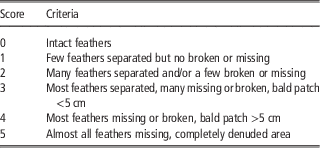
The weights of the animals were measured at hatching, and at 200 days of age. At day 200 the plumage condition was scored according to a standardized protocol (Gunnarsson et al., 1995) with a five-point scale, slightly modified to encompass three parts of the chicken (unlike Tauson et al., Reference Tauson, Ambrosen and Elwinger1984 classification with five body parts on a four-point scale); the head and tail was recorded separately, and wing and body together, and the average was then calculated from the three assessments (Table 1). At 45 weeks of age the five highest, five lowest and eight unselected females were mated each with a different male from the same selection line and with a similar fear score in order to generate the next generation. The collection of the eggs lasted for 3 weeks and the weights of the eggs collected were measured as well as the hatch weight of the 79 chicks in S4.
The criteria for the scores in the plumage condition assessment

The assessment was done on the head and tail separately and the body and wings together, and the final score of the individual was the average of the three separate scores.
At the age of 22 weeks, 99 animals (54 males and 45 females) were tested in a series of behaviour tests designed to measure different aspects of social behaviour.
Social behaviour test (SB)
The SB was carried out to estimate the frequency of social behaviour performed. Three groups were tested in separate arenas at the same time. Each group consisted of three same-sex animals of the same selection strain. In this way one group from each of the three selection strains were tested every day in order to avoid any bias between the lines. The arenas measured 1×1×2 m and were built out of cardboard covered wooden frames with a littered floor. One side and the roof were made of wire mesh, to allow visual observations of the animals in the arena. In the arenas, the birds had free access to feed, water and perches, and the light was kept on 12 : 12 h light–dark rhythm.
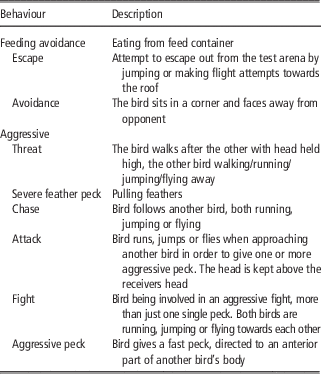
Before the test started, the animals were left for 18 h in the test arenas to allow habituation. Following this, the behaviour of the birds was recorded during a 3-h period, commencing 3 h after the onset of light in the morning. The social behaviours (see Table 2 for ethogram) of the animals were recorded with continuous sampling for 5-min periods interspersed by 10 min pauses. The observer spent the first 5 min recording the behaviour of birds in the first arena, then moved to the second, and the third, before moving to the second and the third arena following the same procedure. This procedure was repeated 12 times, so the total recording time from each arena was 60 min, spread over the 180 min test period. All sampling was done at the same time of the day, starting at 1200 h, which is when egg laying is usually completed. Hence, egg laying did not interfere with the sampling.
Ethogram of the behaviour measured in the social behaviour and in the social dominance test

The behaviours were assessed through continuous recording of 5 min every 15 min, in total 12×5 min.
Social dominance test (SD)
Immediately after the SB the same animals were tested in a SD. The birds were tested in groups of three of the same sex, one bird from each of the selection lines. This was accomplished by moving one bird from each of the three arenas used in the SB (described above) into a new arena, similar to the one they were collected from with the difference that the feed bowls were replaced with small containers (21×9×7 cm) filled with mealworms and covered with a plastic lid with only one narrow hole measuring 2 cm in diameter. In this way only one bird had access to the mealworms at a time. Before the experiment took place, all the birds had been trained in their home pen to eat mealworms from similar containers, both with and without the lid, for a week, so they were all well accustomed to them. In order to distinguish between the three different birds they were equipped with plastic leg rings with different colours. Behaviours reflecting position in the social hierarchy were recorded by continuous sampling for 5 min in each arena, where aggressive behaviours indicated dominance and avoidance indicated submission. The first 5 min for each arena were recorded directly after regrouping of the animals, thereafter the observer rotated between the arenas, collecting data during in total 12×5 min for each group of birds.
During the test, we recorded the frequencies of the behaviours listed in Table 2 for each of the three birds in the group, using continuous recordings.
Exploratory behaviour and sociality test (ES)
In order to investigate the propensity of the animals to explore a novel arena with unknown feed balanced with the propensity to maintain social contact, we tested the animals pairwise in an L-shaped arena containing both familiar and unfamiliar feed, similar to the one described previously by Håkansson and Jensen (Reference Jackson and Diamond2005). All tests were carried out between 0900 and 1300 h. Two animals at the age of 27 weeks (familiar to each other), of the same sex and selection strain, were tested in an L-shaped arena made out of cardboard boxes and covered with wire mesh. The height of the arena was 40 cm and each of the arms was 1.5 m in length and 0.5 m in width. Hence, when a bird was situated about half way into one of the arms, the other arm and its content was not visible to it. In the distal end of each of the arms, one familiar (chicken feed) and one unfamiliar feed source (sun seed) was placed next to each other. The test arena thus allowed the birds a choice between foraging for novel or known feed either alone or together with another bird.
The animals were placed in the arena while in total darkness and the test started when the lights had been turned on for 2 min and continued for 60 min. The location and feeding activity of each of the animals were instantaneously sampled with an interval of 10 s. The position in the arena, and feeding (pecking at the feed source) from the familiar or unfamiliar feed was recorded. For statistical analysis, each tested pair of birds was treated as the independent replicate.
Experiment 2
Animals
Experiment 2 was carried out on birds from the S4 generation, which comprised a total of 79 animals (41 males and 38 females). Eight females and eight males were from selection line H, 20 males and 8 females from selection line L, and 12 males and 22 females from the unselected line U.
SD
Since the dominance test in experiment 1 was related to competition over limited access to feed, we decided to investigate the dominance relations between birds from the different selection lines in the same test, but where competition was over a non-feed-related resource. We studied 42 birds, 7 females and 7 males from each selection strain (H, U and L). Three dominance tests were carried out and in each test we offered limited access to one of the three resources: water, wood chips (for dust bathing) and mealworms (for comparison with experiment 1).
Before the dominance test started, the birds were isolated for 24 h in individual cages measuring 40×100×50 (W×L×H). Here, they had visual and acoustic contact with other animals, but no physical interaction was possible. During this period, they were deprived for 2 h from water, when that was the resource which they were going to be tested against, or for 24 h from access to wood chips to dust bathe in. This was done in order to increase the motivation to drink or to dust bathe. The 2 h of water deprivation was based on our previous experience of how chickens react to this and previous research has shown that 24 h of deprivation from substrate will significantly increase the motivation to dust bathe (Vestergaard, Reference Vestergaard1982). As in experiment 1, the birds were accustomed to eating mealworms from the same containers as used in the test, and their motivation to obtain this resource was always high. The dominance test was then carried out in the same way as in experiment 1, with the difference that the birds were collected directly from the isolation pens to the test pen.
As in experiment 1, the animals were tested in groups of three, one from each selection strain and of the same sex. All the animals were tested with all the resources, one resource at a time. During 3 consecutive weeks they were tested once per week for one of the resources, so there was a resting period of 1 week in between tests. All tests were conducted between 1000 and 1400 h. After a 20 min habituation period in the empty test pen, the limited resource was presented to the animals. The water was presented in a water nipple that could only be operated by one bird at a time, the wood chips were introduced in a plastic box that would only allow one bird to dust bathe at a time (size of the box: 17×11.5×4 cm) and the mealworms were presented as in experiment 1, in a Petri dish (13.5 cm in diameter) with a narrow hole of 1 cm in diameter in the lid, allowing only one bird at a time to obtain worms. The resources were available to the animals throughout the 20 min test period. The behaviour of the birds was recorded on video during the test, in order to exclude any possible effects of the presence of a human in the test situation. During the entire test, we used continuous recording to score for each animal: access to the resource and frequency of aggressive behaviour (Table 2).
Statistics and data analysis
For each test and variable the mean and s.e.m. within selection strain was calculated. Owing to the lack of normality, the differences between selection strains in all the variables recorded in the fear of human test, SB, ES and SD tests were analysed with Kruskal–Wallis ANOVA with sex and selection strain as categorical predictors in separate models. For all statistical analyses, Statistica version 12 was used. Statistical significance was reported when P<0.05.
Results
The selection regime caused a significant difference in fear of human score during the four included generations. In the parental, outbred and unselected population, the mean score was 3.31 (s.e.m.: 0.07). In the fourth selected generation, the H line had a mean score of 3.43 (s.e.m.: 0.1), the U line 2.92 (s.e.m.: 0.11) and the L line 2.74 (s.e.m.: 0.08). The effect of line was highly significant (Kruskal–Wallis, H(2)=16.16, n=79, P<0.001).
Experiment 1
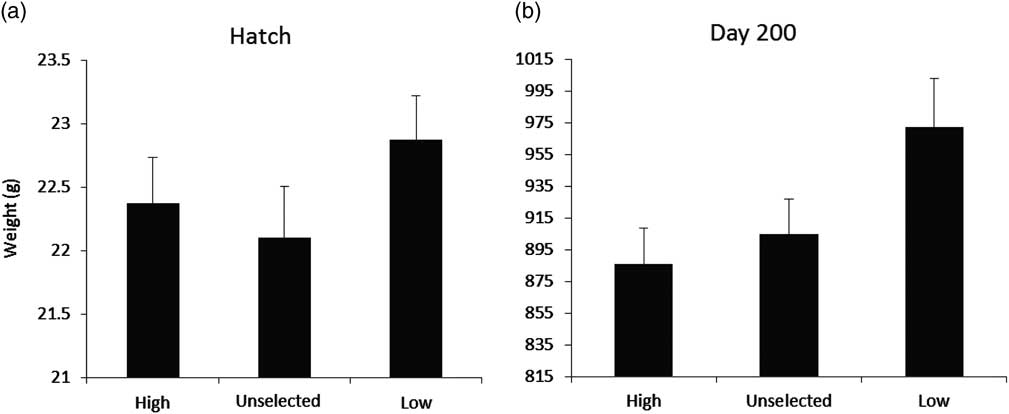
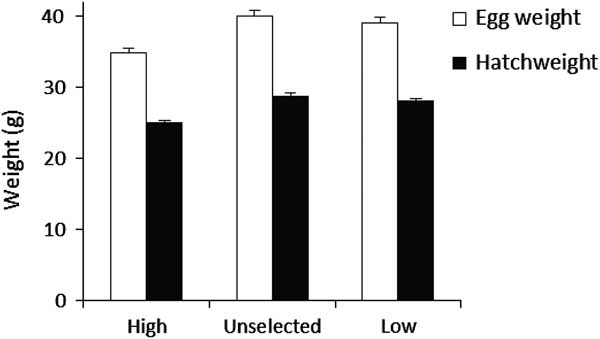
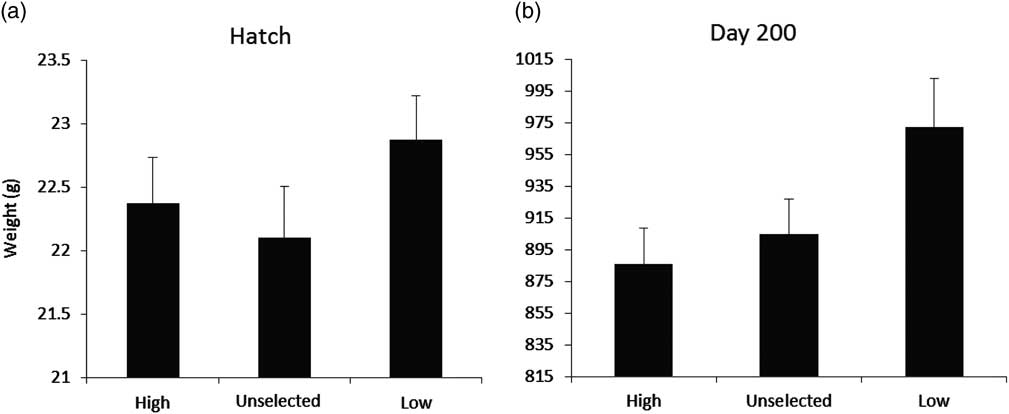
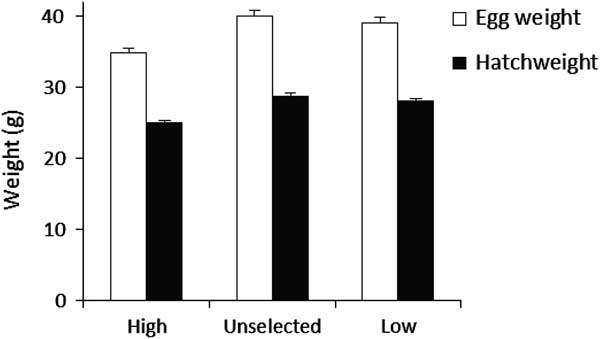
The three strains in the S3 generation had a similar average weight at hatch (Figure 1a). However, at day 200, birds from L were significantly larger than U and H (Figure 1b). Furthermore, H females laid significantly smaller eggs than the other two strains and their offspring (i.e. the S4 generation) were on average significantly smaller at hatch than U and L (Figure 2).
Weights of birds from the S3 generation. (a) Hatch weight (H(2)=2.27, n=142, P=0.32). (b) Weight at 200 days (H(2)=6.16, n=101, P=0.04).
Weight of the eggs and the hatch weight of S4 generated from S3. Egg weights: H(2)=10.00, n=17, P=0.007; chick weights: H(2)=45.44, n=107, P<0.001.
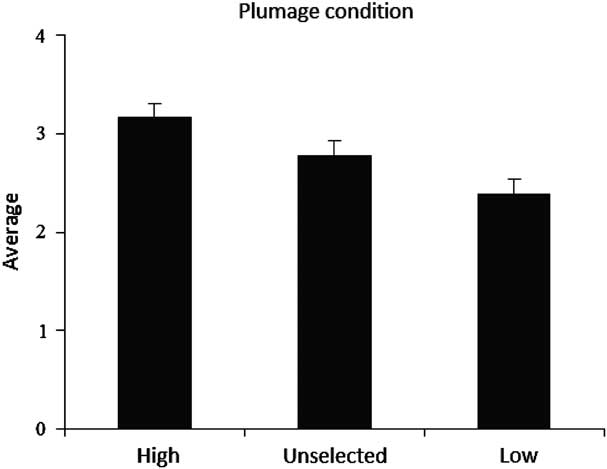
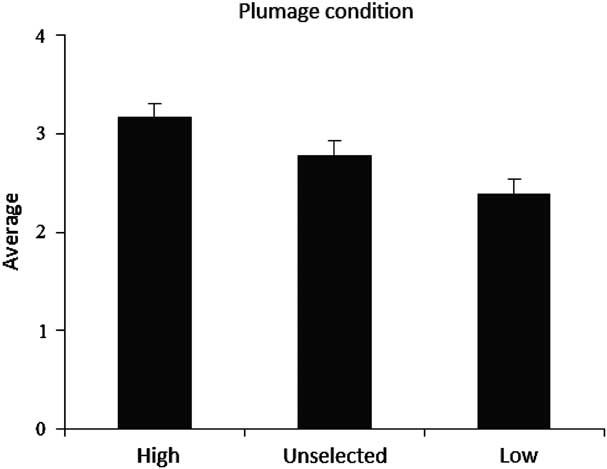
The overall average plumage condition score was significantly higher in birds from both H and U lines than L (Figure 3), indicating a less damaged plumage in the L birds.
Average plumage condition scores of birds in the S3 generation at 200 days of age, on a scale 0 to 5, where 0 represents a completely unaffected plumage and 5 severe damages on all body parts (H(2)=11.55, n=101, P=0.003).
In the SB, there were no significant differences in any of the recorded behaviours. Hence, the frequency of social behaviour was unaffected by selection line.
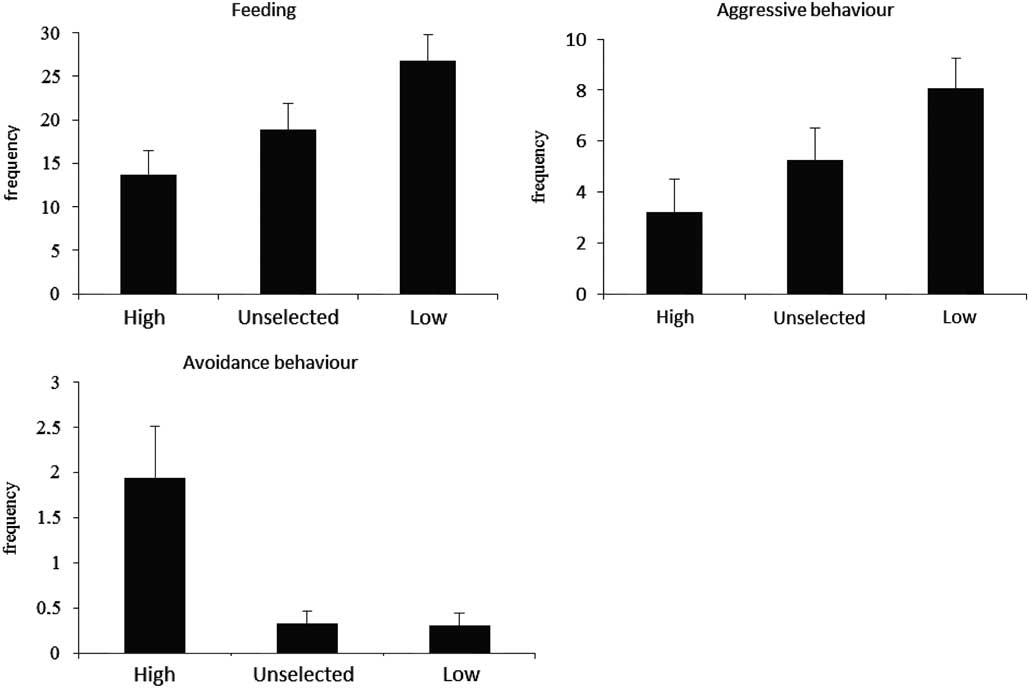
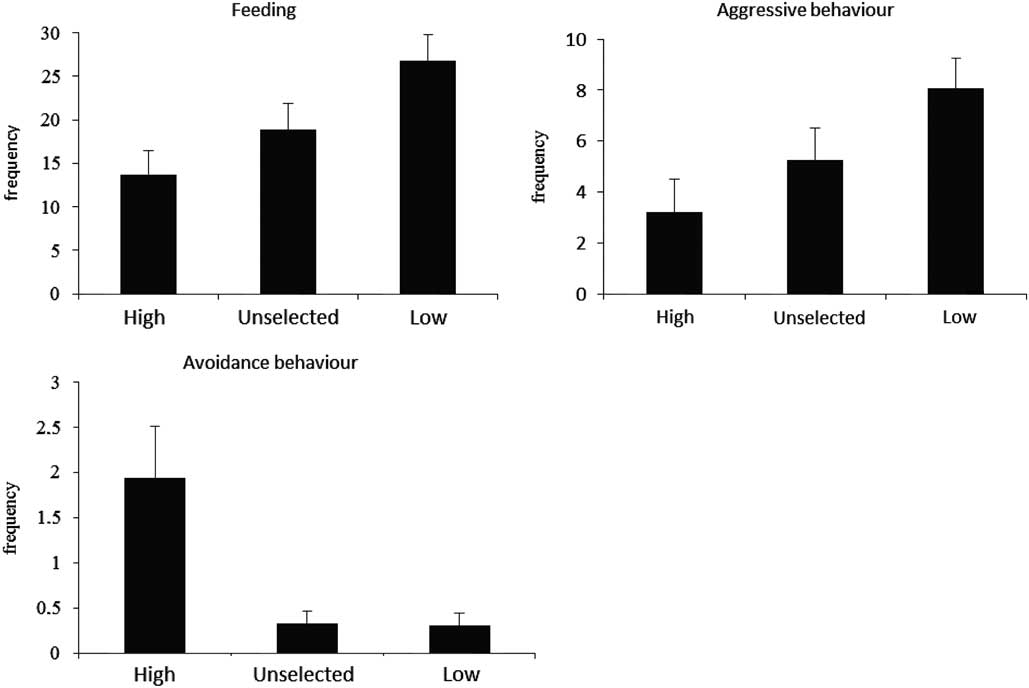
In the SD, birds from the H strain performed significantly less feeding and less overall aggressive behaviours than the other two strains. Consistent with this, they also performed more avoidance behaviour than the other two strains (Figure 4). These results indicate that birds from the H strain were less dominant than those from the other selection lines. Considering differences between the sexes, males performed more aggressive behaviours (7.5±1.19 v. 3.13±0.65 s.e.m.; H(1)=5.39, n=99, P=0.02) and avoidance (0.27±0.13 v. 1.35±0.36; H(1)=8.73, n=99, P=0.003) behaviour (NRS of recordings during 60 min).
Average frequencies of feeding (Kruskal–Wallis: H(2)=17.53, n=99, P<0.001), aggression (H(2)=11.20, n=99, P=0.004) and avoidance (H(2)=7.70, n=99, P=0.02) in the social dominance test in the S3 generation.
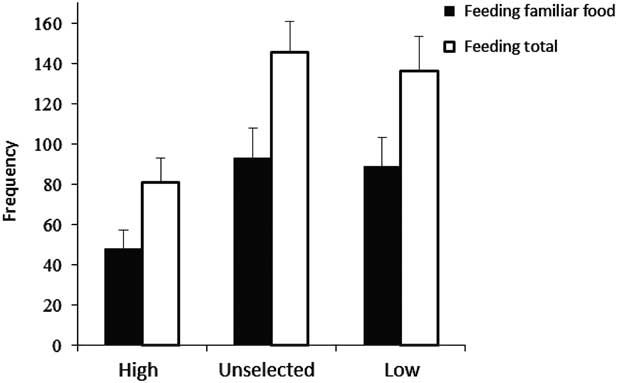
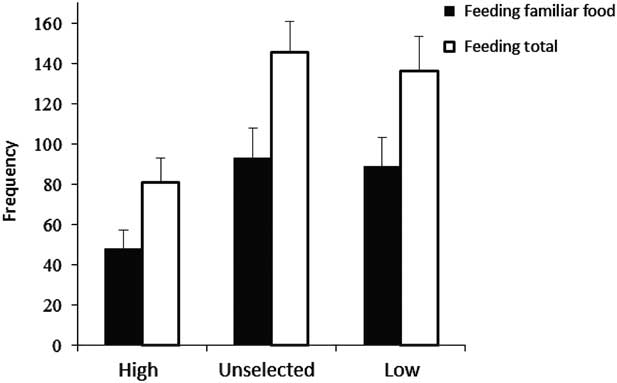
In the ES, the H strain performed significantly less total feeding as well as feeding from familiar feed. There were no significant differences between the selection strains with respect to the unfamiliar feed source (Figure 5). Regardless of selection line, the time spent together in the same arm of the maze was significantly higher in the females than in the males (236±14.96 v. 174±17.02 NRS of recordings during 60 min; H(1)=6.19, n=51, P=0.013), indicating a stronger social cohesiveness among females. However, this was not affected by selection.
Frequency of total feeding (H(2)=10.02, n=51, P<0.007) and feeding familiar feed (H(2)=7.70, n=51, P=0.02) in the exploratory behaviour and sociality test.
Experiment 2
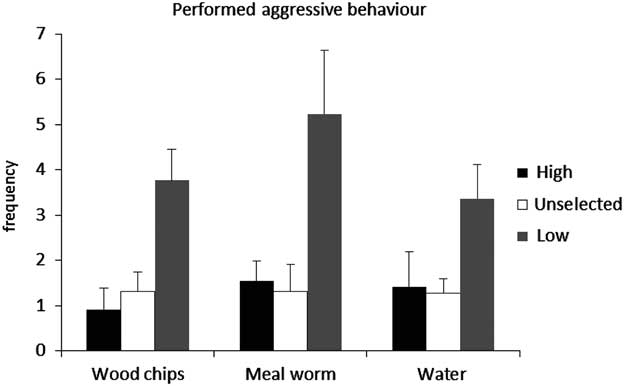
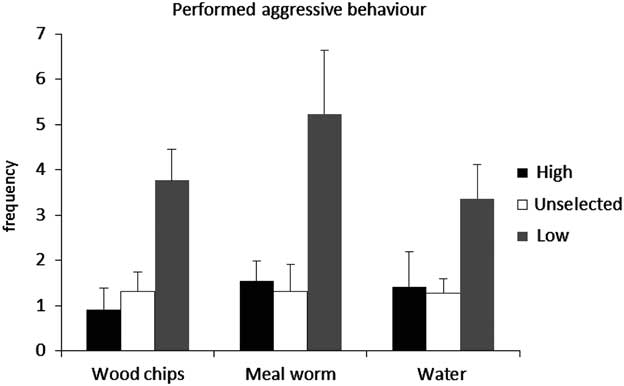
Birds belonging to the L strain performed significantly more aggressive behaviours in all three test situations than both the U and H strain, regardless of the resource (Figure 6), indicating that L strain birds were generally more dominant. There were no significant differences in access to the resource between the three strains. There were no significant sex differences in any of the measured variables.
Frequency of aggressive behaviour performed during the three test situations with different limited resources in the S4 generation (wood chips: H(2)=11.90, n=39, P=0.002; mealworm: H(2)=5.91, n=39, P=0.05; water: H(2)=6.72, n=42, P=0.03).
Discussion
In general, the results showed that chickens selected for a low fear response towards humans (L) secondarily had a higher weight, laid larger eggs and generated larger offspring than birds selected for a high fear response (H) and the unselected strain (U). They also had a less damaged plumage, indicating that they were less exposed to feather pecking. Furthermore, they were more socially dominant and received less aggressive behaviour in the SD. Finally, they also tended to be more feed motivated, both in the SD and in the ES. A possible interpretation of this is that birds selected for low fear were better able to cope with the experimental environment in which they had been selected.
Although we have only carried out selection for four generations in total, it was clear that this produced a significant difference in fear of humans. As this was the target selection criterion, it is of course the expected result and Agnvall et al. (Reference Agnvall, Jöngren, Strandberg and Jensen2012) observed a significant genetic component to this trait after only two generations. In the present study, we found a number of correlated effects on traits related to ability to cope with captivity, which is a fast response to a simulated domestication event. In foxes, Belyaev (Trut et al., Reference Trut, Oskina and Kharlamova2009) found that correlated responses to selection for tameness developed in a small proportion of the animals after 8 to 10 generations, which shows that domesticated phenotypes may start to occur within few generations of reduced fear of humans. The effects we found on social dominance were replicated in two consecutive generations, showing that this is probably a stable behavioural difference between the selection lines in the present experiment. Hence, our results indicate that the ability to obtain high social dominance (as assessed in this study) was affected by selection for high or low fear. Of course, there is a risk that our results are the result of genetic drift, since it comprises a relatively limited number of families. However, each selection line consists of 4 to 10 families, which can be regarded as independent replicates, since selection is done on individual basis. Furthermore, the fact that the results were replicated in two subsequent generation strengthens the impression that they were due to the selection imposed, as does the fact that the unselected birds generally fall in between the selected lines in the variables measured.
In a similar type of test on foxes, Harri et al. (Reference Håkansson and Jensen2003) found that animals selected for tameness monopolized a feed source in 9 out of 10 tests. This was interpreted as a generalization of the reduced fear also towards conspecifics and the test situation, and a reduced stress susceptibility, which could perhaps also explain the effects observed in the present study.
The birds selected for low fearfulness grew larger than the other strains, and this may have confounded the social dominance results to some extent. As earlier reported (Craig et al., Reference Eriksen, Haug, Torjesen and Bakken1975; Cloutier and Newberry, Reference Clutton-Brock2000; Müller et al., Reference Müller, Eising, Dijkstra and Groothuis2002), BW seems to be a reliable predictor of a chicken’s position in a hierarchy. It is therefore not possible to distinguish cause and effects between the observed correlated selection responses, since high BW may either have been a consequence of the increased social competitiveness, or it may have been the factor causing it. Moore et al. (2002) proposed that social dominance is affected by additive genetic variation, which can lead to rapid changes. Fear of human traits may therefore have a shared genetic component with social dominance, but to disentangle the genetic mechanisms, further experiments are needed.
BW may also be an indicator of overall welfare and capacity to cope with the environment (Tachè and Selye, Reference Tachè and Selye1985; Broom, Reference Campo, Gil, Torres and Davila1991), since a calm and confident animal may be better at obtaining feed and growing. However, to establish the overall welfare of the animal, variables such as behaviour disorders, physiological measurements and diseases need to be assessed (Broom, Reference Campo, Gil, Torres and Davila1991) and our results therefore remain suggestive. In a similar study of rats, Albert et al. (Reference Albert, Shchepina, Winter, Römpler, Teupser, Palme, Ceglarek, Kratzsch, Sohr, Trut, Thiery, Morgenstern, Plyusnina, Schöneberg and Pääbo2008) found no differences in BW between rats selected for tameness and those selected for aggressiveness, which indicates that correlated effects on BW may not be universally present, but may depend on species and environmental context.
The larger L birds also laid larger eggs, in accordance with the study by Müller et al. (Reference Müller, Eising, Dijkstra and Groothuis2002), reporting a positive correlation between body size and egg mass. Increased body size in L birds may reflect a better ability to cope and grow in the captive environment used in this experiment. Further, in accordance with this, the L birds in this study also had better plumage condition, both on the head and on average on the whole body. Both exposure to abnormal feather pecking and aggressive pecking can cause deterioration of plumage condition (Jensen et al., Reference Jones, Satterilee and Ryder2005), and a larger and more dominant bird may be more resistant to this. In general, the plumage condition is regarded as good reflection of the welfare of chickens (Campo et al., Reference Cloutier and Newberry2001). It has previously been shown that offspring of barn swallow mothers with high corticosterone levels produce offspring with lower hatch weight and slower plumage development (Saino et al., Reference Saino, Romano, Ferrari, Martinelli and Møller2005), and similar effects have been observed in chickens (Eriksen et al., Reference Harri, Mononen, Ahola, Plyusnina and Rekil2003). The fact that the offspring of the H chickens weighed significantly less could therefore indicate higher stress levels in H chickens. Even though this is well in line with the overall impression, that L birds were better adapted to the environment, this remains an interesting hypothesis, since at present we have no data on levels of stress hormones in the different selection lines. Japanese quail selected solely on high plasma corticosterone response, experienced human contact more aversive than quails selected on low response (Jones et al., Reference Jones, Marin, Satterlee and Cadd1994), emphasizing the link between tameness and general stress susceptibility.
During domestication, chickens have been selected on maximizing the ratio between feed intake and egg laying (Kerje et al., Reference Lindqvist, Schütz and Jensen2003). Probably due to this, domesticated chickens show a higher general feeding motivation and less explorative foraging (Schütz et al., Reference Schütz, Forkman and Jensen2001). In our experiment, the animals selected for low fear response fed more both in the SD and ES tests, although the feed consisted of familiar and unfamiliar chicken feed in the ES and mealworms in the SD. This may imply that increase in feeding motivation could subsequently explain the difference in social dominance. As feeding motivation could be the confounding variable behind the effects observed in experiment 1, we performed the second experiment, which showed that regardless of resource, chickens from the L line were more dominant. Hence, it seems likely that the increased dominance resulting from selection was not merely caused by a generally increased feeding motivation. As there were no overall effect of selection on frequency of social behaviour the increased social dominance cannot be explained simply by a higher degree of social activity in the L line birds.
In conclusion, birds selected for low fear of humans grew to a higher BW and laid larger eggs, with consequently larger offspring and the plumage condition of these birds was better than in those selected for high fear. In spite of the fact that there was no difference in frequency of social behaviours between the selected strains, birds selected for low fear were more dominant in test situations both with and without feed. Overall, this indicates that the L birds from the two tested generations were better adapted to the experimental captivity environment.
Acknowledgements
We thank Lejla Bektic for excellent technical assistance and Markus Jöngren for his contributions to developing the breeding programme. Financial support was obtained from the Swedish Research Council Formas and the European Research Council (advanced grant, project 322206, GENEWELL).