Introduction
The sugarcane stem weevil, Acrotomopus atropunctellus (Boheman) (Curculionidae: Molytinae: Cholini) is endemic to the provinces of Tucumán, Salta and Jujuy, located in the Northwestern region of Argentina (Box, Reference Box1929; Haynes, Reference Haynes1931). This species was recently morphologically redescribed by Pérez et al. (Reference Pérez, Río and Lanteri2012). The phylogeny relationship between the taxonomic positions was genetically established by Marvaldi et al. (Reference Marvaldi, Sequeira, O'Brien and Farrel2002) and confirmed by Bouchard et al. (Reference Bouchard, Bousquet, Davies, Zarazaga, Lawrence, Lyal, Newton, Reid, Schmitt, Ślipiński and Smith2011). A decade ago, this species has been detected across all sugarcane (Saccharaum officinarum) planting areas in the Argentinean Northwest with increasing population densities, raising concerns about potential economic impact on sugarcane production that exceeds 250 000 ha (Salvatore et al., Reference Salvatore, López, Willink, Romero, Digonzelli and Scandaliaris2009). Sugarcane plants are 2–6 m tall forming dense bushes; while, the adult weevils are small (9–12 mm long) and present a similar coloration that cane, making them hard to observe in the field. The reproduction cycle under controlled conditions has not been achieved making difficult to breeding them in the laboratory. They produce small holes with irregular borders in buds, stems and central veins of the leaves. Females lay eggs on the basal and middle portions of young plants. Larvae feed inside the stems and reach the stumps by winter, reducing the reshooting capacity of the cane in subsequent growing seasons (Pérez et al., Reference Pérez, Río and Lanteri2012).
The aggregation behavior in the field of this weevil was described recently, based on sequential sampling program using visual inspection of the soil surface, stalks and leaves of the plants (Perez et al., Reference Perez, Isas, Salvatore, Gastaminza and Trumper2015). However the mechanism of such aggregation is unclear and there is scarce information about a possible chemical communication. Male-produced aggregation pheromones have been reported for many weevil species and generally are used for both, host-finding and mating (Bartelt, Reference Bartelt, Hardie and Minks1999). The use of weevil pheromones as essential key in the insect pest management programs is very promising. This idea is clearly expressed in recent publications of numerous examples of insect control (Tewari et al., Reference Tewari, Leskey, Nielsen, Piñero, Rodriguez-Saona and Abrol2014). The first example of a large-scale and wide-area pest management program was implemented for the cotton boll weevil, Anthonomus grandis Boheman, in which the boll weevil was finally eradicated in California, Arizona and México (Smith, Reference Smith1998). Aggregation pheromones have also been used in the pest management of other weevils including the American palm weevil (Rhynchophorus palmarum L.), Asian palm weevil (Rhynchophorus ferrugineus Olivier), banana corm weevil (Cosmopolites sordidus Germar), strawberry blossom weevil, and pecan weevil (Curculio caryae Horn) (Oehlschlager et al., Reference Oehlschlager, Prior, Perez, Gries, Gries, Pierce and Laup1995; Hedin et al., Reference Hedin, Dollar, Collins, Dubois, Mulder and Hedger1997; Hallett et al., Reference Hallett, Oehlschlager and Borden1999; Cross et al., Reference Cross, Hall, Innocenzi, Hesketh, Jay and Burgess2006; Leskey et al., Reference Leskey, Pinero and Prokopy2008; Alpizar et al., Reference Alpizar, Fallas, Oehlschlager and Gonzalez2012). Other interesting case is the West Indian sugarcane weevil, Metamasius hemipterus L., where Giblin-Davis et al. (Reference Giblin-Davis, Pena, Oehlschlager and Perez1996) have optimized the trap designs and protocols that are used for the enhanced monitoring of weevil populations in the field.
The advantages of using pheromones for monitoring or controlling pests include low or even null pollution impact environmental, lower costs, specificity, easy use, and high sensitivity (Pélozuelo & Frérot, Reference Pélozuelo and Frérot2007; Wall, Reference Wall, Ridgway, Silverstein and Inscoe1990).
The sampling methods used for most sugarcane pests are traps and visual observation (Dinardo-Miranda et al., Reference Dinardo-Miranda, Vasconcelos, Andrade and Dinardo-Miranda2010). Furthermore, traps have not been developed, yet, for A. atropunctellus due to the lack of information about its pheromones. Semiochemical-based monitoring and mass trapping are potential strategies for the control of A. atropunctellus. In the present study, a male specific aggregation pheromone released by the sugarcane stem weevil was isolated and identified and its attractiveness was confirmed in laboratory assays.
Materials and methods
Source of weevils
Two weevil colonies were established from Acrotomopus atropunctellus adults of known age but unknown mating status, one in January 2012 and the other in January 2013, where the insects were maintained in captivity until assaysed. The insects were provided by the Experimental and Agroindustrial Station of Obispo Colombres and collected from sugarcane fields located in Cruz Alta, Tucumán, Argentina. The technicians took the weevils from emergence boxes located in the field which were inspected daily for insects. The day of emergence was scored; however, insects of both sexes were found therefore, it is not possible to affirm that they have not copulated during the 24 h between inspections. Sexes of individuals were separated based on the sexual dimorphism that these insects showed in the abdomen; males present a ventral cavity while females do not. After sexing, adults were placed in plastic boxes (6 × 12 cm2) and fed with sugarcane stem or apple pieces. Insects were kept at 26 ± 2°C under a 12:12 h light/day (L/D) photoperiod.
Collection of volatiles and analysis
This methodology was adapted from that reported by Zarbin et al. (Reference Zarbin, Ferreira and Leal1999).
Groups of 1-day old 20 males and 20 females were maintained separately in all-glass aeration cylindrical chambers (30 cm height × 6 cm outside diameter) with two pieces of sugarcane (4 cm each). Emitted volatiles were collected every 48 h for 40 days (N = 20), and trapped on glass columns (15 cm height × 0.5 cm diameter) with 50 mg of TENAX TA (Alltech, USA). Charcoal-filtered humidified air was pushed through the aeration system (1.0 l min−1). Adsorbed aeration volatiles were eluted with 1 ml of hexane high performance liquid chromatography (HPLC) grade (Sintorgan S.A., Argentina). Adsorbent traps were changed after ten collections. The extracts were concentrated to 200 µl (10 µl per insect) under a nitrogen stream. As control, sugarcane stems and apple pieces with mechanical damage were aerated alone and their volatile compounds were collected. The dead insects were replaced to constantly maintain the number of adults in chambers. The food was renewed approximately every 3 days to avoid loss of quality.
Extracts were analyzed by gas chromatography-mass spectrometry (GC–MS) using a Thermo Scientific Focus GC coupled with DSQII electron ionization mass detector. The GC was operated in the splitless mode. A TR-5MS (30 m × 0.25 mm × 0.25 µm) (Thermo Fisher Scientific) capillary column was used under the following analytical conditions: the initial column temperature was kept at 50°C for 5 min and then, increased at a rate of 7°C min−1 to a final temperature of 250°C, and then, kept for 10 min. Additionally, a chromatograph GC Konik 3000 series equipped with a ZB-FFAP (30 m × 0.25 mm × 0.25 µm) capillary column (Phenomenex, Inc. USA) was used. The column oven was kept at 50°C for 4 min, and then increased at 7°C min−1 to 250°C, and then maintained for 10 min. The use of two types of columns allowed us to compare the retention indexes of the pheromone and chemical standard in two different phases to assess that both molecules were the same.
The concentration of the sex-specific volatile was determined by using an internal standard method taking the commercial sample of sulcatone and undecane as reference compounds. This quantification was done for every sample that presents sulcatone. Results were calculated as the average.
Chemicals
Assay grade (99% purity) of purity of sulcatone (6-methyl-5-hepten-2-one) and sulcatol (6-methyl-5-hepten-2-ol, enantiomeric mixture) were purchased from Sigma-Aldrich, Buenos Aires, Argentina.
Micro-reactions
Chemical derivatizations were carried out in order to characterize the presence of functional groups in the isolated molecule (Attygalle, Reference Attygalle, Millar and Haynes1998).
Catalytic hydrogenation
An aliquot of 50 µl of a crude hexane extract from entrainment (aeration) of males of A. atropunctellus was placed in a screw-capped glass vial, and 0.5 mg of 10% Pd/C (Sigma-Aldrich) was added. A balloon filled with hydrogen was attached to the vial and, after flushing, the mixture was stirred for 8 h at room temperature. The mixture was filtered through a cotton plug in a Pasteur pipette and analyzed by GC-MS (Favaro et al., Reference Favaro, Santos and Zarbin2012).
Reduction by hydride
To 50 µl of crude hexane extract from the aeration of males, placed in a screw capped glass vial, 1 mg of sodium boron tetrahydride (Sigma-Aldrich) was added. After stirring for 3 h at room temperature, 50 µl of water was added to the mixture. The mixture was filtered over anhydrous magnesium sulfate and analyzed by GC-MS.
Epoxidation
A 200 µl aliquot of a crude hexane extract of males was placed in a screw-capped glass vial and cooled to 0°C. After the addition of 1 mg of m-chloroperbenzoic acid (Sigma-Aldrich), the solution was stirred at 0°C for 2 h. Subsequently, a portion of 200 µl of a saturated aqueous solution of sodium hydrogen carbonate was added at 0°C. After separation of the layers, the aqueous one was extracted with diethyl ether, concentrated and analyzed by GC-MS (Palacio-Cortés et al., Reference Palacio-Cortés, Valente, Saad, Tröger, Francke and Zarbin2015).
Laboratory bioassays
Attractiveness of sulcatone to the weevils was tested using two methodologies. In the first one a cylindrical and transparent plastic box with plastic cover was used as experimental arena. Internal diameter was 95 mm and height 60 mm. A small piece of filter paper (0.25 cm2) impregnated with the solution of interest was placed in the center of arena and used as source of volatiles. Aliquots containing 10 µg of sulcatone solution in hexane (1 µg ml−1), host plant material and hexane as control were assayed. One male or female was placed in the edge of arena and was monitored for 30 min. A positive attractive response was considered when the insect inspected the filter paper with its antenna for at least 2 min. A negative response was considered when the insect did not move to the central arena. In this experiment, 30 males and 30 females were used.
The second bioassay performed to determine the attractiveness of A. atropunctellus male specific component was conducted using a glass Y-tube olfactometer (4 cm in diameter, 40 cm length with 20-cm length arms) operated at 2.5 litres min−1 flow of humidified and charcoal filtered air (Ambrogi et al., Reference Ambrogi, Cortes and Zarbin2012). Odour sources were placed at the base of the arms of the olfactometer, and consisted of a 2 × 2 cm2 piece of filter paper loaded with synthetic sulcatone and volatiles extracts of host plant (control) in hexane, similarly to the first assay. The host plant extracts correspond to 48 h volatile fraction collection of two pieces of sugarcane (4 cm each) in the aeration chamber. A single insect was placed at the base of the main olfactometer tube, and its behavior was observed for 20 min; 40 males and females being used. A positive response was defined as the insect walked against the airflow more than 5 cm into an arm toward the odor source and remained there for more than 2 min. No response was defined as the insect did not leave the main tube. Each insect was counted as one data point, and each one was tested only once. The odor source was replaced after each test. Insects that did not choose either of the arms were excluded from statistical analysis. The olfactometer was moved (turned) after every three tests to cancel positional effects. The data were analyzed using a chi-square test (contingency tables) implemented in the statistical InfoStat (2012) package where the sexes and responses were compared analyzing the frequencies of elections.
Both experiments were carried out at 26 ± 2°C in the last 2 h of photoperiod (hours with the highest mating activity observed in laboratory conditions). The insects have between 20 and 40 days of emergence.
Results
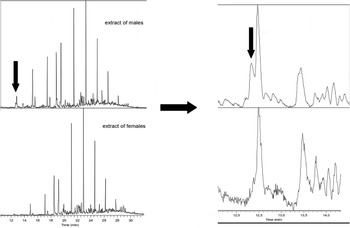
Chromatographic profiles of headspace volatiles of male and female A. atropunctellus revealed the presence of one male-specific compound as shown in Fig. 1.
Gas chromatogram of volatile extracts obtained from aeration of 20 males and females of Acrotomopus atropunctellus for 48 h, showing a male specific compound. Capillary column TR-5MS (30 m × 0.25 mm × 0.25 µm).

No differences were found between the extracts of males and females when the weevils were fed with pieces of apple; however, when the food was comprised of sugarcane stalks and approximately after 20 days of entrainment (20 days from emergence), the male-specific compound was observed.
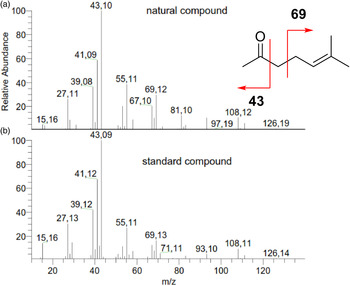
The chemical structure of the male-specific component was identified based on fragmentation patterns in GC-MS, retention index, micro-reactions, and comparison with authentic standard. GC-MS analyses showed that the compound (retention time: 12.12 min; KI: 975) generated a molecular ion at m/z 126. Analysis of the fragmentation pattern [m/z (%): 126(8), 111(18), 108(47), 93(21), 81(16), 69(65), 68(28), 67(37), 55(37), 53(19), 43(100), 41(49), 27(20)] and its comparison with that reported by mass spectrum library and, finally, with a commercial reagent, allowed us to propose 6-methyl-5-hepten-2-one (sulcatone) as the male specific compound (Fig. 2).
Mass spectrum comparison of natural (a) and standard (b) sulcatone.

The base peak at m/z = 43 corresponds to the α rupture to keto group that generates the acylium ion (CH3CO), general feature of methyl ketones. Other significant peak was observed at m/z = 69, due to a fragmentation conducing to an allylic cation formation (Fig. 2).
After the hydrogenation of male extract, sulcatone disappeared and 6-methylheptan-2-one was observed (m/z 128). This behavior confirmed the presence of one unsaturation in the chemical structure.
In order to establish the presence of a carbonyl group in the molecule, the male extract was reduced with sodium boron tetrahydride. This process allowed to obtain 6-methyl-5-hepten-2-ol (sulcatol) with an m/z = 128.
Finally, the male extract was treated under epoxidative conditions using m-chloroperbenzoic acid, to obtain an epoxide derivate of sulcatone, in order to get a conclusive structural elucidation and to confirm the position of the double bond.
In all cases, the reaction products of each micro-reaction were analyzed by GC-MS and their structures were confirmed by reproducing the derivatization with the commercial or synthetic standards and co-injecting to observe one single peak.
A male A. acropunctellus produces approximately 3.0 ± 0.3 ng of pheromone per insect per hour in laboratory conditions.
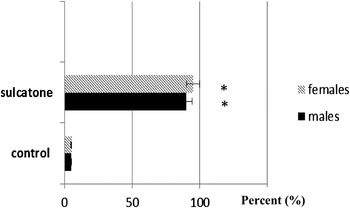
Figure 3 shows the behavioral responses of A. atropunctellus males and females in an arena when they were stimulated with sulcatone and hexane as control. Sulcatone was more attractive to males (χ2 = 18.73, df = 1, P = 0.02) and females (χ2 = 16.34, df = 1, P = 0.03) than to the control; significant differences between sexes were not observed indicating an aggregation behavior. Furthermore, during this experiment it was observed that some weevils moved to finally settle on the arena cover, specifically over the odour source.
Responses of male and female A. acrtropunctellus adults to sulcatone in the experimental arena. *Statistically significant differences between sexes, t-test, P < 0.05.

Similar results were found with the use of Y-tube olfactometer, Table 1. Males and females were highly attracted to sulcatone when tested against the control.
Responses of male and female A. acrtropunctellus adults to sulcatone in the Y-tube olfactometer.

*Statistically significant differences, binomial test, for males χ2 = 14.40, df = 1, P = 0.001 and for females χ2 = 19.88, df = 1, P = 0.001. Individuals without choice were excluded from statistical analysis.
Discussion
Sulcatone is well known as a constituent of the pheromone or attractant of several species of weevils. Some examples are Stenus biguttatus (Schierling et al., Reference Schierling, Seifert, Sinterhauf, Rieb, Rupprecht and Dettner2013), Platypus mutatus (Gonzalez et al., Reference Gonzalez, Villaverde, Alfaro and Zerba2005), Gonioctena viminalis (Dettner & Schwinger, Reference Dettner and Schwinger1987).
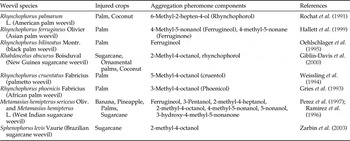
Other sugarcane weevil pheromones were previously identified and reported in Table 2. R. palmarum (American palm weevil) produce a male-specific pheromone, 6-methyl-2-hepten-4-ol (Rhynchophorol) (Rochat et al., Reference Rochat, Malosse, Lettere, Ducrot, Zagatti, Renou and Descoins1991). From other sugarcane weevil named Sphenophorus levis, 2-methyl-4-octanol was isolated as an aggregation pheromone (Zarbin et al., Reference Zarbin, Arrigoni Ede, Reckziegel, Moreira, Baraldi and Vieira2003). Eight male-specific compounds for Metamasius hemipterus sericeus were identified, 3-pentanol, 2-methyl-4-heptanol, 2-methyl-4-octanol, 4-methyl-5-nonanol, and the respective ketones (Perez et al., Reference Perez, Campos, Chinchilla, Oehlschlager, Gries, Giblin-Davis, Castrillo, Peña, Duncan, Gonzalez, Pierce, McDonald and Andrade1997). Rhabdoscelus obscurus, a New Guinea sugarcane weevil, releases as pheromone 2-methyl-4-heptanol, 2-methyl-4-octanol and rhynchophorol (Giblin-Davis et al., Reference Giblin-Davis, Gries, Crespi, Robertson, Hara, Gries, O'Brien and Pierce2000).
Aggregation pheromones of Dryophthorinae weevils reported as pests of palms species and sugarcane.

As a common structural feature, sulcatone, rhynchophorol and related saturated 2-methyl-branched compounds present a terpenoid skeleton. The molecules with the other types of carbon skeleton are assumed to be of polyketide in origin. This similarity, and the fact that weevils produce pheromone only when feed on sugarcane, suggest biogenesis from host-plant terpenes; although, no biosynthesis study has ever proven it (VanderWel & Oehlschlager, Reference VanderWel, Oehlschlager, Prestwich and Blomquist1987; Bartelt, Reference Bartelt, Hardie and Minks1999). The supply of the host plant and not apple pieces in the entrainment chambers during the volatile collection stimulates the pheromone production from male adults. This phenomenon has been reported in other curculionidae species such as A. grandis (Dickens, Reference Dickens1989), Anthonomus musculus (Szendrei et al., Reference Szendrei, Averill, Alborn and Rodriguez-Saona2011), Rynchophorus phoencis (Jaffé et al., Reference Jaffé1993), R. palmarum (Oehlschlager et al., Reference Oehlschlager1992), Pissodes strobi, Pissodes approximatus (Booth et al., Reference Booth, Phillips, Claesson, Silverstein, Lanier and West1983) and, recently, by Conotrachelus psiidi (Palacio-Cortés et al., Reference Palacio-Cortés, Valente, Saad, Tröger, Francke and Zarbin2015).
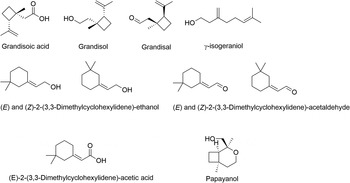
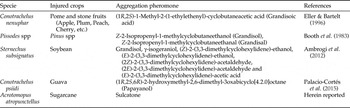
On the basis of our knowledge, this is the first report of the participation of sulcatone in the sexual communication of insects belonging to the Curculionidae family. Male specific pheromone components have been identified only in a few weevils from the subfamily Molytinae (Table 3, Fig. 4), as the case of Conotrachelus nenuphar (Eller & Bartelt, Reference Eller and Bartelt1996; Leskey & Wright, Reference Leskey and Wright2004), Sternechus subsignatus (Ambrogi et al., Reference Ambrogi, Cortes and Zarbin2012; Ambrogi & Zarbin, Reference Ambrogi and Zarbin2008), weevils of the genus Pissodes (Booth et al., Reference Booth, Phillips, Claesson, Silverstein, Lanier and West1983) and Conotrachelus psiidi (Palacio-Cortés et al., Reference Palacio-Cortés, Valente, Saad, Tröger, Francke and Zarbin2015).
Molecular structures of aggregation pheromones described in table 3.

Aggregation pheromones described from Molytinae weevils.

A. acropunctellus produces very low quantities of pheromone per unit of time. The production and release of insect pheromones is governed by a variety of environmental factors and physiological mechanisms. Furthermore, the amount of pheromones that an insect releases is extremely low and varies from a few nanograms to micrograms per unit of time, depending on the species (Piñero & Ruiz-Montiel, Reference Piñero, Ruiz-Montiel, Rojas and Malo2012).
A strong attraction of both male and female weevils to sulcatone was observed in the behavioral bioassays. Furthermore, the aggregation behavior of A. atropunctellus in the field was reported recently (Perez et al., Reference Perez, Isas, Salvatore, Gastaminza and Trumper2015) where the development and validation of a sequential sampling plan for field density estimation of the weevil was proposed, proving that A. atropunctellus has an aggregated distribution in sugarcane crops. These facts are coincident and reinforce the present observations.
In summary, results demonstrated that males of A. atropunctellus produce one sex-specific compound. Both sexes were attracted by sulcatone in bioassays allowing us to conclude, that it is an aggregation pheromone. This pheromone is potentially useful in the field for monitoring and control. For this purpose, the development of a trap baited with sulcatone lure should be extremely useful and critical for pest management. Weevils population monitoring relates trap captures to the abundance or to the damage caused by the insect. The magnitude of trap captures could be used to determine thresholds, either for the timing of control procedures, or for making the decision whether or not remedial action is to be taken.
Acknowledgements
This work was supported by Consejo Nacional de Investigaciones Científicas y Técnicas (CONICET) of Argentina and Agencia Nacional de Promoción Científica y Tecnológica (PICTO-UNSE).