Attention-deficit/hyperactivity disorder (ADHD) is a neuropsychiatric disorder characterized by inattention, hyperactivity, and impulsivity, as well as deficits in executive functioning and motivation (Barkley, Reference Barkley1997; American Psychiatric Association, 2013). It has a childhood prevalence of 4–7% and frequently persists into adulthood, with a prevalence of around 2.5% (Faraone et al., Reference Faraone, Biederman and Mick2005; Simon et al., Reference Simon, Czobor, Bálint, Mészáros and Bitter2009). The expression of the disorder may change with age, such that the dominant features in adulthood are symptoms of inattention and deficits in executive functioning (Nigg et al., Reference Nigg, Stavro, Ettenhofer, Hambrick, Miller and Henderson2005; Barkley et al., Reference Barkley, Murphy and Fischer2008). However, much less is known about the disorder in adults than children (Davidson, Reference Davidson2008).
It is important to identify cognitive biomarkers that can aid diagnosis, clinical subtyping, and targeting of treatments in adult ADHD (Asherson et al., Reference Asherson, Buitelaar, Faraone and Rohde2016). Meta-analyses indicate robust group differences between adults with ADHD and controls in many cognitive domains, for example, visual and phonological working memory (Alderson et al., Reference Alderson, Kasper, Hudec and Patros2013), reaction time variability (Kofler et al., Reference Kofler, Rapport, Sarver, Raiker, Orban, Friedman and Kolomeyer2013), processing speed (Boonstra et al., Reference Boonstra, Kooij, Oosterlaan, Sergeant and Buitelaar2005a), and certain tests of attention (Bálint et al., Reference Bálint, Czobor, Komlósi, Mészáros, Simon and Bitter2009; Skodzik et al., Reference Skodzik, Holling and Pedersen2013). However, several potentially confounding factors are important to consider when studying the cognitive profiles of adults with ADHD. Psychiatric comorbidities and neurodevelopmental comorbidities (e.g. dyslexia; DuPaul et al., Reference DuPaul, Gormley and Laracy2013) are common in individuals with ADHD and often associated with their own profiles of cognitive deficits. Also, studies often investigate patient groups that are mixed with regards to previous and present stimulant medication status, making it difficult to draw conclusions about how medication affects cognitive status. Further, neuropsychological tests often tap a range of processes other than the target process (Burgess, Reference Burgess and Rabbitt1997). Tests which allow for clear distinctions between different components of attention are needed to establish specific cognitive profiles in adults with ADHD, and to determine whether medication affects particular aspects of attention.
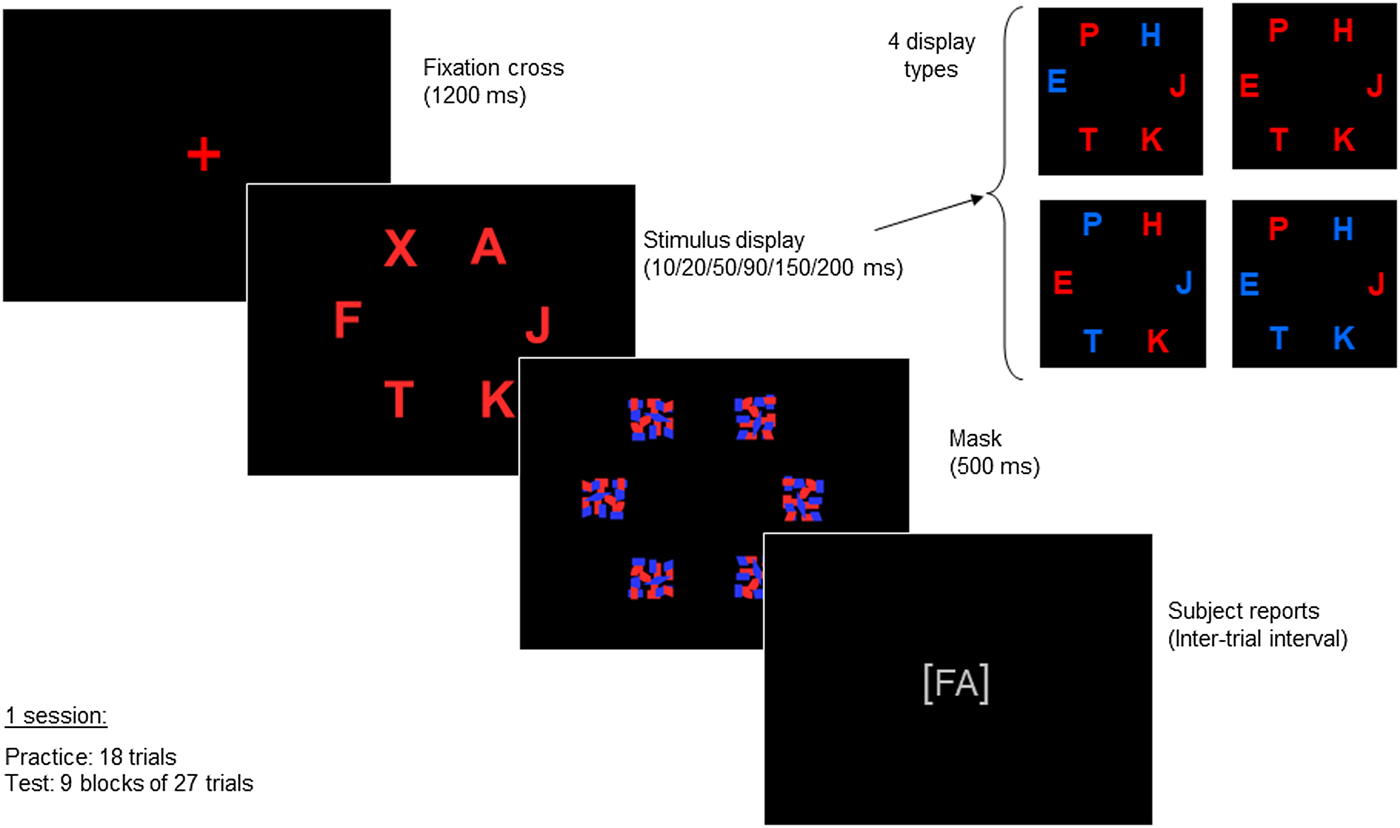
One such test is based on the Theory of Visual Attention (TVA), a mathematical model that accounts for a wide variety of findings in the cognitive and neurophysiological literature on attention (Bundesen, Reference Bundesen1990; Bundesen et al., Reference Bundesen, Habekost and Kyllingsbaek2005). TVA-based assessment denotes computerized testing, which provides highly specific measurements of core processes in visual attention. It comprises two experimental conditions, whole and partial report (see Methods section for details), and uses un-speeded, accuracy-based measures, which are unconfounded by motor processes. Performance on these tasks, when analyzed using TVA-based modeling, yields estimates of five parameters: K, visual short-term memory (VSTM) capacity (measured in number of letters); C, the total processing speed of the visual system (letters/second); t 0, the threshold of conscious perception (ms), which represents the minimum time required for a participant to perceive a letter; α, the efficiency of top–down control of attention (the extent to which a participant is distracted by non-target letters), and w index, the spatial bias of attention (the degree to which there is a leftward or rightward bias between the two visual fields). An example of a trial in TVA-based assessment is shown in Fig. 1.
A single trial of TVA-based assessment. Note: TVA describes attention as a set of mechanisms that distribute processing capacity across the visual field, in order to select the most important information for consciousness and response. TVA-based assessment uses two experimental conditions, whole and partial report. Performance on these conditions, when analyzed using TVA-based modeling, yields estimates of five parameters: K, visual short-term memory (VSTM) capacity (measured in number of letters); C, the total processing speed of the visual system (letters/second); t 0, the threshold of conscious perception (ms); α, the efficiency of top–down control of attention (ranges from perfect selection at 0 to non-selectivity at 1), and w index, the spatial bias of attention (ranges from complete rightward bias at 0 to complete leftward bias at 1, with 0.5 indicating equal weighting between the two visual fields). The test uses un-speeded, accuracy-based measures, which are unconfounded by motor processes. Along with the example of the TVA-based assessment trial shown here, the outline of timing and the four types of stimulus displays in the CombiTVA paradigm are shown: (a) whole report with six targets (red letters) (b) partial report with two, three, or four distractors (distractors: blue letters, targets: red letters). Modified with permission from Vangkilde et al. (Reference Vangkilde, Bundesen and Coull2011). © The Author(s) 2011.

TVA-based assessment has been used in a wide variety of clinical studies (Habekost, Reference Habekost2015), including investigations of ADHD and dyslexia. Two studies (McAvinue et al., Reference McAvinue, Vangkilde, Johnson, Habekost, Kyllingsbæk, Bundesen and Robertson2015; Caspersen et al., Reference Caspersen, Petersen, Vangkilde, Plessen and Habekost2017) found significant impairment in visual processing speed (C) in children with ADHD compared with controls, but not in other investigated parameters (VSTM, K; threshold of conscious perception, t 0; and efficiency of top–down control of attention, α). Finke et al. (Reference Finke, Schwarzkopf, Müller, Frodl, Müller, Schneider, Engel, Riedel, Möller and Hennig-Fast2011) found significant impairments in VSTM capacity (K) only, in adults with ADHD compared with matched controls with another variant of TVA-based assessment. Wiegand et al. (Reference Wiegand, Hennig-Fast, Kilian, Müller, Töllner, Möller, Engel and Finke2016) used the whole report paradigm, which allows investigation of VSTM capacity (K), total processing speed of the visual system (C) and threshold of conscious perception (t 0), and also found specific impairments of VSTM (K) in adults with ADHD compared with controls. Presently, it is unclear whether the different findings in adults and children reflect developmental changes, or result from differences in study design. Given the comorbidity of ADHD and dyslexia, it is relevant to note that TVA-based assessments have found slowed processing speed (C) as an underlying deficit in developmental dyslexia for both adults and children, whereas VSTM capacity (K) may be a modulating component of dyslexia in children only (Bogon et al., Reference Bogon, Finke and Stenneken2014).
Cognitive effects of pharmacological treatment in ADHD
Methylphenidate is recommended as the first-line treatment for ADHD in international guidelines, and reduces symptoms of ADHD in adults effectively (Bushe et al., Reference Bushe, Day, Reed, Karlsdotter, Berggren, Pitcher, Televantou and Haynes2016). An area of interest is the degree to which medication also affects cognitive functioning in adults with ADHD. A recent meta-analysis, mainly comprising acute dose crossover or single challenge designs, indicates small–to-medium effect sizes for working memory, attention, and response inhibition in adults with ADHD (Tamminga et al., Reference Tamminga, Reneman, Huizenga and Geurts2016). Relatively few prospective treatment studies (here defined as studies where methylphenidate is administered for at least 1 week) have investigated effects of stimulant medication on cognitive functioning. Findings of such adult studies, investigating a variety of cognitive functions (e.g. spatial working memory, vigilance, visual attention) after 2–8 weeks of treatment with methylphenidate, have been mixed (e.g. Bouffard et al., Reference Bouffard, Hechtman, Minde and Iaboni-Kassab2003; Ni et al., Reference Ni, Shang, Gau, Lin, Huang and Yang2013; Bron et al., Reference Bron, Bijlenga, Boonstra, Breuk, Pardoen, Beekman and Kooij2014; Goodman et al., Reference Goodman, Starr, Ma, Rostain, Ascher and Armstrong2017). Finke et al. (Reference Finke, Dodds, Bublak, Regenthal, Baumann, Manly and Müller2010) investigated the effects of single doses of methylphenidate in healthy adults, and found a significant, beneficial effect on visual processing speed (C) in individuals with low processing speed at baseline. No study has yet been published on the treatment effects of methylphenidate on attentional functions as assessed by TVA.
The primary purpose of the current study was to investigate (a) attentional functions of stimulant medication-naïve adults with ADHD as measured by TVA-based assessment, and (b) the effects of 6 weeks of methylphenidate treatment on these attentional functions. Based on the available evidence, it was hypothesized that at baseline, adults with ADHD would show deficits in VSTM capacity (K) and visual processing speed (C) compared with matched healthy controls. Further, after 6 weeks of medication, adults with ADHD were expected to show improvements on TVA parameter C. Secondary analyses were planned to investigate (a) the effects of IQ and positive screen for dyslexia on any significant impairments, and (b) the potential relationships between attentional functions and ADHD symptomatology.
Material and methods
Design and population
The study is a prospective, non-randomized, non-blinded, controlled, 6-week follow-up study; a placebo arm for patients was not included. Stimulant medication-naïve adult patients with a primary diagnosis of disturbance of activity and attention (F90.0) or attention-deficit disorder without hyperactivity (F98.8) according to ICD-10 criteria (World Health Organization, 1992) were recruited from the Adult ADHD Clinic at the Copenhagen University Hospital, Glostrup. Diagnosis at the ADHD clinic was based on an in-depth clinical interview including the DIVA 2.0 (Pettersson et al., Reference Pettersson, Söderström and Nilsson2015) interview with the patient, and wherever possible, a significant other; BRIEF-A questionnaire (Roth et al., Reference Roth, Isquith and Gioia2005); the WHO Adult ADHD Self-Report Scale (ASRS) (Kessler et al., Reference Kessler, Adler, Ames, Demler, Faraone, Hiripi, Howes, Jin, Secnik, Spencer, Ustun and Walters2005); and additional testing (e.g. intelligence tests) as required. Patients’ diagnosis according to ICD-10 and DSM-V criteria was confirmed by consensus rating by project clinicians. A healthy control group was included at both assessment points to control for re-test effects.
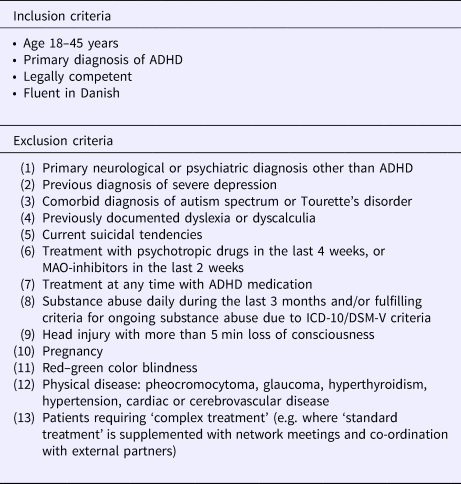
Participants were screened with regards to inclusion and exclusion criteria by project clinicians (see Table 1). Forty-four patients attended baseline testing; two were excluded at baseline. Of the 42 patients with valid baseline testing, 37 had follow-up TVA data available for analysis (see online Supplementary Materials for an overview of patient recruitment and reasons for drop-out/exclusion).
Inclusion and exclusion criteria for patients

Exclusion criteria 2–11 also applied to controls.
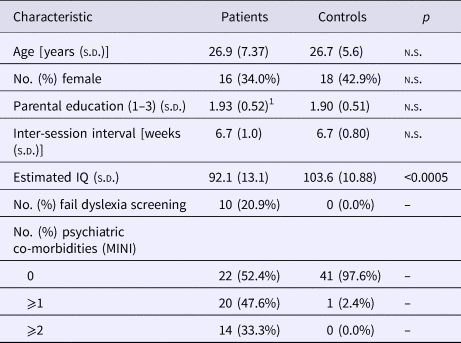
There were no significant differences between patients and controls on age, gender, and parental educational level, but the mean estimated IQ of the ADHD group was significantly lower than controls. Further, 10 patients, but no control, scored below the cut-off score on a dyslexia screening task (i.e. screened positive). Just under half of the patient group and one healthy control screened positive on the clinical interview (Mini-International Neuropsychiatric Interview – MINI) as having at least one co-morbid psychiatric disorder, most commonly anxiety (see Table 2).
Characteristics of adults with ADHD and control participants at baseline

N.S., not significant; –, no statistical analysis undertaken.
Estimated IQ was estimated using the Block Design and Vocabulary sub-tests from the Wechsler Adult Intelligence Scale, fourth edition (Wechsler, Reference Wechsler2008). IQ for one patient, who was fluent in Danish but for whom Danish was his third language, was estimated from Block Design only. MINI, The Mini International Neuropsychiatric Interview. The most common psychiatric disorders were: any anxiety disorder, n = 18; suicidality, n = 8 (no current suicidal ideation); dissocial personality disorder, n = 8; depression, n = 4. One control participant screened positive for depression.
Controls were recruited from http://www.forsoegsperson.dk/. Inclusion criteria were: matching patients on age (±5 years), gender, and parental educational level; aged 18–45 years; legally competent; and fluent in Danish. Exclusion criteria were: exclusion criteria 3–11 described in Table 1; present or previous psychiatric disease (mild/moderate depression/anxiety were not exclusion criteria); and any first-degree relatives with psychosis and/or ADHD. In all, 42 controls with a full baseline dataset were recruited. Four controls elected not to return for follow-up testing, leaving 38 controls with both baseline and follow-up testing.
Medication procedure
Patients’ medication was initiated after the baseline assessments, after which the project psychiatrist had weekly telephone contact with patients; a clinical appointment was undertaken at 3 weeks. All patients were treated with methylphenidate according to their clinical need (i.e. with individual titration), and within the standard clinical dose range. Thirty-six of 37 patients were treated with Concerta, with a stable ‘end-point’ dosage taken for at least 2 weeks before follow-up testing. ‘End-point’ dosages were between 36 and 108 mg daily (M = 64.50 mg, s.d. = 22.10). One patient was treated with a shorter duration methylphenidate, Medikenet CR, because of sensitivity to extended release methylphenidate. All patients had positive tests for plasma methylphenidate at follow-up, showing compliance with the medication procedure (with the exception of one patient, where a blood sample could not be collected). Controls did not receive medication.
Measures
At baseline, participants were assessed with a neuropsychological test battery (including TVA-based assessment, IQ sub-tests and tests of executive functioning), several clinical rating scales and structured interviews. Further, a medical examination was undertaken, and participants completed several questionnaires. Urine samples were collected for screening of drug-abuse and pregnancy; a blood sample was taken from patients at follow-up to confirm medication compliance. In this paper, the TVA test, relevant clinical rating scales, structured interviews, and one questionnaire are described.
Participants were asked to abstain from intake of nicotine and caffeine 1 h before test commencement. Tests were given in a fixed order. Duration of neuropsychological testing was 2.0–2.5 h at baseline and 1.75–2.25 h at follow-up. Participants were compensated with a gift card of €100 per testing day.
TVA-based assessment and estimation of TVA parameters
The test used in the present study was a variation of the CombiTVA test devised by Vangkilde et al. (Reference Vangkilde, Bundesen and Coull2011) (see also Sørensen et al., Reference Sørensen, Vangkilde and Bundesen2014), where both whole report and partial report trials are presented intermixed. As shown in Fig. 1, in whole report trials six red letters are presented, all of which are target letters. In partial report trials, red target letters and two, three, or four blue distractor letters are presented. Two modifications were made to the paradigm in the present study: (1) a greater number of partial report conditions were administered to allow for a more robust estimation of α (the extent to which a participant is distracted by non-target letters); (2) fewer trials were included to shorten administration time. Average administration was approximately 30 min.
The performance of the participants across the different test conditions was modeled by TVA using a maximum likelihood fitting procedure (for details, see Dyrholm et al., Reference Dyrholm, Kyllingsbaek, Espeseth and Bundesen2011), which enables estimation of the previously described five attentional parameters. For details regarding TVA-based assessment, estimation of TVA parameters, and their interpretation, please see online Supplementary Materials.
IQ and dyslexia screening
Intelligence was estimated at baseline using the Block Design and Vocabulary sub-tests from the Wechsler Adult Intelligence Scale, fourth edition (Wechsler, Reference Wechsler2008). A measure of reading speed for real and non sense words (Elbro, Reference Elbro1990), a screening for dyslexia, was given at baseline. This test has been found to distinguish between dyslexic and non-dyslexic individuals (Gellert and Elbro, Reference Gellert and Elbro2016).
Rating scales, questionnaires, and interviews
The MINI 5.0 (Sheehan et al., Reference Sheehan, Lecrubier, Sheehan, Amorim, Janavs, Weiller, Hergueta, Baker and Dunbar1998) is a short, structured interview for psychiatric disorders. The CGI-ADHD-S (Guy, Reference Guy1976) is a clinician rated, seven-point scale for assessment of severity of illness (ADHD symptomatology only). The ASRS (Kessler et al., Reference Kessler, Adler, Ames, Demler, Faraone, Hiripi, Howes, Jin, Secnik, Spencer, Ustun and Walters2005) is an 18-item self-report screening scale of adult attention-deficit/hyperactivity DSM-IV symptoms. Lastly, the AISRS (Spencer et al., Reference Spencer, Adler and Qiao2010) is an 18-item scale designed to capture DSM-IV symptoms of ADHD in adult patients. It uses a semi-structured interview methodology with suggested prompts and explicitly defined descriptors for each item.
Each of the two project clinicians rated the clinical interviews and rating scales independently and consensus ratings were subsequently reached. In cases of disagreement, a third rater (co-author JRMJ) also rated the item.
Statistical analyses
Data were analyzed with SPSS version 22. For both patients and controls, all variables were checked for skewness and outliers by means of visual inspection of histograms and Q–Q plots, and use of Shapiro–Wilks statistical tests. Differences between the patient and control groups were examined by independent samples t tests for normally distributed data and Mann–Whitney tests for non-normally distributed data. Effect sizes were computed using Cohen's d (d = M 1–M 2/s.d.pooled); confidence intervals were estimated according to Nakagawa and Cuthill's guidelines (2007). Spearman's ρ was used for correlational analyses. Two-way mixed analyses of variance (ANOVAs) with group as between-subjects factor and session as within-subjects factor were undertaken to investigate the effects of pharmacological treatment in the patient group. Effect sizes were computed by partial η p2. Non-normally distributed data were logarithmically transformed to fulfill the assumptions of the ANOVA. Post-hoc analyses of within-group differences between baseline and follow-up performance were assessed by paired samples t tests for normally distributed data, and Wilcoxon signed ranks for non-normally distributed data. No a priori predictions regarding the TVA variables t 0, α, and w index were formulated. Thus, Bonferroni corrections were used when determining significance levels for these analyses (significance threshold set at 0.05/3 = 0.017), as well as correlation analyses between symptom scores and TVA variables (significance threshold at 0.05/25 = 0.002). All significance tests were conducted two-tailed.
As estimated IQ was significantly different between the groups, all analyses were re-run with estimated IQ as a co-variate; only one sub-analysis (concerning VSTM capacity, K) was affected and with this exception, analyses without IQ as a covariate are reported here. Further, there were differences between the groups with regards to the number of participants screening positive for dyslexia: 10 patients and no controls screened positive for dyslexia. Analyses were undertaken first for the whole patient group, and secondly including only those patients screening negative for dyslexia.
Results
Baseline comparisons
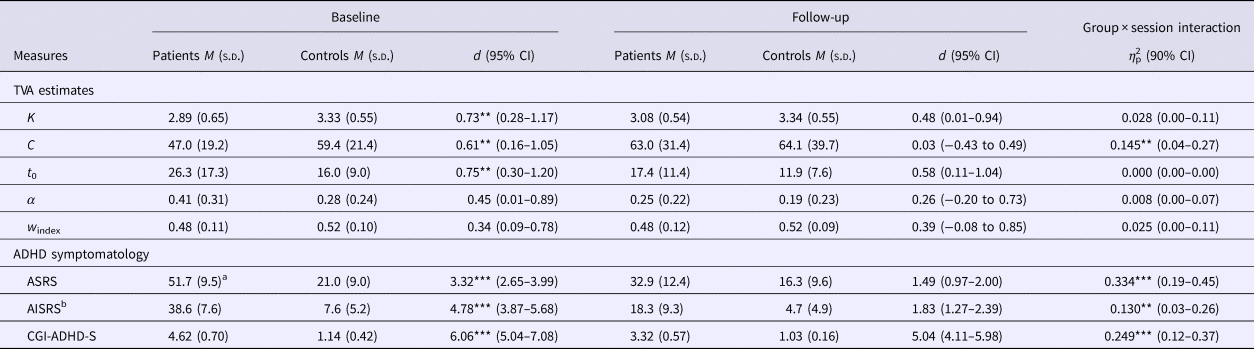
As expected, the ADHD group had significantly higher levels of ADHD symptomatology on both self-report and clinician-rated rating scales; on average, the patients were rated as having moderate to severe ADHD symptomatology. Significant differences were found between patients and controls for three of the five TVA parameters, as shown in Table 3. For the variables of primary interest, K and C, patients had a significantly smaller VSTM capacity K, t (82) = −3.306, p = 0.001, and a significantly slower processing speed C, t (82) = −2.776, p = 0.007. When the analyses were undertaken excluding the 10 patients screening positive for dyslexia, group differences regarding processing speed were reduced to trend level, t (72) = −1.696, p = 0.094; findings initially remained significant for VSTM capacity K, t (72) = −2.163, p = 0.034, but was reduced to trend when controlling for IQ (p = 0.071).
Characteristics of adults with ADHD and control participants at baseline and follow-up

ASRS, The World Health Organization Adult ADHD Self-Report Scale; AISRS, Adult ADHD Investigator Rating Scale; CGI-ADHD-S, Clinical Global Impression-ADHD-Severity; d, effect size, Cohen's d; η p2, effect size; CI, confidence interval.
The AISRS was used as an additional measure after study commencement, and there are missing data points for the first participants (seven at baseline, seven at follow-up).
a One missing data point; bmissing data points.
*p < 0.05; **p < 0.01; ***p < 0.001.
For the three other TVA variables, a significant difference was found between the groups for parameter t 0, reflecting that patients had a significantly higher threshold of conscious perception than controls, U = 520.5, p = 0.001. Differences between the groups were not significant for efficiency of top–down control of attention (α), or spatial bias of attention (w index). The analyses were very similar when excluding participants screening positive for dyslexia.
Correlations between ADHD symptomatology (sub-) scores and neurocognition were not significant for 24/25 possible associations (all p values > 0.05). A single significant correlation between t 0 and AISRS inattention score was initially found, [r s(35) = 0.393, p = 0.016], but this finding did not survive Bonferroni correction.
Performance at 6-week follow-up
TVA parameters
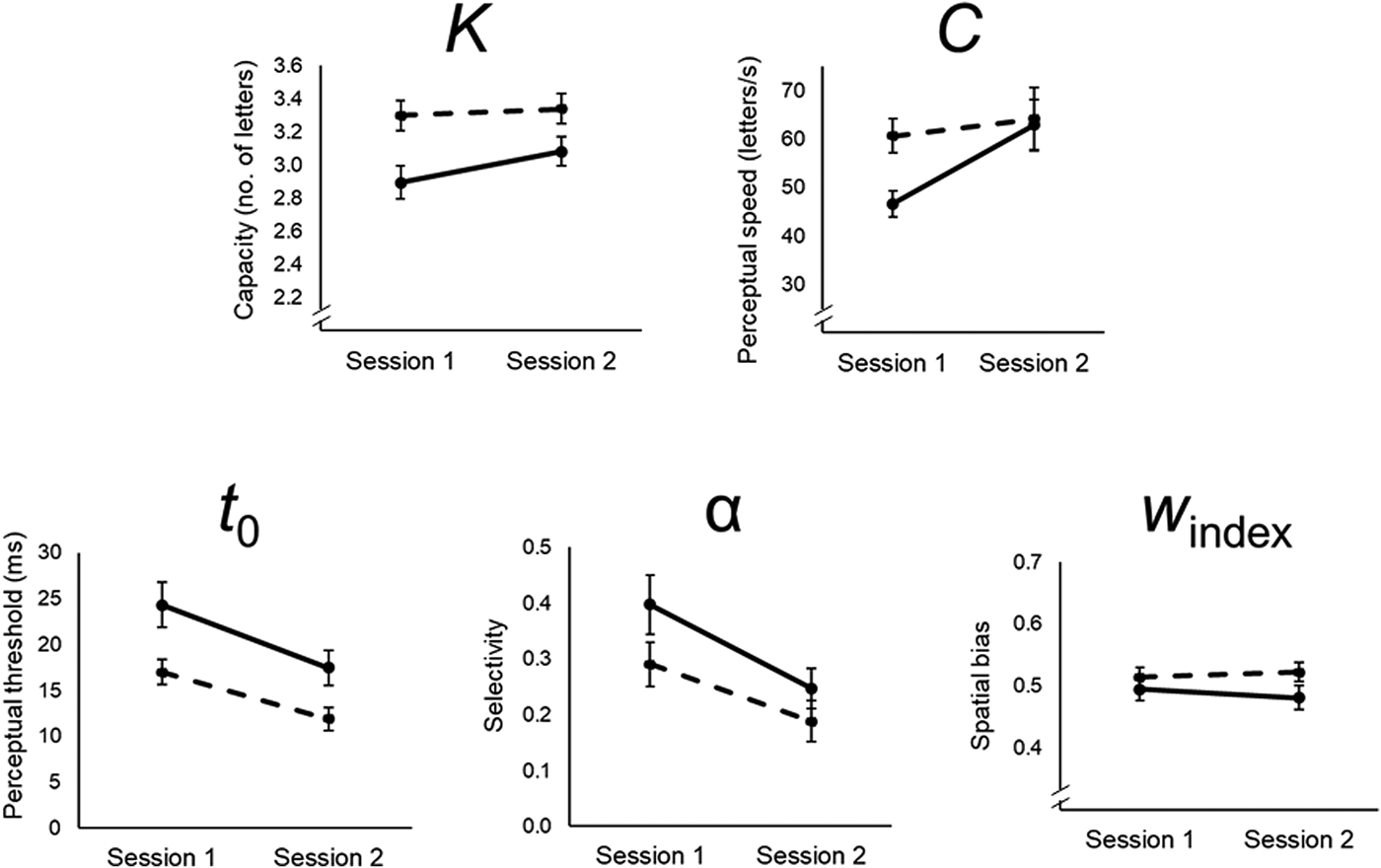
A significant group × session interaction was seen only for processing speed C, F (1,73) = 12.409, p = 0.001. Results were similar in the subgroup of patients who screened negative for dyslexia, such that only this parameter improved significantly in the patient group, F (1,66) = 11.092, p = 0.001 (see Fig. 2). Post-hoc analyses indicated that patients at follow-up improved significantly for all TVA parameters except spatial bias of attention, w index [K: t (36) = −2.333, p = 0.025; C: Z = −3.749, p < 0.0005; t 0: Z = −3.477, p = 0.001; α: Z = −3.477, p = 0.001; w index: Z = −0.415, p = 0.678]. However, controls also improved significantly on two parameters, t 0, Z = −3.633, p < 0.0005, and α, Z = −3.865, p < 0.0005. At follow-up, patients still scored significantly worse than controls in terms of VSTM capacity K, t (73) = −2.055, p = 0.043, and threshold of perception t 0, U = 470, p = 0.014. When patients screening positive for dyslexia were excluded from the analyses, neither the difference in VSTM capacity K nor threshold of visual perception t 0 reached significance.
Results for patients and controls at sessions 1 and 2. Note: Bars indicate standard error of the mean. Solid lines represent patients, dashed lines represent controls.

ADHD symptomatology
The group × session ANOVA interaction analyses were significant for all overall symptom variables (all p values < 0.004), showing that the decrease in symptoms was significantly greater for the patients than controls. Post-hoc analyses indicated that at follow-up, ADHD symptoms had reduced significantly for the patients on all three measures of symptomatology by an average of 18.43 points (s.d. = 12.92) on the ASRS, 20.30 (s.d. = 10.08) points on the ASIRS, and 1.32 points (s.d. = 0.83) on the CGI-ADHD-S (all p values < 0.0005). The controls’ reported ADHD symptoms were also significantly reduced on all three measures (all p values < 0.05), albeit less than for the patients.
Correlations between changes in the five TVA parameters and changes in five ADHD symptomatology scores, respectively, were not significant for 23/25 possible associations (all p values > 0.05). Two significant correlations were initially found between change in t 0 and change in ASRS score [r s (34) = −0.435, p = 0.008], as well as between change in VSTM capacity (K) and change in CGI score [r s (35) = 0.358, p = 0.029], but findings did not survive Bonferroni correction.
Discussion
The purpose of the current study was to (a) investigate specific attentional functions (as measured by TVA) in newly diagnosed, stimulant medication-naïve adults with ADHD and no other dominating comorbidity, and (b) investigate the effect of 6 weeks of treatment with individually titrated methylphenidate on these attentional functions. We found that at baseline, patients performed significantly worse than age-, gender-, and parental education-matched controls on three of the five attentional parameters derived from TVA-based testing. These parameters were visual processing speed (C), VSTM capacity (K), and threshold of conscious perception (t 0). The effect sizes for these findings were in the medium-to-large range (Cohen, Reference Cohen1988), and were not explained solely by differences in intelligence between the groups. After excluding 10 patients from the analysis who screened positive for dyslexia, threshold of conscious perception (t 0) and VSTM capacity (K) still significantly differentiated the groups with medium effects sizes, whilst the difference for visual processing speed (C) was no longer significant.
Our clear finding that VSTM capacity (K) was reduced in the ADHD group confirmed two previous TVA-based studies of adults with ADHD (Finke et al., Reference Finke, Schwarzkopf, Müller, Frodl, Müller, Schneider, Engel, Riedel, Möller and Hennig-Fast2011; Wiegand et al., Reference Wiegand, Hennig-Fast, Kilian, Müller, Töllner, Möller, Engel and Finke2016). This further establishes impairment in VSTM (K) as a core cognitive feature of adult ADHD. The finding adds to previous studies of spatial working memory deficits in adult ADHD, where small-to-medium effects sizes have been found for central executive components, and small effect sizes for storage components of spatial working memory (Boonstra et al., Reference Boonstra, Kooij, Oosterlaan, Sergeant and Buitelaar2005a; Alderson et al., Reference Alderson, Kasper, Hudec and Patros2013).
A clear but unexpected finding was that the threshold of visual perception t 0 was significantly elevated in patients at baseline, also after controlling for IQ and dyslexia screening status. The two previous TVA-based studies of adult ADHD either did not assess this parameter (Finke et al., Reference Finke, Schwarzkopf, Müller, Frodl, Müller, Schneider, Engel, Riedel, Möller and Hennig-Fast2011) or did not report it (Wiegand et al., Reference Wiegand, Hennig-Fast, Kilian, Müller, Töllner, Möller, Engel and Finke2016). Our finding suggests that deficits in near-threshold perception constitute a second and hitherto overlooked characteristic of adult ADHD.
The finding of a significant difference at baseline in visual processing speed (C) was in line with previous child studies of ADHD (McAvinue et al., Reference McAvinue, Vangkilde, Johnson, Habekost, Kyllingsbæk, Bundesen and Robertson2015; Caspersen et al., Reference Caspersen, Petersen, Vangkilde, Plessen and Habekost2017), but appears to contradict the previously mentioned adult studies, which did not find this difference. The discrepant findings in the literature may be partially resolved by considering dyslexia status. After excluding individuals screening positive for dyslexia from the analysis, visual processing speed (C) was no longer significantly different between the groups. However, this may partly be attributable to loss of statistical power. More generally, there is a debate concerning the degree to which low processing speed is associated with ADHD. This may in part reflect factors such as the diverse measures used to assess processing speed in ADHD (Cook et al., Reference Cook, Braaten and Surman2018). The present, as well as previous, TVA results suggest that processing speed (C) is related to both childhood and adult ADHD, although for adults the deficits in VSTM capacity (K) may be larger. To what extent this association is influenced by comorbid dyslexia is presently unclear, given that visual processing speed (C) has been found to be lower in a group of adults with dyslexia (Bogon et al., Reference Bogon, Finke and Stenneken2014), and that three out of four previous TVA studies of ADHD have either included individuals with dyslexia (McAvinue et al., Reference McAvinue, Vangkilde, Johnson, Habekost, Kyllingsbæk, Bundesen and Robertson2015) and/or not screened for dyslexia (Finke et al., Reference Finke, Schwarzkopf, Müller, Frodl, Müller, Schneider, Engel, Riedel, Möller and Hennig-Fast2011; Caspersen et al., Reference Caspersen, Petersen, Vangkilde, Plessen and Habekost2017).
Changes in cognition after 6 weeks of medication
Previous prospective methylphenidate treatment studies have found mixed effects for different aspects of attention, such as vigilance, perceptual sensitivity (d’), and reaction time variability (Bouffard et al., Reference Bouffard, Hechtman, Minde and Iaboni-Kassab2003; Boonstra et al., Reference Boonstra, Kooij, Oosterlaan, Sergeant and Buitelaar2005b; Tucha et al., Reference Tucha, Mecklinger, Laufkötter, Klein, Walitza and Lange2006; Ginsberg et al., Reference Ginsberg, Hirvikoski, Grann and Lindefors2012; Ni et al., Reference Ni, Shang, Gau, Lin, Huang and Yang2013, Reference Ni, Hwang Gu, Lin, Lin, Yang, Huang and Gau2016; Bron et al., Reference Bron, Bijlenga, Boonstra, Breuk, Pardoen, Beekman and Kooij2014; Skirrow et al., Reference Skirrow, McLoughlin, Banaschewski, Brandeis, Kuntsi and Asherson2015; Goodman et al., Reference Goodman, Starr, Ma, Rostain, Ascher and Armstrong2017). In the present study, where TVA-based testing enabled clear distinction between different components of attention, a significant improvement of large effect size was seen in one specific TVA parameter when controlling for re-test effects, the speed of visual processing C, after an average of 6.7 weeks of medication. The result remained significant when excluding patients screening positive for dyslexia from analyses, and when controlling statistically for IQ. The finding confirmed the study's hypothesis regarding medication effects.
Visual processing speed has previously been closely linked to (phasic) alertness (Petersen et al., Reference Petersen, Petersen, Bundesen, Vangkilde and Habekost2017), and it has been suggested that improvements in this parameter could represent an improvement in alertness (Finke et al., Reference Finke, Dodds, Bublak, Regenthal, Baumann, Manly and Müller2010). However, whilst the present study included a healthy control group, we did not include a placebo condition in this study, and clinicians were not blinded to participant or medication status. Thus, it is not possible to conclude that the change in parameter C is a direct treatment effect of methylphenidate, rather than for example a result of non-specific treatment factors, particularly in the light of the mixed results of previous studies. Nonetheless, the fact that improvements were found specifically for visual processing speed (C), rather than indiscriminately across each of the independent parameters assessed, may support the hypothesis that this finding is not solely the result of placebo effects.
Relationship between clinical symptoms and cognition
This study indicated a lack of association between ADHD symptoms and aspects of visual attention pre-treatment. This is in line with the relatively few studies of stimulant medication-naïve individuals with ADHD that report on possible associations between cognitive measures and symptomatology (e.g., Bron et al., Reference Bron, Bijlenga, Boonstra, Breuk, Pardoen, Beekman and Kooij2014; Caspersen et al., Reference Caspersen, Petersen, Vangkilde, Plessen and Habekost2017; Kamradt et al., Reference Kamradt, Nigg, Friderici and Nikolas2017). Further, this study found no significant associations between changes in ADHD symptomatology and changes in processing speed (C), the only attentional parameter to show significant improvements after pharmacological treatment, when controlling for re-test effects. These findings are in line with the relatively few published treatment studies which report on the possible associations between changes in ADHD symptomatology and changes in cognitive performance (e.g. Boonstra et al., Reference Boonstra, Kooij, Oosterlaan, Sergeant and Buitelaar2005b; Coghill et al., Reference Coghill, Rhodes and Matthews2007; Bron et al., Reference Bron, Bijlenga, Boonstra, Breuk, Pardoen, Beekman and Kooij2014). One explanation for this lack of association in changes after methylphenidate treatment is a possible differential dose–response relationships for cognition and ADHD symptoms, respectively (i.e., that the optimal dose for at least some neuropsychological functions may be lower than the optimal dose for ADHD symptomatology) (Hale et al., Reference Hale, Reddy, Semrud-Clikeman, Hain, Whitaker, Morley, Lawrence, Smith and Jones2011).
Strengths and limitations
The present study has a number of strengths and limitations. The sample size was relatively small, which allowed for analysis of subgroups who did or did not screen negative for dyslexia, but not other subgrouping, and may also mean that some analyses were underpowered; clinicians were not blinded to patient status; and there was no placebo condition. Particularly the latter means that conclusions regarding whether changes in visual processing speed (C) are a direct treatment effects of methylphenidate are weakened, and interpretations must be cautious. It is both a strength and a limitation of the study that patients with different dominating comorbidities (e.g. substance use disorders) were excluded. It is a strength in as far as the primary diagnosis in this group was ADHD, but a limitation in that the investigated sample represents only a subgroup of the patients in the referring clinic. Further strengths of the current study were that all patients were initially stimulant medication-naïve, and screened for dyslexia. Lastly, our findings suggest that future studies could fruitfully investigate attentional functioning within the TVA framework by including a third group of individuals with both ADHD and confirmed dyslexia, rather than utilizing a screening instrument for dyslexia only.
Conclusion
We found that stimulant medication-naïve adults with ADHD exhibit deficits in specific and clearly defined aspects of attention: VSTM capacity, threshold of visual perception, and visual processing speed, although the latter may possibly be related to comorbid dyslexia. Improvements after 6 weeks of methylphenidate treatment were seen specifically for one aspect of visual attention, visual processing speed, possibly due to an improvement in general alertness. Finally, we found no significant associations between visual attention and ADHD symptomatology at baseline or after methylphenidate treatment. The latter finding may reflect differential dose relationships for cognition and ADHD symptoms, respectively, but overall, these lack of associations may suggest that cognitive deficits and clinical symptoms are largely separate aspects of ADHD.
Supplementary material
The supplementary material for this article can be found at https://doi.org/10.1017/S0033291718003628.
Acknowledgements
The authors wish to thank the clinicians at the Adult ADHD Clinic at the Copenhagen University Hospital, Glostrup Mental Health Centre, for their invaluable cooperation in recruitment of patients. The study was supported by the UCPH 2016 Program of Excellence (‘Attention to Dopamine’) and the Lundbeck Foundation (R155-2013-16337).
Conflict of interest
Dr Glenthøj is the leader of a Lundbeck Foundation Centre of Excellence for Clinical Intervention and Neuropsychiatric Schizophrenia Research (CINS), which is financed by both an independent grant from the Lundbeck Foundation (R155-2013-16337) based on international review, and the Mental Health Services in the Capital Region of Denmark, University of Copenhagen, and other foundations. Her group has also received a research grant from H. Lundbeck A/S. All grants are the property of the Mental Health Services in the Capital Region of Denmark and administrated by them. She has no other conflicts to disclose. The other authors declare no conflict of interest.
Ethical standards
The authors assert that all procedures contributing to this work comply with the ethical standards of the relevant national and institutional committees on human experimentation and with the Helsinki Declaration of 1975, as revised in 2008.The project was approved by the Ethical Committee of the Capital Region Copenhagen (study number: H-15001438; title: ‘Attention to Dopamine – ADHD project, in collaboration with PECANS II’).