The public often views the civil justice system as one in which disputing litigants bring their cases before neutral arbiters of the law to reach a just resolution (Shapiro Reference Shapiro1981). Proponents of tort reform, on the other hand, maintain that personal injury lawyers “systematically recruit clients who may never have suffered a real illness or injury and use scare tactics” to produce consistently lopsided, pro-plaintiff verdicts (American Tort Reform Association; http://www.atra.org/about). Yet scholars sometimes refer to the civil litigation process as a “black box,” because researchers observe only the evidence juries receive at trial and the verdict that comes out, limiting our ability to understand outcomes in jury trials (MacCoun Reference MacCoun1987). Because the jury deliberation process is largely a black box and scholars have limited access to civil jury verdict data, there are few systematic, empirical explorations of litigation outcomes across states.
Although researchers interested in jury verdicts are left to assess the relationship between observable variables and jury verdicts, jury trial outputs emanate from specific contexts in which states construct the rules that govern court processes and contextual variables condition the decision-making environment. By creating an original data set of civil jury verdicts in five states and applying a theoretical framework that views case outcomes as an interaction among institutional and contextual variables, I explore how the context of the black box shapes the verdicts juries render. A cross-state comparison of civil trial courts’ dispute resolution and resource allocation functions contributes to our understanding of civil trial courts and adds broadly to judicial politics scholarship concerned with the impact of institutional design on court outcomes. This study also provides empirical insight for researchers and policy makers interested in contemporary debates about judicial selection and the impact of tort reform on civil litigation and may provide information of practical use for the many actors who participate in civil litigation processes.
While relatively understudied, civil trial courts of original jurisdiction are significant institutions that adjudicate far more disputes than their appellate counterparts, settle critical disagreements in the lives of citizens, and allocate billions of dollars annually. Despite their importance, access to comprehensive, reliable state jury trial data remains the most difficult obstacle to studying trial courts.Footnote 1 Unlike all federal court or state supreme court decisions, which are published and publicly available, civil jury verdict data are often unpublished, unavailable to the public, and not systematically archived at all in several states. In fact, scholars may readily access “unpublished” federal court decisions using Westlaw and Lexis Nexis, making even those decisions more available than civil trial verdicts. As a result most studies of state trial courts rely on experimental designs or posttrial juror surveys, preventing the examination of actual trial outcomes. Additionally, examinations of actual verdicts typically conduct single-state and single-case issue studies, limiting the generalizability of the findings.
Owing to data limitations, the research designs employed by prior work are insufficient to test the hypothesis that state institutional variation partially explains the verdicts rendered. In order to access the greater theoretical leverage of studying courts comparatively (Brace and Hall Reference Brace and Gann Hall1993, Reference Brace and Gann Hall1995, Reference Brace and Gann Hall1997; Hall Reference Hall2001), I create an original data set comprising all reported jury verdicts decided in Alabama, Hawaii, Indiana, Kentucky, and Tennessee civil trial courts of general jurisdiction in 2009. The data allow me to compare across a number of state-level institutional variables and include more nuanced controls for litigant, attorney, and case characteristics than previous studies.
I argue that institutional and contextual variables condition court outputs in terms of winners and losers, as well as awards, in state civil jury trials. Further, in lieu of individual-level data from actual jurors, these variables serve as the best causal indicators of juries’ verdicts. I begin by drawing guidance from the well-established literature documenting the importance of institutions in shaping state supreme courts’ decisions, a small, yet informative, number of trial court studies, and research examining demand for civil litigation. Taken together the literature suggests a model for studying civil jury verdicts in a cross-state comparative context that examines judicial institutions, the political and social context of the trial venue, and controls for case characteristics and nonjudicial institutions. Finally, I develop and test models of both the liability decision and award amounts in order to better understand the black box. The results demonstrate that the structure and design of court institutions as well as environmental context significantly structure the liability decision, while case-specific factors largely explain award amounts.
Civil Jury Verdicts in Comparative Context
The ideal of courts assumes that verdicts rest solely on facts and evidence (Shapiro Reference Shapiro1981). Yet judicial politics scholarship consistently maintains that judicial institutions and other factors lead to systematic advantages and disadvantages for those coming before the courts. Shapiro also notes that the common law system converts disputes over personal injury, property damage, and contractual obligations into disputes over money; the implication is that courts, like other institutions, engage in resource allocation as well as dispute resolution. Additionally, Heydebrand (Reference Heydebrand1977) argues that the environment in which a court is situated both produces the demand for court services and shapes the decision-making process. Other scholarly research also supports the notion that court outcomes reflect a complex interaction between institutional and contextual variables (Brace and Hall Reference Brace and Gann Hall1993, Reference Brace and Gann Hall1995, Reference Brace and Gann Hall1997) as well as other state political and policy processes (Heydebrand Reference Heydebrand1977; Brace, Langer, and Hall Reference Brace and Langer2001).
Judicial Institutions: Tort Reforms, Judicial Retention, and Fault Standards
State institutions both directly and indirectly shape litigation outcomes by creating the rules courts apply and shaping the environment in which disputes both arise and are resolved. Tort reforms are the most recent and highly salient structural and procedural variation in the application of civil justice from one state to the next (Galanter Reference Galanter1999). Most of the studies empirically investigating the impact of tort reform focus on medical malpractice suits. The findings indicate that reforms decrease medical malpractice filings (Yates, Davis, and Glick Reference Yates, Creel Davis and Glick2001; Avraham Reference Avraham2007; Stewart et al. Reference Stewart, Geoghegan, Myers, Sirinek, Corneille, Mueller, Dent, Wolf and Pruitt2011) and diminish the size of awards successful parties receive (Shepard Reference Shepherd2008; Hyman et al. Reference Hymann, Black, Silver and Sage2009; Zeiler Reference Zeiler2010). While tort reforms might not achieve the desired goal of bringing down consumer costs (Zeiler Reference Zeiler2010; Paik et al. Reference Paik, Black, Hyman and Silver2012) or risk (Rubin and Shepherd Reference Rubin and Shepherd2007; Shepherd Reference Shepherd2008), reforms clearly reshape trial courts’ decision-making processes. Although tort reform research produces important findings, most of the literature looks only at effects within one state and focus exclusively on medical malpractice cases. However, states have not uniformly adopted reforms, and although much of the political debate revolves around medical malpractice, reforms affect the resolution of other tort cases as well.
While the prototype of courts submits that a neutral third party settles disputes, judicial politics scholars largely reject this assumption in light of evidence that judges possess a variety of goals. Although my research focuses exclusively on civil jury trials, where juries render the final verdict rather than judges, judges may, nonetheless, exert a strong influence on jury verdicts. Rowland, Traficanti, and Vernon (Reference Rowland, Traficanti, Vernon, Klein and Mitchell2010) convincingly argue that every jury trial is actually a bench trial: “What the constitutional right to a jury trial actually guarantees citizens is the right to a trial in which a jury decides a dispute largely defined and engineered by the exercise of judicial discretion. These discretionary exercises of judicial judgment answers key questions—for example, what evidence the jury will hear and who among their fellow citizens will constitute the jury—and almost always favor one side or the other and greatly influence the likely resolution of the dispute” (186).Footnote 2
If judges substantially influence juries’ decisions, we might expect jury verdicts to vary in systematic ways in relation to judicial retention mechanisms. While the judicial selection literature largely focuses on state appellate courts rather than trial courts, this research provides overwhelming evidence that selection and retention mechanisms determine the types of judges who ascend to the bench (Brace and Boyea Reference Brace and Boyea2008) and judges’ behavior on the bench (Brace and Hall Reference Brace and Gann Hall1993, Reference Brace and Gann Hall1995, Reference Brace and Gann Hall1997; Brace and Boyea Reference Brace and Boyea2008). Additionally, Huber and Gordon (Reference Huber and Gordon2004) conduct one of the few studies examining judicial retention in trial courts and attribute sentencing inconsistencies in aggravated criminal cases to trial judges’ electoral pressures. The literature indicates that elected judges, especially those elected in partisan, district-based elections (Brace and Hall Reference Brace and Gann Hall1993), feel pressure to comply with reelection demands. Partisan elections may provide information to potential litigants and attorneys about judges’ policy preferences (Hanssen Reference Hanssen1999; Yates, Tankersley, and Brace Reference Yates, Tankersley and Brace2010). Additionally, state supreme court research finds that partisan elections are more expensive (Bonneau Reference Bonneau2006) and more competitive (Hall Reference Hall2001; Bonneau Reference Bonneau2007). The literature indicates that partisan elections, in particular, condition the behavior of judges and other court actors in appellate courts; however, the relevance of this evidence for trial courts remains largely untested.
Though the causal mechanism between judicial retention and jury verdicts is unclear, previous research indicates that partisan elections stand out among retention methods and provides at least three pathways by which jury verdicts rendered in partisan retention jurisdictions might vary from those rendered elsewhere. First, retention method might predict jury verdicts, because partisan elections decrease judges’ independence (Baum Reference Baum2003), which in turn leads judges to prefer electorally popular outcomes and intentionally or unintentionally shape jury verdicts accordingly. Second, jurors are also the voters in partisan election jurisdictions, which could lead to greater congruence between judges’ preferences and jurors’ opinions on cases. Third, studies also propose that court structures that make litigation outcomes more predictable lead to more stable litigation rates (Epp Reference Epp1990; Hanssen Reference Hanssen1999; Yates et al. Reference Yates, Creel Davis and Glick2001, Reference Yates, Tankersley and Brace2010). Attorneys know judges’ partisan affiliations, which could allow for better strategy regarding case selection and courtroom strategy. Although this research cannot disentangle whether any or all of these causal explanations link jury verdicts to judicial retention methods, a multistate analysis provides a unique opportunity to test the hypothesis that partisan elections shape jury verdicts in systematic ways when compared to other retention mechanisms.Footnote 3
The manner in which civil juries determine fault also constitutes an important institutional difference across states. Most states employ comparative fault standards, under which juries can determine the extent to which the plaintiff contributed to the alleged injury and adjust the award accordingly. For example, in a comparative fault state, a jury might assign 30% responsibility to a plaintiff for her causal contribution to an auto accident, and consequently, she would receive 70% of the amount awarded. On the other hand, states that apply the higher standard of contributory negligence prevent plaintiffs from collecting damages if the plaintiff contributed to her injury in any way.Footnote 4
Litigation Context
Unlike legislatures or executives, courts cannot initiate their own agendas and must rely on litigants to bring suits, making civil litigation in state trial courts largely a homegrown process in which both the conflict and the dispute resolution process emanate from the local community. As such, the context in which jurors render verdicts might also shape court outputs. Although considerable scholarly research investigates a potential relationship between the demographic compositions of the community in which a court resides and the verdicts juries render there, researchers come to conflicting conclusions. Some researchers maintain that there is no relationship between community demographic variables and verdicts (Eisenberg and Wells Reference Eisenberg and Wells2002; Rose and Vidmar Reference Rose and Vidmar2002; Saks Reference Saks2002), while others find evidence that verdicts reflect local community characteristics (Vidmar and Rice Reference Vidmar and Rice1993; Bornstein and Rajki Reference Bornstein and Rajki1994; Hastie, Schkade, and Payne Reference Hastie, Schkade and Payne1998).
Studies finding a relationship between demographics and verdicts argue that verdicts reflect the broader economic conditions, racial composition, and citizen ideology of a jurisdiction. Economic conditions appear to shape both litigation rates (Yates et al. Reference Yates, Creel Davis and Glick2001, Reference Yates, Tankersley and Brace2010) and trial outcomes (Tabarrock and Helland Reference Tabarrock and Helland1999; Helland and Tabarrock Reference Helland and Tabarrock2002, Reference Helland and Tabarrock2003). Additionally, Yates et al. (Reference Yates, Creel Davis and Glick2001) hypothesize that residents residing in states with greater income inequality utilize the courts as alternative avenues for seeking economic security, and Kohler-Hausmann (Reference Kohler-Hausmann2011) finds that greater inequality in judicial districts increases the size of tort awards. Furthermore, prior studies find that the racial composition of the county in which the court resides predicts verdicts (Denove and Imwinkelreid Reference Denove and Imwinkelried1995; Diamond, Saks, and Landsman Reference Diamond, Saks and Landsman1998; Hastie et al. Reference Hastie, Schkade and Payne1998; Helland and Tabarrock Reference Helland and Tabarrock2003; Overland Reference Overland2009) as does population liberalism (Dumas and Haynie Reference Dumas and Haynie2012).
My research also seeks to explore a possible indirect connection between nonjudicial institutions and court outputs. Yates et al. (Reference Yates, Creel Davis and Glick2001) hypothesize that higher poverty levels contribute to higher litigation rates but find that Temporary Aid to Needy Families (TANF) payments decrease tort filings. The findings suggest that individuals utilize the courts to settle disputes more often in states with weaker social safety nets; however, these findings do not explore whether or not courts provide economic benefits for these litigants. Additionally, Yates et al. (Reference Yates, Tankersley and Brace2010) find that citizens residing in states with lower political participation rates utilize the courts as alternative paths to political power, implying that citizens turn to the courts when other state institutions appear inaccessible. Greater participation in electoral politics might also represent more trust in political institutions, which could translate into greater support for those seeking judicial remedies.
Litigant Resources, Case Issues, and Alleged Injuries
Scholarship also shows that factors specific to each case partially account for court outcomes and that models of jury verdicts should control for these factors. In particular, parties with greater resources, such as businesses and government, incur considerable advantages over individuals, who presumably possess fewer resources (Galanter Reference Galanter1974; Wheeler et al. Reference Wheeler, Cartwright, Kagan and Friedman1987; Songer, Sheehan, and Haire Reference Songer, Sheehan and Brodie Haire1999; Kritzer Reference Kritzer, Kritzer and Silbey2003). Scholars also contend that high-quality legal representation constitutes an important resource advantage. Litigants represented by larger legal teams relative to their opponent (Szmer, Johnson, and Sarver Reference Szmer, Johnson and Sarver2007; Haire and Moyer Reference Haire and Moyer2008; Dumas and Haynie Reference Dumas and Haynie2012), more experienced advocates (McGuire Reference McGuire1995; Haire, Lindquist, and Hartley Reference Haire, Lindquist and Hartley1999), or more capable attorneys (Johnson, Wahlbeck, and Spriggs Reference Johnson, Wahlbeck and Spriggs2006; Haynie and Sill Reference Haynie and Sill2007) achieve higher success rates. On the other hand, research exploring the “deep pockets” hypothesis maintains that civil juries hold wealthy defendants liable more often and assess larger damage awards against them when compared to other types of litigants (Chin and Peterson Reference Chin and Peterson1985; Hans and Ermann Reference Hans and Ermann1989; MacCoun Reference MacCoun1996; but see Vidmar Reference Vidmar1995).
Data limitations of previous studies result in few comprehensive comparisons of litigant success rates across case types; however, case issues and facts might determine the initial likelihood that the plaintiff wins (Saks Reference Saks2002). In one of the few attempts to empirically investigate plaintiff success rates across case types and injuries, Bovbjerg et al. (Reference Bovbjerg, Sloan, Dor and Ruey Hsieh1991) observe that plaintiffs win medical malpractice cases least often but garner the largest settlements upon success. On the other hand, plaintiffs achieve the highest success rates in automobile cases but receive considerably less compensation. Furthermore, injury severity appears to increase pro-plaintiff verdicts and award amounts (Chin and Peterson Reference Chin and Peterson1985; Bornstein Reference Bornstein1998; Vidmar, Gross, and Rose Reference Vidmar, Gross and Rose1998; Greene and Bornstein Reference Greene and Bornstein2003; Hans Reference Hans and Bornstein2008).
The literature above indicates that an investigation of the black box of the civil verdicts requires a theoretical framework that takes into account cross-state variation in institutional design and the social and political context in which a court resides, and includes controls for nonjudicial institutions and factors specific to the cases. In particular, I hypothesize that tort reforms achieve the desired effect of reducing support for plaintiffs and diminishing the size of awards, evidenced by fewer pro-plaintiff verdicts and smaller damage awards in states with greater numbers of reforms. Additionally, the literature makes clear that judges elected in partisan elections behave differently than their counterparts who are retained by other selection mechanisms. However, previous research provides at least some support for both directional hypotheses. Partisan elections might make trial outcomes more predictable, thereby allowing plaintiff’s attorneys to better determine which cases to take to trial, consequently leading to more pro-plaintiff verdicts. Conversely, the research shows that attorneys and business interests are the two largest sources of campaign contributions (Goldberg et al. Reference Goldberg, Samis, Bender and Weiss2005), suggesting that judges typically receive greater contributions from parties who participate as defendants in litigation. Further, judges, especially those reelected in partisan elections, appear to respond favorably to contributors when those parties appear in their courts (Cann Reference Cann2007; Cann, Bonneau, and Boyea Reference Cann, Bonneau, Boyea and McGuire2009). Shepherd (Reference Shepherd2009) finds that state supreme court judges who are reelected in partisan races by Republican electorates decide cases in line with standard Republican policy. If trial judges behave similarly, we might also expect more defense verdicts in trial courts presided over by judges retained in partisan elections. Additionally, extant scholarly research posits that courts located in urban, liberal counties with greater income inequality and larger black populations will render more pro-plaintiff verdicts and larger awards.
Data and Method
To test the hypothesis that institutional and environmental variables systematically shape civil jury verdicts, I quantified primary source data from jury verdict reporters, a novel and, to date, underutilized data source for civil jury outcomes. Jury verdict reporters are independent publications primarily used by attorneys that provide a summary of each civil case, the attorneys for the parties, the judge presiding over the case, the type of case, the type of injury alleged, and the jury verdict. A number of scholars of trial court adjudication also rely on jury verdict reporters as data sources to produce respected research (Gross and Syverdu Reference Gross and Syverdu1991; Moller, Pace, and Carroll Reference Moller, Pace and Carroll1999; Rose and Vidmar Reference Rose and Vidmar2002; Dumas and Haynie Reference Dumas and Haynie2012). The data collection relies on the 2009 Alabama, Hawaii, Indiana, Kentucky, and Tennessee Reporters (Miller Reference Miller2009a, Reference Miller2009b, Reference Miller2009c, Reference Miller2009d; Seamon Reference Seamon2009), because the editors of these volumes attempt to consistently report all the jury verdicts in each state on the basis of actual trial records rather than self-reported data.Footnote 5 Although the states selected constitute a nonrandom sample, the data provide significant advantages over other currently available data sources and provide the most comprehensive source of civil jury verdicts currently available. Since many states do not make jury verdict data publicly available and/or fail to archive these data at all, the data set represents a unique opportunity to explore the effect of cross-state institutional variation on trial court outcomes. Additionally, these states utilize differing institutional arrangements and rules and provide ample variation at the substate level on social, political, and economic indicators.Footnote 6
Variables and Coding
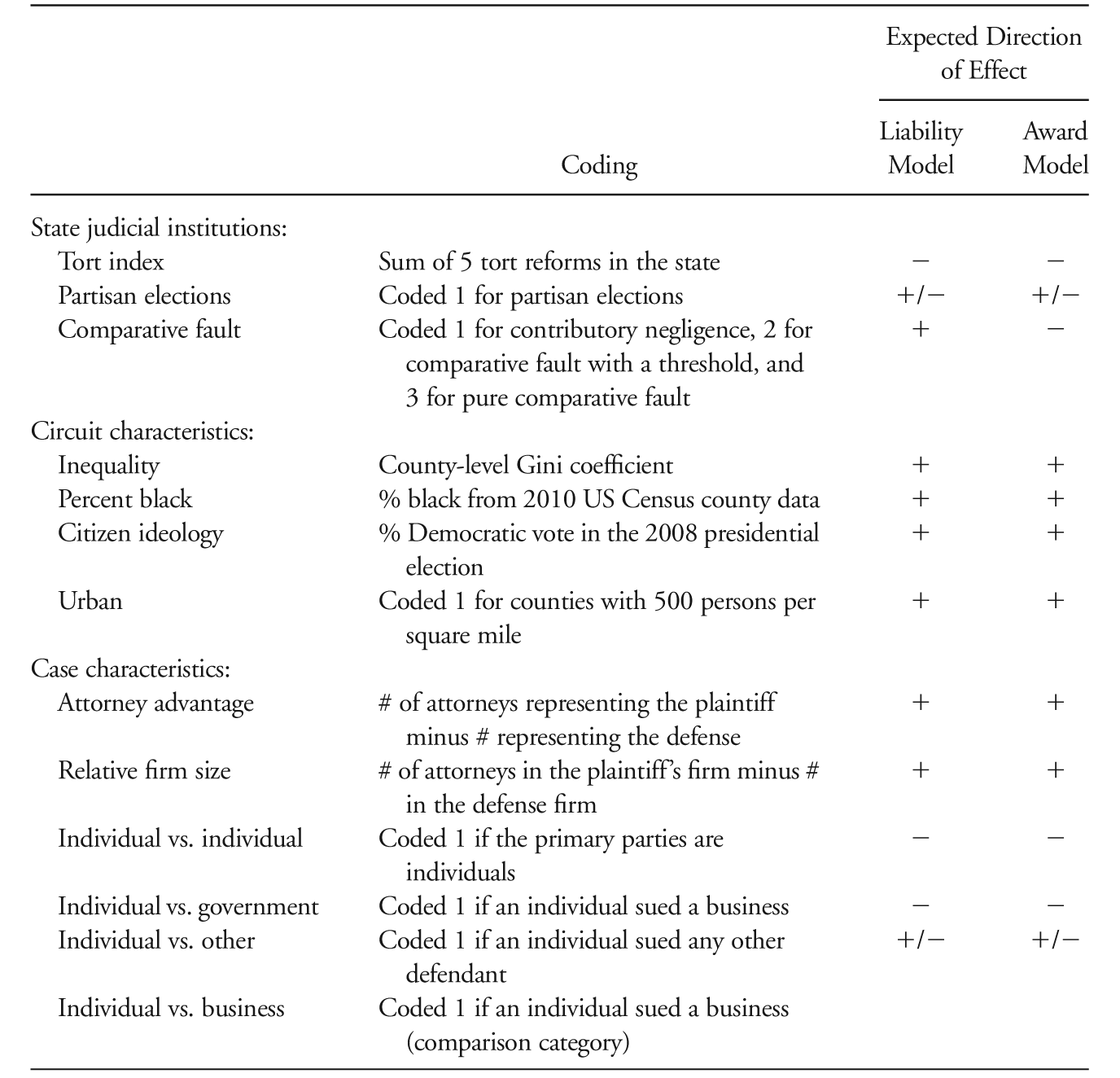
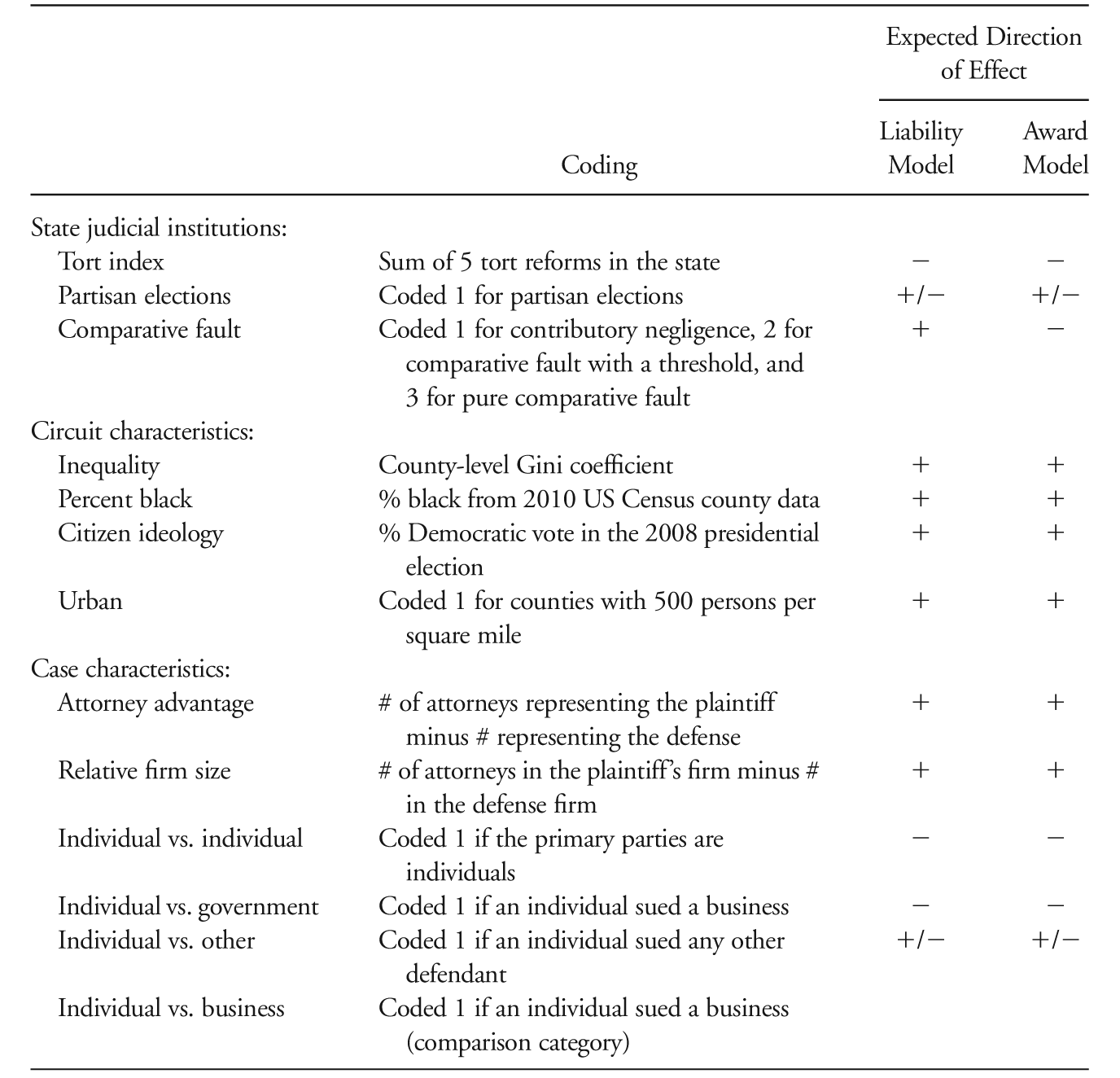
Starting with the institutional variables (for detailed variable descriptions, see table 1), I create an index based on the five most common tort reforms (Schmidt, Browne, and Lee Reference Schmidt, Browne and Duck Lee1997). Although the index cannot account for changes in trial outcomes before and after reforms, the measure can assess the influence of greater numbers of reforms in a state compared to states with fewer reforms. The partisan election variable compares verdicts rendered by juries in courts presided over by judges retained in partisan elections to verdicts rendered by juries in jurisdictions using nonpartisan elections, retention elections, and appointment mechanisms. Next, to capture the influence of fault standards on jury verdicts, I create an ordinal variable that ranges from 1 to 3. Presumably, as the threshold for a plaintiff to collect damages increases from a true comparative fault scenario (where a plaintiff can receive compensation at any level of contribution to the injury) to a contributory negligence standard (where the plaintiff cannot collect at all if the jury deems the plaintiff in any way responsible), the probability of plaintiff success should increase. However, I predict a negative relationship between the index and awards, since juries in comparative fault states can offset the award by some percent.
Key Independent Variables and Coding
Note.—Control variables: nonjudicial institutions: social safety net, dollar amount of the TANF benefit for a family of four and political participation, percentage turnout in the 2008 presidential election; case types: auto negligence, uninsured motorist, medical malpractice, premises liability, fraud, and products liability, general negligence, and other cases; alleged injuries: major physical, minor physical, major nonphysical, and minor nonphysical; volume of litigation in each circuit: lawsuits per thousand residents.
The models also contain contextual variables measuring income inequality, citizen ideology, racial composition, urbanization, and the volume of litigation in each jurisdiction. All states organize judicial districts (also called circuits in some states) around counties; however, districts in rural areas often include multiple counties. For districts that include multiple counties, I generate averages for each indicator. To capture the amount of individual income inequality and minority population in each jurisdiction, the models include the 2010 US census data for county-level income inequality and the percent black population. I also seek to capture the ideological liberalism of each circuit through a commonly used measure, the percent Democratic vote (Nice and Cohen Reference Nice and Cohen1983; Johannes Reference Johannes1984; Glazer and Robbins Reference Glazer and Robbins1985; Fleisher Reference Fleisher1993; Leogrande and Jeydel Reference Leogrande and Jeydel1997) in the 2008 presidential election. A dichotomous variable coded 1 for urban jurisdictions (using the US census definition of 500 persons per square mile in a county) and 0 otherwise controls for urbanization.
Control Variables
To control for the potential effects of other state institutions, the models also include a variable that measures the amount of each state’s TANF payment and the percent voter turnout in each jurisdiction in the 2008 presidential election to gauge the effect of the state’s social safety net and political participation rates on verdicts. Scholarship also indicates that the volume of litigation courts adjudicate affects decision-making patterns (Priest and Klein Reference Priest and Klein1984; Waldfogel Reference Waldfogel1995; Hanssen Reference Hanssen1999). Although preceding scholarship makes no prediction regarding the volume of litigation and the size of awards, the importance of court workloads in shaping the flow of cases indicates a need to control for the number of cases litigated. A variable that measures the lawsuits per 1,000 residents in the district controls for the volume of litigation in each circuit.
Finally, I include variables representing litigant resources, case types, and injury severity. Legal representation constitutes an important resource for disputants, and parties represented by larger legal teams appear to succeed in court more often (Szmer et al. Reference Szmer, Johnson and Sarver2007; Haire and Moyer Reference Haire and Moyer2008; Dumas and Haynie Reference Dumas and Haynie2012). To capture the comparative advantage of legal representation for each side, the models include a variable that is the number of attorneys representing the plaintiff minus the number of attorneys representing the defendant. Plaintiffs and defendants that represent themselves, pro se, receive a score of 0 for the number of attorneys.Footnote 7 The attorney advantage variable ranges from −5 to 4. A score of 0 indicates equally matched parties.
Additionally, the ability to hire superior legal counsel is a considerable benefit possessed by better-resourced parties (Galanter Reference Galanter1974). If larger firm size serves as an indicator of resources and attorney talent (Heinz and Laumann Reference Heinz and Laumann1994), the larger the plaintiff’s firm relative to that of the defense, the more likely the plaintiff should be to win and receive greater compensation. I obtained firm size data using the Martindale Hubble website (a search engine for finding law firms and attorneys that provides general information about the firms and attorneys) and attorney and law firm websites to determine the number of attorneys employed by each firm. I create an ordinal measure of firm size for both plaintiff and defense firms that ranges from 0 to 4. Pro se plaintiffs and defendants receive a score of 0 for firm size. The variable denotes small firms as 1 (those with one or two lawyers), medium firms as 2 (firm sizes between three and 25), large firms as 3 (firms with more than 25 but fewer than 100 lawyers), and very large firms as 4 (those with more than 100 members). The relative firm size variable subtracts the ordinal measure of firm size variable for the plaintiff from that of the defense.
Consistent with prior studies that find resource advantages for classes of litigants (Songer et al. Reference Songer, Sheehan and Brodie Haire1999; Songer, Kuersten, and Kaheny Reference Songer, Kuersten and Kaheny2000), I code each plaintiff and defendant as an individual, business, or government to capture the relative resources of each party. Remaining classes of litigants are coded as “other.” Although litigant classes provide only an indirect measure of resources, previous scholarship maintains that businesses and government possess greater resources than individuals and, consequently, are more likely to win their cases. The models compare cases in which an individual sues an individual, government, or other party to cases in which an individual sues a business.
Finally, scholarship indicates that case facts influence jury verdicts. Case types are grouped into eight issue areas that capture the majority of all cases; all remaining case issues are coded as “other.” The models compare all case types to auto negligence cases, the excluded category. I aggregated injuries into four categories, major physical, minor physical, major nonphysical, and minor nonphysical; major physical injury serves as the excluded category. This research provides an opportunity to systematically explore litigation outcomes across a variety of case types and injuries.
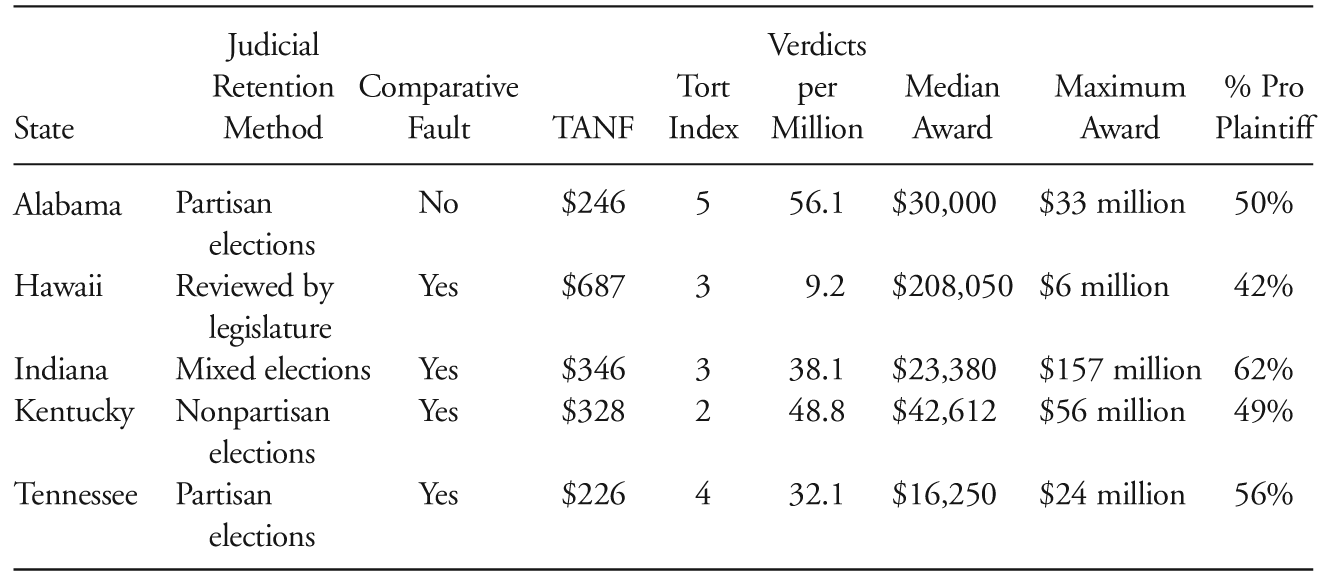
Table 2 provides a descriptive overview of the institutional structures and verdicts rendered in each state. The table first reports the judicial retention method utilized in each state. Indiana allows each jurisdiction to choose its own judicial retention mechanism and utilizes partisan, nonpartisan, and retention elections to retain trial court judges. Both Alabama and Tennessee retain trial court judges through partisan elections, while Kentucky uses nonpartisan elections. Hawaii uses gubernatorial appointment and retention by legislative committee. The table also shows that tort reforms across the five states vary considerably. Alabama is the only state to enact all five of the most common tort reforms but also processes the most civil trials per capita.Footnote 8 Yet, even in Alabama, juries adjudicate only 56 trials per million residents, indicating that trials are relatively infrequent events. The table also compares the median and maximum awards in each state and shows that the typical award varies considerably for the largest awards, demonstrating that very large awards deviate substantially from the norm. Verdicts also evidence apparent disparities in plaintiff success rate across states, with plaintiffs winning only 42% of all decisions in Hawaii and 62% in Indiana.
Institutional Variation

Note.—Tort reforms by state: Alabama: Collateral source rule, joint and several liability, noneconomic damage caps, punitive damage caps, and sanctions on frivolous lawsuits. Hawaii: Collateral source rule, joint and several liability, and noneconomic damage caps. Indiana: Collateral source rule, joint and several liability, and punitive damage caps. Kentucky: Collateral source rule and joint and several liability. Tennessee: Collateral source rule, noneconomic damage caps, joint and several liability, and punitive damage caps.
Analyses and Results
In order to model both courts’ dispute resolution and resource allocation functions, I utilize two dependent variables. The first dependent variable is coded 1 if the plaintiff wins and 0 otherwise. If the plaintiff wins in the first model, I then examine the variables associated with awards upon success. The dependent variable in the award model is the logged dollar amount. I take the natural log of the dollar amount awarded as a result of the highly skewed nature of awards (awards range from $0 to $157 million).Footnote
9
The unit of analysis in both the plaintiff success and the award models is the primary claim in each case. In order to correct for potential selection bias in the award model (see Ansolabehere and Gerber Reference Ansolabehere and Gerber1996), I first estimate the plaintiff success model using probit and generate an inverse Mills ratio, which is then included in a regression model for awards to control for any potential bias created by selection effects (Heckman Reference Heckman1979; Breen Reference Breen1996).Footnote
10
Additionally, regression analyses assume that observations are independent of one another; however, if circuit-level effects are nonindependent, the models may produce correlated error terms. To correct for any potential estimation bias, I generate robust standard errors, clustering on the circuit for each model.Footnote
11
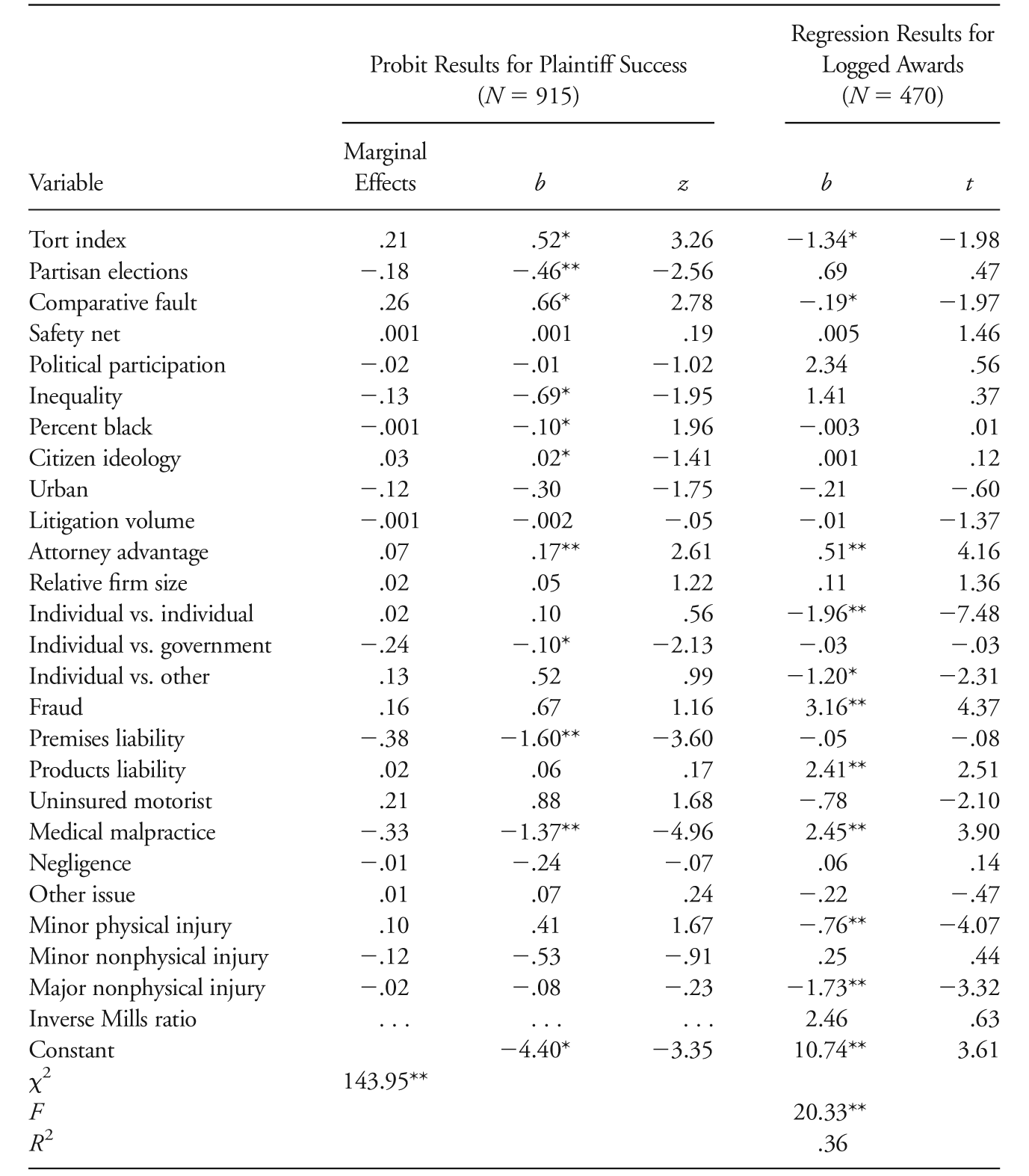
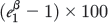
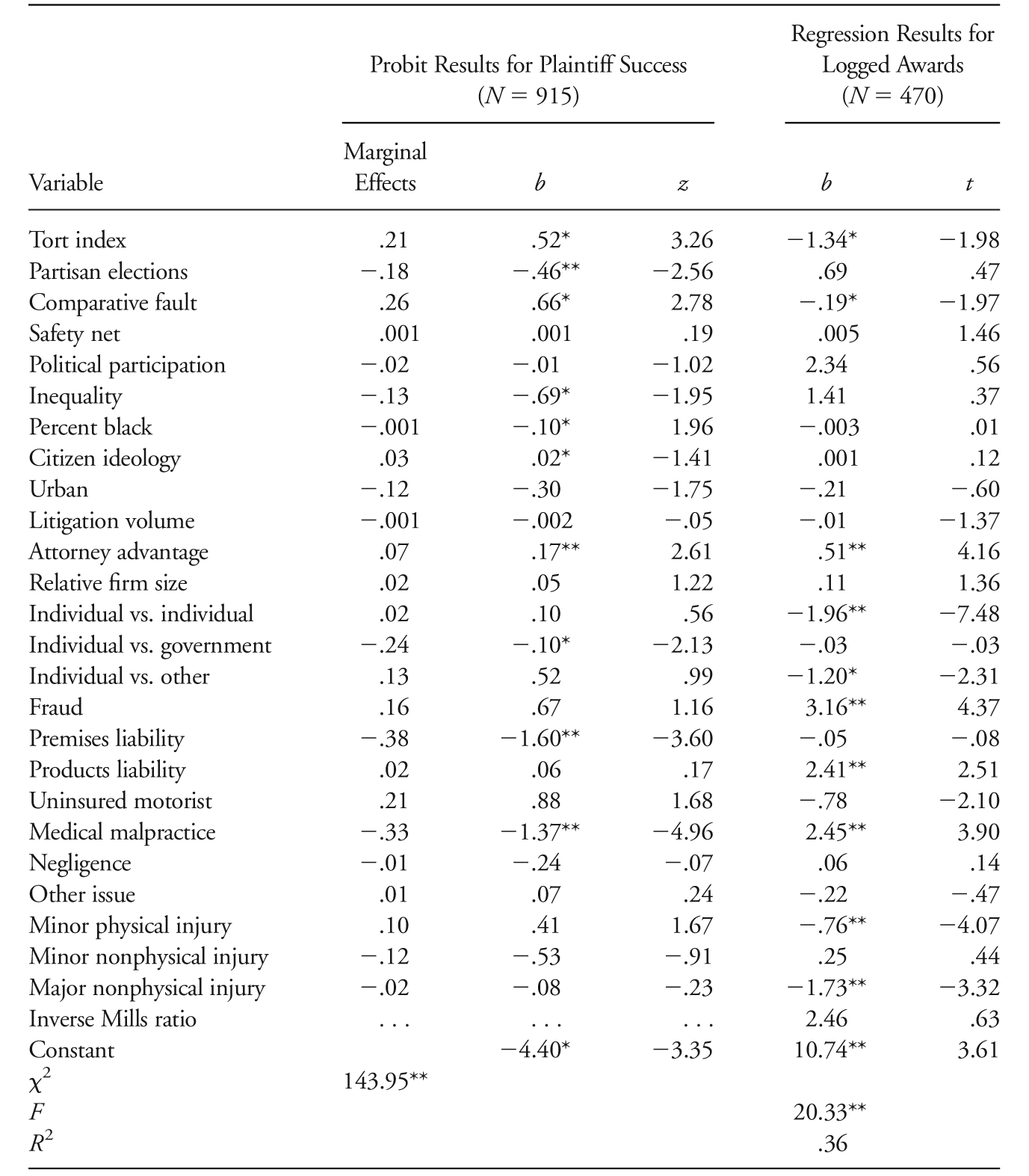
Table 3 reports probit coefficients for the plaintiff success model and regression coefficients for logged awards. Since one cannot easily assess the relative impact of probit coefficients, the table also reports marginal effects, holding all other variables constant at their means. When using a log transformed dependent variable and unlogged independent variables, as in the award model, exponentiated coefficients are interpreted as the percentage change in the dependent variable for a one-unit shift in the explanatory variable: percentage change =
 .
Plaintiff Success and Award Models
*. Significant at the .05 level.
**. Significant at the .01 level.
Beginning with the institutional variables, juries in states with greater numbers of tort reforms render significantly more pro-plaintiff verdicts, indicating that, opposite my expectations, more tort reform is actually associated with increased rather than decreased probability of plaintiff success. In fact, after controlling for other factors, the model predicts that the probability of plaintiff success increases by 21% with each additional reform. Although the causal mechanism is unclear, the finding might hint at an alteration of the pretrial process in response to tort reforms. In states with greater numbers of reforms, attorneys might bring to trial only cases with the highest probability of success. Looking at the data descriptively provides at least some additional support for the attorney strategy explanation. Although many factors might influence the number of medical malpractice cases (the focus of much of the debate regarding tort reform) in a state, looking at the percentages of medical malpractice cases across states suggests a possible relationship between reforms and cases reaching trial. In Alabama, the state with the greatest number of reforms, only 11% of all trials involve medical malpractice claims, while in Kentucky, the state with the fewest reforms, medical malpractice cases make up 28% of all cases, possibly indicating that attorneys take fewer medical malpractice cases to trial in states where medical malpractice reform makes these cases more daunting. However, plaintiffs won 23% of medical malpractice cases in Alabama and only 13% in Kentucky, perhaps showing that greater selectivity in taking cases does in fact lead to more success at trial.
Yet the award model shows that greater numbers of tort reforms appear to substantially diminish the size of awards successful parties receive. With each additional tort reform enacted, awards in the state decrease by 74%. Of course, whether or not this finding represents a normative good is debatable (see Zeiler Reference Zeiler2010). However, the results indicate that unequal tort reform adoption leads to differential outcomes for claimants across states in terms of both litigants’ probability of success and the amount awarded.
Turning to the other institutional variables, the plaintiff success model shows that partisan elections appear to lead to fewer plaintiff wins. When compared to other retention mechanisms, the probability of plaintiff success decreases by 18% in partisan election jurisdictions; however, the retention method variable produces no statistically significant impact on awards.Footnote 12 Although this result could support a number of causal explanations, the finding affords preliminary support for the hypothesis that the manner in which state trial judges retain their seats shapes the outputs of the courts they sit on. As expected, states utilizing lower fault thresholds produce more pro-plaintiff outcomes, while the ability to offset the final award decreases the amount successful plaintiffs receive when they win.
Moving to the contextual variables, the plaintiff success model provides initial support for the hypothesis that income inequality influences litigation outcomes. The models suggest that if citizens in highly unequal contexts seek out the courts because of the lack of responsiveness of other institutions (Yates et al. Reference Yates, Tankersley and Brace2010), the courts fail to afford an outlet. The plaintiff success model shows a positive and highly significant negative effect of income inequality for pro-plaintiff verdicts (a 13% decrease in the probably of plaintiff success for each increase in income inequality) and no effect on the size of awards, implying that highly unequal jurisdictions are less supportive of plaintiffs and no more or less generous with compensation. Yet, the overall liberalism of the circuit significantly increases pro-plaintiff votes. For each percentage increase in the Democratic vote, the probability of a pro-plaintiff verdict increases by 3%. The decisions per year in each circuit variable, the percent black variable, and the urban variable show no significant effect in either model.
Next, I examine the results for case-specific and other control variables. The models show no significant effect for the size of a state’s welfare payment or political participation rates on either plaintiff success rates or awards. However, the attorney advantage variable is positive and significant in both models, showing that when lawyers and firms invest resources into a case, plaintiffs enjoy more victories and garner larger awards. Each increase in the relative legal team size increases the probability of a pro-plaintiff award by 7% and produces a 67% increase in the award successful parties receive. However, the firm size variable shows no substantial effect in either model. Litigant resources, as typically measured on the basis of litigant status, produce less of an effect after controlling for representation; however, the models provide some support for both the resource and the “deep pockets” hypothesis. Suing the government decreases the plaintiff’s probability of success by 24%, providing support for previous research finding that the government possesses considerable advantages in court (Kritzer Reference Kritzer, Kritzer and Silbey2003). Even after controlling for injury severity and case type, awards decrease by 70% when the defendant is an individual, indicating that jurors assess lower damage awards against individual defendants than against businesses and implying that jurors consider ability to pay when assessing awards.Footnote 13
Finally, I explore the influence of case types and alleged injuries on civil jury verdicts. The award model demonstrates the extremely large substantive impact of case type and alleged injury on award amounts. When compared to auto negligence cases, the probability of a pro-plaintiff verdict is 38% lower for a premises liability case and 33% lower for medical negligence. However, the results for the award model show that plaintiffs receive much greater compensation when successfully pursuing fraud, products liability, and medical malpractice claims. In contrast to previous experimental studies that find a link between injury severity and plaintiff success rates (Hans Reference Hans and Bornstein2008), none of the injury severity variables achieve statistical significance in the plaintiff success model. On the other hand, when compared to major physical injuries, plaintiffs receive significantly less compensation for minor physical injuries and major nonphysical injuries.
Discussion
Although scholars cannot directly observe the civil jury deliberation process, exploring the factors that structure and condition litigation outcomes in a cross-state comparative format shows that jury verdicts reflect a complex interaction of factors. Models that examine only one state or one issue area fail to capture important variation in outcomes across states and case types; furthermore, the analyses illustrate that models that examine only outcomes and not awards (or vice versa) fail to capture important distinctions between the two processes. The findings provide further empirical support for scholarship that maintains that the liability decision and the compensation amount constitute separate and distinct processes (Hans and Reyna Reference Hans and Reyna2011). Institutions and contextual factors appear to strongly influence who wins, while case-specific factors determine the amount of compensation. In terms of shaping the liability decision, tort reforms and judicial retention methods predict outcomes across states, while citizen ideology and economic context condition substate patterns of verdicts. Yet, other than tort reforms, which explicitly seek to limit awards, the models show that the amount of compensation correlates much more strongly with the type of case and the severity of the injury rather than institutional variation or environmental factors, indicating greater consistency in awards than some might expect.
The fact that institutional variables produce the largest substantive impact on litigation outcomes highlights the need for additional comparative trial court research, especially in relation to judicial selection method and tort reform adoption. Even after controlling for other potential explanatory factors, the results show that juries render fewer pro-plaintiff verdicts where judges run for reelection in partisan races. While this finding is clearly preliminary, future research in this area could inform policy debates concerning judicial selection and retention in trial courts and make important contributions to extant scholarly research. Furthermore, tort reforms, often praised by supporters for creating consistency in the law (Joyce Reference Joyce2010), actually appear to increase disparities in outcomes across states as states enact different numbers and kinds of reforms.
Although this study improves our understanding of the civil litigation outcomes, a few limitations should be considered when interpreting the results. The data provide the most comprehensive database of civil jury verdicts available, including state-level and considerable substate variation and should produce generalizable results to states with similar institutional arrangements and socioeconomic and political contexts. Yet the study examines only five states and makes no claim that the states necessarily represent the nation in its entirety. While these data provide a more comprehensive sample of verdicts for analysis than other sources, data restrictions provide several possible limitations for the generalizability of the results. First, a true regional approximation of the United States is impossible with only five states, leaving open the possibility of regional or state-specific differences based on political culture, population size, variation in economic activity and development, and other factors. Furthermore, this research examines jury verdicts in 2009, which cannot account for variation in verdicts over time. Given the courts’ apparent response to economic conditions, fluctuations in the economy over time might produce different patterns of verdicts. It also seems reasonable to assume that courts’ dockets will contain a somewhat different mix of cases from one year to the next, which could also influence aggregate patterns of winners and losers and awards, given the substantially different probabilities for success and award sizes for different types of cases. The importance of institutions such as judicial selection and tort reform also suggest that litigation outcomes will vary over time as states continually reshape their judicial institutions. Future research should expand the data analysis to additional states, where possible, to explore dispute resolution and resource allocation across other institutional and environmental contexts.
Readers should also note that the focus of this research is on tried rather than settled cases, and the models examine only cases resolved through trial. However, scholars argue that settled and tried cases might vary in significant ways (Priest and Klein Reference Priest and Klein1984; Waldfogel Reference Waldfogel1995), suggesting that trials might not represent the universe of disputes. Additionally, judges likely exert an even greater influence on case outcomes at the pretrial and settlement phase, implying that judicial retention method might have an even greater effect on settled cases. Despite these limitations, the multistate format of this study advances our understanding of the “black box” of civil jury verdicts and demonstrates the importance of judicial institutions and context in determining litigation outcomes.