Ebstein’s anomaly and tricuspid valve dysplasia affects 1 in 20,000 live births and makes up 0.5% of congenital cardiac disease.Reference Nora, Nora and Toews1, Reference Fyler, Buckley and Hellenbrand2 The outcome is poor in a proportion of foetuses affected with Ebstein’s anomaly, especially once congestive heart failure develops, resulting in 48% of prenatal mortalityReference Hornberger, Sahn, Kleinman, Copel and Reed3 and total perinatal mortality of 87.5%.Reference Luis-Miranda, Arias-Monroy, Alcantar-Mendoza, Arroyo, Reyes and Jarer4 In addition, Ebstein’s anomaly and tricuspid valve dysplasia are associated with serious morbidity including: lower birth weight, prematurity, and the need for more intensive medical therapy.Reference Yu, Yun and Won5
Predicting the outcomes of foetuses with Ebstein’s anomaly and tricuspid valve dysplasia continues to be challenging. Morphometric parameters have been the focus of analysis in the past, with several studies demonstrating conflicting results. Cardiomegaly, the right atrial area index, and the absence of prograde flow across the pulmonary outflow appeared to be helpful predictors;Reference McElhinney, Salvin and Colan6 however, the same factors did not correlate with mortality and were not found to be good predictors in other studies.Reference Barre, Durand, Hazelzet and David7, Reference Lasa, Tian, Guo and Rychik8 Subsequently, some of these morphometric factors were combined in the Simpson Andrews Sharland score and this was evaluated together with the presence of retrograde ductal flow, which appeared to have good discrimination for survival.Reference Barre, Durand, Hazelzet and David7, Reference Andrews, Tibby, Sharland and Simpson9 It has also been postulated that the size of the fossa ovalis may correlate with survival and the left ventricular output.Reference Luis-Miranda, Arias-Monroy, Alcantar-Mendoza, Arroyo, Reyes and Jarer4, Reference Pavlova, Fouron and Drblik10
Abnormalities of left ventricular systolic function in foetuses with Ebstein’s anomaly and tricuspid valve dysplasia have been evaluated only in a few studies. The left ventricular myocardial performance index has been assessed previously with conflicting results,Reference Hornberger, Sahn, Kleinman, Copel and Reed3, Reference Lasa, Tian, Guo and Rychik8 and the left ventricular eccentricity index appeared to correlate with survival in a study by Ishii.Reference Ishii, Tworetzky, Harrild, Marcus and McElhinney11 At present, no studies have looked at the prognostic significance of prenatal right ventricular function or haemodynamic parameters. Previous studies have focused mostly on morphometric parameters and less on the impact of functional and haemodynamic abnormalities in this population. In this study, we evaluated functional and haemodynamic parameters in addition to morphometric data as potential prognostic factors for foetuses with Ebstein’s anomaly and tricuspid valve dysplasia. We also looked to further evaluate the size of the interatrial communication as a predictor for survival in this population. As a subset of our cohort was treated with transplacental digoxin, we also evaluated their outcomes.
Methods
This study is a retrospective review of prenatal and postnatal demographic, clinical, and echocardiographic data on a cohort of 21 foetuses diagnosed with Ebstein’s anomaly at All Children’s Hospital Systems and Johns Hopkins Medicine between 1 January, 2005 and 30 September, 2012. Patients were identified via review of the foetal echocardiogram logs, electronic echocardiography storage system database (Syngo dynamics), and/or billing records of foetal echocardiograms for diagnoses of Ebstein’s anomaly or tricuspid valve dysplasia. Foetuses receiving transplacental therapy for heart failure with digoxin were included.
We collected maternal demographic and pregnancy-related data including: the presence of intrauterine growth retardation; maternal diabetes; maternal medications; the presence of brain sparing circulation; delivery mode and the indication for early delivery, if applicable; data on foetal structural cardiac and associated non-cardiac defects; and genetic data from the medical records. We also extracted data on the main outcome variables; survival, after 30 days of birth; and response to transplacental digoxin therapy.
All foetal echocardiograms were reviewed, and data collection focused on the first and last foetal echocardiogram, and when important clinical changes were noted. The first postnatal echocardiogram after birth and those after cardiovascular surgery were reviewed. In addition to the collection of original echocardiographic measurements, the study team performed remeasurements of select parameters and new measurements while blinded to previous results and patient outcomes.
Haemodynamic parameters included the estimated right ventricular pressure calculated from the peak velocity of the tricuspid valve regurgitant jet, using the Bernoulli’s Principle: 4×V (Fig 1); the umbilical artery pulsatility and resistance indices; the middle cerebral artery pulsatility and resistance indices; the cerebroplacental ratio – ratio of middle cerebral artery pulsatility index/umbilical artery pulsatility index; and the cardiovascular profile score. Haemodynamic abnormalities included in the cardiovascular profile score are: the presence of hydrops, venous and arterial Doppler abnormalities, Doppler findings consistent with systolic and diastolic dysfunction, and cardiomegaly.
Example of measurement of tricuspid regurgitation (TR) velocity and estimation of right ventricular (RV) pressure in foetus with Ebstein’s anomaly and severe tricuspid regurgitation.

Functional parameters included the presence of antegrade versus retrograde ductal blood flow; the degree and velocity of tricuspid regurgitation; aortic peak velocity; qualitative right and left ventricular function, that is, normal, mildly depressed, or severely depressed; left ventricular shortening fraction, measured by M-mode when available; right and left myocardial performance indices (myocardial performance index=A–B/B, where A=time interval from AV closure to AV opening, and B=ejection time); and the systolic/diastolic ratio, where S (systolic) time included the duration of the tricuspid regurgitation jet, and D (diastolic) time included the interval from the end of the tricuspid regurgitant jet to the onset of the subsequent tricuspid regurgitant jet.
Morphometric measurements included the cardiothoracic ratio (area-based method), the Celermajer index of severity, which is a ratio of the sum of areas of the right atrium and any atrialised portion of the right ventricle to the combined area of the functional right ventricle and left side of the heart, the fossa ovalis to atrial septum length ratio defined as the maximal length of the septum primum divided by the left atrial diameter in the four-chamber view (Fig 2), and the atrial septum excursion ratio defined as the ratio of the fossa ovalis diameter divided by the length of the atrial septum in the four-chamber view.
The fossa ovalis (FO)/atrial septal length ratio is obtained by dividing the fossa ovalis diameter by the length of the atrial septum during systole in the four-chamber view. LA=left atrium; LV=left ventricle; RA=right atrium; RV=right ventricle.
The following parameters were remeasured by members of the study team experienced in foetal echocardiography and blinded to previous results: the ductal blood flow, flow across the right ventricular outflow tract, the tricuspid regurgitation velocity, the degree of pulmonary regurgitation, the estimated right ventricular pressure, the left and right Tei indices, the cardiovascular profile score, the aortic peak velocity, the cardiothoracic ratio, and the umbilical artery and middle cerebral artery pulsatility and resistance indices. Agreement of measurements between team members were determined with intraclass correlation coefficient and ranged from 0.49, for the first foetal echo for the Celermajer index, to 0.98, for the last foetal echo estimated right ventricular pressure. New measurements were also taken by these members of the study team, including: the atrial septum excursion ratio, fossa ovalis/atrial septal length ratio, the systolic/diastolic ratio, and the cerebroplacental ratio. Postnatal factors included: the gestational age and weight at birth, APGAR scores, prostaglandins administration, mechanical ventilation, chromosomal anomalies and other birth defects, cardiovascular procedures or surgeries needed, age at intrauterine foetal demise, and postnatal age of death. Postnatal echocardiography parameters included: measurements of the right and left ventricular function, postnatal shortening fraction and ejection fraction, and the presence of foramen oval versus atrial septal defect. This study was approved by the All Children’s Hospital Institutional Review Board.
Statistical analysis
Discrete variables were summarised using counts and percentages and numeric variables were summarised using mean (standard deviation, SD) or median (range). Participants who survived 30 days after birth were considered as survivors, and those who died intrauterine or <30 days after birth were considered as non-survivors. Discrete variables were compared between survivors and non-survivors using χ2 analysis or Fisher’s exact test, as appropriate. Continuous variables were compared between groups using t-test or the Mann–Whitney U-test. All analyses were performed using SAS version 9.3, and a p-value <0.05 was considered statistically significant.
Results
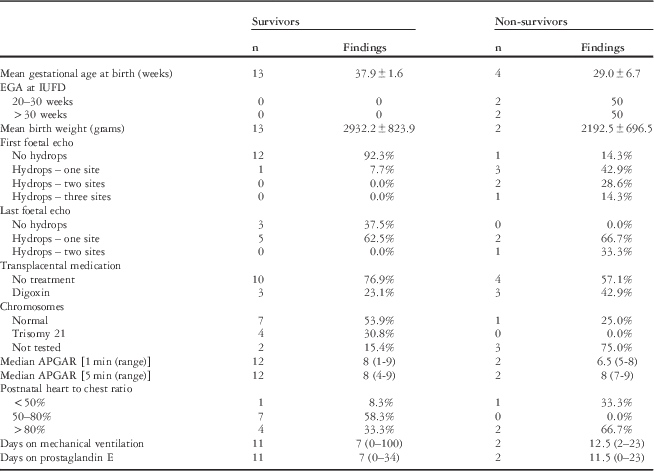
The clinical and demographic characteristics are shown in Table 1. A total of 17 foetuses with Ebstein’s anomaly and four with tricuspid valve dysplasia were included in the study. We excluded one case of Ebstein’s anomaly because the cause of death was not related to congenital heart disease. Of the 20 remaining participants, 13 (65%) survived to 30 days after birth and seven (35%) did not survive. Of those who did not survive, four foetuses died spontaneously in utero and three died postnatally. The mean birth weight of survivors (2932.2 g, SD=823.9) was higher than that of non-survivors (2192 g, SD=696.5). The mean gestational age at birth (37.9 weeks, SD=1.6) was higher for survivors than for non-survivors (29.0 weeks, SD=6.7). The mean gestational age at diagnosis for non-survivors (25.9 weeks, SD=4.5) was earlier than for survivors (28 weeks, SD=6.3). The majority of foetuses had normal weight for gestational age with only two having intrauterine growth restriction. Hydrops was less severe in survivors than in non-survivors. The non-survivors were more likely to have hydrops that involved two or three sites, such as pericardial effusion, pleural effusion, skin oedema, and/or ascites, in the first foetal echocardiogram. Of the non-survivors, 43% were treated with transplacental medication (digoxin), compared with 23% of survivors. Chromosomal abnormalities were documented in four patients, including one diagnosed with Trisomy 21. At birth, the median APGAR scores at 1 minute was higher for survivors (eight) than for non-survivors (6.5), but there was no difference between the two groups for APGAR scores at 5 minutes. The non-survivors were more likely to have a postnatal heart to chest ratio >80% in the chest x-ray at birth.
Cohort characteristics.
EGA=estimated gestational age; IUFD=intrauterine foetal demise
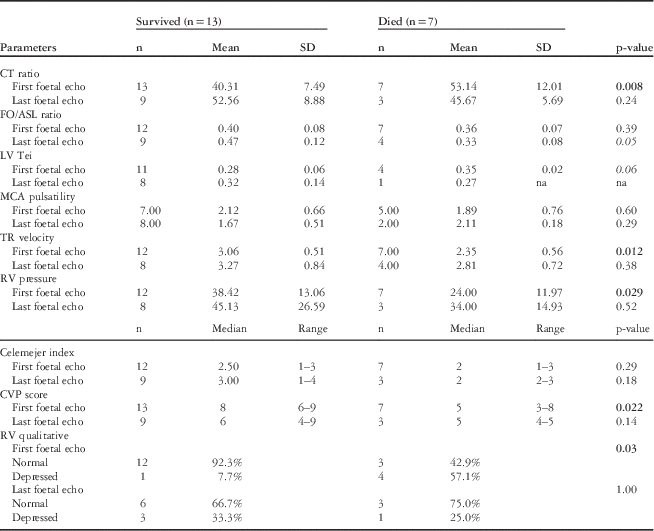
The results for morphometric, functional, and haemodynamic parameters are presented in Table 2. For haemodynamic parameters, we observed a statistical significant difference (p=0.012) between survivors (3.06, SD=0.51) and non-survivors (2.35, SD=0.56) for the mean tricuspid valve regurgitation velocity at the first foetal echocardiogram. As expected, based on the results of the tricuspid regurgitation velocity, the estimated mean right ventricular pressure was higher (p=0.029) at the first foetal echocardiogram for survivors (38.42, SD=13.06) than for non-survivors (24.00, SD=11.97). In addition, there was a statistical significant difference (p=0.022) for the median cardiovascular profile score at the first foetal echocardiogram between survivors (eight, range six to nine) and non-survivors (five, range three to eight).
Factors associated with survival.
CT ratio=cardiothoracic ratio; CVP score=cardiovascular profile score; FO/ASL ratio=fossa ovalis/atrial septal length ratio; RV pressure=right ventricular pressure; Tei index=myocardial performance index; TR velocity=tricuspid regurgitation velocity
Statistically significant p-values are in bold font; borderline statistically significant p-values are in italics
For functional parameters, we observed the left ventricular myocardial performance index at the first foetal echocardiogram showed borderline statistical significant difference (p=0.06) between survivors (0.28, SD=0.06) and non-survivors (0.35, SD=0.02). With regard to the right ventricular function, the proportion of depressed function in non-survivors was higher (57%) than that in survivors (7.7%) at the first foetal echocardiogram (p=0.031).
For the morphometric parameters, we observed a statistical significant difference (p=0.008) in the mean cardiothoracic ratio between survivors (40.31, SD=7.49) and non-survivors (53.14, SD=12.01). The mean fossa ovalis/atrial septal length ratio at the last foetal echo showed a borderline statistical significant difference (p=0.05) between survivors (0.47, SD=0.12) and non-survivors (0.33, SD=0.08).
The atrial septum excursion ratio, Celermajer index, middle cerebral artery pulsatility index, cerebroplacental ratio, ductal flow patterns, right ventricular myocardial performance index, left ventricular fractional shortening, and the systolic-to-diastolic ratio did not show statistical significant difference between survivors and non-survivors in our population.
Among the small number (n=7) of patients treated with digoxin, there was no difference between survivors and non-survivors when we compared the cardiovascular profile score, Celermajer index, and cardiothoracic ratio (Fig 3).
Transplacental treatment factors. In the treated patients, there were no significant changes in the Celermajer index or the cardiovascular profile (CVP) score for non-survivors.
Discussion
In this study, we evaluated haemodynamic, functional, and morphometric parameters as potential prognostic factors for Ebstein’s anomaly and tricuspid valve dysplasia in a cohort of 21 foetuses that included a wide spectrum of tricuspid valve defects. We also evaluated the effects of transplacental therapy with digoxin in the foetuses with advanced heart failure. The most innovative part of the study was the inclusion of haemodynamic and functional variables in addition to morphometric variables.
For haemodynamic parameters, we observed lower tricuspid regurgitant velocity with lower estimated right ventricular pressure and lower cardiovascular profile scores at the first foetal echocardiogram for non-survivors as compared with survivors. Our finding that the tricuspid regurgitation velocity was lower in non-survivors at the first foetal echocardiogram, thus predicting lower generated right ventricular pressure and ventricular dysfunction, is consistent with the findings of Neves et alReference Neves, Mathias and Wilhm12 where lower right ventricular pressure was found associated with risk of death. In the study by Neves et al, the authors reviewed 28 foetuses with right heart defects and heart failure, including four cases with Ebstein’s anomaly.
The cardiovascular profile score involves the assessment of five categories of ultrasound markers: hydrops, cardiomegaly, abnormal myocardial function, redistribution of cardiac output, and abnormal venous Doppler measurements for the assessment of heart failure. These abnormalities are usually observed before the development of hydrops foetalis. We found the cardiovascular profile score was lower (<6) in non-survivors as compared with survivors. Similar results were noted by Wieczorek et al.Reference Wieczorek, Hernandez-Robles, Ewing, Leshko, Luther and Huhta13 In Wiecozorek’s study on 131 foetuses with several types of congenital left and right heart disease, they observed that foetuses with a score ⩽7 were more likely to suffer mortality, but only three patients with Ebstein’s anomaly were included. Similarly, Neves et alReference Neves, Mathias and Wilhm12 in their study of right heart disease observed that foetuses with a score ⩽6 were 3.7 more times more likely to die. In the study by Neves, only four foetuses with Ebstein’s anomaly were included. A more recent study published while conducting our research found that 2/16 survivors had higher cardiovascular profile scores of 7 and 8 and the non-survivors had lower scores of 5 or less.Reference Luis-Miranda, Arias-Monroy, Alcantar-Mendoza, Arroyo, Reyes and Jarer4
Assessment of right ventricular function in the foetus with Ebstein’s anomaly may be challenging secondary to geometrical changes of the ventricle and atrialisation of the ventricular wall. For the functional parameters, we observed qualitatively decreased right ventricular function for non-survivors as compared with survivors. Non-survivors also had a low tricuspid regurgitation velocity. As the tricuspid valve function is intimately associated with the right ventricular function, the peak velocity of the tricuspid regurgitant jet may be used to assess the pressure generated by the right ventricle.Reference Huhta14 With progressive right ventricular dysfunction, the right ventricular pressure will decrease. The right ventricular myocardial performance index was available only in a few foetuses and could not be analysed. On the other hand, the left ventricular myocardial performance index was elevated at the first foetal echo in non-survivors as compared with survivors, consistent with the findings of Inamura et alReference Inamura, Taketazu, Smallhorn and Hornberger15 who observed higher Tei indices in foetuses with tricuspid valve dysplasia that developed hydrops and died in utero.
For the morphometric parameters, we found a small fossa ovalis/atrial septal length ratio for non-survivors as compared with survivors at the last foetal echocardiogram. Our finding that the fossa ovalis/atrial septal length ratio was ⩽0.36 at the first foetal echo for non-survivors in comparison with survivors adds to the existing evidence of the role of the atrial septal communication in patients with Ebstein’s anomaly. Pavlova et alReference Pavlova, Fouron and Drblik10 found the smallest fossa ovalis in two foetuses with hydrops, whereas all other foetuses without hydrops had a ratio of >0.3. In their study, they also found a positive linear correlation between the Z-score of the left ventricular output and the size of the fossa ovalis. Miranda et alReference Luis-Miranda, Arias-Monroy, Alcantar-Mendoza, Arroyo, Reyes and Jarer4 found a relative foramen ovale–atrial septal length ratio of <0.3 to be one of the predictors for a poor prognosis, in their retrospective analysis of 16 patients; all non-survivors had a fossa ovalis/atrial septal length ratio of <0.3, with the smallest ratio found in two patients with hydrops. On the basis of these results, we recommend that the fossa ovalis/atrial septal length ratio be measured routinely in the foetal echocardiograms of patients with Ebstein’s anomaly and tricuspid valve dysplasia.
Our finding that the cardiothoracic ratio for non-survivors is higher than for survivors is consistent with previous studies. The non-survivors in our cohort were found to have a mean cardiothoracic ratio of 0.53 at the first foetal echocardiogram. Chaoui et alReference Chaoui, Bollmann and Goldner16 showed that 15/19 non-survivors in their analysis had a ratio >0.6, with associated lung hypoplasia found at autopsy. Similarly, Miranda et alReference Luis-Miranda, Arias-Monroy, Alcantar-Mendoza, Arroyo, Reyes and Jarer4 found that a cardiothoracic index of >0.55 was associated with a poor prognosis.
In our cohort, survivors had less severe hydrops, higher mean gestational age at birth, and higher birth weights than non-survivors. These findings are similar to the ones observed in a previous study.Reference Yu, Yun and Won5 The proportion of non-survivors in this study (46%) is similar to that observed in previous studies. Miranda et al,Reference Luis-Miranda, Arias-Monroy, Alcantar-Mendoza, Arroyo, Reyes and Jarer4 found an in utero mortality of 37%, neonatal mortality of 50%, and total perinatal mortality of 87.5%. In their retrospective review of 16 cases with Ebstein’s anomaly, 15 cases had severe tricuspid insufficiency. Andrews et alReference Andrews, Tibby, Sharland and Simpson9 observed 35% survival at birth and 23% survival at 1 month in their cohort of 44 foetuses in whom they had 19 terminations.
Our small number of foetuses treated with transplacental digoxin was at the severe end of the spectrum, and we did not observe significant findings in the analysis of their cardiovascular profile score, Celermajer index, or cardiothoracic ratio data.
This study has several strengths. The main strength was the inclusion of several functional and haemodynamic measurements that have not been previously studied in the literature. We included the evaluation of newly measured functional and haemodynamic parameters, as well as measurements from the first and last foetal echocardiogram and when a significant haemodynamic change occurred. This cohort included foetuses with a wide spectrum of severity of their tricuspid valve anomaly. The new measurements were taken by a team well experienced in foetal echocardiography measurements and while blinded to the other results and outcomes. All patients who received transplacental therapy with digoxin were reviewed further.
At the same time, there were limitations of this study that should be considered. Owing to the retrospective nature of the study, some follow-up data and some images were not available for remeasuring. Some foetuses and neonates died before a follow-up echocardiography could be performed. The foetuses treated with digoxin were at the severe end of the spectrum, which may have biased our results with regard to treatment. Owing to the small size of the cohort, we could not run statistically significant models that will adjust for effect of other factors to determine variable independency associated with survival. Despite the small sample size, the results of this study will serve as a framework for future research with a larger sample size.
In summary, this study illustrates the importance of evaluating haemodynamic and functional parameters in addition to morphometric data in foetuses with Ebstein’s anomaly or tricuspid valve dysplasia to predict outcomes and help guide prenatal management and therapy. A low cardiovascular profile score, abnormal right ventricular function predicted by low velocity tricuspid regurgitation jet, and restriction across the fossa ovalis may be important negative prognostic indicators in these foetuses. The parameters evaluated in this research study are easy to obtain and reproducible and have been previously tested in smaller studies; therefore, a large prospective study is warranted to further evaluate these findings.
Acknowledgements
The authors acknowledge the expert statistical guidance provided by the clinical and translational research team and the support of the members of the foetal team for their expertise and insights with this research project.
Conflicts of interest
None.
Ethical Standards
The authors assert that all procedures contributing to this study comply with the ethical standards of the relevant national guidelines on human experimentation and with the Helsinki Declaration of 1975, as revised in 2008, and that this study has been approved by the Institutional Review Board of All Children’s Hospital Johns Hopkins Medicine.