Introduction
In many developed countries, in particular the EU and in North America, the poultry industry is confronted with a strong public opposition regarding intensive poultry production. Media reports, activities of animal welfare groups and political parties have contributed to the negative image of the industry (Swinnen et al., Reference SWINNEN, MCCLUSKEY and FRANCKEN2005). The problem, to some extent, is the result of changes in housing systems from free range to confined buildings, which made it impossible for the public to see how eggs or poultry meat are produced. Moreover post-materialistic values, such as sustainability and ethical concerns including animal welfare, have become significant elements of the European society in the 21st century (Vanhonacker et al., Reference VANHONACKER, VERBEKE, VAN POUCKE and TUYTTENS2008). According to the survey of the European Commission (2016) the majority of Europeans (94%) stated that it is important to protect the welfare of farmed animals. In total, 82% of all respondents were of the opinion that welfare of farmed animals should be protected better than it is now (European Commission, 2016), and two thirds of Europeans would like to know more about the conditions under which farmed animals are kept in their country (European Commission, 2016).
Vanhonacker, Verbeke, Van Poucke and Tuyttens (2008) compared farmers and consumers perceptions of animal welfare in Flanders, Belgium, and reported different attitudes. For farmers, stocking density, slaughter without stress and the transportation of the animals were important and according to them, were well taken care of. Consumers evaluated the same criteria as much more problematic and considered outdoor access as more important than farmers, for whom outdoor access implied hygienic problems. The gap between the image of the industry in society and the reality of modern, market-oriented poultry production has widened continuously due to the lack of knowledge transfer from the industry to the consumers of the conditions in which meat livestock is produced (Frewer et al., Reference FREWER, KOLE, VAN DE KROON and DE LAUWERE2005; Verbeke, Reference VERBEKE2005; Maria, Reference MARIA2006).
Against this background the Poultry Association of Lower Saxony (Niedersächsischer Geflügelwirtschaftsverband) and the Science and Information Centre for Sustainable Poultry Production at the University of Vechta started a joint project in 2012: the Transparency Project. This addresses the necessity of the poultry industry to display transparency to the public. Moreover it aims at contributing to a professional and rationalised discourse about sustainable poultry farming. Framed within the transparency project is a scientific survey which was conducted at 36 farm business openings between September 2012 and October 2015. The aim was to compare assumptions and perceptions of the visitors beforehand with the actual impression the visitors gained after being guided through the poultry houses. The results of the survey are presented in the following paper.
Lower Saxony: the centre of the German poultry industry
Market-oriented animal production in the north western part of Germany began in the last decade of the 19th century when small farmers were able to import feed via harbours on the coast of the North Sea by railroad (Windhorst, Reference WINDHORST1975; Klohn and Voth, Reference KLOHN and VOTH2008). World Wars I and II interrupted the development, and it was not before the 1960s that intensification in the poultry industry started. Within a short time, vertically integrated companies developed, in egg as well as in poultry meat production. Besides primary production, breeding companies, large feed mills and equipment companies as well as research institutes made the success of the poultry farms possible. A ‘Silicon Valley of agricultural technology’ and modern poultry production originated along the Autobahn A1 between the cities of Bremen and Osnabrück (Windhorst, Reference WINDHORST2004). Parallel to the intensification of animal production, the opposition against large-scale poultry farms began in the late 1960s, in particular against keeping laying hens in cages.
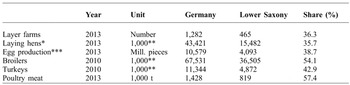
The dominating role of Lower Saxony in German poultry production is documented in Table 1 . Unfortunately, no recent data are available for the number of laying hens, broilers and turkeys. The next agricultural census will be held in 2016. However, the regional concentration in Lower Saxony will have further increased because of the ongoing sectoral concentration in the poultry sector. Poultry is not evenly distributed in Lower Saxony, most of the laying hens, broilers and turkeys are concentrated in the north-western part.
The contribution of Lower Saxony to German poultry production (Source: Beck, Reference BECK2014).

* in farms with 3,000 and more places
** places
*** shell eggs for consumption
Without being able to go into detail in this paper, it can be stated that poor soils, small farms, a favourable location to the population agglomeration in North Rhine –Westphalia, the main market, and the excellent railroad and Autobahn infrastructure created this concentration. As the small farmers were hardly able to make a living from plant production because of their small acreage and the poor soils, they willingly accepted the possibility to produce eggs and poultry meat.
This high regional concentration has caused environmental problems because of the large amounts of slurry and manure originating from poultry and the pig farms which are concentrated in the northwest of Lower Saxony. Primary production remains dependent on the imports of soybeans, maize and small grains as components of the compound feed from the USA and South America as well as from EU member countries. Because excreta cannot be transferred back to the agricultural land where these commodities were grown, the oversupply of slurry and manure resulted in pollution of groundwater (nitrification) and odour problems. Besides this, the high use of antibiotics has been another point of criticism. In combination with long-lasting opposition against housing systems in layers, broiler and turkey husbandry, the image of the poultry industry changed for the worse. These challenges need suitable reactions, so it is not surprising that new ways had to be found in Lower Saxony to meet this challenge, and that the transparency project started here. However, the need for action on the part of the poultry industry to be more transparent to the public is transferable to other European Countries as the latest report on animal welfare of the European Commission (2016) demonstrates.
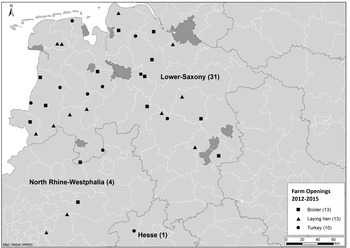
Figure 1 shows the location of the farms which were opened to the public from 2012 until 2015. This includes six farm openings where the pretests during the pilot phase were conducted. It reflects the regional concentration of the poultry flocks.
The transparency project
The transparency project is based on a before and after comparison of attitudes of farm visitors. The aim was to compare assumptions and perceptions of the visitors prior to the farm visit with the actual impression the visitors articulated immediately after having been guided through the poultry houses. Thus, the survey included a questionnaire designed for two interview cycles with every visitor. This technique of questioning was generated after the pretest on six farm openings in September and October 2012. In order to reassign the questionnaire from the first round to the correspondent, every questionnaire had an imprinted number and was provided with an attached slip of paper where the identical number was inscribed to identify the interviewee.
The farmer and the veterinarian guided visitor groups through the poultry house and explained the systems and characteristics of the particular poultry species. They informed the visitors about egg and poultry meat production and were open to questions. Frequently, visitors enquired about critical topics of the poultry sector as killing one-day-old male chicks or beak trimming in laying hens as well as the use of antibiotics in broiler and turkeys. These topics were explained objectively by the farmer or the veterinarian. Throughout the event scientists from the University of Vechta and the managing director of the Poultry Association of Lower Saxony were available for further questions or information. Additional material with facts and figures about intensive poultry and egg production was provided.
The spatial distribution of the farm openings within the transparency project in Lower Saxony (2012 - 2015).

Biosecurity
Biosecurity played a crucial role in conducting the project and protocols were followed strictly. Every person who wished to enter the facility had to go through a sanitation process. To follow the biosecurity rules, a tent was organised for the day of the farm visit to channel the visitors from the unclean (black) area through hygienic barriers into the clean (white) area inside the poultry barn. Before entering the poultry house each visitor had to collect a coverall, a pair of disposable overshoes and a hairnet. Once the visitors were dressed in protective clothing, they crossed the first hygienic barrier at the exit of the tent into the vestibule of the poultry house. There they washed their hands in a disinfectant and were given a second pair of disposable overshoes. At the second hygienic barrier between vestibule and the barn, where the poultry were kept, they had to cover their shoes again with disposable overshoes. From there they were guided into the area where the poultry was kept. Each visitor had to register in a visitor's log book for traceability in case of a disease outbreak.
Questionnaire and statistical analyses
The two-part questionnaire was designed to get information on the general attitude towards the visit on the poultry farm, assessment of the available space for the poultry, light and air quality, experiences with modern poultry farming and additional demographical information (place of residence, gender and age of respondents). The first question allowed the visitors to express their attitudes towards their visit of the poultry house. Visitors had the option to choose between ‘open-minded/ positive’, ‘sceptical/ negative’ and ‘no idea’. Hence, response categories had nominal values. Furthermore the respondents were asked ‘What do you expect: do the animals have enough space in the poultry house?’ The same questions were asked for light and air quality respectively. Answers were registered on a nominal scale with the categories ‘positive (adequate)’, ‘negative (not adequate)’ and ‘no idea’. The second part addressed the same criteria with the intention to check if a change in the attitude of the interviewed person could be observed after having visited the poultry house. The first question of the second round enquired the interviewees to express their feelings after having seen the poultry house and the animals (‘your feeling after the visit in one word’). Response categories were ‘positive’, ‘negative’, and ‘no idea’. Visitors were asked to express their opinions about the stocking density, the light and air conditions. ‘How do you evaluate the offer of space for the animals after your visit?’ for light and air conditions was asked respectively.
The collected data was analysed using SPSS 23 and transliterated in pre- and post- questioning. Bivariate analysis including cross-tabulation with chi-square and McNemar-Browker tests were applied to prove significant changes of attitudes in terms of sociodemographic variables and variables of the different housing systems of laying hens, broilers and turkeys. The chi square test was used for independence to determine whether sociodemographic differences, e.g. gender or age, is related to different attitudes towards intensive poultry production. The McNemar-Browker test was applied to determine if there were differences on a dichotomous dependent variable between two paired groups. For example, this was used to identify whether the proportion of e.g. urban respondents who were sceptical towards intensive poultry production before visiting a farm had changed significantly after they had experienced and learnt about the animals and how they are kept.
Characterisation of the opened farms
The enterprises that opened their doors to the public were family-owned farms and very diverse in size and farming systems. The sizes of the farms ranged from 31 to 750 hectares with a mean of 183.05 hectares and a median of 155 hectares. Among the farms, poultry husbandry was generally conducted alongside further agricultural activities. Of the 30 farms, 22 were farming agricultural land, growing mostly small grains, corn, silage maize and grassland. Ten farms were supplying energy through a biogas plant. Furthermore, six of the 30 farms were involved in pig and sow husbandry while four farmers were active in dairy farming.
The participating farms in the project were all involved in intensive poultry and egg production. Almost two thirds of the farms (18) were maintaining one or two poultry houses each, seven farms were managing three to four poultry houses while one farmer had seven poultry houses and another one had 10. For a realistic picture of the animal density in the poultry houses, the project aimed at opening the farms relatively close to the due date of the slaughtering of broilers and turkeys. The guidelines in Germany for animal density on laying hen farms in poultry houses state nine animals per square metre usable area and maximum of 18 animals per square metre usable area in aviary systems. For free-range systems an additional 4 m² per animal has to be provided in the outdoor area. These conditions were standard on the laying hen farms. Hence, the criteria of weight were not seen as relevant for the evaluation on laying hen farms and therefore not elicited. However, the age of the laying hens ranged from 20 to 80 weeks.
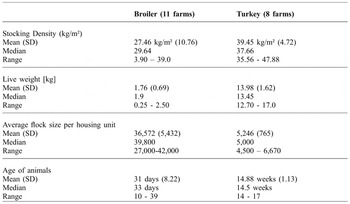
Table 2 offers an overview of the average stocking density on broiler and turkey farms, as well as average live weight, flock size per housing unit and the age of the animals with the mean and median number and the range of these parameters. The maximum animal density in broiler production in Germany is 39 kg/m² at the end of the growing period. On the turkey farms, only male turkeys were shown to the public. Every turkey farm was participating in a quality management programme. Under this condition, the maximum of animal density per square meter is 58 kg for male turkeys.
With a mean of 27.46 kg/m², the stocking density in broiler houses were below the maximum and had a standard deviation of 10.76. On average, the broilers were 31 days old (SD=8.22). One farm opened its door when the broilers were 10 days old. This was due to the fact that the opening was part of a broader regional farm opening event. The stocking density of turkeys were, on average, 39.45 kg/m² at an average age of 14.9 weeks (SD=1.13). The mean and medium number of the flock size of laying hens in free range systems were 15,337 (SD=6,018) and 15,000, respectively. In barn systems the mean and median number were 33,000 (SD=11,357) and 38,000, respectively.
Characteristics of broiler and turkey houses; stocking density, live weight, number of animals, age of animals.

Empirical data collection
The results presented in the paper are based on 30 farm openings between 2013 and 2015 while six additional farm openings were conducted in 2012 and served as a pretest. The questionnaire was adapted after the pretest, hence data from 2012 could not be included. However it was possible during the period of the pretest to derive hypothesis from empirical observations. These hypotheses formed the scope of investigation in this paper and were verified or falsified.
Of the 30 farm openings in the evaluation, 11 were on laying hen, 11 on broiler farms and 8 on turkey farms. Twenty-six poultry meat and egg producing family farms were opened to the public in Lower Saxony, three farms in the northern part of North Rhine-Westphalia and one turkey farm in Hesse ( Figure 1 ). The farms that were willing to participate were registered by the Poultry Association of Lower Saxony (Niedersächsischer Geflügelwirtschaftsverband) and selected by geographical criteria. It was important not to open two farms in the same region within a year. The aim was to offer citizens from different regions the opportunity to visit a farm in their neighbourhood. For the following evaluation only the questionnaire of interviewees older than 18 years were evaluated. This may be seen as a deficit in the setup of the evaluation and will be discussed in a later chapter. Of the 9,000 visitors, 4,670 were reached for the survey. Farmers and employees in the agricultural sector were excluded from the evaluation. This was necessary to obtain valid results from the target group of consumers who had never seen the interior of a poultry house. Hence, the results are based on 30 farm openings from March 2013 until September 2015 with 2,922 interviews.
Place of residence, gender and age of the farm visitors
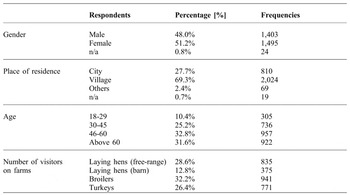
Table 3 shows that 69.3% of the interviewees lived in rural areas, mainly in small villages, 27.7% in cities and 2.4% were in hotels or on campgrounds as they were visiting during their vacation and used the chance to visit a modern poultry farm. The high percentage of visitors from rural areas was a result of the location of the poultry farms either in or close to small villages. The ratio of female and male visitors did not differ significantly.
Sociodemographic characteristics of the interviewees and proportion of respondents on each farm.

Two thirds of the interviewed visitors were older than 45 years and only 10% were younger than 30 years. Table 3 displays the frequency of respondents on the different poultry farms. Broiler farms recorded most respondents (941). On laying hen free-range farms, 835 persons were interviewed, followed by 771 visitors who could be questioned on turkey farms. So far, three laying hen farms with barn systems have been opened of which 375 questionnaires were considered in the analysis.
Hypotheses
The following hypotheses should either be verified or falsified by interviewing the farm visitors:
-
1. living in rural areas have a less critical attitude regarding intensive poultry production than those living in cities because the latter have less relation to agriculture and base their attitudes mainly on media reports.
-
2. Female visitors are more critical towards intensive poultry production than males because their evaluation is more driven by emotion than by facts.
-
3. Younger visitors are more critical towards intensive poultry production than older age groups because they could not experience the gradual intensification of the production and are now confronted with the present situation of keeping poultry mainly in confined buildings.
-
4. Housing systems with outdoor access or access to outdoors are rated more positively than systems without this possibility.
-
5. The evaluation of housing systems for laying hens, broilers and turkeys vary considerably because of differences in flock size, animal density per m2, light intensity and air quality in the poultry houses and the availability of an outdoor access.
-
6. The attitude towards intensive poultry production will be less critical after the farm visit than before entering the poultry houses.
Attitudes in relation to place of residence
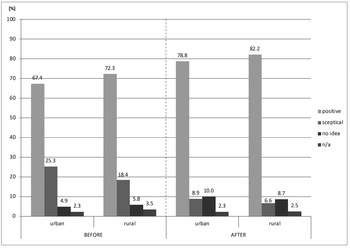
Does living in urban areas favour criticism on intensive poultry production because urban residents are more estranged from modern farming than rural residents? The attitudes of the two resident groups ( Figure 2 ) were significantly distinct from one another (chi square=19.755, df=6, p=0.003). Although visitors from urban areas were more sceptical before entering the poultry houses (25.3%), their scepticism declined more strongly (16.4%) than that of the rural residents (11.8%) after they exited. In contrast, critical attitudes of rural residents were lower before entering (18.4%). Yet, the positive perceptions of poultry husbandry were generally on a high level among both urban (78.8%) and rural (82.2%) residents after they had left the poultry houses. It is worth mentioning that an increase of rural and urban respondents who were irresolute of how to rate their impressions after visiting the farms was observed.
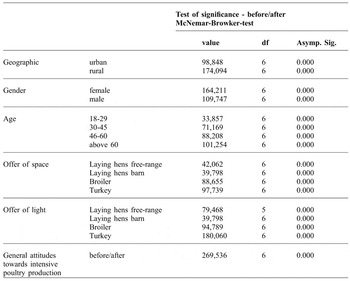
When exiting the poultry houses, a significant difference in the attitudes of urban and rural visitors to intensive poultry and egg production was observed (chi square=21.863, df=6, p=0.001). The alterations in opinions within the paired samples of urban and rural respondents before and after the visit were statistically significant ( Table 4 ).
Attitudes of rural and urban residents towards intensive poultry production before and after the farm visit (2013-2015).

Attitudes in relation to gender
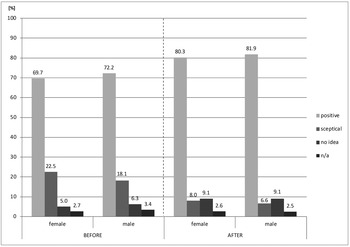
The statistical analysis proved that the differences in opinions between female and male respondents were significant prior to entering the poultry houses (chi square=20.829, df=6, p=0.002). As hypothesised, women were more sceptical towards intensive poultry production than men. After the visit their scepticism was almost on the same level as that of the male interviewees ( Figure 3 ). Both females and males were positively impressed by what they had seen on farm. The first-hand impressions contributed to an increase of indecisive opinions by both genders about the visit. The responses of males and females differed significantly after they had seen the poultry house (chi square=15.380, df=6, p=0.017). Also, the attitude change of the dependent groups after the visit were statistically significant when comparing to perception before the visit ( Table 4 ).
Attitudes of females and males towards intensive poultry production before and after the farm visit (2013-2015).

Attitudes in relation to age
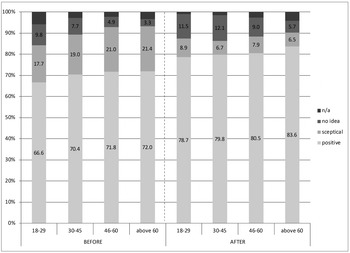
Prior to the visit, the youngest age group was least sceptical (17.7%) but had also the lowest proportion of respondents being open-minded (66.6%). Scepticism about the housing systems in intensive poultry production increased with the age of the visitors, whereby the most critical was the oldest age group (21.4%). The different responses depending on age prior to the visit were statistically significant (chi square=39.745, df=12, P<0.0001). After exiting the poultry house, the response pattern from the different age groups were partially reversed ( Figure 4 ).
The strongest scepticism was found among the youngest age group (8.9%) while negative attitudes among the oldest age group fell by 14.9% to a level of only 6.5% after the visit. Overall the positive first impression after having visited the poultry farm was on a high level in all age groups ( Figure 4 ). The difference in responses of the interviewees from the various age groups were statistically significant after the visit (chi square=39.546, df=12, P<0.0001). In addition, the paired samples of the different age groups changed their opinion significantly after being guided through the poultry houses ( Table 4 ).
Change of attitude towards intensive poultry production in relation to age (2013-2015).

Evaluation of housing systems
Determining if housing systems with outdoor access or access to winter gardens were rated more positively than systems without this possibility, was another subject of the analysis. Of the 11 laying hen farms, eight farms were working with the free-range system and three had barn systems.
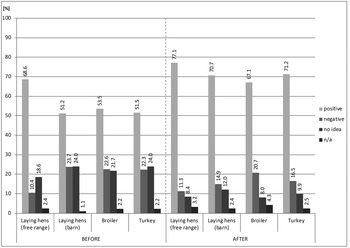
Only half of the respondents on the laying hen (barn), broiler and turkey farms had positive expectations on the available space prior to the visit. Almost one quarter of the interviewees on each of those farms were sceptical about the available space in the poultry houses.
The opinions of the respondents towards the available space on the different poultry farms were statistically significant prior to the visit (chi square=83.911, df=9, P<0.0001). After the visit, scepticism declined notably and positive impressions on the available space increased by approximately 20% on laying hen (barn and free-range) and turkey farms. At the same time, negative views on animal density increased by 0.9% on free-range farms. However, laying hens in free-range systems got the best evaluation on animal density (77.1%) followed by turkey farms (71.2%). The offer of space for broilers received the lowest positive grading with 67.1% of the respondents who believed that the available space was sufficient for the animals. The responses of the visitors to the available space on the different poultry farms were statistically significant (chi square=42.226, df=9, P<0.0001).
McNemar-Browker test: Statistical significance of paired samples after being guided through the poultry house .

Rating of the available space for laying hens, broilers and turkeys before and after the farm visit (2013-2015).

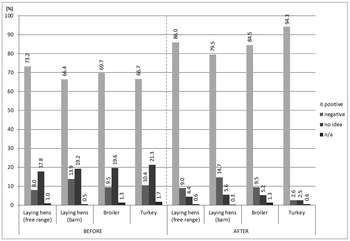
Good light conditions were acknowledged for all poultry species even though a slight increase of negative impressions was noticed for laying hen free-range (1.0%) and barn systems (0.8%). The very positive rating of light conditions was predominant among the respondents of turkey farms (94.3%), which received the highest positive rating on light conditions. This was probably caused by the prevalence of natural light through large windows which seemed to be comfortable to the visitors. The different ratings of the light conditions on the farms were statistically significant before and after the visit (before: chi square=18.121, df=9, p=0.34; after: chi square=71.380, df=9, P<0.0001).
Rating of the light offer to laying hens, broilers and turkeys before and after the farm visit (2013-2015).

The hypothesis of a better evaluation of housing systems with outdoor access cannot be verified entirely because the evaluation of light offer was better on turkey farms. This may result from the availability of natural light through large open windows. However, the space conditions on laying hen free-range farms received the highest rating despite the minor increase of negative opinions. Nevertheless, the previous explanations of the results affirm that there was a considerable variation in the ratings of the different housing systems for laying hen, broiler and turkey farms, which were statistically significant.
Attitudes changed to a less critical impression after the farm visits
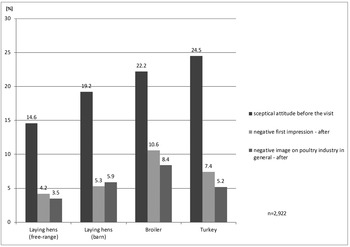
The results prove hypothesis (6) that the attitudes towards intensive poultry production were less critical after the farm visits than before entering the poultry houses. The experience in the poultry houses caused a statistically significant change of attitudes (McNemar-Browker=269.536, df=6, p<0.0001). While 20.3% of all visitors were sceptical prior to entering the poultry houses, their attitude had changed considerably after visiting the farms. With only 7.3% of all visitors obtaining a negative first impression, even less went home with a negative image on the poultry industry (5.8%). Over 80.0% were positively impressed when exiting the poultry houses. Three quarters of all visitors left the farm with a positive image of the intensive poultry industry. It is worth mentioning is that the percentage of visitors who did not articulate a particular opinion of how to rate the poultry industry increased considerably after having visited the poultry houses. This may be due to the fact that their impressions differed remarkably from media reports. This was concluded from answers received from persons whom we additionally interviewed after their farm visit.
Considering the changes of attitudes in relation to the different poultry species, Figure 7 shows that the highest percentage of sceptics prior to the visit were among the visitors on turkey (24.5%) and broiler farms (22.2%). The strongest negative image on intensive poultry production was left by the visitors of broiler farms ( Figure 7 ). Least sceptical were the visitors of the free-range laying hen farms (14.6%). Their scepticism declined by about 10% after they had seen the housing systems. The attitudes of the respondents who visited turkey farms (19.2%) decreased strongest by 17.1% after the visit. In total, the visitors of laying hen free-range farms had the least critical attitude towards intensive poultry production. This supports the hypothesis (5) that housing systems with an outdoor access are rated more positively than systems without this possibility.
Change of the attitude towards intensive poultry production as a result of the farm visits (2013-2015).

Change of the attitude of sceptics towards intensive poultry production as a result of the farm visits (2013-2015).

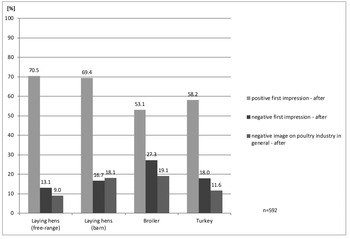
In order to find out how the farm visits changed the attitudes of the sceptical visitors, these respondents were selected for a detailed analysis. Figure 8 reveals that 70.5% and 69.4% respectively of the sceptics had a better image after leaving egg producing free-range farms as well as laying hen barns. Critics of housing systems on broiler farms remained more reserved in their attitude when exiting the poultry house. While 53.1% of them reported a positive picture, 27.3% remained critical and 19.1% of the visitors of broiler farms articulated a negative image on the poultry industry in general. The higher scepticism regarding broiler farms resulted mainly from the high animal density and the offer of light (Figures 5 and 6). About 58% of the sceptics who visited turkey farms changed their attitude after they had seen the housing system. In total, 18.0% of the critical visitors maintained a negative attitude and 11.6% said that their image towards the poultry industry in general was negative.
Discussion
The evaluation of the 2,922 questionnaires showed that hypothesis (1) could be confirmed, urban residents were more critical towards intensive poultry and egg production than rural residents. Regarding hypothesis (2), females were more critical towards intensive poultry production before entering the poultry houses than males but the attitudes of males and females were almost on the same level after the visit. Hypothesis (3) only applied for the results after the visit. Prior to the visit, the oldest age group was most sceptical. A detailed analysis of the critics revealed that younger visitors were more critical once they had visited a poultry house and least positive regarding their perspective on the intensive poultry industry. Hypotheses (4) and (5) were confirmed. Laying hens in free-range systems and turkeys had the highest positive acceptance while the attitude towards intensive broiler growing was seen more critical, due to the high animal density/m2 and lack of outdoor access. Hypothesis (6) was confirmed, whereby the attitude towards intensive egg and poultry meat production was less sceptical after the visit of the poultry houses than before. However, the number of visitors without a particular opinion increased, which showed that a number of visitors were not sure if the production systems which they had seen indeed met their expectations of animal welfare standards.
The first round of farm openings and their evaluation has left some critical points regarding the methodology. In subsequent farm openings in 2016 organisers will endeavour to get a higher number of urban residents to visit the farms, which will not be easy as most of the farms are located in considerable distance to urban agglomerations. Two questions regarding the educational level and occupation of the visitors have been included since 2015. Personal conversations with a number of visitors before and after the visit of the poultry houses showed that those with a higher educational level were more sceptical than those with a lower educational level. It is planned to evaluate the questionnaires of the first round (2013-2015) again for visitors less than 18 years old to find out if their attitude differs considerably from visitors which were 18 to 29 years old. If this should be the case, younger visitors will be included in the following phase of the project, even though they have been excluded in this analysis as they were not opinion leaders in households. The response categories for animal density (light, air quality etc.) have been changed to a Likert-scale for the second project period in order to offer the interviewees a more distinct rating scale. Questions about consumer patterns, animal welfare and whether the visitors would prefer eggs and poultry meat from alternative poultry farms have been included and will be presented in the next review of the survey, when a substantial amount of data has been gathered.
Conclusions
The public opposition towards intensive poultry production was the starting point for the transparency project. The survey project has contributed to display transparency to the public, it made it possible to gather reliable data on the acceptance and tolerance of consumers towards intensive poultry meat and egg production. As the results show, provision of direct transparency from producer to consumer reduced fears and scepticism effectively. Moreover it served as a win-win situation for producers and consumers. The producers on the one side were offered the chance to move away from ‘reaction’ as defending their everyday work against negative reports and towards a proactive approach by inviting the public, media and critics to a dialogue. Consumers were able to inform themselves first-hand on site and were able to correct or confirm assumptions and conceptions they had made prior to the farm visits. For sustaining such dialogue it will be essential for producers to stay accessible to the public in order to build and maintain confidence and credibility in their work. The positive results of the survey reveal that it is worthwhile for other European countries which have a modern, market-oriented poultry industry to consider equal transparency projects and initiatives for their citizens and consumers. Post-materialistic values will continue to play a significant role in the 21st century.