Introduction
How do states respond to, and seek to defuse, popular protest? This critical question has gained traction in the literature on the functioning and resilience of contemporary authoritarian regimes. Complementing substantial attention to the organization of intra-elite conflict, the embrace of electoral competition and the adaptation of ostensibly liberal institutions (Gandhi and Lust-Okar, Reference Escribà-Folch2009; Brancati, Reference Brancati2014), scholars have begun to catalogue the repertoire of practices authoritarian states use to respond to contentious popular pressure, and to understand how these reactions affect the development of protest and regime durability (e.g. Way and Levitsky, Reference Way and Levitsky2006; Davenport, Reference Davenport2007a, b; Cai, Reference Cai2008b; Boudreau, Reference Boudreau2009; Robertson, Reference Schubert2010; Bellin, Reference Bellin2012; Johnston, Reference Jansen2012; Trejo, Reference van Leeuwen2012; Chang and Vitale, Reference Chang and Vitale2013; Koesel and Bunce, Reference Kennedy2013; Lorentzen, Reference Liu, Zhang, Wu and Qi2013).
To date, however, this debate has notably under-appreciated the ‘strategic political communication’ (Manheim, Reference Lorentzen1991: 7) by the political elite. Although some studies have touched upon aspects of communication, they have focused on smear campaigns and censorship (Robertson, Reference Schubert2010; King et al., Reference Johnston2013; Koesel and Bunce, Reference Kennedy2013). While undoubtedly important, such negative responses do not comprise the full range of discursive acts contemporary authoritarian rulers deploy. Moreover, the discussion on authoritarian protest response lacks a clear conceptual distinction between discursive and non-discursive elite behavior and does not take into account the substantial insights gained in studies of elite communication on protest in democracies (e.g. della Porta, Reference Perry1999; Koopmans and Olzak, Reference King, Pan and Roberts2004; Shriver et al., Reference Steinhardt2013).
This study adopts an explicitly communicative approach to protest response. It focuses on the co-evolution of rapidly accelerating contention and the public communication on protest by the Chinese Communist Party (CCP) leadership between 1990 and 2010.Footnote 1 Combining evidence on popular mobilization with an interpretive analysis of elite discourse and a keyword frequency count in key central government outlets, the article shows that although China’s rulers have maintained unwavering hostility to specific forms of mobilization they categorically regard as regime-challenging,Footnote 2 they have responded to waves of more mundane unrest with increasing sympathy for protesters. The leadership has gradually acknowledged the legitimacy of widespread protest-provoking grievances and became more vocal in emphasizing the non-political nature of most protests. It has also blamed local officials for the occurrence of unrest in more explicit terms and circumscribed the conditions for legitimate repression. China’s leaders have never endorsed street protests or given up their principle of ‘stability’ (wending), yet their public discourse has rendered livelihood-centered acts of contention against local targets increasingly ‘rightful’ (O’Brien and Li, Reference Nathan2006).
This article argues that the rationale behind this response pattern has been to safeguard one-party rule through two intended effects: first, to persuade the public of the leadership’s benevolent intentions and deflect discontent from the regime and, second, to temper both local officials and protesters. Yet it also shows that the unintended consequence of discursive accommodation may well have been an acceleration of popular mobilization. It thus provides a new perspective to understand why contention in post-1989 China has become endemic, but remains conspicuously moderate. The article demonstrates that quite in contrast to what one would expect in an authoritarian regime, but similar to what has been found in Western democracies a few decades earlier (della Porta, Reference Perry1999), waves of contentious mobilization have spurred increasing sympathy for protesters in elite communication. Although protester rights have not been institutionalized, popular protest in China has moved closer to the orbit of normal politics. The pattern of more outspoken elite communication on protest also stands in stark contrast to the finding that China’s gargantuan internet censorship system is primarily geared at removing popular discourse on the very same issue (King et al., Reference Johnston2013). The resulting gap between elite and tolerated mass expression sheds new light on the communicative strategy the Chinese leadership draws upon to keep discontent at bay.
For the wider debate on authoritarian contentious politics, studying elite ‘protest discourse’ (della Porta, Reference Perry1999: 86) offers at least four valuable insights: first, its public nature implies that it is less susceptible to the notorious problem of obtaining reliable data that studies of repression in authoritarian contexts suffer from. It provides a yardstick on how the rulers’ attitudes on protest vary over time, space, and contentious issue. Second, as discursive responses to protest are predominantly the domain of elites and other kinds of reactions those of local enforcement, focusing exclusively on the latter means that elite behavior receives less attention than it possibly should. The extensive literature on Chinese contentious politics, for instance, is therefore characterized by a substantial lack of attention to the ‘intentions and actions’ of the leadership (Lorentzen, Reference Lohmann2015; see also Stern and O’Brien, Reference Stockmann2012). Third, public communication is the primary resource for citizens to gauge the agenda of political elites and the resulting political opportunity for successful contention. If this is true in democracies (Koopmans and Olzak, Reference King, Pan and Roberts2004), the linkage between elite discourse and perceived opportunity may well be even more important in authoritarian contexts where leaders’ ad hoc assessments are decisive and protester rights fragile. Elite discourse may therefore also be a convenient tool for authoritarian leaders to grant and, if necessary, revoke tolerance for dissent without the constraints of institutions. Fourth, apart from citizens, local bureaucrats are the other key audience of elite communication. Authoritarian rulers have been found to use public discourse to demonstrate their power to subordinates or shepherd economic policy by local officials (Wedeen, Reference Wedeen1999; Huang, Reference Hess and Martin2013). Elite communication on protest and protest policing could open a new angle to understand how autocratic principals attempt to steer their agents’ use of repression. In addition, all these points can provide a fresh perspective on the fundamental question of how contention ‘transform[s] regimes’ (Tilly, Reference Tong2006: 216).
Two dimensions of responses to popular protest
Traditionally, scholarship on state responses to protest focused on street interaction between protesters and the police; the effects and rationales of repression, tolerance, or concessions; and the institutional environment of protest (e.g. Davenport, Reference Davenport1995; della Porta and Reiter, 1998; McCarthy and McPhail, Reference Luckmann1998; Tarrow, Reference Thomas1998; Goldstone and Tilly, Reference Fox2001; Goodwin, Reference Gandhi and Lust-Okar2001). More recently, however, research has broadened its scope (Davenport, Reference Davenport2007a: 18). Scholars have begun to explore practices described as ‘soft’ (Ferree, Reference Deng and O’Brien2005; Linden and Klandermans, Reference Li2006), ‘covert’ (Cunningham and Noakes, Reference Cunningham and Noakes2008) or ‘relational repression’ (Deng and O’Brien, Reference della Porta2013), as well as the discourse on protest by political elites.
Donatella della Porta (Reference Perry1999: 67) argued that such discourse intervenes ‘between structure and action’. Similarly, Ruud Koopmans and Susan Olzak suggested that
regime weaknesses and openings that do not become publicly visible may be considered ‘nonopportunities,’ which for all practical intents and purposes might as well not exist at all (Koopmans and Olzak, Reference King, Pan and Roberts2004: 201).
Charles Tilly (Reference Tong2006: 183) pointed out that the very act of labeling contentious action by authorities and third parties ‘influences the reactions of both participants and other political actors’.
Empirical evidence gathered in democracies has provided three main insights: first, elite communication indeed has a significant impact on contentious mobilization. It also affects state repression as well as contentious violence (Koopmans and Olzak, Reference King, Pan and Roberts2004; Ferree, Reference Deng and O’Brien2005; Koopmans, Reference Kerkvliet2005; Shriver et al., Reference Steinhardt2013). Second, for these reasons, politicians in democracies, who face significant constraints on the use of repression, sometimes turn to stigmatizing or ridiculing discourse to demobilize challengers, exclude them from the political process, or legitimize coercion (Ferree, Reference Deng and O’Brien2005; Koopmans, Reference Kerkvliet2005; Linden and Klandermans, Reference Li2006; Shriver et al., Reference Steinhardt2013). Third, over time, however, the increasing normalization of protest in the political process of European and North American democracies between the 1950s and 1980s has been facilitated by public discourse that became more supportive of protester rights (della Porta, Reference Perry1999: 92). Hence, elite communication turned out not to be an epiphenomenal byproduct of, but an important ‘input into contentious politics’ (Davenport, Reference Davenport2005: xxiv).
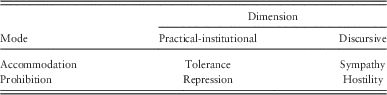
To clarify how discursive responses to protest are distinct from non-discursive reactions, one can differentiate between practical-institutional and discursive dimensions, and accommodating and prohibitive modes of response (Table 1). The practical-institutional dimension of response comprises various formal and informal practices of protest policing, as well as the design of the institutional context of protest. It varies between tolerance and repression. The discursive dimension comprises all forms of public communication by state and other political elites on the practices and institutions of protesting and responding to protest.Footnote 3 It ranges from sympathy, characterized by statements and labels that justify protesters’ grievances, claims, or their contentious acts and de-legitimize repressive measures, to hostility, characterized by utterances with the opposite connotation. In the following, this specific kind of communication will be understood as ‘protest discourse’ (della Porta, Reference Perry1999: 86).
Dimensions and modes of state and elite responses to popular contention

Although institutions are designed by political elites, the practices of policing protest within these institutions are the domain of local enforcement and allow only indirect inferences on elite action and intention. By contrast, protest discourse is predominantly the domain of elite behavior.
Protest response in contemporary authoritarian regimes
Scholars have begun to pay increasing attention to how contemporary authoritarian states respond to popular contention or try to prevent it. These studies have brought to light a substantial variation in the intensity and organization of repression, catalogued and explained variation in response strategies, and investigated their repercussions for the development of contention and regime survival (e.g. Hess and Martin, Reference Goodwin2006; Way and Levitsky, Reference Way and Levitsky2006; Davenport, Reference Davenport2007a, Reference Davenportb; Cai, Reference Cai2008b; Boudreau, Reference Boudreau2009; Bellin, Reference Bellin2012; Johnston, Reference Jansen2012; Trejo, Reference van Leeuwen2012; Chang and Vitale, Reference Chang and Vitale2013; Escribà-Folch, Reference Deng2013; Greitens Reference Gerring2013; Hess, Reference Greitens2013; Koesel and Bunce, Reference Kennedy2013; Lorentzen, Reference Liu, Zhang, Wu and Qi2013).
Most of this research has revealed response patters that seek to demobilize or completely preempt the open expression of discontent. Some authoritarian states, however, have moved beyond such a robust prohibitive inclination. Instead of indiscriminate repression that risks converting moderate dissent into fundamental opposition (Tarrow, Reference Thomas1998: 84–85; Goodwin, Reference Gandhi and Lust-Okar2001: 292), they have engaged in variants of ‘governing’ or ‘managing contention’ (Robertson, Reference Schubert2010: 12; Trejo, Reference van Leeuwen2012: 45). They accept a certain level of protest as unavoidable, or even useful, and proactively seek to ‘control, manipulate, and channel it’ into forms that are less threatening (Robertson, Reference Schubert2010: 18). These states rely on selective repression of contention that is dangerous to the regime, display conditional tolerance for less principled and organized forms of protest, and mobilize counter-demonstrations (Cai, Reference Cai2008b; Robertson, Reference Schubert2010; Trejo, Reference van Leeuwen2012; Lorentzen, Reference Liu, Zhang, Wu and Qi2013).
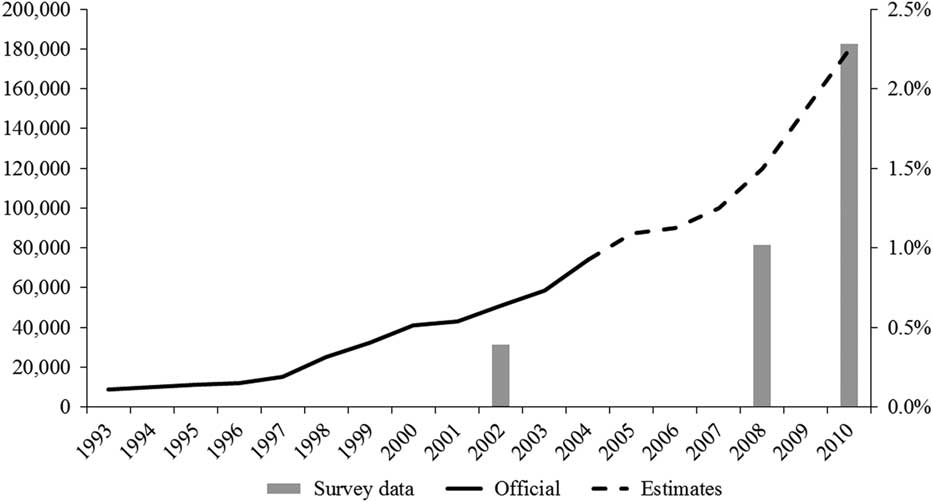
Being a high-capacity single party regime with rapidly proliferating protests, China has been at the center of this discussion. According to official statistics the annual number of so-called ‘mass incidents’ (qunti xing shijian), an official euphemism for acts of collective contention, surged from 8700 to 74,000 between 1993 and 2004. According to unofficial estimates, the number of incidents climbed further to 180,000 by 2010. Likewise, survey data suggests that protest participation over the ‘past 3 years’ expanded from 0.39% of the population in 2002, to 1.02% in 2008, and a remarkable 2.28% in 2010 (see Figure 1). China’s leaders were thus forced to contemplate a response and seemingly opted for a strategy of conditional tolerance.
“Mass incidents” and protest participation in China, 1993–2010 Note: “Official” refers to figures published in internal and semi-public public security publications that are consistent and available from 1993 to 2004. “Estimates” refers to subsequent figures circulated in the Chinese media. For detailed sources please refer to appendix A. “Survey data” refers to the percentage of respondents who participated in protests over the preceding three years (right axis). Data is based on the Asian Barometer surveys 2002 and 2008, and the Chinese General Social Survey 2010. Sample sizes were 3,183, 4,780, and 10,192 respectively.

Outlays for ‘stability maintenance’ (weiwen) have grown by leaps and bounds (Chen, Reference Chen2013). Most ethnic, religious, and political protests are categorically regarded as regime-challenging by the leadership and are met with an iron-fisted approach (see also footnote 2). The risk of repression also remains real for other protesters (Tanner and Green, Reference Tarrow2007; Cai, Reference Cai2008a; Chen, Reference Chen2012: 138, Reference Chen2013). However, substantial evidence suggests that over the 2000s Chinese local officials have become increasingly inclined to manage rather than crudely repress localized contention with limited socio-economic claims. Cadres draw on a mix of tolerance and targeted repression, forms of soft repression, or concessions and mobilize just about any government agency that may assist in defusing unrest (Cai, Reference Cai2008a; Su and He, Reference Tanner2010; Chen, Reference Chen2012, Reference Chen2013; Deng and O’Brien, Reference della Porta2013; Lee and Zhang, Reference Koopmans and Olzak2013; Zhou and Yan, Reference Zhou and Yan2014). Somewhat mirroring the state’s conditional tolerance, Chinese protesters seem to be guided by a notable ‘rules consciousness’ (Perry, Reference Paik2007, Reference Pei2008). In a pattern Peter Lorentzen (Reference Liu, Zhang, Wu and Qi2013: 130) called ‘loyalist protest’, resisters frequently accuse local state agents of abuses, but restrain themselves to rather narrow, livelihood-centered demands, demobilize as soon as grievances are addressed, and avoid making claims against the regime. By contrast, protesters are often at pains to express their support for the CCP and the central government (O’Brien and Li, Reference Nathan2006; Lee, Reference Koopmans2007; Perry, Reference Paik2007, Reference Pei2008; Cai, Reference Cai2010; Chen, Reference Chen2012).
Thus, recent research has provided an increasingly nuanced picture of contention and state response in contemporary authoritarian settings. As pointed out above, however, scholarship has largely shunned the discursive dimension of state response. It has thereby overlooked the principal channel through which political leaders engage discontented citizens directly and deprived itself of a readily accessible yardstick for gauging elite behavior, perceived political opportunity, principal-agent dynamics, and regime-evolution. Moreover, in spite of the voluminous literature on contention in China, a number of important questions remain not well understood: how does the central state coordinate demands for conditional leniency with its local agents in the absence of robust legal constraints on repressive behavior? What explains protesters’ noticeable modesty? Why, after all, has contention proliferated so rapidly?
Evidence and analytical strategy
This study is based on an in-depth analysis of protest discourse in major outlets of the Chinese central leadership, chiefly the People’s Daily (Renmin Ribao) and the two official news agencies. Content released through these outlets is vetted by the highest levels of propaganda authority and is the closest approximation of the position of the CCP party center (Shambaugh, Reference Shambaugh2007: 53–54; Wu, Reference Wu1994: 195–196). Although the leadership is also characterized by power struggles and factionalism, its members are unified in their interest in regime survival and usually display a high degree of cohesion in public communication. The following, moreover, shows that leading officials who are usually regarded as belonging to different factions expressed very similar positions on protest, indicating a substantial degree of unity in this policy domain. For analytical purposes the central leadership is therefore treated as a collective actor.
The analysis pays particular attention to the most authoritative pronouncements, such as the title pages of the People’s Daily, leaders’ speeches or quotations, as well as the publicized annual government work report to the National People’s Congress (NPC). In order to strengthen claims on change over time, the frequency of keywords appearing on the front pages of the People’s Daily is also examined. The observation period between 1990 and 2010 covers, depending on the definition, two to five administrations and two to three major power reshuffles. It should therefore be appropriate for identifying underlying patterns that transcend the particular preferences of individual leaders.
The content analysis focuses on utterances that refer to protest and social conflict in general terms or specifically highlight typical forms of livelihood-centered contention. This kind of protest discourse comprises the vast majority of official communication. Statements that explicitly refer to domains which are regarded as highly sensitive by the leadership – religious and ethnic contention as well as political protests abroad – are drawn upon for illustrative purposes. These as well as explicit references to Chinese nationalistic protests, which are sometimes actively ‘stage manage[d]’ (Weiss, Reference Weiss2013: 20) by the authorities, have been excluded in the keyword frequency counts. For more details on the exclusion strategy, as well as the exact numbers of articles counted and omitted, please refer to appendices B–F.
For background information on the evolution of popular unrest and closed-door elite behavior, the analysis draws on relevant scholarly research, official statistics, news media accounts, and conversations with Chinese policy researchers that have insight into elite deliberations. With this evidence the study aims to capture the essence of the ‘signaling game’ (Huang, Reference Hess and Martin2013) between the Chinese leadership, discontented citizens, and local officials. As the evidence is ‘nonexperimental and cannot be analyzed in a sample-based format’, the study relies on a historical narrative that pulls different pieces of information together akin to the logics of ‘process tracing’ and ‘discourse tracing’ (Gerring, Reference Ferree2007: 172–185; LeGreco and Tracy, Reference Lee2009). Comparisons, counter-factuals and timing are important heuristic devices.
Popular mobilization and strategic elite communication in China, 1990–2010
After the CCP’s life-and-death crisis surrounding the Tiananmen Movement of 1989, the leadership’s dominant message was that challenging the authorities in any form was not permitted. This notion was captured most succinctly in Deng Xiaoping’s ultra-conservative 1989 dictum ‘stability overrides everything’ (wending yadao yiqie) (Li, Reference LeGreco and Tracy1995: 465). It was with this concern in mind that in 1991 the new CCP General Secretary Jiang Zemin proclaimed in the People’s Daily that the armed forces had ‘to be prepared to handle sudden incidents at any time’ in order to protect ‘social stability’ (Xinhua She, 1991).
In early 1992, Deng Xiaoping set out on his famous Southern Tour to garner support for the contested course of continuing economic reform. By the time of the 14th Party Congress in October 1992, the reformers’ victory was settled. Surrounding these shifts at the top, a surge of popular resistance began at the grassroots. It was dramatically epitomized in a major popular uprising in Sichuan Province’s Renshou County,Footnote 4 leading the political elite in Beijing to be ‘panicked by rural rioting’ (Bernstein and Lü, Reference Bernstein and Lü2003: 119).Footnote 5
Initially, the state media began to take note of renewed popular unrest by blaming it on ‘a small number of people who incited parts of the masses’ (see, e.g. Meng, Reference McCarthy and McPhail1992). Yet this framing began to change in early 1993 when Jiang Zemin internally re-invoked Mao Zedong’s 1957 elaborations on distinguishing between different forms of dissent. According to Mao, ‘contradictions among the people’ (renmin neibu maodun), including protests against official misconduct without regime-challenging demands, were to be treated with leniency, while ‘contradictions with the enemy’ (diwo maodun) warranted ruthless repression. Highlighting that ‘new contradictions’ were bound to emerge under conditions of renewed economic reform, Jiang cautiously acknowledged legitimate popular grievances and urged officials not to overreact (Jiang, Reference Huang1993). Subsequently, this interpretation of ‘contradictions among the people’ appeared in the government work report delivered to the NPC and was publicized in the People’s Daily (Premier of the State Council, 1993).
Between 1994 and 1996, the growth of unrest apparently slowed somewhat (Figure 1). Relevant references in the center’s public pronouncements became rare. But around and subsequent to the CCP’s 15th Party Congress in late 1997, peasant and worker protests began to surge again, leading to a number of major clashes between citizens and local authorities (Blecher, Reference Blecher2002; Bernstein, Reference Bernstein2004). The nationwide number of incidents recorded by the authorities skyrocketed from 12,000 in 1997 to 25,000 in 1998 and >32,000 in 1999 (Figure 1). The central government responded by initially criticizing local officials through internal channels (Li, Reference Liu1997). Beginning in late 1998, however, top leaders began to go public. Jiang Zemin urged public security officials not ‘to act tyrannically’ (Liu et al., Reference Linden and Klandermans1998). He also asked local cadres to show ‘patience’ even when ‘certain unreasonable demands’ were brought up. When cadres ‘oppress the masses’, Jiang stressed, they had to be ‘dealt with severely’ (Liu et al., Reference Li1999). Likewise, in early 1999, Premier Zhu Rongji poured scorn on rural officials on the title page of the People’s Daily, claiming that
Contradictions between farmers and cadres in the countryside are sometimes rooted in grassroots cadres’ sloppy work methods, their rude work style, and their use of official power for personal gain. This must definitely change (Sun and Chen, Reference Sun and Chen1999).
Moreover, around the same time the neologism ‘mass incidents’, which facilitated discussing protest candidly without having to turn to more loaded terminology, began to appear in the leadership’s pronouncements (see also Tanner, Reference Tanner and Green2004: 144).
In contrast to these increasingly neutral-to-sympathizing depictions of protest, contentious incidents by supporters of the Falun Gong sect, which had been declared an enemy subsequent to a nationally coordinated protest in central Beijing in 1999, were denounced in the most vilifying language. Conspicuously absent from these descriptions was the term ‘mass incidents’. Instead, Falun Gong protests were stylized as ‘illegal gathering incidents’ (feifa juji shijian) or ‘evil incidents’ (e’lie shijian) that were ‘anti-government’ and ‘anti-people’ in nature (see, e.g. Renmin Ribao, 1999).
Although the number of contentious incident continued to proliferate after 1999, when new leadership, under Hu Jintao, ascended to power in 2002–03, grassroots activism again entered a phase of rapid expansion. Official statistics indicate that the number of events climbed from about 58,500 in 2003 to almost 74,000 in 2004 (Figure 1). From mid-2003 onwards, a growing surge of aggrieved citizens arrived in Beijing to petition the central government. By 2004, they began to use more disruptive tactics to bring their grievances to the attention of the authorities. In one case, frustrated petitioners organized a resistance movement against a dam building project in Sichuan Province that led to clashes between reportedly up to 100,000 protesters and security forces (Li et al., Reference Li2012: 321–323).Footnote 6
Beginning in fall 2004, the new leadership began to respond publicly by placing the issue of managing ‘contradictions’ and ‘mass incidents’ at the core of its new policy agenda of ‘Building a Socialist Harmonious Society’. In a major speech on the subject in early 2005, Hu Jintao again turned to Mao’s theory of contradictions and highlighted that China was about to enter a ‘crucial stage of development’ that would lead to an ‘increase and diversification’ of ‘contradictions’. Therefore, ‘problems which harm the masses’ interests’ had to be ‘solved’ and popular complaints had to be dealt with in a ‘legal, timely, and reasonable’ manner. If ‘mass incidents’ occurred nonetheless, they had to be ‘handled appropriately’ (Hu, Reference Hess2005). A few weeks later, the media quoted the Minister for Public Security, Zhou Yongkang, clarifying that ‘mass incidents’ were not to be interpreted as regime-challenging protests:
In the ultimate analysis these incidents are contradictions among the people … essentially belong to the category of economic interest grievances, and have no evident political objective (Chen, Reference Chen2005).
The new leadership also embarked on a broader endeavor of discursive disarmament. In his first government work report in 2004, Premier Wen essentially omitted all elements that could be interpreted as supportive of a hardline approach to protest. For instance, he excluded all references to ‘hostile forces’ or ‘elements’, which had been part of these reports on and off since 1990. Until 2010, such terminology did not re-emerge (Premier of the State Council, 1990–2010). Again highlighting the discursive distinction between different kinds of contention, highly conspiratorial and hostile language was used to portray events in the simultaneously occurring Color Revolutions in Eastern Europe and Central Asia (Koesel and Bunce, Reference Kennedy2013: 756–757).
After two years of a relative slowdown in popular activism over 2005–06, contentious pressure mounted once more. Circulated numbers on ‘mass incidents’, climbing from 100,000 in 2007 to 120,000 in 2008 and 180,000 in 2010, as well as survey data suggest that the country went into another cycle of rapid protest expansion (Figure 1). Likewise, a scholarly database suggests that the number of particularly large-scale incidents tripled from 25 in 2006 to a peak of 76 in 2008 (Tong and Lei, Reference Trejo2010).Footnote 7
The central authorities responded with considerable publicized sympathy. Shortly after some particularly violent protester–police clashes in mid-2008 and mid-2009, regulations that stipulated punishments for officials who caused or mishandled protests were publicized with great fanfare (Renmin Ribao, 2008, 2009a). This move stood in sharp contrast to the past when such edicts were handed down internally. The Minister for Public Security, Meng Jianzhu, weighed in with an attention-raising essay on police work, urging officials to stick to the principle of ‘three-cautions’ and to ‘use the police reasonably’ during ‘mass incidents’ (Meng, Reference Manheim2008). Moreover, illustrative of how much the party line had come to side with protesters by then is a provincial propaganda circular carried by the national state media subsequent to an incident in 2009:
In the overwhelming number of cases the core contradictions [behind mass incidents] are located in the relationship between party committees, governments, and the masses. Again and again this is related to … [officials’] inappropriate policy-making, their indifferent work, and dishonest work-style … All levels of the party and government … should not blindly criticize the masses, or wrongly stigmatize petitioners (Zhongguo Xinwen She, 2009).
This portrayal again contrasted sharply with the intensely hostile depictions of ethnic protests and riots in Tibet and Xinjiang in 2008 and 2009, which were squarely blamed on hostile outside forces in conjunction with domestic ‘criminal elements’ and framed as ‘smashing-vandalizing-plundering-torching violent incidents’ (dazaqiangshao baoli shijian) (Li and Li, Reference Lee and Zhang2008; Renmin Ribao, Reference Robertson2009b) – terminology that hailed from the Cultural Revolution.
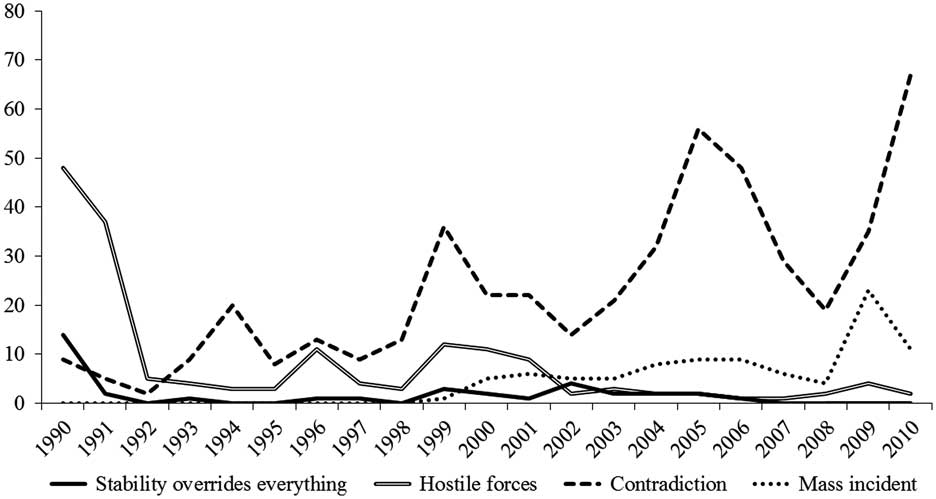
The trend toward increasing sympathy in the leadership’s protest discourse is further highlighted by the annual frequency of key terms appearing on page 1 of the People’s Daily between 1990 and 2010 (Figure 2). Terminology typical of a hostile reading, such as ‘stability overrides everything’ and ‘hostile forces’, was very common immediately after the Tiananmen crisis, but had already been scaled down by 1992. After 1998, when protests had surged, such terms had a slight comeback and then almost vanished from the ruling elite’s vocabulary. The opposite trend is evident for keywords indicating a sympathizing or neutral reading of discontent and protest, such as ‘contradictions among the people’ (or ‘social contradictions’) and ‘mass incidents’. The usage of these terms substantially increased over time, peaking every few years subsequent to the above outlined periods of particularly intense popular activism.
Keywords in the People’s Daily’s (title page), 1990–2010 Note: Depicted values represent the annual frequency of articles that contain the relevant key words. “Hostile forces” also includes the term “hostile elements.” “Contradiction” stands for “contradictions among the people” and “social contradictions.” Articles with explicit references to nationalistic, ethnic minority, or religion-based contention were excluded. Also excluded were references to foreign forces or events abroad. For further details see appendices B to F.

The intended and unintended consequences of elite protest discourse
Although the Chinese leadership has never endorsed the act of taking to the streets, the question of why authoritarian elites would show even ‘the slightest wavering’ toward protests remains (Johnston, Reference Hung2010: 127). In the following, I develop an argument that interprets the observed response pattern in light of the assumed overarching policy objective of safeguarding the regime. Mindful of the need to distinguish between ‘motivation and effect’ when interpreting authoritarian elite behavior (Brancati, Reference Brancati2014), the discussion considers clues for both the motivations behind the elite’s public communication as well as its intended and unintended consequences.
Regime legitimation
If legitimacy is understood as a dualism composed of a ‘claim to legitimacy’ by the ruler and a more or less pronounced ‘belief in legitimacy’ among the ruled (Weber, Reference Weber2006: 215), then legitimation – the establishment of the claim – is principally a symbolic exercise of discursive ‘articulations’ (Luckmann, Reference Lorentzen1987: 111). One of the defining characteristics of Communist rule in the Maoist tradition has been that the CCP has never been content with ruling primarily on the basis of state coercion and popular pretense that is characteristic for many authoritarian regimes (Wedeen, Reference Wedeen1999). Although such mechanisms are part of the party’s tool-kit, the leadership has always tried hard to ‘establish its legitimacy through the transformation of minds’ and the induction of genuine belief through its public discourse (Liu, Reference Li, Liu and O’Brien2010: 330).
An established record of attitude research has revealed that the Chinese ruling elite has been astonishingly successful in animating political support and that its public communication has been a very important component of that endeavor. Kennedy (Reference Jiang2009) has shown that political support for the central government in China is very high and that consumption of the state-controlled media has a strong positive effect on it. Li has found that petitioners in Beijing rationalize their puzzling confidence in the central government’s ‘good intentions’ with its publication of pro-citizen policies. Thus, although they harbor serious doubts about local officials, many aggrieved citizens seem to believe that ‘central leaders are the finest men in China because the policies they make are very good indeed’ (Li, Reference Li2013: 14–15, see also 2004). Likewise, ethnographic research on protesting workers has shown that the promulgation of populist policies and central government discourse in the news media was crucial for workers’ ‘faith in the moral and political integrity of the central state’ (Lee, Reference Koopmans2007: 119; similarly Blecher, Reference Blecher2002: 300).
A critical impasse for the leadership has been how to communicate mounting conflict between citizens and local officials in a way that shields itself from popular blame (Cai, Reference Cai2008b). Discursive accommodation helps to resolve this predicament. By openly admitting that severe tensions exist, Chinese leaders have bolstered the credibility of their messages. Would they have insisted on Leninist orthodoxy, and pretended that conflict between citizens and the socialist state did not exist, official discourse would have run serious risk of completely ‘ceas[ing] to be a believable representation of reality’ as it did in the late Eastern Bloc (Yurchak, Reference Yurchak1997: 183; see also Lohmann, Reference Liu, Wang and Chen1994: 58). Kozlov (Reference Koesel and Bunce2002: xvii, 314) concluded that the hostility of the Kremlin’s public response to localized protests in the 1950s and 1960s which – similar to post-1989 China – exhibited substantial support for the central government, characterized the ‘Soviet leadership’s inadequate grasp of popular consciousness’ and laid the foundation for the subsequent ‘ideological collapse of the regime’. This credibility problem has not been lost on the CCP. Chinese assessments of the breakdown of the Soviet Union have highlighted that the complete censorship of negative news made the authorities lose ‘the people’s trust’ (Shambaugh, Reference Shriver, Adams and Cable2008: 67).
Moreover, by criticizing local officials and blaming them for the occurrence of unrest, the leadership has followed a time-tested CCP strategy of creating a wall of symbolic distance between itself and its policies, on the one hand, and local agents and policy implementation, on the other. Nathan (Reference Meng1985: 156) observed that publicized criticisms of local officials served to detach the party center ‘from acts of arrogance … committed in its name and so assures the public that the leaders care for their welfare’ in the Mao era. Likewise, in 1989 Deng (Reference della Porta1994) pushed for publicizing exemplary cases of official corruption in order to prevent the people from ‘com[ing] to believe that we are protecting the wrongdoers’.Footnote 8
Similar concerns also seem to have driven patterns of protester-sympathizing elite discourse in other authoritarian contexts. Vietnamese Communist leaders have responded to livelihood-centered protests and strikes that have proliferated since the 1990s by sympathizing with protesting peasants and ‘publicly chastis[ing] employers for abusing workers’ in order not to alienate these two core constituencies of legitimate Communist rule (Kerkvliet, Reference Johnston2011: 182; see also Thomas, Reference Tilly2001: 324). Robert Jansen (Reference Hu2011: 83–84) has shown that left-leaning Latin American authoritarian leaders have tried to bolster support with a populist rhetoric that portrays local elites as exploitative and thereby mobilized disadvantaged classes into contention.Footnote 9
Although much of the CCP’s ideological pronouncements may not induce belief anymore, there is substantial evidence that severely discontented and protest-prone citizens do take the leadership and its policies very seriously and that public communication has been critical for this state of affairs. Evidence from other authoritarian systems and the party’s own experience has indicated that the framing of state–society conflict and official misconduct are critical for eliciting popular support. Hence, it is plausible that the discursive accommodation of popular unrest has been a vital component of the central government’s relatively successful endeavor of protecting its popular legitimacy.
Agent and protester governance
The CCP leadership is facing a knotty coordination problem. Local leading officials enjoy a great deal of power over all branches of government, which provides plenty of opportunity for abusing authority, and fosters popular grievances. These constantly run the risk of being used by activists with a broader political agenda and scale-up into regime-challenging protests. To safeguard themselves against this hazard, central leaders have been reluctant to firmly restrain their local agents’ flexibility in applying coercion (Cai, Reference Cai2008a). This ensures that the security apparatus remains a credible threat, but implies that it is at substantial risk of being misused for ‘tak[ing] revenge against those who complain about [official] abuses’ (Tanner and Green, Reference Tarrow2007: 669; see also Cai, Reference Cai2008a). The more coercion is indiscriminate, space for expressing moderate demands narrows, and the more likely it is that aggrieved populations become supporters of ‘revolutionary movements’ (Goodwin, Reference Gandhi and Lust-Okar2001: 292; see also Tarrow, Reference Thomas1998: 84–85). Hence, the leadership must walk a fine line in holding both its local agents and protesters in check.
Seemingly being aware of this twin-predicament, in his return to Maoist logic in 1993 Jiang Zemin (Reference Huang1993) internally reiterated the necessity of thwarting any ‘subversive activities by hostile forces’ in order to ‘maintain stability’, but also underlined that a simplistic approach of ‘coercion and commandism’ would be counterproductive. Haphazard repression, he underlined, would provide regime opponents with opportunities to ‘make use of our mistakes in handling contradictions among the people’. Similarly, a more recent internal Ministry of Public Security (Reference Meng2008) regulation mandates severe punishments for regime opponents that attempt to ‘meddle’ in protests, but at the same time requires officers to ‘cautiously use police force’ and refrain from even policing specified types of moderate protests. Moreover, a fundamental assumption behind the Maoist tradition of ‘criticism and self-criticism’ and the later developed concept of ‘public opinion supervision’ is that publicized criticism has an impact on the conduct of local officials (Nathan, Reference Meng1985: 156; Tong, Reference Tong and Lei2011: 23–26). The experience of numerous Maoist mass campaigns has also ingrained into the collective memory of the CCP the idea that elite discourse is capable of directing existing ‘grievances of the people’ at specific ‘targets’, and away from others (Liu, Reference Li, Liu and O’Brien2010: 357). Hence, I argue that the second intention behind the leadership’s protest discourse has been to temper both official and protester behavior.
Sinologists have observed that local officials rely on hostile cues in the center’s discourse to ‘discredit and disrupt’ popular resistance, and that the vagueness of official language grants them a great deal of ‘discretion’ to decide if a political ‘boundary has been crossed’ (O’Brien and Li, Reference Nathan2006: 12; Stern and O’Brien, Reference Stockmann2012: 188). Hence, when such cues become less often used and the circumstances of legitimate repression are increasingly specified, as demonstrated above, this discretionary space contracts. By publicly criticizing local officials’ conduct the leadership also sends out a strong signal that it is united and less inclined to tolerate protest-provoking and escalating behavior. Crucial is, moreover, that it thereby also informs citizens of its policy preferences and establishes what Micheal Chwe called ‘common knowledge’ (Chwe, 2001). This is a necessary condition for a ‘sandwich strategy’ of policy implementation in which authoritarian elites engage citizens ‘to support policy goals against reluctant bureaucrats’ (Fox, Reference Elfstrom and Kuruvilla1993: 152).Footnote 10 By making it known to local officials that citizens also know of the center’s preference against ham-fisted repression, officials have to take into account that protesters may accuse them of acting against the ‘spirit of the Center’ (zhongyang jingshen) (O’Brien and Li, Reference Nathan2006: 6) when they apply harsh coercion. However, by promoting sympathy for protesters in general, while continuing to display steadfast hostility to specific forms of regime-challenging contention, the leadership also signals to citizens where the boundary of tolerance is; leniency can only be expected as long no political demands are made and distance is kept from dissident groups.
The leadership’s faith in publicly based instruments of agent and protester governance helps to understand why it moved from criticizing officials behind closed doors to vocal public condemnations during the period of rapidly rising unrest in 1997 and 1998, when internal criticism had apparently not brought about the desired behavioral change. It also illuminates why central authorities eventually turned to publicizing regulations on protest management in response to major protester–police clashes in 2008 and 2009. Lastly, it helps to account for the conspicuous co-occurrence of vocal sympathy for protesters during periods of extensive mobilization in 2004–05 and 2008–09, which stood in stark contrast to the firm hostility used in depicting the Color Revolutions and domestic ethnic unrest.
Social movement scholars have shown that protests that are ‘widely condemned’ in elite discourse are more prone to be met with repression than those which ‘receive broad public support’ (Koopmans, Reference Kerkvliet2005: 160; see also Shriver et al., Reference Steinhardt2013). Likewise, a growing emphasis on protester rights in elite discourse in Western democracies has complicated the justification of forceful measures by the police and contributed to a change of ‘police knowledge’ toward more cooperative conceptions of protester–police relations (della Porta, Reference Perry1998: 229, Reference Perry1999: 93). Studies have also indicated that public discourse by non-movement elites ‘significantly shapes the targets’ of grassroots contention (Koopmans and Olzak, Reference King, Pan and Roberts2004: 199), and is capable of preventing or demobilizing certain forms of contention (Ferree, Reference Deng and O’Brien2005; Shriver et al., Reference Steinhardt2013).
Thus, the Chinese leadership’s not unprincipled discursive accommodation of contentious pressure may indeed have supported its objectives of taming local officials and reinforcing the self-restraint displayed by most Chinese protesters.
The proliferation of protest
Although mobilization patterns in post-1989 China have been thoroughly researched, the question of why contention has proliferated so rapidly remains less well understood. Some scholars argued that the expansion of popular grievances due to a halt of liberalizing institutional reforms and a predatory model of development are driving the growth of unrest (Pei, Reference O’Brien and Li2006; Paik, Reference O’Brien and Li2012: 16). Others focused on changes in the political opportunity structure. Chen (Reference Chen2012) highlighted how the state has facilitated protest proliferation through an unintended conversion of social control and participation institutions under economic reform. Peter Lorentzen (Reference Liu, Zhang, Wu and Qi2013) argued that reforms have made it increasingly difficult for the central state to obtain accurate information about discontented social groups and local officials, which made the tolerance of protest more valuable.
This analysis suggests paying more attention to how changing signals from the political elite have transformed the perception of opportunity by citizens. The leadership’s protest discourse has not only become more favorable to protesters, it has also provided new spaces for the Chinese press to cover demonstrations and for intellectuals to publicly question the principle of maintaining stability (Elfstrom and Kuruvilla, Reference della Porta and Reiter2014; Steinhardt, Reference Steinhardt2015, 2016). Hence, ‘discursive opportunities’ (Koopmans and Olzak, Reference King, Pan and Roberts2004) for acts of resistance – in elite communication and in the wider media environment – have considerably, if not dramatically, increased.
A repeated theme in scholarship on Chinese contentious politics has been that citizens display, what Elizabeth Perry (Reference Paik2007: 21) termed, ‘a seasoned sensitivity to…top-down signals emanating from the state’. Elite cues were found to be decisive for activists’ assessment of ‘opportunities and threats’ in an uncertain environment (Stern and O’Brien, Reference Stockmann2012: 177; see also O’Brien and Li, Reference Nathan2006; Li et al., Reference Li2012; Elfstrom and Kuruvilla, Reference della Porta and Reiter2014). In combination with what is known about the mobilization-enhancing function of protester-sympathizing elite discourse and media coverage in democracies, it is therefore plausible to surmise that the leadership’s increasing inclination to accommodate protesters discursively has altered the popular perception of opportunity and contributed to the impressive proliferation of contention in China. Given the pay-offs in terms of regime legitimation and agent control, combined with the ability to signal what kinds of acts remain off limits, Chinese leaders have apparently come to the conclusion that this risk was worth taking.
Conclusion
The Chinese political elite have responded to cycles of intensifying grassroots contention since the early 1990s with increasing, yet not unconditional, discursive accommodation. This article has suggested that the underlying rationale behind this puzzling reaction has been to safeguard one-party rule through protecting the leadership’s popular image and tempering the behavior of local officials and protesters. There are good reasons to believe that these intentions have at least partly come to fruition. But there are equally good reasons to surmise that discursive accommodation has contributed to the further proliferation of protest in China.
This study concurs with others in that central government discourse is a critical pivot around which contention in China revolves (O’Brien and Li, Reference Nathan2006; Perry, Reference Paik2007, Reference Pei2008; Stern and O’Brien, Reference Stockmann2012). Yet it shows more clearly that elite signals have changed to the favor of protesters. Nonetheless, the leadership’s refusal to institutionalize protester rights implies that boundaries of tolerance can be redrawn at any time. The current administration under Xi Jinping seems to be in the process of doing just that. Will Chinese citizens remain content with such a conditionally granted and feeble right to dissent? Recent evidence suggests that some protests have become more proactive, public spirited, or inspired by fundamental political discontent (Li, Reference Li2010; Elfstrom and Kuruvilla, Reference della Porta and Reiter2014; Steinhardt and Wu, Reference Stern and O’Brien2016; Zhong and Hwang, Reference Zhong and Hwang2016). It remains to be seen if social forces will continue to ‘play by the official rules of the game’ (Perry, Reference Paik2007: 21) or begin to push for more systemic political change.
The study of elite protest discourse has also revealed another dimension of the Chinese leadership’s ‘art of mastering the people’ (yu ren zhi shu) through the strategic manipulation of signals in the public domain. While going out of their way to silence popular online discourse on protest (King et al., Reference Johnston2013), this article has shown how leaders became increasingly outspoken on the very same topic in the state-controlled media. Perhaps not unlike the early 19th century Qing dynasty emperors who revived the Confucian ‘rhetoric of benevolent rule’ to restore the central state’s prestige and appease those revolting against predatory local officials (Hung, Reference Holbig2011: 173), discursive accommodation is part and parcel of a larger effort to rebuild the party-state’s legitimacy and agenda-setting power (Schubert, Reference Shambaugh2008; He and Warren, Reference Goldstone and Tilly2011; Holbig, Reference He and Warren2013; Stockmann, Reference Su and He2013). To the Chinese political elite, ‘talk’ is therefore quite literally ‘power’ (Manheim, Reference Lorentzen1991: 7).
For the broader debate on authoritarian contentious politics, the case of China has shown that widening the analytical gaze on state responses from social practices and institutions to elite discourse pays off. It opens a readily accessible source of evidence to study the behavior of political elites as well as principal-agent dynamics in a domain that is critical for regime stability. It also allows gauging the perception of opportunity by those who contemplate the risk of taking to the streets in an authoritarian environment. Moreover, the approach has opened intriguing comparative perspectives: similar to developments in Western democracies a few decades earlier (della Porta, Reference Perry1999), accelerating contentious pressure in China has also led to more protester-sympathizing elite communication. Such flexible discursive responses to protest may provide authoritarian elites with a critical reservoir of popular legitimacy and coordinative capacity to extend the longevity of their rule. Hence, analyzing public elite communication on protest can provide new insights into how authoritarian elites manage instability and how regimes evolve that scholars ought to pay more attention to.
Acknowledgments
For helpful comments on presentations and previous drafts of this manuscript the author is grateful to five anonymous reviewers and Thomas Bernstein, Cai Yongshun, Chen Gang, Heike Holbig, Jeffrey Isaac, Leonid Peisakhin, Francesca Polletta, Dorothy Solinger, Su Yang, Wu Fengshi, Christopher Young as well as Thomas Richter, Maria Josua and other members of the research team ‘Persistence and Change in Non-Democratic Regimes’ at the German Institute of Global and Area Studies (GIGA). The author thanks Zeng Yu for research assistance. Support from a Direct Grant by the Faculty of Social Science (project code: 4052046), The Chinese University of Hong Kong is gratefully acknowledged.
Supplementary Material
To view supplementary material (appendices A-F) for this article, please visit http://dx.doi.org/10.1017/S1755773916000102