

1. Introduction
Economic analysis plays an important role in examining and highlighting the difficult trade-offs associated with policies to address the novel coronavirus-2019 (COVID-19) pandemic and informing related decisions. Any such analysis requires estimating the value of averting cases of illness or death. In cost-effectiveness analysis, these values are often expressed as quality-adjusted life years (QALYs). In benefit-cost analysis, these values are typically expressed in monetary terms, as the value per statistical life (VSL) for fatal cases and the value per statistical case (VSC) for nonfatal cases. These measures are also used to estimate the incurred or expected burden of disease.
Analyses of COVID-19 policies frequently focus on fatalities, in part because the per case values are large compared to the values for nonfatal cases. For example, the U.S. Department of Health and Human Services (HHS) recommends a central VSL estimate of $11.4 million per expected death averted (2020 dollars and income levels) (HHS, 2016, 2021). However, the number of nonfatal COVID-19 cases far outstrips the number of fatal cases. For example, according to the U.S. Centers for Disease Prevention and Control (CDC, 2021a), there were 124 million cases of symptomatic illness and 920,000 deaths associated with COVID-19 reported between February 2020 and September 2021; that is, about 130 cases per death reported. This ratio is likely an underestimate. Not all cases are known and reported due in part to limited testing, and those with mild illness are less likely to seek medical care or report the infection. Thus, omitting the value of averting nonfatal cases may substantially underestimate the value of protection against COVID-19.
Nonfatal cases are also an increasingly important component of the benefits of preventing COVID-19 as the pandemic evolves. Vaccinations, infection-acquired immunity, and emerging drug therapies are decreasing fatality rates, while nonfatal cases are a persistent concern. Such cases pose a risk of serious illness and continued transmission, which in turn may allow more dangerous variants to emerge. These cases also continue to strain the health care system and make it difficult for people to work, slowing economic recovery. Including the value of averting nonfatal cases in the benefit tallies may significantly change the policy implications, affecting the extent to which the policy is found to be cost-effective or cost-beneficial.
But therein lies a problem. Little is known about the value of reducing nonfatal cases. Valuation research that directly addresses COVID-19 is only beginning to emerge, and studies implemented at the beginning of the pandemic do not reflect evolving understanding of the associated symptoms, their likelihood, and their duration nor the changes in these impacts attributable to new variants. In addition, every study has advantages and limitations. Ideally, analysts would be able to compare and combine the results of several valuation studies to explore uncertainties in the estimates and the policy implications.
Kniesner and Sullivan (Reference Kniesner and Sullivan2020) and Viscusi (Reference Viscusi2020) provide important insights into these issues. Viscusi illustrates the potential effects of including morbidity when valuing COVID-19 health impacts, applying values from studies of asthma, chronic bronchitis, and job-related injuries. Kniesner and Sullivan apply values derived from research on motor-vehicle and work-related injuries and explore alternative adjustments to better reflect the characteristics of COVID-19 morbidity.
In this paper, we further investigate these values, focusing on the USA and relying on systematic review of the literature. We briefly summarize the conceptual framework for valuing nonfatal illness and injury as well as an approach for approximating these values recommended in the HHS (2016) Guidelines for Regulatory Impact Analysis and elsewhere. That approach estimates the QALY gains associated with averting nonfatal conditions then converts them to monetary values.Footnote 1
To address the lack of valuation research that explicitly addresses COVID-19, we rely on research on similar conditions as proxies. To identify these proxy conditions, we review the research on COVID-19 symptoms associated with cases of differing severity and compare them to the symptoms of more well-studied illnesses. To estimate QALY gains, we review the literature on the impacts of these similar illnesses on health-related quality of life (HRQoL). We multiply the resulting HRQoL gain by the duration of the associated COVID-19 phase to estimate the QALY gains per symptomatic nonfatal COVID-19 case averted. These QALY gains can be used directly in cost-effectiveness analysis. We then follow a standard approach to estimate the monetary value of these QALY gains, using values derived from the VSL, and discuss the VSL estimates appropriate for COVID-19.
Our research suggests that the average value per nonfatal case varies significantly depending on the extent to which cases of differing severity are averted by the policy. For example, as discussed in the concluding section, if we rely on U.S. CDC data from 2020 to 2021 to estimate the distribution of severity, we find an average value of $30,000 per nonfatal symptomatic case averted (assuming the age of those affected is 40 years). If we instead rely on more recent severity data from Qatar that addresses cases among vaccinated individuals during the Omicron wave, this average decreases to $5600 per case.
The approach we develop can be updated to reflect the evolving information on the characteristics of COVID-19 cases and is applicable to other health endpoints for which proxy measures of value are needed. Thus our work provides a framework for application in other contexts and also illustrates the advantages and challenges of this approach.
2. Conceptual framework
Valuing nonfatal risk reductions associated with COVID-19 policies presents major challenges. Some challenges relate to evolving understanding of the disease itself, including the characteristics of the individuals most likely to be affected and the symptoms and duration. Other challenges relate to the conceptual framework for valuation and gaps and inconsistencies in the available empirical research. We combine approaches used in cost-effectiveness analysis and in benefit-cost analysis to address these challenges.
In cost-effectiveness analysis, analysts often rely on QALYs to value both the fatal and nonfatal effects of illnesses or injuries. The QALY is a nonmonetary measure that integrates the duration and severity of illness. QALYs are derived by multiplying the amount of time an individual spends in a health state by a measure of the health-related quality of life (HRQoL) associated with that state. HRQoL is estimated using a scale anchored at 0 and 1, where 1 corresponds to full health and 0 corresponds to a state that is as bad as dead (values cannot be greater than 1 but may be less than 0 for states that are judged to be worse than dead). Numerous approaches, including generic indices, have been developed for estimating QALYs and the associated research literature is large (Institute of Medicine, Reference Miller, Robinson and Lawrence2006; Neumann et al., Reference Neumann, Sanders, Russell, Siegel and Ganiats2016).
In benefit-cost analysis, analysts rely on monetary estimates of individual willingness to pay (WTP) to value both fatal and nonfatal health effects. WTP is the maximum amount of money an individual would exchange for an improvement, such as a reduction in the risk of becoming ill or dying over a defined time period. Stated preference studies that rely on surveys, or revealed preference studies that rely on market data, are typically used for valuation. Per case values are calculated by dividing individual WTP for a small risk change in a defined time period by the risk change. For example, for fatal effects, the $11.4 million VSL recommended by the HHS implies that the average U.S. resident would be willing to exchange $114 of his or her own income for a mortality risk reduction of 1-in-100,000. While the VSL literature is extensive (Robinson & Hammitt, Reference Robinson and Hammitt2016; Viscusi, Reference Viscusi2018), the WTP literature for nonfatal effects is small compared to the large number of effects for which values may be needed.Footnote 2
QALYs and WTP are based on different normative frameworks. QALYs reflect individuals’ willingness to trade-off time spent in different health states. Their construction assumes that how individuals value health states is independent of the duration of the state, the age at which it is experienced, the individual’s remaining life expectancy, and his or her wealth and income (see, e.g., Pliskin et al., Reference Pliskin, Shepard and Weinstein1980; Bleichrodt et al., Reference Bleichrodt, Wakker and Johannesson1997; Hammitt, Reference Hammitt2002; Reference Hammitt2013). In contrast, WTP reflects individuals’ willingness to exchange money, which could be spent on other things, to reduce the risk of experiencing the health state of concern. It reflects a broader view of welfare than QALYs, which focus solely on health.
In benefit-cost analysis, these two frameworks are at times merged to address limitations in the empirical WTP literature, combining QALY estimates with monetary estimates of the value per QALY. For nonfatal effects, the monetary value per QALY has been directly estimated in some empirical studies (see, e.g., Pennington et al., Reference Pennington, Baker, Brouwer, Mason, Hansen, Robinson, Donaldson and Team2015; Ryen & Svensson, Reference Ryen and Svensson2015; Hammitt, Reference Hammitt2017). These studies suggest that individual WTP per QALY depends on the severity and duration of the health condition, as well as other factors. Simple economic models suggest that marginal and average WTP per QALY should decrease with the magnitude of the QALY gain, but they provide little guidance on the rate of decrease. While empirical studies also suggest that WTP per QALY is a decreasing function of the magnitude of the QALY gain, the rate of decrease seems implausibly large (e.g., WTP seems insufficiently sensitive to the severity and duration of impaired health). The estimated valuation functions appear to result in values that are too large for minor health effects of short duration, and too small for severe, long-lasting effects.
Given concern about the plausibility of these direct estimates and the extent to which they are applicable across various types of illnesses, analysts typically derive the value per QALY from a VSL estimate. In particular, HHS recommends estimating the value per QALY by dividing its recommended VSL by the expected discounted present value of QALYs remaining for an individual at the mean age of the population studied.Footnote 3 As noted earlier, in 2020 dollars at 2020 income levels, the recommended VSL estimate is $11.4 million. The value per QALY derived from this estimate is $580,000 if a 3 % discount rate is used and $970,000 if a 7 % discount rate is used (HHS, 2021).
Using these estimates to value QALYs is based on several simplifying assumptions. The first is that the value per QALY is constant. Both theory and empirical research suggest this is not the case. VSL and the value per QALY are likely to depend on the characteristics of the population affected (such as income, age, life expectancy, and health status) and the characteristics of the risk (such as whether it is associated with severe morbidity or is viewed as voluntary or controllable). However, the use of these estimates provides a reasonable proxy when WTP estimates are unavailable, providing insights into the likely values of nonfatal effects and a starting point for exploring the effects of associated uncertainties.
Developing these estimates involves four steps, as illustrated in Figure 1 and described in more detail below. For cost-effectiveness analysis, only the QALY estimates from the third step are needed. For benefit-cost analysis, these QALY estimates are translated into monetary values in the fourth step.
Analytic steps.

3. Health states and durations
As introduced above, we expect that the value of reducing nonfatal risks will depend on the characteristics of the individuals affected and of the risks themselves. For COVID-19, we focus on prevalent, well-documented effects. We use this information to develop a categorization scheme that can be used to compare COVID-19 symptoms to those of other illnesses addressed in the valuation literature. We recognize that our understanding of the effects of COVID-19 on health is evolving and that the impacts of a specific policy may differ, in which case this approach can be adapted to address any differences in impacts.
CDC categorizes symptomatic COVID-19 cases as mild-to-moderate (henceforth shortened to “mild”), severe, and critical (CDC, 2021b). Most cases fit into the mild category (Wu & McGoogan, Reference Wu and McGoogan2020; CDC, 2021b, 2022); symptoms may vary substantially across cases within this category. Within each category, the symptoms are generally similar across age groups (CDC, 2021b). However, most cases documented among younger populations are less severe than those among older populations (Dong et al., Reference Dong, Mo, Hu, Qi, Jiang, Jiang and Tong2020; Lu et al., Reference Lu, Zhang, Du, Zhang, Li, Qu and Zhang2020).
We adapt descriptions of these three severity levels of acute symptomatic disease from the published medical literature, focusing on common, widespread symptoms. Our goal is to describe cases of differing severity for valuation purposes. The per case values we develop can then be applied to the distribution of cases averted by severity level associated with a particular policy. The distribution of averted cases must consider the conditions likely to exist without and with the policy at that time. For example, this distribution may depend on the dominant COVID-19 variant, the effectiveness of vaccines against that variant, and the drug therapies available to reduce symptom severity.
We start with information from Wu and McGoogan (Reference Wu and McGoogan2020) and CDC (2021b) as the basis for our severity categorization. We use symptom descriptions from Dong et al. (Reference Dong, Mo, Hu, Qi, Jiang, Jiang and Tong2020) to generalize to younger populations, combining the mild and moderate categories. We then adapt thresholds for blood oxygen saturation based upon Berlin et al. (Reference Berlin, Gulick and Martinez2020) and Gandhi et al. (Reference Gandhi, Lynch and Del Rio2020).
We assume that all symptomatic individuals begin by experiencing symptoms characteristic of mild disease. This assumption is consistent with the typical trajectory of COVID-19 for more severe cases (Berlin et al., Reference Berlin, Gulick and Martinez2020). We furthermore assume that individuals who experience only mild symptoms are not likely to be hospitalized, although some may be hospitalized for monitoring (Gandhi et al., Reference Gandhi, Lynch and Del Rio2020).
While many individuals will begin to recover after experiencing mild symptoms, others will progress to more severe stages. Those with severe disease are typically hospitalized and may be treated aggressively to avoid the need to implement emergency procedures if sudden respiratory arrest occurs (Berlin et al., Reference Berlin, Gulick and Martinez2020). Individuals with critical disease are likely to be treated in the ICU and may require mechanical ventilation.
Across all severity levels, individuals often experience persistent symptoms rather than returning quickly to their pre-disease health status. While the long-term effects of COVID-19 are not fully known, evidence indicates that many individuals experience persistent fatigue, cough, shortness of breath, and pain months after symptom onset (Carfì et al., Reference Carfì, Bernabei and Landi2020; Longfonds, 2020; Patient-Led Research for COVID-19, 2020; Tenforde et al., Reference Tenforde, Kim, Lindsell, Rose, Shapiro, Files and Gibbs2020; Huang et al., Reference Huang, Huang, Wang, Li, Ren, Gu and Kang2021; Nalbandian et al., Reference Nalbandian, Sehgal, Gupta, Madhavan, McGroder, Stevens and Cook2021). Several studies have also noted that severe post-acute symptoms are not restricted to individuals with severe and critical disease; some nonhospitalized individuals with initially mild disease may experience severe, persistent post-acute symptoms (Meys et al., Reference Meys, Delbressine, Goërtz, Vaes, Machado, Van Herck and Burtin2020; Moreno-Pérez et al., Reference Moreno-Pérez, Merino, Leon-Ramirez, Andres, Ramos, Arenas-Jiménez and Asensio2021; Praschan et al., Reference Praschan, Josephy-Hernandez, Kim, Kritzer, Mukerji, Newhouse, Pasinski and Chemali2021). Individuals with critical disease are likely to experience the most severe long-term effects on average (Huang et al., Reference Huang, Huang, Wang, Li, Ren, Gu and Kang2021), which may resemble physical and cognitive impairment seen among survivors of similar illnesses such as sepsis (Wiersinga et al., Reference Wiersinga, Rhodes, Cheng, Peacock and Prescott2020).
For duration, we develop working assumptions based on available data. We use 10 days as our working assumption for the typical duration of acute symptoms among mild cases. This assumption is based upon evidence indicating that the typical duration may range between 1 and 2 weeks (CDC, 2020; Gandhi et al., Reference Gandhi, Lynch and Del Rio2020; Lee et al., Reference Lee, Hong, Kim, Lee and Lee2020; World Health Organization, 2020). We use 7 days as our working assumption for the length of mild symptoms among severe and critical cases based upon evidence indicating that severe and critical symptoms develop after approximately 7 days from initial symptom onset (Berlin et al., Reference Berlin, Gulick and Martinez2020; Dong et al., Reference Dong, Mo, Hu, Qi, Jiang, Jiang and Tong2020; Wiersinga et al., Reference Wiersinga, Rhodes, Cheng, Peacock and Prescott2020; CDC, 2021c). We use 4 days as the length of severe symptoms; the available data suggest that the typical length of hospital stay among adult COVID-19 cases that do not involve admission to the ICU ranges from 3–5 days (CDC, 2021c). We use 12 days as our working assumption for the length of critical symptoms; among adult nonfatal COVID-19 cases admitted to the ICU, length of hospitalization typically ranges from 10 to 14 days (CDC, 2021b, c).
Our working assumptions for the duration of post-acute illness are based upon weaker evidence than those for the duration of acute illness. For mild cases we use 10 days as the illustrative length of post-acute symptoms, for a total of 20 days of symptoms. The available evidence suggests that symptoms may persist longer or shorter than this assumed duration.Footnote 4 Notably, between 1-in-10 and 1-in-2 COVID-19 patients experience symptoms lasting longer than 4 weeks, which has been termed “long COVID” (Sivan & Taylor, Reference Sivan and Taylor2020; Sudre et al., Reference Sudre, Murray, Varsavsky, Graham, Penfold, Bowyer and Pujol2021; Chen et al., Reference Chen, Haupert, Zimmermann, Shi, Fritsche and Mukherjee2022). Data on these longer-term symptoms and their duration is evolving.
For severe cases, we use 45 days as the illustrative length of chronic symptoms, for a total of 56 days with symptoms. Evidence from hospitalized individuals with COVID-19 indicates that post-acute symptoms may persist for shorter or longer time periods.Footnote 5 For critical cases, we draw on evidence suggesting that disability may be long-term among survivors of similar critical diseases, such as sepsis (Wiersinga et al., Reference Wiersinga, Rhodes, Cheng, Peacock and Prescott2020). We follow others in assuming that a degree of disability for critical cases will be permanent (Khazeni et al., Reference Khazeni, Hutton, Garber, Hupert and Owens2009).Footnote 6
Because valuation research that explicitly addresses nonfatal cases of COVID-19 is just beginning to emerge, we focus on research on the value of averting other proxy illnesses with similar symptoms.Footnote 7 Mild symptoms, which correspond to the first stage of symptoms for individuals with all disease severity levels, appear similar to symptoms of influenza (CDC, 2020).Footnote 8 Severe symptoms, experienced by patients with severe disease, appear similar to symptoms of influenza with severe respiratory complications (CDC, 2020). Critical symptoms may be similar to symptoms of sepsis (Wiersinga et al., Reference Wiersinga, Rhodes, Cheng, Peacock and Prescott2020) and conditions involving acute respiratory failure, including conditions frequently requiring prolonged mechanical ventilation.Footnote 9
As for post-acute symptoms, research suggests that individuals with mild and severe disease often experience persistent cough, shortness of breath, and fatigue (Carfì et al., Reference Carfì, Bernabei and Landi2020; Tenforde et al., Reference Tenforde, Kim, Lindsell, Rose, Shapiro, Files and Gibbs2020; Nalbandian et al., Reference Nalbandian, Sehgal, Gupta, Madhavan, McGroder, Stevens and Cook2021). These symptoms, though they may not fully characterize the post-acute experience of individuals with COVID-19, are similar to those of chronic obstructive pulmonary disease (COPD).Footnote 10 Among individuals with critical disease, post-acute COVID-19 symptoms may resemble the post-acute experience of individuals with sepsis (Wiersinga et al., Reference Wiersinga, Rhodes, Cheng, Peacock and Prescott2020). Survivors of respiratory failure and acute respiratory distress syndrome (ARDS) may experience similar long-lasting physical and psychological disability (Davidson et al., Reference Davidson, Caldwell, Curtis, Hudson and Steinberg1999; Herridge et al., Reference Herridge, Cheung, Tansey, Matte-Martyn, Diaz-Granados, Al-Saidi and Cooper2003; Herridge et al., Reference Herridge, Cheung, Tansey, Matte-Martyn, Diaz-Granados, Al-Saidi and Cooper2011).
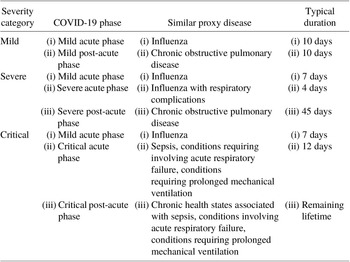
In Table 1, we summarize the results of this investigation.
Summary of COVID-19 phases, similar diseases, and durations for symptomatic cases.

As indicated by the table, we use influenza (without or with complications), COPD, sepsis and conditions involving acute respiratory failure or requiring prolonged mechanical ventilation, as proxies for different phases of COVID-19 cases of varying severity.
4. Effects on health-related quality of life
In our review of the HRQoL literature, we found few studies that address nonfatal cases of COVID-19. The available studies (see Supplementary Table S1) generally address post-acute COVID-19 after hospitalization among small samples of patients from countries other than the USA.
Given that these studies do not provide estimates for cases of varying severity and may not be representative of patients more generally, we turn our attention to studies of the proxy conditions summarized above. In reviewing this literature, we focus on publicly available primary research, written in English, to ensure that those who apply these estimates and review the resulting analyses can access the underlying studies.
To select and evaluate the quality and applicability of these studies, we apply three criteria. These are derived from the recommendations of Institute of Medicine (Reference Miller, Robinson and Lawrence2006) and HHS (2016), which in turn build on the recommendations of other expert groups.Footnote 11 First, the studies should rely on data collected from a U.S. sample within the past 20 years. Second, the studies should describe the effects of the health state on HRQoL using information from those who have experienced the condition, such as patients. Third, the studies should apply preference weights to health states derived from a survey representative of the general U.S. population.
To address the first criterion, we would ideally restrict attention to studies that collect data from representative samples of the U.S. population as a whole, because our goal is to estimate values applicable to national U.S. policies. Given the small number of studies that meet this criterion, we also consider studies that address a subset of the U.S. population; for example, those in a particular location or health care system. We prioritize studies with data from at least 100 patients as an indicator of the likely representativeness of the sample. However, given the narrow patient inclusion criteria applied in some studies, we report data from smaller samples as supplementary estimates. We also include data from other high-income countries to provide insights when sufficient U.S. data are not available.Footnote 12
To address the second criterion, descriptions of impacts, we prioritize studies in which patients describe the effects of a disease on their quality of life. Commonly, these patients complete structured surveys associated with generic HRQoL indices – such as the EQ-5D, Health Utilities Index (HUI), SF-6D, or Quality of Well-Being (QWB) scale – that capture the impacts of a disease on dimensions of health, such as functional status and pain. When few such studies are available, we also consider studies that rely on expert assessment of impacts using a structured survey instrument.Footnote 13
For the third criterion, preference weights, we focus on data from the general population. Structured survey instruments, such as those described above, typically use weights derived from a sample of the general public. We prioritize research using the EQ-5D index because weights specific to the U.S. population have been developed. When few studies using this index and weights are available, we consider results using other HRQoL indices as supporting evidence.
We start with studies listed in the comprehensive Tufts Medical Center Cost-Effectiveness Analysis (CEA) Registry.Footnote 14 Because that database excludes studies that provide QALY estimates without comparing them to costs, we also reviewed the reference lists from relevant studies and searched Google Scholar for each condition. We discuss our findings for each health condition below. The specific studies we considered are listed in the Supplementary Material.
4.1. Influenza
We did not identify any studies of influenza that met our three selection criteria. We then expanded our search to include data from other high-income countries and other HRQoL indices; we identified three studies that provide nine estimates of HRQoL across various influenza severity categories. When we further relaxed our criteria to include smaller sample sizes and expert assessments, we identified an additional four studies and five estimates of HRQoL. We included both confirmed cases of influenza as well as influenza-like illnesses. Because descriptions of severity are not standardized across studies, these estimates may not be fully comparable.
The resulting “with condition” HRQoL estimates (see Supplementary Table S2) ranged from less than 0 to 0.7. Excluding estimates based on small patient samples (less than 100 participants in total) or expert assessment narrows the range to between 0.23 and 0.7. Estimates tend to be higher for influenza cases noted as not involving hospital care (0.50–0.70) compared with cases noted as involving hospital care (0.23–0.62). Estimates were also higher for influenza-like illness compared with confirmed influenza disease. None of the studies reports using U.S. preference weights, which may lead to different results.
As noted earlier, we use influenza as a proxy condition for the effects of the mild acute phase of COVID-19, and influenza with respiratory complications as a proxy for the severe acute phase. Thus for the mild acute phase, we rely on influenza HRQoL estimates for cases not described as receiving hospital care, which range from 0.50 to 0.70. In our illustrative calculations, we use a working assumption of 0.60, the midpoint of this range, for the HRQoL of acute, mild COVID-19. Similar estimates have been used in cost-effectiveness analyses to value HRQoL of influenza without hospitalization (Lee et al., Reference Lee, Bartsch, Brown, Cooley, Wheaton and Zimmerman2015).
In the severe acute phase, COVID-19 cases are typically hospitalized. We exclude HRQoL scores less than 0 (worse than dead), because they come from a small study that does not explain the reason for these exceedingly low values. Accordingly, we focus on HRQoL estimates for influenza cases identified as receiving hospital care which range from 0.23 to 0.62. In our illustrative examples, we use a working assumption of 0.43, the approximate midpoint of this range, for the HRQoL of acute, severe COVID-19.
4.2. Chronic obstructive pulmonary disease
Next, we review estimates of COPD as a proxy for post-acute severe COVID-19. Given the relatively large number of studies that address COPD, we identified several that meet our selection criteria.
The “with condition” estimates range from 0.62 to 0.83 for baseline COPD disease (see Supplementary Table S3). Estimates for individuals with more severe disease are typically lower than estimates for individuals with milder disease. The symptoms of COPD vary over time and are more pronounced during disease exacerbations. When the HRQoL of COPD exacerbations was explicitly assessed, HRQoL estimates were also lower, ranging between 0.49 and 0.59.
Given that individuals with mild COVID-19 appear unlikely to experience very severe post-acute symptoms, we assume that moderate COPD (Global Initiative for Chronic Obstructive Lung Disease (GOLD) stage II) is the best proxy.Footnote 15 We are not able to match post-acute COVID-19 symptoms more precisely to specific COPD severity levels given the limited COVID-19 data available. Estimates corresponding to moderate COPD ranged from 0.70 to 0.832. We use a working assumption of 0.77, the approximate midpoint of this range, in our illustrative calculations to correspond to HRQoL of post-acute mild COVID-19 disease.
Information on post-acute severe COVID-19 symptoms is also limited, and we are again not able to precisely match the symptoms to a particular COPD category. We assume that severe COPD (GOLD stage III) corresponds most closely to post-acute severe COVID-19.Footnote 16 Estimates for severe COPD HRQoL ranged from 0.707 to 0.81. We use a working assumption of 0.76, the approximate midpoint of this range, for the HRQoL associated with post-acute severe COVID-19.
4.3. Acute sepsis, respiratory failure, and prolonged mechanical ventilation
We next review the literature on acute sepsis, conditions involving acute respiratory failure, and conditions involving prolonged mechanical ventilation, which we use as proxies for acute critical COVID-19. Obtaining primary evidence on health status among critically ill patients is difficult and infrequently attempted (Heyland et al., Reference Heyland, Guyatt, Cook, Meade, Juniper, Cronin and Gafni1998).
Consistent with these concerns, we did not find any studies that met our selection criteria. Expanding our search to include all countries regardless of income level, small sample sizes, and primary data collection from experts and the general public, we identified the two studies that report “with condition” HRQoL estimates of −0.295 and 0.23 (see Supplementary Table S4).Footnote 17
Given the limited data available, it is difficult to estimate HRQoL for these conditions. Several studies have recommended using a HRQoL estimate of 0.1 for sepsis and other conditions treated in the ICU (Macario et al., Reference Macario, Chow and Dexter2006; Wu et al., Reference Wu, Chaiyakunapruk, Pratoomsoot, Lee, Chong, Nelson and Smith2018). Thus we use an estimate of 0.1 as a proxy to value acute critical cases of COVID-19.
4.4. Post-acute sepsis, respiratory failure, and prolonged mechanical ventilation
Finally, we review the literature on long-term outcomes of sepsis, conditions involving acute respiratory failure, and conditions involving prolonged mechanical ventilation as proxies for post-acute critical COVID-19. We again did not find any studies that met our selection criteria. We then relaxed our criteria to consider evidence from other high-income countries and indices other than the EQ-5D. We identified four studies and seven estimates that met these criteria. When we further relaxed our criteria to allow for studies that collected data from fewer than 100 patients and evidence based upon expert assessment, we identified one additional study providing four HRQoL estimates.
The “with condition” HRQoL scores range from 0.5 to 0.75 over a period of up to 1 year (see Supplementary Table S5). These studies suggest that quality of life may improve somewhat for survivors of these conditions over the first 3 months following acute disease, but then plateau. Estimates corresponding to 6 months or 1 year after the acute episode range between 0.64 and 0.75.
Our working assumption for our illustrative calculations is that individuals with critical COVID-19 disease will experience chronic symptoms for the remainder of their lives, consistent with prior research that models the long-term effects of critical disease (Khazeni et al., Reference Khazeni, Hutton, Garber, Hupert and Owens2009). While longer-term HRQoL scores were not available, some research suggests that HRQoL remains depressed at 5 years among ICU survivors of ARDS (Herridge et al., Reference Herridge, Cheung, Tansey, Matte-Martyn, Diaz-Granados, Al-Saidi and Cooper2011), as well as for other conditions treated in ICUs (Cuthbertson et al., Reference Cuthbertson, Roughton, Jenkinson, MacLennan and Vale2010).Footnote 18 Based on the HRQoL estimates we reviewed, we use a working assumption of 0.70, the midpoint of the range of estimates at 6 months or longer from the acute episode of critical disease, to correspond to the HRQoL of post-acute critical COVID-19 disease. This estimate is particularly uncertain given the current limited knowledge of COVID-19 long-term effects and the limited data on long-term HRQoL estimates for other critical diseases.
4.5. Summary of HRQoL estimates
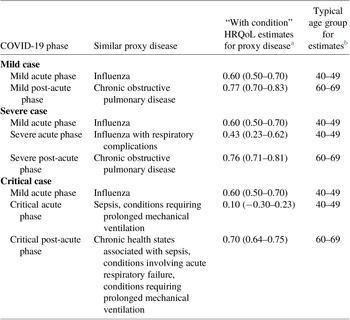
In Table 2, we summarize the results of our HRQoL literature review, focusing on the studies that best meet our selection criteria. These estimates cover relatively wide ranges that come close to overlapping in most cases despite differences in the severity of the conditions. These ranges reflect variation in the populations, indices, weights, conditions, and other characteristics of the methodology across studies, not simply differences in the diseases themselves. Most of the studies on average address middle-aged or elderly adults.
Summary of literature review results.

a Reported numbers include the central HRQoL estimate from the literature review, which is the midpoint in most cases (as discussed above), as well as the range of estimates.
b Typical 10-year age bands that correspond most closely to the average ages of individuals considered in the studies.
As indicated by the table, when placed on a 0-to-1 scale (with 0 representing conditions as bad as death and 1 representing full health), these conditions lead to HRQoL levels ranging from close to 0 to about 0.8, for individuals of middle to advanced age.
To calculate the difference between with condition and without condition HRQoL, we assume that without condition HRQoL equals population-average HRQoL (which varies with age), using Hanmer et al. (Reference Hanmer, Lawrence, Anderson, Kaplan and Fryback2006) EQ-5D estimates with U.S. weights.Footnote 19 We further assume that illness decreases baseline health by the same fraction across age groups. Specifically, we divide the “with condition” HRQoL from Table 2 by the population-average HRQoL for an individual in the corresponding typical age group. For example, we divide the HRQoL for mild acute phase (influenza) by the HRQoL for ages 40–49 and the HRQoL for mild post-acute phase (COPD) by the HRQoL for ages 60–69. We then multiply this intermediate estimate by the population-average HRQoL corresponding to each age category to yield estimates of the “with condition” HRQoL for each age range.
Individuals under age 20 and over age 90 were not included in the Hanmer et al. (Reference Hanmer, Lawrence, Anderson, Kaplan and Fryback2006) study. Individuals under age 20 also were not well represented in the “with condition” estimates of HRQoL obtained from the literature review. We use HRQoL estimates corresponding to the 20–29 age group to approximate HRQoL among individuals under age 20. Similarly, for individuals age 90 and older we use HRQoL estimates corresponding to those for the 80–89 age group.
We use the resulting proportional changes in HRQoL to estimate “with condition” HRQoL for each severity category and phase, for three illustrative ages (20, 40, and 70). These results are reported in Table 3.
Estimated “with condition” HRQoL for proxy conditions, illustrative estimates by age.

As indicated by the table, the effects of these conditions on HRQoL vary by phase and decrease slightly with age.
5. Value per nonfatal statistical case
The estimates in the prior section reflect HRQoL for nonfatal cases of differing severity. The value of averting these cases is equal to the difference between with and without condition health, taking into account both the change in HRQoL and its duration. Multiplying the change in HRQoL by duration yields estimates of the averted QALY losses associated with preventing a nonfatal case. These QALY estimates can be used directly in cost-effectiveness analysis, which involves multiplying the QALY estimate by the number of averted cases of each type and calculating the costs per QALY. For benefit-cost analysis, the QALY change per nonfatal case is multiplied by the value per QALY to estimate the monetary value per case.
More specifically, building on the process introduced in Figure 1, we first calculate “with condition” HRQoL by age based on the literature review summarized in Section 4, the results of which are illustrated in Table 3. Second, we compare these estimates to estimates of population average HRQoL, as discussed in Section 5.1 below. Third, we multiply the resulting HRQoL increment by the duration estimates in Table 1 to estimate the change in QALYs, summing the results for each phase to estimate the value. Fourth, we multiply these QALY estimates by the value per QALY, as discussed in Section 5.2.
These steps are illustrated in Figure 2.
Calculating the value per averted nonfatal case.

Relying on estimates of population average health in these comparisons assumes that, with the policy, those affected would not experience COVID-19 symptoms. Some policies may reduce the severity (and/or duration) of the symptoms rather than eliminating them entirely. Under that scenario, analysts should compare the values for cases of differing types. For example, if the policy reduces the severity of some cases from “critical” to “mild,” the value per case would be the difference between the QALY gain associated with each type of case, multiplied by the value per QALY.
5.1. Change in QALYs per averted nonfatal case
We use the HRQoL estimates discussed above to calculate the change in QALYs per symptomatic case. First, we calculate the absolute change in HRQoL score for each category, phase, and age group, by comparing the with condition values from Table 3 to the population average values from Hanmer et al. (Reference Hanmer, Lawrence, Anderson, Kaplan and Fryback2006). For example, Hanmer et al. report that the population-average HRQoL for a 40-year old is 0.875. Thus the change in HRQoL for the mild acute phase for a 40-year-old would be 0.875 − 0.600
 $ = $
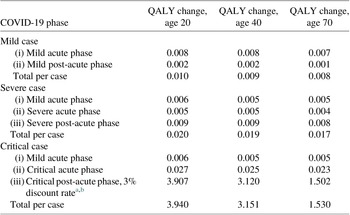
0.275. We then multiply by the duration of each condition (see Section 2) to estimate the change in QALYs. As part of this calculation, we convert from days to years assuming 365 days per year. For example, the change in QALYs for the mild acute phase for a 40-year-old would be 0.275 × (10/365) = 0.008. The results for all disease phases and age groups are reported in Table 4.Footnote 20
Estimated change in QALYs per nonfatal symptomatic case, based on proxy conditions.

Note: Estimates of totals per case may not equal the sum of change in QALYs by phase due to rounding.
a In these calculations, we assume the post-acute effects are a constant decrement throughout the individual’s lifetime for critical cases, given uncertainty about the duration of these impacts and the extent to which they change over time. Remaining life expectancy is calculated from conditional survival rates by year of age reported in Arias and Xu (Reference Arias and Xu2020).
b Discounting to reflect time preferences is necessary in this case because duration is greater than 1 year.
5.2. Monetary value per averted nonfatal case
We estimate the monetary value of these QALY gains based on estimates of the value per QALY derived from the VSL.Footnote 21 Hammitt (Reference Hammitt2020), Viscusi (Reference Viscusi2020), and Robinson et al. (Reference Robinson, Eber and Hammitt2021a, Reference Robinson, Sullivan and Shogren b) discuss the VSL estimates applicable to COVID-19 in detail. They note that although it is common to focus solely on the effects of age on VSL, both theory and empirical research suggest that numerous other factors affect these values. These include individual characteristics such health status and income as well as age and life expectancy, and also risk characteristics such as morbidity prior to death, qualitative risk attributes (such as dread), and the magnitude of the risk change. The net effect of these factors is uncertain; they are counterbalancing to an unknown extent.
Thus, consistent with the recommendations of that work, we rely on the population-average VSL estimate of $11.4 million recommended by HHS (2016, 2021), in 2020 dollars and at 2020 income levels. This estimate is very similar to the estimate used by the U.S. Department of Transportation (2021), as well as the U.S. Environmental Protection Agency’s (2010) estimate and the publication bias-adjusted estimate recommended by Viscusi (Reference Viscusi2018) when adjusted to the same year. HHS converts these VSL estimates to a constant value per QALY, assuming that the VSL estimates reflect on average an individual of 40 years of age. The calculations combine data on conditional survival rates for each subsequent year of age (Arias & Xu, Reference Arias and Xu2020) with data on HRQoL at each age (Hanmer et al., Reference Hanmer, Lawrence, Anderson, Kaplan and Fryback2006), discounted using a 3 % rate. The resulting value per QALY is $580,000. In Table 5, we report the values per nonfatal case averted that result when we multiply this value by the QALY estimates from Table 4.
Value per nonfatal statistical case, illustrative estimates by age (2020 dollars and income levels, 3 % discount rate).

Note: Estimates of totals per case may not equal the sum of the values by phase due to rounding.
While reflecting several simplifying assumptions, these illustrative calculations show that the value per averted nonfatal case may vary substantially depending on the severity of the disease, ranging over orders of magnitude. These estimates suggest that the value of averting a case of COVID-19 for an individual at age 40 may be about $5300 for mild cases, $11,000 for severe cases, and $1.8 million for critical cases.Footnote 22
As discussed in the introduction, our approach is based on the data currently available and the estimates can be updated as more information emerges on the effects of COVID-19. Although each step in our approach involves some uncertainty, uncertainty about the monetary value per QALY is likely to have the largest impact on the estimates.
In Table 6, we explore the effect of changing the VSL estimates used to derive the value per QALY. HHS (2016, 2021) recommends that analysts conduct sensitivity analysis using VSL estimates of $5.3 million and $17.4 million, which translate into values per QALY of $270,000 and $880,000 respectively, using a 3 % discount rate (2020 dollars). In Table 6, we report the results of using these low and high values, for an individual age 40.
Value per nonfatal statistical case, sensitivity analysis (2020 dollars and income levels, 3 % discount rate).

Note: Values for individual age 40; low estimates based on $5.3 million VSL, high estimates based on $17.4 million VSL.
As indicated by the table, applying the low value per QALY reduces our estimates by almost 50 %, while the high value increases them by about 50 %.
Because this approach focuses on estimating individual willingness-to-pay, costs that accrue to third parties can be added to more fully account for the impact on social welfare. For example, Tsai et al. (Reference Tsai, Vogt and Zhou2021) report medical costs for fee-for-service Medicare patients, including inpatient and outpatient care. If we extrapolate these costs to other insurers and age groups using an adjustment factor (1.49) based on average hospitalization costs across insurers (Avalere Health, 2020), we find that average medical costs averted per mild case are about $230, per severe case are about $27,000 (assuming such cases are hospitalized but not placed on ventilators), and per critical case are about $74,000 (assuming hospitalization and ventilation). These estimates exclude other averted third-party costs, such as the value of caregiving provided by family and friends.Footnote 23
6. Conclusions and implications
The value of reducing nonfatal COVID-19 risks is uncertain, but estimating these values provides useful information for evaluating interventions to decrease the spread of the disease. Because little research is available that directly addresses the value of reducing nonfatal risks, we turn to proxy measures. We draw on the HRQoL literature for similar conditions and estimate the QALY gains per symptomatic nonfatal COVID-19 case averted, valuing them using estimates recommended by HHS.
We find that the value of averting nonfatal COVID-19 cases varies substantially depending on severity. The value of averting critical cases is also sensitive to age, given that the effects persist through the remaining life span. For an individual of age 40, we estimate that the gains per averted case are about 0.01 QALY for mild cases, 0.02 QALY for severe cases, and 3.15 QALYs for critical cases. These gains translate into monetary values of about $5300 per mild case, $11,000 per severe case, and $1.8 million per critical case, using our central estimates of the value per QALY and a 3 % discount rate.
In benefit-cost analysis, the distribution of cases by severity should be estimated based on an epidemiological model or other approach that compares health impacts in the “without policy” baseline to health impacts with the policy. To illustrate the implications of our approach, we calculate the average value of averting a symptomatic but nonfatal COVID-19 case based on the national severity distribution. As noted earlier, costs paid by third parties, including medical costs paid by insurers, should be added to these estimates to more fully account for the impacts of these cases. These estimates do not include fatal cases, the valuation of which is discussed in more detail in Hammitt (Reference Hammitt2020), Viscusi (Reference Viscusi2020), Robinson et al. (Reference Robinson, Eber and Hammitt2021a, Reference Robinson, Sullivan and Shogren b) and elsewhere.
CDC reports that there were approximately 124 million symptomatic COVID-19 cases resulting in 7.5 million hospitalizations in the USA from February 2020 to September 2021 (CDC, 2021c) and that the percentage of hospitalizations resulting in ICU admission was 21.9 % from March 2020 to January 2022 (CDC, 2022). We assume that cases involving ICU admission are critical (1.3 %), cases involving hospitalization without ICU admission are severe (4.7 %), and other symptomatic cases (94.0 %) are mild. Using values corresponding to individuals aged 40 years for illustration, we find an average QALY loss of 0.051 and a value per nonfatal symptomatic case averted of $30,000. Given a value per fatal case averted of $11.4 million, this suggests that the value of averting about 380 nonfatal cases would be equivalent to the value of averting one death.
The average QALY loss is similar to that reported by Basu and Gandhay (Reference Basu and Gandhay2021); using their simulation model, they estimate that a representative U.S. resident will experience a QALY loss of 0.055. For the average value per nonfatal case, our illustrative estimate is somewhat lower than the $46,000 weighted average estimated by Kniesner and Sullivan (Reference Kniesner and Sullivan2020), based on their estimates of COVID-19 case and hospitalization counts as of July 2020 and U.S. Department of Transportation values for motor vehicle injuries of differing severities.
The average value may change substantially over time and with characteristics of the population of interest. For example, recent data from vaccinated populations in Qatar during the Omicron wave indicate that 99.75 % of the nonfatal symptomatic cases averted were mild, 0.23 % were severe, and 0.02 % were critical (Abu-Raddad et al., Reference Abu-Raddad, Chemaitelly, Ayoub, AlMukdad, Yassine, Al-Khatib and Smatti2022). Applying this severity distribution to a population of 40-year-old Americans, we estimate that the average QALY loss per symptomatic case decreases to 0.010 and the average value per symptomatic case averted decreases to $5600.
While our approach provides a flexible and useful framework for estimating the values of averting nonfatal health effects across different contexts, it also involves several layers of uncertainty. First, the symptoms of COVID-19 may differ from the effects of the diseases we use as proxies in ways that affect HRQoL. Second, for several of the proxy conditions, the HRQoL literature is sparse. Third, HRQoL with and without the condition may vary by age or underlying health impairments, influencing these estimates. Fourth, the duration of the symptoms may differ from our illustrative estimates. Fifth, the long-term effects of COVID-19 are particularly uncertain at this time. Finally, as illustrated by our sensitivity analysis, the approach used to estimate the value per QALY may substantially affect these estimates. Despite these limitations, these estimates can be used to illustrate the potential magnitude of the benefits associated with averting nonfatal cases, and can be updated as needed as new information on health impacts becomes available.
The approach we present can be used to address other illnesses that are not well-covered by the QALY or WTP literature. This is of particular importance given that some agencies, such as HHS, recommend that monetized QALYs be used in their analyses when suitable WTP estimates of reasonable quality are not available. Our work also highlights some limitations of the QALY literature in this context. Many of the studies we identified were based on small or specialized samples that were not representative of the national population. Some focus on cases that may not reflect the average or typical severity of the illness. Inconsistencies in the indices and weights used also inhibit comparability and synthesis. Additional nationally representative QALY studies that address a range of illnesses would be useful for improving the conduct of both cost-effectiveness analyses and benefit-cost analyses focused on national policies.
Acknowledgements
This article builds on work conducted for the U.S. Department of Health and Human Services (HHS) under subcontract to Industrial Economics, Incorporated and Mathematica Policy Research. Eber’s work was also supported in part by grant number T32HS000055 from the HHS Agency for Healthcare Research and Quality, under its National Research Service Award program for institutional research training in health policy. We thank participants in several seminars and conference sessions for their helpful comments, including those hosted by HHS offices and agencies, Erasmus University, Harvard T.H. Chan School of Public Health, the University of Southern California, the Society for Benefit-Cost Analysis, and the Society for Risk Analysis. We also thank the four anonymous reviewers for their insightful feedback. The views expressed are our own and do not reflect the views nor endorsement of HHS or other organizations.
Supplementary Material
To view supplementary material for this article, please visit http://doi.org/10.1017/bca.2022.11.
Competing Interests
The authors declare none.