Introduction
Several disease control models have established that a holistic approach is the key to effective and sustainable intervention against endemic diseases, especially those whose transmission is inexplicably linked to poverty, low sanitation and low standard of living (Macdonald, Reference Macdonald1965; Lewis, Reference Lewis1975; Bundy et al., Reference Bundy, Cooper, Thompson, Didier and Simmons1987; Anderson & May, Reference Anderson and May1991). The most important of such diseases include helminth infections, which in sub-Saharan Africa affect over 683 million people in areas where climatic and other environmental conditions also favour unabated disease transmission (de Silva et al., Reference de Silva, Brooker, Hotez, Montresor, Engels and Savioli2003). The usual approach to assessing the public health impact of water development projects are limited to water-related helminth infections such as schistosomiasis, dracunculiasis, etc. while ignoring others which are directly or indirectly linked to the environmental conditions created by such projects. The implication of this lapse to both individual and public health situations in endemic communities are unimaginably high. This is why the World Health Organization and other disease control funding agencies have recommended not only a holistic approach to disease control but also a periodic morbidity control of all helminth infections among high-risk groups (e.g. school-aged children) to reduce transmission and morbidity below critical levels (WHO, 1987). Elucidating the helminth disease profile of a locality, a vital component of this strategy, requires regular auditing of each disease, a goal that can be achieved by either single or multiple infection diagnosis. Since most helminth infections are intestinal and hence, diagnosed by faecal sample analysis, multiple rather than single-infection diagnosis seems more robost for many reasons. Firstly, it is very cost effective having high saving potentials on transportation, equipment, time and other ancillary costs. It also gives a clearer on-the-spot picture of the disease situation in an area, identifying not just affected individuals but also those with multiple infections that constitute an enormous risk to environmental contamination (Mafiana, Reference Mafiana1995; Okon & Oku, Reference Okon and Oku2001; Ukpai & Ugwu, Reference Ukpai and Ugwu2003; Sam-wobo et al., Reference Sam-wobo, Mafiana and Idowu2004). Such information is both invaluable and indispensable to effective planning, implementation and monitoring of control programmes. This paper presents the results of a multiple-infection diagnosis of intestinal helminths in Eko-ende and Ore, two lakeside communities located on the shore of Erinle Dam, Osun State, Nigeria. It is hoped that the findings of the investigation will contribute to effective disease control planning and implementation in Erinle Dam and others in Nigeria and other tropical nations with similar heavy burdens of infectious disease.
Materials and methods
Study area
This study was conducted in Eko-Ende and Ore, Ifelodun and Odo-Otin Local Government Areas respectively, Osun State, southwestern Nigeria located between Latitude 7° 30′–7° 35′ N and Longitude 4° 30′–4° 35′ E (Adewunmi et al., Reference Adewunmi, Gebremedhin, Becker, Olorunmola, Dorfler and Adewunmi1993; Oladejo & Ofoezie, Reference Oladejo and Ofoezie2006). Eko-ende is located 2 km southeast of Oba-Ile while Ore is about 1 km south of Ilie, two peri-urban communities described by Oladejo & Ofoezie (Reference Oladejo and Ofoezie2006). The communities are similar to Ilie and Oba-Ile in many respects. They all lie within the same latitudes and longitudes and each has a population of less than 5000 persons with an annual growth rate of about 3%. The inhabitants are Yoruba, many of whom are peasant farmers and petty traders (Oladejo & Ofoezie, Reference Oladejo and Ofoezie2006). The climate is characteristically hot and humid with a mean annual rainfall of 1100 mm and mean annual temperature of 27 °C (Ayoade, Reference Ayoade, Barbour, Oguntoyinbo, Onyemelukwe and Nwafor1982).
Study population and patient selection
Children of school going age (3–18 years old), attending or not attending school were selected for the study and followed as separate groups. In accordance with local requirements, the children were selected with the informed consent of their parents and the traditional ruler of each area. All examinations and sample collections were performed at the palace of the respective traditional rulers. Each selected child was interviewed to obtain information on age, school attendance status and places visited six months prior to the study. All children who were away from either community for 30 days or more during the six months were excluded from the study.
Sample collection and parasitological examination
The objectives of the investigation were explained to the children, community leaders, family, teachers and other interested persons present. The benefit of knowing one's health status and the importance of individual co-operation to the overall success of the project was stressed. Thereafter, a pre-labelled wide-mouthed, screw-capped plastic container was given to each selected child with explanation on how to handle faecal samples. Samples were collected between the hours of 1100 and 1700 h local time when children were normally most active and the circadian pattern of most human parasites egg output at a peak (Stimmel & Scott, Reference Stimmel and Scott1956; Pugh, Reference Pugh1979). A few children who were unable to provide samples the first day were given a second chance the next day, after which those that still failed were replaced. Samples were preserved in 10% formaldehyde and returned to the laboratory, about 200 km away, to assess the presence and number of helminths eggs in the faeces using the Kato thick smear method (WHO, 1994). The method involves straining a small quantity of each sample across a metal screen (mesh size 250 μm) after vigorous mixing. A template (of 50 mg well capacity) full of strained faeces was transferred into a glass slide and covered with a cellophane strip previously soaked in 50% glycerine-malachite green solution for at least 24 h. The faecal material was evenly spread under the cellophane strip by gently pressing the slide, inverted. The presence and number of helminth eggs were determined under the microscope at 100 × magnification and eggs per gramme (epg) of faeces was obtained by multiplying each slide count by 20 (Pitchford & Visser, Reference Pitchford and Visser1975). Children found to be positive for any of the parasites were sent to a local health care centre for treatment.
Statistical analyses
Differences in the prevalence of each parasite infection among subgroups were determined using the χ2 values from the contingency tables. Variations in mean egg counts between dichotomous variables were assessed with the Student-t test and one-way analysis of variance (oneway-ANOVA) for explanatory variables with more than two levels (Zar, Reference Zar1984). All analyses were performed using SPSS for Windows version 11.
Results
Overall infection patterns
Six species of intestinal helminths, namely Ascaris lumbricoides, hookworm (Necator americanus, Ancylostoma duodenale or both), Trichuris trichiura, Taenia species, Strongyloides stercoralis and Schistosoma mansoni, were recorded in the Eko-ende and Ore communities. From a total of 309 children examined in both communities, 242 (78.3%) were infected with at least one intestinal helminth (76.2% in Eko-ende and 80.9% in Ore). All six parasite species occurred in both communities except Taenia spp. and S. stercoralis which were found only at Ore. The overall prevalences of Ascaris, hookworm, Trichuris and S. mansoni were 67.0%, 43.7%, 20.7% and 25.6% respectively with corresponding intensities of 737.3 ± 1068.0, 275.3 ± 660.5, 50.6 ± 156.4 and 42.0 ± 113.6 epg faeces. Five children (6–15 years old) infected with Taenia and S. stercoralis were all resident at Ore community.
Age and gender patterns of infection
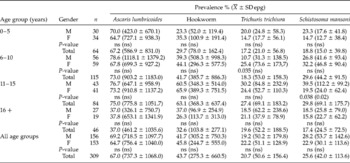
The age and gender distribution of prevalence and intensity of intestinal helminth infections in both communities combined are presented in table 1. Prevalence values of the four commonest infections, i.e. A. lumbricoides (37.0–75%), hookworm (32.6–63.1%), T. trichiura (19.6–27.4%) and S. mansoni (17.4–29.8%), were more age- than gender-dependent. While gender-dependent distribution of infections was comparable and followed no clear-cut patterns in all age groups except those in the 6–10 year old and 11–15 year old for T. trichiura and S. mansoni, respectively, age-dependent patterns were pronounced. For each of the four common infections, the prevalence increased from the youngest age-group to a peak in the 11–15 year age-bracket. The pattern of intensity of infection was fairly similar to the prevalence pattern except that the peak mean intensity of A. lumbricoides (903.2 ± 1183.0 epg faeces) and hookworm (385.7 ± 886.3 epg faeces) occurred earlier in the 6–10-year-old bracket while those of T. trichiura (69.1 ± 183.2 epg faeces) and S. mansoni (69.1 ± 175.7 epg faeces) were recorded among the 11–15-year-old age group. A significant gender-dependent intensity pattern was recorded for S. mansoni infection only among the 11–15-year-olds. Of five boys infected with Taenia spp. and S. stercoralis, three were in the 6–10 year age bracket and two in the 11–15 year age group.
Prevalence and intensity of intestinal helminths in relation to gender and age of schoolchildren in Eko-ende and Ore communities, Osun State, Nigeria.

ns, not significant at 5% level of significance; n, number examined.
Infection patterns relative to village and school attendance status
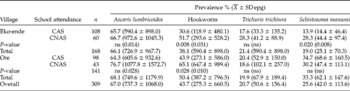
Patterns of both prevalence and intensity of all four common infections were remarkably similar between children in Eko-ende and Ore communities. While the prevalence and intensity of A. lumbricoides and T. trichiura were comparable between communities, those of hookworm and S. mansoni were significantly higher (P < 0.05) at Ore than at Eko-ende (table 2). Dividing the children into attending school and not attending school, portrayed a remarkable pattern. Within each village, the prevalence and intensity of the four common infections except S. mansoni in Ore were higher among children not attending school than their counterparts attending school, while the infection pattern of S. mansoni in Ore was higher among attending school children. Differences in the prevalence reached significant levels for hookworm in both villages and S. mansoni in Eko-ende while differences in morbidity levels reached significant levels for A. lumbricoides and hookworm in both villages and S. mansoni in Eko-ende.
Prevalence and intensity of intestinal helminths in children attending school in Eko-ende and Ore communities, Osun State, Nigeria.

CAS, children attending school; CNAS, children not attending school; n, number examined; ns, not significant at 5% level of significance.
Result of statistical comparison of degrees of infections between Eko-ende and Ore communities: (i) Prevalence: A. lumbricoides (ns); hookworm (sig; χ2 = 4.7, P = 0.020); T. trichiura (ns); S. mansoni (sig.; χ2 = 8.2, P = 0.003). (ii) Intensity: A. lumbricoides (ns); hookworm (sig.; F = 7.6, P = 0.006); T. trichiura (ns); S. mansoni (sig.; F = 8.3, P = 0.004).
Multiple infection patterns
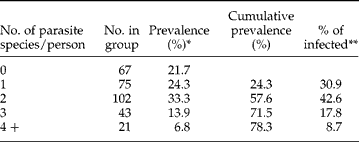
The distribution of zero, single and multiple infections of the four common parasites per individual are summarized in table 3. Up to 78.3% of individuals in Eko-ende and Ore communities were infected with at least one of the four parasites while 54.0% had at least two parasites, 20.7% at least three and over 6% four parasites. The most common double infection was the Ascaris/hookworm combination which accounted for 53% of 103 cases observed. This was followed by Ascaris/S. mansoni (24%) and Ascaris/T. trichiura (14%) combinations. The least occurring combination was Taenia/Strongyloides which accounted for less than 1%. Of 43 observed triple infections, Ascaris, hookworm and T. trichiura combination accounted for over 54% and Ascaris, hookworm and S. mansoni combination 37%. The most important four-parasite species infection was the Ascaris/hookworm/T. trichiura/S. mansoni combination which accounted for over 86% of 21 cases observed. The prevalence of single and double infections was higher at Eko-ende (102 of 178) while that of individuals with three and four parasite infections were greater at Ore (38 of 64). The differences were, however, not significant at the 5% level of probability.
Prevalence of zero, single and multiple infections of intestinal helminths among schoolchildren in Eko-ende and Ore communities, Osun State, Nigeria.
* Rate of infection among the examined population.
** Rate of infection among the infected population.
Discussion
The results of this investigation have clearly shown that the communities around Erinle Dam are endemic for many common infections transmitted by a combination of environmental contamination, poverty and low standards of living. About four out of every five persons in the communities were infected with one or more parasitic infections (ascariasis, hookworm, trichuriasis, schistosomiasis, strongyloidiasis and/or taeniasis). In terms of prevalence and intensity, ascariasis appears the most important public health problem in the communities. Its overall prevalence (67%) is more than 3.7 times the national average (18%) while the prevalence range (66.1–68.1%) falls within the upper one-third of the national range (0.9–98.2%) (Crompton, Reference Crompton, Crompton, Nesheim and Pawlowski1989). The age-dependent pattern of this disease (i.e. rising prevalence and intensity in younger age groups and a declining trend in older age groups, is consistent with observations in many other communities within the rainforest belt of southern Nigeria (Oyewole et al., Reference Oyewole, Ariyo, Sanyaolu, Oyibo, Faweya, Monye, Ukpong and Okoro2002; Agbolade et al., Reference Agbolade, Akinboye and Awolaja2004; Egwunyenga & Ataikiru, Reference Egwunyenga and Ataikiru2005).
However, while the patterns of infection of hookworm, trichuriasis and schistosomiasis suggest a lesser public health importance, in reality they have serious public health implication for these communities. For instance, a 25.6% overall prevalence of Schistosoma mansoni is more than 2.5 times the national average (13.1%) (Ofoezie, Reference Ofoezie2002) and Erinle lake is one of the few sites in southern Nigeria where the disease is being transmitted, despite its location many latitudes below the southern border of the distribution of Biomphalaria pfefferi distribution in West Africa (Betterton, Reference Betterton1984). Biomphalaria pfeifferi is the only intermediate host of Schistosoma mansoni in Nigeria (Brown, Reference Brown1994). Besides, the hookworm infection rate of 43.7% is disturbing at a time when the disease is believed to be dying out in most other parts of the country. The high prevalence of hookworm is either an indication of poverty (inability to purchase protective footwear) or ignorance of hookworm transmission. Even the five cases of Taenia and Strongyloides spp. have serious implications because these are rare diseases in many parts of Nigeria.
In our earlier report of a complementary investigation at Ilie and Oba-Ile (two neighbouring communities) (Oladejo & Ofoezie, Reference Oladejo and Ofoezie2006), we highlighted an unabated Schistosoma haematobium transmission in Erinle reservoir and suggested that this is evidence of serious environmental contamination in the area. The findings of the present investigation has therefore shown that the level of environmental contamination in the area is even more widespread than feared and the public health situation is indeed alarming. Unabated schistosomiasis transmission would have suggested only faecal contamination of water, but the observed patterns of many soil-transmitted parasitic infections (i.e. ascariasis, hookworm and trichuriasis) are clear evidence of not just indiscriminate soil contamination but also poor sanitation and an overall low standard of living. Besides, ascariasis and the few cases of taeniasis further suggest unhygienic food preparation and handling, especially vegetables and meat. This conclusion is consistent with that of Crompton (Reference Crompton, Crompton, Nesheim and Pawlowski1989), who showed that these diseases thrive in places and communities where poverty, ignorance and general social deprivation are entrenched and where facilities for safe water supply and excreta disposal are lacking. Kagei (Reference Kagei and Yokogawa1983) also reported that while hookworm is transmitted by unprotected skin exposure to contaminated soil, ascariasis and trichuriasis are driven by exposure to dirty utensils, unwashed vegetables and dirty fingers and fingernails.
As emphasized in our earlier treatise, the Nigerian government has a role to play in ameliorating the effect of these diseases and reducing their levels to below public health importance. Asaolu & Ofoezie (Reference Asaolu and Ofoezie2002) have emphasized that most tropical infections can be controlled through the implementation of appropriate health-saving measures such as provision of safe water supply and sanitation, appropriate and timely drug delivery to high risk groups and effective health education to the uninformed. Implementation of these measures in Erinle and similar dams in Nigeria and elsewhere cannot be recommended more forcefully.