Milk fever (MF) is a hypocalcaemic disorder occurring in dairy cows soon after parturition that involves severe hypocalcaemia (serum Ca concentration <1.5 mmol/l, 6.0 mg/ml), flaccid paresis due to neuromuscular dysfunction, ataxia, recumbency and depression with or without loss of consciousness (Rodríguez et al., Reference Rodríguez, Arís and Bach2017; Cai et al., Reference Cai, Kong, Wu and Wang2018). A high incidence of this disease is found in older, high-producing cows with 3 or more lactations (Goff, Reference Goff2014). Reports from the United States indicate that 5–7% of dairy cows develop MF every year (Reinhardt et al., Reference Reinhardt, Lippolis, McCluskey, Goff and Horst2011; Goff, Reference Goff2014) and 47% of multiparous cows have various degrees of subclinical hypocalcaemia (serum Ca concentration <2.0 mmol/l, 8.0 mg/ml) around parturition (Reinhardt et al., Reference Reinhardt, Lippolis, McCluskey, Goff and Horst2011). Several periparturient disorders, such as dystocia, ketosis and displaced abomasum are associated with hypocalcaemia (Curtis et al., Reference Curtis, Erb, Sniffen, Smith, Powers, Smith, White, Hillman and Pearson1983; Rodríguez et al., Reference Rodríguez, Arís and Bach2017). In addition, parturient hypocalcaemia may reduce rumen and abomasum motility cause mobilisation of body fat into the circulation as free fatty acid, thus increasing the risk of metabolic disorders (Reinhardt et al., Reference Reinhardt, Lippolis, McCluskey, Goff and Horst2011; Goff, Reference Goff2014).
The major homoeostatic responses to hypocalcaemia are intensification of intestinal absorption and bone resorption of Ca. However, Ca homoeostasis in parturient cows depends primarily on intestinal Ca absorption, because of delayed bone Ca resorption for a week or more (Ramberg et al., Reference Ramberg, Mayer, Kronfeld, Phang and Berman1970, Reference Ramberg, Johnson, Fargo and Kronfeld1984). Feeding acidogenic diets prepartum by manipulating the dietary cation and anion difference (DCAD) is a mainstay approach for the prevention of parturient hypocalcaemia (Wilkens et al., Reference Wilkens, Nelson, Hernandez and McArt2020). A low-DCAD diet, which induces metabolic acidosis in parturient cows, increases exchangeable bone Ca by stimulation of osteoclastic bone resorption, contributing to the maintenance of Ca homoeostasis (Goff, Reference Goff2014). Therefore, it may be beneficial to monitor prepartum bone metabolism to predict the risk of parturient hypocalcaemia.
Tartrate-resistant acid phosphatase isoform 5b (TRAP5b) is a biomarker of osteoclastic bone resorption (Fohr et al., Reference Fohr, Dunstan and Seibel2003). Circulating TRAP5b activity has been reported to correlate with the number of osteoclasts in bone (Rissanen et al., Reference Rissanen, Suominen, Peng and Halleen2008). Osteoprotegerin (OPG) is a protein that regulates bone resorption by inhibiting osteoclast differentiation and formation (osteoclastogenesis) in the bone microenvironment (Simonet et al., Reference Simonet, Lacey, Dunstan, Kelley, Chang, Luthy, Nguyen, Wooden, Bennett, Boone, Shimamoto, DeRose, Elliott, Colombero, Tan, Trail, Sullivan, Davy, Bucay, Renshaw-Gegg, Hughes, Hill, Pattison, Campbell, Sander, Van, Tarpley, Derby, Lee and Boyle1997). The blood OPG concentration increases in pregnant mice and women, suggesting that this protein may play an important role in the prevention of excessive maternal bone resorption (Yano et al., Reference Yano, Shibata, Mizuno, Kobayashi, Higashio, Morinaga and Tsuda2001; Naylor et al., Reference Naylor, Rogers, Fraser, Hall, Eastell and Blumsohn2003). Bone-specific alkaline phosphatase (BAP) is a non-collagenous protein secreted by osteoblasts, an isoenzyme of alkaline phosphatase (ALP), which is essential for bone mineralisation, and serves as a specific biomarker of osteoblast function and bone formation (Fohr et al., Reference Fohr, Dunstan and Seibel2003). In cattle, circulating BAP activity has been measured using a spectrometry method with heat-inactivation or wheat-germ lectin precipitation techniques (Kim et al., Reference Kim, Yamagishi, Ueki, Miura, Saito, Sato and Furuhama2010; Mohebbi et al., Reference Mohebbi, Khaghani and Mohammadnia2010), a commercial ELISA kit employing an antibody against human BAP (Staric and Hodnik, Reference Staric and Hodnik2020) and an agarose gel electrophoresis (AGE) method separating the bone isoenzyme of ALP (ALP3) from other isoenzymes (Chiba et al., Reference Chiba, Hatate, Onomi, Moriyama, Goto and Yamagishi2020a, Reference Chiba, Onomi, Hatate, Moriyama, Goto and Yamagishi2020b). Every measuring method has shown an increase in blood BAP and ALP3 activities around calving, and higher activity in younger than older cows (Kim et al., Reference Kim, Yamagishi, Ueki, Miura, Saito, Sato and Furuhama2010; Staric and Hodnik, Reference Staric and Hodnik2020; Chiba et al., Reference Chiba, Onomi, Hatate, Moriyama, Goto and Yamagishi2020b).
Circulating TRAP5b activity in dairy cows increased commencing 1 week prepartum and was maintained at this level up to a few days postpartum (Devkota et al., Reference Devkota, Takahashi, Sato, Sasaki, Ueki, Osawa, Takahashi and Yamagishi2015). Multiparous cows had a higher serum OPG concentration than late-pregnant heifers at 21 d precalving, indicating that older cows may preserve their bone mineral content during late pregnancy (Hatate et al., Reference Hatate, Kawashima, Hanada, Kayano and Yamagishi2018, Reference Hatate, Kawashima, Kayano, Hanada and Yamagishi2020). Our pilot study, using the data of cows recruited from several experiments (Hatate et al., Reference Hatate, Kawashima, Kayano, Hanada and Yamagishi2020), showed that the decrease in the ratio of OPG and TRAP5b (O/T ratio) towards calving was less pronounced in MF cows compared to cows without MF. A report from Slovenia (Staric and Hodnik, Reference Staric and Hodnik2020) described a correlation between prepartum serum BAP activity (10–2 d before calving) and the serum Ca concentration on the day of calving in dairy cows reared in the barn during winter, and suggested that this could be used as a biomarker to predict which cows were at higher risk of MF. Because bone homoeostasis depends on osteoblast–osteoclast interactions (Chen et al., Reference Chen, Wang, Duan, Zhu, Schwarz and Xie2018; Kim et al., Reference Kim, Lin, Stavre, Greenblatt and Shim2020), we hypothesised that synchronous evaluation of serum biomarkers reflecting osteoblastic and osteoclastic bone metabolism before parturition would be useful for predicting the risk of MF. We investigated whether prepartum levels of serum TRAP5b, OPG, and ALP3 are related to the degree of hypocalcaemia at calving and the risk of MF in cows with advancing parity.
Materials and methods
The experimental procedures performed in this study complied with the Guide for the Care and Use of Agricultural Animals of Obihiro University (approval number: #18-148).
Animals and study design
The study was performed in the University Farm of Obihiro University of Agriculture and Veterinary Medicine (OUAVM), which had approximately 90 dairy cows and 90 young stock of the Holstein-Friesian breed. The lactating cows were housed in a free-stall barn with concrete slatted floor and cubicles and offered a total mixed ration. They had voluntarily access to an outdoor paddock at any time during the whole year and to pasture during the period May to October. Milking was performed twice a day (6 : 00 and 18 : 00) in a milking parlour. Average 305-d milk yield was approximately 8600 kg. The pregnant lactating cows were dried-off about 60 d before the expected calving date and housed in a free-stall barn with outside paddock until 4–3 weeks prior to the expected calving. Thereafter, all late-pregnant cattle were grouped into another free-stall barn with outside paddock, and then housed in an individual pen from 1 d prepartum until 5 d postpartum.
A total of 58 late-pregnant Holstein cattle were enrolled in the study between January 2019 and March 2020. Blood samples were taken between 3 weeks prepartum and 5 d postpartum. In all, 87 cattle calved during the course of the study; 29 of those animals were not enrolled in the study due to calving earlier than the expected parturition date or workload constraints. During the 3 weeks prior to the expected parturition date, they were given water and hay ad libitum with a total mixed ration containing corn and grass silage, concentrated mix, vitamins, and minerals (0.86% Ca, 0.39% phosphorus (P) and 0.16% magnesium (Mg) in dry matter, DM) (online Supplementary Table S1). After parturition, all cows were fed a total mixed ration of corn and grass silages, grain, soy bean meal and concentrate mix (0.53% Ca, 0.46% P and 0.26% Mg in DM). The dietary cation–anion difference (DCAD) calculated from the dietary minerals was 9.29 and 18.8 mEq/100 g of the dietary DM before and after parturition, respectively.
The enrolled cattle were assigned to four groups: nulliparous (NP, n = 13), primiparous (PP, n = 20), multiparous in the 2nd lactation (M2, n = 13), and multiparous in the 3rd–5th lactation (M3, n = 12). The duration of dry period in the enrolled cows (NP, PP M2 and M3 groups) was 58.2 ± 2.7 d (mean ± standard error of the mean, sem). Of the multiparous cows, eight animals (two and six cows in the M2 and M3 groups, respectively) developed MF (MF cows) within a few hours after calving, and recovered after an intravenous injection of 500 ml of a 40% calcium borogluconate solution (Ca treatment); the remaining animals (n = 17) did not show clinical signs of MF (non-MF cows). A tentative clinical diagnosis of MF was made based on the clinical history and presence of clinical signs characteristic of MF, as reported previously (Sasaki et al., Reference Sasaki, Sasaki, Sato, Devkota, Furuhama and Yamagishi2013). Briefly, before treatment initiation, each animal was checked for the presence of any of eight characteristic clinical signs of MF: astasia, anorexia, cold extremities, flaccid tail, tachycardia (>80 beats/min), tachypnoea (>36 breaths/min), decreased rectal temperature (<38.0°C), and coma. Other problems were identified by careful physical examination and information from the staff of the University Farm. The response to Ca treatment and serum Ca concentration measured later were also the basis for the diagnosis of MF.
Coccygeal blood samples were withdrawn at 3- or 4-d intervals during the 3 weeks prior to the expected parturition date and twice after calving (within 12 h after calving (0 d), and 5 d later). In the MF cows, blood at 0 d was sampled just before the Ca treatment. The blood was taken into a nonheparinised and silicone-coated 9 ml tube (Venoject II, VP-AS109K; Terumo Corporation, Tokyo, Japan) with an 18-G × 3.8-mm blood collection needle (Nipro Medical, Osaka, Japan). Blood samples were stored briefly on ice in water until transported to the laboratory (<2 h), coagulated for 30 min at 37°C in an incubator and then centrifuged for 20 min at 700 × g. Serum was collected and frozen at−60°C until serum biochemistry was performed. Age, parity, and the body condition score (BCS) (Ferguson et al., Reference Ferguson, Galligan and Thomsen1994) at 3 weeks prepartum (−3 weeks), the calving ease score (CES) (Van Tassell et al., Reference Van Tassell, Wiggans and Misztal2003) at calving, and the cumulative milk yield during the 5-d postcalving period were recorded as clinical information.
Serum biochemistry
The serum samples at 3, 2, and 1 weeks prepartum (−3, −2, and −1 weeks), and at d 0 and 5 d after calving, were analysed. The prepartum sampling days before calving in each group are shown in online Supplementary Table S2. Serum Ca concentrations and ALP activities were measured using a biochemical autoanalyser (TBA-120FR; Canon Medical Systems, Otawara, Japan) employing an Arsenazo-III reagent kit (Ca-II Seiken; Denka Seiken, Tokyo, Japan). The TRAP5b concentrations were measured by a fluorometric method using naphthol-ASBI-phosphate (Wako Pure Chemical Corp., Osaka, Japan) as the substrate. We used a modified version of the Janckila method (Matsuo et al., Reference Matsuo, Togashi, Sasaki, Devkota, Hirata and Yamagishi2014), where the serum was added to a 0.25-mmol/l naphthol-ASBI-phosphate solution containing 100 mmol/l sodium acetate and 50 mmol/l sodium tartrate (Wako Pure Chemical Corp.). Following incubation at 37°C for 30 min, fluorescence was detected (excitation wavelength = 405 nm, emission wavelength = 535 nm) using a multilabel counter (NIVO 5S; PerkinElmer Inc., Waltham, MA, USA). The intra- and interassay coefficients of variation were 5.6 and 7.8%, respectively. Serum OPG concentrations were measured using a bovine OPG ELISA kit (BO0027; NeoScientific, Cambridge, MA, USA) according to the manufacturer's instructions. This ELISA is a quantitative competitive immunoassay that uses an antibody against bovine OPG. After incubation with horseradish peroxidase at 37°C for 60 min, OPG concentrations were measured by recording absorbances at 450 nm using the multilabel counter (NIVO 5S). The intra- and interassay coefficients of variation were 11.3 and 9.7%, respectively. Serum ALP3 activities were measured using an AGE method employing a QuickGel ALP agarose gel kit (catalogue no. J713; Helena Laboratories Japan, Saitama, Japan), a QuickGel ALP (bone-type) reagent (catalogue no. J871; Helena Laboratories) and an automatic electrophoresis system (Epalyzer-2; Helena Laboratories) as described previously (Chiba et al., Reference Chiba, Hatate, Onomi, Moriyama, Goto and Yamagishi2020a). After electrophoresis (23 min at 230 V and 15°C), the gels were stained and scanned as densitometric images. The ALP3 fraction (%) was assessed; its activity was calculated from the total ALP (t-ALP) activity measured using the biochemical autoanalyser (TBA-120FR) with the Japan Society of Clinical Chemistry (JSCC) method reagent kit (ALP-II Seiken; Denka Seiken) containing a 4-nitrophenyl phosphate disodium salt hexahydrate (pNPP) substrate and a 2-ethylaminoethanol (EAE) buffer (Hata et al., Reference Hata, Fujitani, Takeshita, Tanaka, Matsuda, Takaishi, Shinokawa and Hoshi2021). The serum O/T ratio was calculated for each animal to assess the OPG activity acting on a single osteoclast (Hatate et al., Reference Hatate, Kawashima, Kayano, Hanada and Yamagishi2020). The ratio of ALP3 to TRAP5b (A/T ratio) was calculated to assess the balance of osteoblastic and osteoclastic bone metabolism using the following equation: A/T = ALP3 activity/(TRAP5b activity × 10) (Takehana et al., Reference Takehana, Hatate and Yamagishi2018).
Statistical analyses
Numerical data are expressed as mean ± sem, and discrete data are presented as median and interquartile range (IQR). Longitudinal blood biochemistry data were analysed in the mixed model for repeated measures using SAS Enterprise Guide (ver. 8.2; SAS Institute Inc., Cary, NC, USA). Changes in each blood parameter were analysed by group (NP, PP, M2, and M3) and the health status of multiparous cows (non-MF vs. MF). A mixed model for repeated measures of the first-order ante-dependence between time points was implemented by setting individual cows (nested by group) as random effects, followed by Tukey's test for post hoc analysis. Other statistical analyses were performed with EZR software (Kanda, Reference Kanda2013), and a graphical user interface for R (R Foundation for Statistical Computing, Vienna, Austria). For comparison of clinical data among the groups, one-way ANOVA with the Tukey–Kramer test for multiple comparisons or the Kruskal–Wallis test was performed. Student's t-test or the Mann–Whitney U test was performed to compare clinical data between multiparous MF and non-MF cows (MF vs. non-MF cows). The Pearson correlation coefficient (r) was calculated to assess the strength of the linear associations between bone markers in the prepartum period (−3, −2, and −1 weeks) and the serum Ca concentration at 0 d, and according to parity and age. The strength of associations was interpreted as strong (r = 1–0.81), good (r = 0.8–0.61), moderate (r = 0.6–0.41), fair (r = 0.4–0.21), or poor (r < 0.2) (Brennan and Silman, Reference Brennan and Silman1992). The sensitivity and specificity for MF, and the area under the receiver operating characteristic (ROC) curve (AUC) values, were calculated for each bone marker prepartum. The cut-off value was identified by a Youden index (calculated by combination of the sensitivity and specificity [sensitivity + specificity − 1]). The discriminating ability of AUC was interpreted as outstanding (1–0.9), excellent (0.9–0.8), or acceptable (0.8–0.7) (Mandrekar, Reference Mandrekar2010). The level of significance in all statistical analyses was set at P < 0.05.
Results
Comparison of clinical information among the groups and between MF and non-MF cows
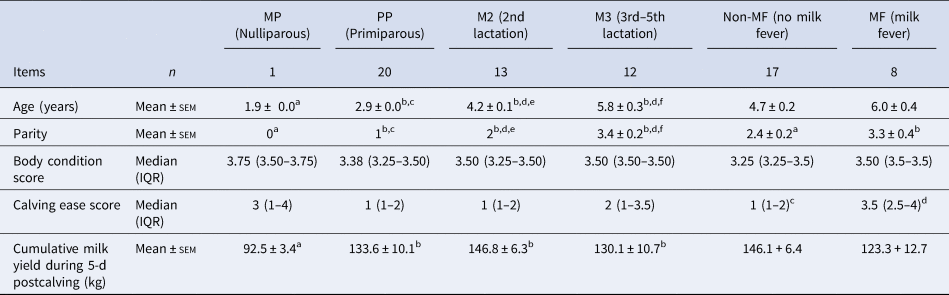
Data are reported in Table 1. BCS was higher in the NP than PP group (P < 0.01). The cumulative milk yield during the 5-d postcalving period was lowest in the NP group (P < 0.001). There were no statistically significant differences in calving ease score (CES) among the groups. Parity was higher in the MF than non-MF cows (P < 0.05), although the ages were not statistically different (P = 0.064). CES was higher in the MF than non-MF cows (P < 0.05). There were no differences in BCS or cumulative milk yield during the 5-d postcalving period between the non-MF and MF cows (Table 1).
Clinical information of all 58 Holstein cattle and of 25 multiparous cows with and without milk fever

sem, standard error of the mean; IQR, interquartile range.
Different letters in the same row indicate significant differences between groups (a,bP < 0.05, c,dP < 0.01, e,fP < 0.001).
The body condition score (BCS) is a 5-point scale (range: 1–5) that progresses in quarter points (0.25 points); 1 represents emaciated cows, and 5 obese cows (Ferguson et al., Reference Ferguson, Galligan and Thomsen1994).
The calving ease score (CES) is also a 5-point scale (1, no problem; 2, slight problem; 3, needed assistance; 4, considerable force; 5, extreme difficulty) (Van Tassell et al., Reference Van Tassell, Wiggans and Misztal2003).
Longitudinal blood biochemistry data in all groups and MF and non-MF cows
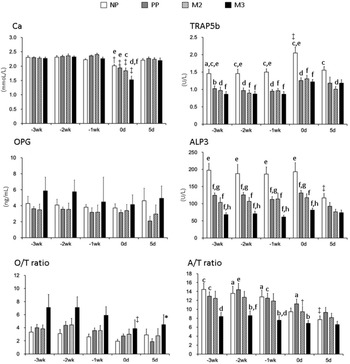
As shown in Fig. 1, serum Ca concentrations were decreased at 0 d in all groups (P < 0.01 or 0.001); the Ca level at 0 d was lower in the M3 group (1.52 ± 0.13 mmol/l) compared with the other groups (2.01 ± 0.04, 1.97 ± 0.05 and 1.84 ± 0.10 mmol/l for NP, PP and M2 respectively, all P < 0.01 or greater). Serum TRAP5b activities in the NP group were higher than in the PP (P < 0.05 or 0.01) and M3 groups (P < 0.001) during−3 weeks to 0 d, and the M2 group (P < 0.01 or 0.001) during −3 weeks to 5 d; the NP group showed a transient increase in this activity at 0 d (P < 0.001). During −3 weeks to 0 d, serum ALP3 activities in the NP group were higher than in the PP, M2 and M3 groups (all P < 0.001); the activities in the PP group were higher than in the M3 group (P < 0.001). The NP group showed a decrease in serum ALP3 activity at 5 d (P < 0.001). The O/T ratio of the M3 group decreased at 0 d (P < 0.001) and 5 d (P < 0.05). The A/T ratios of the NP and PP groups were higher than those of the M3 group at −3 to −1 week (P < 0.05 or 0.01), and at −3 weeks to 0 d (P < 0.05, 0.01 or 0.001), respectively; the NP and M2 groups showed a decrease in this index at 5 d (P < 0.001) and 0 d (P < 0.01), respectively. There were no significant group differences or fluctuations in serum OPG concentrations.
Changes in serum calcium (Ca), tartrate-resistant acid phosphatase isoform 5b (TRAP5b), osteoprotegerin (OPG), and bone isoenzyme of ALP (ALP3) concentrations/activities, and in two indices [ratio of circulating OPG and TRAP5b (O/T ratio) and ratio of ALP3 to TRAP5b (A/T ratio)] during −3 weeks to 5 d around parturition in 58 Holstein cattle. Data are presented as mean ± standard error of the mean (sem). NP, nulliparous group (n = 13); PP, primiparous group (n = 20); M2, multiparous in 2nd lactation group (n = 13); M3, multiparous in 3rd–5th lactation group (n = 12). Symbols indicate significant within-group differences from −3 weeks (*P < 0.05, †P < 0.01, ‡P < 0.001). Different letters indicate significance differences between groups (a,b, P < 0.05; c,d, P < 0.01; e,f and g,h, P < 0.001).

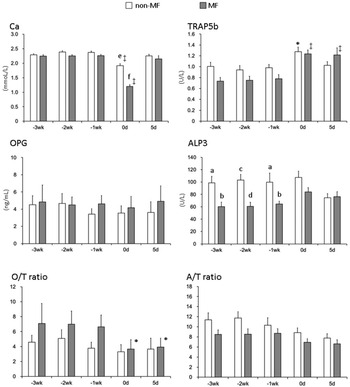
As shown in Fig. 2, serum Ca concentrations decreased at 0 d in both MF (1.19 ± 0.06 mmol/l; P < 0.001) and non-MF cows (1.92 ± 0.07 mmol/l; P < 0.001). The Ca concentrations of MF cows were lower than those of non-MF cows at 0 d (P < 0.001). Serum TRAP5b activities increased at 0 d (P < 0.05) in non-MF cows, and at 0 d (P < 0.001) and 5 d (P < 0.001) in MF cows. Serum ALP3 activities of non-MF cows were higher than those of MF cows during −3 to −1 weeks (P < 0.05 or 0.01). The O/T ratios decreased from −3 weeks to 0 d and 5 d (P < 0.05) in the MF cows, whereas they were unchanged in the non-MF cows during the sampling period. There were no significant group differences or fluctuations in serum OPG concentrations or A/T ratios in the MF and non-MF cows.
Changes in serum calcium (Ca), tartrate-resistant acid phosphatase isoform 5b (TRAP5b), osteoprotegerin (OPG), and bone isoenzyme of ALP (ALP3) concentrations/activities, and in two indices [ratio of circulating OPG and TRAP5b (O/T ratio) and ratio of ALP3 to TRAP5b (A/T ratio)] during −3 weeks to 5 d around parturition in 25 multiparous cows. Data are presented as means ± sem. MF, cows with milk fever (n = 8); non-MF, cows without milk fever (n = 17). Symbols indicate significant differences from −3 weeks within groups (*P < 0.05, ‡P < 0.001). Different letters indicate significance differences between groups (a,b, P < 0.05; c,d, P < 0.01; e,f, P < 0.001).

Associations of prepartum serum bone biomarkers with serum Ca concentrations at 0 d, and according to parity, and age
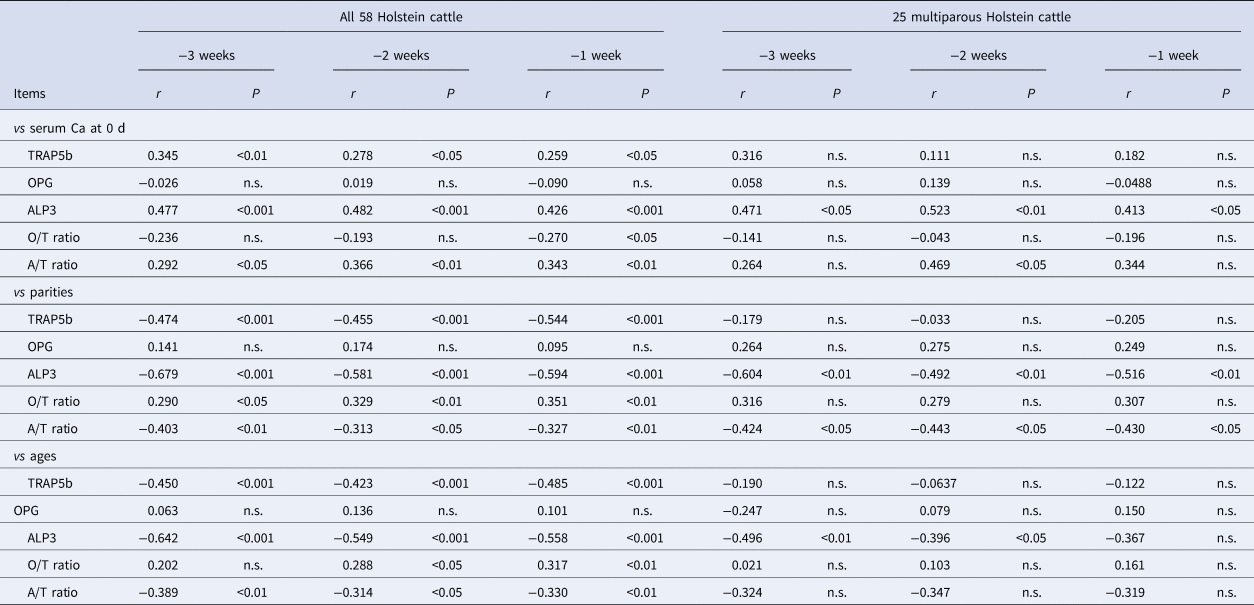
Data are reported in Table 2. Serum TRAP5b activity had fair positive associations with the serum Ca concentration at 0 d, and moderate negative associations with parity, and age at all timepoints. Serum ALP3 activity had moderate positive associations with the serum Ca concentrations at 0 d, and good or moderate negative associations with parity and age at all timepoints. The O/T ratio had fair negative associations with the serum Ca concentration at 0 d at −1 week as well as fair positive associations with parity at all timepoints and with age at −2 and −1 week. The A/T ratio had fair positive associations with the serum Ca concentration at 0 d, and moderate or fair negative associations with parity and age at all timepoints.
Pearson's correlation coefficient (r) values of the associations of serum parameters with serum calcium concentrations at 0 d, and according to parity and age

In the 25 multiparous cows, serum ALP3 activity had moderate positive associations with serum Ca concentrations at 0 d at all timepoints, and good or moderate negative associations with parity at all timepoints, and age at −3 weeks (Table 2). The A/T ratio had a moderate positive association with the serum Ca concentration at 0 d at −2 weeks, and moderate negative associations with parity at all timepoints.
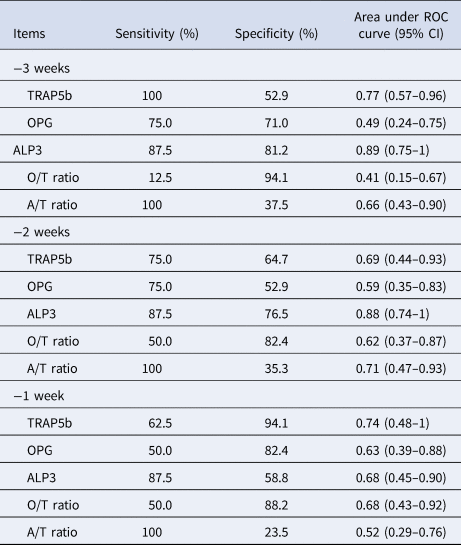
Diagnostic accuracy of prepartum serum bone biomarkers for discriminating MF in 25 multiparous cows
As shown in Table 3, serum ALP3 activity had excellent diagnostic accuracy for MF at −3 weeks (sensitivity = 87.5%, specificity = 81.2%, AUC = 0.89, cut-off point = 82.8 U/l) and −2 weeks (sensitivity = 87.5%, specificity = 76.5%, AUC = 0.88, cut-off point = 75.3 U/l). Although other parameters showed greater sensitivity or specificity than ALP3, the AUC values of these parameters were poor.
Diagnostic accuracy of prepartum bone biomarkers for MF in 25 multiparous cows

Discussion
This study investigated serum fluctuations of Ca and three bone biomarkers reflecting osteoclastic and osteoblastic bone metabolism during −3 weeks to 5 d peripartum in 58 late-pregnant cattle with different parities. The first major finding was that the serum Ca concentration decreased at 0 d in all groups. Specifically, the Ca concentration in multiparous cows with more than three lactations (M3 group) was lower than that in heifers (NP group) and other cows with one or two lactations (PP and M2 groups). These observations are in line with previous findings showing increased severity of parturient hypocalcaemia with advanced parity (Kim et al., Reference Kim, Yamagishi, Ueki, Miura, Saito, Sato and Furuhama2010; Hatate et al., Reference Hatate, Kawashima, Hanada, Kayano and Yamagishi2018, Reference Hatate, Kawashima, Kayano, Hanada and Yamagishi2020; Megahed et al., Reference Megahed, Hiew, El Badawy and Constable2018; Chiba et al., Reference Chiba, Onomi, Hatate, Moriyama, Goto and Yamagishi2020b), supporting the long-held hypotheses that elderly parturient cows tend to have disturbed Ca homoeostasis due to rapid leakage of large amounts of Ca into the colostrum (Martín-Tereso and Verstegen, Reference Martín-Tereso and Verstegen2011; Megahed et al., Reference Megahed, Hiew, El Badawy and Constable2018) and an age-related inability to promptly mobilise Ca from bone and the gastrointestinal tract (Ramberg et al., Reference Ramberg, Johnson, Fargo and Kronfeld1984; Yamagishi et al., Reference Yamagishi, Miyazaki and Naito2006; Martín-Tereso and Verstegen, Reference Martín-Tereso and Verstegen2011; Hatate et al., Reference Hatate, Kawashima, Hanada, Kayano and Yamagishi2018, Reference Hatate, Kawashima, Kayano, Hanada and Yamagishi2020). The cumulative milk yield during the 5-d postcalving period was lower in the NP than other groups.
Another major finding of this study was that 8 of 25 multiparous cows (M2 and M3 groups) developed MF within a few hours after calving and received successful Ca treatment. The MF cows had lower Ca concentrations, higher parity, and higher CES than the non-MF cows. However, age and cumulative milk yield during 5 d postpartum were not different between the groups. These findings are in line with previous observations that MF increased in incidence by 9% with each lactation (DeGaris and Lean, Reference DeGaris and Lean2008) and was associated with a 2.6 times greater risk of dystocia (Correa et al., Reference Correa, Erb and Scarlet1993). Severe hypocalcaemia at calving likely results from a delay in the adaptive mechanisms of Ca metabolism that restore homoeostasis within a few days (Martín-Tereso and Verstegen, Reference Martín-Tereso and Verstegen2011).
Bone homoeostasis depends on the balance of osteoclast and osteoblast functions and, under healthy conditions, is tightly regulated without any major alteration in net bone mass or mechanical strength (Chen et al., Reference Chen, Wang, Duan, Zhu, Schwarz and Xie2018; Kim et al., Reference Kim, Lin, Stavre, Greenblatt and Shim2020). Recent studies showed that osteoclasts and osteoblasts communicate via cell–cell contact and secretory factors (Kim et al., Reference Kim, Lin, Stavre, Greenblatt and Shim2020). In this study, TRAP5b and ALP3 were used as serum biomarkers of osteoclastic and osteoblastic bone metabolism (Fohr et al., Reference Fohr, Dunstan and Seibel2003). OPG is among the secretory factors produced by osteoblasts and works as a decoy receptor binding to RANKL (receptor activator for nuclear factor-κB ligand), thus negatively regulating osteoclastic differentiation (Kim et al., Reference Kim, Lin, Stavre, Greenblatt and Shim2020). Our NP group had higher serum activities of TRAP5b and ALP3 than the other three groups during −3 weeks to 0 d, indicating that the skeleton of heifers remains in a growth state, with greater bone turnover involving osteoclasts and osteoblasts (Yamagishi et al., Reference Yamagishi, Takehana, Kim, Miura, Hirata, Devkota, Sato and Furuhama2009; Hatate et al., Reference Hatate, Kawashima, Kayano, Hanada and Yamagishi2020). The NP group had a transient increase in serum TRAP5b activity at 0 d and a reduction of serum ALP3 activity at 5 d, indicating acceleration of osteoclastic bone resorption at calving, followed by a diminution of osteoblastic bone formation (Kim et al., Reference Kim, Yamagishi, Ueki, Miura, Saito, Sato and Furuhama2010; Chiba et al., Reference Chiba, Onomi, Hatate, Moriyama, Goto and Yamagishi2020b). The O/T ratio decreased at 0 and 5 d in the M3 group, therefore, osteoclastic differentiation was considered to be activated by high Ca demand. The A/T ratio in the M3 group was lower than in the NP and PP groups during −3 weeks to 0 d and negatively correlated with age and parity (−3 to −1 weeks), suggesting lessened activity of osteoblasts relative to osteoclasts in cows with advancing parity.
Prior to this study, we expected that changes in bone resorption and osteoclastic differentiation would be associated with severe hypocalcaemia and MF during parturition. The MF cows showed elevated serum TRAP5b activity and a decreased O/T ratio during 0–5 d postcalving, suggesting that the numbers of osteoclasts increased due to osteoclastogenesis in response to severe hypocalcaemia (Hatate et al., Reference Hatate, Kawashima, Kayano, Hanada and Yamagishi2020). However, the MF cows had lower serum ALP3 activity during the 3-weeks prepartum period than the non-MF cows, although the A/T ratio in the MF cows was similar to that in the non-MF cows. These findings suggest that prepartum osteoblast function was weak in the MF cows, but the balance between osteoblasts and osteoclasts was within the physiological range. Bone turnover was lower in MF cows.
In the Pearson correlation analysis, all 58 late-pregnant cattle showed serum ALP activity with good or moderate associations with the serum Ca concentration, parity, and age. Serum TRAP5b activity had moderate associations with parity and age, whereas the A/T ratio had a moderate association with parity. The serum Ca concentration in parturient cows tends to be higher in younger animals (Kim et al., Reference Kim, Yamagishi, Ueki, Miura, Saito, Sato and Furuhama2010; Hatate et al., Reference Hatate, Kawashima, Hanada, Kayano and Yamagishi2018, Reference Hatate, Kawashima, Kayano, Hanada and Yamagishi2020; Megahed et al., Reference Megahed, Hiew, El Badawy and Constable2018). Circulating ALP3 and TRAP5b activities are lower as parity advances (Kim et al., Reference Kim, Yamagishi, Ueki, Miura, Saito, Sato and Furuhama2010; Hatate et al., Reference Hatate, Kawashima, Kayano, Hanada and Yamagishi2020; Chiba et al., Reference Chiba, Onomi, Hatate, Moriyama, Goto and Yamagishi2020b). Therefore, these associations are considered to reflect the relationship between the Ca concentration at 0 d, parity, and age.
In our multiparous cows, serum ALP3 activity had a moderate association with the serum Ca concentration at 0 d. Serum ALP3 activity also had good or moderate associations with parity and age. In addition, serum ALP3 activity had excellent ability to predict MF at calving at −3 weeks (87.5% sensitivity, 81.2% specificity), and −2 weeks (87.5% sensitivity, 76.5% specificity). Staric and Hodnik (Reference Staric and Hodnik2020) found a correlation between serum BAP activity during 10–2 d before calving and the serum Ca concentration after calving in 23 Holstein multiparous cows with or without MF. In their cows, the AUC (reflecting the diagnostic value) of BAP activity was 0.80 (95% confidence interval: 0.63–0.98, sensitivity = 90%, specificity = 64.3%). These observations suggested that serum ALP3 activity during the prepartum period is a promising biomarker of MF in multiparous cows. Notably, our data indicate that the best time for measurement is in the range of 2–3 weeks prepartum.
The study had some limitations. First, it was conducted on one farm and included a relatively small number of multiparous cows with MF. The validity of the results regarding prediction of MF needs to be confirmed in additional studies including more farms and cows, and in countries other than Japan and Slovenia, previously studied by Staric and Hodnik (Reference Staric and Hodnik2020). Farm-to-farm variations in the percentage of Ca fed on a dry matter basis, and in the DCAD of the close-up rations, may influence the degree of hypocalcaemia and/or incidence of MF (Kurosaki et al., Reference Kurosaki, Yamato, Sato, Naito, Mori, Imoto and Maede2007; Megahed et al., Reference Megahed, Hiew, El Badawy and Constable2018). Insufficient dietary Mg supply is also a major risk factor for milk fever (DeGaris and Lean, Reference DeGaris and Lean2008; Goff, Reference Goff2014). In this study, the incidence of milk fever was high in the enrolled cows, probably due to the low Mg concentration and the positive DCAD in the prepartum diet (DeGaris and Lean, Reference DeGaris and Lean2008; Goff, Reference Goff2014). A second limitation was the method for measuring ALP3 activity. The study from Slovenia (Staric and Hodnik, Reference Staric and Hodnik2020) employed a commercial ELISA kit for testing human BAP activity using a mouse anti-human BAP antibody. In our study, serum ALP3 activity was measured by the AGE technique, in which the ALP3 activity was calculated from the t-ALP activity measured by the JSCC reagent method. Starting in April 2020, medical laboratories in Japan have been switching from the JSCC method to the International Federation of Clinical Chemistry and Laboratory Medicine (IFCC) method for measuring t-ALP. The IFCC reagents contain a 2-amino-2-methyl-1-propanol buffer instead of EAE buffer (Hata et al., Reference Hata, Fujitani, Takeshita, Tanaka, Matsuda, Takaishi, Shinokawa and Hoshi2021). Because the IFCC method is currently used worldwide for t-ALP measurement, it is necessary to accumulate the ALP3 data by the IFCC method.
Early identification of cows at high risk of developing MF before parturition would allow prevention measures to be tailored to these cows. Prophylaxis with oral Ca drenching around calving (Thilsing-Hansen et al., Reference Thilsing-Hansen, Jørgensen and Østergaard2002) will be available for high-risk cows with MF. An increase in the percentage of the high-risk prepartum cows could be evidence of inadequate feed management of mineral and DCAD in the close-up rations.
In conclusion, the severity of parturient hypocalcaemia increased with advancing parity in 58 late-pregnant cattle. The MF cows showed an elevated serum TRAP5b activity and decreased O/T ratio after calving, suggesting that the number of osteoclasts was increased by osteoclastogenesis in response to severe hypocalcaemia. Interestingly, the MF cows had lower serum ALP3 activity during the 3-weeks prepartum period, indicating that osteoblast activity was probably low in those cows immediately prepartum. In the multiparous cows, serum ALP3 activity during the 2–3 weeks prepartum period had a moderate positive association with the serum Ca concentration at 0 d, and excellent ability to predict MF (at the cut-off points 75.3 or 82.8 U/l). Therefore, these data suggest that prepartum serum ALP3 activity is a promising biomarker to predict MF in multiparous cows.
Supplementary material
The supplementary material for this article can be found at https://doi.org/10.1017/S0022029922000218.
Acknowledgements
The authors thank the staff of the University Farm and Veterinary Medical Center of OUAVM for their help and support. Funding for this study was provided, in part, by a JSPS Grants-in-Aid for Scientific Research (18K05988).