


1. Introduction
Throughout the article, we consider metric graphs  $\mathcal G=(\mathbb{V}_\mathcal G, \mathbb{E}_\mathcal G)$ such that
•
 $\mathcal G$ is connected and has at most countably many edges;
•
$\text{deg}(\textrm{v}) \lt \infty$ for every
$\textrm{v}\in\mathbb{V}_\mathcal G$, where
$\text{deg}(\textrm{v})$ is the total number of edges incident at the vertex
$\textrm{v}$;•
$e_0:=\displaystyle\inf_{e\in\mathbb{E}_\mathcal G}|e| \gt 0$, where
$|e|$ is the length of the edge e.


For simplicity, if a graph  $\mathcal G$ satisfies these properties, we say that
 $\mathcal G$ is in the class G, and we write
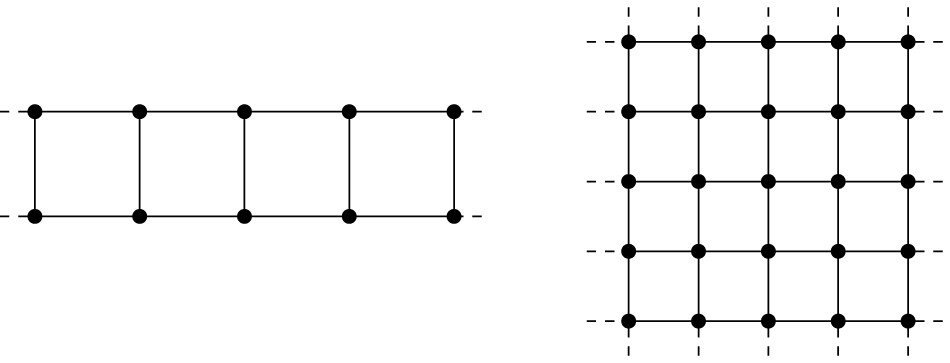
 $\mathcal G\in\mathbf{G}$. The notion of metric graph is detailed in [Reference Berkolaiko and Kuchment8]. A graph in G is non-compact if at least one of its edges is unbounded (that is, the graph has at least one half-line) or if the total number of edges in the graph is infinite. It is evident that the set of all non-compact graphs in G is extremely wide and varied, as it contains structures that may exhibit sensibly different behaviours, making thus impossible to handle them all at once. For this reason, in the present article, we will focus on two specific families of non-compact graphs: graphs with finitely many edges (and thus with at least one half-line, see, e.g., figure 1) and periodic graphs (see, e.g., figure 2), i.e., graphs with infinitely many edges, whose length is uniformly bounded from above, arranged in a periodic pattern (for a rigorous definition of periodic graphs, see, e.g., [Reference Berkolaiko and Kuchment8, definition 4.1.1]).
A non-compact graph in G with finitely many vertices and edges.

Examples of periodic graphs.

Given a graph  $\mathcal G\in\mathbf{G}$ and p > 2, we look for solutions
 $(u, \lambda)$ of the problem
 \begin{equation}
\begin{cases}
u''+u^{p-1}=\lambda u & \text{on every }e\in\mathbb{E}_\mathcal G\\
u\in H^1(\mathcal G),\quad u \gt 0 &\text{on }\mathcal G\\
\sum_{e\succ \textrm{v}}\frac{du}{dx_e}(\textrm{v})=0 & \text{for every }\textrm{v}\in\mathbb{V}_\mathcal G\,,
\end{cases}
\end{equation}
where  $e\succ\textrm{v}$ indicates that the edge e is incident at the vertex
 $\textrm{v}$, and
 $\frac{du}{dx_e}(\textrm{v})$ denotes the derivative of u at
 $\textrm{v}$ along the edge e identified with the interval
 $[0,|e|]$ in such a way that the vertex
 $\textrm{v}$ corresponds to 0.
Our focus here is devoted to normalized solutions of (1.1), i.e., solutions u in the mass constrained space
 \begin{equation*}
H_\mu^1(\mathcal G):=\left\{v\in H^1(\mathcal G)\,:\,\|v\|_{L^2(\mathcal G)}^2=\mu\right\},
\end{equation*}
in the L 2-supercritical regime p > 6. To this end, we look for critical points of the energy functional  $E:H^1(\mathcal G)\to{\mathbb R}$
 \begin{equation*}
E(u,\mathcal G):=\frac12\|u'\|_{L^2(\mathcal G)}^2-\frac1p\|u\|_{L^p(\mathcal G)}^p
\end{equation*}
constrained to  $H_\mu^1(\mathcal G)$. It is well known that these critical points satisfy (1.1) (except possibly for the sign condition), for a suitable λ that arises as a Lagrange multiplier associated with the mass constraint.
Recently, much effort has been devoted to establish the existence of normalized solutions of non-linear Schrödinger (NLS) equations (1.1) on metric graphs in the L 2-subcritical (i.e.,  $p\in(2,6)$) or L 2-critical regimes (i.e., p = 6). In these two cases, the energy functional
 $E(\cdot, \mathcal G)$ is bounded from below and coercive on the mass constraint (one needs to require µ smaller than a threshold when p = 6). Various results of existence, non-existence, and multiplicity have been obtained (see, e.g., [Reference Adami, Dovetta, Serra and Tilli2, Reference Adami, Serra and Tilli3, Reference Adami, Serra and Tilli5, Reference Agostinho, Correia and Tavares7, Reference Berkolaiko, Marzuola and Pelinovsky9–Reference Besse, Duboscq and Le Coz11, Reference De Coster, Dovetta, Galant and Serra21, Reference Dovetta23, Reference Dovetta and Tentarelli25, Reference Kairzhan, Marangell, Pelinovsky and Xiao28, Reference Kairzhan, Noja and Pelinovsky29, Reference Noja and Pelinovsky31–Reference Pierotti, Soave and Verzini34]).
Conversely, in the L 2-supercritical regime on general metric graphs, i.e., when p > 6, the energy functional  $E(\cdot, \mathcal G)$ is always unbounded from below on
 $H_\mu^1(\mathcal G)$ and the approaches developed when
 $p \leq 6$ are not directly applicable anymore. As a matter of fact, the existence of normalized solutions in the case p > 6 only started to be considered very recently in [Reference Borthwick, Chang, Jeanjean and Soave13, Reference Carrillo, Galant, Jeanjean and Troestler16, Reference Chang, Jeanjean and Soave17] when the graph is compact or when the non-linearity is restricted to a compact subset of the graph.
The main existence results of the article are stated in the next two theorems. Here, by pendant, we mean a bounded edge with a vertex of degree 1, whereas by a signpost we mean the union of a bounded edge and a loop, glued together at a common vertex.
Theorem 1.1. Let  $\mathcal G\in\mathbf{G}$ be a non-compact metric graph with finitely many edges and at least one pendant or one signpost. Then, for every p > 6, there exists
 $\mu_{p,\mathcal G} \gt 0$, depending on p and
 $\mathcal G$, such that, for every
 $\mu\in(0,\mu_{p,\mathcal G}]$, problem (1.1) admits a solution
 $u\in H_\mu^1(\mathcal G)$ satisfying
 $E(u,\mathcal G) \gt 0$ and λ > 0.
Theorem 1.2. Let  $\mathcal G\in\mathbf{G}$ be a periodic graph. Then, for every p > 6, there exists
 $\mu_{p,\mathcal G} \gt 0$, depending on p and
 $\mathcal G$, such that, for every
 $\mu\in(0,\mu_{p,\mathcal G}]$, problem (1.1) admits a solution
 $u\in H_\mu^1(\mathcal G)$ satisfying
 $E(u,\mathcal G) \gt 0$ and λ > 0.
Theorems 1.1–1.2 are the first results on the existence of normalized solutions to (1.1) when p is L 2-supercritical, the graph  $\mathcal G$ is non-compact, and the non-linearity acts on the whole of
 $\mathcal G$ (whereas without the mass constraint some results can be found, e.g., in [Reference Chen, Dovetta, Pistoia and Serra18, Reference De Coster, Dovetta, Galant, Serra and Troestler22]). The only results for supercritical p obtained so far [Reference Borthwick, Chang, Jeanjean and Soave13, Reference Carrillo, Galant, Jeanjean and Troestler16, Reference Chang, Jeanjean and Soave17] either require
 $\mathcal G$ to be compact or the non-linearity to be localized on the compact core of the graph. The solutions found in those articles are critical points of mountain pass type for the energy
 $E(\cdot,\mathcal G)$ in the mass constrained space
 $H_\mu^1(\mathcal G)$, and the assumptions on the compactness of the graph or on the localization of the non-linearity are essentially used to obtain a minimum of compactness needed to prove that Palais–Smale sequences converge. Such an issue, together with the very boundedness of these sequences, is one of the major problems when dealing with supercritical problems. We recall that arguments based on scaling, employed for example for the NLS equation on
 ${\mathbb R}^N$, are not available on metric graphs since these are not scale invariant.
The solutions found in theorems 1.1–1.2 are again of mountain pass type for  $E(\cdot,\mathcal G)$ in
 $H_\mu^1(\mathcal G)$, in the same spirit of [Reference Borthwick, Chang, Jeanjean and Soave13, Reference Chang, Jeanjean and Soave17]. In our results, however, we manage to avoid all compactness assumptions on
 $\mathcal G$ and on the non-linearity, replacing them with the requirement that the prescribed mass of the solutions we seek be small and exploiting specific topological features of the graphs under exam.
Let us give some elements of our strategy. As in [Reference Borthwick, Chang, Jeanjean and Soave13, Reference Chang, Jeanjean and Soave17], we shall obtain the solutions of theorems 1.1–1.2 as a limit of a sequence of solutions of approximating problems. To this aim, we first consider the family of functionals  $E_\rho:H^1(\mathcal G)\to{\mathbb R}$ given by
 \begin{equation*}
E_\rho(u,\mathcal G):=\frac12\|u'\|_{L^2(\mathcal G)}^2-\frac\rho p\|u\|_{L^p(\mathcal G)}^p\, \quad \text{where} \quad \rho \in [1/2,1].
\end{equation*}
The functionals  $E_\rho(\cdot,\mathcal G)$ have a mountain pass geometry and adapting [Reference Borthwick, Chang, Jeanjean and Soave14, theorem 1.10] to our context we show that, for almost every
 $\rho \in [1/2,1]$,
 $E_\rho(\cdot,\mathcal G)$ admits a bounded Palais–Smale sequence at the mountain pass level with certain Morse index-type properties. We prove that this sequence converges and that its limit is a critical point uρ of
 $E_\rho(\cdot, \mathcal G)$ constrained to
 $H_\mu^1(\mathcal G)$. We then consider a sequence
 $\rho_n \to 1$ and show that the sequence of corresponding solutions
 $u_{\rho_n}$ converges to a critical point
 $u \in H_\mu^1(\mathcal G)$ of
 $E(\cdot, \mathcal G)$, which is the solution we are looking for in theorems 1.1–1.2.
Whether it is to derive the existence of uρ, for almost every  $\rho \in [1/2,1]$, or later in the analysis of the sequence
 $(u_{\rho_n})_n $, we are led to study the convergence of such Palais–Smale sequences. The non-compactness of the domain and the information on the Morse index guarantee that the corresponding Lagrange multipliers are non-negative. Then, in order to recover the necessary compactness, we rule out the possible partial loss of mass at infinity proving that, on every non-compact graph, all solutions of (1.1) have positive energy. This result, which is perhaps of independent interest, requires the small mass assumption and is given in proposition 3.1. To conclude, we are left to exclude that the whole mass runs away at infinity. This is accomplished either exploiting the invariance under translations on periodic graphs or suitable topological assumptions on graphs with finitely many edges. Noteworthy, for this final step to be completed, the previous conditions must be combined again with the small mass assumption.
We wish to notice that both the requirement of small mass and on the topology of the graph are far from arbitrary or technical but reflect instead important features of the NLS equation on graphs. Indeed, it seems to us that existence results for mountain pass type solutions with the non-linearity acting on the whole structure are likely not to hold on general non-compact graphs when even just one of our assumptions is dropped.
Consider first the topological assumptions we exploited: in theorem 1.1, the presence of a pendant or a signpost and in theorem 1.2, the periodicity of  $\mathcal G$. As already said, these kind of assumptions have been deeply investigated in the subcritical and critical cases (see, e.g., [Reference Adami, Dovetta, Serra and Tilli2, Reference Adami, Serra and Tilli3, Reference Adami, Serra and Tilli5, Reference Agostinho, Correia and Tavares7, Reference Berkolaiko, Marzuola and Pelinovsky9–Reference Besse, Duboscq and Le Coz11, Reference De Coster, Dovetta, Galant and Serra21, Reference Dovetta23, Reference Dovetta and Tentarelli25, Reference Kairzhan, Marangell, Pelinovsky and Xiao28, Reference Kairzhan, Noja and Pelinovsky29, Reference Noja and Pelinovsky31, Reference Pankov32]) to obtain existence or non-existence of ground states and of more general solutions. This is, on the contrary, the first time that topological properties of the graphs are shown to play a role in the supercritical regime. Here they are crucial to provide suitable estimates on the mountain pass level needed to restore compactness. The relevance of these conditions is highlighted by the fact that for non-periodic graphs that do not satisfy the assumptions of theorem 1.1 one cannot hope, generally, to prove existence of solutions as in the preceding results. In fact, in proposition 4.4, we show that for graphs satisfying the so-called assumption (H) (a topological condition on graphs with half-lines originally introduced in [Reference Adami, Serra and Tilli3]) the mountain pass level we construct coincides with the level of the corresponding problem (with the same prescribed mass) on
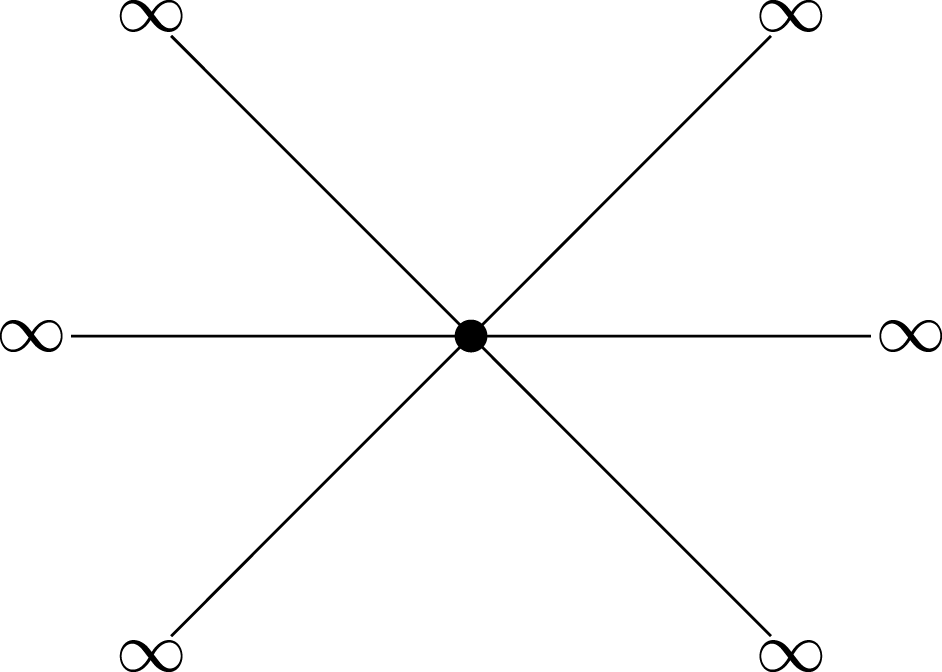
 ${\mathbb R}$. However, a prototypical example of graphs fulfilling assumption (H) is the star graph (figure 3), for which it is well known (see, e.g., [Reference Adami, Cacciapuoti, Finco and Noja1]) that, for any mass µ, no solution of (1.1) exists with energy equal to that of the mountain pass level on
 ${\mathbb R}$. We conjecture that the same is true for all graphs satisfying assumption (H) but, at the present time, we are not able to prove this statement in its full generality. If a proof of this result were available it would be extremely interesting, since it would reveal a deep property of the NLS equation on graphs: in [Reference Adami, Serra and Tilli3, Reference Adami, Serra and Tilli5], it is shown that in the subcritical and critical regimes, assumption (H) prevents the existence of ground states; the validity of our conjecture would then provide a similar statement for mountain pass solutions in the supercritical case.
A star graph with six half-lines glued together at their common origin.

The importance of the smallness assumption on the mass in theorems 1.1–1.2 is analogous. As indicated, a key step in our argument is to prove that, for small masses, all solutions of (1.1) have a non-negative energy. On the contrary, the next two results show that, in general, for large values of µ there do exist solutions with negative energy.
Theorem 1.3. Let  $\mathcal G\in\mathbf{G}$ be a non-compact graph with finitely many edges, no pendant and exactly one half-line. Then, there exists δ > 0 such that, for every
 $p\in[6,6+\delta]$, there exists µ > 0, depending on p and
 $\mathcal G$, for which problem (1.1) admits a positive solution
 $u\in H_\mu^1(\mathcal G)$ with
 $E(u,\mathcal G) \lt 0$.
Theorem 1.4. Let  $\mathcal G\in\mathbf{G}$ be a non-compact graph with finitely many edges, at least one of which bounded, and such that every vertex of
 $\mathcal G$ is attached to an even number of half-lines (possibly zero). For every p > 6, there exists
 $\overline{\mu} \gt 0$, depending on p and
 $\mathcal G$, such that, for all
 $\mu \ge \overline{\mu}$, problem (1.1) admits a positive solution
 $u\in H_\mu^1(\mathcal G)$ with
 $E(u,\mathcal G) \lt 0$.
As its proof shows, the solutions of theorem 1.3 are obtained as a perturbation of negative energy ground states of E at the critical exponent p = 6, that on graphs satisfying the hypotheses of theorem 1.3 are known to exist for a full interval of masses (see [Reference Adami, Serra and Tilli5, theorem 3.3]). On the contrary, the result of theorem 1.4 is not perturbative and it was communicated to us by Galant [Reference Galant26] (to whom we are sincerely grateful). Since their energy is negative, such solutions cannot be found by our mountain pass approach, which is designed to work at strictly positive levels. Observe also that the simplest graph fulfilling theorem 1.3 is perhaps the tadpole graph (figure 4), that contains a signpost, whereas the simplest one to which theorem 1.4 applies is the so-called  $\mathcal{T}$-graph (figure 5), that was extensively studied in [Reference Agostinho, Correia and Tavares7] and that contains a pendant. This shows that, without the small mass assumption, there is no chance to recover our mountain pass argument, even in presence of the topological features introduced above.
The tadpole graph, i.e., a loop attached to a half-line.

The  $\mathcal{T}$-graph, i.e., a pendant attached to a full line.

We finally note that the advantage given by the small mass to control from below the energy of solutions was already observed and exploited in some related problems posed on  ${\mathbb R}^N$ (see, for example, [Reference Molle, Riey and Verzini30]).
The remainder of the article is organized as follows. Section 2 collects some preliminary results on the mountain pass approach we will use and on the NLS equation on the real line. Section 3 provides a general lower bound on the energy of positive solutions of (1.1) with small mass. In §4, we introduce the mountain pass problem and we derive some a priori estimates on the mountain pass level depending on the topology of the graphs. Finally, in §5–7, we prove theorems 1.1–1.4, respectively.
1.1. Notation
In what follows, for  $u\in L^q(\mathcal G)$, we will write
 $\|u\|_q$ in place of
 $\|u\|_{L^q(\mathcal G)}$, omitting the explicit reference to the domain of integration when it coincides with the whole space. Conversely, the full notation for norms will always be used whenever the domain of integration is a proper subset of the full space.
2. Preliminaries
This section collects various preliminary results that will be largely used in the rest of the article.
2.1. A general existence result for bounded Palais–Smale sequences
The main aim of this subsection is to rewrite in the context of the present article the content of [Reference Borthwick, Chang, Jeanjean and Soave14, theorem 1.10]. To this end, for any ρ > 0, let  $E_\rho:H^1(\mathcal G)\to{\mathbb R}$ be given by
 \begin{equation*}
E_\rho(u,\mathcal G):=\frac12\|u'\|_2^2-\frac\rho p\|u\|_p^p\,.
\end{equation*}
Remark 2.1. Throughout the article, the notation Eρ will be used when ρ ≠ 1 only. When ρ = 1, we will always write E as in §1, avoiding the symbol E 1.
We recall the following definition.
Definition 2.2. Let  $\mathcal G\in\mathbf{G}$, p > 6, µ > 0, and ρ > 0. For every
 $u\in H_\mu^1(\mathcal G)$ and
 $\theta \geq 0$, the quantity
 \begin{align*}
\widetilde{m}_\theta(u)&:=\sup\left\{\textrm{dim}\,L: L \, \textrm{subspace of}\ T_uH_\mu^1(\mathcal G)\ \textrm{such that}\ D^2E_\rho(u,\mathcal G)[w,w] \right.\\
& \left. \lt -\theta\|w\|_{H^1(\mathcal G)}^2,\,\forall w\in L\setminus\{0\}\right\}
\end{align*}
is called the approximate Morse index of u with respect to θ, where  $T_uH_\mu^1(\mathcal G)$ is the tangent space to
 $H_\mu^1(\mathcal G)$ at u and
 \begin{equation*}
D^2E_\rho(u,\mathcal G)[w,w]:=E_\rho''(u,\mathcal G)[w,w]-\frac{E_\rho'(u,\mathcal G)[u]}{\|u\|_2^2}\| w\|_{L^2(\mathcal G)}\qquad\forall w\in T_uH_\mu^1(\mathcal G)\,.
\end{equation*}
If u is a critical point of Eρ constrained to  $H_\mu^1(\mathcal G)$ and θ = 0, we say that
 $\widetilde{m}_0(u)$ is the Morse index of uas a constrained critical point.
The next theorem, that is no more than [Reference Borthwick, Chang, Jeanjean and Soave14, theorem 1.10] applied to the family of functionals Eρ above, provides a general existence result of bounded Palais–Smale sequences for these functionals constrained to  $H_\mu^1(\mathcal G)$, with further information on their approximate Morse index.
Theorem 2.3. Let  $\mathcal G\in\mathbf{G}$, p > 6, and µ > 0 be given. Let
 $I\subset(0,+\infty)$ be a given interval and assume that there exist
 $A,B\subset H_\mu^1(\mathcal G)$ independent of ρ for which
 \begin{equation*}
c_\rho:=\inf_{\gamma\in\Gamma}\max_{t\in[0,1]}E_\rho(\gamma(t),\mathcal G) \gt \max\left\{\sup_{u\in A}E_\rho(u,\mathcal G),\sup_{u\in B}E_\rho(u,\mathcal G)\right\}\qquad\forall \rho\in I\,,
\end{equation*}
where
 \begin{equation*}
\Gamma:=\left\{\gamma\in C\left([0,1],H_\mu^1(\mathcal G)\right)\,:\,\gamma(0)\in A,\gamma(1)\in B\right\}\,.
\end{equation*}
Then, for almost every  $\rho\in I$, there exist sequences
 $(u_n)_n\subset H_\mu^1(\mathcal G)$, such that, as
 $n\to+\infty$,
 $\zeta_n\to0^+$ and
(i)
$\displaystyle E_\rho(u_n,\mathcal G)\to c_\rho$;(ii)
$\displaystyle E_\rho'(u_n,\mathcal G)-\frac{E_\rho'(u_n,\mathcal G)[u_n]}{\mu}u_n\to0$ in the dual of
$H_\mu^1(\mathcal G)$;(iii)
$(u_n)_n$ is bounded in
$H_\mu^1(\mathcal G)$;(iv)
$\displaystyle \widetilde{m}_{\zeta_n}(u_n)\leq 1$.


Theorem 2.3 will be used as a key tool in the proof of theorems 1.1–1.2. The information on the Morse index will play a relevant role combined with the following lemma that simply rephrases in our setting [Reference Borthwick, Chang, Jeanjean and Soave13, lemma 2.5].
Lemma 2.4. Let  $\mathcal G\in\mathbf{G}$,
 $p \gt 6,\mu \gt 0$, and ρ > 0. Assume that
 $(u_n)_n\subset H_\mu^1(\mathcal G)$,
 $(\lambda_n)_n\subset{\mathbb R}$, and
 $(\zeta_n)_n\subset{\mathbb R}^+$ are such that, as
 $n\to+\infty$,
 $\zeta_n\to0^+$ and
(i) if a subspace
$W\subset H^1(\mathcal G)$ satisfies
\begin{equation*}
E_\rho''(u_n,\mathcal G)[w,w]+\lambda_n\|w\|_2^2 \lt -\zeta_n\|w\|_{H^1(\mathcal G)}^2\qquad\forall w\in W\setminus\{0\}
\end{equation*}for sufficiently large n, then
$\text{dim}\,W\leq2$, and(ii) there exist
$\lambda\in{\mathbb R}$, a subspace
$Y\subset H^1(\mathcal G)$ with
$\text{dim}\,Y\geq3$, and a > 0 such that, for every large n,
\begin{equation*}
E_\rho''(u_n,\mathcal G)[w,w]+\lambda\|w\|_2^2\leq-a\|w\|_{H^1(\mathcal G)}^2\qquad\forall w\in Y.
\end{equation*}


Then  $\lambda_n \gt \lambda$ for every n large enough.
2.2. NLS equations on the real line
For every  $\mu,\rho \gt 0$, it is well known that there exists a unique solution
 $(\phi_{\mu,\rho},\lambda_{\mu,\rho})\in H_\mu^1({\mathbb R})\times{\mathbb R}^+$ of the problem
 \begin{equation}
\begin{cases}
u''+\rho u^{p-1}=\lambda u & \text{on }{\mathbb R}\\
u \gt 0,\quad u(0)=\max_{x\in{\mathbb R}}u(x)\,.
\end{cases}
\end{equation}
Setting
 \begin{equation}
\alpha=\frac2{6-p}\,,\qquad\beta=\frac{p-2}{6-p}\,,
\end{equation}
this solution can be written explicitly as
 \begin{equation*}
\phi_{\mu,\rho}(x)=\rho^{\frac{\alpha}{2}}\phi_{\mu,1}\left(\rho^\alpha x\right)\qquad\forall x\in{\mathbb R},
\end{equation*}
where
 \begin{equation*}
\phi_{\mu,1}(x)=\mu^\alpha \phi_{1,1}(\mu^\beta x)\qquad\forall x\in{\mathbb R}
\end{equation*}
and
 \begin{equation*}
\phi_{1,1}(x)=C_p\text{sech}^{\frac\alpha\beta}(c_p x)\,,
\end{equation*}
with  $C_p,c_p \gt 0$ suitable constants depending only on p. In particular, the previous relations show that, for every p > 6 and
 $x\in{\mathbb R}$, as µ → 0 it holds
 \begin{equation}
\begin{aligned}
\phi_{\mu,\rho}(x)&\,= C_p'\rho^{\frac\alpha2}\mu^\alpha e^{-\frac{2c_p}{p-2}\rho^\alpha\mu^\beta x}+o\left(\mu^\alpha e^{-\frac{2c_p}{p-2}\rho^\alpha\mu^\beta x}\right)\\
\phi_{\mu,\rho}'(x)&\,=C_p''\rho^{\frac{3\alpha}2}\mu^{\alpha+\beta} e^{-\frac{2c_p}{p-2}\rho^\alpha\mu^\beta x}+o\left(\mu^{\alpha+\beta} e^{-\frac{2c_p}{p-2}\rho^\alpha\mu^\beta x}\right)
\end{aligned}
\end{equation}
for suitable constants  $C_p',C_p'' \gt 0$ depending only on p. Furthermore, direct computations yield the identity
 \begin{equation}
\|\phi_{\mu,\rho}'\|_{2}^2=\frac{p-2}{2p}\rho\|\phi_{\mu,\rho}\|_p^p\,,
\end{equation}
so that
 \begin{equation}
E_\rho(\phi_{\mu,\rho},{\mathbb R})=\frac{p-6}{4p}\rho\|\phi_{\mu,\rho}\|_p^p\,.
\end{equation}
Recalling that  $E(\phi_{\mu,1},{\mathbb R})=\mu^{2\beta+1}E(\phi_{1,1},{\mathbb R}) \gt 0$, it then follows that
 \begin{equation}
E_\rho(\phi_{\mu,\rho})=\theta_p\rho^{\frac4{6-p}} \mu^{2\beta+1} \quad \mbox{with} \quad \theta_p:=\frac{p-6}{4p}\|\phi_{1,1}\|_p^p \gt 0.
\end{equation}
In particular, (2.6) implies that  $E_\rho(\phi_{\mu,\rho})$ is a strictly decreasing function of µ > 0.
2.3. Gagliardo–Nirenberg inequalities on graphs
For every non-compact graph  $\mathcal G\in\mathbf{G}$, we recall here the following well-known Gagliardo–Nirenberg inequalities
 \begin{align}
\|u\|_{p}^p\leq K_{p,\mathcal G}\|u\|_{2}^{\frac p2+1}\|u'\|_{2}^{\frac p2-1}\qquad & \forall u\in H^1(\mathcal G),\,p \gt 2\,,\\
\|u\|_{\infty}\leq \sqrt{2}\|u\|_{2}^{\frac12}\|u'\|_{2}^{\frac12}\qquad & \forall u\in H^1(\mathcal G)\,, \nonumber
\end{align}
with  $K_{p,\mathcal G} \gt 0$ depending on p and
 $\mathcal G$ only (for a proof of these inequalities, see, e.g., [Reference Adami, Serra and Tilli4, Section 2]).
2.4. Properties of the Lagrange multiplier
For  $\mathcal G\in\mathbf{G}$, let
 \begin{equation}
\lambda_\mathcal G:=\inf_{u\in H^1(\mathcal G)\setminus\{0\}}\frac{\|u'\|_{2}^2}{\|u\|_{2}^2}
\end{equation}
be the bottom of the spectrum of the operator  $\displaystyle-\frac{d^2}{dx^2}$ on
 $\mathcal G$ endowed with Kirchhoff conditions at the vertices. Introducing the shorthand notation
 \begin{equation*}
S_\mu =\left\{u\in H_\mu^1(\mathcal G) \mid u \,\text{solves } (1.1) \,\text{for some } \lambda \in {\mathbb R} \right\},
\end{equation*}
we have the following lemma.
Lemma 2.5. Let  $\mathcal G\in\mathbf{G}$. There results
(a) if
$u \in S_\mu$, then
$\lambda \geq - \lambda_\mathcal G$;(b) if
$\mathcal G$ is a graph with at least one half-line or a periodic graph, then
$\lambda_\mathcal G=0$;(c) if
$\mathcal G$ is a non-compact graph with finitely many edges and
$u \in S_{\mu}$ for some µ > 0, then λ > 0;(d) if
$\mathcal G$ is a graph with at least one half-line or a periodic graph, then for any m > 0 there exists
$\mu_m \gt 0$ such that, if
$u \in S_\mu$ with
$\mu \in (0, \mu_m]$, then
$\lambda \geq m$.


To prove lemma 2.5(d), we shall need the next preliminary lemma.
Lemma 2.6. Let  $u \in S_\mu$. Then
 \begin{equation}
\|u\|_{\infty} \le \left(\frac{p}2 \lambda + \frac{p\pi^2}{2e_0^2}\right)^{\frac1{p-2}}.
\end{equation}
Proof. This can be checked by standard phase plane considerations as follows. Let  $M := \|u\|_{\infty} \gt 0$. If
 $M^{p-2} \le p\lambda/2$, there is nothing to prove, so we only deal with the case
 $M^{p-2} \gt p\lambda/2$. Let then M be achieved in some edge e at a point called q. Reversing, if necessary, the orientation of the coordinate along e, we can assume u to be non-increasing on an interval
 $[q,r]$ of length
 $a \ge e_0/2$. Indeed, if no such interval existed, then u would attain a local minimum in the interior of e, which is impossible since u > 0 on
 $\mathcal G$, while the condition
 $M^{p-2} \gt p\lambda/2$ forces all local minima of u to be strictly negative.
Since u solves (1.1), for every  $x\in[q,r]$, there results
 \begin{equation*}
\frac12 |u'(x)|^2 + \frac1p |u(x)|^p - \frac{\lambda}2 |u(x)|^2 = \frac1p |u(q)|^p - \frac{\lambda}2 |u(q)|^2 = \frac1p M^p - \frac{\lambda}2 M^2 \gt 0.
\end{equation*}
Then
 \begin{equation*}
a = \int_q^r dx = \int_{u(r)}^M \frac{du}{\sqrt{\frac2p\left(M^p -u^p\right)- \lambda\left(M^2-u^2\right)}}
\end{equation*}
or, setting  $t = u/M$,
 \begin{equation*}
a = \int_{u(r)/M}^1 \frac{dt}{\sqrt{\frac2p M^{p-2}\left(1 -t^p\right)- \lambda\left(1-t^2\right)}}.
\end{equation*}
Now, as  $t \in (0,1]$, we have
 $1-t^p \ge 1-t^2$, so that
 \begin{align*}
a &\le \frac1{\sqrt{\frac2p M^{p-2} -\lambda}}\int_{u(r)/M}^1 \frac{dt}{\sqrt{1-t^2}}\le \frac1{\sqrt{\frac2p M^{p-2} -\lambda}}\int_0^1 \frac{dt}{\sqrt{1-t^2}} \nonumber\\
& = \frac{\pi}{2\sqrt{\frac2p M^{p-2}-\lambda}}\,,
\end{align*}
namely
 \begin{equation*}
M^{p-2} \le \frac{p}2 \lambda + \frac{p\pi^2}{8a^2} \le \frac{p}2 \lambda + \frac{p\pi^2}{2e_0^2},
\end{equation*}
since  $a \ge e_0/2$.
Proof of lemma 2.5
Point (a) is somehow standard, but we prove it for completeness. Let  $\mathcal K$ be a given connected, bounded subset of
 $\mathcal G$, and let φ solve
 \begin{equation*}
\begin{cases}
-\varphi''=\lambda_1(\mathcal K) \varphi & \text{on every edge of } \mathcal K\\
\varphi \gt 0 &\text{on }\mathcal K\\
\sum_{e\succ \textrm{v}}\frac{d \varphi}{dx_e}(\textrm{v})=0 & \text{for every vertex }\textrm{v} \text{in } \mathcal K \backslash \partial \mathcal K\\
\varphi(x) = 0 & \text{for }x \in \partial \mathcal K,
\end{cases}
\end{equation*}
with  $\lambda_1(\mathcal K)$ the first eigenvalue of
 $\displaystyle-\frac{d^2}{dx^2}$ on
 $\mathcal K$ with the above boundary conditions. Let
 $u \in H^1(\mathcal G)$ solve
 \begin{equation*}
\begin{cases}
u'' + u^{p-1 }=\lambda u & \text{on every } e\in\mathbb{E}_{\mathcal G}\\
u \gt 0 &\text{on }\mathcal G\\
\sum_{e\succ \textrm{v}}\frac{d u}{dx_e}(\textrm{v})=0 & \text{for every }\textrm{v} \in\mathbb{V}_\mathcal G,
\end{cases}
\end{equation*}
for some  $\lambda \in {\mathbb R}$. Multiplying the equation of u by φ and the equation of φ by u we get
 \begin{align*}
&- \int_{\mathcal K}u' \varphi ' \,dx+ \int_{\mathcal K} u^{p-1} \varphi\,dx = \lambda \int_{\mathcal K} u \varphi \quad\,dx \quad\text{and} \quad - \varphi' u_{| \partial \mathcal K} \\
&+ \int_{\mathcal K}\varphi' u'\,dx = \lambda_1(\mathcal K) \int_{\mathcal K} u \varphi\,dx.\end{align*}
Note that  $- \varphi' u_{| \partial \mathcal K} \gt 0$, so that
 $ - \int_{\mathcal K}\varphi'u'\,dx \gt - \lambda_1(\mathcal K) \int_{\mathcal K}u \varphi\,dx.$ Coupling with the other equation yields
 \begin{equation*}
\int_{\mathcal K} u^{p-1} \varphi\,dx \lt (\lambda + \lambda_1(\mathcal K)) \int_{\mathcal K} u \varphi\,dx.
\end{equation*}
Since the integrals are positive,  $\lambda \gt - \lambda_1(\mathcal K)$. By the arbitrariness of
 $\mathcal K$, this gives
 $\lambda \geq - \lambda_{\mathcal G}.$ The proof of (b) is evident for graphs with half-lines, whereas for periodic graphs we refer, e.g., to [Reference Boni, Dovetta and Serra12, Appendix A]. To prove (c), it is enough to observe that, if
 $u\in S_\mu$, then it is strictly positive everywhere on
 $\mathcal G$ by definition. This is impossible if λ = 0, because in this case all non-zero solutions on a half-line are restrictions of periodic functions (and thus not in
 $L^2(\mathcal G)$). To prove (d), let m > 0 be arbitrary and assume by contradiction that there exist sequences
 $\mu_n \to 0$ and
 $(u_n)_n \subset S_{\mu_n}$ solving (1.1) with λn such that
 $0 \leq \lambda_n \lt m$.
Since
 $u_n \in S_{\mu_n}$,
 \begin{equation}
\|u'_n\|_{2}^2 \le \|u'_n\|_{2}^2 +\lambda_n \|u_n\|_{2}^2 = \|u_n\|_{p}^p\,,
\end{equation}
which coupled with (2.7) yields
 \begin{equation*}
\|u'_n\|_{2}^2 \le \|u_n\|_{p}^p \le K_{p,\mathcal G}\mu_n^{\frac{p+2}{4}}\|u_n'\|_{2}^{\frac{p-2}{2}},
\end{equation*}
namely
 \begin{equation*}
1 \le K_{p,\mathcal G}\mu_n^{\frac{p+2}{4}}\|u_n'\|_{2}^{\frac{p-6}{2}}.
\end{equation*}
Since  $\mu_n \to 0$, this shows that
 $\|u_n'\|_{2} \to +\infty$, and then the same for
 $\|u_n\|_{p}$, by (2.10). Hence, by
 $\|u_n\|_{p}^p \le \|u_n\|_{\infty}^{p-2}\mu_n$, we see that
 $ \|u_n\|_{\infty} \to \infty$, and the contradiction is achieved invoking (2.9).
3. A general energy estimate for positive solutions
The aim of this section is to prove an asymptotic estimate on the energy of small mass positive solutions of (1.1). The main result of the section is the following.
Proposition 3.1. Let  $\mathcal G\in\mathbf{G}$ be either a non-compact graph with finitely many edges or a periodic graph. If
 $\mathcal G$ has no pendant, then
 \begin{equation}
\liminf_{\mu \to 0} \inf_{u \in S_\mu} \frac{E(u,\mathcal G)}{E(\phi_{\mu,1},{\mathbb R})} \ge 1.
\end{equation}
If  $\mathcal G\in{\mathbf{G}}$ has at least one pendant, then
 \begin{equation}
\liminf_{\mu \to 0} \inf_{u \in S_\mu} \frac{E(u,\mathcal G)}{E(\phi_{2\mu,1},{\mathbb R}^+)} \ge 1.
\end{equation}
Proof. We start proving (3.1). If it is false, there exist  $\delta \in (0,1)$, a sequence
 $\mu_n \to 0$ and a sequence
 $(u_n) \subset S_{\mu_n}$ such that, for every n,
 \begin{equation}
\frac{E(u_n,\mathcal G)}{E(\phi_{\mu_n,1},{\mathbb R})} \le 1-\delta.
\end{equation}
Each un solves (1.1) for some  $\lambda_n \geq 0$. In view of lemma 2.5(d), we have that
 $\lambda_n \to +\infty$ as
 $n \to \infty$. To proceed, consider a point qn in some edge en where un attains a local maximum. Since un solves (1.1), it must be
 $u_n(q_n) \ge \lambda_n^{\frac{1}{p-2}}$. If equality holds, un is constant on en by uniqueness in the Cauchy problem, and en is a bounded edge. But then
 \begin{equation*}
\mu_n = \int_\mathcal G |u_n|^2{\,dx} \ge \int_{e_n} |u_n|^2{\,dx} = \lambda_n^{\frac{2}{p-2}}|e_n| \ge \lambda_n^{\frac{2}{p-2}}|e_0|,
\end{equation*}
which is impossible since  $\lambda_n \to +\infty$ and
 $\mu_n \to 0$. Therefore, un is strictly larger than
 $\lambda_n^{\frac{1}{p-2}}$ at all its local maximum points, which are, therefore, non-degenerate. Since
 $u_n \in H_{\mu_n}^1(\mathcal G)$, outside a compact set
 $K_n \subset \mathcal G$, un is smaller than some number, say 1 (certainly smaller than
 $\lambda_n^{\frac{1}{p-2}})$, and thus all local maximum points of un are in Kn. Since by the preceding argument, they are also isolated, it then follows that each un can have at most a finite number of maximum points.
Since  $\mu_n \to 0$, we can also assume that
 $\min_e u_n \lt 1$ for every
 $e \in \mathbb{E}_\mathcal G$ and every n. We then set
 \begin{equation*}
A_n = \{x \in \mathcal G \mid u_n(x) \gt 1\}
\end{equation*}
and we note that no local minimum point of un can be in An. Each An is the disjoint union of a finite number of connected open subsets  $B_1^n,\ldots, B_{k_n}^n$ of
 $\mathcal G$ such that
(i)
$|B_i^n| \to 0$ for every
$i=1,\ldots,k_n$ as
$n\to \infty$;(ii) each
$B_i^n$ contains at least one local maximum point of un;(iii) each
$B_i^n$ contains at most one vertex of
$\mathcal G$;(iv) if
$B_i^n$ contains more than one local maximum point of un, then it contains exactly one vertex of
$\mathcal G$.


Indeed, (i) is obvious as  $u_n \ge 1$ on each
 $B_i^n$ and
 $\mu_n \to 0$. Moreover, since each
 $B_i^n$ is non-empty, bounded, contained in An and u = 1 on
 $\partial B_i^n$, it contains at least one local maximum point of un, i.e., property (ii) holds. Property (iii) follows by the fact that, if some
 $B_i^n$ contains at least two vertices of
 $\mathcal G$, then, being connected, it contains at least a whole edge of
 $\mathcal G$, which is impossible because the minimum of un on each edge of
 $\mathcal G$ is strictly smaller than 1. Finally, to prove (iv), observe that, if two local maximum points of un belong to the same edge of
 $\mathcal G$, then the fact that un solves (1.1) implies that un has a local minimum point halfway between the two local maximum points. Moreover, by phase plane analysis, it is easy to see that the value attained by un at this local minimum point coincides with the minimum value of un on the whole edge. Hence, un is smaller than or equal to 1 at least at one point between two consecutive local maximum points belonging to the same edge, in turn implying that these local maximum points do not belong to the same
 $B_i^n$. Therefore, if
 $B_i^n$ contains at least two local maximum points, these must belong to different edges. By connectedness, then,
 $B_i^n$ must contain a vertex, and by (iii) this vertex is unique.
Now, since  $0 \lt u_n\le 1$ on
 $\mathcal G\setminus A_n$, it follows that
 \begin{equation}
E(u_n,\mathcal G\setminus A_n) \ge -\frac1p \|u_n\|_{L^p(\mathcal G\setminus A_n)}^p \ge - \frac1p \|u_n\|_{L^2(\mathcal G\setminus A_n)}^2 \ge -\frac1p \mu_n = o(1)
\end{equation}
as  $n \to \infty$.
For every n, we denote shortly by Bn a set  $B_{i_n}^n$ such that
 \begin{equation}
E(u_n, B_{i_n}^n) = \min_i E(u_n, B_i^n),
\end{equation}
which exists since for every n the number of  $B_i^n$’s is finite. Up to subsequences, we can assume that either every Bn contains exactly one vertex
 $\textrm{v}_n$ or that no Bn contains a vertex, and we treat the two cases separately.
Let us first suppose that Bn contains no vertex of  $\mathcal G$, for every n. In this case, for each n,
 $B_i^n$ is an interval
 $(-a_n,a_n)$ contained in an edge en and the restriction of un to
 $[-a_n,a_n]$ is strictly positive, symmetric with respect to 0 and decreasing, say, on
 $[0,a_n]$. It satisfies
 \begin{equation*}
\begin{cases}
u_n''+u_n^{p-1}=\lambda_n u_n & \text{on }[-a_n,a_n]\,,\\
u_n(0)= \|u_n\|_{L^\infty(-a_n,a_n)} \gt \lambda_n^{\frac{1}{p-2}},& \\
u_n(\pm a_n) =1 &
\end{cases}
\end{equation*}
and
 \begin{equation*}
\frac12 |u_n'(x)|^2 + \frac1p |u_n(x)|^p - \frac{\lambda_n}2 |u_n(x)|^2 = C_n \qquad\text{for every } x \in [-a_n,a_n]
\end{equation*}
for some constant Cn. By lemma 2.6, we see that, as  $n \to \infty$,
 \begin{equation}
C_n = \frac12 |u_n(0)|^2\left(\frac2p |u_n(0)|^{p-2} -\lambda _n \right)
\le \frac12 |u_n(0)|^2 \left(\lambda_n + \frac{\pi^2}{e_o^2} -\lambda _n \right) =
O\left(\lambda_n^{\frac{2}{p-2}}\right).
\end{equation}
We now set
 \begin{equation*}
v_n(x):=\lambda_n^{-\frac1{p-2}}u_n\left(x/\sqrt{\lambda_n}\right),
\end{equation*}
so that vn is a strictly positive function defined on the interval  $\left[-\sqrt{\lambda_n}a_n,\sqrt{\lambda_n}a_n\right]$, symmetric with respect to 0 and decreasing on
 $\left[0,\sqrt{\lambda_n}a_n\right]$. It satisfies
 \begin{equation}
\begin{cases}
v_n''+v_n^{p-1}=v_n & \text{on }\left[-\sqrt{\lambda_n}a_n,\sqrt{\lambda_n}a_n\right]\,,\\
v_n(0)= \|v_n\|_{L^\infty\left(-\sqrt{\lambda_n} a_n,\sqrt{\lambda_n} a_n\right)}\ge 1, &\\
v_n\left(\pm \sqrt{\lambda_n} a_n\right) =\lambda_n^{-\frac1{p-2}} &
\end{cases}
\end{equation}
and
 \begin{equation*}
\frac12 |v_n'(x)|^2 + \frac1p |v_n(x)|^p - \frac12 |v_n(x)|^2 = \lambda_n^{-\frac{p}{p-2}} C_n \qquad\text{for every } x \in \left[-\sqrt{\lambda_n}a_n,\sqrt{\lambda_n}a_n\right].
\end{equation*}
Then, recalling (3.6), we deduce that, as  $n\to \infty$,
 \begin{align*}
\left|v'\left(\pm \sqrt{\lambda_n}a_n\right)\right|^2 &= 2\lambda_n^{-\frac{p}{p-2}} C_n + \left|v\left(\pm \sqrt{\lambda_n}a_n\right)\right|^2 - \frac2p \left|v\left(\pm \sqrt{\lambda_n}a_n\right)\right|^p \\
&= O\left(\lambda_n^{-1}\right) + o(1) = o(1).
\end{align*}
Summing up, vn satisfies (3.7) and  $\left(v_n(\pm(\sqrt{\lambda_n}a_n)),v_n'(\pm\sqrt{\lambda_n}a_n)\right) \to (0,0)$ as
 $n\to+\infty$. By continuity in the phase plane, it then follows that
 $\sqrt{\lambda_n}a_n \to \infty$ and that
 \begin{equation}
E\left(v_n,[-\sqrt{\lambda_n}a_n,\sqrt{\lambda_n}a_n]\right)=E(\phi,{\mathbb R})+o(1)\qquad\text{as }n\to+\infty\,,
\end{equation}
where ϕ is the unique solution in  $H^1({\mathbb R})$ of
 \begin{equation}
\begin{cases}
\phi''+\phi^{p-1}=\phi & \text{on }{\mathbb R}\\
\phi(0)=\|\phi\|_{L^\infty({\mathbb R})} \ge 1.
\end{cases}
\end{equation}
Note that  $\phi=\phi_{\nu,1}$ for
 $\displaystyle\nu:=\lim_{n\to+\infty}\|v_n\|_{L^2\left(-\sqrt{\lambda_n} a_n,\sqrt{\lambda_n} a_n\right)}^2 \gt 0$. Since by direct computations
 \begin{equation*}
E(u_n,B_n)=\lambda_n^{\frac{p+2}{2(p-2)}}E\left(v_n,[-\sqrt{\lambda_n}a_n,\sqrt{\lambda_n}a_n]\right),
\end{equation*}
by (3.8) it follows
 \begin{equation*}
\begin{aligned}
E(u_n,B_n) \ge \lambda_n^{\frac{p+2}{2(p-2)}}E(\phi_{\nu,1}, {\mathbb R}) + o\left( \lambda_n^{\frac{p+2}{2(p-2)}}\right) = &\,E(\phi_{\nu_n,1},{\mathbb R}) + o( E(\phi_{\nu_n,1},{\mathbb R})) \\
\ge&\, E(\phi_{\mu_n,1},{\mathbb R}) + o( E(\phi_{\mu_n,1},{\mathbb R})),
\end{aligned}
\end{equation*}
the last inequality coming by the fact that  $\nu_n:=\lambda_n^{\frac{6-p}{2(p-2)}}\nu\leq\mu_n$ by definition of ν and
 \begin{equation*}
\|v_n\|_{L^2\left(-\sqrt{\lambda_n} a_n,\sqrt{\lambda_n} a_n\right)}^2=\lambda_n^{\frac{p-6}{2(p-2)}}\|u_n\|_{L^2(B_n)}^2\leq\lambda_n^{\frac{p-6}{2(p-2)}}\mu_n\qquad\forall n\,.
\end{equation*}
Hence, by (3.4),
 \begin{align*}
E(u_n, \mathcal G) = E(u_n, A_n) + E(u_n, \mathcal G\setminus A_n) &\ge E(u_n, B_n) +o(1) \\
& \ge E(\phi_{\mu_n,1},{\mathbb R}) + o( E(\phi_{\mu_n,1},{\mathbb R})),
\end{align*}
so that
 \begin{equation*}
\frac{E(u_n, \mathcal G) }{E(\phi_{\mu_n,1},{\mathbb R}) } \ge 1 + o(1),
\end{equation*}
which violates (3.3) when  $n\to \infty$ and completes the proof in case Bn contains no vertex of
 $\mathcal G$.
We now assume (keeping in mind (3.5)) that every Bn contains a (unique) vertex  $\textrm{v}_n$. Thus, each Bn is the union of
 $k_n \ge 3$ line segments glued together at this vertex.
Hence, letting  $k_n:=\text{deg}(\textrm{v}_n)$, there exist
 $a_1^n,\ldots,a_{k_n}^n \gt 0$ such that Bn can be identified with the intervals
 $[0,a_1^n),\ldots,[0,a_{k_n}^n)$ glued together at the origin (identified with
 $\textrm{v}_n$). Since by construction Bn contains at least one local maximum point of un on
 $\mathcal G$, there are
 $i_n \ge 0$ intervals
 $[0,a_1^n),\ldots,[0,a_{i_n}^n)$ on which un is increasing from 0 to a local maximum point and then decreasing from this maximum point to the end of the interval, whereas on the intervals
 $[0,a_{i_n+1}^n),\ldots,[0,a_{k_n}^n)$ un is decreasing from 0 to the end of the interval. Note that
 $i_n \lt k_n$, because otherwise un would have a local minimum point at
 $\textrm{v}_n$, and by the Kirchhoff condition this would imply
 $u_n(\textrm{v}_n)\le 1$, contradicting
 $\textrm{v}_n\in B_n$.
Observe that, if
 \begin{equation}
\limsup_{n\to+\infty} \lambda_n^{-\frac1{p-2}}u_n(\textrm{v}_n)=0,
\end{equation}
arguing as in the previous part of the proof on each interval (if any)  $[0,a_i^n]$,
 $i = 1, \ldots, i_n$, yields, as
 $n\to+\infty$,
 \begin{equation*}
E\left(u_n,[0,a_i^n]\right) = \lambda_n^{\frac{p+2}{2(p-2)}}E(\phi_{\nu,1},{\mathbb R})+o\left(\lambda_n^{\frac{p+2}{2(p-2)}}\right)
\end{equation*}
for  $\nu\leq\lambda_n^{\frac{p-6}{2(p-2)}}\mu_n$. On the other hand, on each interval
 $[0,a_i^n]$ with
 $i = i_n+1, \ldots, k_n$, if
 $a_i^n = o\left(1/\sqrt{\lambda_n}\right)$, then
 \begin{equation*}
E(u_n,[0,a_i^n]) \ge -\int_0^{a_n}|u_n|^p{\,dx} \ge o \left(\lambda_n^{\frac{p}{p-2}}\right)a_i^n = o \left(\lambda_n^{\frac{p+2}{2(p-2)}}\right).
\end{equation*}
If, on the contrary,  $\sqrt{\lambda_n}a_i^n$ is bounded away from 0, then
 $E(u_n, [0,a_i^n]) \gt 0$ (this can be seen, e.g., combining the scaling procedure used in the previous part of the proof with [Reference Dovetta and Tentarelli25, lemma 4.5]). All in all, this yields, as above,
 \begin{equation*}
E(u_n, B_n) \ge E(\phi_{\mu_n,1},{\mathbb R}) + o( E(\phi_{\mu_n,1},{\mathbb R})).
\end{equation*}
Conversely, if (3.10) does not hold, there exists K > 0 such that along a subsequence (not relabelled) we have
 \begin{equation*}
\lambda_n^{-\frac1{p-2}}u_n(\textrm{v}_n) \geq K\qquad\forall n\,.
\end{equation*}
Considering the restriction of un to  $\overline{B_n}$, set then
 $v_n(x):=\lambda_n^{-\frac1{p-2}}u_n(x/\sqrt{\lambda_n})$. The function vn is defined on a star graph with kn bounded edges, identified with the intervals
 $\left[0,\sqrt{\lambda_n}a_i^n\right]$,
 $i= 1, \ldots, k_n$. Moreover, on each edge, vn is either increasing from 0 to a local maximum point and then decreasing to the end of the edge or decreasing, and it satisfies
 \begin{equation*}
\begin{cases}
v_n''+v_n^{p-1}=v_n & \text{on each } \left[0,\sqrt{\lambda_n}a_i^n\right]\\
v_n(0) \ge K & \\
\sum_{i=1}^{k_n}\frac{dv_n}{dx_i}(0)=0,
\end{cases}
\end{equation*}
where  $\displaystyle\frac{dv_n}{dx_i}(0)$ denotes the outgoing derivative of vn at 0 along
 $\left[0,\sqrt{\lambda_n}a_i^n\right]$. Furthermore,
 $v_n\left(\sqrt{\lambda_n}a_i^n\right)\to0$ as
 $n\to+\infty$ for every i.
Arguing exactly as in the previous part of the proof, we obtain again that  $|v_n'(\sqrt{\lambda_n}a_j^n)|\to0$ and
 $\sqrt{\lambda_n}a_i^n\to+\infty$ as
 $n\to+\infty$ for every i. By continuity in the phase plane, this implies that the restriction of vn to each interval
 $[0,a_i^n)$ converges to the restriction of the function ϕ of (3.9) to a suitable interval of the form
 $[b_i,+\infty)$. Together with the fact that vn satisfies the Kirchhoff condition at the vertex of the star graph, this implies that
 \begin{equation*}
E\left(v_n,\sqrt{\lambda_n}B_n\right)=E(w_n,S_{k_n})+o(1)\qquad\text{as }n\to+\infty\,,
\end{equation*}
where  $S_{k_n}$ is the infinite star graph with kn half-lines and wn is a
 $H^1(S_{k_n})$ positive solution of
 \begin{equation*}
\begin{cases}
w_n''+w_n^{p-1}=w_n & \text{on }S_{k_n}\\
w_n(0) \ge K & \\
\sum_{i=1}^{k_n}\frac{dw_n}{dx_i}(0)=0.
\end{cases}
\end{equation*}
Since  $k_n\geq 3$ for every n, it is well known that
 $E(w_n,S_{k_n}) \ge E(\phi_{\nu_n,1},{\mathbb R})$ (see, e.g., [Reference Adami, Cacciapuoti, Finco and Noja1]), where
 $\nu_n \le \mu_n$ is the mass of wn. Hence, recalling that
 $\displaystyle E(u_n,B_n)=\lambda_n^{\frac{p+2}{2(p-2)}}E\left(v_n,\sqrt{\lambda_n}B_n\right)$, we conclude as in the previous case. This completes the proof of (3.1).
The proof of (3.2) is completely analogous to that of (3.1). The only difference is that if un ‘concentrates’ on a pendant, then one must use the half-soliton  $\phi_{2\mu_n,1}$ and its level
 $E(\phi_{2\mu_n,1}, {\mathbb R}^+) \lt E(\phi_{\mu_n,1},{\mathbb R})$ in the asymptotic estimates.
Remark 3.2. If  $\mathcal G$ has no pendant, it is clear that the proof of proposition 3.1 can be easily modified to check that
 \begin{equation*}
\liminf_{\mu\to0}\inf_{u\in S_{\mu,\rho}}\frac{E_\rho(u,\mathcal G)}{E_\rho(\phi_{\mu,\rho},{\mathbb R})}\geq1\qquad\forall \rho\in\left[1/2,1\right],
\end{equation*}
where  $S_{\mu,\rho}$ is the set of all solutions of the problem
 \begin{equation*}
\begin{cases}
u''+\rho u^{p-1}=\lambda u & \text{on every }e\in\mathbb{E}_\mathcal G\\
u\in H_\mu^1(\mathcal G),\quad u \gt 0 &\text{on }\mathcal G\\
\sum_{e\succ \textrm{v}}\frac{du}{dx_e}(\textrm{v})=0 & \text{for every }\textrm{v}\in\mathbb{V}_\mathcal G\,.
\end{cases}
\end{equation*}
Observe that, since  $u\in S_\mu$ if and only if
 $\rho^{-\frac1{p-2}}u\in S_{\rho^{-\frac2{p-2}}\mu,\rho}$, this implies that, given
 $\mathcal G$ with no pendant, p > 6 and ɛ > 0, there exists
 $\overline{\mu}_{\mathcal G,p,\varepsilon} \gt 0$ independent of
 $\rho\in\left[1/2,1\right]$ for which
 \begin{equation*}
\inf_{u\in S_{\mu,\rho}}\frac{E_\rho(u,\mathcal G)}{E_\rho(\phi_{\mu,\rho},{\mathbb R})}\geq 1-\varepsilon\qquad\forall\mu\in\left(0,\overline{\mu}_{\mathcal G,p,\varepsilon}\right],\,\forall \rho\in\left[1/2,1\right]\,.
\end{equation*}
Analogously to proposition 3.1, the same is true for graphs with a pendant, replacing  $E_\rho(\phi_{\mu,\rho},{\mathbb R})$ with
 $E_\rho(\phi_{2\mu,\rho},{\mathbb R}^+)$.
Recalling (see (2.6)) that both  $E(\phi_{\mu,1},{\mathbb R}) \to + \infty$ and
 $E(\phi_{2\mu,1},{\mathbb R}^+) \to + \infty$ as µ → 0, the following is a direct consequence of proposition 3.1.
Corollary 3.3. Let  $\mathcal G\in\mathbf{G}$ be either a non-compact graph with finitely many edges or a periodic graph. There exists
 $\tilde{\mu} = \tilde{\mu}(\mathcal G, p) \gt 0$ such that, if
 $\mu \in (0, \tilde{\mu}]$, then every solution
 $u \in H_\mu^1(\mathcal G)$ to (1.1) (or (1.1) in which
 $u^{p-1}$ is replaced by
 $\rho u^{p-1}$) satisfies
 $E(u, \mathcal G) \gt 0$ (respectively
 $E_{\rho}(u, \mathcal G) \gt 0$).
4. Mountain pass structure and a priori estimates
In this section, we introduce the mountain pass geometry that will be exploited to prove theorems 1.1–1.2 and we derive topology-driven a priori estimates on the mountain pass level.
We start with the next lemma, analogous to those in [Reference Borthwick, Chang, Jeanjean and Soave13, Reference Chang, Jeanjean and Soave17], that provides the precise description of the mountain pass structure we will consider.
Lemma 4.1. Let  $\mathcal G\in\mathbf{G}$ be either a non-compact graph with finitely many edges or a periodic graph. Then, for every p > 6 and every µ > 0, there exists δ > 0, depending on
 $\mathcal G,p,\mu$ but not on
 $\rho\in\left[1/2,1\right]$, such that
 \begin{align*}
c_\rho(\mathcal G)&:=\inf_{\gamma\in\Gamma}\max_{t\in[0,1]}E_\rho(\gamma(t),\mathcal G) \\
& \gt \max\left\{\sup_{u\in A_\delta}E_\rho(u,\mathcal G),\sup_{u\in B}E_\rho(u,\mathcal G)\right\}\qquad\forall \rho\in\left[1/2,1\right]\,,
\end{align*}
where  $\Gamma:=\left\{\gamma\in C([0,1],H_\mu^1(\mathcal G))\,:\,\gamma(0)\in A_\delta,\; \gamma(1)\in B
\right\}$ and
 \begin{equation*}
A_\delta:=\left\{u\in H_\mu^1(\mathcal G)\,:\,\|u'\|_2^2\leq\delta\right\}\,,\qquad B:=\left\{u\in H_\mu^1(\mathcal G)\,:\, E_{\frac12}(u,\mathcal G) \lt 0\right\}\,.
\end{equation*}
Proof. The proof works exactly as that of [Reference Borthwick, Chang, Jeanjean and Soave13, lemma 3.1], additionally recalling here that, for every  $\mu,k \gt 0$, the set
 \begin{equation*}
A_k:=\left\{u\in H_\mu^1(\mathcal G)\,:\,\|u'\|_2^2\leq k\right\}
\end{equation*}
is non-empty whenever  $\mathcal G\in\mathbf{G}$ is a non-compact graph with finitely many edges or a periodic graph because for all such graphs we already pointed out in (2.8) that
 $\lambda_\mathcal G=0$.
Remark 4.2. On the real line, it is well known that
 \begin{equation*}
c_\rho({\mathbb R})=E_\rho(\phi_{\mu,\rho},{\mathbb R})\qquad\forall \mu \gt 0,\, \forall\rho\in\left[1/2,1\right],
\end{equation*}
where  $\phi_{\mu,\rho}$ is as in §2. Furthermore, setting
 $a_p:=\left(\frac{p-2}{4}\right)^{\frac2{p-6}}$, exploiting (2.4) it is easy to see that there exists a (small)
 $\varepsilon_p \gt 0$ such that the path
 $\overline{\gamma}:=(\overline{\gamma}_t)_{t\in[0,1]}\subset H_\mu^1({\mathbb R})$ given by
 \begin{equation*}
\overline{\gamma}_t(x):=\sqrt{a_p t+\varepsilon_p}\,\phi_{\mu,\rho}\left((a_p t+\varepsilon_p)x\right)
\end{equation*}
satisfies  $\overline{\gamma}_0\in A_\delta$,
 $\overline{\gamma}_1\in B$, and
 $\displaystyle c_\rho({\mathbb R})=\max_{t\in[0,1]}E_\rho(\overline{\gamma}_t,{\mathbb R})=E_\rho\left(\overline{\gamma}_{\frac{1-\varepsilon_p}{a_p}},{\mathbb R}\right)$. Observe also that, by (2.4), (2.5), (2.6),
 \begin{equation*}
\|\overline{\gamma}_t'\|_2^2=\overline{C}\mu^{2\beta+1},\qquad\|\overline{\gamma}_t\|_p^p=\overline{C}'\mu^{2\beta+1}\,
\end{equation*}
with  $\overline{C},\overline{C}' \gt 0$ depending on
 $p,\rho,t$ only, and being bounded both from above and away from zero, uniformly for
 $\rho\in\left[1/2,1\right]$ and
 $t\in[0,1]$. Clearly, since for every µ and ρ, there results
 \begin{equation*}
c_\rho({\mathbb R}^+)= 2^{2 \beta}c_\rho({\mathbb R}),
\end{equation*}
an analogous path can be constructed at mass µ on the half-line simply taking the restriction to  ${\mathbb R}^+$ of the path
 $\overline{\gamma}\subset H_{2\mu}^1({\mathbb R})$.
The main result of this section is the following proposition that establishes suitable a priori estimates on the level  $c_\rho(\mathcal G)$.
Proposition 4.3. For every  $\mathcal G\in\mathbf{G}$ and every p > 6, when µ → 0
 \begin{equation*}
c_\rho(\mathcal G)\leq c_\rho({\mathbb R})+o(c_\rho({\mathbb R})).
\end{equation*}
Moreover, if  $\mathcal G$ has a pendant,
 \begin{equation*}
c_\rho(\mathcal G)\le c_\rho({\mathbb R}^+)+o\left(c_\rho({\mathbb R}^+)\right),
\end{equation*}
whereas if  $\mathcal G$ has a signpost, then
 \begin{equation*}
c_\rho(\mathcal G) \lt c_\rho({\mathbb R}).
\end{equation*}
All relations are uniform for  $\rho\in\left[1/2,1\right]$.
Proof. We argue in three steps.
Step 1: proof of  $c_\rho(\mathcal G)\leq c_\rho({\mathbb R})+o(c_\rho({\mathbb R}))$. Let
 $\mathcal G\in\mathbf{G}$ and p > 6 be fixed. Let
 $e\in\mathbb{E}_\mathcal G$ be any given edge of
 $\mathcal G$, and let
 $4\ell:=|e|$ be its length. To prove the first part of proposition 4.3, we will now show that, as soon as µ → 0, there exists a path
 $\gamma=(\gamma_t)_{t\in[0,1]}\subset H_\mu^1(\mathcal G)$ such that γt is compactly supported on e for every
 $t\in[0,1]$ and
 $\displaystyle\max_{t\in[0,1]}E_\rho(\gamma_t,\mathcal G)\leq c_\rho({\mathbb R})+o(c_\rho({\mathbb R}))$ for every
 $\rho\in\left[1/2,1\right]$.
To this end, let  $\overline{\gamma}\subset H_\mu^1({\mathbb R})$ be the path given in remark 4.2 and define
 $v_t:e\to{\mathbb R}$ as
 \begin{equation*}
v_t(x):=\begin{cases}
\overline{\gamma}_t(x) & \text{if }x\in\left[-\ell,\ell\right]\\
\overline{\gamma}_t(\ell)(2-x/\ell) & \text{if }x\in\left(\ell,2\ell\right]\\
\overline{\gamma}_t(-\ell)(2+x/\ell) & \text{if }x\in\left[-2\ell,-\ell\right),
\end{cases}
\end{equation*}
where we tacitly identified the edge e with the interval  $[-2\ell,2\ell]$. Extending then vt to be identically zero on
 $\mathcal G\setminus e$, we define
 $\gamma_t\in H_\mu^1(\mathcal G)$ as
 \begin{equation*}
\gamma_t:=\frac{\sqrt{\mu}}{\|v_t\|_2}\,v_t\,.
\end{equation*}
Note that, by definition of vt, remark 4.2 and (2.3),
 \begin{equation}
\begin{aligned} \|v_t\|_2^2&=\|\overline{\gamma}_t\|_{L^2(-\ell,\ell)}^2+\frac{2\ell}3\overline{\gamma}_t(\ell)^2\,=\mu+\frac{2\ell}3\overline{\gamma}_t(\ell)^2-2\|\overline{\gamma}_t\|_{L^2(\ell,+\infty)}^2\\
&\,=\mu+C\mu^{2\alpha}e^{-2\tau c\mu^\beta\ell}+o\left(\mu^{2\alpha}e^{-2\tau c\mu^\beta\ell}\right)\qquad\text{as }\mu\to0\,,
\end{aligned}
\end{equation}
for constants  $C,c \gt 0$ depending on
 $p,\rho,t$ only and both bounded from above and away from zero uniformly for
 $\rho\in\left[1/2,1\right]$ and
 $t\in[0,1]$, and
 $\tau:=\alpha/\beta$ (with
 $\alpha,\beta$ as in (2.2)). Analogous computations lead to
 \begin{equation*}
\begin{aligned}
\|v_t'\|_2^2&\,=\|\overline{\gamma}_t'\|_2^2+C'\mu^{2\alpha+\beta}e^{-2\tau c\mu^\beta\ell}+o\left(\mu^{2\alpha+\beta}e^{-2\tau c\mu^\beta\ell}\right)=\|\overline{\gamma}_t'\|_2^2+o\left(\|\overline{\gamma}_t'\|_2^2\right)\\
\|v_t\|_p^p&\,=\|\overline{\gamma}_t\|_p^p+C''\mu^{\alpha p}e^{-p\tau c\mu^\beta\ell}+o\left(\mu^{\alpha p}e^{-p\tau c\mu^\beta\ell}\right)\\
&=\|\overline{\gamma}_t\|_p^p++o\left(\|\overline{\gamma}_t\|_p^p\right)\qquad\text{as }\mu\to0\,,
\end{aligned}
\end{equation*}
again with  $C',C'' \gt 0$ depending on
 $p,\rho,t$ only and both bounded from above and away from zero uniformly for
 $\rho\in\left[1/2,1\right]$ and
 $t\in[0,1]$ by remark 4.2. All in all, as soon as µ is small enough we obtain
 $\gamma_0\in A_\delta$,
 $\gamma_1\in B$ and
 \begin{equation*}
E_\rho(\gamma_t,\mathcal G)=\frac{\mu}{\|v_t\|_2^2}\frac12\|v_t'\|_2^2-\left(\frac\mu{\|v_t\|_2^2}\right)^\frac p2 \frac1p\|v_t\|_p^p= E_\rho(\overline{\gamma}_t,{\mathbb R})+o(E_\rho(\overline{\gamma}_t,{\mathbb R}))
\end{equation*}
uniformly for  $\rho\in\left[1/2,1\right]$ and
 $t\in[0,1]$, in turn yielding
 \begin{equation*}
c_\rho(\mathcal G)\leq\max_{t\in[0,1]}E_\rho(\gamma_t,\mathcal G)=\max_{t\in[0,1]}\left(E_\rho(\overline{\gamma}_t,{\mathbb R})+o\left(E_\rho(\overline{\gamma}_t,{\mathbb R})\right)\right)=c_\rho({\mathbb R})+o(c_\rho({\mathbb R}))
\end{equation*}
for sufficiently small µ.
Step 2: proof of  $c_\rho(\mathcal G) \leq c_\rho({\mathbb R}^+)+o(c_\rho({\mathbb R}^+))$ for graphs with a pendant. This step works exactly as Step 1, with the only difference that we now construct a path
 $\gamma\subset H_\mu^1(\mathcal G)$ such that γt is compactly supported on the pendant of
 $\mathcal G$ for every
 $t\in [0,1]$ and
 $\displaystyle\max_{t\in[0,1]}E_\rho(\gamma_t)\leq c_\rho({\mathbb R}^+)+o(c_\rho({\mathbb R}^+)) \lt c_\rho({\mathbb R})$. By remark 4.2, such a path γ can be obtained repeating verbatim the construction of Step 1 starting with the restriction to
 ${\mathbb R}^+$ of
 $\overline{\gamma}\subset H_{2\mu}^1({\mathbb R})$.
Step 3: proof of  $c_\rho(\mathcal G) \lt c_\rho({\mathbb R})$ for graphs with a signpost. The argument is again analogous to that of Step 1, suitably adapted to functions defined on the tadpole graph, i.e., the graph
 $\mathcal{T}_\ell$ given by a loop
 $\mathcal{L}$ of length
 $2\ell \gt 0$ and a single half-line
 $\mathcal H$. Note first that, for every µ, ρ, it holds
 \begin{equation}
c_\rho(\mathcal{T}_\ell) \lt c_\rho({\mathbb R})\,.
\end{equation}
To see this, take again the path  $\overline{\gamma}\subset H_\mu^1({\mathbb R})$ introduced in remark 4.2 and define
 $\widetilde{\gamma}\subset H_\mu^1(\mathcal{T}_\ell)$ as
 \begin{equation*}
\widetilde{\gamma}_t(x):=\begin{cases}
\overline{\gamma}_t(x) & \text{if }x\in\left[-\ell,\ell\right]\\
\overline{\gamma}_t\left(\frac{x+2\ell}2\right) & \text{if }x\in{\mathbb R}^+
\end{cases}
\end{equation*}
where, with a slight abuse of notation, we identified the loop  $\mathcal{L}$ with the interval
 $[-\ell,\ell]$ and the half-line
 $\mathcal H$ with
 ${\mathbb R}^+$. Straightforward computations show that, for every
 $t\in[0,1]$,
 \begin{equation}
\begin{aligned}
&\|\widetilde{\gamma}_t\|_2^2=\mu\,,\qquad\qquad\|\widetilde{\gamma}_t\|_{L^p(\mathcal{T}_\ell)}^p=\|\overline{\gamma}_t\|_{L^p({\mathbb R})}^p\,,\\
&\|\widetilde{\gamma}_t'\|_{L^2(\mathcal{T}_\ell)}^2=\|\overline{\gamma}_t'\|_{L^2(-\ell,\ell)}^2+\frac14\|\overline{\gamma}_t'\|_{L^2({\mathbb R}\setminus[-\ell,\ell])}^2=\|\overline{\gamma}_t'\|_2^2-\frac34\|\overline{\gamma}_t'\|_{L^2({\mathbb R}\setminus[-\ell,\ell])}^2\,,
\end{aligned}
\end{equation}
so that  $\widetilde{\gamma}_0\in A_\delta$,
 $\widetilde{\gamma}_1\in B$ and
 $E_\rho(\widetilde{\gamma}_t,\mathcal{T}_\ell) \lt E_\rho(\overline{\gamma}_t,{\mathbb R})$, in turn yielding (4.2).
To show then that the same inequality holds on  $\mathcal G$ when it has a signpost, it is enough to adapt the construction in Step 1 to the path
 $\widetilde{\gamma}$. Denote by
 $\mathcal{P}$ the signpost of
 $\mathcal G$ and let
 $2\ell$ be the length of its loop and 2a be that of its bounded edge. For every
 $t\in[0,1]$, we define
 $v_t:\mathcal{P}\to{\mathbb R}$ as
 \begin{equation*}
v_t(x):=\begin{cases}
\widetilde{\gamma}_t(x) & \text{if }x\in\mathcal{L}\\
\widetilde{\gamma}_t(x) & \text{if }x\in \left[0,a\right]\cap\mathcal H\\
\widetilde{\gamma}_t(a)\left(2-\frac xa\right) & \text{if }x\in[a,2a]\,,
\end{cases}
\end{equation*}
again with the slight abuse of notation to identify the loop of  $\mathcal{P}$ with the loop
 $\mathcal{L}$ of the tadpole
 $\mathcal{T}_\ell$ and its bounded edge with the interval
 $[0,2a]$ on the half-line
 $\mathcal H$ of
 $\mathcal{T}_\ell$. Extending vt to zero on the rest of
 $\mathcal G$, we then define
 $\gamma\subset H_\mu^1(\mathcal G)$ as
 $\displaystyle\gamma_t:=\frac{\sqrt{\mu}}{\|v_t\|_2}\,v_t$, for every
 $t\in[0,1]$. Arguing as in Step 1, by (2.3), there results
 \begin{align}
\|v_t\|_2^2&=\|\widetilde{\gamma}_t\|_{L^2(\mathcal{L}\cup(\mathcal H\cap[0,a]))}^2 +\frac{\overline{\gamma}_t\left(\frac{a+2\ell}2\right)^2a}{3}=\mu-\|\widetilde{\gamma}_t\|_{L^2(\mathcal H\cap(a,+\infty))}^2+\frac{\overline{\gamma}_t\left(\frac{a+2\ell}2\right)^2a}{3} \nonumber\\
&=\mu-\int_{a}^{+\infty}\left|\overline{\gamma}_t\left(\frac{x+2\ell}{2}\right)\right|^2\,dx+\frac{\overline{\gamma}_t\left(\frac{a+2\ell}2\right)^2a}{3}\nonumber\\
&=\mu-2\int_{\frac{a+2\ell}{2}}^\infty\left|\overline{\gamma}_t(y)\right|^2\,dy+\frac{\overline{\gamma}_t\left(\frac{a+2\ell}2\right)^2a}{3}\nonumber\\
&=\mu+K\mu^{2\alpha}e^{-2\tau c\mu^\beta\left(\frac{a+2\ell}2\right)}+o\left(\mu^{2\alpha}e^{-2\tau c\mu^\beta\left(\frac{a+2\ell}2\right)}\right)\qquad\text{as }\mu\to0\,,
\end{align}
where  $c,\tau$ are the same as in (4.1) and K > 0 is a constant depending on
 $p,\rho,t$ only, bounded from above and away from zero uniformly for
 $\rho\in\left[1/2,1\right]$ and
 $t\in[0,1]$. Similarly, recalling also (4.3), we have
 \begin{align}
\|v_t'\|_2^2&=\|\widetilde{\gamma}_t'\|_{L^2\left(\mathcal{L}\cup(\mathcal H\cap[0,a])\right)}^2+\frac{\overline{\gamma}_t\left(\frac{a+2\ell}{2}\right)^2}{a} \nonumber\\
&=\|\widetilde{\gamma}_t\|_{L^2(\mathcal{T}_\ell)}^2-\|\widetilde{\gamma}_t'\|_{L^2(\mathcal H\cap(a,+\infty))}^2+\frac{\overline{\gamma}_t\left(\frac{a+2\ell}{2}\right)^2}{a} \nonumber\\
&=\|\overline{\gamma}_t'\|_2^2-\frac34\|\overline{\gamma}_t'\|_{L^2({\mathbb R}\setminus[-\ell,\ell])}^2-\|\widetilde{\gamma}_t'\|_{L^2(\mathcal H\cap(a,+\infty))}^2+\frac{\overline{\gamma}_t\left(\frac{a+2\ell}{2}\right)^2}{a} \nonumber\\
&=\|\overline{\gamma}_t'\|_{2}^2-K'\mu^{2\alpha+\beta}e^{-2\tau c\mu^\beta\ell}+o\left(\mu^{2\alpha+\beta}e^{-2\tau c\mu^\beta\ell}\right)
\end{align}
and
 \begin{align}
\|v_t\|_p^p&=\|\widetilde{\gamma}_t\|_{L^p(\mathcal{L}\cup(\mathcal H\cap[0,a]))}^p+\frac{\left|\overline{\gamma}_t\left(\frac{a+2\ell}{2}\right)\right|^pa}{p+1} \nonumber\\
&= \|\widetilde{\gamma}_t\|_{L^p(\mathcal{T}_\ell)}^p-\|\widetilde{\gamma}_t\|_{L^p(\mathcal H\cap(a,+\infty))}^p+\frac{\left|\overline{\gamma}_t\left(\frac{a+2\ell}{2}\right)\right|^pa}{p+1} \nonumber\\
&=\|\overline{\gamma}_t\|_{L^p({\mathbb R})}^p+K''\mu^{\alpha p}e^{-p\tau c\mu^\beta\left(\frac{a+2\ell}{2}\right)}+o\left(e^{-p\tau c\mu^\beta\left(\frac{a+2\ell}{2}\right)}\right)\,,
\end{align}
for constants  $K',K'' \gt 0$ depending on
 $p,\rho,t$ only and bounded from above and away from zero uniformly for
 $\rho\in\left[1/2,1\right]$ and
 $t\in[0,1]$. Coupling (4.5) and (4.6) yields, since p > 2 and a > 0,
 \begin{equation*}
E_\rho(v_t,\mathcal G)=E_\rho(\overline{\gamma}_t,{\mathbb R})-K'\mu^{2\alpha+\beta}e^{-2\tau c\mu^\beta\ell}+o\left(\mu^{2\alpha+\beta}e^{-2\tau c\mu^\beta\ell}\right)
\end{equation*}
as µ → 0, which together with (4.4) (and recalling again remark 4.2 and (2.6)) gives
 \begin{align*}
E_\rho(\gamma_t,\mathcal G)&=\frac{\mu}{\|v_t\|_2^2}\frac12\|v_t'\|_2^2-\left(\frac\mu{\|v_t\|_2^2}\right)^\frac p2 \frac1p\|v_t\|_p^p \nonumber\\
&=\left(1-O\left(\mu^{2\alpha}e^{-2\tau c\mu^\beta\left(\frac{a+2\ell}2\right)}\right)\right)E_\rho(v_t,\mathcal G) \nonumber\\
&= E_\rho(\overline{\gamma}_t,{\mathbb R})-K'\mu^{2\alpha+\beta}e^{-2\tau c\mu^\beta\ell}E_\rho(\overline{\gamma}_t,{\mathbb R})\nonumber\\
&\quad +o\left(\mu^{2\alpha+\beta}e^{-2\tau c\mu^\beta\ell}E_\rho(\overline{\gamma}_t,{\mathbb R})\right)
\end{align*}
as µ → 0. Since K ʹ is bounded away from zero uniformly for  $\rho\in\left[1/2,1\right]$ and
 $t\in[0,1]$, by remark 4.2 the previous identity entails
 $\displaystyle c_\rho(\mathcal G)\leq \max_{t\in[0,1]}E_\rho(\gamma_t,\mathcal G) \lt \max_{t\in[0,1]}E_\rho(\overline{\gamma}_t,{\mathbb R})=c_\rho({\mathbb R})$ as soon as µ is small enough, and we conclude.
We end this section with a more precise characterization of the mountain pass level  $c_\rho(\mathcal G)$ under further topological conditions on the graph. To this end, we recall that a non-compact graph
 $\mathcal G\in\mathbf{G}$ with finitely many edges is said to satisfy assumption (H) if every
 $x\in\mathcal G$ lies on a trail (i.e., a path of adjacent edges of
 $\mathcal G$, each one run through exactly once) containing two half-lines. Assumption (H) has been introduced for the first time in [Reference Adami, Serra and Tilli3], but the formulation we reported here is taken from [Reference Adami, Serra and Tilli6].
Proposition 4.4. Let  $\mathcal G\in\mathbf{G}$ be a non-compact graphs with finitely many edges. Then
 \begin{equation}
c_\rho(\mathcal G)\leq c_\rho({\mathbb R})\qquad\forall\mu \gt 0,\,\forall\rho\in\left[1/2,1\right].
\end{equation}
Furthermore, if  $\mathcal G$ satisfies assumption (H), then equality holds in (4.7).
Proof. The validity of (4.7) is evident as soon as  $\mathcal G$ has at least one half-line. To show that
 $c_\rho(\mathcal G)=c_\rho({\mathbb R})$ whenever
 $\mathcal G$ satisfies assumption (H) recall that, by standard properties of rearrangements on graphs (see, e.g., [Reference Adami, Serra and Tilli3, Section 3]), if
 $u\in H^1(\mathcal G)$ is a positive function on
 $\mathcal G$ satisfying assumption (H), then its symmetric decreasing rearrangement on the line
 $\widehat{u}\in H^1({\mathbb R})$ is such that
 \begin{equation}
\|u\|_r=\|\widehat{u}\|_r,\quad\forall r\geq1,\qquad\|u'\|_2\geq\|\widehat{u}'\|_2\,.
\end{equation}
By (4.8) it follows that, if  $\gamma\in C\left([0,1],H_\mu^1(\mathcal G)\right)$ is a path in
 $H_\mu^1(\mathcal G)$ such that
 $\gamma_0\in A_\alpha$ and
 $\gamma_1\in B$ on
 $\mathcal G$, then the symmetric decreasing rearrangement
 $\widehat{\gamma}_t$ of γt provides a path
 $\widehat{\gamma}\in C\left([0,1], H_\mu^1({\mathbb R})\right)$ (the strong continuity in
 $H^1({\mathbb R})$ of the map
 $t\mapsto\widehat{\gamma}_t$ can be proved, e.g., as in [Reference Coron19]) such that
 $\widehat{\gamma}_0\in A_\alpha$ and
 $\widehat{\gamma}_1\in B$ on
 ${\mathbb R}$, and
 $E_\rho(\widehat{\gamma}_t,{\mathbb R})\leq E_\rho(\gamma_t,\mathcal G)$ for every t. As this ensures that
 $c_\rho(\mathcal G)\geq c_\rho({\mathbb R})$, coupling with (4.7) yields the desired identity.
5. Graphs with finitely many edges: proof of theorem 1.1
In this section, we provide the proof of the first main existence result of the article, i.e., the existence of positive solutions of mountain pass type on non-compact graphs with finitely many edges stated as in theorem 1.1.
Before proving theorem 1.1, we establish a useful alternative for bounded Palais–Smale sequences of Eρ with small mass.
Lemma 5.1. Let  $\mathcal G\in\mathbf{G}$ be a non-compact graph with finitely many edges and p > 6. There exists
 $\overline{\mu}=\overline{\mu}(p,\mathcal G) \gt 0$ such that, for every
 $\mu\in\left(0,\overline{\mu}\right]$ and every
 $\displaystyle\rho\in\left[1/2,1\right]$, if
 $(u_n)_n\subset H_\mu^1(\mathcal G)$ satisfies
 $u_n\geq0$ on
 $\mathcal G$ and, as
 $n\to+\infty$,
(a)
$\displaystyle E_\rho(u_n,\mathcal G)\to c_\rho(\mathcal G)$,(b)
$\displaystyle E_\rho'(u_n,\mathcal G)+\lambda_n u_n\to0$ in the dual of
$H^1(\mathcal G)$, with
$\displaystyle \lambda_n:=-\frac{E_\rho'(u_n,\mathcal G)[u_n]}{\mu}=\frac{\rho\|u_n\|_p^p-\|u_n'\|_2^2}{\mu}$ for every n, and(c)
$\displaystyle u_n\rightharpoonup u$ in
$H^1(\mathcal G)$,


then either  $u\equiv 0$ on
 $\mathcal G$ or u is a critical point of Eρ constrained to
 $H_\mu^1(\mathcal G)$ at level
 $c_\rho(\mathcal G)$.
Proof. Since  $(u_n)_n$ is bounded in
 $H^1(\mathcal G)$ by (c), so is
 $(\lambda_n)_n \subset {\mathbb R}$. Hence, up to subsequences,
 $\lambda_n\to\lambda$ as
 $n\to+\infty$, for some
 $\lambda\in{\mathbb R}$.
By weak lower semicontinuity,  $m:=\|u\|_2^2\in[0,\mu]$. If m = 0, then
 $u\equiv0$. Conversely, if
 $m=\mu$, then
 $u\in H_\mu^1(\mathcal G)$,
 $u_n\to u$ in
 $L^2(\mathcal G)$ and thus in
 $L^p(\mathcal G)$, so that by (b) and
 $\lambda_n\to\lambda$ it follows
 \begin{equation*}
\|u_n'-u'\|_2^2+\lambda\|u_n-u\|_2^2=o(1)\qquad\text{as }n\to+\infty\,,
\end{equation*}
that is  $u_n\to u$ in
 $H^1(\mathcal G)$, and u is a critical point of Eρ constrained to
 $H_\mu^1(\mathcal G)$ at level
 $c_\rho(\mathcal G)$. Hence, to prove the lemma, it is enough to rule out the case
 $m\in(0,\mu)$.
To this end, we argue by contradiction. Assume thus  $0 \lt m \lt \mu$, so that
 $u\not\equiv0$ on
 $\mathcal G$ satisfies
 \begin{equation}
\begin{cases}
u''+\rho u^{p-1}=\lambda u & \text{on every }e\in\mathbb{E}_\mathcal G\\
u\geq 0 &\text{on }\mathcal G\\
\sum_{e\succ \textrm{v}}\frac{du}{dx_e}(\textrm{v})=0 & \text{for every }\textrm{v}\in\mathbb{V}_\mathcal G\,.
\end{cases}
\end{equation}
By standard arguments, u > 0 on  $\mathcal G$, that is
 $u\in S_{m,\rho}$ (where
 $S_{m,\rho}$ is the set defined in remark 3.2). Thus we have from lemma 2.5(c) that λ > 0. By remark 3.2, see also corollary 3.3, there exist
 $\overline{\mu} \gt 0$ (depending on p and
 $\mathcal G$ only), such that for every
 $\mu\in\left(0,\overline{\mu}\right)$ and every
 $\displaystyle\rho\in\left[1/2,1\right]$, there results
 \begin{equation}
E_\rho(u,\mathcal G) \ge \frac{1}{2} E_\rho(\phi_{2m, \rho}, {\mathbb R}^+)\,.
\end{equation}
Set then  $v_n:=u_n-u$. By weak convergence of un to u in
 $H^1(\mathcal G)$, as
 $n \to \infty$, we have
 \begin{equation}
\|v_n\|_2^2=\mu-m+o(1),\qquad\|v_n'\|_2^2=\|u_n'\|_2^2-\|u'\|_2^2+o(1)\,,
\end{equation}
so that by Brezis–Lieb lemma [Reference Brezis and Lieb15] and (a)
 \begin{equation}
E_\rho(v_n,\mathcal G)=E_\rho(u_n,\mathcal G)-E_\rho(u,\mathcal G)+o(1)=c_\rho(\mathcal G)-E_\rho(u,\mathcal G)+o(1)\qquad\text{as }n\to+\infty\,.
\end{equation}
Moreover, by (b), (c), (5.1), and  $\lambda_n\to\lambda$, it is easy to see that
 $v_n\to0$ in
 $H^1(\mathcal K)$, where
 $\mathcal K$ denotes as usual the compact core of
 $\mathcal G$. This can be easily seen for instance by taking the difference between (b) and (5.1) both tested with
 $\varphi_n:=(u_n-u)\eta$, where η is compactly supported on a fixed neighbourhood of
 $\mathcal K$ and
 $\eta\equiv1$ on
 $\mathcal K$. Hence, up to negligible corrections in
 $H^1(\mathcal G)$ that do not affect the validity of (5.3) and (5.4), we can take vn to be identically zero on
 $\mathcal K$ for every n. Since
 $\displaystyle\mathcal G\setminus\mathcal K=\bigcup_{i=1}^N\mathcal H_i$, where
 $\mathcal H_i,\,i=1,\ldots,N$, are all the half-lines of
 $\mathcal G$, this means that we can think of vn as the sum of its restrictions
 $v_{n,i}$ to the half-lines
 $\mathcal H_i$,
 $i=1,\ldots,N$. As
 $v_{n,i}$ vanishes at the vertex of
 $\mathcal H_i$, we can embed
 $\mathcal H_i$ in
 ${\mathbb R}$ and extend each
 $v_{n,i}$ by 0. Up to translations, there is no loss of generality in further assuming that each
 $v_{n,i}$ satisfies
 $\|v_{n,i}\|_\infty=v_{n,i}(0)$. Moreover, standard arguments (see, e.g., [Reference Coti Zelati and Rabinowitz20]) show that, for every
 $i=1,\ldots, N$, as
 $n\to+\infty$,
 \begin{equation}
\int_{\mathbb R} v_{n,i}'\varphi'\,dx-\rho\int_{\mathbb R} v_{n,i}^{p-1}\varphi\,dx+\lambda\int_{\mathbb R} v_{n,i}\varphi\,dx=o(1)\|\varphi\|_{H^1({\mathbb R})}\qquad\forall \varphi\in H^1({\mathbb R})\,.
\end{equation}
Observe that, together with (5.3) and λ > 0, this entails that (up to subsequences)  $\|v_{n,i}\|_\infty\not\to0$ as
 $n\to+\infty$ at least for one value of i. Indeed, otherwise
 $\|v_{n,i}\|_p^p \to0$ as
 $n\to+\infty$ contradicting (5.5).
All in all, (5.3) and (5.5) imply that there exists  $k\in{\mathbb N}$,
 $k\geq1$, such that
 \begin{equation*}
E_\rho(v_n,\mathcal G)=\sum_{i=1}^NE_\rho(v_{n,i},{\mathbb R})=k E_\rho\left(\phi_{\frac{\mu-m}{k},\rho},{\mathbb R}\right)+o(1)
\end{equation*}
as soon as n is large enough. Coupling with (5.2) and (5.4) then yields (recalling (2.6))
 \begin{align*}
c_\rho(\mathcal G) &\geq k E_\rho\left(\phi_{\frac{\mu-m}{k},\rho},{\mathbb R}\right)+ E_\rho(u,\mathcal G) +
o(1) \geq E_\rho\left(\phi_{\mu-m,\rho},{\mathbb R}\right)\\
&\quad + \frac{1}{2} E_\rho(\phi_{2m,\rho},{\mathbb R}^+) +o(1) \\
&= \theta_p \rho^{\frac{4}{6-p}}\left((\mu-m)^{2\beta +1} + 2^{2\beta -1} m^{2\beta +1}\right) +o(1)\\
& \ge (1-\tau)^{2\beta+1}E_\rho(\phi_{\mu,\rho},{\mathbb R})+ o(1)
\end{align*}
where  $(1-\tau)^{2\beta+1} \gt 1$ since
 $2\beta + 1 \lt 0$, and
 $\tau:=\left(2 (\frac{1}{2})^{-2\beta}+1\right)^{-1}$ is such that τµ is the minimum point of the function
 $m\mapsto (\mu-m)^{2\beta +1} + 2^{2\beta -1} m^{2\beta +1}$ on
 $(0,\mu)$. Note that τ depends on p only.
However, by proposition 4.3 (and recalling that τ < 1 and  $2\beta+1 \lt 0$), up to a possible reduction of the threshold
 $\overline{\mu} \gt 0$, there results
 $c_\rho(\mathcal G)\leq (1-\tau/2)^{2\beta+1}c_\rho({\mathbb R})=(1-\tau/2)^{2\beta+1} E_\rho(\phi_{\mu,\rho},{\mathbb R})$ for every
 $\mu\in(0,\overline{\mu}]$ and every
 $\displaystyle\rho\in\left[1/2,1\right]$, contradicting the preceding inequality and completing the proof.
Proof. Proof of theorem 1.1
The proof is divided in two steps: in the first one, we prove existence of positive critical points of Eρ constrained to  $H_\mu^1(\mathcal G)$ for almost every
 $\displaystyle\rho\in\left[1/2,1\right]$, in the second one we prove that (a subsequence of) these critical points converges, as
 $\rho\to1^-$, to a positive critical point of E in
 $H_\mu^1(\mathcal G)$.
Step 1. For every fixed µ > 0, by lemma 4.1 and theorem 2.3, it follows that, for almost every  $\displaystyle\rho\in\left[1/2,1\right]$, there exists a bounded sequence
 $(u_n)_n\subset H_\mu^1(\mathcal G)$ satisfying properties (i)–(iv) of theorem 2.3. Furthermore, as pointed out in [Reference Borthwick, Chang, Jeanjean and Soave14, remark 1.4], it is not restrictive to assume
 $u_n\geq0$ on
 $\mathcal G$ for every n. Set
 \begin{equation}
\lambda_n:=-\frac{E_\rho'(u_n,\mathcal G)[u_n]}{\|u_n\|_2^2}=\frac{\rho\|u_n\|_p^p-\|u_n'\|_2^2}{\mu}\,.
\end{equation}
Since  $(u_n)_n$ is bounded in
 $H^1(\mathcal G)$ by property (iii) of theorem 2.3,
 $(\lambda_n)_n$ is bounded too, so that as
 $n\to+\infty$ up to subsequences
 $\lambda_n\to\lambda_\rho$, for some
 $\lambda_\rho\in{\mathbb R}$, and
 $u_n\rightharpoonup u_\rho$ in
 $H^1(\mathcal G)$, for some
 $u_\rho\in H^1(\mathcal G)$ satisfying
 \begin{equation}
\begin{cases}
u_\rho''+u_\rho^{p-1}=\lambda_\rho u_\rho & \text{on every }e\in\mathbb{E}_\mathcal G\\
u_\rho\geq0 &\text{on }\mathcal G\\
\sum_{e\succ \textrm{v}}\frac{du_\rho}{dx_e}(\textrm{v})=0 & \text{for every }\textrm{v}\in\mathbb{V}_\mathcal G\,.
\end{cases}
\end{equation}
Since  $\mathcal G$ is a graph with at least one half-line and un satisfies properties (iv) of theorem 2.3, by lemma 2.4 and [Reference Borthwick, Chang, Jeanjean and Soave13, lemma 3.2] we obtain
 $\lambda_\rho\geq0$.
We now show that  $u_\rho\not\equiv0$ on
 $\mathcal G$. Assume by contradiction that this is the case, so that
 $u_n\rightharpoonup 0$ in
 $H^1(\mathcal G)$ and
 $u_n\to0$ in
 $L_{loc}^\infty(\mathcal G)$ as
 $n\to+\infty$. Note that the convergence of un to 0 cannot be in
 $L^\infty(\mathcal G)$, because then
 $u_n\in H_\mu^1(\mathcal G)$ would imply
 $u_n\to0$ in
 $L^p(\mathcal G)$, which together with (5.6) and
 $\liminf \lambda_n\geq0$ would yield
 $E_\rho(u_n,\mathcal G)\to0$, that is impossible since
 $E_\rho(u_n,\mathcal G)\to c_\rho(\mathcal G) \gt 0$. Hence,
 $u_n\to0$ in
 $L_{loc}^\infty(\mathcal G)$ but not in
 $L^\infty(\mathcal G)$. Whenever the mass is smaller than a threshold independent of ρ, arguing as in the proof of lemma 5.1 it is then easy to see that, denoting by
 $\mathcal H_i$,
 $i=1,\ldots,N$, the half-lines of
 $\mathcal G$, as
 $n\to+\infty$ there results
 \begin{equation*}
\begin{aligned}
&\|u_n\|_{L^2(\bigcup_{i=1}^N\mathcal H_i)}^2=\mu+o(1)\\
&\int_{\mathcal H_i}u_n'\varphi'\,dx-\int_{\mathcal H_i}u_n^{p-1}\varphi\,dx+\lambda\int_{\mathcal H_i}u_n\varphi\,dx=o(1)\|\varphi\|_{H^1(\mathcal H_i)},\qquad\forall i=1,\ldots,N\,,
\end{aligned}
\end{equation*}
and, up to negligible corrections in  $H^1(\mathcal G)$, un can be taken to be identically zero on
 $\mathcal K$. Since
 $\|u_n\|_\infty$ is uniformly bounded away from 0, it then follows that there exists
 $k\in{\mathbb N}$,
 $k\geq1$, such that
 \begin{align}
E_\rho(u_n,\mathcal G)&=k E_\rho\left(\phi_{\frac\mu k,\rho},{\mathbb R}\right)+o(1)\geq E_\rho(\phi_{\mu,\rho},{\mathbb R})+o(1) \nonumber\\
&=c_\rho({\mathbb R})+o(1)\qquad\text{as }n\to+\infty\,,
\end{align}
the first inequality following by (2.6). However, since by assumption  $\mathcal G$ contains either a pendant or a signpost, proposition 4.3 ensures that
 $E_\rho(u_n,\mathcal G)=c_\rho(\mathcal G)+o(1) \lt c_\rho({\mathbb R})$ as µ → 0 (uniformly in ρ), contradicting (5.8). Hence,
 $u_{\rho}\not\equiv0$ on
 $\mathcal G$.
Up to possibly lowering the threshold on the mass, by lemma 5.1, we then have that uρ is a critical point of Eρ constrained to  $H_\mu^1(\mathcal G)$ at level
 $c_\rho(\mathcal G)$. Moreover, since uρ satisfies (5.7) and
 $\mathcal G$ is a non-compact graph with finitely many edges, we have
 $\lambda_\rho \gt 0$ and
 $u_\rho \gt 0$ on
 $\mathcal G$.
Step 2. Since the previous argument works for every  $\mu\in(0,\mu_{p,\mathcal G}]$ and almost every
 $\displaystyle\rho\in\left[1/2,1\right]$, for some value
 $\mu_{p,\mathcal G} \gt 0$ depending on p and
 $\mathcal G$ only, by Step 1 there exists
 $u_\rho \gt 0$ critical point of Eρ constrained to
 $H_\mu^1(\mathcal G)$ at level
 $c_\rho(\mathcal G)$, for every
 $\mu\in(0,\mu_{p,\mathcal G}]$ and for almost every
 $\displaystyle\rho\in\left[1/2,1\right]$. We then fix any µ in this interval and consider the limit
 $\rho\to1^-$ (along a subsequence of ρ’s, not relabelled). Recall first that uρ satisfies (5.7) with
 $\lambda_\rho \gt 0$. Since
 $\|u_\rho\|_2^2=\mu$ for every ρ, arguing exactly as in the proof of proposition 3.1 proves that
 $(\lambda_\rho)_\rho$ is bounded as
 $\rho\to1^-$. By (5.7), the boundedness of λρ and that of
 $E_\rho(u_\rho,\mathcal G)=c_\rho(\mathcal G)$, we obtain that
 $(u_\rho)_\rho$ is bounded in
 $H_\mu^1(\mathcal G)$ as
 $\rho\to1^-$. All in all, this implies that, as ρ → 1,
 $(u_\rho)_\rho\subset H_\mu^1(\mathcal G)$ satisfies
 $E(u_\rho)\to c(\mathcal G)+o(1)$. Indeed, the continuity of the map
 $\rho\mapsto c_\rho(\mathcal G)$ as
 $\rho\to1^-$ follows repeating the argument of [Reference Jeanjean27, lemma 2.3]. Furthermore,
 \begin{equation*}
E'(u_\rho,\mathcal G)+\lambda_{\rho} u_\rho\to0\qquad\text{in the dual of }H^1(\mathcal G)
\end{equation*}
where, up to subsequences,  $\lambda_\rho\to\lambda\geq0$ as
 $\rho\to1^-$. Therefore, repeating verbatim the argument of Step 1 yields a positive critical point of E in
 $H_\mu^1(\mathcal G)$ at level
 $c(\mathcal G)$, i.e., a solution of (1.1) as desired.
6. Periodic graphs: proof of theorem 1.2
In this section, we prove our existence result for mountain pass solutions on periodic graphs. The line of the argument is essentially the same as the one exploited in the previous section for graphs with half-lines, but the periodicity of the graph will now be crucial to recover the necessary compactness. The first result in this direction is indeed the analogue of lemma 5.1.
Lemma 6.1. Let  $\mathcal G\in\mathbf{G}$ be a periodic graph and p > 6. There exists
 $\overline{\mu}=\overline{\mu}(p,\mathcal G) \gt 0$ such that, for every
 $\mu\in\left(0,\overline{\mu}\right]$ and every
 $\displaystyle\rho\in\left[1/2,1\right]$, if
 $(u_n)_n\subset H_\mu^1(\mathcal G)$ satisfies
 $u_n\geq0$ on
 $\mathcal G$ and, as
 $n\to+\infty$,
(a)
$\displaystyle E_\rho(u_n,\mathcal G)\to c_\rho(\mathcal G)$,(b)
$\displaystyle E_\rho'(u_n,\mathcal G)+\lambda_n u_n\to0$ in the dual of
$H^1(\mathcal G)$, with
$\displaystyle \lambda_n:=-\frac{E_\rho'(u_n, \mathcal G)[u_n]}{\mu}$ for every n, and(c)
$\displaystyle u_n\rightharpoonup u$ in
$H^1(\mathcal G)$,


then either  $u\equiv 0$ on
 $\mathcal G$ or u is a critical point of Eρ constrained to
 $H_\mu^1(\mathcal G)$ at level
 $c_\rho(\mathcal G)$.
Proof. Since the proof is very similar to that of lemma 5.1, we only highlight the main differences.
Let us consider first the case of a periodic graph  $\mathcal G$ with no pendant. If we assume
 $m:=\|u\|_2^2\in(0,\mu)$, arguing exactly as above we obtain that
 $u\in S_{m,\rho}$ solves (5.1) for some
 $\lambda \in {\mathbb R}$, where up to subsequences
 $\lambda_n\to\lambda$ as
 $n\to+\infty$. Note that by lemma 2.5(b),
 $\lambda \geq 0$ and also, assuming µ > 0 sufficiently small, λ > 0 by lemma 2.5(c). Moreover, exploiting the periodicity of
 $\mathcal G$, we can consider
 $u_n-u$ and suitably translate it on
 $\mathcal G$ to obtain a function vn such that, as
 $n\to+\infty$,
 \begin{equation*}
\begin{aligned}
&\|v_n\|_2^2=\mu-m+o(1)\\
&E_\rho(v_n,\mathcal G)=c_\rho(\mathcal G)-E_\rho(u,\mathcal G)+o(1)\\
&E_\rho'(v_n,\mathcal G)+\lambda v_n\to0\,\text{in the dual of }H^1(\mathcal G)
\end{aligned}
\end{equation*}
and, for every n, vn attains its  $L^\infty$ norm in a given compact subset of
 $\mathcal G$ independent of n. Since
 $(v_n)_n$ is bounded in
 $H^1(\mathcal G)$ by definition, the argument used for un implies that
 $v_n\rightharpoonup w$ in
 $H^1(\mathcal G)$, for some w satisfying again (5.1) with the same λ as u. Iterating this procedure, we eventually end up with finitely many functions wk,
 $k=1,\ldots, N$, each one solving (5.1) with the same λ > 0 (here
 $w_1=u$,
 $w_2=w$ as above) and such that
 \begin{equation*}
\mu=\|u_n\|_2^2=\sum_{k=1}^N\|w_k\|_2^2,\qquad c_\rho(\mathcal G)=E_\rho(u_n,\mathcal G)=\sum_{k=1}^NE_\rho(w_k,\mathcal G)+o(1)
\end{equation*}
as  $n \to +\infty$. Note however that
 $N\geq2$ since by assumption
 $\|w_1\|_2^2=m\in(0,\mu)$, so that in particular there exists
 $\overline{k}\in\left\{1,\ldots,N\right\}$ for which
 $\displaystyle\|w_{\overline{k}}\|_2^2\leq\frac\mu2$. Remark 3.2 and proposition 4.3 then ensure the existence of a value
 $\overline{\mu} \gt 0$, depending only on p and
 $\mathcal G$, such that for every
 $\displaystyle\rho\in\left[1/2,1\right]$ and
 $\mu \in (0, \overline{\mu}]$,
 \begin{align*}
& E_\rho(\phi_{\mu,\rho},{\mathbb R})+o\left(E_\rho(\phi_{\mu,\rho},{\mathbb R})\right)\geq c_\rho(\mathcal G) \gt E_\rho(w_{\overline{k}},\mathcal G)\\
&\geq E_\rho\left(\phi_{\frac\mu2,\rho},{\mathbb R}\right)+o\left(E_\rho\left(\phi_{\frac\mu2,\rho},{\mathbb R}\right)\right)\,,
\end{align*}
i.e., a contradiction in view of (2.6).
If  $\mathcal G$ has a pendant, the proof is exactly the same, making use of the corresponding estimates in remark 3.2 and proposition 4.3.
We are now almost ready to prove theorem 1.2, for which we only need the following preliminary lemma, that is the counterpart of [Reference Borthwick, Chang, Jeanjean and Soave13, lemma 3.2] in the context of periodic graphs.
Lemma 6.2. Let  $\mathcal G\in\mathbf{G}$ be a periodic graph. For every λ < 0, there exists a subspace
 $Y\subset H^1(\mathcal G)$ such that
 $\text{dim}\,Y=3$ and
 \begin{equation}
\|w'\|_2^2+\lambda\|w\|_2^2\leq\frac\lambda2\|w\|_{H^1(\mathcal G)}^2\qquad\forall w\in Y.
\end{equation}
Proof. It is a direct consequence of the fact that  $\lambda_\mathcal G=0$ (with
 $\lambda_\mathcal G$ given by (2.8)) for every periodic graph
 $\mathcal G$. Indeed, from this it follows that, for every λ < 0, there exists
 $w_0\in H^1(\mathcal G)$ with compact support such that
 \begin{equation*}
\|w_0'\|_2^2\leq \frac{-\lambda}{2-\lambda}\|w_0\|_2^2\,,
\end{equation*}
i.e., w 0 satisfies (6.1). Exploiting the periodicity of the graph, it is then straightforward to take  $w_1,w_2\in H^1(\mathcal G)$ to be two different copies of w 0, suitably translated on
 $\mathcal G$ so that
 $w_0, w_1, w_2$ have disjoint supports. The proof is then completed simply taking
 $Y=\text{span}\left\{w_0,w_1,w_2\right\}$.
Proof of theorem 1.2
The proof follows exactly the same line as that of theorem 1.1, replacing whenever needed lemma 5.1 with lemma 6.1 and [Reference Borthwick, Chang, Jeanjean and Soave13, lemma 3.2] with lemma 6.2. The only significant difference arises when one shows that the weak limit uρ of the Palais–Smale sequence  $(u_n)_n\subset H_\mu^1(\mathcal G)$ for Eρ at level
 $c_\rho(\mathcal G)$ is not identically equal to 0 on
 $\mathcal G$. In the case of a periodic graph, it is even easier to perform this passage. Indeed, exploiting the periodicity of
 $\mathcal G$, there is no loss of generality in taking from the very beginning each un to attain its
 $L^\infty$ norm in a given compact subset of
 $\mathcal G$ independent of n. Like this, if we assume by contradiction that
 $u_n\rightharpoonup0$ in
 $H^1(\mathcal G)$ as
 $n\to+\infty$, then
 $u_n\to0$ in
 $L^p(\mathcal G)$, in turn entailing (just as in the proof of theorem 1.1)
 $\|u_n'\|_2^2\to0$ and
 $E_\rho(u_n,\mathcal G)\to0$ as
 $n\to+\infty$, that is impossible since
 $E_\rho(u_n,\mathcal G)\to c_\rho(\mathcal G) \gt 0$ by assumption.
7. Proof of theorems 1.3–1.4
This section is devoted to the proof of theorems 1.3–1.4, i.e., to show the existence of solutions of (1.1) with negative energy on non-compact graphs  $\mathcal G\in\mathbf{G}$ with finitely many edges and suitable topological assumptions when the mass is large enough.
We begin with the proof of theorem 1.3. Since we will prove the theorem with a perturbative argument around p = 6, let us briefly recall some previous results at this critical exponent. First, when p = 6, it is well known that the function  $\phi_{\mu,1}$ as in §2 solves the minimization problem
 \begin{equation*}
\inf_{u\in H_\mu^1({\mathbb R})}E(u,{\mathbb R})
\end{equation*}
if and only if  $\displaystyle\mu=\mu_{\mathbb R}:=\frac{\sqrt{3}\pi}2$. In this case,
 $E(\phi_{\mu_{\mathbb R},1},{\mathbb R})=0$. Moreover, for every λ > 0, the function
 $\varphi_\lambda(x):=\sqrt{\lambda}\phi_{\mu_{\mathbb R},1}(\lambda x)$ satisfies
 $\varphi_\lambda\in H_{\mu_{\mathbb R}}^1({\mathbb R})$,
 $E(\varphi_\lambda,{\mathbb R})=0$ and
 \begin{equation}
\frac{\lambda}2\mu_{\mathbb R}=J_{\lambda,6}(\varphi_\lambda,{\mathbb R})=\inf_{v\in\mathcal N_{\lambda,6}({\mathbb R})}J_{\lambda,6}(v,{\mathbb R})\,
\end{equation}
where
 \begin{equation}
J_{\lambda,p}(v,{\mathbb R}):=\frac12\|v'\|_2^2+\frac{\lambda}2\|v\|_2^2-\frac1p\|v\|_p^p
\end{equation}
and
 \begin{equation}
\mathcal N_{\lambda,p}({\mathbb R}):=\left\{v\in H^1({\mathbb R})\,:\,\|v'\|_2^2+\lambda\|v\|_2^2=\|v\|_p^p\right\}\,.
\end{equation}
Conversely, when p = 6 and  $\mathcal G$ has finitely many edges, no pendant and exactly one half-line, it has been shown in [Reference Adami, Serra and Tilli5, theorem 3.3] that the minimization problem
 $\displaystyle \inf_{u\in H_\mu^1(\mathcal G)}E(u,\mathcal G)$ has a solution if and only if
 $\displaystyle\mu\in\left(\mu_{\mathbb R}/2,\mu_{\mathbb R}\right]$. Furthermore, for every
 $\displaystyle\mu\in\left(\mu_{\mathbb R}/2,\mu_{\mathbb R}\right]$, if
 $u\in H_\mu^1(\mathcal G)$ is such that
 $\displaystyle E(u,\mathcal G)= \inf_{u\in H_\mu^1(\mathcal G)}E(u,\mathcal G)$, then
 $E(u,\mathcal G) \lt 0$.
The following preliminary lemma moves from these considerations to establish existence of solutions to the problem
 \begin{equation*}
\inf_{v\in\mathcal N_{\lambda,p}(\mathcal G)}J_{\lambda,p}(v,\mathcal G)
\end{equation*}
for p slightly above 6 (where  $J_{\lambda,p}(v,\mathcal G)$,
 $\mathcal N_{\lambda,p}(\mathcal G)$ are defined analogously to (7.2), (7.3)).
Lemma 7.1. Let  $\mathcal G\in\mathbf{G}$ be a non-compact graph with finitely many edges, no pendant and exactly one half-line. Then, there exist
 $\overline{\lambda} \gt 0$ and δ > 0 (depending on
 $\mathcal G$) such that
 $\displaystyle\inf_{v\in\mathcal N_{\overline{\lambda},p}(\mathcal G)}J_{\overline{\lambda},p}(v,\mathcal G)$ is attained, for every
 $p\in[6,6+\delta)$.
Proof. Recall first that, by [Reference De Coster, Dovetta, Galant, Serra and Troestler22], if  $\mathcal G\in\mathbf{G}$ is a non-compact graph with finitely many edges, for every p > 2 and λ > 0 the minimization problem
 $\displaystyle \inf_{v\in\mathcal N_{\lambda,p}(\mathcal G)}J_{\lambda,p}(v,\mathcal G)$ admits a solution if
 \begin{equation}
\inf_{v\in\mathcal N_{\lambda,p}(\mathcal G)}J_{\lambda,p}(v,\mathcal G) \lt \inf_{v\in\mathcal N_{\lambda,p}({\mathbb R})}J_{\lambda,p}(v,{\mathbb R})\,.
\end{equation}
Hence, to prove the lemma, it is enough to show that (7.4) holds at a certain value of λ for every p sufficiently close to 6, whenever  $\mathcal G$ has finitely many edges, exactly one half-line and no pendant. Moreover, since at fixed λ > 0 the map
 $\displaystyle p\mapsto\inf_{v\in\mathcal N_{\lambda,p}(\mathcal G)}J_{\lambda,p}(v,\mathcal G)$ is easily proved to be continuous, we are left to prove the validity of (7.4) at p = 6.
Let then p = 6. In this case, by the aforementioned result of [Reference Adami, Serra and Tilli5], there exists  $\overline{u}\in H_{\mu_{\mathbb R}}^1(\mathcal G)$ such that
 \begin{equation}
E(\overline{u},\mathcal G)=\inf_{u\in H_{\mu_{\mathbb R}}^1(\mathcal G)}E(u,\mathcal G) \lt 0\,.
\end{equation}
By [Reference Dovetta, Serra and Tilli24, theorem 1.3], it then follows that
 \begin{equation*}
J_{\overline{\lambda},6}(\overline{u},\mathcal G)=\inf_{v\in\mathcal N_{\overline{\lambda},6}(\mathcal G)}J_{\overline{\lambda},6}(v,\mathcal G), \quad \text{with} \quad \overline{\lambda}:=\frac{\|\overline{u}\|_6^6-\|\overline{u}'\|_2^2}{\mu_{\mathbb R}}\,.
\end{equation*}
By (7.1) and (7.5), we then have
 \begin{equation*}
\inf_{v\in\mathcal N_{\overline{\lambda},6}(\mathcal G)}J_{\overline{\lambda},6}(v,\mathcal G)=E(\overline{u},\mathcal G)+\frac{\overline{\lambda}}{2}\|\overline{u}\|_2^2 \lt \frac{\overline{\lambda}}{2}\mu_{\mathbb R}=\inf_{v\in\mathcal N_{\overline{\lambda},6}({\mathbb R})}J_{\overline{\lambda},6}(v,{\mathbb R})\,,
\end{equation*}
and we conclude.
Proof of theorem 1.3
Since it is a standard fact that solutions of the problem  $\displaystyle\inf_{v\in\mathcal N_\lambda(\mathcal G)}J_{\lambda,p}(v,\mathcal G)$ satisfy (1.1), in view of lemma 7.1 to complete the proof of theorem 1.3, it is enough to show that, as soon as p is sufficiently close to 6, functions
 $u\in\mathcal N_{\overline{\lambda},p}(\mathcal G)$ for which
 $\displaystyle J_{\overline{\lambda},p}(u,\mathcal G)=\inf_{v\in\mathcal N_{\overline{\lambda},p}(\mathcal G)}J_{\overline{\lambda},p}(v,\mathcal G)$ satisfy
 $E(u,\mathcal G) \lt 0$ (where
 $\overline{\lambda}$ is the number given by lemma 7.1).
To this end, we argue by contradiction. Assume that there exist exponents  $p_n\to 6^+$ and functions
 $u_n\in\mathcal N_{\overline{\lambda},p_n}(\mathcal G)$ such that
 $\displaystyle J_{\overline{\lambda},p_n}(u_n,\mathcal G)=\inf_{v\in\mathcal N_{\overline{\lambda},p_n}(\mathcal G)}J_{\overline{\lambda},p_n}(v,\mathcal G)$ and
 $E(u_n,\mathcal G)\geq0$. Since pn is bounded and the proof of lemma 7.1 shows that
 $\displaystyle \inf_{v\in\mathcal N_{\overline{\lambda},p_n}(\mathcal G)}J_{\overline{\lambda},p_n}(v,\mathcal G) \lt \inf_{v\in\mathcal N_{\overline{\lambda},p_n}({\mathbb R})}J_{\overline{\lambda},p_n}(v,{\mathbb R})$, it follows that
 $(u_n)_n$ is bounded in
 $H^1(\mathcal G)$. Hence, up to subsequences
 $u_n\rightharpoonup u$ in
 $H^1(\mathcal G)$ and
 $u_n\to u$ in
 $L_{loc}^\infty(\mathcal G)$ as
 $n\to+\infty$, for some
 $u\in H^1(\mathcal G)$.
Note first that  $u\not\equiv0$ on
 $\mathcal G$. Indeed, if it were
 $u\equiv0$ on
 $\mathcal G$, we would have
 $u_n\to0$ in
 $L^\infty(\mathcal K)$. Therefore, denoting by
 $\mathcal H$ the unique half-line of
 $\mathcal G$, it would follow
 \begin{align}
\inf_{v\in\mathcal N_{\overline{\lambda},p_n}(\mathcal G)}J_{\overline{\lambda},p_n}(v,\mathcal G)&=J_{\overline{\lambda},p_n}(u_n,\mathcal G)=J_{\overline{\lambda},p_n}(u_n,\mathcal H)+o(1) \nonumber\\
&\geq \inf_{v\in \mathcal N_{\overline{\lambda},p_n}({\mathbb R})} J_{\overline{\lambda},p_n}(v,{\mathbb R})+o(1)
\end{align}
which is impossible by the proof of lemma 7.1.
Arguing in a similar way, we also observe that un converges strongly in  $H^1(\mathcal H)$ to u. Indeed, un being a solution of (1.1) with
 $\lambda=\overline{\lambda}$ implies that
 $u_n(x)=\varphi_{\overline{\lambda},p_n}(x+a_n)$ for every
 $x\in\mathcal H$, where
 $\varphi_{\overline{\lambda},p_n}$ is the unique H 1 solution of (2.1) with
 $\lambda=\overline{\lambda}$ and
 $p=p_n$ (and ρ = 1), and
 $a_n\in{\mathbb R}$ is a suitable number depending on n. It is then easy to see that
 \begin{equation}
\liminf_{n\to+\infty}a_n \gt -\infty\,,
\end{equation}
because if this were not the case we would obtain again a contradiction as in (7.6). By (7.7),  $p_n\to6^+$, and the properties of
 $\varphi_{\overline{\lambda},p_n}$, it thus follows that the restriction of un to
 $\mathcal H$ converges strongly in
 $H^1(\mathcal H)$ to
 $\varphi_{\overline{\lambda},6}(\cdot+a)$, for a suitable
 $a\in{\mathbb R}\cup\{+\infty\}$ (if
 $a=+\infty$, then un tends to 0 strongly in
 $H^1(\mathcal H)$). By uniqueness of the limit, this means that
 $u(\cdot)\equiv\varphi_{\overline{\lambda},6}(\cdot+a)$ on
 $\mathcal H$ and, in particular,
 \begin{equation}
\|u_n\|_{L^2(\mathcal H)}\to\|u\|_{L^2(\mathcal H)},\qquad\|u_n\|_{L^{p_n}(\mathcal H)}\to\|u\|_{L^6(\mathcal H)}\qquad\text{as }n\to+\infty\,.
\end{equation}
Moreover, since  $u_n\to u$ in
 $L^\infty_{loc}(\mathcal G)$, then
 $u_n(x)\to u(x)$ almost everywhere on the compact core
 $\mathcal{K}$ as
 $n\to+\infty$. Since
 $\mathcal K$ is a set of finite measure by assumption and un is uniformly bounded from above (by the uniform boundedness in
 $H^1(\mathcal G)$), by dominated convergence, we have
 \begin{equation*}
\|u_n\|_{L^{p_n}(\mathcal K)}\to\|u\|_{L^6(\mathcal K)}\qquad\text{as }n\to+\infty\,.
\end{equation*}
Together with (7.8), the strong convergence of un to u in  $L^2(\mathcal K)$ and weak lower semicontinuity, this yields
 \begin{equation*}
\begin{aligned}
&\|u_n\|_2\to\|u\|_2,\qquad\|u_n\|_{p_n}\to\|u\|_6\qquad\text{as }n\to+\infty\\
&\liminf_{n\to+\infty}\|u_n'\|_2\geq\|u'\|_2\,,
\end{aligned}
\end{equation*}
that is
 \begin{equation*}
\sigma:=\frac{\|u'\|_2^2+\overline{\lambda}\|u\|_2^2}{\|u\|_6^6}\leq\liminf_{n\to+\infty}\frac{\|u_n'\|_2^2+\overline{\lambda}\|u_n\|_2^2}{\|u_n\|_{p_n}^{p_n}}=1\,,
\end{equation*}
the last equality being a consequence of  $u_n\in\mathcal N_{\overline{\lambda},p_n}(\mathcal G)$ for every n. Noting that
 $\sigma^{\frac14}u\in\mathcal N_{\overline{\lambda},6}(\mathcal G)$ by definition, we obtain
 \begin{align*}
&\inf_{v\in\mathcal N_{\overline{\lambda},6}(\mathcal G)}J_{\overline{\lambda},6}(v,\mathcal G)\leq J_{\overline{\lambda},6}\left(\sigma^{\frac14}u\right)\\
&\quad =\left(\frac12-\frac16\right)\sigma^{\frac32}\|u\|_6^6\leq \liminf_{n\to+\infty}\left(\frac12-\frac1{p_n}\right)\|u_n\|_{p_n}^{p_n}\\
&\quad =\liminf_{n\to+\infty}\inf_{v\in\mathcal N_{\overline{\lambda},p_n}(\mathcal G)}J_{\overline{\lambda},p_n}(v,\mathcal G)=\inf_{v\in\mathcal N_{\overline{\lambda},6}(\mathcal G)}J_{\overline{\lambda},6}(v,\mathcal G),\end{align*}
where we exploited also the continuity of the map  $p\mapsto\inf_{v\in\mathcal N_{\overline{\lambda},p}(\mathcal G)}J_{\overline{\lambda},p}(v,\mathcal G)$. The previous chain of inequalities shows that σ = 1,
 $u\in\mathcal N_{\overline{\lambda},6}(\mathcal G)$,
 $J_{\overline{\lambda},6}(u,\mathcal G)=\inf_{v\in\mathcal N_{\overline{\lambda},6}(\mathcal G)}J_{\overline{\lambda},6}(v,\mathcal G)$ and that the convergence of un to u is strong in
 $H^1(\mathcal G)$. By lemma 7.1, [Reference Dovetta, Serra and Tilli24, theorem 1.3], and the aforementioned results of [Reference Adami, Serra and Tilli5], this implies that
 $\|u\|_2^2=\mu_{\mathbb R}$ and
 $E(u,\mathcal G)=\inf_{v\in H_{\mu_{\mathbb R}}^1(\mathcal G)}E(v,\mathcal G) \lt 0$. By strong convergence in
 $H^1(\mathcal G)$, this entails
 $E(u_n,\mathcal G) \lt 0$ for sufficiently large n, providing the contradiction we seek and concluding the proof.
We can now conclude our analysis by proving theorem 1.4.
Proof of theorem 1.4
Let  $\mathcal G$ be a non-compact graph with finitely many edges, at least one of which bounded, and such that every vertex is attached at an even number (possibly zero) of half-lines. Observe first that, on a graph with these properties, for every λ > 0, there exists a positive solution uλ of (1.1). Indeed, since for every vertex
 $\textrm{v}_i\in\mathbb{V}_{\mathcal G}$ there exists
 $k_i\in{\mathbb N}$ such that
 $\textrm{v}_i$ is attached to
 $2k_i$ half-lines, we can group these half-lines in pairs and think of them as ki full lines crossing at the same point
 $\textrm{v}_i$. Then, identifying
 $\textrm{v}_i$ with the origin of each of these ki lines and denoting by φλ the unique solution of the NLS equation (2.1) on
 ${\mathbb R}$ (with ρ = 1), it is readily seen that the function
 \begin{equation*}
u_\lambda(x):=\begin{cases}
\lambda^{\frac1{p-2}} & \text{for }x\in\mathcal K\\
\varphi_\lambda(x+\tau_\lambda) & \text{for }x\,\text{on each of the} k_{\textrm{i}} \text{lines attached to} \textrm{v}_i, \text{for every} \textrm{v}_i\in\mathbb{V}_{\mathcal G},
\end{cases}
\end{equation*}
with  $\mathcal K$ the compact core of
 $\mathcal G$ and
 $\tau_\lambda \gt 0$ such that
 $\displaystyle\varphi_\lambda(\tau_\lambda)=\lambda^{\frac1{p-2}}$, solves (1.1) on
 $\mathcal G$. Note that τλ exists because
 \begin{equation*}
\| \varphi_{\lambda} \|_{\infty}
= \varphi_{\lambda}(0)
= \left( \frac{\lambda p}{2} \right)^{\frac{1}{p-2}} \gt \lambda^{\frac{1}{p-2}}.
\end{equation*}
To complete the proof of theorem 1.4, we are thus left to show that, varying λ, uλ has negative energy as soon as its mass is sufficiently large. Since uλ is made of a constant function on the compact core of  $\mathcal G$ and a certain number, say k, of full copies of φλ, we have
 \begin{align*}
\| u_{\lambda} \|_{2}^{2}
&= |\mathcal K| \lambda^{\frac{2}{p-2}} + k \| \varphi_{\lambda} \|_{2}^{2}
= |\mathcal K| \lambda^{\frac{2}{p-2}} + k \lambda^{\frac{6-p}{2(p-2)}} \| \varphi_1 \|_{2}^{2}\,,\\
\| u_{\lambda} \|_{p}^{p}
&= |\mathcal K| \lambda^{\frac{p}{p-2}} + k \| \varphi_{\lambda} \|_{p}^{p}
= |\mathcal K| \lambda^{\frac{p}{p-2}} + k \lambda^{\frac{p+2}{2(p-2)}} \| \varphi_1 \|_{p}^{p}\,,\\
\| u_{\lambda}' \|_{2}^{2}
&= k \| \varphi'_{\lambda} \|_{2}^{2}
= k \lambda^{\frac{p+2}{2(p-2)}} \| \varphi'_1 \|_{2}^{2}\,,
\end{align*}
where we used the well-known relation  $\displaystyle \varphi_{\lambda}(x) = \lambda^{\frac{1}{p-2}} \varphi_1\left(\sqrt{\lambda}x\right).$ Therefore,
 \begin{equation*}
E(u_{\lambda},\mathcal G)
= \frac{1}{2}\| u_{\lambda}' \|_{2}^{2} - \frac{1}{p} \| u_{\lambda} \|_{p}^{p}
= k \left( \frac{\| \varphi'_1 \|_{2}^{2}}{2} - \frac{\| \varphi_1 \|_{p}^{p}}{p} \right) \lambda^{\frac{p+2}{2(p-2)}}
- \frac{|\mathcal K|}{p} \lambda^{\frac{p}{p-2}}.
\end{equation*}
Since p > 2, one has  $\frac2{p-2} \gt 0$ and
 $\frac{p}{p-2} \gt \frac{p+2}{2(p-2)}$. Hence, if λ is large enough (depending on k,
 $|\mathcal K|$ and p), then
 $\|u_\lambda\|_2$ is large and
 $E(u_{\lambda},\mathcal G) \lt 0$.
Acknowledgements
S.D. acknowledges that this study was carried out within the project E53D23005450006 ‘Nonlinear dispersive equations in presence of singularities’—funded by European Union—Next Generation EU within the PRIN 2022 program (D.D. 104 - 02/02/2022 Ministero dell’Università e della Ricerca). This manuscript reflects only the author’s views and opinions and the Ministry cannot be considered responsible for them. The work has been partially supported by the INdAM GNAMPA project 2023 ‘Modelli nonlineari in presenza di interazioni puntuali’. This work has been carried out in the framework of the Project NQG (ANR-23-CE40-0005-01), funded by the French National Research Agency (ANR). L. Jeanjean thank the ANR for its support.
Statements and declarations
The authors have no relevant financial or non-financial interests to disclose.
Data availability statement
Data sharing is not applicable to this article as no datasets were generated or analysed during the current study.