A political party may employ one of two basic strategies in its efforts to attract voters […]. It may distribute divisible benefits – patronage of various sorts – to the individuals who support the party. Alternatively, it may distribute collective benefits or appeal to a collective interest.
4.1 Introduction
The Pronasol program was inaugurated in what today is known as Valle de Chalco Solidaridad, a municipality located in the State of Mexico, on the eastern outskirts of Mexico City. It split off from Chalco as a separate jurisdiction in 1994 and was renamed Chalco Solidaridad after Pronasol. At the end of the 1970s, Chalco was a rapidly expanding shantytown, as people began migrating out of Mexico City in search of land. By the 1980s, the valley was occupied by nearly a quarter million people living without potable water, paved streets, medical services, schools, or electricity. In the 1988 presidential elections, the people of Chalco voted two to one against the PRI. The PRI was so unpopular that the prospect of a visit from recently elected President Salinas filled officials with fear.
Salinas’ team carefully planned a magical spectacle for his visit to Chalco, where it was decided that he would announce his strategy to “put an end to poverty.” He invited more than thirty intellectuals and public opinion leaders to accompany him and spread publicity about the visit. They spent the night hosted in the humble homes of local families to gain perspective on the impact of Salinas’ new poverty-reduction strategy. For his first act, as President Salinas walked down the dark, dirty streets, the newly installed public lighting turned on for the first time, illuminating the faces of a still-skeptical audience. Salinas then came to a raised podium where he opened a public faucet to release a gushing flow of potable water. As Chalco inhabitants shouted in unison “ciérrale, ciérrale” (“turn it off, turn it off,” repeating a public campaign slogan against wasting water), Salinas told them that he wanted to make very clear that this time “government promises were for real,” and that the new public services were here to stay. The hope was that after witnessing what some residents still remember as a “miracle,” Chalco voters would handsomely reward the PRI in future elections.
Impressive as it sounded, the program over the long run did not do much to reduce the number of Mexicans living in poverty. Salinas devoted more than $15 billion in federal funds to the program. State officials, governors, municipal authorities, local party brokers, and community leaders were all branded with its symbolic ribbon: a red, white, and green braid that represented Mexicans working in solidarity. The emblem was placed on every project across the country. There was also continuous government propaganda, such as TV ads that showed touching scenes of women, children, peasants, old people, and farm laborers, all being helped out of poverty by the program. In the aggregate, public infrastructure projects covered 72 percent of all expenditures. A large share of these resources was spent on the construction of interstate highways that were not particularly beneficial to poor citizens without automobiles. Particularistic transfers (construction materials, credit to small businesses, tractors, scholarships, etc.) accounted for 28 percent of all Pronasol expenditures. Yet with the passing of time the program’s portfolio changed. By 1994, close to 40 percent of the funds were devoted to clientelistic transfers.Footnote 1
In this chapter we perform a systematic analysis of the political logic of Pronasol‘s vast operations. We test our predictions about the political factors shaping politicians’ decisions to invest in core versus swing voters and to transfer private versus public goods to buy votes. By modeling these logics, we will demonstrate with systematic evidence that Pronasol was driven by the PRI’s inescapable need to sustain its core constituencies, staunch the erosion of its dominant-party status, punish and deter further exit to the opposition by municipal electorates, and to claim credit for reversing six years of deteriorating social and economic conditions in the wake of the financial collapse of 1982.
We focus on Pronasol for three main reasons. First, our theory of vote buying is about discretionary transfers, and political and bureaucratic discretion was the touchstone of Pronasol. The program was characterized by the discretionary selection of projects and beneficiaries, with input from voluntary “solidarity committees” at the community level (Kaufman and Trejo, Reference Kaufman and Trejo1997). However, in virtually all cases, it was organized at the top and run initially from the Office of the President and later from the Ministry of Social Development (Sedesol) (Bailey, Reference Bailey, Cornelius, Craig and Fox1994). Equally centralized was its system of financial control and coordination, with the Finance Ministry directly routing federal transfers to localities as well as earmarking revenue-sharing grants for state governments.Footnote 2
Second, we are interested in understanding what makes poverty-alleviation programs effective or ineffective. Pronasol was ostensibly designed to alleviate poverty and the program became the cornerstone of government social policy. However, as we will demonstrate in later chapters, the program’s results were disappointing. Results in this chapter suggest that Pronasol failed to help the poor because the program was administered with the overarching goal of sustaining the PRI’s electoral hegemony by locking in voters through clientelism rather than seeking to reduce poverty.
Third, Pronasol distributed excludable private transfers as well as public goods, which allows us to assess our thesis of portfolio diversification. Pronasol was a large umbrella, comprising twenty subsidiary programs that involved a wide range of benefits delivered over six years to every municipality in the country. These included private goods – such as student scholarships, worker retraining grants, and temporary employment schemes – and club goods for producer groups, especially cheap credit and financial and managerial support for a privileged network of small businesses (known as empresas de solidaridad) as well as rural infrastructure for ejidos, the semicollective peasant farms still tied organizationally to one of the PRI’s corporatist pillars. Pronasol also included a broad list of small-scale social and economic infrastructure projects as well as a very large program of municipal block grants for public works and maintenance.Footnote 3 Finally, there were two special programs that dedicated funds to the construction of regional hospitals and state and interstate highways, spanning numerous municipalities and states.
In order to discern the motives beneath Pronasol‘s vast operations, we model the per capita allocations for each municipality over six years as total, private, and public goods, as well as the share of particularistic transfers in the total sum of allocations to every municipality during the Salinas administration. We equate particularistic transfers, as explained in the introduction, with clientelism and discretionary public goods projects with pork-barreling.
We proceed in two steps. The first is to model total municipal-level allocations from 1989 until 1994 without taking into account how municipal elections held between those dates might have changed yearly allocations. We call this the “centralist” logic of the program, designed with the overarching goal of sustaining the PRI’s electoral dominance at the national level. Although Pronasol was a highly centralized program largely engineered out of the office of the president, it was operated by a vast network of state governors, municipal presidents, and local party brokers. The second step is to model the extent to which Pronasol’s allocations responded to the short-term dynamics of local elections, including the timing of municipal elections, their level of competitiveness, partisan divisions in the local electorate, and the partisan identity of municipal government. We call this the “peripheral logic” of the program.
Our overriding hypothesis is that the bulk of Pronasol‘s allocations, for both private and public goods, should favor the PRI’s core constituencies. Yet our conditional party loyalty model generates more nuanced predictions than simply claiming that more transfers are conferred upon hegemonic bastions. This is because not all loyal municipalities are alike. In some places, the PRI had a virtual electoral monopoly with no opposition presence; elsewhere, loyal voters had credible exit options. Our theory leads us to expect that the PRI would target more particularistic transfers to loyal municipalities whose support is expected to weaken in upcoming elections if the party fails to deliver benefits. We operationalize our notion of conditional party loyalty by looking at the dynamics of party loyalty over time. In particular, we expect the PRI to increase its clientelistic practices in loyal municipalities where voters’ partisan attachments are eroding.
Our theoretical approach argues that party machines will diversify their portfolio of electoral investments, targeting the party’s core with particularistic benefits while delivering public goods where the party’s core is not strong enough to win elections. Our expectation is that politicians should emphasize public over private goods provision when they need to attract more heterogeneous voter groups to win an election.
A substantial amount of research has already accumulated on Pronasol, but we depart from this body of work in several respects. Many studies employ state-level data for specific years (Molinar and Weldon, Reference Molinar, Weldon, Cornelius, Craig and Fox1994; Bruhn, Reference Bruhn1996) or, when looking at municipalities, focus on limited samples (Hiskey, Reference Hiskey2003). Only Magaloni (Reference Magaloni2006) and the present study cover all Mexican municipalities over the lifespan of the program.Footnote 4 Molinar and Weldon claim that Pronasol funds poured into communities where the PRI had its poorest showing in the 1988 presidential elections. Taking our Chalco example as emblematic, this is the so-called buy-back strategy, meant to persuade localities that bolted in 1988 to return to the fold. Using municipal-level data for two states, Hiskey (Reference Hiskey2003) claims that Pronasol money went to hegemonic bastions where the PRI won with the largest margins of victory. Critiquing these results for their strong endogeneity problems and using municipal-level data for the entire life of the program, Magaloni (Reference Magaloni2006) shows that the PRI followed an “entry-deterrence” strategy in which opposition-controlled municipalities were systematically punished with fewer funds while loyal municipalities in more competitive contexts were rewarded by the PRI. Our results here are consistent with Magaloni (Reference Magaloni2006) in that the bulk of Pronasol’s programs were targeted to hegemonic places where loyalties were eroding, as opposed to the most secure bastions. But our analysis diverges when we dissect Pronasol’s allocations for targeted particularistic goods versus public goods. We build upon the theory of conditional party loyalty, which dissects the PRI’s strategic decisions better.
Furthermore, whereas previous studies have mostly focused on one or two programs (see articles in Cornelius, Fox and Craig, Reference Cornelius, Craig and Fox1994), our work encompasses all of Pronasol‘s programs. In order to assess the welfare effects of Pronasol (discussed in Chapters 5 and 6) as well as its political logic, we have classified programs into the general categories of private and public goods provision.
This chapter is organized as follows. The next section proposes a new approach to the measurement of core size. The third section is dedicated to the overarching logic that informs Pronasol by offering support for our claims that core municipalities received disproportionately larger transfers and that hegemonic decline spurred intensified clientelism. This section also discusses the relationship between economic development at the municipal level and the distribution of clientelism and pork within Pronasol, questioning the conventional view that clientelism is endemic to settings of poverty and largely absent from wealthier regions. The last section explores the peripheral logic of Pronasol, gauging the effects of municipal elections and local partisan configurations on program transfers.
4.2 How to Measure Core Support
When focusing on aggregate electoral data, the conventional measure for core support of a party in Mexican electoral studies is its most recent vote share. But core support should not be measured using short-term indicators, for two reasons. The first relates to problems of endogeneity that stem from the fact that vote shares at time t are likely to be shaped by allocation decisions at time t and t-1. “Since there may well be serial correlation and an effect of expenditures on elections, studies that disregard the possibility of simultaneity must be treated with caution” (Schady, Reference Schady2000: 298).Footnote 5
But there is a second, theoretical reason why a party’s core support should not be inferred from vote returns of a single election: partisan loyalties are long-term attachments. A party’s core backers are those voter groups that honor partisan loyalties beyond one election, a form of stable support not readily captured by myopic measures of election results. Indicators like vote shares or victory margins in the preceding electoral cycle do not unambiguously reflect long-term attachments, and might be attributable to factors idiosyncratic to that election. Instead, underlying trends in the electoral history of local jurisdictions divulge more information about the dynamics of partisan loyalties than the vote returns of a single election.Footnote 6
Students of Mexican electoral politics have long documented a clear modernization trend since the 1960s, in which the PRI gradually lost support across the country, especially in places exhibiting higher levels of development. Nevertheless, the PRI retained secure electorates in vast regions, often running uncontested for decades. After the devastating financial crisis of 1982, the process of dealignment from the hegemonic party became more pronounced, progressing at varying paces throughout the country, with some hegemonic bastions holding steady, others slowly drifting away, and still others showing rapidly deteriorating support for the PRI. During this time of contested hegemony, short-term electoral indicators fail to give an accurate picture of voter loyalties. In particular, conventional measures of party support – vote shares, the closeness of electoral races as measured by the margin of victory, electoral competitiveness reflected in the effective number of parties, and electoral volatility understood as net intertemporal vote swings – do not capture the deeply rooted partisan attachments that were crucial for building and sustaining hegemony over several decades.
Core support and stable partisan attachments, we contend, should be inferred from the long-term evolution in a party’s vote shares. Thus, we focus on long-term voting trends in municipal elections. Long series of electoral returns summarize a great deal of information about the evolution of partisan loyalties and about the capacity of party cadres and brokers to deliver the vote for the PRI. Our theory leads us to predict that parties should target their core base with largesse, particularly when voter loyalty is conditional on the delivery of benefits.
In order to identify conditional party loyalty we calculate two variables that are distinct from vote shares, margins, competitiveness, and volatility. The first one measures the size of the PRI’s core in each municipality. The second one captures the erosion of partisan attachments through time. This means that for each municipality our estimations describe not only the size of the PRI’s core, but also the extent to which loyalties are stable, as measured by a time-sensitive level of erosion of core support.
The size of the core and the rate of erosion of loyalty in each municipality are calculated using data from 1970 to 1988. The data is truncated on both ends because there is no available compilation of municipal-level electoral data prior to 1970. After 1988, municipal electoral data suffer from an endogeneity problem given that Pronasol was enacted in December, 1988. To measure the size of the core, we borrow from asset-pricing analysis in the finance literature and regress the PRI’s average vote share in the country as a whole (VNi) on its vote share in each individual municipality (Vmi). Hence for every municipality we estimate, across time i, the regression is:
The alpha parameter measures core support, namely, the predicted value of the PRI’s vote share in a given municipality in the hypothetical scenario that the party receives no votes at the national level. Alpha conveniently captures the way in which local electorates behave independently of national electoral patterns in that it isolates the level of voter loyalty, as mediated by the local party organization and its brokers who mobilize electoral support for the party as a whole in that municipality.
In order to ensure that vote shares are bound between 0 and 1 we estimate the regressions in log-odds ratios. To understand better how alpha reflects the differential safety of each municipality, from the perspective of the PRI, one can express it in terms of an ordinary least squares framework:
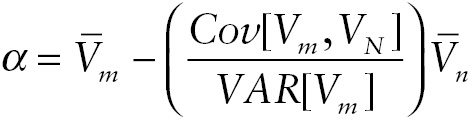
Notice that alpha represents how much higher or lower the average vote share in a given municipality is with respect to the national average vote share gained in all municipal elections that same year, but corrected by risk (the term in brackets). In these calculations, the PRI’s national vote share (VN) is not its support in federal elections, but rather its aggregate electoral support in all municipal elections held in different states between 1970 and 1988. Alpha is thus the predicted value of every municipality’s PRI vote, controlling for its national vote share in any given year in that period. The expected value of national vote shares is adjusted with the covariance between national and municipal electoral patterns divided by the variability of municipal elections.
By analogy with asset pricing, alpha measures the degree to which a municipality outperforms or underperforms the national market in municipal votes. “Excess returns” in elections, then, signal the skill or capacity of a municipal party, its office holders and cadres, brokers and candidates, organizational linkages and campaign strategies, in assuring relative support levels above the national trend. Chronic underperformance, in contrast, implies that municipal parties are unable to stem losses in any given election and are therefore vulnerable to takeover. The alpha parameter, in short, tells us how many more or fewer votes the PRI receives in each municipality, according to its known behavior in the past.Footnote 7
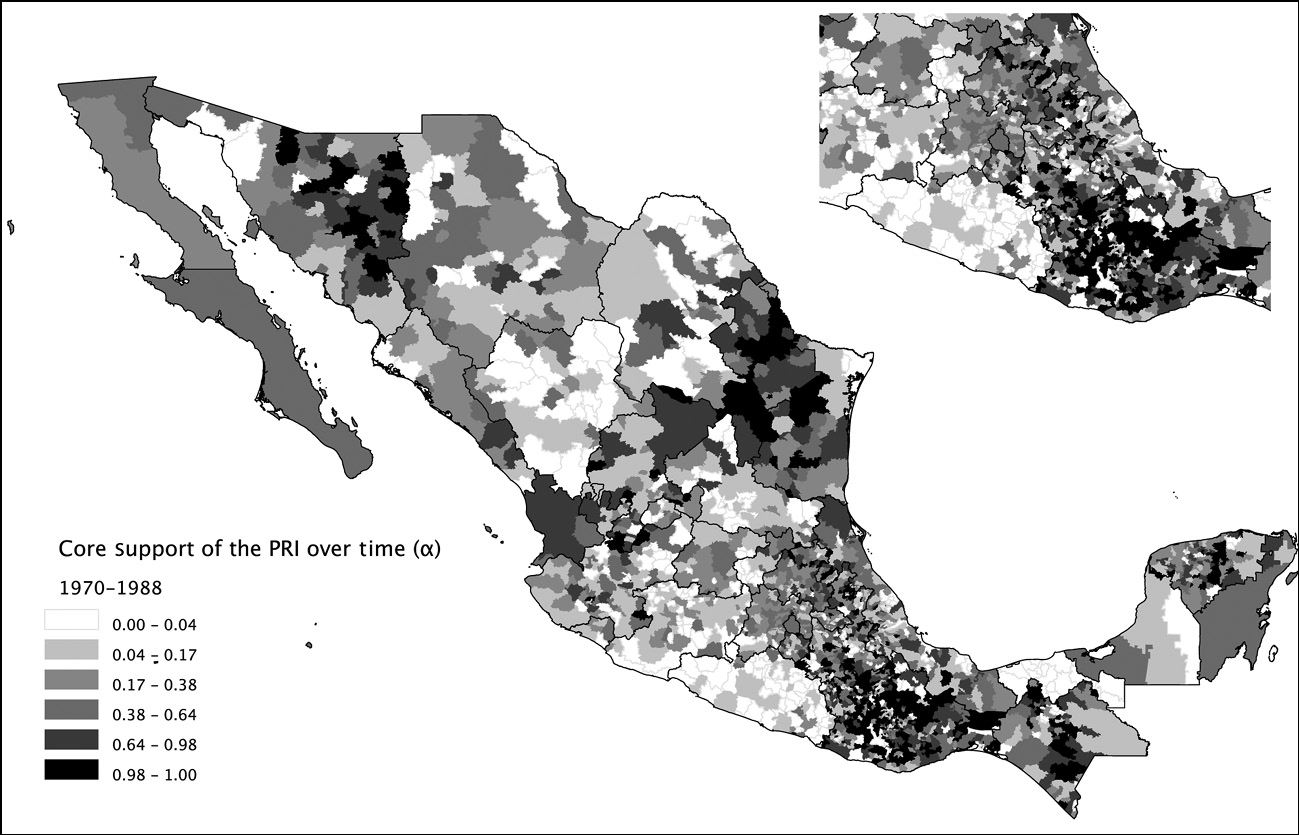
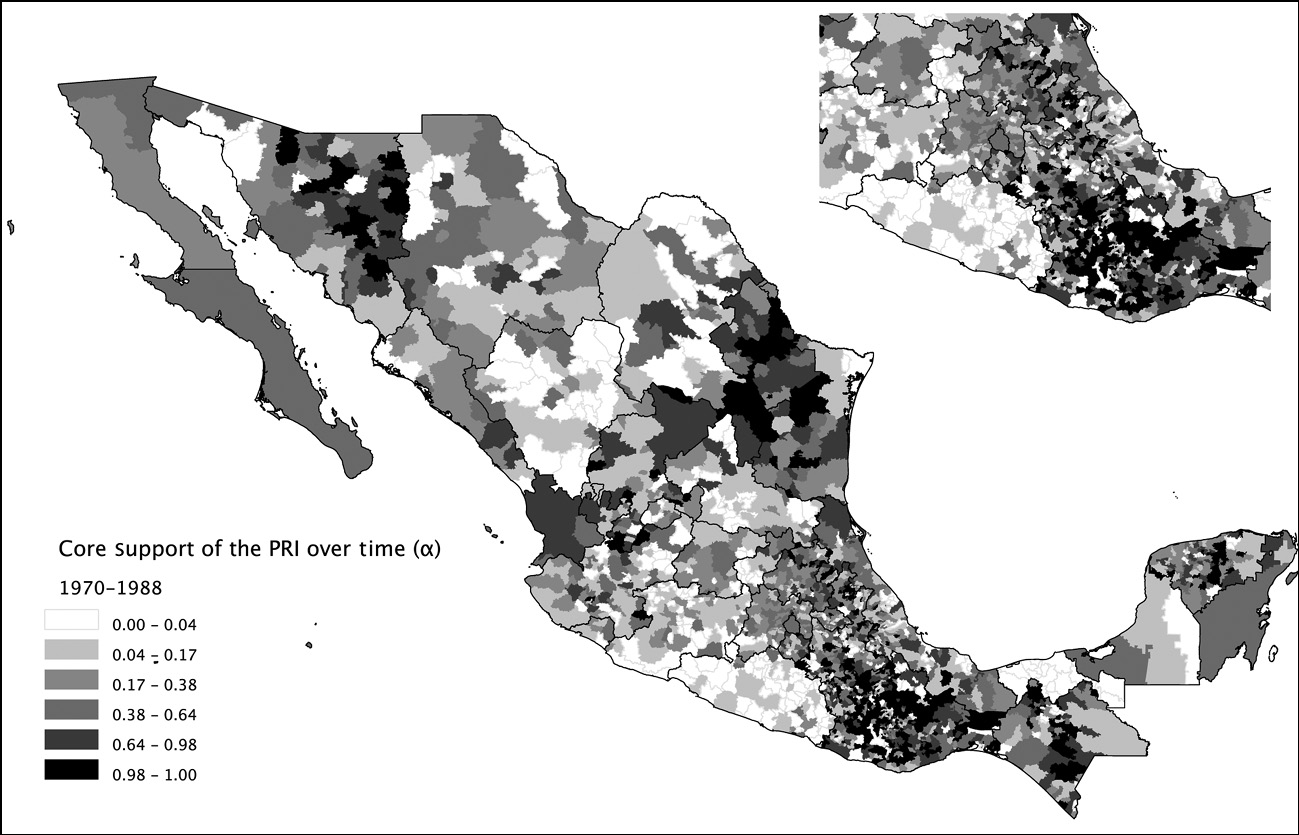
A useful illustration of the geography of alpha is provided in the municipal map in Figure 4.1. The darker zones have the highest alpha scores and include all municipalities in which the PRI held sway in uncontested elections or sustained its hegemony with at least 65 percent of the municipal vote since the onset of the series. The white zones are those with significant opposition presence, including several scores of municipalities won by opposition parties at least once between 1970 and 1988. The patent advantage of using log-odds ratios here is that they magnify opposition strength in a pattern spread throughout the country, when opposition presence was clearly marginal outside the big cities.
PRI core voter support.
To measure the erosion of partisan attachments we use the linear trend in PRI municipal vote shares between 1970 and 1988. The trend is indicated by the slope of a time series regression for each municipality on a time trend of the form:
Note that this is not a pooled time-series estimation, but rather the calculation of separate regressions, one for each municipality, where T reflects every year an election is celebrated. In federal elections, on average, the PRI suffered a yearly decline of 1.25 percent of its national vote from the peak year of hegemony in 1961, when it garnered 91 percent of the national total, to the national elections of 1994. In municipal elections, the decline averaged 1.5 percent per year since 1970 over aggregated three-year cycles. In the case of municipal trends, the variation across units is large, given that the accumulated impact of demographic change, modernization, political and economic events, and other election-relevant factors on the party’s electoral fortunes was highly differentiated across the country’s states and municipalities.
The slope of each of the regressions captures the erosion of the PRI’s core support. Given the overall trend of decline for the PRI, this corresponds to the rate of dealignment from the party in every locality. As an analogy, the slope is the municipal trend in volatility specific to one party.Footnote 8 We term this variable decline. Higher negative numbers mean greater erosion of support over the years.
There is some overlap between erosion and the commonly used concept of volatility – more volatile municipalities do show more negative slopes for the PRI. But erosion and volatility are very different indicators. The conventional standard for measuring volatility in a party system is the Pederson index. However, this index suffers from the same deficiency as vote share in t-1 or first differences in consecutive election returns. Short-term volatility may simply not reveal sufficient information about the electoral dynamics of a jurisdiction. Instead, a long-term measure better reflects the cumulative effects of demographic change, geographical mobility, economic shocks, and political events in the historical dealignment from the PRI, as well as the slow but steady growth of opposition support in that period.
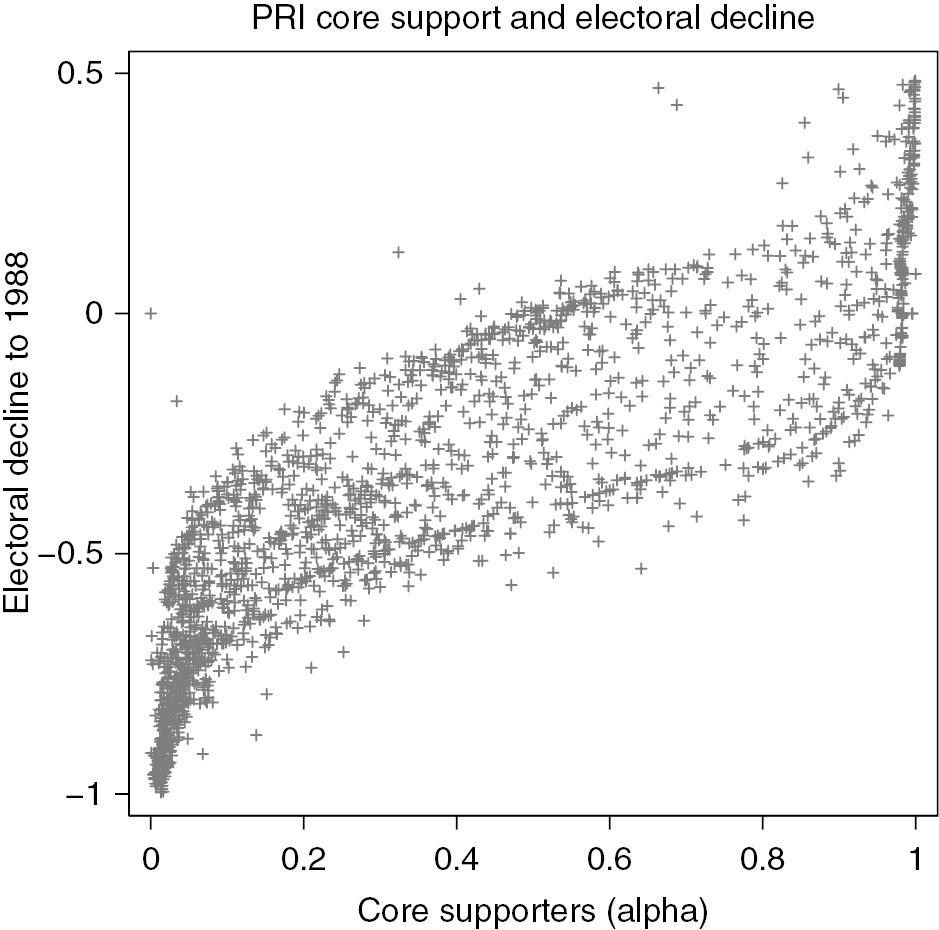
Figure 4.2 provides a scatter plot of our municipal measures of core size and its erosion. Naturally, there is a positive association between both variables, whereby higher levels of PRI core support correlate with lower levels of erosion over the years. Yet the figure shows that for any given level of core support on the horizontal axis, there are widely varying trends in electoral decline, on the vertical one. The average core value through 1988 was 0.47, while the average trend in dealignment was –0.29.
Correlation between core voter support and vote erosion (municipal level data using PRI vote shares from 1970 to 1988).
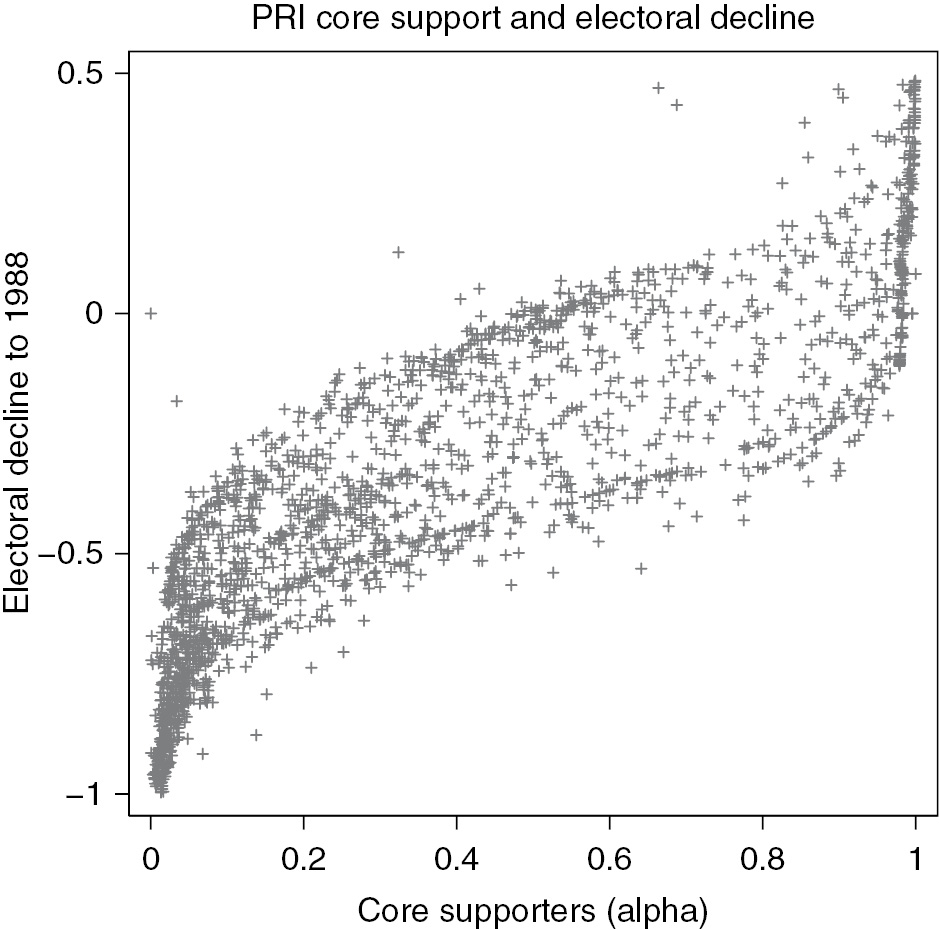
Our approach is to characterize each municipality by both core support and core erosion. Municipalities with high core support (large alphas) are loyal places. Loyal municipalities vote for the PRI in high numbers and remain reliable supporters even when other municipalities defect in response to economic recession, budget cutbacks, lack of jobs, currency devaluations, inflation, and so forth. Our theoretical expectations are that the PRI would invest resource transfers, for both private and public goods, in loyal places. But loyal voters are not all alike. Our core-voter model dissects loyalty according to levels of conditional core support. Some loyal municipalities exhibit little or no erosion of core voter support, while others have experienced a rapid deterioration over time. If core voters are not attended, they may defect and become swing voters in subsequent elections. This hypothesis leads us to expect that the PRI should concentrate its clientelistic practices in places where core size is shrinking in an attempt to lock-in still loyal voters.
With respect to municipalities with low core support (a small alpha), our theory leads us to predict an incumbent party’s disinterest in vote-buying through particularistic transfers. These small-core municipalities are places where the local party organization and its brokers have failed to mobilize strong support in favor of the PRI in one election after another. It is possible that in those places the local party organization is too weak and disorganized to be able effectively to target benefits. Voters in these places are also likely to be distant from the PRI and perhaps wealthy enough to desist from selling their votes to a corrupt party machine. Even when we do not expect the party to target small-core places with particularistic transfers, our theoretical approach proposes that the incumbent party should increase public goods provision for the purpose of attracting swing voters and even opposition backers.
Our empirical predictions according to how core size and erosion, our two main independent variables, shape Pronasol’s investments are: first, the bulk of Pronasol transfers for both private and public goods should favor settings of high core support, meaning that alpha should be positively associated with allocations.
Second, consistent with our argument that partisan loyalties are conditional and that clientelism is used to lock-in a party’s core backers, we expect private goods to be allocated preferentially to still loyal municipalities with higher rates of erosion (relative to those where erosion is negligible). Higher negative numbers mean higher erosions of core support; the effect of this variable should therefore be negative.
Third, we expect the PRI to allocate more public relative to private goods in small-core municipalities where the party must seek to build more encompassing electoral coalitions and cannot rely on its local agents to target benefits and carry the district. However, in line with the “punishment regime” approach, if the PRI has lost the municipality to the opposition in the past, we expect the PRI to punish these places with lower overall expenditures on public goods programs (Magaloni, Reference Magaloni2006; Diaz-Cayeros et al., Reference Diaz-Cayeros, Magaloni and Weingast2001).
4.3 Modeling Pronasol’s Centralist Logic
The model specification for our investigation of the centralist logic of Pronasol is exceedingly parsimonious. Aside from controls for population size and levels of development, our statistical model uses only three political variables: the measure of core size, the measure of core decline (both constructed with long-term municipal electoral data from 1970 to 1988), and the measure of electoral shock from the 1988 presidential election. We add this variable because there is consensus in the literature that this election led the PRI to enact Pronasol and influenced program expenditures.
The system shock in 1988 resulted from the split in the ruling party wrought by presidential contender Cuauhtémoc Cárdenas and his defeat in an election widely viewed as fraudulent. Cárdenas is the son of a former president, the revered Lázaro Cárdenas (president from 1934 to 1940). Cuauhtémoc split from the PRI, the party his father helped found, to form the group Corriente Democratizadora in 1987. The 1988 contest, by the official and much disputed count, saw the PRI lose almost a quarter of the national vote and created a strong and permanent opposition on the left. Following the bitter postelectoral conflict over the legitimacy of the vote count, president-elect Carlos Salinas promised a dramatic shift in social policy, aimed at poverty relief and social development after six years of a roller-coaster economy and stringent austerity in public finances. Pronasol mushroomed into being shortly thereafter. Apart from the effort to mitigate protest, stifle discontent, shore up legitimacy for the new government, and marshal support for other parts of its reform agenda, Pronasol was an attempt to revive a ruling party reeling from the split and the electoral meltdown (Dresser, Reference Dresser, Cornelius, Craig and Fox1994; Cornelius, Craig, and Cook, 1994). Numerous studies of spending patterns have stressed the specter of the 1988 elections in the new government’s effort to showcase its solidarity program, Pronasol. Specifically, this research highlights the purported attempt to buy back both the voters and the turncoat machines that defected to Cárdenas (Molinar and Weldon, Reference Molinar, Weldon, Cornelius, Craig and Fox1994; Bruhn, Reference Bruhn1996), finding evidence for a disproportional flow of transfers to states where support for Cárdenas was high.Footnote 9
In addition to being part of the conventional wisdom about the motives and uses of Pronasol, the buy-back thesis merits our attention because it counters our expectations about the association between voter loyalty and party largesse. In effect, it is a variation on the swing-voter model. If the PRI targeted defectors from its ranks in 1988, then it rewarded partisan disloyalty. But if it did not, as Magaloni (Reference Magaloni2006) finds, our hypotheses about conditional party loyalty would be buttressed.
In order to gauge the accuracy of the buy-back claim, we include the controversial measure of the PRI’s vote margins at the municipal level in the 1988 presidential race (1988 margin). This measure is controversial because the electoral data are incomplete. Electoral authorities at the time released the voting tallies for 29,999 precincts, out of a nationwide total of nearly 55,000, but never revealed the remainder’s vote counts. Once these partial data are aggregated into municipal-level figures, precinct coverage ranges from almost 100 percent (in big cities) to just under 10 percent (in more outlying rural municipalities). While the bias of underreporting might be distributed along an expected continuum of high to low opposition support, as the precinct moves away from the cities, it is nonetheless the case that the geography of the Cárdenas vote in 1988 – cutting a swathe from east to west across the middle and heavily populated part of the country – does not seem to fit the conjecture. The 1988 vote margins reach only a correlation of 0.20 with the alpha measure of core support for the PRI, and one of 0.07 with the measure of core erosion. This dissociation between federal and local voting patterns should allow for a clean test of the impact on allocation decisions of the electoral shock from 1988.
Control variables in the model are straightforward. The creators of Pronasol pronounced it a program for poverty relief and social development. It is a reasonable assumption that the census-based measure of poverty or social marginality, known as the CONAPO index, guided the allocations made within the program over the course of its existence. Developed by the Mexican government, the CONAPO index calculates the level of social marginality per municipality, using a set of indicators that include the percentage of the employed population living below the minimum wage, illiteracy, housing without access to sewage, electricity, drinking water, and population engaged in rural activities.
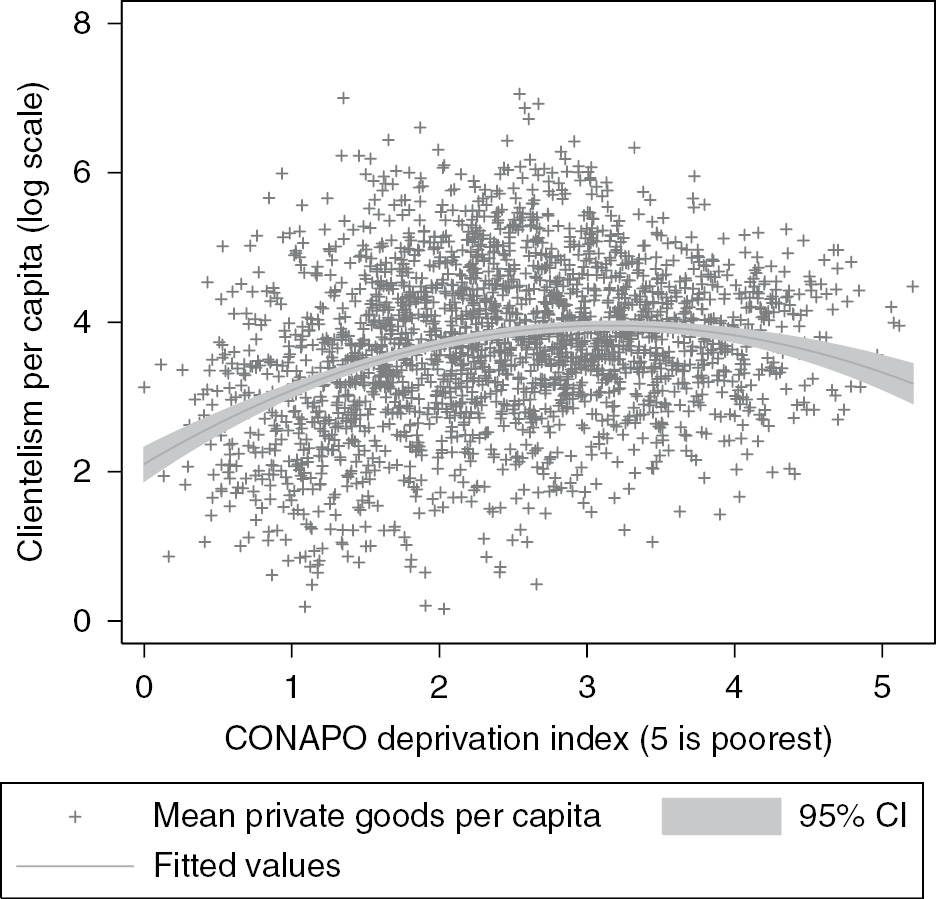
In addition to the CONAPO index, we include its square value (CONAPO2). In earlier work (Magaloni, Diaz-Cayeros, and Estévez, Reference Magaloni, Diaz-Cayeros, Estévez, Kitschelt and Wilkinson2007), we found a curvilinear relationship between private goods provision and development levels, with more per capita funds going to municipalities at medium levels of development. Here, the reason for including the quadratic expression is to test for its impact on other categories of Pronasol expenditures that we use as dependent variables. Figure 4.3 shows the per capita allocation of private goods according to development levels as measured by the poverty index. Clientelism (measured by particularistic transfers) exhibits an inverted J-shape relationship with development, even without controlling for other variables, which is striking from the modernization point of view. As we will demonstrate, this relationship does not depend on political configurations as reflected by the measures of core support and core erosion (nor other conventional measures of political competition, such as the number of parties).
Clientelism and development.
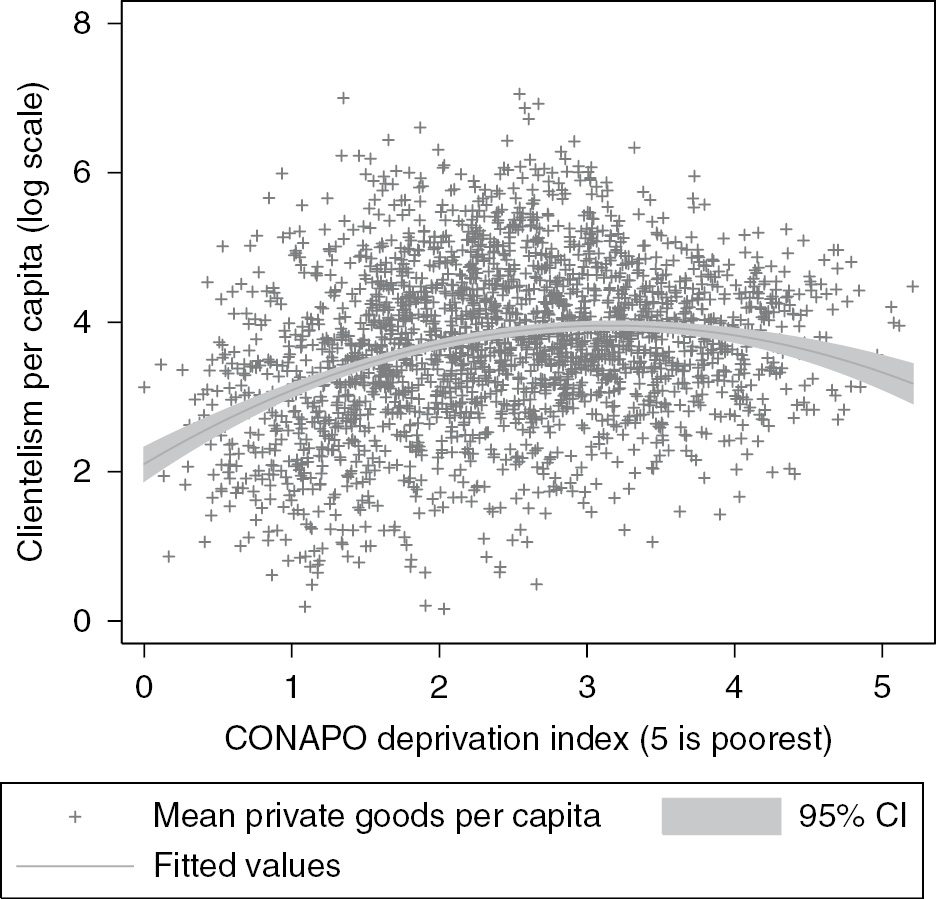
The finding that clientelism tends to decrease at the highest levels of development is consistent with the socioeconomic theory of linkage building, which states that richer voters’ preference for public goods provision over private transfers makes it too expensive for a party to attempt to buy them off through particularism (Kitschelt, 2000). Thus, clientelism tends to be greatly reduced, albeit never fully eradicated, at the highest level of development. Contrary to this theory, the Mexican case documents that clientelism is greatest at middle levels of development, not in the poorest localities.
The question arises as to whether core support, core erosion, and political variables in general respond to economic development. Our dataset allows us to separate the socioeconomic from the political processes that influence clientelism. In cross-national comparisons, development is correlated with political competition, and in Mexican studies, development levels usually show a strong inverse relation with PRI support (Klesner, Reference Klesner2000). Our long-term measures of municipal electoral behavior, on the contrary, are distinctly political. There is no correlation between the poverty index and the erosion of electoral support, as measured by our variable erosion (ρ = 0.05). Although poor localities tend to have larger shares of core voters, as one might expect, the correlation between the poverty index and alpha is modest at best (ρ = 0.24).
We also control for municipal size in the models, employing the natural log of population (logpop). To some extent, one should expect that large and more heterogeneous populations would be associated with higher development levels, but the Pearson’s correlation between logpop and CONAPO is 0.40, indicating that these variables measure different municipal-level traits. In another order of calculation, in the event large cities are favored with per capita expenditures, one could surmise a political interest in those jurisdictions with large raw voting power.
The dependent variables for the central models of Pronasol are mean municipal-level expenditures from 1989 to 1994. We run four cross-sectional models. Model 1 considers total per capita expenditures. Models 2 and 3 look at per capita private and public goods, respectively. These three are all expressed in logarithmic terms. Model 4 tests the shares of private goods within total Pronasol transfers to each municipality. In order to ensure that the estimations do not suffer from spatially autocorrelated errors, a spatial lag is included. We have calculated a (queen) proximity matrix of order 2 in which both the contiguous and the contiguous-at-one-remove values in the dependent variable are taken into account. The spatial weights and the regressions including the spatial lag were all run on GeoDA. Results are provided in Table 4.1.
| 1 | 2 | 3 | 4 | |
|---|---|---|---|---|
| Total PC Expenditures | Private Goods PC | Public Goods PC | Share (Private/Total) | |
| Spatial lag | 0.031 | –0.032 | 0.051 | 0.060 |
| (0.037) | (0.055) | (0.041) | (0.058) | |
| Constant | 7.305 | 3.866 | 7.065 | –0.057 |
| (0.257)** | (0.356)** | (0.274)** | (0.052) | |
| Logpop | –0.272 | –0.168 | –0.251 | 0.011 |
| (0.012)** | (0.020)** | (0.013)** | (0.003)** | |
| Conapo | 0.014 | 0.804 | –0.249 | 0.160 |
| (0.062) | (0.108)** | (0.069)** | (0.017)** | |
| Conapo2 | –0.008 | –0.132 | 0.037 | –0.028 |
| (0.012) | (0.020)** | (0.013)** | (0.003)** | |
| Alpha | 0.319 | 0.395 | 0.162 | 0.035 |
| (0.076)** | (0.130)** | (0.083)* | (0.021)* | |
| Decline | –0.233 | –0.628 | –0.048 | –0.103 |
| (0.068)** | (0.119)** | (0.076) | (0.018)** | |
| 1988 Margin | 0.192 | 0.033 | 0.250 | –0.028 |
| (0.038)** | (0.066) | (.042)** | (0.012)* | |
| N | 2422 | 2422 | 2422 | 2422 |
| R2 | 0.310 | 0.125 | 0.220 | 0.073 |
Note: Coefficients from OLS cross-sectional regressions of municipal-level allocations
(ln) from 1989 until 1994. Robust standard errors in parentheses.
* Significant at 5% level; ** significant at 1% level.
The initial result to highlight is that total per capita transfers averaged over six years show an extremely weak relationship to municipal welfare levels as measured by the CONAPO index (column 1). This is partially mitigated by a strongly negative relationship with municipal size, which rules out a big-district strategy for capturing large voter blocs. Thus, Pronasol funds, which were presumably intended to help the poor, were, in reality, spent with other priorities in mind.
The strictly electoral variables are unambiguous in their impact. First, larger overall transfers are strongly associated with the PRI’s traditional strongholds in municipal elections. The larger the core size for the party, as measured by alpha, the greater the total flow of per capita transfers. Second, the rate of vote loss over the long term affects allocations in the expected direction, with strong declines attracting higher levels of investment. Third, those localities staunchly loyal to the PRI in 1988 were favored with more transfers during the Salinas administration, while those that backed the opposition were punished, in relative terms. With respect to the overarching logic of Pronasol, a buy-back strategy aimed at voters who earlier had defected was not a systematic criterion in the geographical distribution of funds. Nor could it have been, since to bribe municipalities back into the fold would have established the wrong incentive by rewarding defection. In sum, the core-voter model and the notion of conditional party loyalty are strongly supported by these results with respect to total Pronasol transfers.
A more nuanced story about the core-voter strategy is told through the distinction made between the two basic types of electoral investment contained within Pronasol (columns 2 and 3). Our expectations are that core supporters will be preferentially targeted for benefits, in the form of both private and public goods. However, the objectives sought by the provision of private versus public goods will separate according to how threatening the core’s defection is in any given municipality. Our conditional party loyalty theory claims that locking-in the core and halting core defection is a key motive of clientelism. Public goods are not the favored instruments for keeping the core loyal. These claims are strongly supported by the empirical evidence. Consistent with our conditional party loyalty theory, the PRI tried to halt the drift of its core base through the intensification of clientelistic transfers rather than through the provision of public goods. The variable decline is strongly significant in the expected direction in models 1, 2, and 4, but not in model 3. These results provide support to our claim that clientelism as an investment strategy is intended to preserve preexisting core constituencies that might otherwise defect.
From columns 2 and 3 it is clear that small municipalities as measured by population size (logpop) fare better than large ones for both categories of electoral investment. However, the poverty index and its squared value assume diametrically opposed associations with the two types of benefit outlay. With respect to clientelism, one observes an inverted J-shaped relationship with development level. Intermediate levels of development (or poverty) attract higher levels of private goods provision, while the polar opposites on the scale are less favored by particularistic transfers. In the case of public goods provision, the opposite relationship holds. It is the poorest and richest ends of the development continuum that receive larger transfers for collective goods, while the intermediate levels obtain fewer of these benefits. At the same time, the coefficients for the quadratic expression are much larger in the case of clientelism, indicating a pronounced differential in distribution. The curve for public goods is flatter and seems to indicate almost a buckshot strategy, if not quite a universalistic one, for the distribution of collective goods at all levels of development. In any case, the important result that Pronasol did not particularly favor the poorest municipalities continues to hold.
The last model in column 4 tests for the determinants of the share of clientelism within the complete basket of Pronasol transfers to each municipality. In our view, a critical difference with respect to the debate over core- versus swing-voters is that investment diversification entails obvious advantages for incumbent politicians with discretionary funds available. It is probably the case that the larger overall share of public goods provision within Pronasol (an average 72 percent over six years) and the intense media campaign that accompanied its expansion served to shield from public scrutiny the clientelism that lay within the program and that increased in proportion over time. The specific combination of these investments for each municipality, we posit, reflected to some degree the risk assessment the PRI devised for each locality and balanced the imperatives of catering to its long-term core constituencies while claiming credit for collective welfare benefits.
The results of the diversification model are presented in the last column of Table 4.1. The poverty index shows an inverted J-shaped curve, much like that of per capita private goods transfers. Municipalities at intermediate levels of development obtain the highest shares of private goods, but the poorest municipalities still receive almost double the share going to the richest. Population size is positively associated with the composition of the portfolio, with higher shares of clientelism going to larger municipalities, but this result reflects lower relative transfers for collective goods than for private ones.
The alpha parameter reflecting core size is positively related to shares of clientelism, as it was (more strongly) for private transfer amounts. These results are an indication that, per our predictions, the relative share of public goods in the portfolio increases where the PRI’s core is smaller and the party faces stronger competitive pressures, a point that will become even more transparent when analyzing the peripheral logic of Pronasol with respect to local elections and local partisan configurations. Public goods provision is not as effective an instrument for the retention of partisan loyalties, but is used in places with low core support as a means of attracting non-core-voter groups. The measure for long-term electoral dealignment follows its earlier pattern, with intensified clientelism for those locations with higher rates of decline in PRI support.
Finally, the shock waves from 1988 skewed the distribution of total Pronasol funds in favor of districts loyal to the PRI in that watershed election. The results for public and private goods transfers within the program, however, reveal a differential impact of the 1988 elections. Most of the reward for loyalty in 1988 is concentrated in greater public goods provision, with disloyal districts assigned fewer funds for public works. Outlays for clientelism are unrelated to 1988 election returns.
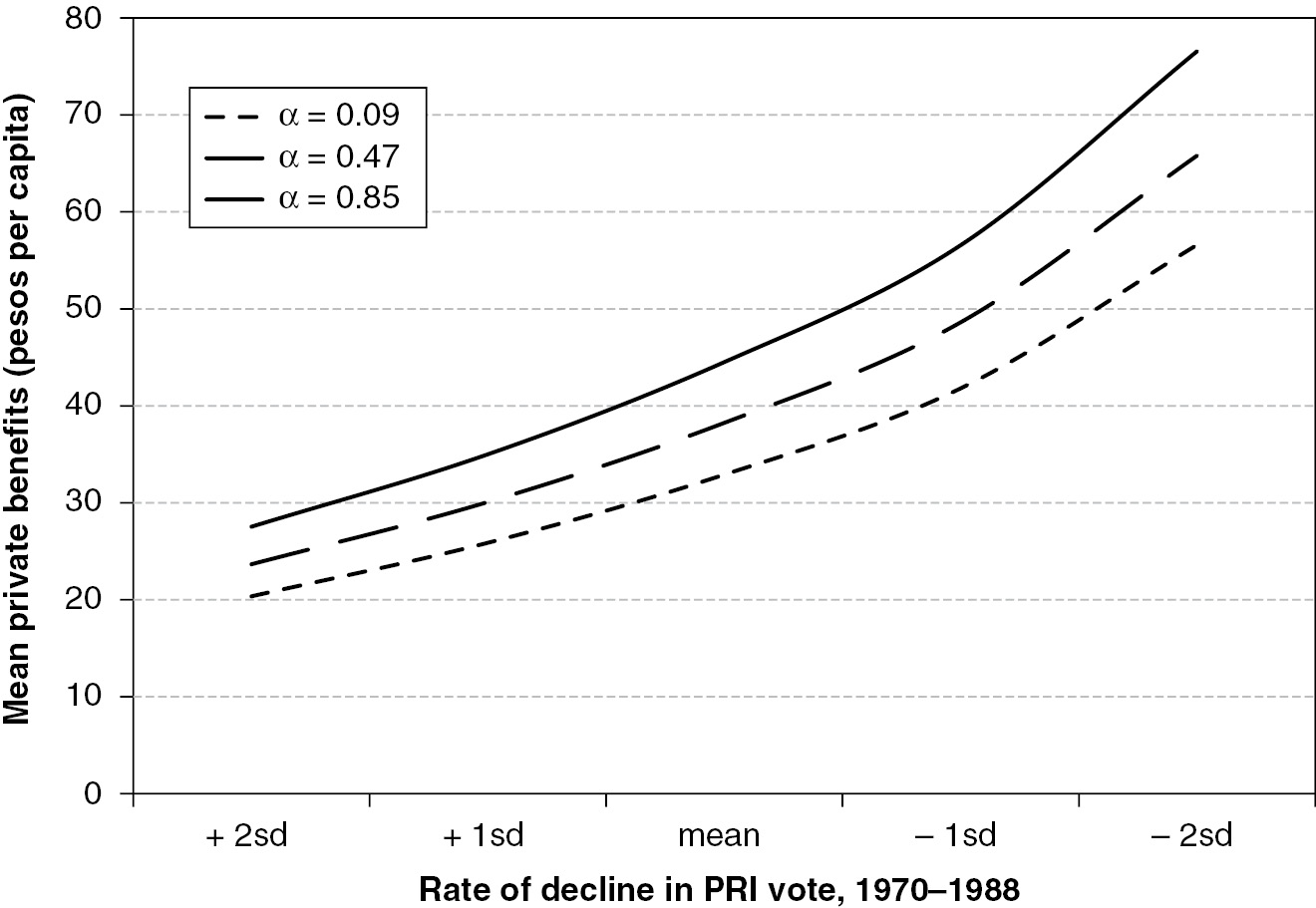
To have a sense of the range of effects for our main explanatory variables alpha and decline, Figure 4.4 simulates the predicted values of per capita private goods provision or clientelism, according to varying electoral variables and with the socioeconomic controls and 1988 margins set at their means. Shown are three scenarios for alpha: a stronghold municipality at one standard deviation above the mean; another at the mean; and a third one at one standard deviation below the mean. The graph then plots the per capita transfers for private goods according to the rate of decline in party loyalty over time. The simulated effects for both variables are substantively important: a stronghold with stable support for the PRI receives a bonus of 8 pesos per capita over one with few core supporters; an unstable bastion obtains 20 pesos more per inhabitant than the amount going to the PRI’s weakest districts. Moreover, when the PRI’s rate of decline increases from the mean rate (–0.299) by one additional standard deviation (–0.682), per capita allocations grow by about 10 pesos; when it jumps two standard deviations (–1.164), the benefits almost double in value per head over those for municipalities at the average rate of dealignment.
Simulated effects of municipal electoral history on private goods.
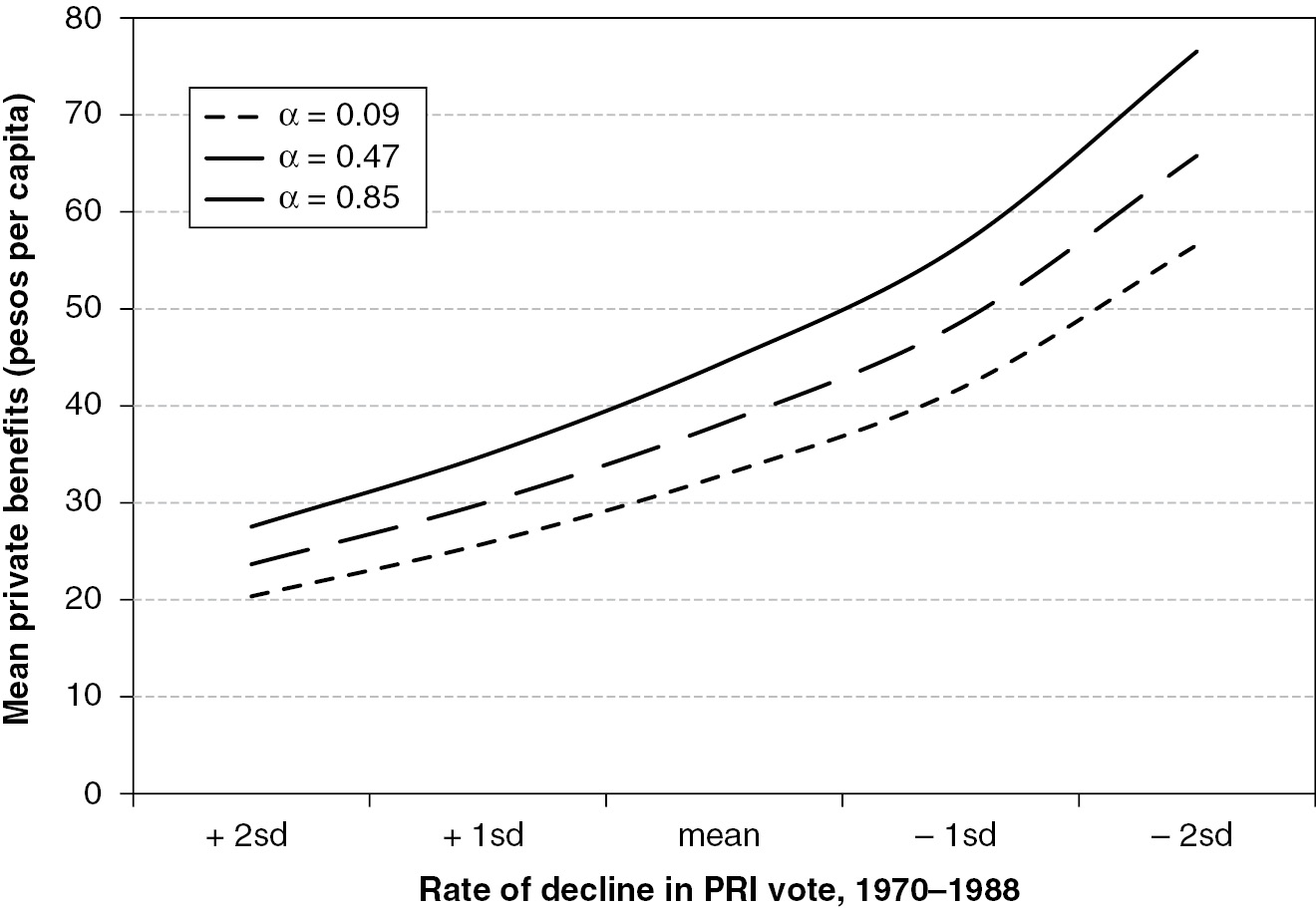
On the basis of these general models of Pronasol allocations, the conclusion is inescapable. Pronasol was a program designed and operated on behalf of the PRI’s core constituencies throughout the country and its expenditures markedly benefited municipalities consistently loyal to the ruling party. There is scant evidence in these models of behavior approximating the party opportunism of the swing-voter model. We also uncover strategic behavior by the PRI that resulted in more clientelistic transfers disproportionately targeted to municipalities where core support was eroding more rapidly over time due to a multifaceted process of development. Consistent with our theory of conditional party loyalty, the PRI used clientelism primarily as an attempt to lock-in its core base. Finally, there is no evidence of a buy-back logic. Disloyal municipalities, and especially those that supported Cárdenas in 1988, were punished with fewer per capita transfers. Overall, Pronasol’s total per capita expenditures were not targeted to benefit the poor, but to sustain the PRI’s electoral hegemony, to block if not destroy the embryonic party formation that resulted from the Cárdenas split, and to lock-in ruling party voters through intensified clientelism.
4.4 The Peripheral Logic of Pronasol
The partisan heart of Pronasol should beat just as strongly when faced with more immediate or short-term challenges such as election schedules, local party systems, and the party label of local incumbents. Our expectations are that the investment strategy adjusted to every municipality’s political facts on the ground will reflect the dependence of the national incumbent on the party machines and operators who reliably turn out the vote and govern localities in alliance with party higher-ups.
To this point we have focused on Pronasol‘s political motives as centrally devised, driven by national electoral imperatives, including safeguarding hegemony and maximizing electoral support across the board. But as we have emphasized, Pronasol’s operations on the ground were run through a vast network of politicians and officials, including state governors, municipal authorities, local party brokers and community leaders, as well as centrally designated Pronasol delegates. In this section we assess the extent to which local and regional politicians were able to shape Pronasol’s investment strategies to attend to their district’s electoral needs. We ask in particular if Pronasol’s disbursements responded to municipal election schedules, local party system configurations, and the party label of local incumbents.
Our expectations are that the investment strategy adjusted to every municipality will continue to reflect a core-voter orientation. However, we expect to observe some tinkering of Pronasol according to local election calendars and expectations about the competitiveness of coming municipal elections.
Municipalities, of course, range widely in terms of their levels of electoral competitiveness and their party system configurations. Small cores in one set of localities translate into lower vote shares, tighter electoral margins, and a larger effective number of competitors within the municipal party system. In such places, it is unlikely that mere cultivation of the core constituency will produce victory in any upcoming election. Electoral competition, then, should oblige incumbent politicians to appeal to segmented electorates beyond their normal constituencies through policies and promises that entail a broadly cast net of welfare benefits generated by public goods provision – thus, the imperative of diversification in the choice of electoral investments.
In addition to previously used socioeconomic controls and the lagged values of the dependent variables, the peripheral models respecify the political and electoral variables used earlier. In the peripheral logic models, we are dealing with pooled-time series, where our dependent variables vary from year to year, rather than cross-sectional models. Here we include dummy indicators for election year, one for federal elections held in 1991 and 1994 (national election), and another for election years in the staggered municipal calendar (local election). It should be noted that in Mexico’s busy election calendar, municipal elections take place in staggered three-year cycles, meaning that every year there are municipal elections taking place in different states. If national and local politicians took electoral dynamics into account in their allocation decisions, we expect both variables to be positively associated with our dependent variables.
Also included are electoral variables strongly related to the political measures specified for the previous models but which highlight more telltale features of partisan control and competition during the years of the Salinas administration. We propose a typology of competitiveness from the perspective of the PRI, which incorporates the influence of the electoral legacy of the 1970s and 1980s and dissects its strength in the 1990s. The typology comprises four exclusive categories of municipal competition:
1. Monopoly is defined as a one-party municipality in which the PRI had an unbroken string of victories with at least 65 percent of the vote in every election since 1970, and ran uncontested (100 percent of the vote) during the Salinas administration.
2. Hegemony is defined as a municipality in which the PRI registered vote shares between 65 and 100 percent from the 1970s to the Salinas years, but faced opposition on the ballot.
3. Marginals is the label given to all other municipalities governed by the PRI, though they are not, strictly speaking, marginal districts, but rather competitive ones, in which an opposition party has sufficient strength to count as a viable contender in any local election.
4. Opposition refers to municipalities governed by any opposition party.
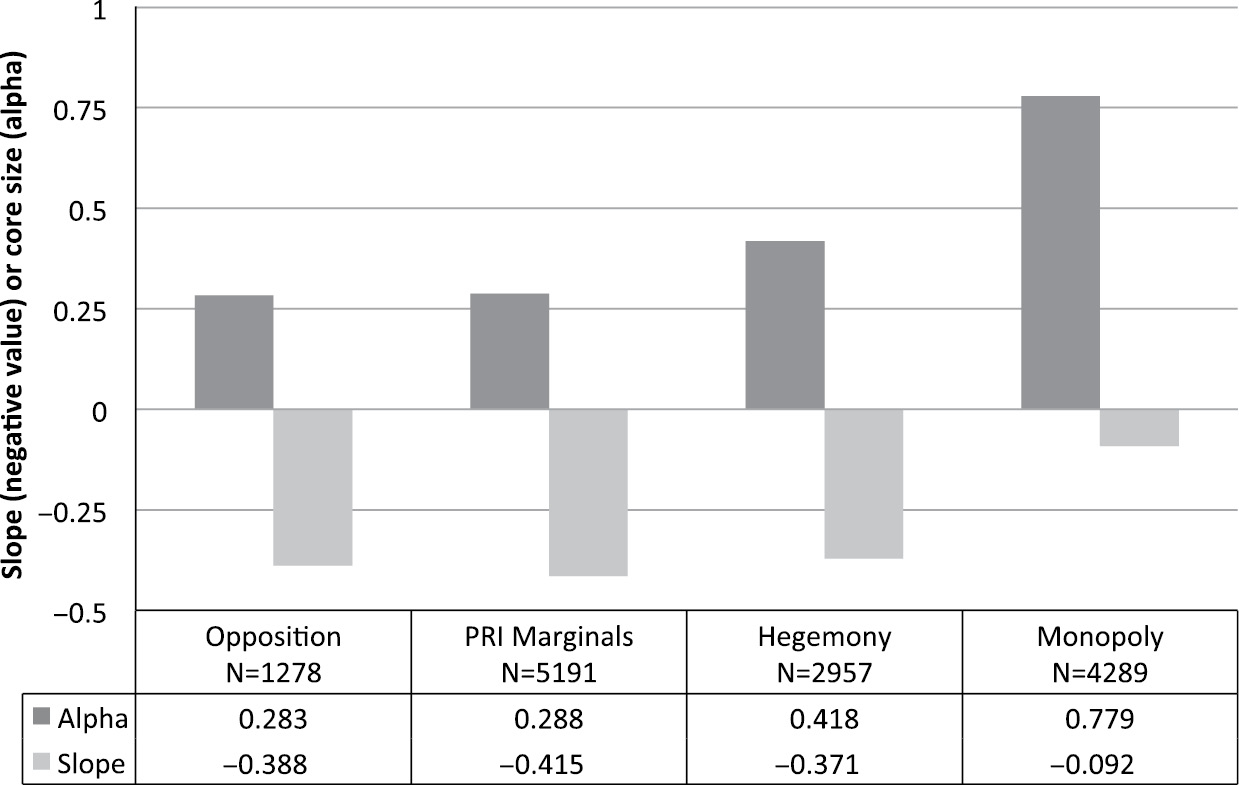
This simple typology of competitive challenges faced by the PRI at the municipal level is defined in terms of mean alpha and decline scores (Figure 4.5). Predictably, the categories of monopoly and hegemony exhibit much larger mean cores than competitive municipalities. But only monopoly provides a stable electoral trend over time. The municipalities corresponding to opposition and marginals are practically indistinguishable in terms of their electoral legacies.
Mean core size and trends by level of competition.
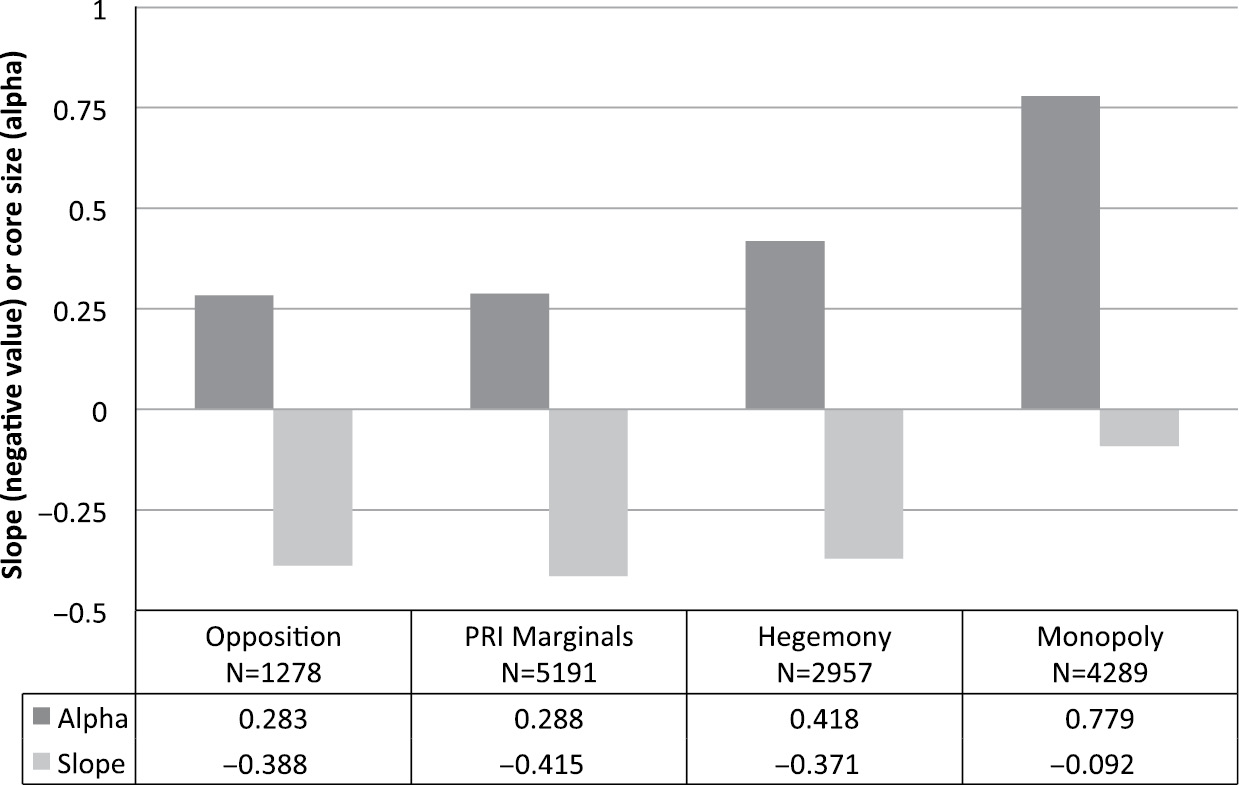
In line with the results from the central models in Table 4.1, we expect in these peripheral models that the highest per capital funding levels should go to hegemonic municipalities where alpha is large but, in contrast to monopolistic electoral markets, strong erosion of PRI support over time has occurred. Although PRI marginals and opposition municipalities possess very similar electoral legacies, they should receive very different treatments, the latter being unambiguously out of favor, consistent with the notion of a punishment regime. Once again, this punishment strategy is inconceivable within the swing-voter model.
More conventional indicators of competitiveness also differentiate these categories in predictable ways. Table 4.2 describes the Laakso-Taagepera index of the effective number of parties (N), as well as the mean absolute margin of victory in municipal elections held from 1989 to 1994 for the four categories. While the PRI’s monopolistic and hegemonic municipalities could endure the loss of one standard deviation in votes, or the entry of 0.5 competitors as measured by the Laakso-Taagepera index, without facing high odds of losing the municipality, the same was not true for competitive municipalities. If the ruling party had staked its interests in winning competitive municipalities, logically it should be expected to invest more heavily in them, following the imperatives of the swing-voter model. Our theory holds, instead, that core constituencies should continue to reap the benefits of electoral investment.
| Effective N | (sd) | Margin of Victory | (sd) | |
|---|---|---|---|---|
| Monopoly | 1.224 | (.401) | 0.807 | (.308) |
| Hegemony | 1.585 | (.516) | 0.518 | (.264) |
| PRI Marginals | 1.825 | (.785) | 0.276 | (.242) |
| Opposition | 1.437 | (.980) | 0.288 | (.266) |
There are two strategic exceptions to this general expectation. First, monopolistic or noncompetitive elections in which the ruling party runs uncontested do not require a high ratio of clientelism-to-pork transfers because core supporters have no credible exit option. Second, we claim that the PRI should diversify its spending by investing in higher shares of public goods in competitive or high-N municipalities, which, not coincidentally, are the municipalities with small PRI cores.
To explore this facet of investment diversification further, we include municipal-level N in the peripheral model, in line with Chhibber and Nooruddin (Reference Chhibber and Nooruddin2004). However, since the local structure of competition during the period 1988–1994 is clearly affected by Pronasol expenditures, we instrument the effective number of municipal parties with its value in t−1.Footnote 10 This instrumented measure of
 captures, then, the effect of an expected competition structure in any municipality.
The results for the peripheral models are presented in Table 4.3. The first two models test for per capita allocations in private and public benefits, respectively, and the third for the relative share of private goods within the total basket of municipal funds. Since we explore the effects of local electoral politics on transfers over time, yearly observations are pooled, controlling for the time trend (year) and the lagged value of each dependent variable.
| 1 Private Goods pc |
2 Public Goods pc |
3 Share (Private/Total) | |
|---|---|---|---|
| N | –0.122 | 0.363 | –0.057 |
| (0.064)* | (0.070)** | (0.009)** | |
| Monopoly | 0.403 | 0.269 | –0.015 |
| (0.096)** | (0.047)** | (0.007)* | |
| Hegemony | 0.720 | 0.262 | 0.028 |
| (0.089)** | (0.042)** | (0.008)** | |
| Marginal | 0.444 | –0.051 | 0.030 |
| (0.077)** | (0.039) | (0.007)** | |
| Local Election | 0.189 | –0.737 | 0.097 |
| (0.102) | (0.113)** | (0.014)** | |
| National Election | 0.285 | 0.061 | –0.001 |
| (0.048)** | (0.024)** | (0.004) | |
| Logpop | 0.154 | –0.175 | 0.008 |
| (0.023)** | (0.013)** | (0.002)** | |
| Conapo | 1.226 | –0.091 | 0.123 |
| (0.112)** | (0.062) | (0.010)** | |
| Conapo2 | –0.194 | 0.016 | –0.021 |
| (0.022)** | (0.011) | (0.002)** | |
| Year | 0.421 | –0.005 | 0.034 |
| (0.021)** | (0.011) | (0.002)** | |
| Private Goods t−1 | 0.377 | ||
| (0.010)** | |||
| Public Goods t−1 | 0.190 | ||
| (0.009)** | |||
| Private Share t−1 | 0.319 | ||
| (0.010)** | |||
| Constant | –40.363 | 5.883 | –3.162 |
| (2.058)** | (1.044)** | (0.164)** | |
| N | 11008 | 10995 | 10991 |
| R2 | 0.35 | 0.15 | 0.19 |
Note: Coefficients from OLS pooled time series regressions of municipal-level per capita allocations (ln) and shares. Robust standard errors in parentheses.
* Significant at 5% level; ** significant at 1% level.
The behavior of the control variables is very similar to that observed in the earlier models. Clientelism is strongly curvilinear with development levels, while pork shows no relationship to the poverty index. Per capita transfers for private goods increase and for public goods decrease with municipal size. Importantly, recourse to clientelism increases strongly over the lifespan of the program.
Electoral cycles in spending are quite clearly present during the Salinas term, but specifically for federal elections in 1991 and 1994. Indeed, a national election always trumps local ones, indicating the dominance of the centralist strategy over six years of Pronasol operations. There is weak evidence that Pronasol’s particularistic transfers increased prior to municipal elections, but transfers for public goods paradoxically decrease quite dramatically. In other words, the local election calendar did not dictate disbursements among Pronasol’s social infrastructure projects. Credit-claiming by its municipal parties perhaps rested on the record of accumulated pork-barrel transfers, but was not based on opportunistic infusions of funds for public works and infrastructure projects. Nonetheless, the context of an upcoming municipal election modifies the investment strategy in favor of clientelism, albeit with its funding levels unchanged. This relative stability of clientelistic transfers with respect to local electoral cycles, in contrast to the erratic flows of resources for public goods, supports the core-voter model. Particularism, as expected, enjoys a steady and constant resource flow that confirms the primacy of delivering the goods to core voters.
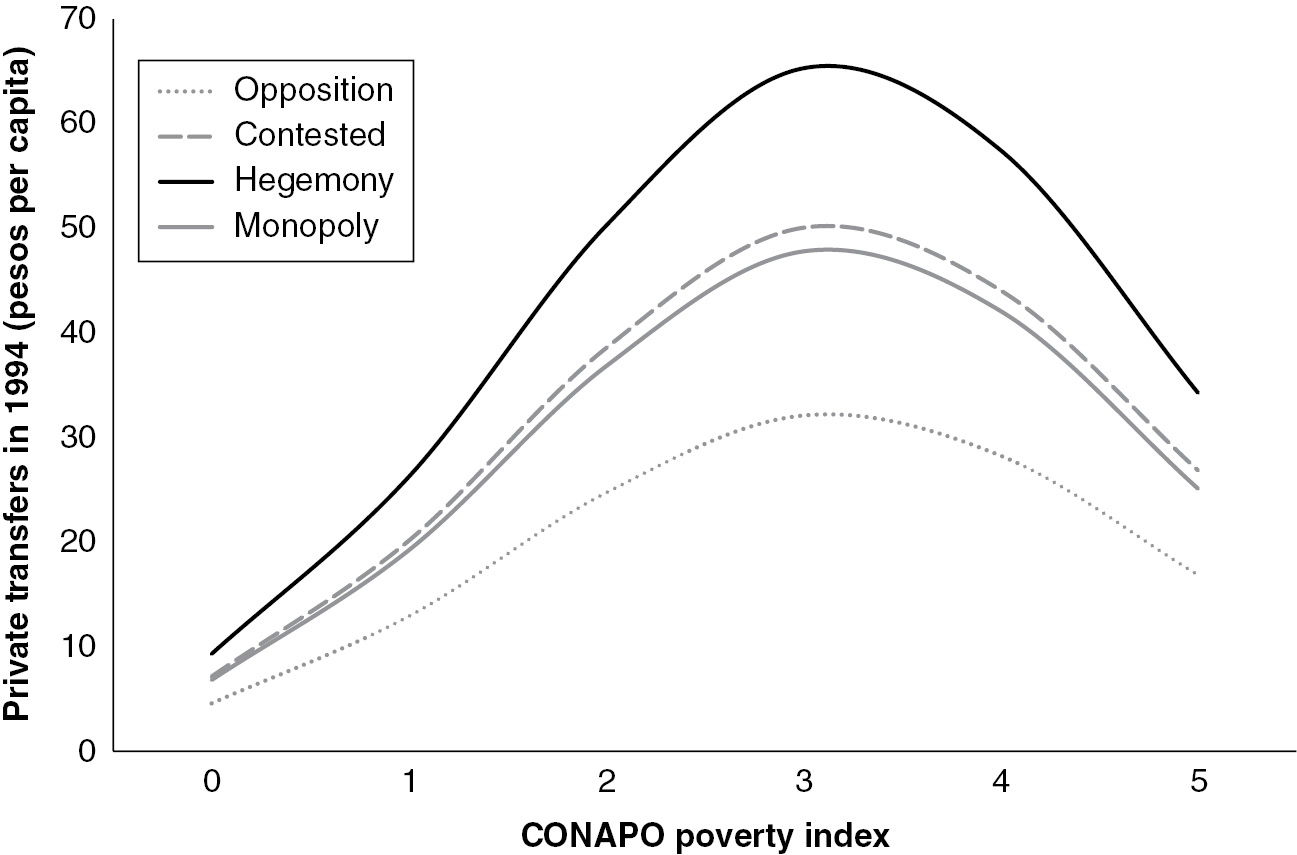
Municipal competition types perform as expected. Clientelistic per capita transfers are highest in hegemonic municipalities, while monopolies and marginals receive almost equal treatment. Opposition-controlled municipalities, the base category for model comparisons, obtain the lowest amounts of particularistic transfers. In the case of per capita public goods transfers, one-party and hegemonic districts enjoy the highest allocations, while opposition districts and PRI marginals receive very similar treatment at lower levels of funding.
The full measure of the core-centered logic of Pronasol can be appreciated in Figure 4.6, which maps clientelism for each category of competition against the poverty index. Particularistic transfers to hegemonic municipalities were double those received by opposition-held municipalities, at any level of development. Particularistic transfers destined for monopolies and marginals were about 50 percent higher than what opposition-held municipalities received. The largest breach in absolute terms comes at intermediate levels on the poverty index, as before, yet the poorest localities enjoy at least three times the resources delivered to the richest. At the same time, one-party and competitive municipalities controlled by the PRI are assigned similar amounts of clientelism at all development levels.
Clientelism and competition.
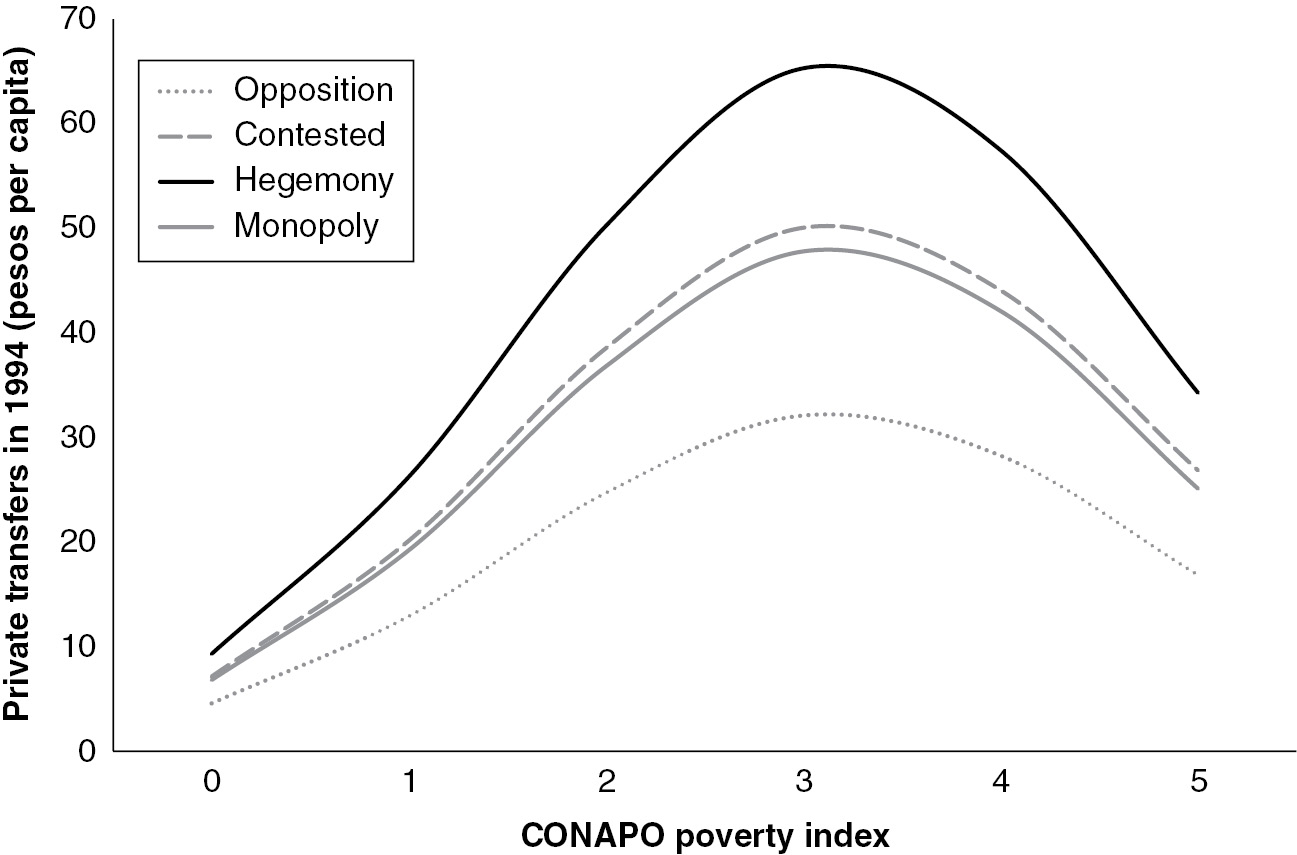
From the perspective of the swing-voter model, this distribution of particularistic transfers would seem perverse; from that of the core-voter model, it reflects the centrality of partisan expectations and commitments to both voters and local party brokers. That is, private benefits that are selectively targeted should not be given to outsiders because they generate the wrong type of incentives by rewarding defection. Larger core constituencies take the greater slice of the pie, mitigated only by the lower incidence of private transfers in situations of monopoly where core voters have no credible exit option. This last finding is in accordance with Medina and Stokes (Reference Medina, Stokes, Kitschelt and Wilkinson2006) who argue that monopolies suffer benign neglect by incumbents with respect to handouts. In competitive municipalities, with smaller cores, the party label of municipal government is decisive for allocation. Again, the swing-voter model would argue for similar treatment of all marginals, since a weak marginal municipality controlled by the opposition entails the same vote-buying potential as a weak marginal governed by the PRI. However, that claim devalues the comparative advantage of partisan organizations in control of government in local politics. Hence, our results indicate that opposition municipalities, even if lost by small margins, invariably get the short end of the stick.
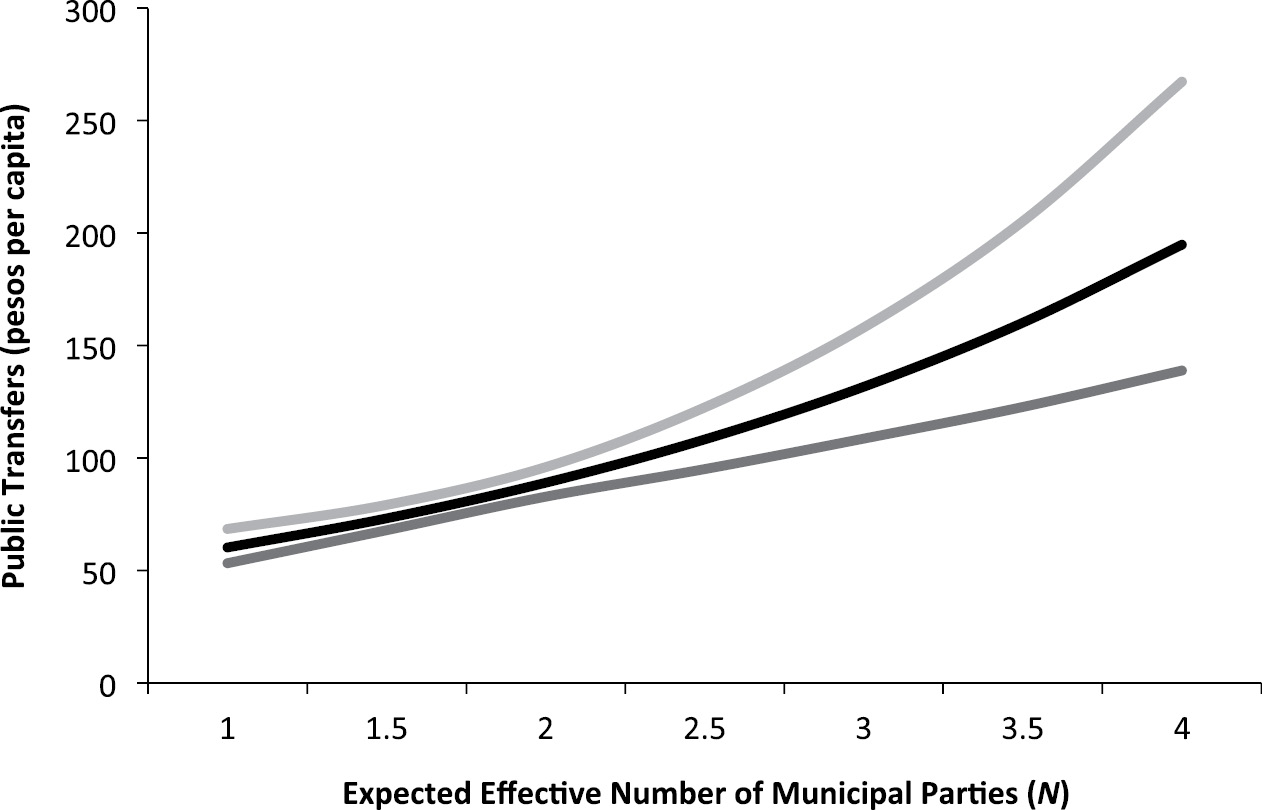
However, what the swing-voter model fails to find in patterns of private transfers in the Mexican case can account for part of the distribution of pork transfers across municipalities. The results reveal that more public goods are assigned to districts where the coming elections are expected to be competitive. This is measured by the predicted effective number of parties (
 ) which has a positive and statistically significant sign for public goods allocations and a negative and statistically significant sign for private goods allocations and for the share of private goods within the municipal portfolio. The same results hold if we run the regressions with expected margin of victory, with higher public goods provision where upcoming municipal elections are expected to be close. These results support our claim that incumbent parties will diversify their portfolios by investing more in collective goods in competitive districts. We should emphasize that
 is the expected competition structure for the very next election. This instrumented variable of competitiveness, unlike our party configuration typology, is constructed with short-term election results or returns from the previous municipal race. Thus, the effect of N conveniently captures the way in which politicians adjust investment decisions according to short-term election imperatives.
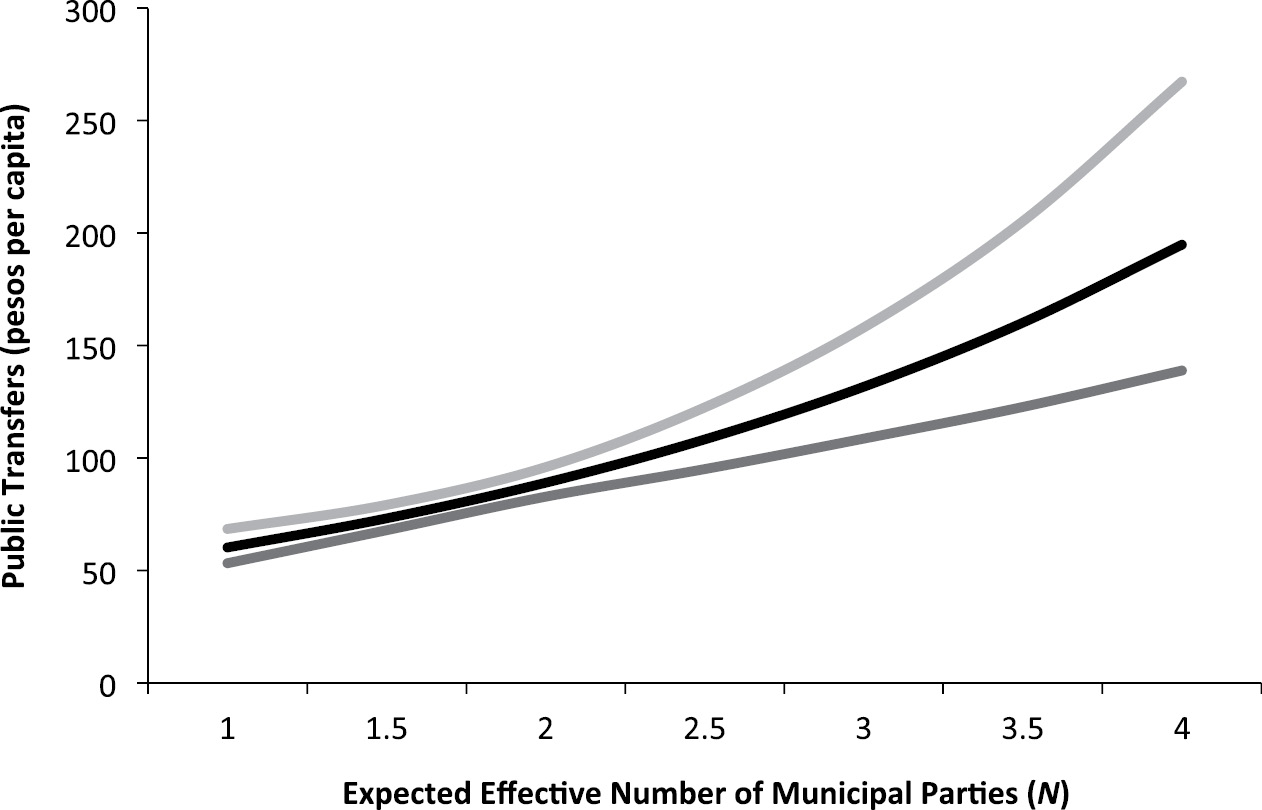
In Figure 4.7 we simulate the effects of
 on the disbursement of collective benefits in local election years, holding other variables at their mean. The patent result is that per capita expenditures for collective goods increase rapidly as the expected effective number of parties grows. For the bipartisan and multipartisan competition mushrooming in Mexico in the 1990s, this corresponds to about double the per capita investment in pork assigned to low-N municipalities in an election year. As a result of the skew favoring core constituencies in the allocation of private transfers, the share of public goods within the Pronasol basket increases markedly for N in the competitive range.Footnote 11 The cost is hefty, since per capita transfers for pork are routinely two to three times the amount distributed as private transfers.
Clientelism and effective competition.
4.5 Conclusion
The Pronasol projects in Chalco Solidaridad had a lasting impact on improving the lives of the poor in that municipality. Many other Pronasol projects also contributed to improving welfare by bringing health clinics, schools, water systems, sewage systems, electrification, and more to previously impoverished localities. Unfortunately, this was not the overarching logic behind Pronasol’s vast operations. One of the central political motivations behind its public infrastructure projects, as our results suggest, was that the PRI could no longer count on core support sufficient to win elections and thus needed to legitimize itself through broader collective projects for which it could claim credit. For the most part, the poor were not actually targeted nor preferentially benefited by the program’s array of particularistic and collective projects. Our results in this chapter demonstrate that clientelism was used to lock-in the PRI’s core base of support. But, as we will demonstrate in subsequent chapters, clientelism contributed very little to improving the welfare of the poor. Although our results demonstrate that it paid to be loyal to the PRI, the logic of political linkages left the poor trapped in a long-term relationship of material dependence.
The results in this chapter provide robust empirical support for our main theoretical claims. The chapter has presented empirical evidence for our theory of conditional party loyalty. The theory departs from the core- versus swing-voter debate in viewing partisan loyalties as endogenous, shaped by the history of interactions and tactical redistributions. Voters’ loyalties cannot be taken for granted, we argue, and this is especially true where voters respond weakly to ideological, programmatic, and other symbolic appeals, as is prevalent throughout the developing world.
We see politicians as motivated by both short- and long-term considerations. They seek to construct partisan coalitions that are stable over time and they want to win the current election as well. These goals often place parties in a strategic dilemma: if they appeal to swing voters to win the current election by delivering discretionary transfers to them, they risk alienating their core voters in future elections. Alienating the core can be quite self-destructive. One solution to this dilemma, we have argued, is to diversify the portfolio of electoral investments, targeting particularistic transfers to core supporters, while delivering collective benefits to electorates at large.
The strategy we uncover has a strong core-voter bias: parties should primarily target particularistic benefits to voters who have consistently supported them in the past. These voters are not only better known by local party brokers, but are also less risky as investments. Yet the more the core is willing to drift, given the presence of alternatives to the ruling party, the more we expect a machine to rely on clientelism to lock-in loyal voters. Our theory argues that discretionary private transfers are preferable to collective goods if one is to construct stable and durable electoral coalitions. This form of political exchange is what we, and others, have characterized as clientelism.
Our theory is also one of portfolio diversification. Pronasol‘s strong bias in favor of core constituencies and districts under firm PRI control is undeniable with regard to discretionary transfers of private benefits. Clientelism was consistently used to reward core-voter groups, with politicians strongly intensifying this practice in municipalities that were experiencing higher core erosion over time. The strategy employed in the allocation of pork-barrel projects is less straightforward. Our results reveal that within Pronasol’s overarching strategy, public goods provision also emphatically favored core districts and punished opposition-controlled ones. However, local politicians modified their portfolios of electoral investment to increase the share of public goods over private goods in small core voter municipalities. Intended to attract support from broader and more heterogeneous coalitions, pork appears to be a second-best, though necessary, strategic choice for party machines facing rising competition.
Finally, the models accounting for the peripheral logic of Pronasol strongly suggest that politicians privileged and even intensified clientelistic practices prior to national and municipal elections alike. Local party organizations and brokers were able to adjust investment decisions to take their own short-term electoral needs into account. Overall, our empirical results demonstrate that poverty alleviation was, at best, a secondary objective. Expenditures did not systematically benefit the poorest municipalities. The entire program with its vast array of transfers and projects was administered with the goal of sustaining the PRI’s electoral hegemony. Pronasol was highly successful at buying votes for the PRI, as we will demonstrate in later chapters, but extremely ineffective at combating poverty.