1. INTRODUCTION
In a recent review, Naomi Tadmor called on scholars to move beyond ‘either or’ questions about the relative importance of kinship and household, and instead to investigate ‘how diverse kinship and family patterns interacted in particular historical contexts’.Footnote 1 This article addresses Tadmor's challenge in the Irish case. Drawing on a major new database of qualitative life-history interviews, I examine the interactions amongst family households, kinship networks and communities in rural Ireland during the first half of the twentieth century, through the lens of childhood memories. The analysis shows how the circulation of children between households – on a daily basis and at different stages of the life course – contributed to the reproduction, and sometimes disruption, of community, kinship and class relationships. It shifts our focus away from the rules and structures emphasised within the literature on inheritance and household formation towards the everyday practices associated with enacting family and kinship processes in particular historical contexts. From this ‘child's eye’ perspective we gain a new understanding of the landscape of family and community life in early to mid-twentieth-century Ireland. We see how households were embedded in overlapping sets of kinship and community relationships that were precarious, in the sense that they had to be actively maintained, and were subject to disruption and change. We see also how non-family households – often depicted as remnants of failing family systems – formed integral parts of local kinship circles, and were deeply engaged in the everyday lives of family households, including the promotion of family survival and social mobility. Finally, the analysis shows the pervasiveness of multiple forms of inequality in rural communities, cross-cutting household, neighbour and kinship ties.
The article begins with a brief overview of the existing research on kinship, family and community in early twentieth-century rural Ireland, placing it in the context of contemporary international scholarship, followed by a detailed discussion of the data on which the empirical analysis is based. The subsequent sections examine two different ‘circulations’ of children and adolescents within the rural community. First, the everyday circulation of children from home to school demonstrates children's roles in reinforcing – and sometimes threatening – kinship and neighbour relationships amongst households. Stories of the journey to and from school also provide an opportunity to discuss and address some of the challenges associated with using narrative life-story data. Second, I examine accounts of children being sent to live with relatives in households other than their natal home. I argue that this circulation of children and adolescents formed part of a set of flexible, adaptive practices oriented towards preserving and supporting kinship groups, and in some cases towards improving family status by facilitating upward social mobility. By shifting the analytic focus away from the processes surrounding household formation and reproduction, the perspective of childhood memories yields new insights on family practices beyond the household in traditional rural communities.Footnote 2
2. KINSHIP, FAMILIES AND HOUSEHOLDS IN EARLY TWENTIETH-CENTURY RURAL IRELAND
Ireland occupies a unique place within the historical sociology of pre-modern families and households, partly because of the rich heritage of anthropological research beginning with Conrad Arensberg and Solon Kimball's classic study,Footnote 3 and partly because of the endurance, through most of the first half of the twentieth century, of a distinctive social structure dominated by small farmers, and characterised by an exceptional combination of late ages at marriage with high proportions never marrying, high marital fertility and high levels of emigration.Footnote 4 Following Arensberg and Kimball, Damien Hannan linked the stability of this rural social structure to its ‘cultural autonomy and effective methods of self-reproduction’.Footnote 5 Under a stem-family system of inheritance, the marriage of a single male heir coincided with the retirement of his father and mother, who continued to live in the farm household. Non-inheriting children either left the family home, or remained as unmarried ‘relatives assisting’.Footnote 6 Individual households were linked together by kinship, the main ‘protective institution’ governing the ‘reciprocities of act, sentiment and obligation’ that bound people together within locally restricted communities.Footnote 7
Contrary to Arensberg and Kimball, however, Hannan argued that neighbour groups were of greater significance than kin in the exchange of seasonal labour and everyday mutual assistance. Kinship groups were more important for coping with long-term crises and for providing emotional support. In contrast to neighbour groups, where exchanges were expected to be reciprocal, kinship groups were characterised by enduring obligations without the implicit expectation of reciprocity, and by ‘a common identity where shame on one member brings shame on another’.Footnote 8 The successful reproduction of these interlocking systems of mutual aid depended on the minimisation of class and status differences between families. In this context, kinship represented a key resource for the maintenance of local status, and, ultimately, economic success. Hannan found that families with the strongest local kinship groups were best placed to benefit from the changes associated with modernisation.Footnote 9 Whereas kinship served to ‘level out’ economic pressures on families in traditional communities, in more ‘modern’ contexts – characterised by greater integration to the market economy and the substitution of capital for labour – differences amongst kinship groups exacerbated processes of social differentiation.
The extent of class division and exploitation within the Irish rural community has been one of the principal points of debate in the literature, together with questions about the prevalence of stem-family households. In a famous critique, Peter Gibbon argued that Arensberg and Kimball's depiction of ‘traditional’ Irish small-farm society ranged ‘from the inaccurate to the fictive’, particularly with regard to the minimisation of social differences.Footnote 10 Quantitative analyses of early twentieth-century census data have found mixed evidence, at best, in support of stem-family households.Footnote 11 However, as Steven Ruggles highlighted, the demographic potential for multigenerational households was constrained in countries with late marriage and long generations, and also where the overall proportion of elderly people in the population (both married and unmarried) was comparatively high, leading to fewer options for co-residence. Both conditions were present in early twentieth-century Ireland, so that comparatively few multigenerational households might nevertheless have been consistent with a prevailing stem-family ideal.Footnote 12 In support of Arensberg and Kimball, Hannan argued that the rural small-farm society depicted by the ethnographers was distinctive to the western part of the country, where class differences were considerably less developed than in the commercialised farming districts of the east and where the rate of farm family reproduction was much greater before the Second World War than in other regions. Unmarried siblings who remained at home as ‘relatives assisting’, and ‘residual’ family households with unmarried heads, were therefore more common in the commercial farming districts up to the late 1940s.Footnote 13
Because scholarship on Ireland in the 1970s and 1980s took the ‘normative’ stem-family system of household formation and inheritance as its starting point, the prevalence of ‘residual’ households (where farm succession had apparently failed), and of significant numbers of unmarried ‘relatives assisting’, were seen as evidence of rural decay during the first half of the twentieth century. Ethnographies carried out in the 1960s and 1970s suggested that farm families faced a growing problem of persuading young adults to remain on the land.Footnote 14 However, in what remains a provocative argument, Timothy Guinnane challenged the conventional wisdom that young adults invariably desired marriage, arguing that under some circumstances people might choose alternative paths to economic security and family continuity:
Individuals could remain unmarried and still run holdings and make provision for adverse times and old age by relying on a number of substitutes for marriage and children, including land, connections with other kin, and both formal and informal relations with heir-substitutes.Footnote 15
As Guinnane showed, the ‘rural decay’ argument – at least for the early part of the twentieth century – is challenged by the evidence that high rates of celibacy were at first more pronounced in the richer agricultural counties of the east, and were observed on large valuable farms, as well as on small, marginal holdings. Guinnane framed his alternative argument within a critique of John Hajnal's ‘neo-Malthusian’ model of household formation, which, he claimed, failed to take account of the wider economic and institutional environment that framed the decision to marry. In this respect he anticipated more recent arguments, which emphasise the flexibility and adaptability of family–household practices in response to different demographic and economic circumstances.Footnote 16
In summary, Ireland has occupied an important, but controversial, place in the literature on household and kinship processes in pre-industrial societies. The long shadow of Arensberg and Kimball's ethnographic account ensures that Ireland retains its iconic status as an exemplar of the household processes associated with the Northwest European marriage pattern, in spite of the uneven quantitative evidence supporting their depiction and in the face of criticisms centring on their conflation of kinship and community ties, and their obfuscation of class relationships. However, recent developments in the international literature on historical family systems have not, as yet, given rise to a sustained reappraisal of the Irish case.Footnote 17 This article moves the debate forward, placing the evidence on Ireland in the context of contemporary scholarship, through analysis of an alternative data source, one which permits a fresh look at the rural Irish scene through the lens of childhood memories. In doing so, it generates new hypotheses about the interrelationships amongst households and kinship groups that may be tested in other European contexts.
3. DATA
The study is based on the ‘Life Histories and Social Change’ (LHSC) database created as part of a funded research project jointly led by the author, and currently held in the Irish Qualitative Data Archive.Footnote 18 This database comprises 113 life-story interviews with respondents who were selected from the sample of people who took part in all eight waves of a nationally representative panel study (‘Living in Ireland’; LII), conducted each year between 1994 and 2001. The LHSC interviews were carried out between 2005 and 2008 with respondents from three birth cohorts who opted in to the project: those born before 1935; between 1945 and 1954; and between 1965 and 1974. The life-story interviews are semi-structured according to life stage. While respondents were encouraged to recount their life stories in their own words, interviewers prompted them to discuss particular themes (including family, household and community relationships) in order to maximise comparability across cases. Respondents also completed a life-history calendar and simple retrospective social network schedule. The interviews lasted from 90 minutes to 3 hours on average.Footnote 19
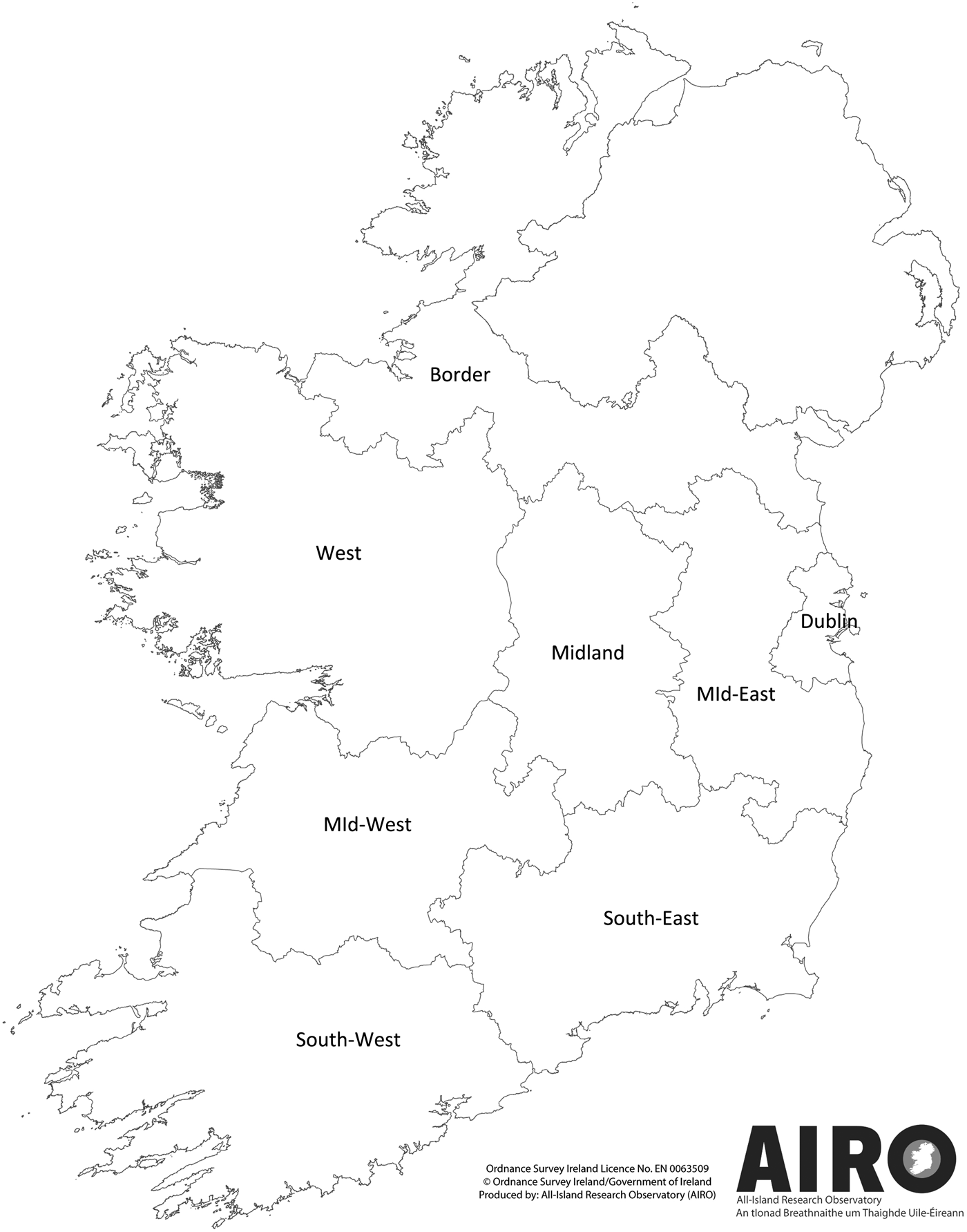
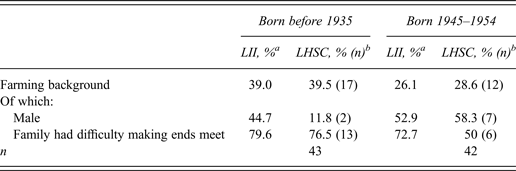
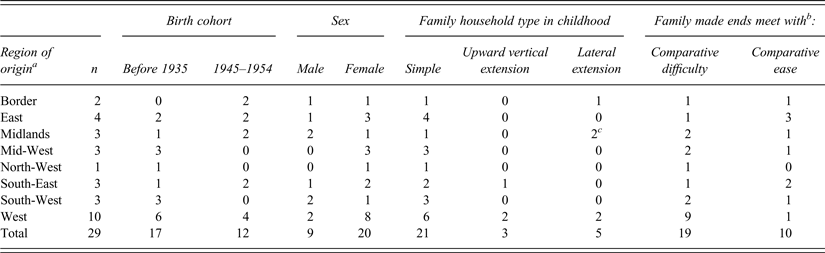
The analysis in this paper centres on the life stories of all the respondents from the first two cohorts (i.e. born before 1954) from a farming background (Table 1). The cases were selected using the LII variable on father's occupation – those who reported their fathers to have had a ‘skilled agricultural’ occupation.Footnote 20 They included nine men – two from the first and seven from the second cohort – and twenty women – fifteen from the first and five from the second cohort. Inspection of the qualitative data showed that the great majority of respondents in the sample came from small and middling farm backgrounds, although two might more accurately be described as from labouring families that occupied small plots of land. Table 2 shows the distribution of respondents by region of origin, birth cohort, sex, perception of family's standard of living when growing up, and family–household type in childhood using the Hammel–Laslett classification.Footnote 21 The measure of family's standard of living is based on the respondents’ answers to a question on the LII survey, while the family–household classification is derived from the LHSC life-history calendar. Figure 1 illustrates the regions referred to in Table 2.
NUTS 3 regions of Ireland.

Aspects of the qualitative life history data (Life Histories and Social Change Study) compared with nationally representative panel data (Living in Ireland Study)
Sources: a Economic and Social Research Institute (ESRI) Living in Ireland (LII) survey, wave 1, 1994. Irish Social Science Data Archive: http://www.ucd.ie/issda/data/livinginirelandlii/. Weight applied in the calculation of percentages; b Life Histories and Social Change (LHSC) Project, J. Gray and S. Ó Riain, Life Histories and Social Change Project [collection]. Maynooth, Co. Kildare: Irish Qualitative Data Archive [producer], ID10028. Irish Qualitative Data Archive [distributor]; ESRI Living in Ireland survey, Irish Social Science Data Archive: http://www.ucd.ie/issda/data/livinginirelandlii/
Study sample details
a In the anonymised ‘Life Histories and Social Change’ dataset the names of places have been replaced by the NUTS 3 regions in which they are located. NUTS 3 is a European Union standard subdivision of countries for statistical purposes. The Irish NUTS 3 regions are displayed in Figure 1.
b Responses to the Living in Ireland question, ‘[T]hinking back to when you were growing up, how would you say that your family was able to manage financially, compared to other families at that time? Were you able to make ends meet?’: 1, with great difficulty; 2, with some difficulty; 3, with a little difficulty; 4, fairly easily; 5, easily; 6, very easily. In the table, ‘comparative difficulty’ refers to any response in the range 1–3; ‘comparative ease’ refers to any response in the range 4–6.
c One combined lateral and upward vertical extension.
Sources: J. Gray and S. Ó Riain, Life Histories and Social Change Project [collection]. Maynooth, Co. Kildare: Irish Qualitative Data Archive [producer], ID10028. Irish Qualitative Data Archive [distributor]; Economic and Social Research Institute Living in Ireland survey, Irish Social Science Data Archive: http://www.ucd.ie/issda/data/livinginirelandlii/
The lives analysed in this study traversed a period of continuity and change in Irish society. In 1926, shortly after independence, farmers comprised 44 per cent of gainfully employed men.Footnote 22 Just over half of all farms were less than 30 acres in size, a proportion that had changed little since the middle of the previous century.Footnote 23 Following the Great Famine of the 1840s, Irish agriculture was marked by a steady decline in the area of land devoted to tillage during the second half of the nineteenth century, and an increase in the numbers of cattle and sheep. However, from the beginning of the twentieth century to the late 1950s these trends continued at a much slower pace as Irish agriculture entered a period of stagnation, in part due to the protectionist and pro-tillage policies adopted by the state, and in part because of the increased demand for tillage output during the two world wars. The numbers of people engaged in agriculture fell relatively slowly through the mid 1940s, but the rate of decline accelerated from that point onwards, with particularly significant decreases in the numbers of agricultural labourers and of those described in the census as ‘relatives assisting’. Within this overall pattern there were some marked regional differences. Median farm sizes were higher in the more commercialised east and south, where, as we have seen, marriage rates and the proportions of non-family households and ‘relatives assisting’ were higher. By contrast, the north-west and west of the country were characterised by higher rates of marriage and farm succession, together with greater levels of emigration.
Many of the members of the second LHSC cohort grew up during the 1950s, ‘a miserable decade for the Irish economy’, when real national income virtually stagnated and net emigration reached its twentieth-century peak.Footnote 24 However, this was followed by a decade of rapid growth in the 1960s accompanied by increases in middle-class and skilled manual occupations. Age at marriage had been decreasing steadily since the 1930s, but began to decline more rapidly in the 1950s.Footnote 25 In the context of an expanding education system and changing occupational structure, farm families were well positioned to take advantage of the new opportunities that were now emerging within Ireland. During the same period, continuously increasing out-migration was accompanied by rapid growth in the ‘failure’ rate of farm succession in the west.Footnote 26 Compared with older respondents, the farmers’ sons and daughters in our second cohort experienced more opportunities for social mobility, but in many respects their childhood experiences were similar to those who grew up in earlier decades. As I elaborate further in the next section, interpreting the life stories requires careful attention not just to life stage and historical period, but also to the historical standpoint from which the stories were narrated.
4. TO SCHOOL THROUGH THE FIELDS
The life-story interviews contain many vivid and varied recollections of childhood. However, as Julia Brannen observed, childhood memories are shaped by social and individual time in complex ways.
Childhood in different historical periods is examined retrospectively when, as adults, people reflect upon past childhoods while also being cognizant of the changes that they witness subsequently. Recollections are also shaped by individuals’ subsequent exposure to different practices and ideas about childhood. In making sense of accounts of childhood, we need therefore to address how informants’ accounts are permeated by time perspectives as well as addressing, via our sociological accounts, the times to which these accounts refer.Footnote 27
Research drawing on biographical data has been subject to the criticism that it romanticises past social relationships.Footnote 28 However, in Ireland, in recent years there has been an outpouring of revelations about brutal and neglectful treatment of children in the past, especially in the state-sponsored industrial schools and orphanages that were run by religious orders. Memoirs of unhappy childhoods marked by poverty and abuse have become a publishing phenomenon, but they have also sparked controversy about their accuracy – or at least, their representativeness. Thus, for example, Moira Maguire and Séamas Ó Cinnéide argued that ‘Media and popular accounts of these allegations [against the religious orders] have tended to highlight the most salacious and lurid details while silencing alternative memories or accounts and ignoring the historical context.’Footnote 29 By contrast, Diarmaid Ferriter drew a distinction between ‘idyllic’ and ‘bleak’ memoirs, implying that the latter have greater authenticity than the former because they include ‘recollection of what made them happy, what gave them pleasure and relief, as well as what damaged them’, whereas the former, he claimed, contain ‘not a hint of darkness’.Footnote 30
I share Brannen's view that making sense of memories of childhood is both a theoretical and a methodological challenge.Footnote 31 In order to contextualise the narratives, it is necessary to ‘fill in what is unsaid’ by drawing on conceptual and empirical knowledge about the structural and historical context for what is being described, and also to pay attention to how the memories are framed by individual, generational and historical time. As Jane Humphries noted, memories of childhood can be truthful, without being entirely accurate or representative.Footnote 32 Respondents may gloss over some aspects of their experience, or represent similar phenomena in different ways, sometimes in response to contemporary normative frames. By ‘reading across the grain’ of the narratives of childhood memories, framing them in the context of existing theoretical and empirical knowledge, it is possible to develop a robust understanding of the social worlds that are being described.
The argument can be illustrated through the accounts of walking to school through the fields that appear in the life stories of many of our respondents who grew up in rural environments during the 1930s and 1940s.Footnote 33 The childhood memoir To school through the fields, published by Alice Taylor in 1988, was immensely popular, ‘the biggest selling book ever published in Ireland’ according to its publisher.Footnote 34 However, for Ferriter the book is ‘memoir as fantasy rather than as a contribution to social history’, one that deemed ‘perfection to have been ubiquitous’.Footnote 35 So, how should we interpret the tales of walking to school through the fields that appear in our respondents’ narratives? The tales are presented as both happy and unhappy memories. Thus for example:
Interviewer: And were there other children around when you were growing up?
Respondent: There was, we had first cousins just up the road from us, first cousins of our own age and then there was [the family] at the shop down the road a bit, there were three or four of them and they had everything and anything, and we used to all meet and walk, there was about twenty of us walking to school together and it was so nice, having our own fun. (Brenda [LH146], b. 1934, West)
On the other hand, a number of respondents described the walk to school in terms of its physical hardship – how far they had to walk, having to spend the day in wet clothes if it rained on the way, and the trials of walking barefoot:
Interviewer: And did you have much of a walk to it?
Respondent: We had to walk about a mile and a half and in the summer without a shoe on our foot of course. Then the roads wasn't tarmacadamed, they were sandy and stones and you'd hit your toe on a stone and you'd be bleeding and the dirt going into it, there was no such talk about [iodine] or nothing, no disinfectant, you let nature deal with it. (Kathleen [LH111], b. 1924, West)
But another respondent had happy memories of walking barefoot:
Respondent: Another thing we used to do going to school, we used to walk to school of course and once it came the end of April or May – we weren't allowed to do it any earlier – but we used to love taking off our shoes and walking to school. And the teacher used to encourage it, to walk in our bare feet and … but we used to do it before May. And when we go down to [our neighbours’] house we put our shoes in their barn and go to school [laughs]. And I remember coming home from school as well in the winter times there was ice you know, the little small loch of water that would rest on grass you know, and is shallow, and we used to slide on that coming home from school. And this is the things that we weren't supposed to do, you know, that would hold us up coming home from school. (Dolores [LH141], b. 1934, Midlands)
The happy memories are framed in terms of the sociability of walking to school, the opportunity it provided of dropping in to neighbours’ houses (where one might get a treat), and the sense of freedom it gave. The walk to school through the fields was the child's version of the ‘visiting’ that constituted the chief leisure activity of the adults, a moment when it was possible to construct their own child-centred world, between the twin spaces of discipline and work imposed by adults at home and at school, despite the undeniable physical hardship it entailed, and the scolding or punishment often received for prolonging it. Understood in the context of the social relationships in which they were embedded, therefore, the ‘happy’ memories tell us as much as the unhappy ones.
In their account of the ‘cuaird’, the practice of visiting by adults, Arensberg and Kimball emphasised its ‘institutional flavour’. The evening gathering of senior ‘old men’ played an important part in knitting the local community together, defining its relationship towards the outside world, appraising its members and reinforcing shared beliefs and practices. Younger adults’ gatherings united them in the development of common interests and values, but, according to the ethnographers, did not have consequences for the community as a whole, reflecting the lack of power of those who were not heads of households.Footnote 36 The memories of those who grew up in rural Ireland during the first half of the twentieth century reveal that children similarly used the journey to school as a way of establishing their place within the community. However, in contrast to Arensberg and Kimball's argument, the life narratives show that children's practices did play a part in developing or reinforcing relationships amongst neighbouring families, and that these practices were not subject to total control by adults. Mary ([LH125], b. 1929, West) described how children would gather one another up from the houses round about, in the process interacting with adults as well:
Interviewer: How far was the school?
Respondent: Well we used to say if we went around the road it would be 4 or 5 miles but we could do it a nearer way, across a bridge, across a river and if there was a flood in the river we had to go around the road. But anyway it was only about 2 and a half miles across the fields and it was grand.
Interviewer: There was a bit of a troop of you.
Respondent: There was, there was a big troop, but we'd go down and if the [names] hadn't arrived we'd go and see what was keeping them and she'd be there rubbing their faces to get them ready and [unclear] around the fire and she'd have a turn me twice in it, now you don't know what a turn me twice is. It is a flat cake that you put in the oven and bake it on both sides and you turn it twice. And she took that out and cut it up and we'd have a bit of it too.
Children also ‘dropped in’ on extended family members on the way to and from school. Enda ([LH229], b. 1950, Midlands) stopped with his aunt and uncle who had no children of their own, while Kathleen ([LH111], b. 1924, West) used to visit her grandmother on the way home for treats and a ‘mug of cabbage water’ that would keep her going till dinner time.
Thus for children, the primary school lay at the heart of a set of encompassing circles of family and friends that made up a relatively self-contained local community:
Interviewer: And there [were] about eight houses around you. And how was that, were there kids in the other houses and would you have played together?
[…]
Respondent: [For] a start you were a big family, you were self-contained, you could play with each other anyway. But there were several houses and there was always a couple of children around our age. There were a couple who were finishing school when we started. But then what you'd have is a pocket of houses here, the school might be in the middle, so within a radius of about 4 miles you'd have maybe 50 or 60 houses. But again distance was nothing, you'd consider all of them as your friends and you'd go off across the bog to visit them. (Michael [LH217], b. 1946, West)
Sometimes, however, children's practices came into conflict with adult status hierarchies. For one respondent, who lived on a very large farm in the East, the practice of going to school through the fields was itself frowned upon:
Respondent: [T]here was a long avenue up to the house so there was a sense of isolation. Now from the house you could look across and see the village. But to go there, you went all around the world, down the avenue and around. I can remember my grandmother being very unimpressed with me one day when I came home from school through the fields. (Ruth [LH220], b. 1946, East)
For this respondent's family, maintaining an appropriate sense of status required keeping their distance from the surrounding community. In most cases, however, parents’ efforts to enforce status hierarchies took the form of prohibition on playing with particular children and on going into certain houses: ‘We didn't know [why] but you'd be told not to, they weren't explained’ (Mary [LH125], b. 1929, West). Nora ([LH228], b. 1950, West) referred to her father's anxiety about whom she befriended in the context of a discussion of class hierarchies. She illustrated these with an account of how the priest read out at Mass the amounts of money contributed by different families:
Respondent: Our neighbours now who had more land than we had and [were] considerably wealthy, they would be first on the list, ‘Mr and Mrs such and such’, you know, and that would be the top money, and then there was ‘Mr and Mrs such a body’ next and ‘Mr and Mrs such a body’ next and then you would come to the bottom and it would be just ‘Jack such a body’ or ‘Neil such a body’, there was no mention of Mrs … [It] was a case of someone with just a few shillings, it was horrible really.
These memories of hierarchies amongst families were recounted by respondents from all regions in our sample, including the West. Brenda, who described the walk to school with her cousins and friends in such happy terms in the quotation at the start of this section, once made the mistake of lingering too long at her friend's house:
I remember one time me pals … they used to come to my house and I went off to their house, and stayed a bit longer than what I was told and they came back with me and there was a terrific present, my Daddy got a rod and beat me for 10 minutes and they went home crying to their mother saying that I was beat so much. And their mother wasn't pleased because I was in a good house and playing with her children and she was offended that I should be beat after leaving her home because she wouldn't do that to her children. (Brenda [LH146], b. 1934, West)
The story illustrates how children's circulation from house to house was a social practice that played a part in producing and reproducing the fabric of community ties – one that was not entirely controlled by adults and could threaten the structure of local social relationships. Brenda's friends’ mother was offended because Brenda's father's treatment of his daughter seemed to reflect negatively on her own family's status.
In summary, the journey to and from school illustrates the importance of family and community relationships beyond the household, and the ways in which those relationships were enacted and reproduced in everyday life. In this daily ‘circulation’, children learned the contours and boundaries of local social relationships. Just like the adult ‘ramblers’ who gathered in different households after the day's work was done, children's visiting served to regulate and maintain local social relationships within and between families, including hierarchies of class and status. However, the circulation of children between home and school could cause anxiety and tension for adults because it was not entirely within their control, and had the potential to disrupt precariously maintained family statuses within the community. For children themselves it represented a precious moment of freedom from the discipline of home and school, and therefore a source of fond memories despite the distance, the cold and rain, and the bare feet on hard roads.
5. CHILDREN'S CIRCULATION BETWEEN HOUSEHOLDS
Many of our respondents told us that ‘lingering’ on the way home from school was what got them into trouble most often. As we have seen, some parents were concerned about their children's safety, while others worried about who they might mix with. But in most cases, children prolonged the time between school and home to extend the freedom it gave them from work. Descriptions of working hard on the farm after school are ubiquitous in the life stories. To give just one example:
Interviewer: Did they want you to do well when you went to school do you think, had you to do your work?
Respondent: Oh, yes, we had to do the homework and when we went to the national school we'd always have work to do when we came home from school outside. When the potatoes had been dug and that we often had the job of picking potatoes, well the big ones might be gone but you might have to pick the small ones and it would be cold weather at that time, the potatoes were dug later than they are now. We'd all have to do that because they could have had four or five men digging all day, there was no machines then, so that when we came from school that would be the first thing that we'd do. (Claire [LH131], b. 1931, West)
Household-centred approaches to traditional small-farm societies have tended to emphasise the significance of children and adolescents as sources of labour. Under Hajnal's model of the west-European marriage pattern, maintaining an optimal balance between labour supply and consumption required the circulation of children and young adults between households.Footnote 37 In Ireland, there are references in the ethnographic literature to the practice of ‘lending’ children within kinship groups at busy times of the year.Footnote 38 Longer patterns of circulation occurred through the institution of life-cycle service, which allowed households to meet their labour requirements at different stages of the family life-cycle, while providing adolescents and young adults with skills and savings which, under favourable circumstances, could be used to start their own households.Footnote 39
Nevertheless, Tony Fahey queried the extent to which children's labour was really essential in Irish farm families during the first half of the twentieth century, arguing that aggregate demand was relatively weak.Footnote 40 Our life narratives contain no memories consistent with being ‘lent out’ for work on a daily basis, although there are accounts of children's work providing an opportunity for sociability outside the household. For example:
Respondent: There was a well about 200 or 300 yards away and you had to go to the well to bring the water. But we used to like going to the well because there was an old guy, a bachelor, lived nearby and it was a kind of meeting house and it was a chance to meet your local neighbour or girlfriend or something. So you'd spill a bucket of water and offer to go down to the well! (Michael [LH217], b. 1946, West)
While there is evidence that farm servanthood persisted in Ireland through the 1940s,Footnote 41 just one of the respondents in this study actually experienced being sent into service herself: ‘finished [school] at fourteen and out the road then slaving for other people’ (Kathleen [LH111], b. 1924, West).
On the other hand, stories of children being sent to live with other relatives on a semi-permanent basis occur in many of the life narratives under consideration here. In some cases, children were sent to live with relatives following the death of a parent. For example, David's cousin ‘lived in my house for a number of years, his mother had died, who was a sister of my mother's and he came down and lived with us and was reared with us’ (David [LH202], b. 1945, Border). There was a practice of sending young children to live with relatives as a means of coping with large family sizes, and also to facilitate school attendance. James's wife explained how her two oldest children had attended a different national school than the rest:
Respondent: The boy came back when it was market day but the eldest girl wouldn't come back she was too taken with … was too fond of above and she stayed with them till she was thirteen she was crying when she had to come back.
Interviewer: Is that right? And did you miss her then? Did you, or were you happy enough?
Respondent: [Unclear] I had such a crowd of them. (Wife of James [LH109], b. 1924, South-West)
There are also memories of older, adolescent children moving to live in a relative's household, in a pattern reminiscent of life-cycle service. However, in general, our respondents viewed the practice as an act of altruism (or at least mutual benefit) on the receiving household's part, rather than a means of distributing labour requirements.Footnote 42 Dolores described how her sister had gone to live with her grandmother, and ‘went to school from there’:
Interviewer: Who made the decision?
Respondent: [I'd] say Granny asked if she would come over and stay with her because probably Mammy had enough at home you know and that kind of thing. (Dolores [LH141], b. 1934, Midlands)
Dolores described ‘doing a novena’ to be allowed to join her sister in her grandmother's house, but observed that she had been ‘better off with my own brothers and sisters at home’. The practice of ‘farming out’ children did lead to strained relationships within families.Footnote 43 Sheila described always having felt ‘distant’ from her oldest sister, who had gone to live with two aunts (her father's sisters) in a local town:
Interviewer: Was it to give your mother a break or what was it?
Respondent: Well it wasn't, she had a better time with them because they gave her everything. I mean when we were getting Confirmation, she had the veil that was handed down to all of us, it was handed to everyone in the locality. I mean they were able to give her things that she couldn't have at home I suppose. (Deirdre [LH129], b. 1930, South-West)
These accounts of the circulation of children amongst relatives show how family exchanges were not bound by households. In addition to stories about children going to live with relatives, our respondents provided accounts of unmarried adults visiting family households for periods of varying duration to help with work. For example, Patricia remembered an aunt who worked as a housemaid in a local ‘big house’: ‘she was always up helping my mother … [She'd] play with us’ (Patricia [LH139], b. 1933, North-West). In reverse, married adults would provide regular support to adults living in non-marital households. Irene's mother continued to care for her unmarried brothers even after starting her own family:
Respondent: She had six brothers, as I said, and she used to travel a mile and a half every day, to her brothers’ house to cater for them and to look after them, to do the ironing or washing, as well as having her own children. She used to bring them, of course, they looked after the kids as well. I remember, I know they used to look after us when we were kids … There were nine of us in the family and they used to bring us clothes, and shoes. They would look after us in every way. We had only one or two cows, when we were kids. When the cows calved, they always gave us a couple of calves to rear and so to get extra money because things were [terrible] in those days. They were very good to us. (Irene [LH119], b. 1928, South-East)
Thus resources for production, labour and caring were distributed across marital and non-family households within kinship networks. However, these exchanges were not always egalitarian at the level of individuals.
Inequalities by gender and sibling order have been well recognised within the literature on inheritance. In Ireland, women almost never inherited land, but there appears to have been no fixed rule about which son inherited.Footnote 44 From the late nineteenth century onwards, however, increasing proportions of Irish adults remained unmarried throughout their lives, including substantial numbers of heads of farm households. As Guinnane noted, in the absence of a son, farmers often bequeathed land to nephews or other relatives. Such an arrangement might be preceded by adoption of the ‘heir substitute’ into the household. Owen remembered that:
Respondent: [My] mother was the eldest of four and one of the uncles went to live with a brother of his fathers, obviously an uncle and um [sic] he was there and he's still in the same place. He went at a very young age, but I suppose, they found that they [were] almost unable to carry too many. (Owen [LH216], b. 1946, Midlands)
In the changing Ireland of our respondents’ childhoods, the allocation of resources for education and social mobility became an additional focus of opportunity and inequality within families.Footnote 45 In his account of going to live with an unmarried uncle, Francis provided a detailed description of the complex pattern of extended family and inter-household practices that could occur in the eastern part of the country:
Respondent: [When] I went to secondary school, because we lived where we lived, at that time there was no school transport so it was either a boarding school or nothing. So there was a compromise worked out that I moved to [south-eastern county] with my aunt and uncle … I lived there for the five years, came home for the holidays and cycled to a school in [south-eastern county]. I didn't like it at the time, I thought it was a fierce lonely isolated existence. My uncle and aunt would be very conservative people, probably at that time in their fifties … It worked out very well because [my uncle] had a farm and he had no help on the farm so here was a ready-made helper. The aunt was a teacher who taught in a town about thirty miles away … [So] she'd arrive for the weekend and keep the house. It was a funny sort of existence as well in that my [step-grandfather] was there at the time, but there was also a woman in the house, which was a funny thing, she was a distant cousin who came to work for my grandfather before my grandmother [re]married. So when my grandfather died she stayed on and she reared that family … [So] that was the household into which I went. (Francis [LH235], b. 1952, East)
As Francis's account indicates, before the introduction of free secondary education, together with a school transport system in 1967, access to education beyond primary school was limited, in rural areas, to those who could afford to send their children to boarding school.Footnote 46 The ‘compromise’ that Francis described entailed a continuation and adaptation of the kinship practices that had ‘taken in’ a distant cousin at the beginning of the century, who spent her life working ‘I suspect for no pay, but was always treated as a member of the family’. Like this elderly cousin, whose presence had provided a buffer against the family disruption caused by the death of his grandmother, Francis helped to keep up his uncle's farm (his father's place of origin) by providing labour. However, in contrast to the elderly cousin (‘At that time of course there was no employment of any kind so if you got a job with a distant cousin you were kept for life’), Francis secured in exchange an opportunity for social mobility through education that otherwise would not have been available to him.
6. CONCLUSION
This article set out to examine the interaction between kinship and family patterns in Irish rural communities during the first half of the twentieth century, from the perspective of childhood memories. By interrogating the ‘circulation’ of children – on a daily and residential basis – the analysis shed new light on the extent to which farm households were embedded in kinship and neighbour networks. The scholarship on European family systems, including the literature on Ireland, has tended to examine family formation in the context of households as economic units, and to treat kinship ties as external, secondary supports. However, as this analysis has shown, transactions between households were at the heart of children's lived experience of family life in rural Ireland. Kinship networks comprised family and non-family households that exchanged support and worked to maintain and enhance the status of the extended family within the community. Viewed in this way, it is possible to see the ‘residual’ family–household forms that have conventionally been treated as evidence of rural ‘decay’, as part of a flexible system of kin adaptation to changing social and economic circumstances.
However, the childhood memories also show how family statuses were ‘precarious’, and vulnerable to challenges arising from the everyday practices of family members with different sets of interests, including children themselves. Rural communities across Ireland were marked by differences in class and status between kinship groups. Within extended families there were ‘winners’ and ‘losers’: sibling order, gender, life stage and personal misfortune could all have an impact on where individual members ended up within family and kinship hierarchies in changing historical contexts. As new opportunities for social mobility emerged in twentieth-century Ireland, farm families adapted kinship practices that supported and enhanced families within their communities but which did not benefit all family members equally. By examining rural family systems as interconnected sets of relationships within and across households – relationships that were precariously maintained in everyday exchanges amongst family members vested with unequal power – it is possible to develop a fuller understanding of the reproduction and transformation of both households and kinship groups in changing historical contexts.
ACKNOWLEDGEMENTS
The life histories on which the analysis in this paper is based were originally collected with funding from the Irish Research Council. The author would like to thank Ruth Geraghty of the Irish Qualitative Data Archive for her assistance.